


96,99 €
Mehr erfahren.
- Herausgeber: John Wiley & Sons
- Kategorie: Geisteswissenschaft
- Sprache: Englisch
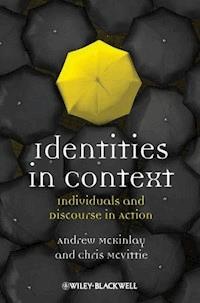
Identities in Context is a comprehensive guide to contemporary discursive research on issues relating to identity across a variety of contexts.
- Provides a comprehensive guide to contemporary discursive research on identity
- Introduces themes and concepts in a structured way that allows readers to easier assimilate the different aspects of discourse and identity
- Offers a narrative account of how discursive research has contributed to the understanding of various phenomena, such as interactions in legal and health care settings
- Features several reader-friendly aids, including chapter outlines and a glossary of terms and concepts
Sie lesen das E-Book in den Legimi-Apps auf:
Seitenzahl: 507
Veröffentlichungsjahr: 2011
Ähnliche




















Contents
About the Authors
Preface
Acknowledgments
1 Introduction
What Are Identities?
What Is Discourse?
Identities in Discourse
About this Book
A Note on Transcription
2 National Identities
What Are National Identities?
Time and Place
Nationality and the Media
Nationality and Prejudice
Discussion
3 Ethnic and Religious Identities
Ethnic Identities
Religious Identities
Ethnic and Religious Prejudice
Discussion
4 Gender Identities
What Are Gender Identities?
Women’s Gender Identities
Men’s Gender Identities
Gender and Other Identities
Prejudice
Discussion
5 Health Identities
Identities and Health
Contexts of Health and Identity
Identity Challenges
Discussion
6 Identities and the Law
Lawyers’ Discourse
Judges’ Discourse
Lay People’s Discourse
Discussion
7 Organizations, Work and Identities
Organizations and Identities
Organizations and Contexts
Identity Challenges
Discussion
8 Virtual Identities
Communications Technologies and Identities
Online Communities
Illness and Support Groups
Identity Challenges
Discussion
Afterword
Glossary
References
Author Index
Subject Index
This edition first published 2011© 2011 Andrew McKinlay and Chris McVittie
Blackwell Publishing was acquired by John Wiley & Sons in February 2007. Blackwell’s publishing program has been merged with Wiley’s global Scientific, Technical, and Medical business to form Wiley-Blackwell.
Registered OfficeJohn Wiley & Sons Ltd, The Atrium, Southern Gate, Chichester, West Sussex, PO19 8SQ, United Kingdom
Editorial Offices350 Main Street, Malden, MA 02148-5020, USA9600 Garsington Road, Oxford, OX4 2DQ, UKThe Atrium, Southern Gate, Chichester, West Sussex, PO19 8SQ, UK
For details of our global editorial offices, for customer services, and for information about how to apply for permission to reuse the copyright material in this book please see our website at www.wiley.com/wiley-blackwell.
The right of Andrew McKinlay and Chris McVittie to be identified as the authors of this work has been asserted in accordance with the UK Copyright, Designs and Patents Act 1988.
All rights reserved. No part of this publication may be reproduced, stored in a retrieval system, or transmitted, in any form or by any means, electronic, mechanical, photocopying, recording or otherwise, except as permitted by the UK Copyright, Designs and Patents Act 1988, without the prior permission of the publisher.
Wiley also publishes its books in a variety of electronic formats. Some content that appears in print may not be available in electronic books.
Designations used by companies to distinguish their products are often claimed as trademarks. All brand names and product names used in this book are trade names, service marks, trademarks or registered trademarks of their respective owners. The publisher is not associated with any product or vendor mentioned in this book. This publication is designed to provide accurate and authoritative information in regard to the subject matter covered. It is sold on the understanding that the publisher is not engaged in rendering professional services. If professional advice or other expert assistance is required, the services of a competent professional should be sought.
Library of Congress Cataloging-in-Publication Data is available for this title.
Hardback: 9781405191197
A catalogue record for this book is available from the British Library.
This book is published in the following electronic formats: ePDF 9781444397208; Wiley Online Library 9781444397222; ePub 9781444397215
About the Authors
Andy McKinlay is Head of the School of Philosophy, Psychology and Language Sciences at the University of Edinburgh, where he teaches discourse analysis and social psychology. His research interests lie in the areas of identity and discourse. This research has especially focused on the notion of ‘problem’ identities and on how people strive to develop a positive sense of themselves by taking up or challenging a range of inferences which may be made about them because they are categorized in a particular way. He has published over 50 articles on social psychology and discourse and is co-author (with Chris McVittie) of Social Psychology and Discourse, published in 2008 by Wiley-Blackwell. Beyond work he is married, enjoys jazz guitar, and owns three dogs which he enjoys walking if it is not too rainy.
Chris McVittie is Senior Lecturer in Social Psychology and Qualitative Methods at Queen Margaret University, Edinburgh. His research interests focus on issues of discourse and identities, especially in contexts of inclusion and exclusion. He has published widely and presented at numerous national and international conferences on these topics and is co-author (with Andy McKinlay) of Social Psychology and Discourse, published in 2008 by Wiley-Blackwell. Outside work, he is married, and enjoys playing golf and having the attention of three cats who share their home with him.
Preface
The topic of ‘who we are’ is one that has attracted scholars and thinkers throughout the centuries. What we have aimed to provide in this book is an overview of contemporary research on this topic from one particular theoretical standpoint: the view on identity as seen from the perspective of those researchers whose focus is on analysing discourse. Of course, discursive researchers had studied a whole range of topics within the broader domain of social psychology, and in a previous book (McKinlay and McVittie, 2008) we showed how the discursive approach can be applied to a wide range of social psychological topics. However, as was also the case in that text, we do not intend here to offer up a ‘defence’ of discursive methods. Our view is that discursive research is a mature enough discipline to no longer require pleas for acceptance from other branches of psychology. Hopefully, as the reader moves through the following chapters, he or she will be persuaded that the analysis of discourse is a fruitful means for exploring the topic of identity.
We have chosen to organize this book around what we regard as ‘key themes’ in the psychology of identity. The earlier chapters focus on nationality, ethnicity, religion and gender because these are important ‘dimensions’ of identity which have been of long-standing interest to social scientists. The later chapters turn to what might be described as ‘contexts’ of identity: health, law, organizations, and the virtual world. However, as the reader will discover, we do not view these dimensions and contexts as analytically foundational. The viewpoint of identity set out in this book is that identities are constructed, maintained and challenged through the particularities of social interaction. So, for example, when someone is described in terms of nationality, or when identities are made out within legal contexts, this is a matter of discursive action. In this respect, the dimensions and contexts which provide the chapter headings for this book should be viewed merely as signposts to help the reader move through the text, rather than as analysts’ terms whose meanings and consequences can be taken for granted. That said, we hope that by selecting these themes as structuring devices we will allow the reader to easily draw comparisons both within the realm of discursive research presented here and across domains by comparing the discursive researcher’s perspective on, say, ethnicity with that of other forms of research such as experimental social psychology or sociology. This marks out one potential advantage for the present text. A number of previous texts have used the analysis of discourse as a means of making sense of identity. However, often these texts have been especially concerned with warranting the discursive approach in contrast with that of other approaches, or in arguing for one particular form of discursive research over another as the ‘best’ way to analyse identities. While we acknowledge the usefulness of setting out methodological distinctions within social science in general, and within discursive research in particular, our aim here is quite different. We seek to offer the reader an up-to-date account of how discursive researchers have explored major themes in identity irrespective of whether they would describe themselves as ‘critical discourse analysts’, ‘conversation analysts’ or in terms of some other discursive brand.
In pursuing this goal, we have tried to develop a text which reaches beyond the narrow interests of one section of social psychology. In the following chapters, we will see people discuss themselves and others in terms of gender, the colour of their skin, which god they worship, and where they come from. And we will discover the positive features of such talk, as well as its darker side. In addition, we will follow people as they construct a sense of themselves and others in a variety of contexts such as health and the law. What all of this means is that the following chapters will, we hope, provide an important resource for a large range of people – in fact anyone who is concerned with who we are (or can be said to be) and what consequences follow for us from that. So anyone who finds themselves dealing with the social realities of everyday life, or who is involved with contexts of health or the law or employment, should be able to make use of this book, precisely because the discursive research approach is one that foregrounds the importance of understanding real people in real interactions from their own perspectives.
We have sought to ensure that this book provides the reader with access to a wide range of contemporary research. We have also tried to ensure that what is on offer here has a genuinely international flavour. Much of the development of discursive research can be traced back to Europe and to the United States. However, the topic of identity is one that has been pursued by discursive researchers around the world. We have tried to give the reader a sense of this in the examples of research that we have selected.
Advantages for the Student
As with our previous book, the design of the present text is intended to aid the student reader in his or her studies. Each chapter is structured around clearly ‘signposted’ themes that are also presented on the title page of each chapter. At the end of each chapter there is a ‘Chapter Summary’ box in which the major issues raised within the chapter are briefly reviewed. There is also a ‘Connections’ box for each chapter in which the reader is offered guidance about the ways in which issues that arise in that chapter are picked up in other chapters. In addition, each chapter concludes by identifying several ‘Further Readings’ which are accompanied by brief descriptions which allow the reader to see their relevance. In any field, jargon can be a problem. To help with this, each chapter identifies potentially difficult terms which are marked out in bold font. These terms appear alphabetically on the front page of each chapter, under ‘Key Terms’, and also in the book’s ‘Glossary’ section, where a brief explanation of the term is provided. In each chapter, we have interspersed ‘technical’ discourse research terms with terms associated with the chapter’s main theme, in the hope that this will provide a user-friendly way of coming to grips with discursive research terminology. These terms are usually introduced on their first occurrence in the text, unless they are dealt with substantively later in the book.
Advantages for the Teacher
We have made sure that each chapter of the book is a ‘stand-alone’ text which could form the basis for one or several lessons in its own right. This is one of the reasons why we have adopted the tactic of focusing each chapter on a particular ‘theme’ such as ‘gender’ or on a particular context, such as ‘health’. The clearly structured nature of each chapter should allow the teacher to develop lessons of this sort with the minimum of effort. We have also provided ‘Connections’ boxes for each chapter which describe links between that chapter and other chapters within the book. In this way the teacher can, if he or she wishes, create a series of inter-linked lectures which pursue different topics but which are easily presented as a coherent whole. At the end of each chapter we have also included an ‘Activity Box’ which provides an idea for how students could practically examine one or more of the themes which arise in the chapter, for example through student projects or student-led seminars.
Acknowledgments
The authors and publisher gratefully acknowledge the permission granted to reproduce the copyright material in this book:
Chapter 3
Lamont, P., Coelho, C. and McKinlay, A. (2009). Explaining the unexplained: Warranting disbelief in the paranormal. Discourse Studies, 11, 543–559.
Chapter 4
Seymour-Smith, S. (2008). ‘Blokes don’t like that sort of thing’: Men’s negotiation of a ‘troubled’ self-help group identity. Journal of Health Psychology, 13, 785–797.
Richardson, E. (2007). She was workin like foreal’: Critical literacy and discourse practices of African American females in the age of hip hop. Discourse and Society, 18, 789–809.
Chapter 5
Slade, D., Scheeres, H., Manidis, M., Iedema, R., Dunston, R., Stein-Parbury, J. et al. (2008). Emergency communication: The discursive challenges facing emergency clinicians and patients in hospital emergency departments. Discourse and Communication, 2, 271–298.
Guise, J., McKinlay, A. and Widdicombe, S. (2010). The impact of early stroke on identity: A discourse analytic study. Health, 14, 75–90.
Chapter 6
Tracy, K. (2009). How questioning constructs judge identities: oral argument about same-sex marriage. Discourse Studies, 11, 199–221.
Chapter 7
Yamaguchi, T. (2007). Controversy over genetically modified crops in India: Discursive strategies and social identities of farmers. Discourse Studies, 9, 87–107.
Holmes, J., Schnurr, S. and Marra, M. (2007). Leadership and communication: Discursive evidence of a workplace culture change. Discourse and Communication, 1, 433–451.
Tracy, K. and Durfy, M. (2007). Speaking out in public: Citizen participation in contentious school board meetings. Discourse and Communication, 1, 223–249.
Chapter 8
Rellstab, D.H. (2007). Staging gender online: Gender plays in Swiss internet relay chats. Discourse and Society, 18, 765–787.
1
Introduction
Topics Covered in this Chapter
What Are Identities?
What Is Discourse?
Identities in Discourse
About this Book
A Note on Transcription
Key Terms
Action orientation
Categorization
Conversation analysis
Critical discourse analysis
Discourse analysis
Discourses
Discursive psychology
Face
Flexibility
Foucauldian discourse analysis
Ideology
Interactional context
Interest
Membership categories
Membership categorization analysis
Narrative analysis
Norm
Objective
Orienting
Positioning
Pre-analytic categories
Repertoires
Rhetorical psychology
Self-processes
Social constructionism
Stake
Subject positions
Talk-in-interaction
Variability
This book is about identities and discourse. Our aim is to provide the reader with insight into the range of contemporary studies drawn from discursive research literature which have explored how identities are developed, maintained, challenged and resisted within particular domains of interaction. To do this, we will examine certain features of identity such as gender or nationality which have been of abiding interest to social researchers throughout modern history. We will also pursue how identities are folded into specific contexts of interaction such as health or the law. But we want the reader to be clear from the start that we do not view these features and contexts as pre-analytic categories which the researcher draws upon to make sense of research data in the way that a chemist might draw upon the categories of matter in the periodic table. As will be clear from subsequent chapters, our view is that identities and the contexts in which they arise are matters which are constructed, maintained and challenged as people go about their interactional business. In this sense, features such as ‘gender’ and contexts such as ‘health’ are elements of interaction which the participants in those interactions produce and reproduce in discourse. And so it is through their descriptions and formulations and reformulations that these features and contexts make their appearance. However, we did want to provide the reader with a text that is easily navigable. So we have chosen to structure the book in this way, around readily recognizable themes, so that the reader will immediately have a ‘toehold’ on the materials being discussed and also so that he or she will find it easy to compare what is said here with what is said about similar topics in quite different areas of research. Towards the end of this chapter, we will describe what the subsequent chapters will be focusing on. However, before doing that, it is useful to begin by providing a preliminary discussion of the central elements which run throughout those later chapters: identities and discourse.
Pre-analytic categories Typologies produced by an analyst before the analysis has been performed.
What Are Identities?
We seldom have difficulty in talking about ourselves and about other people. Indeed, discussing one’s friends, one’s relatives, celebrities and so on is one of the most natural ways in which we engage with other people. This seems to imply that at an everyday level we all have a very clear grasp on who we are and who other people are. However, throughout the ages, philosophers, scientists, poets, playwrights and other thinkers have challenged our easy acceptance that we know who we are and that we likewise know who others are. In more recent times, social scientists have struggled with the same issue and acknowledge that the term ‘identity’ and related terms such as ‘the self’, although prevalent, continue to stand in need of clarification.
Lesen Sie weiter in der vollständigen Ausgabe!
Lesen Sie weiter in der vollständigen Ausgabe!
Lesen Sie weiter in der vollständigen Ausgabe!
Lesen Sie weiter in der vollständigen Ausgabe!
Lesen Sie weiter in der vollständigen Ausgabe!
Lesen Sie weiter in der vollständigen Ausgabe!
Lesen Sie weiter in der vollständigen Ausgabe!
Lesen Sie weiter in der vollständigen Ausgabe!
Lesen Sie weiter in der vollständigen Ausgabe!
Lesen Sie weiter in der vollständigen Ausgabe!
Lesen Sie weiter in der vollständigen Ausgabe!
Lesen Sie weiter in der vollständigen Ausgabe!




