


13,99 €
Mehr erfahren.
- Herausgeber: Parkstone International
- Kategorie: Geisteswissenschaft
- Sprache: Englisch
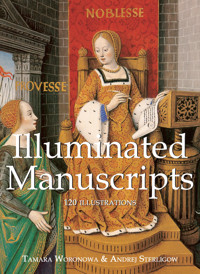
Those who have had the chance to hold a medieval manuscript in their hands cannot fail to have been impressed by the feeling of being in touch with a long-passed epoch. Back when a book was a true handicraft and every copy the result of a laborious process, the object was more a work of art than a volatile commercial product. The Mega Square Illuminated Manuscripts puts the reader in touch with amazing medieval illustrations and unique adornments, which document the imaginative power of their creators.
Das E-Book können Sie in Legimi-Apps oder einer beliebigen App lesen, die das folgende Format unterstützen:
Seitenzahl: 74
Veröffentlichungsjahr: 2022
Ähnliche




















Tamara Woronowa and Andrej Sterligow
Illuminated
© 2014, Confidential Concepts, Worldwide, USA
© 2014, Parkstone Press USA, New York
© Image-Barwww.image-bar.com
Editor’s note:
The countries indicated in the captions refer to the place of origin of the works and not to their current location. As regards the dimensions indicated, they are linked, unless mentioned otherwise, to the volume.
All rights reserved. No part of this may be reproduced or adapted without the permission of the copyright holder, throughout the world.
Unless otherwise specified, copyright on the works reproduced lies with the respective photographers. Despite intensive research, it has not always been possible to establish copyright ownership. Where this is the case, we would appreciate notification.
ISBN: 978-1-78160-865-4
Contents
CHRONOLOGY
LIST OF ILLUSTRATIONS
A
A Rose and Solomon’s Seal
About the Fabled Trojan Origin of French People
Account of a Converted Noble Roman Woman
Account of a Devout Monk who after his Death Appeared at Night to the Sexton of his Monastery
Account of Damnation of a Money-Lender and Salvation of a Beggar Woman to whom the Holy Virgin and Virgins Appear
Adam Naming the Animals
Allegory Illustrating the Treatise “De la Fortitude”
Allegory Illustrating the Treatise “De la Prudence”
Angel Appearing before King Evalach
Atlas Holding the Terrestrial Globe and Archimedes Measuring it with Compasses
Avicenna and the Translator of his Work, Represented by a Monk Below (Initial of book 3)
B
Beehive
Beginning of a Section
C
Canon Table
Christ Entering Jerusalem and Christ’s Arrest (top), the Washing of the Feet and the Prayer of the Calice (bottom)
Christ in Majesty (top), the Author, Lactantius (bottom) (Opening Page of Book 1)
Coat of Arms of René d’Anjou and Jeanne de Laval
Creation of Eve, Temptation and Expulsion
Creation of the World (Opening Page)
Crossing a River with the Help of Pontoons and Fascines
Crucifixion (top) and Deposition (bottom)
D
Deer
Destruction of the Greek Fleet Lured by False Shore Fires
Dispute of a Shepherd and Shepherdess
E
Elephant
Enthroned Louis XII Dictacting a Reply to Hector of Troy
Exodus
Extraction of Aloe, Gold, Alum and Antimony
F
Fauvel Sets Off to Meet Fortune
First Canon Table
Francis I, Surrounded by his Court, Receiving Anne de Montmorency (Frontispiece)
G
Gaiete Sets off to Meet Billas
Galley Fleet on a River
Girart and Oriana
Greek Ships Caught in a Tempest
H
How St John Was Called by Christ from Earthly to Divine Marriage
Humanist Author in his Study (Opening Page)
I
Illustration of a Battle during the Great Schism
Initial of the Second Book of Kings
Initial to Psalm 1
Initial to Psalm 26
Initial to Psalm 51
Initial to the Book of Daniel, Daniel in the Lion’s Pit
Initial to the Book of Ezekiel
Initial to the Prayer “O Gloriosa Virgo Maria”
J
Jason Sets off to Capture the Golden Fleece
Joust between the Count Ferry of Lorraine and the Count of Eu of the House of Valois
K
King René Leaves for the Joust with the Duke of Alençon
Knight
Mark the Evangelist
Marriage Supper of the Lamb (top) and Last Judgment (bottom)
Matthew the Evangelist
Mercury Explaining that a Marriage Must be Based on Love (Venus in the centre) Accompanied by the Three Graces (Frontispiece)
Messengers Ready to Take Anna’s Letter
Miniature to the Office of the Dead
N
New Testament (Frontispiece)
Nimrod in Front of the Tower of Babel under Construction
Nobleman (probably Wolfert Van Borssel) Visiting the Author (the translator?)
O
Opening of the Canon of the Mass
Opening of the Canon of the Mass
Opening Page of the Gospel According to St John (In Principio)
Opening Page with Historiated Initial (probably Pope Gregory the Great)
P
Pastoral Scene
Pawn
Peasant Dictating an Address to a Boy
Philip the Good, Duke of Burgundy, Receiving the Manuscript from Abbot Guillaume Fillastre on January 1457
Presentation of the Manuscript to the King
Prowess and Nobility
R
Reason, Arbitrating the Dispute between Virtue and Fortune (Frontispiece)
S
Score with Historiated Initial Representing the Resurrection
Siege of a Fortress
Signatures of English Nobles on a Manuscript’s Page
Signs of the Zodiac
Solomon Builds the Temple of Jerusalem
St Antoine in the Desert
St Jerome (Frontispiece)
St John in Patmos
St John Kneeling before Christ
St Thomas Aquinas Teaching
Stork
Swordfish
T
The Adoration of the Magi
The Announcement to the Shepherds
The Annunciation
The Annunciation
The Annunciation with the Prophet Isaiah and James the Great (top), the Nativity with the Prophet Daniel and the Adoration of the Shepherds and the Magi (bottom)
The Apparition of the Virgin and Child to St Peter of Luxembourg
The Author at Work
The Author Comparing the Merits of Pleasure, Usefulness and Elegance
The Battle of Roosebeke
The Boy Christ Engaged in a Dispute with the Elders in the Temple (top), the Author, Lactantius (bottom) (Opening Page of Book 4)
The Coronation of Charlemagne
The Coronation of the Virgin
The Creation of Eve
The Creation of the World
The Crowing with Thorns
The Dangers of Love
The Descent of the Holy Ghost
The Doge Presenting the Instructions to Angelo Gradenigo, the Captain of the Galleys Setting off for Beirut
The Eighth Joy of Married Life
The Festival of the Romans and the Sabines
The Flight into Egypt
The Holy Face
The Kneeling Author Presenting his Book to the Young Sovereign
The Last Judgment
The Marriage of Paris and Helen
The Mystical Crucifixion on the Tree of Life
The Nativity of Christ
The Presentation at the Temple
The Raising of Lazarus
The Story of Chilperic
The Trinity Enthroned (Opening Page)
The Trojans Founding Four Cities: Venice, Cycambre, Carthage and Rome
The Uprising of the Counts of Flanders
The Virgin and Child Surrounded by Angels Appearing to a Knight
The Visitation
The Wooden Horse Taken into Troy
Third Battle between the Greeks and the Trojans
Title Page Including an Image of Petrarch
Trinity in Glory
V
Virgin and Unicorn
W
Whale
Avicenna and the Translator of his Work, Represented by a Monk Below (Initial of book 3)
Canon, Ibn-Cina (Avicenna), 1343. Parchment, Latin, 42 x 26 cm, Italy
Chronology
15th Century B.C.E.:
First illuminated manuscripts of papyrus in Ancient Egypt.
2nd Century:
Creation of the codex (bound book). The codex that will not truly supplant the scroll (a roll of parchment or paper) until the 4th century. More hard-wearing, the parchment, elaborated with animal skin, will replace the papyrus.
6th Century:
First illuminated manuscripts in the codex of Western monasteries.
6th Century-8th Century:
The “insular art” (“of the islands of” Ireland and Northumbria) stands out by the creativeness of its Gospel adornements, with designs of plants and mosaics. The Merovingian manuscripts of linear style are modelled on Antiquity and Byzantine art to illustrate prayer books and lectionaries. The main centers of production are the monasteries of Fleury, Tours (Val de Loire), Luxeuil (Burgundy) and Corbie (Picardy).
8th Century:
The work of the first British historian, Bede the Venerable (c. 673-735), entitled Historia Ecclesiastica Gentis Anglorum introduced for the first time an historiated initial in a manuscript.
8th Century-10th Century:
Carolingian Renaissance: setting of the main principles of the art of illuminated manuscripts. Rationalising the decor (naturalistic figural art), focused on the initial capital and a few miniatures. Enriching of the material: prepared manuscript with purple background, decor of gold and silver (The Purple Gospelbook). The thematic of the codex spreads to profane texts (Bestiary). Flourishing art at the court of Charles the Bald (Sacramentary of Saint-Amand), but in other places as well as the Rhine Valley, Tours, Rheims and Metz.
13th Century:
The French illuminated manuscripts set the laws of the Gothic style for the whole Western world. Keen interest on architectural forms, brights colours (blue, red, white), quest for the volume and movement (Psalter, 1218-1242). Creation of full-page miniatures. The ornementation gains margins which become populated with ivy, grotesques and drolleries. The era of monastic fabrication declines with the advent of urban workshops run by laymen.
14th Century:
Refinement of the silhouettes and elegance of the Parisian School, under the direction of Jean de Pucelle. Flourishing of the illuminated manuscript art in Provence and Catalonia, strongly influenced by oriental taste (Lo Breviari d’amor). In Italy, the illuminated manuscripts of Bologna are done according to the teaching of Giotto: coloured tints, details and perspective (Story of the Trojan War). Straightness of the Germanic-style figures (Book of Chess). Famous Flemish artists (such as the Limburg Brothers, The Very Rich Hours of the Duke of Berry) are drawn by the enlightened patronage of Charles V, the Dukes of Burgundy, the Dukes of Berry and of the Valois Princes.
15th Century:




