


9,99 €
Mehr erfahren.
- Herausgeber: tredition
- Kategorie: Geisteswissenschaft
- Sprache: Englisch
A detailed analysis of Kazuo Ishiguro's masterpiece The Remains of the Day in nine essays. In neun Aufsätzen wird Kazuo Ishiguros Meisterwerk The Remains of the Day eingehend analysiert.
Das E-Book können Sie in Legimi-Apps oder einer beliebigen App lesen, die das folgende Format unterstützen:
Seitenzahl: 117
Veröffentlichungsjahr: 2022
Ähnliche




















In memoriam Peter Freienstein
Peter Freienstein
Paul W. Maloney
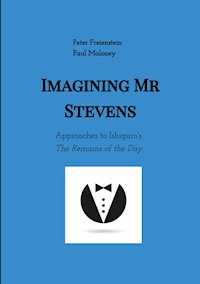
Imagining Mr Stevens
Approaches to Ishiguro’s The Remains of the Day
© 2022 Paul W. Maloney
Umschlag: Paul W. Maloney unter Verwendung eines Motivs von © AlexVector (shutterstock)
Weiterer Mitwirkender: Peter Freienstein
Druck und Distribution im Auftrag des Autors:
tredition GmbH, Halenreie 40-44, 22359 Hamburg, Deutschland
ISBN
Paperback
978-3-347-63154-0
Hardcover
978-3-347-63155-7
e-Book
978-3-347-63156-4
Das Werk, einschließlich seiner Teile, ist urheberrechtlich geschützt. Für die Inhalte ist der Autor verantwortlich. Jede Verwertung ist ohne seine Zustimmung unzulässig. Die Publikation und Verbreitung erfolgen im Auftrag des Autors, zu erreichen unter: tredition GmbH, Abteilung "Impressumservice", Halenreie 40-44, 22359 Hamburg, Deutschland.
Contents
1 Time, Space and the Subconscious
2 The Butler’s Tale
3 The Jargon of Equivocation
4 Blindness
5 Finitude
6 Greatness
7 Upstairs, Downstairs
8 Dignity
9 Two Triumphs and a Tragedy
Bibliography
Note: All page numbers refer to the paperback edition of Ishiguro’s novel, published by Faber and Faber Ltd., London in 1990 (ISBN 0-571-15491-3).
1
Time, Space and the Subconscious
An English butler well past his prime, presently in the employ of a Mr Farraday, the American who has recently acquired Darlington Hall, a stately home in Oxfordshire, undertakes—apparently for the first time in his life and at the urging of his employer—a six-day motoring tour through the south of England. That, in a nutshell, is the plot of Kazuo Ishiguro’s novel The Remains of the Day. While the butler’s progress from one station to the next serves to structure the eight chapters of the novel (each of which—with the exception of the Prologue—is given a title stating both a point in time and a location), the plot extends far beyond the events of the journey. Stevens, the main character and narrator, drifts back in his mind to events of the past, in particular those of the 1920s and 1930s, some of them involving his father, but mainly concerned with the two most important people in his life, his former employer Lord Darlington, and Miss Kenton, who was housekeeper at Darlington Hall for much of the twenties and thirties.
The narrator Stevens frequently jumps back and forth between the present and the past; as several chapters also contain longer reflections on topics close to Stevens’s heart, the narrative as a whole produces a rather impressionistic effect when read for the first time. By and large, Stevens relates both the events of the past and the details of his journey in chronological order. (The most notable exception is the re-encounter with Kenton, now Mrs Benn, which is related in the final chapter, even though it actually transpires on the afternoon of Day Four.) Stevens thus offers both short-term recollections (when he recounts the events of the day) and memories of the past (when he recalls events that happened thirty or more years before). As the narrator frequently calls attention to his momentary vantage point (there are seven all together), all of his stories have a certain anecdotal character; they are seldom perceived by the reader as ‘action’, but rather as episodes that are related in order to illustrate a certain point the narrator wishes to make (usually connected with his claim to ‘greatness’ as a butler).
The following table may be helpful in coordina-ting the events of the present and the past as they are related in the course of the narrative:
present
past
Prologue: July 1956 (vantage point: Darlington Hall)
Farraday suggests to Stevens that he take a few days off. Stevens ultimately decides to accept the offer.
Day One – Evening (vantage point: a guest house in Salisbury)
Stevens stops at the roadside and talks to an old man, who urges him to climb a hill.
Day Two – Morning (vantage point of Day One)
Stevens has arrived in Salisbury. He relates an incident of the day before in which he stops his car to avoid running over a hen.
The early 1920s: Kenton arrives at Darlington Hall at about the same time as Stevens’s father. A conflict arises between Stevens and Kenton over the elder Stevens, whose health is declining. During an international conference in 1923, Stevens’s father dies of a stroke.
Day Two – Afternoon (vantage point: Mortimer’s Pond, Dorset)
Stevens lets the motor of his car overheat and stops at a house for help. Asked about his place of employ, Stevens denies having worked for Darlington. Later, Stevens sits by a pond and recalls reacting similarly when asked the same question by one of Farraday’s visitors.
Day Three – Morning (vantage point: a tea room in Taunton)
Stevens relates his misadventure at the inn where he spent the previous night.
Stevens addresses Darlington’s position on fascism and anti-Semitism in the 1930s.
Day Three – Evening (vantage point: spare room at the Taylors’ house in Moscombe)
Stevens is marooned outside of Moscombe when his car runs out of fuel. He descends to the village and is offered a room for the night at the Taylors’ house, where he becomes the centre of attention and takes part in a discussion on dignity and politics.
Darlington has two Jewish maids dismissed from the staff. Kenton is bitterly opposed, whereas Stevens acquiesces. Kenton tells Stevens she has begun seeing a suitor. When he learns that her aunt has died, Stevens fails to console her.
Day Four – Afternoon (vantage point: restaurant of the Rose Garden Hotel, Little Compton)
Stevens describes a sudden storm that has emptied the rose garden. He then relates the incidents of the morning: while Dr. Carlisle drives him to his car, they discuss the events of the previous evening.
Mid-1930s. Kenton informs Stevens that her suitor has proposed to her. Darlington’s godson, Reginald Cardinal, comes unannounced to Darlington Hall and informs Stevens that Darlington is attempting to engineer a détente between Britain and Nazi Germany.
Day Six – Evening (vantage point: the pier at Weymouth)
Stevens sits on a bench at the pier and recalls his rendezvous with Kenton two days earlier. He later has a brief conversation with a retired butler.
Through the double-tiered structure of the narrative, the reader is implicitly called upon to relate the chronicle of the past to the events of the present. The most obvious such connection is, of course, the figure of Kenton, who dominates Stevens’s tales of the past and who also forms the object of his journey to Cornwall. Further parallels concern Darlington, either directly (as when Stevens is asked about his past affiliation) or on the thematic level (when, as in the Moscombe episode, the question of the political responsibility of the common man is brought up). In a broader context, the tale of Stevens’s car trip forms a contrasting background to his autobiographical account of his earlier days: whereas in the flashbacks Stevens appears exclusively in his professional capacity within the walls of Darlington Hall, in the present we see Stevens out in the real world of mid-1950s Britain, floundering painfully through social situations that frequently confound him.
From the first morning of his motoring trip Stevens is aware of the close relationship between his frame of mind and the act of travelling: “The feeling swept over me that I had truly left Darlington Hall behind, and I must confess that I did feel a slight sense of alarm—a sense aggravated by the feeling that I was not on the correct road at all, but speeding off in totally the wrong direction into a wilderness” (p. 24). Less accessible to his conscious mind is the even more obvious parallel between his trip through the English countryside and his mental journey into the past. Both have for Stevens the ultimate object of recovering the past; neither of them succeeds in this regard. Stevens’s progress is dialectical on at least two accounts. The more he tries to impress his listener with Darlington’s noble intentions, the deeper he entrenches himself in contradictions and threadbare excuses. And his purported quest to solve the staffing problem at Darlington Hall by persuading Kenton to return fares no better. With each day that brings him nearer to his goal, Stevens becomes less certain of the sentiments expressed in Kenton’s letter; face to face with the object of his quest, he wisely refrains from even broaching the subject.
In order to do justice to the complexity of the narrative, it would thus seem more accurate to speak of a three-tiered structure, one which involves not only time and space, but also the subconscious mind of the narrator. As Stevens travels forward in space and backward in time, he is exposed to sights and experiences that trigger chains of association in his mind. A prime example can be found in the chapter ‘Day Three – Morning’, as Stevens looks out of the window while enjoying a cup of tea and glimpses a signpost pointing the way to the town of Mursden (p. 133). The name reminds him of Giffen’s silver polish, the premium brand of its time, which was manufactured in Mursden, and which in turn causes him to recall the effect of Darlington’s highly polished silver on the mood of Lord Halifax, who had been invited to Darlington Hall for a clandestine meeting with the German ambassador Ribbentrop in the mid-1930s. From there it is but a small step to Darlington’s dalliance with the fascist and anti-Semitic movements of the time—and here Stevens shows himself to be a true ‘silver-polisher’, ostensibly rebuking all who accuse his former master of fascist sympathies while at the same time — as it were, behind his own back — presenting evidence to the contrary.
The effect of the subconscious is no less apparent in the narrator’s omissions, the most obvious of which being the complete absence of Day Five in the chronology of the plot. After his rendezvous with ‘Mrs Benn’ on the afternoon of Day Four, Stevens evidently requires two full days before he is able to reflect on the import of what was said (and what was not said).
In an essay written for The Guardian in 2016, Ishiguro—with reference to his second novel, An Artist of the Floating World—describes how reading Proust’s The Rembrance of Things Past while recovering from the flu gave him the impulse he needed for his work in progress: “The ordering of events and scenes didn’t follow the demands of chronology, nor those of an unfolding linear plot. Instead, tangential thought associations, or the vagaries of memory seemed to move the novel from one section to the next. Sometimes the very fact that the present episode had been triggered by the previous one raised the question ‘Why?’ For what reason had these two seemingly unrelated moments been placed side by side in the narrator’s mind?”1
What is true of An Artist—in many respects a study for Remains—is even more true of Ishiguro’s third novel. The narrator Stevens embarks on a journey through inner space that forces him to confront the subterfuges he has subsided on all his life for what they are.
As if this were not enough, Ishiguro treats the landscape through which his narrator manoeuvers in a manner rife with symbolism, frequently paralleling the ‘inner landscape’ Stevens must navigate. On the morning of the first day of his journey, for example, he climbs a hill to admire the view; having reached the top, he feels at once surrounded by comforting intimations of ‘greatness’. A mere two days later, having run out of fuel, he is compelled to descend in the dusk through trackless fields and in the end is confronted—albeit inadvertently—with a harsh challenge to his overblown self-image. A memorable example of such a symbolic landscape is to be found again near the end of the novel, as Stevens and Kenton wait for the bus to arrive and chat about their respective futures. The conversation breaks off, and the narrator relates: “On the other side of the road, all I could see were more farm fields; a line of telegraph poles led my eye over them into the far distance” (p. 237). The relentlessly bleak landscape mirrors the total lack of perspective that is Stevens’s vision of his future (“work, work and more work,” ibid.).
The title of the novel calls our attention to the fact that times of day also have a symbolic significance for Ishiguro. Stevens’s autobiographical account corresponds roughly to the classical metaphor that views a human lifespan as one ‘day’: he describes first the events of 1922 - 1923, when he was presumably in his early 30s, a time he recalls as a “turning point” in his career, when he “came of age as a butler” (p. 70); secondly, we see him at the height of his powers in the mid-1930s; ultimately, he appears as an elderly man, perhaps in his mid-60s, in the chronicle of the present (1956). Stevens’s companion on Weymouth pier uses the metaphor of life’s ‘day’ when he speaks of the ‘evening’ – meaning retirement – as being the best part of life for most people. Stevens reflects on his advice in words that all but quote the title of the novel: “Perhaps, then, there is something to his advice that I should cease looking back so much, that I should adopt a more positive outlook and try to make the best of what remains of my day” (p. 244). Crushed by the realization of his own waning powers (“whatever I do I find I am far from reaching the standards I once set myself” – p. 243) Stevens consoles himself with his intention of making the best of what is left him.




