


11,49 €
Mehr erfahren.
- Herausgeber: Atlantic Books
- Kategorie: Geisteswissenschaft
- Sprache: Englisch
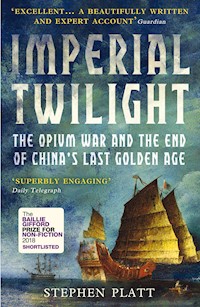
SHORTLISTED FOR THE 2018 BAILLIE GIFFORD PRIZE A Financial Times Book of the Year A Sunday Times Book of the Year ________________________________________ 'Entertaining and well-paced... Platt's compelling book is a sobering read that should focus the minds of those who like to talk of the achievements of the Victorian age without thinking about how those were achieved, or how they were funded.' Peter Frankopan, Spectator ________________________________________ In 1839 Britain embarked on the first of its wars with China, sealing the fate of the most prosperous and powerful empire in Asia, if not the world. Motivated by drug profiteering and free-trade interests, the Opium War helped shaped the China we know today, sparking the eventual fall of the Qing dynasty and the rise of nationalism and communism in the twentieth century. Imperial Twilight is a riveting and revealing account of the end of China's Golden Age and the origins of one of the most unjust wars in history.
Das E-Book können Sie in Legimi-Apps oder einer beliebigen App lesen, die das folgende Format unterstützen:
Veröffentlichungsjahr: 2018
Ähnliche



















Imperial Twilight
ALSO BY STEPHEN PLATT
Autumn in the Heavenly Kingdom:
China, the West, and the Epic Story of the Taiping Civil War
Provincial Patriots:
The Hunanese and Modern China
Imperial Twilight
The Opium War andthe End of China’s Last Golden Age
STEPHEN PLATT
This edition published by arrangement with Alfred A. Knopf, an imprint of The Knopf Doubleday Group, a division of Penguin Random House, LLC.
First published in Great Britain in 2018 by Atlantic Books, an imprint of Atlantic Books Ltd.
Copyright © Stephen R. Platt, 2018
The moral right of Stephen R. Platt to be identified as the author of this work has been asserted by him in accordance with the Copyright, Designs and Patents Act of 1988.
All rights reserved. No part of this publication may be reproduced, stored in a retrieval system, or transmitted in any form or by any means, electronic, mechanical, photocopying, recording, or otherwise, without the prior permission of both the copyright owner and the above publisher of this book.
1 2 3 4 5 6 7 8 9
A CIP catalogue record for this book is available from the British Library.
Hardback ISBN: 978-1-78649-486-3
E-book ISBN: 978-1-78649-488-7
Paperback ISBN: 978-1-78649-487-0
The illustration credits on p.528 constitute an extension of this copyright page.
Maps by Mapping Specialists, Ltd
Designed by Soonyoung Kwon
Printed in Great Britain
Atlantic Books
An Imprint of Atlantic Books Ltd
Ormond House
26–27 Boswell Street
London
WC1N 3JZ
www.atlantic-books.co.uk
For Francie, Lucy, and Eliot
Desolate castle, the sky, the wide desert.
There is no wall left to this village.
Bones white with a thousand frosts,
High heaps, covered with trees and grass;
Who brought this to pass?
Who has brought the flaming imperial anger?
Who has brought the army with drums and with kettle-drums?
Barbarous kings.
A gracious spring, turned to blood-ravenous autumn . . .
—LI BO (701–762), TRANS. EZRA POUND,
“Lament of the Frontier Guard”
Weave a circle round him thrice,
And close your eyes with holy dread,
For he on honey-dew hath fed
And drunk the milk of Paradise.
—SAMUEL TAYLOR COLERIDGE,
“Kubla Khan”
Contents
Maps
Introduction: Canton
PROLOGUE
The Journey of James Flint 3
PART I
Gracious Spring
CHAPTER 1
A Time of Wonder
CHAPTER 2
Black Wind
CHAPTER 3
The Edge of the World
CHAPTER 4
Sea and Land
CHAPTER 5
Points of Entry
CHAPTER 6
Hidden Shoals
PART II
The Milk of Paradise
CHAPTER 7
Boom Times
CHAPTER 8
Fire and Smoke
CHAPTER 9
Freedom
CHAPTER 10
A Darkening Turn
CHAPTER 11
Means of Solution
CHAPTER 12
The Last Honest Man
PART III
Blood-Ravenous Autumn
CHAPTER 13
Showdown
CHAPTER 14
Will and Destiny
CHAPTER 15
Aftermath
CODA
Houqua and Forbes
Acknowledgments
Notes
Bibliography
Index
Introduction: Canton
If you stand outside the wall, it is impossible to gauge the size of the city. Canton is built on a plain, so the low, flat buildings of brick and wood that lie inside are invisible from where you stand. The wall is thirty feet high and crenellated, built from large blocks of sandstone at its base and smaller bricks above. It stretches as far as you can see in either direction, with forts visible on top at regular intervals, cannons peering outward. Near you is one of the twelve massive wooden gates that open into the city, a shadowed cave guarded by soldiers and horsemen. The gates creak open each morning at dawn, and close again each evening around 9 p.m. Not that you will be allowed in. As a foreigner, you are stopped at the gate and turned away. You will not see the fantastic warren of narrow streets inside, paved with thick slabs of granite. You will not see the dense brick houses with their sloping tiled roofs, the vast examination hall with its thousands of cells, the lavish mansions, the temples, the gardens, or the government offices that lie within.1
Instead, you stay outside and wander back through the suburbs, the sprawling and amorphous settlements surrounding the wall where you could walk for miles without any sense of their coming to an end. It is steamy weather, so humid your sweat seems to just blend into the air around you. The paved streets are twisting and so very narrow that you can sometimes touch the walls on both sides at the same time. The buildings here, fronted with fragrant carved wood, are mostly two stories high, with tall shutters on the windows. Above you, laundry hangs to dry on lines stretched across the top of the alley, creating a canopy effect. It is hard to hear over the din of the hawkers and the shouting of porters and chair-bearers as they try to push their way through. Everywhere is the press of humanity—people traveling on foot or carried in sedan chairs, lounging in the alleyways, eating in open-air restaurants as street performers and beggars ply them for money.
If there are other foreigners about in the suburbs you might overhear a few snatches of Pidgin English, the local trading language. It is a hybrid of the Cantonese dialect of the city and the European tongues native to the foreigners who come to trade here (“pidgin” means “business”). For the most part it is made up of English words, sometimes with a bit of Hindi or Portuguese, set to Chinese grammar and pronunciation. It is a meeting ground between vastly different languages and will take some getting used to. Fragments of it will be absorbed back into English—having a “look-see” or eating “chow,” asking someone to hurry up “chop-chop” or telling them “Long time no see.” In its full-blown form it is a colorful singsong of a language. “I saw a man eating” becomes “My look-see one piecee man catchee chow-chow.” “He has no money” translates to “He no hab catchee dollar.” “You belongy smart inside” means “You’re very smart.”
Vertical signs hang from the sides of most buildings with Chinese characters announcing what is for sale in the shops on the ground floor. You can’t read them. But you may be relieved to see that some stores have signs written out in English letters to lure you in. You enter one of these shops through a tall central doorway flanked by two large open windows. It is cooler inside, out of the sun. There is a counter near one of the windows, piled with writing materials. A clerk flips the beads of an abacus rapidly with one hand while he writes down calculations with the other. It is quiet except for the clicking of the abacus. The shop is crammed to the rafters with silk of every description.
Back out in the alley you continue on your way, past shops selling tea, medicine, porcelain, a hundred other goods. A great deal of money changes hands here. There are craftsmen and artists—cabinet makers, blacksmiths, tailors, painters. The painters work in oil, on glass or canvas. They can produce Chinese or European images for you with equal skill, easily replicating anything you bring to them. They will even hold sittings for a visitor like yourself to get your portrait painted. Some of the foreigners say their oil portraits aren’t always so flattering. But as the joke goes, when they complain the painters just tell them, “No hab got handsome face, how can hab handsome picture?”
It is not a clean city—though neither, for that matter, are London or Boston. It is especially filthy near the Pearl River, which is where we are headed. The sluggish water of the canals feeding into the river is thick with sewage and refuse from the nearby houses. Rows of sampans are tied up several deep in the river, where the boat people live. Piles of garbage are strewn along the bank. The smell of refuse stewing in the humid warmth is something you will stop noticing in time.
Now we come to the factory district at the edge of the river. This is where you belong.
What you will notice first as you enter from along the river is the relatively enormous amount of open space before you. You have seen nothing like it in the tightly packed suburbs, where alley gives way to alley and there are no open public areas (the great gardens of the suburbs are private and lie behind walls). But here is a wide expanse of hard-trodden dirt with space to walk around freely. This plaza of reclaimed land—the square, as it is known—slopes gently down to a muddy riverfront densely crowded with ships. The ships here are all small ones, for the river is fairly shallow; all of the giant oceangoing vessels you might have expected to see are about ten miles downriver at a deeper anchorage called Whampoa.
There are small groups of Chinese wandering around on the open square, and if you turn away from the water you will see what they have come for. Jarringly out of place in comparison to the low wooden houses of the suburbs, here is an imposing row of thirteen large buildings of brick and granite, higher than anything you have yet seen in Canton—higher even than the city wall. They are distinctly European in appearance, with columned verandas and terraces. Several have tall flagpoles out front that fly the national flag of a Western country: Britain, France, the United States.
These are the factories, where the foreigners live. In spite of the name, they are not sites of manufacturing (a “factor” is a term from India meaning a trader). They contain living quarters, warehouses, and offices. Each one has a Chinese “compradore,” or chief steward, who staffs it with a small army of servants—cooks, valets, butlers, even menial servants to pull the ropes that keep the ceiling fans spinning in this oppressive heat. They keep the factories well supplied with food and other necessities. Some have a few head of livestock or a milk cow on hand. If a factory is inhabited by a single national group, it gets to fly its flag out front. The ones without flags host a variety of foreign businessmen, many from India.
For the most part the factory buildings have been built touching one other to economize on space, but there are three gaps between them—short, busy streets filled with single-story Chinese shops. Even on this small scale there are important gradations, better or worse parts of “town.” The more respectable alleys are New China Street and Old China Street—toward the left if you face the factories from the water. About twelve feet wide, they have orderly rows of retail stalls and tailor shops, a place for temporary visitors to pick up souvenirs and get clothing made. The less respectable alley, a narrower and dirtier one off to the right, is called Hog Lane, and it is mainly crammed with bars catering to foreign sailors from the ships down at Whampoa, who occasionally get a few days of shore leave, which—as in any other port they might encounter—they mainly spend getting drunk. The Chinese proprietors of the bars have adopted English names like “Jolly Jack” and “Tom Bowline.” Their liquor shacks are so tiny they don’t have benches or a bar per se, just a rope over which a sailor can hang by his armpits and drink until he passes out.
In all the compound, it is the British factory that is most striking. Larger than the others, it has its own fenced-in space in front that reaches all the way down to the riverbank. Standing out in front under the limp Union Jack on this sultry afternoon you can see the factory’s broad, columned terrace with a view up and down the river, where the merchants of the East India Company can enjoy their tiffin and sometimes catch a bit of a breeze. If you go through the front gate, past the vigilant Chinese guard with his rattan cane, entering through the shade of the veranda, you will find upstairs a European world that might make you forget where you are. Along the wide hallways you will find counting rooms, tea-tasting rooms, and parlors. There is a chapel with a spire that holds the only public clock in the compound. There are well-appointed living apartments, a dining hall with room for more than a hundred guests, a billiard room, a library of four thousand books.
Looking around inside the vast, chandeliered British dining hall—the portrait of a king on one wall, a former ambassador on another—drinking your sherry as a bustling crowd of servants prepares to serve a dinner of roast beef and potatoes with gravy, you could be forgiven for imagining you had stumbled into some colonial outpost. But this is not India. The British are not in charge here. The Chinese are. These buildings are, all of them, owned by Chinese merchants, who rent them out to the foreign traders so they will have a place to stay and do their business. The armies of servants answer to their Chinese superiors, not to those they wait on. They report what goes on with the guests. Watched over at all times, the foreigners feel sometimes like grubby infants—coddled and helpless, attended always by their nurses. They need permission to do just about anything.
As opulent as these surroundings may be, the residents sometimes feel that they have volunteered to become prisoners here. Despite the feeling of open space outside on the square, the compound is quite limited in size. It runs for just three hundred yards along the waterfront, and between the square out front and the extensive factory buildings behind, it is about two hundred yards deep. The longer you are here, the smaller it will feel. Foreigners are not permitted to go into the city itself, and they can only wander through the very nearest parts of the suburbs. Farther on, and throngs of young boys will materialize to throw rocks at them and call them foreign devils. Even farther, and Chinese soldiers will come to escort them gently home. Every ten days a small group is allowed to take the air in a nearby garden. Other than that, this is their gilded cage. There is nothing else like it in the world. The entire formal trade of Europe and America with China, the largest empire in existence, goes on here in a space of just twelve acres—less, some like to point out, than the footprint of one of the pyramids in Egypt.
You may not want to spend too many years of your life here, but as you see it in the early 1830s, Canton hardly seems the kind of place to start a war.
No event casts a longer shadow over China’s modern history than the Opium War. Sparked by an explosive series of events that took place in the Canton factory compound in 1839, the war would end in 1842 with China’s humiliating defeat and a treaty all but dictated by the British aggressors, setting a disastrous pattern for the century to come. Textbooks in China on “modern” history, as a rule, take the Opium War as their starting point, the moment when China left its traditional past behind and was dragged forcibly into the world of European imperialism. The war occupies that place not because it was so destructive; in fact, it was relatively small and contained. It caused none of the large-scale social dislocation that China’s major internal wars of the nineteenth century like the Taiping Rebellion did. It did not topple the ruling dynasty or even remotely threaten to do so. There weren’t even that many battles fought.
But the symbolic power of the Opium War is almost limitless. It has long stood as the point when China’s weakness was laid bare before the world, the opening of a “Century of Humiliation” in which Western (and later Japanese) predators would make war on China to bully it into granting territorial concessions and trading rights. It marked a sea change in relations with the West—the end of one era, when foreigners came to China as supplicants, and the dawn of another, when they would come as conquerors. And it carries especially strong power because China unquestionably had the moral high ground: as remembered since, and as charged by critics at the time, Great Britain unleashed its navy on a nearly defenseless China in order to advance the interests of its national drug dealers, who for years had been smuggling opium to China’s coast against the laws of the country. The shocking grounds of the war have provided the very foundation of modern Chinese nationalism—from the overthrow of the Qing dynasty in 1912 and the rise, first of the Republic, and then the People’s Republic of China, the Opium War has stood for the essence of everything modern China has tried to leave behind: weakness, victimhood, shame.
Because we live in a world so heavily shadowed by this memory, it has been easy for westerners of more recent generations to imagine that this was always the case—that weakness and victimhood were somehow inherent to China’s nature. Through the twentieth century, China was a poor, vulnerable, and frequently chaotic nation that never seemed a contender for power. A third-world nation in the eyes of the wealthier countries, it was alternately a pariah or an object of sympathy. For that reason, the country’s worldly aspirations of the late twentieth and early twenty-first centuries—to play a leading role in the UN, to host the Olympics, to put a man on the moon—were initially viewed by outsiders almost with bemusement, as if it were an overly ambitious upstart forgetting its proper place. That bemusement has now given way to alarm in many quarters as China strengthens its naval power to unprecedented levels and lays claim to vast swaths of contested maritime territory, asserting its power in ways completely unknown to living memory.
But over the long term, China is anything but an upstart. And as its economic and military power today grow far beyond anything it seemed capable of in the twentieth century, it is coming to resemble far less the weak, bullied nation that suffered the Opium War than the confident and central empire that preceded it. If we take this war not as a beginning but as an ending, and shift our sights instead back into the era before it took place, back before that ostensible dividing line with the modern era, we find a China that was powerful, prosperous, dominant, and above all envied. The memory of that lost era looms ever larger in China today, as a reminder of its potential (some would say rightful) place in the world, a nostalgic vision of what it could be once again.
This is a book about how the Opium War came to be—that is, how China declined from its eighteenth-century grandeur and how Britain became sufficiently emboldened to take advantage of that decline. The central question of the war, as I see it, is not how Britain won, for that was never in serious doubt—in military terms the Opium War pitted the most advanced naval power in the world against an empire with a long and vulnerable coastline that had not needed a seagoing navy in more than a hundred years and so did not have one. Rather, the central question is a moral one: how Britain could have come to fight such a war in China in the first place—against, it should be noted, savage criticism both at home and abroad.
A sense of inevitability has always been projected backwards onto this era in hindsight, as if the war were always meant to be, but when viewed in the light of its own time the Opium War could hardly have been more counterintuitive. Aside from the audacity of sending a small fleet and a few thousand troops to make war on the world’s largest empire, critics at the time pointed out that Britain was putting its entire future tea trade at risk for only the vaguest and least justifiable of goals. It seemed paradoxical in the 1830s that a liberal British government that had just abolished slavery could turn around and fight a war to support drug dealers, or that proponents of free trade would align their interests with smugglers. If we revisit these events as they actually unfolded, rather than as they have been reinterpreted afterward, we find far more opposition to this war in Britain and America on moral grounds, and far more respect for the sovereignty of China, than one would otherwise expect.
One reason a reader might not expect such opposition to this war is that we too easily forget how much admiration China used to command. Because of its great strength and prosperity in the late eighteenth century, Europeans viewed China in a dramatically different light than they did the other countries of the East. At a time when India was an object of British conquest, China was an object of respect, even awe. Occasional calls for the use of naval power to advance trade there were struck down as self-defeating, while British traders in Canton who made trouble were generally ordered home or at least reminded to behave themselves. In commerce, China held all the cards. In stark contrast to the British Orientalist vision of India in the late eighteenth century—lost in the past, childlike and divided, a prize to be captured and controlled—China represented instead a strong, unified empire and another living civilization.
For that reason, readers who are familiar with the East India Company as a force of imperial conquest in India will find a very different face of it in China. When young Britons went to work for the Company overseas, it was India that attracted the military adventurers, the administrators, those with dreams of empire. The bean counters, by contrast, went to Canton. (And remarkably, it should be noted that in the early nineteenth century those bean counters in their quiet factories served the Company’s bottom line in London far better than the conquerors of India did.) Even as goods—especially cotton and later opium—flowed steadily from India to China, there was almost no professional circulation between the two regions, where Company agents developed largely separate worldviews. When visitors acculturated to British India intruded into the separate world of Canton, they would often cause problems—not just with the Chinese, but with their more experienced countrymen as well.
The Opium War would force those two worlds together, tainting the old admiration and respect for China with a taste for blood. The war would never be universally popular in Britain, however, and fierce opposition to the use of force in China would linger for a long time afterward (another controversial China war in the 1850s would entail the dissolution of Parliament and new elections to disempower the British lawmakers who tried to stop it). Nevertheless, by the time the war finally began, an ongoing collision of two competing worldviews—between those British who respected China’s power and prosperity and those who said it was no more enviable than India—reached a crucial threshold.
Thus, while the Opium War was ultimately a war over trade, the story of its origins is, to a significant degree, the story of how the grand mystery of China faded in the cold light of knowledge as British subjects first began to learn the language and explore the interior of the country—and, pursuant to those projects, how the admiring Western views of China that were so prevalent in the late eighteenth century came to be eroded over time by disillusionment and contempt. Within that shift lies the key to understanding how Britain’s government could come to a point in 1839 where it was willing to consider, for the first time in two hundred years, the use of violence to further its economic ends there.
Western histories of the Opium War for general readers have long told the story with a wink as the predictable triumph of West over East, a lesson taught to a childish people who dared to look down on the British as barbarians and tried to make them “kowtow” (a loaded term that used to indicate a specific ceremony of kneeling before the Qing emperor but now lives on in our language with the general meaning of “showing obseqious deference”). In such accounts, China typically appears as an unchanging backdrop, a caricature of unthinking traditions and arrogant mandarins stuck in the ancient past who are incapable of appreciating the rise of British power.2
With this book, I aim instead to give motion and life to the changing China that lay beyond the confines of Canton in the early nineteenth century—the rebellions, the spread of corruption, and the economic troubles that preoccupied the country’s rulers and formed the wider context for the issues of foreign contact that lie at the story’s center. Though the Chinese of this era have long been depicted as oblivious to the outside world, that is a false view. Coastal officials in China were fully aware that they had no capacity to resist a European navy; they knew what the British were capable of if given cause for war. Their naiveté, such as it was, resulted not from ignorance but from their faith in the stabilizing power of trade—in particular, their assumption that as long as the British enjoyed profitable commerce in Canton they would never have reason to resort to violence (a belief that was shared along the way, incidentally, by nearly everyone in the British government who had a say in the matter).
On the Western side of my story is a cast of British and American sojourners who tried to get beyond their limited confines in Canton—traders, explorers, missionaries, government agents, and smugglers who, for a variety of reasons both commendable and not, tried to see, contact, and understand more of the country than they were supposed to. Together, they embodied the long Western dream of opening China—“opening” here not to mean that China was always and universally closed (it was not), but to capture how it was experienced by the British and Americans of the late eighteenth and early nineteenth centuries. They were tightly restricted in their ability to conduct trade, they were forbidden to learn the Chinese language, and they were kept within exceptionally close boundaries with no ability to travel farther into the empire or interact with the general population. Some wished it were otherwise, and their efforts in that direction would have great repercussions.
On the Chinese side, meanwhile, this is the story of an empire in decline from a lofty, almost unimaginable height—a wealthy, powerful, civilized state controlling roughly a third of the world’s population, riven by internal pressures of overpopulation, official corruption, and sectarian dissent (all three of which, notably, count again among the Chinese government’s most pressing concerns today). The characters on this side will include emperors and officials who tried to maintain the order of the state, rebels and others at the fringes of society who tried to subvert it, and reform-minded Confucian scholars who—far from clinging blindly to tradition—proposed creative and pragmatic solutions to the problems of their time. Together, the Chinese and Western sides of the story are meant to give the reader a broader vision of this grand eclipse of empires in the early nineteenth century—China, crossing its meridian and entering into a long decline, while Britain rose to new nationalistic heights through its victories in the Napoleonic Wars and beyond. The Opium War was the point where those two arcs finally crossed.
In closing, a word on inevitability. Although this early age of contact between China and the West has long been treated in retrospect as if it were somehow always destined to end in war, it was not. The Opium War did not result from an intractable clash of civilizations, as it would later be framed in the West. Neither did it represent the culmination of some grand imperial master plan, as it is generally understood in China. To nearly all parties concerned, including even the government ministers who launched it, the war was all but unthinkable until it actually began. The truth is that over the long term, the foreigners and Chinese who came together at Canton found far more common ground than conflict. This book will have much to say about the individuals who made the war possible, but they are by no means the whole story. It is also a book about the many others, now mostly forgotten, who stood against the more familiar currents of their time and can remind us how differently the course of events might have gone—among them British activists who opposed the opium trade, Chinese scholars who counseled pragmatism in foreign relations, and Americans whose relationships with their Chinese counterparts set a more positive pattern than most of the British. As we look to the future of our own era, with China’s arc once again ascendant, such figures are every bit as important for us to remember as the ones who caused all the trouble.
Imperial Twilight
PROLOGUE
The Journey of James Flint
In the summer of 1759, James Flint sailed up the coast of China and almost didn’t come back. He was at the time the only Englishman who knew how to speak and write in Chinese, a talent that made him extremely valuable to the small community of East India Company traders who lived for a few months of the year in the factories outside the port city of Canton. Those British traders, known as “supercargoes,” had recently learned that the emperor would no longer allow them to visit other cities up the coast, which frustrated them not only because they wanted access to multiple Chinese ports for the sake of competition, but also because the senior customs official in Canton (known to them as the “hoppo”) was corrupt. He regularly demanded bribes from them and charged higher duties than he was supposed to. Their only recourse, as they saw it, was to try to appeal directly to the emperor in Beijing, in hopes that he might discipline the hoppo and allow them access to one or two other ports for their trade. As Flint was the only one among them who could communicate in Chinese, it fell to him to bring their appeal north.
James Flint’s path to learning Chinese had not been in any way a product of his own hopes or interests. As a child in England, he had been adopted in the 1730s by a ship’s captain named Rigby who brought him halfway around the world to the trading enclave of Canton and left him there, just a boy at the time, with instructions to learn the local language so he might make himself useful and perhaps get a job with the East India Company. Rigby then sailed away, intending to reunite with the boy sometime in the future. It was three years before young James finally heard from Rigby again, in a letter summoning him to Bombay. James took passage from Canton, but Captain Rigby died in a shipwreck not long after writing the letter, and by the time James got to India there was no one there to greet him. The British administrators in Bombay, at a loss as to what to do with the orphan boy, put him back on a ship to Canton, alone and penniless.1
With no money for a passage back to England, and nobody to care for him there even if he could get back, young James found a home with the East India Company’s supercargoes. He grew up over the years under their guardianship in Canton and the nearby Portuguese settlement of Macao—an adolescent, then a young man with a long Chinese braid, who dressed like the English when their ships were in port but wore clothes like the Chinese when they were not. He had no family but the East India Company, no home but the hybrid trading world in the small compound outside the broad stone walls of Canton where the foreigners stayed. Along with his native English he learned to speak the local dialect of Cantonese and a bit of the official dialect of Mandarin, and he could read and write in Chinese as well.
It was, as Captain Rigby had hoped, enough to make him a living. The British ships that came and went from Canton paid Flint a respectable fee to negotiate their terms of trade with local merchants. Without him, they had to rely on native translators, who charged high fees and usually took the side of their Chinese patrons. When discussions got thorny, the native translators were useless. The British supercargoes had long wanted one of their own kind to represent them in their business dealings, someone they could trust to put their interests first, and with Flint they finally had that. In time he was made a supercargo himself, and by 1759 when the others sent him up the coast to try to reach the emperor, he had put in more than twenty years of service at Canton.2
Flint sailed from Macao on the morning of June 13, 1759, on the Success, a little English snow with an eight-man crew and three servants, their course set for the port of Ningbo midway up the coast. He carried a formal petition in Chinese, addressed to the emperor, that his Chinese teacher had helped him write. Along with asking the emperor to investigate the Canton hoppo, Flint’s petition also requested permission for the British to trade at Ningbo, which was closer to the centers of production of tea and silk (and closer to the northern climates where there might be a better market for English woolens than at subtropical Canton). The British had traded at Ningbo in the past and knew that the merchants there still wanted their business—Flint himself had ascertained as much during a series of short voyages up to the city a few years earlier. But the officials in Canton were jealous of other ports siphoning off their business. And the government in Beijing enjoyed a steady income from the taxes on land transport for all of the goods that were carried down to Canton, income that would be lost if the trade went on in more convenient places. For those reasons, and to keep foreign relations focused and closely supervised, the emperor seemed intent on restricting the British to Canton alone.3
The initial stage of the voyage was unpromising. Upon his reaching Ningbo in late June, the officials in the port told Flint that his ship was forbidden to remain there. Flint pleaded that he carried a petition for the emperor, asking that the officials at least forward it for him to Beijing, but they would not accept it or even allow anyone from his ship to disembark. They told him to go back to Canton. He could not do that, though; it was impossible to sail back down against the winds in that season, and would be until September at least, when the strong southwest monsoon that swept up the coast of China during the summer months would reverse itself. So, absent any welcome from shore, Flint gave up on Ningbo and the Success continued on its plaintive course northward into the unknown.
On July 10, after two more weeks of feeling its way up the coast without a chart, the Success finally arrived at the broad, turbid mouth of the White River in northern China (known today as the Hai River), the maritime gateway to the inland city of Tianjin. Beyond Tianjin, a road led overland to Beijing. An official from one of the large forts that guarded the shallow river’s mouth came out in a junk to inform Flint that his ship was forbidden to proceed inland. But everything was negotiable, and after some further conversation the official said perhaps he could represent Flint’s case to his colleagues in Tianjin. For a fee, he could tell them that the Success hadn’t come on purpose but had simply been blown to this part of the coast by foul weather, and in that case Flint might be allowed up the river. The price he named for his services was 5,000 Chinese taels, a bribe worth nearly $7,000 at the time, or about $200,000 in today’s currency. Flint protested that he didn’t have that much money on board, but the official said he wouldn’t risk his position for anything less than half that sum. He gave Flint one night to think about it.4
Flint could not turn back. Aside from the adverse winds that made a southbound cruise impossible, the unsanctioned voyage of the Success up the coast would soon become known to the jealous officials down in Canton, who, if they knew the English had failed to get the attention of the emperor, were likely to become even more antagonistic. So Flint finally gave in and offered the man 2,000 taels—less than he had demanded, but still an astronomical bribe. He would pay two-thirds down, the remainder when he left. The official was true to his word, and on July 21, Flint continued upriver to Tianjin, where the senior official in charge of the city gave him a polite reception. Less polite, though, were the ordinary residents of Tianjin, who got into such a commotion over the arrival of a foreign ship that soldiers had to be called in to prevent a mob from storming it. An official transmitted Flint’s petition to the emperor in Beijing, and Flint himself was moved into housing on land to wait for a response, in a Buddhist temple surrounded by guards to protect him from the mobs. There were twenty of them, which proved barely enough to keep the locals at bay.
A response from the capital came one week later. As much as Flint was given to know of its contents, the emperor had been moved by the foreigners’ complaints about corruption at Canton and was appointing a commissioner to investigate the hoppo. So Flint’s petition had been at least partially successful. Indeed, the British complaints about excessive customs charges at Canton were welcome to the ears of an emperor keenly interested in maintaining control over the remote distances of his vast empire, who knew that legitimate reports of official misconduct were far more difficult to come by than bland cover-ups.
Since Flint was the complainant, though, he was made responsible for seeing the accusations through. The emperor ordered him to leave the Success and its crew behind at Tianjin, and rather than sail back down the coast with them in the autumn as he had planned, he was to proceed immediately overland to Canton in the company of the imperial commissioner in order to provide him with proof of the hoppo’s corruption. Flint and the commissioner left the next morning, beginning a journey down the north–south axis of the empire along an inland route through China never before traversed by an English-man. Flint did not leave a record of what he saw, but he arrived safely in Canton six weeks later. The Success and its crew, however, would never be heard from again.5
Regrettably for James Flint, it turned out that there was more to the emperor’s response than he knew. The hoppo was indeed removed from office and replaced by someone more honest, but beyond that, the emperor had also been disturbed by Flint’s audacity in circumventing the established channels of communication. In particular, Flint had sailed an English ship into ports where foreign vessels were forbidden, and he had submitted a petition in Chinese directly to the sovereign despite having no rank or status within the empire.
And so it was that another edict arrived, not long after Flint got back to Canton, ordering his arrest for those crimes.6 The local authorities at Canton gladly took him into custody and locked him up in a jail at the edge of Macao. As he languished there for months, and as those months turned into years, the British supercargoes were completely powerless to secure his release—or even to visit him, for that matter. At one point during his long incarceration, the Qing governor in Canton went so far as to write a letter to the king of England extolling the Chinese government’s generosity in merely sentencing James Flint to prison, calling his punishment “such amazingly gracious treatment that he should think of it with tears.” He said that all the British who had come to China for trade “have been so drenched with the waves of the imperial favour that they should leap for joy and turn towards us for civilization!”7
The only sense in which Flint’s treatment might be termed “gracious” was in how it compared to the fate of his Chinese teacher. As the emperor saw it, Flint could not have made his voyage, and thus could not have committed his various crimes, if native Chinese subjects had not helped him learn the language and write the petition. They were the ones most to blame. And so, by the emperor’s further orders, on the same day that James Flint was arrested, his Chinese teacher was taken into custody as well and decapitated.8 The teacher’s head was then hung on display as a public warning to any other Chinese at Canton who might in the future think of helping one of the foreign traders learn their language. Flint was finally released in November 1762, after three years in prison, at which point the local authorities put him forcibly onto a British ship and banished him from China forever, thereby rendering useless the one valuable skill he had managed to acquire in the term of his unfortunate life.
Some Chinese accounts maintain that James Flint died immediately after his release from prison, but he did in fact manage to live on, if obscurely, in England. Sources are thin, but he makes an appearance, happily enough, in January 1770 teaching Benjamin Franklin how to make tofu.9 So his knowledge did not go entirely to waste. Nevertheless, the failure of Flint’s petition and his deportation from China marked the end of any hope that the English East India Company would be allowed to venture beyond the narrow confines of the port of Canton. For more than eighty years after Flint’s arrest—an age handed down to posterity as the “Canton era”—all legal British, French, Dutch, Indian, and American trade with the entire, enormous empire of China was formally restricted to that one single southern port with its tiny, seasonal compound for foreigners. It was the lone point of sanctioned commercial contact between maritime westerners and mainland Chinese, a symbol both of the Qing dynasty’s power to dictate international trade on its own terms and—to the British and other foreigners who suffered the same limiting conditions—of the disdain the emperor felt for them. The East India Company traders had tried to ask for more, but after the dismal outcome of Flint’s petition they realized that the wisest course of action was simply to stop complaining and be thankful for what they had.
There were good reasons why the East India Company did not do anything else that might put their little foothold in China at risk. In the eyes of Europeans in the late eighteenth century, the empire of the Qing dynasty was an unequaled vision of power, order, and prosperity. It had long been, as Adam Smith described it in 1776 in The Wealth of Nations, “one of the richest, that is, one of the most fertile, best cultivated, most industrious, and most populous countries in the world.” Smith believed China to have been at a stable climax of development for eons—at least as far back as Marco Polo’s visit in the thirteenth century—which meant that although it did not have the capacity to develop any further (an advantage he reserved largely for Europe), it nevertheless showed no signs of retreating from its pinnacle of prosperity. “Though it may perhaps stand still,” he insisted, “[China] does not seem to go backwards.”10
Enlightenment champions of reason saw in China the model of a moral and well-governed state that needed no church—a secular empire, founded on rational texts and ruled by scholars. “Confucius,” wrote Voltaire with admiration in his Philosophical Dictionary of 1765, “had no interest in falsehood; he did not pretend to be a prophet; he claimed no inspiration; he taught no new religion; he used no delusions.”11 In reading extracts from Confucius’s works, Voltaire concluded, “I have found in them nothing but the purest morality, without the slightest tinge of charlatanism.” The state that had been founded on those works was, he believed, the oldest and most enduring in the world. “There is no house in Europe,” he observed, “the antiquity of which is so well proved as that of the Empire of China.”
China’s political unity in the later eighteenth century was dazzling not just to British economists and French philosophers but to Americans as well, once they began to emerge as a nation of their own. In 1794, a U.S. citizen of Dutch descent, who had served as interpreter for an embassy from the Netherlands to China, dedicated the published account of his voyage to George Washington, celebrating in particular “the virtues which in your Excellency afford so striking a resemblance between Asia and America.” China was for him the standard by which Western countries could be measured: Washington was virtuous because he exhibited some of the qualities of a Qing dynasty emperor. The highest hope that the writer could muster for the future of his new nation was that Washington, in his “principles and sentiments,” might procure for the United States “a duration equal to the Chinese Empire.”12
These were not just Western fantasies. China in the eighteenth century was not only the most populous and politically unified empire on earth, but also the most prosperous. The standard of living in its wealthy eastern and southern cities was easily a match for the companion regions of western Europe, as was life expectancy. To measure by the consumption of luxury goods such as sugar and tea, the quality of life in eastern China in the 1700s appears to have left Europe behind.13 At the same time, however, due to the Qing government’s tight strictures on foreign trade and residence, China was also seen from outside as impossibly guarded and remote, “the only civilised nation in the world,” as one British writer put it, “whose jealous laws forbid the intrusion of any other people.”14 The immense riches of the empire were—to the eternal frustration of westerners—always just out of reach.
The southern port city of Canton, as China’s primary point of contact with the oceangoing West, thus took on an especially intense air of mystery. One early account of the city by a French traveler, published in London in 1615, described Canton as a vast and secretive metropolis, “the principall Cittie of all China, . . . beyond which there is no passage; say any body what hee will to the contrary.” No European had ever made it into China beyond the city of Canton, he wrote, “except (as they say) six Jesuits . . . of whom there was never since heard any newes, nor is their hope ever to see their returne.”15
British trade in the city had gotten off to an appropriately rocky start in June 1637, when a Captain Weddell arrived off Macao, the Portuguese settlement eighty miles down the Pearl River delta from Canton, leading a small fleet of English merchant ships and bearing a letter from King Charles I requesting commerce with China. The Portuguese refused to allow Weddell’s fleet to land at Macao, so he led his ships up the river toward Canton until they were blocked at the “Tiger’s Mouth,” a strategic strait in the Pearl River with several major forts that guarded the onward passage to the city. Holding back the main body of his fleet, Weddell sent ahead a single, heavily armed pinnace with fifty men on board to “seeke For speech and trade with the Chineses.”16 The pinnace, lacking a native pilot, felt its way carefully upriver until a fleet of twenty Chinese war junks arrived to turn it back. Before making the English leave the river, however, the admiral of the Chinese fleet invited two of them to discuss what they had come for. When the pinnace returned to Weddell’s fleet a few days later, it happily reported that the Chinese admiral, while expressly forbidding them to come to Canton, had promised the British a license to trade alongside the Portuguese at Macao.17
When the Portuguese were presented with this news, however, they still refused to let Weddell’s ships anchor at Macao, no matter what the admiral had told them. After a pause for counsel, Weddell decided to head back up the river and force his way to Canton. This time he sailed his entire fleet up through the Tiger’s Mouth, drawing fire from Chinese defenders on both shores and responding with broadsides of his own. A landing party managed to capture one of the Chinese forts, running up the English colors and looting its guns before burning down all of the buildings inside. During a lull in the fighting, the Chinese invited a few of the English to come up to Canton for negotiations, but the talks soured and several men were taken prisoner. Captain Weddell then proceeded to make war, “laying waste towns and villages,” as one account put it, “and burning several of their vessels.”18 In the end, the Chinese capitulated and said they would allow the English to trade directly at Canton. Weddell’s spirited efforts proved unnecessary, though, for the Ming dynasty collapsed just seven years after his voyage and Canton was largely destroyed during the wars of Manchu conquest that followed the founding of the Qing dynasty in 1644. It would be nearly eighty years before English trade with Canton could be established on any kind of a regular basis.19
Even as Captain Weddell tried to open trade in Canton at gunpoint, he had no idea how important this port would eventually become to his country. Notably, it was one of the merchants who sailed in Weddell’s fleet in 1637—Peter Mundy by name—who left the first written record of an Englishman drinking a cup of tea. Just before the hostilities broke out, Mundy noted that some locals along the Pearl River “gave us a certaine Drinke called Chaa” (“cha” being the Chinese name for tea), “which is only water with a kind of herbe boyled in itt.” He wasn’t terribly impressed, noting clinically, “It must bee Drancke warme and is accompted wholesome.”20
Weddell’s merchants had come in search of sugar and ginger at Canton, and tea was an unknown product. But by the time the East India Company began sending its ships to China in earnest in 1717, along with purchasing the more familiar commodities of copper, porcelain, and raw silk, the ships’ masters were also instructed to bring back “Tea as much as the Ship can conveniently stow.”21 By 1725 the Company would be importing 250,000 pounds of tea into England from Canton per year, displacing silk as the primary object of trade with China. Through the eighteenth century Britain’s appetite for the drink continued to grow at an enormous rate, and the import figures kept climbing, growing nearly 10,000 percent by 1805, at which point the Company would be shipping home 24 million pounds of tea per year. It became England’s national beverage, “practically a necessary of life” as some in government described it, and in 1784, Parliament passed a law requiring the East India Company—which enjoyed a complete monopoly on all British trade with China—to hold a year’s supply of it in strategic reserve at all times.22 The only place in the world where the British could obtain their tea was in China, and the only place in China they could buy it was in Canton.
So it would remain, quietly, for thirty years after Flint’s arrest, until the autumn of 1792—when the British government, flush with pride in its rising industrial revolution, and hoping that the emperor might finally be convinced to reconsider his limitations on foreign trade, took it upon itself to send an emissary to China to try to open the country’s gates for real.
PART I
Gracious Spring
CHAPTER 1
A Time of Wonder
On the morning of September 26, 1792, several days of cold English rain came to an end, a light wind picked up from the north, and HMS Lion, a sixty-four-gun ship of the line, unfurled its sails and weighed anchor to depart the harbor at Spithead. It was a time of peace for Great Britain, and the First Lord of the Admiralty felt he could spare the vessel for a two-year voyage to China to ensure that Lord Macartney, the ambassador who sailed on board, would arrive at the court of the Chinese emperor in a suitably impressive fashion.1 The Lion carried four hundred passengers and crew, and was accompanied for its journey by the Hindostan, a fifty-six-gun East Indiaman (a merchant ship of the East India Company’s fleet, armed as well as many a naval man-of-war), which carried the members of Macartney’s large entourage who couldn’t fit as passengers on the Lion, as well as most of the six hundred crates and packages of cargo that he was bringing to China as gifts for the emperor. If the voyage should meet with success, Macartney would be the first ambassador from Great Britain ever to pay his respects in China; his lone would-be predecessor, a Lieutenant Colonel Charles Cathcart, had sailed from England five years earlier but died at sea on the long outbound journey.2
Macartney had had a long if somewhat rocky career as a diplomat. A courtly and determined man with a square jaw and sharp eyes, he had been knighted at age twenty-seven and in his younger years served as an envoy to Russia, where he would have been made ambassador if he hadn’t managed to seduce not one but two women of Empress Catherine’s court while in the country.3 By the time of the embassy to China he was middle-aged and a bit on the portly side, but still considered a fine example of British manhood. Since Russia, he had served as governor of Grenada and spent a contentious term as governor of Madras. At the end of his service in Madras he was offered, but declined, the governor-generalship in Bengal. Macartney was proud and optimistic, and imagined himself fully prepared to accommodate the strange customs and practices of the country to which the king now sent him.
In excited anticipation of the Oriental splendor of the Chinese court—at least as he had read about it in fanciful accounts and extrapolated from his experiences in India—Macartney had prepared the most colorful and grandiose outfit he could muster: “a suit of spotted mulberry velvet,” as his valet described it, “with a diamond star, and his ribbon; over which he wore the full habit of the order of the Bath, with the hat, and plume of feathers, which form a part of it.”4 Dressed up like a peacock, he felt certain to make a grand impression in a country that he, and most of his entourage, to say nothing of his countrymen, had only ever encountered in their imaginations.
Macartney’s mission was a joint venture of the British government and the East India Company, the latter of which bore its costs. Its primary goal was the expansion of British trade into Chinese ports north of Canton—the same request James Flint had brought to the emperor more than thirty years earlier, with such discouraging results (though some, including Macartney himself, believed that if Britain had sent a royal ambassador to Beijing back in 1759, rather than a mere interpreter, things might have gone differently).5 Nevertheless, the situation for British traders in China had improved considerably in the intervening years. By 1792, the East India Company’s share of the Canton trade had grown to eclipse that of all of its continental rivals. The young United States had sent its first trading ship to Canton in 1784, almost immediately upon achieving independence, but compared to the mighty fleet of the East India Company, which sent six ships to Canton for every one of theirs, the upstart Americans still posed no competition worth speaking of.6
Best of all for the East India Company, in 1784 the British government had dramatically lowered its tariff on tea imports to combat smuggling from Europe, reducing the tax from upwards of 100 percent to a flat 12.5 percent across the board, so profits were pouring in. The Company’s tea imports had tripled, and British cotton textiles were selling well to Chinese merchants in exchange. The London Times in 1791 noted hopefully that the China trade was “in the most flourishing state. All English Manufactures find a ready sale there; and the Chinese begin to think that our cottons are superior to their own.”7 Thus the Company itself was actually quite lukewarm about the embassy. Its directors were comfortable in their supremacy, suitably rich, and deeply aware of precedent (or rather the lack thereof) in their direct relations with the Chinese throne. They worried that any new requests from Britain might be taken as impertinence, offending the emperor and damaging rather than advancing their trade in Canton. But industrialists in northern England were demanding expanded markets for their goods, so an optimistic home secretary made sure that the mission went forward against the Company’s misgivings.8
The sailing routes from England to Macao and Canton in south China were well known thanks to a long history of direct trade, but the Lion’s planned course beyond Canton, up the coast of China and through the Yellow Sea to Beijing, was as yet uncharted by European sailors. So to command the Lion, Macartney chose a Royal Navy captain, Sir Erasmus Gower, who had been around the world twice and was experienced at the careful business of navigating large ships through unknown waters. No expense was spared; the government gave Gower the freedom to choose all of his own officers, of whom he brought an outsized complement of what one member of the embassy proudly described as “young gentlemen, of the most respected families, glowing with all the ardour and enterprise of youth.”9
Dangers aside, the unknown nature of the waters through which they were planning to sail was one of the main attractions of the voyage, an ancillary goal of which was to gather naval intelligence. The Yellow Sea was bordered by both the Qing Empire and Korea, and “no fairer occasion,” one passenger noted, “could offer for penetrating into it, and adding so much to marine knowledge, without creating suspicion or giving offence to the court of Beijing.”10 After all, there was no way for Macartney to get to Beijing without sailing through that unknown sea, unless he were somehow to disembark in Canton and travel a thousand miles overland to the capital with his entire retinue and many tons of fragile baggage. If nothing else, a basic chart of the coastline would open the way for other British ships in the future, of which they hoped there would be many.
The essential strategy of Macartney’s mission was reflected in the presents that crowded the hold of the Hindostan




