


15,99 €
Mehr erfahren.
- Herausgeber: John Wiley & Sons
- Kategorie: Geisteswissenschaft
- Serie: After the Postcolonial
- Sprache: Englisch
The poor and working people in cities of the South find themselves in urban spaces that are conventionally construed as places to reside or inhabit. But what if we thought of popular districts in more expansive ways that capture what really goes on within them? In such cities, popular districts are the settings of more uncertain operations that take place under the cover of darkness, generating uncanny alliances among disparate bodies, materials and things and expanding the urban sensorium and its capacities for liveliness. In this important new book AbdouMaliq Simone explores the nature of these alliances, portraying urban districts as sites of enduring transformations through rhythms that mediate between the needs of residents not to draw too much attention to themselves and their aspirations to become a small niche of exception. Here we discover an urban South that exists as dense rhythms of endurance that turn out to be vital for survival, connectivity, and becoming.
Sie lesen das E-Book in den Legimi-Apps auf:
Seitenzahl: 224
Veröffentlichungsjahr: 2018
Ähnliche



















CONTENTS
Cover
Table of Contents
Series Page
Title Page
Copyright
Acknowledgements
Dedication
1: The Uninhabitable
Districting Somewhere
A Human Surge
A Lure for (Yet) Another South
The Evening of Spiraling Darkness
Composition and Refusal
Fugitive Graces
Ensemble Work
2: Ensemble Work
Strange Alliances
Free Town
The Spiral and the Scene of the Crime
Chicago
Les Abricots
3: The Mechanics of Improvised Relations
Deriving Jakarta: The Complex Tissue of the Generic Brand
Hyderabad: Looking Out for the Ummah from the Trash
4: Inscribing Sociality in the Dark: The Pragmatics of a Legible Home
Triple Darkness
Subtracting the Darkness
“A Backward Muslim Area”
The Voice(s) of Islam
Acting Sideways: Attainments and Failures
Rogue Care: An Incipient Islamic Urban Politics
Coming Home
5: The Politics of Peripheral Care
Undoing Harm
Dangerous Rehearsals
Towards a Peripheral Political
References
Index
End User License Agreement
Guide
Cover
Table of Contents
Series Page
Title Page
Copyright
Acknowledgements
Dedication
Begin Reading
References
Index
End User License Agreement
Pages
ii
iii
iv
vi
vii
1
2
3
4
5
6
7
8
9
10
11
12
13
14
15
16
17
18
19
20
21
22
23
24
25
26
27
28
29
30
31
32
33
34
35
36
37
38
39
40
41
42
43
44
45
46
47
48
49
50
51
52
53
54
55
56
57
58
59
60
61
62
63
64
65
66
67
68
69
70
71
72
73
74
75
76
77
78
79
80
81
82
83
84
85
86
87
88
89
90
91
92
93
94
95
96
97
98
99
100
101
102
103
104
105
106
107
108
109
110
111
112
113
114
115
116
117
118
119
120
121
122
123
124
125
126
127
128
129
130
131
132
133
134
135
136
137
138
139
140
141
142
143
144
145
146
147
148
149
150
151
152
After the PostcolonialA series sponsored by the Smuts Memorial Fund University of Cambridge
AbdouMaliq Simone, Improvised Lives
Improvised Lives
Rhythms of Endurance in an Urban South
AbdouMaliq Simone
polity
Copyright © AbdouMaliq Simone 2019
The right of AbdouMaliq Simone to be identified as Author of this Work has been asserted in accordance with the UK Copyright, Designs and Patents Act 1988.
First published in 2019 by Polity Press
Polity Press65 Bridge StreetCambridge CB2 1UR, UK
Polity Press111 River StreetHoboken, NJ 07030, USA
All rights reserved. Except for the quotation of short passages for the purpose of criticism and review, no part of this publication may be reproduced, stored in a retrieval system or transmitted, in any form or by any means, electronic, mechanical, photocopying, recording or otherwise, without the prior permission of the publisher.
ISBN-13: 978-1-5095-2339-9
A catalogue record for this book is available from the British Library.
Library of Congress Cataloging-in-Publication Data
Names: Simone, A. M. (Abdou Maliqalim), author.Title: Improvised lives : rhythms of endurance in an urban South / AbdouMaliq Simone.Description: Cambridge, UK : Medford, MA, USA : Polity, 2018. | Series: After the postcolonial | Includes bibliographical references and index.Identifiers: LCCN 2018019547 (print) | LCCN 2018035694 (ebook) | ISBN 9781509523399 (Epub) | ISBN 9781509523351 | ISBN 9781509523368 (pbk.)Subjects: LCSH: Urbanization--Developing countries. | Cities and towns--Developing countries. | Sociology, Urban--Developing countries.Classification: LCC HT149.5 (ebook) | LCC HT149.5 .S56 2018 (print) | DDC 307.7609172/4--dc23LC record available at https://lccn.loc.gov/2018019547
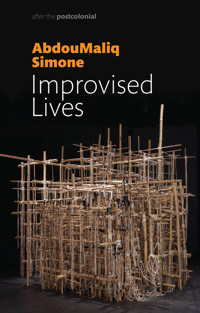
Cover image: Venu, 2012, By: Asim Waqif, Indian, founded in 1978; Bamboo, cotton and jute rope, tar. interactive electronics; Length x width x height: 426.8 x 548.8 x 426.8 cm (14 x 18 x 14 ft.), work will be reconfigured on site; Collection Galerie Daniel Templon, Paris, Brussels; L-SE 1204.8.1
The publisher has used its best endeavours to ensure that the URLs for external websites referred to in this book are correct and active at the time of going to press. However, the publisher has no responsibility for the websites and can make no guarantee that a site will remain live or that the content is or will remain appropriate.
Every effort has been made to trace all copyright holders, but if any have been inadvertently overlooked the publisher will be pleased to include any necessary credits in any subsequent reprint or edition.
For further information on Polity, visit our website: politybooks.com
Acknowledgements
Gratitude is extended to: the Smuts Fund of Cambridge University for sponsoring the three lectures on which this monograph is based; Gautam Bhan of the Indian Institute for Human Settlements, who provided invaluable advice and support for organizing the manuscript and providing logistical support for work in India; Anant Maringanti and the Hyderabad Urban Lab, for hosting the residency program where much of the manuscript was written, and to Sushmita Pati, Priya Sen, and Tripta Chandola for their support for work in Delhi; Edgar Pieterse, Lisa Damon, John Thompson, and Morten Nielsen for reading various iterations of the manuscript, as well as the “Group of 20” colleagues and friends assembled at Cambridge University on November 16, 2017, to review the project; Rika Febriyani, for her collaboration on every aspect of this project; and, above all, Ash Amin, for making this all possible and for his belief in me.
Dedication
ForZaira Cheyenne Simone and Na’ilah Xazaar Simone
1The Uninhabitable
The uninhabitable: those “lands of no one” (McKittrick 2013: 6). Lands that embodied inferiority and, once appropriated and settled through colonization, were further specified as the exclusive purview of those whose emplacement was to be considered “incongruous with humanness” (McKittrick 2013: 7). Katherine McKittrick asks, in the context of the plantation, whether or not that which was defined as lifeless perhaps points to simply a different form of life embedded in a range of “secretive histories” (2013: 10).
How we live is finally not that important; that we live is… (Moten 2017: 191)
It hurts to live always undone and unfinished. It is heartbreaking. It is heartbreaking even when the impossibility is joyful or you catch a glimpse of a life outside that inflexible weight. (McKittrick and Weheliye 2017: 28)
Districting Somewhere
For several decades, my stepdaughter has occupied a two-room flat in a dreary mass of apartment blocks in the Algiers suburb, Les Eucalyptus. She is fond of pointing out that she lives in a world on her own surrounded by glassy-eyed neighbors with far-away looks. They are not really there; they do not adhere to any script, she says. Their eyes are on prizes somewhere else. Each neighbor has different destinations in mind. Even when they navigate the same routines of drudgery, going to useless jobs, to markets short on everything, and to municipal buildings rife with conspiracies, they never take the same steps twice; they always alter the route.
Even on the single hallway in her building of chipped concrete, the dealers, the Salafists, and those who are devout about nothing in particular don’t so much carve out territory but allow paths to be constantly crossed so that there is nothing recognizable to defend. If the police and their bevy of hangers-on report infractions, then the proliferation of possible mistakes that residents make never repeating the same routine twice turn everyday life into something nearly impossible to police. Yet simple courtesies and signs of respect are offered no matter how profound the fundamental disagreements about the basic life orientations. The repetition of prayer, intoxication, petty scams, and household chores induces a haze of tolerance, allowing the most minimal of actions to provoke small but pliable alterations in the unfolding of a day or night and the prospects or dangers this might bring.
All of the residents are convinced of big people behind the scenes. They can even sometimes name names. But they are also skeptical of their convictions. Ever attentive of each other, regardless of whoever they have thrown their lot in with, the profusion of words, gossip, stories, and impressions make up their bets on shaping the near future, indifferent though they may be as to what that future actually consists of.
For, in such districts, existing under permanent suspicion and suspension, it is important to manufacture evidence that can be sifted through for clues that point to culprits in all directions; where the attentiveness of gazes, so vital to keep everyone in line, can’t look everywhere at once, and so small gaps open for a quick deal, a quick fuck, a quick way out. This is not a world, my stepdaughter says, that is inhabitable.
Those who wear the pants may be weakly united in their need to occupy the public sphere, to mark out a domain amidst a landscape of dilapidated cafés, mechanic sheds, and tin-can-laden corner groceries. But Les Eucalyptus is a district of endless favors, sincere and feigned respect for those with the semblance of any kind of connection. Silently, the occasional young woman keeps her head down, resists the temptations of domestic dramas and household problem solving to finish enough school to get salaried somewhere. The financing for a new mosque or two may suddenly appear from disputed sources, but the pipes in most flats leak and often run dry. There are few repairs. Neighbors hear everything and know little about what to make of it.
Again, it is not that collective denial or stasis rules. For despite the stereotypes, the public and private are subject to oscillating inversions. Sitting in a café may be the only opportunity to be alone, even when, especially at night, all of the tables are taken. “Holding up the walls,” as is the common expression for unemployed men, may indeed actually hold something up, as in intercept, block, or sustain. For the walls that divide domestic spaces, the purview largely of women, are not just porous sieves of information but marks of complex geographies where bonds and cuts in webs of lateral relations are made.
All of the doors that open and close a hundred times a day where nothing tangible seems to be exchanged, all of the stairs that are climbed up and down even when no doors are opened, all of the turning of the next corner, the hesitations between school, shop, mosque, and home, all of the shared taxis hailed to reach the next kilometer, all make up the rhythms whereby Les Eucalyptus is turned inside out and back.
The question of holding is important. No matter how improvised, lives need to be held, supported. They need a somewhere in which to take place, and places need to be assessed in terms of what they are able to hold. But to hold easily mutates into a form of capture, and if urban life comes to depend upon improvisation, the holding cannot take the form of a strictly notated score. It cannot keep a strict count; it can’t make some lives count more or less than others. For when improvisation takes off, one direction cannot count as more generative than any other; this uncertainty is part of the risk of such composition. Additionally, a somewhere must hold the “secretive histories” that McKittrick refers to in the chapter’s opening lines; it must hold a darkness that provides cover for experiments residents may initiate but are not yet ready to commit fully to. A somewhere must proportion exposure and opacity.
So, improvised lives require a somewhere, and in this book I will look at this somewhere as districts, as places capable of holding an intensive heterogeneity of lives and ways of doing things, but which also do not hold residents down to specific regimens of discipline or anticipation. Rather, they attempt to hold residents to each other just enough to enable an atmosphere of mutual witnessing, to hold residents to an ethic of letting others go their own way without that way being seen as having dire implications for anyone else. Residents are then held in an atmosphere of things continuously being worked out and proportioned. An atmosphere of countervailing, complementary, and incommensurable measures that gives rise to a specific, yet changing sense of place.
This is a book situated in districts. Or more, precisely, it is a book about districting. By districting, I mean a process of creating a platform for operating in the world using a repertoire of available classifications and administrative categories to set out a terrain that is then turned into something that exceeds all efforts to definitively pin it down, to contain what it can do. This surfeit of experience provides the opportunity for residents to write themselves into a milieu that otherwise might seem to marginalize them and their ways of doing things. It is a process that aims less to make a particular place inhabitable than it does to enable residents to spiral in and out, propel themselves into the larger urban surrounds and then bear back down again into the familiar places now rendered unfamiliar. It is the creation of a rhythm of itineraries that are themselves uninhabitable.
Let us take a well-known example of districting in the work of Sun Ra. For Sun Ra, going back in time, Egypt was the touchstone for what would become a complex interweaving of mythology, numerology, space travel, theosophy, Black nationalism, and the occult. Nominally a jazz musician who managed huge “arkestras” over a long career that folded in every type of music and sound imaginable, Sun Ra’s commitment was to a “Black knowledge society” – a technical capacity for going into the future as an extra-planetary urbanization. While the metaphors of Saturn and outer space permeated the representations of such an urbanization, what was intended beyond such metaphors was the technical realization of the imaginations and capacities Blacks honed in their great migration to the cities of the North from the hardscrabble rural tenancies of the South and the repressive Jim Crow practices that sought to keep them at the peripheries of Southern towns and cities.
This movement between the mythic pasts of Blackness and its future realization beyond the earth seemingly unable to accommodate it was Sun Ra’s persistent practice of districting. But he was also engaged in much more prosaic efforts in this regard. When Sun Ra showed up in Chicago after the Second World War, there had already been several decades where Blacks of different residential histories and class backgrounds had worked hard to use the sheer presence of Black bodies in the city – their looks, voices, movements, rhythms, appetites, sexualities, and strivings – to build economies that enabled some measure of autonomy from subservience and resistance to marginalization. Racialized apparatuses of control came down hard on these efforts, and Sun Ra encountered a Chicago that put a squeeze on trade unions, the political left, radical organizations, as well as outlets of popular culture – show venues, media, and radio.
It was at this point that the emphasis on Black knowledge as technical operations took hold in Sun Ra’s project. Black people did not go through all they went through just in order to be integrated into the terms of an American society that did everything possible to keep them out. After having acquired a substantial history of being in cities, of proving that there could be something like a “Black city” itself, extra-ordinary, “extra-planetary” efforts were required in order to concretize these attainments.
From street pamphleteering, small book imprints, records, and performances that crossed swing, bop, blues, show tunes, and experimental improvisation, appearances at strip clubs, weddings, concert halls, street parties, jazz clubs, circuses, and universities, and the intersection of intensive musical and philosophical experimentation with novelty entertainment and nods to the full gamut of Black associational life, Sun Ra and his large bands and associates tried to become a district in themselves. This was not just improvised expression, but a process of intensive study (Sites 2012).
For Sun Ra, then, districting referred to an incessantly inventive practice of operating in the discontinuities between having a location in which one is identified and from which one can identify and speak to others and the capacity to address others, call upon them, and implicate them beyond the specificity of any location. As such, Egypt did not hold anything in itself, it was not a promise ready to spring into any kind of revolutionary action, but more a device that could relay the knowledge Sun Ra said that Blacks needed toward aspirations that continuously had to find different masks under which to operate, and also away from the strict codifications of what could be counted. For Sun Ra, it didn’t matter that much if Black people were missing from inhabiting American urban life; what was more important was that they went “missing in action.”
A Human Surge
Amidst the competing choruses of exaggeration and indifference, of longings for extinction and desperate boosts of immune systems, something surges forward and back. The surge is both power failure and inexplicable excess; it jumps scales while sometimes eliminating anything to fall back on. It is a strange rhythm neither reconcilable to ancient cyclic times nor acceleration. This is a rhythm perhaps best exemplified in Eduardo Williams’ film, The Human Surge (2016). Wavering indiscernibly between documentary and fiction, youth in Buenos Aires, Maputo, and Isla Bohol (Philippines) are depicted as incessantly in motion, seemingly aimless even as many of them have steady jobs. They search for free Wi-Fi hotspots, Internet cafés, and ways to turn online activity into money.
In the first two cities, young men attempt to modulate the willful exposure of their bodies on Internet sites that offer particular amounts of money to see flesh. They are not good at this game, and they don’t care. The recesses of the web do not hold their attention as much as do the prolific spaces of relative abandonment and infrequent visitation that dot their cities but that are not yet ruins. They talk about obscure theories of genomes and mathematics, witchcraft and far-off galaxies, the possibilities of pre-natal memories and future predilections, moving from one quick obscure observation to another. Impossible to stand still, always equipped with cellphones, but sometimes fixated on the slightest shift in light, in the movements of ants, the film’s youth constantly engage a domain larger than the immediate surrounds even as they seemingly occupy a marginal position within it.
Here, the surge as rhythm emerges from attempts to reach beyond the confines of limited places and routines, and yet retains a microscopic view of the constantly surprising details about the places that could be left behind. This is a rhythm of endurance, of surging forward and withdrawing. It is not a rhythm of endless becoming nor of staying put; it is making the most of the “hinge,” of knowing how to move and think through various angles while being fully aware of the constraints, the durability of those things that are “bad for us” (Stoler 2016).
For, as Williams’ film clearly demonstrates, individuals always have to work out a sense of proportionality, even when things cannot be made proportionate in any clear, definitive way. What is it about themselves and their capacities which are to be extended to particular others and what do these acts of self-extending indicate about what is being withheld, in part, as a lure to incite the engagement of others? This working out of proportionality is not merely the calculations of self-interest. It is also the sculpting of a field of affordances that shape the connections, interdependencies, and autonomies persons conceive and operationalize with each other. So, any notion of the social is always “out of joint,” never assumed as a stabilized whole. Rather, it is an ongoing deformation of systemic entities, as individuals are the carriers of social affordances and memory, and societies are the parts of ongoing transformations of personhood (Corsín Jiménez 2008) – a scale without scale.
Such scale without scale can be seen across many Southern districts of the urban poor, where the South becomes something to be crossed, a “cross to bear,” a something “over there” that bears weighty appellations: “We are the ones that God forgot,” “We have become dogs,” or “This is the middle of nowhere.” These are targeted populations (Parks 2016), ones that must be kept in line by being forgotten or kept in the crosshairs, or in analyses where hairsplitting questions about “what are these populations really?” prevail. The appellations deem these spaces uninhabitable, not fit for human habitation, environments full of toxicity and violence, fast and slow.
But in these designations, there is a certain detachment, a detachment from the imperative to compare, to be viewed within the hierarchies of sufficiency or sustainability. If God has truly forgotten these places, then perhaps there is a kind of freedom not to be remembered by or incorporated into God’s analytics. For in environs full of everyday catastrophe, the only way to live with it is to attain some indifference, where all that which is capable of producing an unjustifiable or unnecessary death – when each death is necessary and therefore justified – is flattened out. Where it becomes an even surface that carries the marks of every event, but at the same time does not distinguish among them.
The very conditions that would seem to condemn residents to obvious hardship take on, in such a detachment, a more minimal operation (Laruelle 1999) in that they no longer solely point to that hardship but simply are what they are, and thus able to become elements of a broader sense of interactions. They become marks without meaning, lines of scarification on bodies prepared for battle, prayer, sex, and repose – not only the death to which they seem normatively consigned.
We may see many of the world’s urban districts as uninhabitable. But is what makes them uninhabitable only the obvious conditions of violence, oppression, and toxicity that are their predominant characterizations? What if something else were at work? What if, besides being a descriptor of the ways in which these districts are scenes of a crime, a crime against the humanity of their residents, the uninhabitable was also a method, not one necessarily chosen by residents, but rather something converted into a method from the shards of broken lives and broken infrastructures that make up a district’s heritage. What if the uninhabitable enabled a kind of thinking that challenged or refused what it means to viably inhabit a place? What if it was a method to more fully understand the rhythms of endurance, the surges of life that carry bodies forward and back between destinations that are altered in each approach, each retreat? So here I want to explore the uninhabitable as a method to think about these rhythms of endurance.
A Lure for (Yet) Another South
In terms of its role as method, I want to look at the uninhabitable as a lure, how it draws one into a place and situation in a way that does not describe or account for it. Rather, it pulls one into its shifting terrain, fuzzy boundaries, its vibrations and rhythms that cannot be contained by any spatial structure. No component, no entity of the place stands out more than any other. Mud walls, broken concrete, oil spills, toxic fumes, riven bodies, stomped feet, wild gestures, attentive gazes – all of these elements dance with each other as curling smoke, momentary anthems, sometimes embracing each other as repeated refrains in the cold mornings and anxious nights. Everything is packed into a density of contact, of the discrepant rubbing up against each other in multiple frictions, sparks that ignite chain reactions, the webs of many crammed causations looking out for any possible vehicle of release. The heterogeneous shapes and economies of poor and working-class districts, segmented and distinctly inscribed across urban fabrics though they may be, make up specific machines. These machines produce contexts along the way, along the way of things passing through each other, of bodies passing by, of failed lives passing out of view, of scenarios and conclusions passing into something else.
The explorations of this book largely concern what was formerly known as the Global South, a world within a world that has disappeared as a world, if it ever indeed was a world. Perhaps the South was a world by default. It was the forcible enclosure wrought by a head without a body, then looking for a body anywhere, as the impetus for colonization, a practice that destroyed worlds by assuming natives did not have any (Neyrat 2016). So, to deem something uninhabitable was to make it available to interventions of all kinds, and particularly interventions that would operate at a distance, that sought to affect things by being removed from them; to operate as a body in the abstract; to manipulate but not feel (Satia 2014).
So the South I want to invoke here is a South not so much as a conceptual designation, not so much a residue of political aspiration or legacy, but something closer to science fiction, something made up as it goes along, not dissimilar to the chronopolitics of the Afrofuturists. This long-standing series of projects by Black people to write themselves into a future foreclosed to them cycles back in time in order to recuperate materials, unreal yet enduring fictions, to imagine non-human futures devoid of racial tropes.
All passages, to avoid becoming voids of the middle, still have to take place along corridors. They still need vehicles of transit, for even djinns and ghosts have geographies. And so the South becomes latitude defined not so much by common colonial demise or recuperation, not so much by a look or a specific modality of sensuousness, but a form of passage, of residents trying to reach each other even if they may have only vague ideas about each other. In the Human Surge, youthful men in Buenos Aires and Maputo become dimly aware of each other. Through the ongoing commodification of their black and brown bodies, they become aware of being in the same boat.




