


Erhalten Sie Zugang zu diesem und mehr als 300000 Büchern ab EUR 5,99 monatlich.
- Herausgeber: The History Press
- Kategorie: Geisteswissenschaft
- Sprache: Englisch
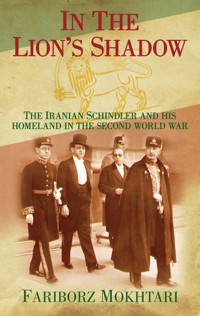
After the invasion of France in 1940 a junior Iranian diplomat, the aristocratic Abdol-Hosein Sardari, more or less accidentally found himself in charge of Iran's legation in Paris. He set about cultivating German and Vichy officials in order to protect the Iranian Jewish community in the country. In a dangerous but brilliant manoeuvre he met the absurd radical purity laws head-on to claim that despite the fact that some Iranians had followed the teachings of Moses for thousands of years, they had always been of Iranian stock and therefore were 'Mosaique' not 'Juden'. This book includes the Nazi official correspondence seeking 'expert opinion' on this troublesome argument! Alongside the dramatic, not to say romantic narrative of Sardani's life (he refused to abandon the Iranian Jews in France even when recalled by his government and continued without pay) is the larger picture of the betrayal of Iran's neutrality by the Allies, then the eventual handing over of Axis diplomats and citizens to the Soviets 'to be interrogated severely'. Author Dr Mokhtari argues that contrary to constant accusations Iran did not favour the Nazis and he employes previously unpublished archival documents to bolster that argument. This is the story of a man who to the uninformed may look to be one of the most unlikely of 'the Righteous' in his background and religion - but as the author shows, he represents the true, tolerant Iranian culture that is still alive today, despite the expressions and actions of the current repressive regime.
Sie lesen das E-Book in den Legimi-Apps auf:
Seitenzahl: 402
Veröffentlichungsjahr: 2011
Das E-Book (TTS) können Sie hören im Abo „Legimi Premium” in Legimi-Apps auf:
Ähnliche




















For my Father and all men of honour
CONTENTS
Title
Dedication
Prologue
IntroductionThe Diplomat in the Lion’s Shadow
1The CountryRayhan the Entrepreneur
2The PeopleFrom Kashan to Paris
3The Unlikely SaviourSardari and his Friends
4Hubris and Hypocrisy‘Small Nations Must Not Tie Our Hands’
5The Sacrifice‘Everyone has a Destiny’
6The TerrorThe Sound of Polished Boots
7The CampaignThe List
8The Aftermath‘He Saved My Father’
Epilogue‘Persia Can Never Go Under’
Notes
Plates
Copyright
PROLOGUE
This is a true story, a story of compassion and human connection. Arthur Schopenhauer (1788–1860) believed that in moments of crisis, humans had the capacity to share others’ pains to the point of risking their own lives, for they would spontaneously realise the unity of all life. He reasoned in the nineteenth century – as the Iranian poet Sa’di (1194–1292) had done in the thirteenth – that all humans were united in life as if parts of a single living organism.1 This recognition is what triggers selfless and instinctive acts of compassion. This story validates Schopenhauer’s conclusion, best considered within its own historical context. The narrative centres on the lives of a number of Jewish families trapped in German-occupied Paris, saved by an Iranian Muslim diplomat. That diplomat – Abdol Hossein Sardari – represented a nation, a culture and a government. This is therefore a story within a story, for it also reflects a national sentiment.
Iran, one may argue, has certain uncommon characteristics. Its national history goes back 3000 years or more, and therefore its only rival in that respect may be China, with which Iran once shared borders. Iranians may have been the first to build a vast federated state with governing standards of justice, tolerance, liberty and cooperation. To ignore the culture is to miss much of the story, as if to watch an opera from afar on a stage barren of scenery amidst a chattering crowd.2
Robert Satloff set off on a journey in search of an Arab Wallenberg or Schindler and wrote about it in his book Among The Righteous in 2006.3 Iranians, as they would sternly point out, are not Arab, but are mostly Muslim. They also have a culture of tolerance irrespective of the Islamic Republic’s pretensions, exemplified by Cyrus the Great and manifested in his Charter of Human Rights.
I had heard stories of Iranians assisting Jewish refugees entering Iran from Iraq, Afghanistan and the former Soviet Union. I had heard persistent rumours of Iranian diplomats having helped Jews abroad for decades. When I saw a reference to one such diplomat stationed in France during the Second World War in a book by Professor Abbas Milani, I wanted to know more.4 After contacting the publisher and the author, I was referred to three sources: Dr Fereydoun Hoveyda (former Iranian ambassador to the United Nations), Mr Ahmad Tavakoli (retired diplomat and former first secretary at Iran’s consulate in Milan, Italy), and Dr Ahmad Mahrad (Professor, University of Hanover, Germany). Initial contacts resulted in my determination to dig deeper. To substantiate the testimonials, I searched through captured German documents at the National Archives in Washington DC. Although decades had passed, I had to find Second World War survivors to prove to myself that the story was indeed true. My appeals for information, thanks to the internet, spread worldwide. As fate would have it, the vital contact was closer than I had anticipated. Speaking to an old high school friend and his wife about my search, she suggested contacting a fellow high school mate of ours whose wife’s family may have had relatives in France during the war. That conversation – much to my delight and surprise – resulted in contacts that made meeting and interviewing several survivors possible.5 Other interviews followed and more survivors were found in Venezuela, France and Israel. Similarly, another casual conversation with an old friend from my conscription-basic-training days resulted in locating another survivor, a relative of his living in Paris.6 Having established the story’s essence, learning about the diplomat and his motivation became my next objective. Fortunately, several members of his family, particularly Ambassador Farhad Sepahbody, Mrs Angela Sepahbody, Mrs Firouzeh Ensha, and the late Ambassador Fereydoun Hoveyda were extremely helpful. I am grateful to Mr Manuchehr Omidvar and Ms Behnaaz Dilmanian of the weekly Payam magazine, Mr George Haroonian of the Council of the Iranian American Jewish Organization, Rabbi Mr David Shofet of the Nessah Educational & Cultural Center in Los Angeles, Dr Houman Sarshar of the Center for Iranian Jewish Oral History in New York, the Petrossian family, and many others who generously called or responded to my inquiries with their information. My gratitude to Mrs Eliane Senehi Cohanim, Mr Nasser Cohanim and the late Mr Ibrahim Morady is more than could be expressed in words. This story, I am convinced, had to be told. I hope that the readers, particularly young Iranians, find it as inspiring as I have. I hope that they renew their pride in their heritage of liberty and tolerance, and rededicate themselves to preserving it, for it is indeed a most precious national inheritance.
Iran has fallen upon hard times more than once, but has managed to rise up time and again. What has assured the nation’s survival has been its profound cultural consciousness, which is expressed in its literature and the frequently recited poetry. That is the essence of Iranian identity and the fountainhead of Iranian national pride. New York Times Reporter Elaine Sciolino has observed,
As I have encountered Iran over the years, I have found two important components of the Iranian soul: love of poetry and love of country. No other people I know takes its poetry so seriously. And few countries have such a deep-rooted and long-lasting sense of national pride. Even the revolution and the creation of the Islamic Republic could not eradicate that unique sense of Persianness that goes hand in hand with the poets who extolled the virtues of beauty, love, and bravery.7
The current Islamic Republic regime in Iran is over 30 years old; but it does not reflect Iran’s culture in its entirety. Nor do the Republic’s policies represent the nation’s collective sentiments. Undeniably, the regime has survived for a few decades, but that tenure, even if ten times as long, would be no more than a passing moment if viewed in the Iranian historical context. The Iranian contemporary philosopher Abdolkarim Soroush, once the darling of Iran’s revolutionaries, is reported to have declared that Islam had sunk such deep roots in Iran that ‘only an Islamic revolution could uproot it.’8 The Islamic Republic may very well see to it that the philosopher’s prediction comes through – and fast. Three decades after a theocratic regime rode the crest of a revolutionary wave to establish the Islamic Republic, the number of Iranians regularly performing the Muslims’ mandatory daily prayers has significantly declined.9 The outcome of the 2009 presidential election suggested a similar simmering crisis of political legitimacy and widespread disenchantment. A survey commissioned by the Islamic Republic in October 2002 had already revealed a public opinion at variance with the regime’s foreign policy as 70 per cent of the respondents favoured renewing relations with the United States, while 40 per cent considered US policy towards Iran defensible. The regime, taken aback, lashed out; 70 per cent approval for re-establishing normal relations with ‘the Great Satan’ was just beyond the pale. The polling directors – amongst them Abbas Abdi with the credential of being one of the hostage-takers at the US Embassy in Tehran in 1979 – were promptly arrested.10 The lives of Iranian revolutionaries reflect the tragedy they brought upon the nation in the name of virtue and national independence. Dr Soroush, a bespectacled, balding, middle aged man with a stern face, greying facial hair – and in keeping with Iran’s post-revolutionary elites’ fashion – sartorially rumpled, spoke unhappily on ‘Morality, Politics and the Principles of Post-Religious Government’ at George Washington University in Washington DC on 15 November 2009. A disciple of Ayatollah Ruhollah Khomaini whilst still a high school student in the 1960s, he emerged on the scene to purge the faculty, curricula and personnel of Iran’s universities to mould them to serve the Islamic Republic. As his intellectual journey continued towards maturity, he gradually advocated a democratic government in which religion and liberty would have a complementary coexistence. Once a committed devotee of Khomaini’s theocracy and his velayat-e faqih, he had at last discovered that ‘there was nothing divine about the clerical monopoly of power.’11 He was dismissed from his university teaching position in 1995 for having come to the conclusion that the Islamic dictatorship he had helped to build had to be replaced with nothing less than an ‘Islamic democracy’. He once told the American journalist Sciolino, ‘If you do not preach the official interpretation of Islam, you will not be allowed to go to a mosque to preach, you will not be allowed to teach at a high school or a university. This official interpretation is an achievement – a negative achievement – of the revolution.’ Many former firebrand revolutionaries are openly remorseful when engaged in private conversation. Mehdi Bazargan, the revolution’s first prime minister, confessed ‘We should have known better. The evidence was there all along.’12 A former university professor from a clerical family close to the Khomaini household, a devout Muslim and former anti-Shah revolutionary, confided to the author that he had ‘visited the late king’s tomb in Cairo to seek forgiveness’.
I must thank friends and colleagues Professors William J. Olson and Lawrence Chalmer at the National Defense University and Professor Alfred C. Mierzejewski at the University of North Texas for reading and commenting on the manuscript. I am particularly indebted to Dr Mierzejewski for his assistance in my search of German documents and help in their translation. I am grateful to Mr Sean McBride, a capable doctoral student, who volunteered to assist me in the search for and translation of documents at the US National Archives, and Mr Joshua Yaphe who also helped with sources. I am much obliged to my editor Mr Shaun Barrington of The History Press, my literary agent Ms Leslie Gardner of Artellus Ltd and to my good friend of four decades Mr Farhud Batmanglich, President of Xanthus Design in Washington DC, for help in making this book possible.
It must be said that I alone am responsible for any errors. I humbly offer my apologies for any shortcomings and welcome additional information from readers with interest and appreciation.
INTRODUCTION
THE DIPLOMAT IN THE LION’S SHADOW13
Anoshiravan Sepahbody, Iran’s seasoned Minister Plenipotentiary in France, finally left Paris for the little spa-town of Vichy on Saturday 26 October 1940.14 German troops had already occupied Paris on 14 June and the new French Chief of State, the aged Marshal Henri Philippe Benoni Omer Joseph Petain, a hero of the First World War, had sought and received an armistice agreement with the occupiers.15 Not allowed to form his government in Paris, Petain had relocated to Vichy in the unoccupied zone. Overwhelmed by the unexpected German victory an estimated seven million French civilians had also fled south in panic, sullen and demoralised. The German victory had come so quickly that many found it hard to comprehend.16 Yet France had decisively lost the war and embassies and legations accredited to the French government had been compelled to relocate from Paris to the provisional capital in central France. The German ‘Occupation Security Administration’ had granted Sepahbody, his wife, their teenage son, their Swiss nurse-au pair and the legation’s Spanish chauffeur, a single official safe passage on 23 October. The safe passage document – the Ausweis – had been stamped valid until the end of the month, giving them less than a week to relocate. Despite the official travel permit, the trip proved difficult. Vichy is only 350 kilometres (220 miles) south of Paris, but getting there at the time was not an easy task. Security check points on the way frequently halted all civilian traffic and troop movements caused long delays. The road was crowded too, although a far cry from the panic-stricken days of June when the German Army had punched through France’s defences towards Paris with unprecedented speed. Complete demoralisation had triggered a mass exodus south that had clogged roads for days. The endless stream of people fleeing on foot was gone by November but automobiles, slow moving trucks and horse drawn carts were still on the road swerving in all directions to avoid potholes and the occasional bomb crater.
As the Sepahbodys moved further away from Paris the number of vehicles on the road decreased and their official embassy automobile with fluttering little flags mounted on its fenders could at last pick up speed. Cruising on an empty stretch of road some 50 miles north of Maulins, the passengers finally relaxed. Maulins was a city just north of the demarcation line that separated the occupied and the unoccupied zones. Seeing a road sign pointing to the city raised the anticipation of reaching their destination in a couple of hours, and when the roar of an approaching aircraft suddenly filled the air the passengers had no reason for concern. The sound became louder as two Luftwaffe fighter planes appeared behind the vehicle. The fighters suddenly swept low, buzzed the car and roared upwards. The envoy dismissed the move as a possible security routine to comfort others riding in the car. Alarm set in only when the planes that had already soared high in the sky turned around. Alarm turned to panic as the planes closed in fast and dived towards the car with blazing machine guns. The realisation that they had been targeted was sudden and terrifying. The German aviators, whether by mistake or for their own amusement, had chosen to strafe the Iranian legation’s massive American-made black Buick. The quick thinking Spanish driver – who had witnessed the recent civil war in his own country – managed to swerve the car sharply away from the fighters’ line of fire at the very last moment, saving it from the four streams of fire.
Although the occupants were lucky to have dodged the bullets, the planes had run their car off the road. It came to a dead stop after several violent jolts as the fighters soared away to disappear into the autumn sky. Relieved that the planes had departed and that no one had been hurt, the Sepahbodys, their au-pair and the driver gradually unfolded themselves out of the vehicle. They instinctively thanked God for having survived the incident, but were overcome with indignation. Having regained their composure, they set out to resume their journey, for they had no other alternative. The car was stuck in a ditch stubbornly defying all exertions to dislodge it. The back wheels kicked up clouds of dust, spinning frantically without effect. It took hours to find enough help from the surrounding farms to extract the car, then push it back onto the road. Once on the road again, they all realised the extent of damage to the front axle. The once grand automobile had been reduced to a sorry looking heap.
The car, with its droopy front end and wobbly wheels, squeaked as it slowly limped forward. Everyone felt some relief upon arriving in Moulins, hoping to have the car repaired quickly. They were soon disappointed for they were told that the repairs would take several days at least. Reluctantly they sought lodging, but not a single vacant hotel room could be found in the entire town. The German Army, it turned out, had sequestered every available room in Maulins for its officers. The sun had already set when Sepahbody, frustrated, tired and angry, lodged a protest at the German Army headquarters in Moulins. He expressed outrage over the aerial attack in violation of diplomatic norms and the compounded inconveniences it had caused his family and himself. His diplomatic status, Iran’s neutrality in the war and its good relations with Germany, prompted an immediate response. Iran’s Minister Plenipotentiary and his entourage were assigned suitable lodging at a hotel reserved for officers and a message from the commandant expressed regret for the Luftwaffe’s mistake.
The family, upset and tired, finally settled in at the hotel for the evening. They had already covered nearly 80 per cent of the journey to Vichy, yet remained stuck in the occupied zone. Repairing the car would take a minimum of three days.17 The next morning as Minister Sepahbody and his family entered the dining hall for breakfast, the Swiss au-pair was the first to notice a derogatory caricature on their reserved table. The drawing depicted a grotesque nose with the caption ‘No Longer a Place for Jews Here.’ She gasped in disbelief and protested at the top of her voice in German. The intended insult was an additional affront to the envoy of a friendly nation that German warplanes had assaulted the previous day and nearly killed. Sepahbody, the consummate diplomat, expressed his dismay, addressing the commanding general who happened to be at his own table in the room. The General walked to the envoy’s table, politely clicked his heels, apologised, then turned to face the officers present in the dining hall. He sternly demanded to know who had been responsible ‘for the stupidity’. After a moment’s hesitation a young officer stood up ramrod straight. The young junior officer confessed he had not known the gentleman had been an Iranian diplomat. He had assumed erroneously, he said, that he had been a Jew. The General called the junior officer to step forward, slapped him once, gave him a tongue-lashing and ordered him to apologise to the Iranian Minister.18 He then addressed the officers in the dining hall. He made it clear that he would not tolerate such an embarrassment from anyone under his command. He turned to Sepahbody once more, apologised and clicked his heels smartly before retiring to his own table. He was red-faced, irritated and clearly embarrassed.
France had been politically polarised before the war. Her defeat facilitated an authoritarian regime headed by the conservative Marshal Petain who embarked upon a delicate balancing policy of collaboration. His aim was to transform France through a national revolution, but also preserve her sovereignty and autonomy despite the overwhelming power of Germany. He resisted pressure to enter the war on Germany’s side even after the British killed 1300 French sailors when they sank the French fleet in the Algerian port of Mers-el-Kebir in July 1940, to prevent it being used by Germany. Petain would not be persuaded. He clearly disappointed Hitler at their meeting in October as he refused to join the war effort. Petain was extremely popular at first, judging by the number of streets and squares named for him in towns and villages throughout France, and the torrent of gifts that arrived daily at Hotel du Parc, his headquarters in Vichy. Collaboration did not mean trust. Each side orchestrated an extensive spy network against the other. Vichy counter-intelligence proved itself a match for the Germans’. The Vichy arrested some 2000 German agents and executed several dozen in two years. Yet Petain’s popularity dwindled in 1941 and he was soon accused of having sold out to the enemy by all sides. Occupation of the entire country in November 1942 and increasing numbers of executions by the occupiers – eight French victims in 1940, to well over 500 in the following 18 months – completely sapped Petain’s popularity.19
The Nazi propaganda machine had declared Iranians an Aryan nation and a racial kin of the Germans. Iran and Germany had enjoyed excellent relations in trade, industry and general construction and both countries wished to maintain their ties, for they were mutually beneficial. Iran’s government, having declared its neutrality in the war, was keen to maintain the relations to avoid disrupting its fast-paced national development, begun in 1924. Germany cultivated the ties with Iran for both economic and political reasons. Bilateral trade was significant and checking the influences of Russia and Britain in the Middle East was a welcome aspiration for both Iran and Germany.
Before leaving Paris, Minister Sepahbody had entrusted Iran’s legation, housed in a beautiful French mansion at 5 Rue Fortuny, to his brother-in-law Abdol-Hossein Sardari, a young diplomat with a 1936 law degree from the University of Geneva. His doctoral dissertation, an examination of the late nineteenth-century labour market in Switzerland, reflected his tolerant disposition.20 Sardari, working at the consular section of the legation, found himself unexpectedly charged with the responsibility of protecting Iranian interests in occupied France. Amiable and gregarious, Sardari was a member of the Qajar Royal Family that had ruled Iran until 1925. He was a charming bachelor with an uncommon gift for socialising in general and entertaining guests in particular. Under his direction the Iranian legation became a hub of social activity. Soon the lavish diplomatic receptions were popular amongst high ranking German military officers and civilian officials. As the Iranian flag – the tri-coloured green white and red with the golden lion and sun at its centre – continued to fly high over the legation, Sardari cultivated personal friendship with both German and Vichy officials.21 The friendships allowed him to solicit support in protecting the Iranian community in France, particularly the Iranian Jewish businessmen and their families.
To protect his Jewish fellow Iranians against German racial policies he contrived an argument credible enough to give the Nazis pause. The bitter reality was that the Nazis with their anti-Jewish ideology had gained control of France. If the Iranian Jews were to be saved, they had to be distinct from all others. Thus emerged the argument that Iranian Jews were not Semite but of Iranian Aryan racial stock. The Persian Emperor Cyrus had freed Jewish exiles in Babylon in 538 BC and they had naturally returned to their homes. It was after that event that some Iranians, whom Sardari termed ‘Mousaique’ or ‘Djuguten,’ had gradually found the teachings of the Prophet Moses attractive. That Iranian passports and official documents did not refer to race or religion supported his observation that Iranians were not divided by racial distinctions.22 Reasonable people may not agree that the narrative was Sardari’s own intellectual creation. He certainly had the general sympathy and support of his government and fellow Iranians, pointing to the possibility that he may not have been alone in developing the argument. His idea or not, what remains important is that he followed through with it, argued it skilfully, and proved persuasive enough. A lawyer by training, he fine-tuned his arguments to fit official German positions. The Nazi Party distinguished non-Muslim Iranians as people of ‘nicht Judische Abstammung and Blutmassig nicht Juden’. The first included Iranian Armenians, Christians and Zoroastrians. The second comprised Iranians whose religion was based on the teachings of Moses but their blood and race were not Jewish.23 The Nazi leadership in Berlin, perhaps in response to Sardari’s arguments, initiated a number of inquiries in 1942 to determine the blood classification of the followers of Moses in Iran, Georgia and Afghanistan. The Racial Policy Department – Rassenpolitisches Amt Berlin – in a number of inquiries dated 15 October 1942, solicited expert opinion on the issue of blood classification from the New History Research Institute – Institut fur die Erforschung der Geschichte des neuen Deutschland – in Berlin, World Services –Weltdienst – in Munich and the Institute for Jewish Research – Institut fur Erforschung der Judenfrage – in Frankfurt/Main. More inquiries were addressed to a number of academic institutions.24 The responses of the academics were frequently non-committal, accompanied by suggestions of further research that necessarily required funding. Some influential Nazis objected to the proposition that Iranian Jews were different as inappropriate nonsense. Adolf Eichmann, head of the racial policy department of the SS, in a letter dated 12 December 1942 to the German Ministry of Foreign Affairs, flatly rejected the distinction between Iranian and non-Iranian Jews.25 There was of course tremendous confusion with regards to the very notion of precise ‘biological’ race. Otmar von Verschuer, the geneticist wartime director of the Kaiser Wilhelm Institute of Anthropology, Human Heredity and Eugenics – the immdiate superior of the infamous Dr Josef Mengele – doubted that Jews were a race at all. Verschuer considered them a ‘mongrel breed, basically indistinguishable in terms of blood from the Germans,’ although they could become a separate race through inbreeding. ‘By committing itself to a policy based on biological racism, the [Nazi] regime was thus in fact condemning itself to extreme uncertainty, and this gave discretion to the policy-makers and permitted wide variation in nationalities policy from place to place.’26
Sardari exploited the internal ideological differences skilfully. He also utilised the Nazi propaganda that identified Iranians as a nation of Aryans. With the assistance of his German, French and Iranian friends he succeeded in saving the Iranian Jewish families and their friends in France from certain harassment and possible annihilation. By 1940 the families had grown to over 100 in Paris alone. The de facto governor of occupied France, German Ambassador Otto Abetz, had assured Sardari that Iranian Djuguten would not be subjected to ‘the special Nazi laws’.27 Sardari was undeniably helped by some German diplomats. The German diplomatic corps had not been thoroughly ‘Nazified’ and some old aristocrats who had traditionally served in the German Foreign Ministry had remained. The old diplomats did not hold much respect for the new upstarts such as Foreign Minister Joachim von Ribbentrop and Otto Abetz, who had been late-comers to the German diplomatic service.28 The opportunists who had jumped on the Nazi bandwagon to advance their own ambitions were the ones who carried out the Party’s racial policies, but their motivations may not have been ideological. The so called ‘Jewish Experts’ of the Foreign Ministry’s Abteilung Deutschland, Referat D-III, illustrate the point. These men had sought a civil service career and entered the Party between March and May 1933, just as the direction of the political wind became clear. It may have been opportunistic careerists who carried out the most inhumane of Nazi policies as civil servants.29
When inquiries regarding Iranian Jews finally reached the highest levels of the Foreign Ministry, they were referred to Friedrich-Werner Graf von der Schulenburg, the recognised old hand in Iranian affairs who had served as Germany’s Minister in Tehran from 1924 to 1929. In a note dated 14 April 1943, he cautiously confirmed Sardari’s thesis.30
As I recall the Djuguten constitute a Muslim sect that essentially follows Mohammedan principles. The scope of the theology of Moses that they have adopted is very limited. On the basis of blood they are Iranian, not Semite. Therefore, applying the German Jewish laws to them seems unjustified. We are trying, despite all the difficulties facing us, to maintain our good relations with Iran. Prejudice against Djuguten will defeat our efforts and will give our enemies propaganda ammunition to use against us. The Political Bureau XIII [of the Ministry of Foreign Affairs] recommends not applying the laws of German Jews to Djuguten, or at the very least, postponing their implementation.31
Schulenberg, Professor Ahmad Mahrad has argued, must have tried as skilfully as he could to undermine Nazi racial policies. He was executed on 10 November 1944 for involvement in the Stauffenberg conspiracy to assassinate Hitler.32
Iranian Jews, having been assured of their own safety, implored Sardari to help their non-Iranian friends. Sardari faced a serious problem in September 1941 when Russian and British armies simultaneously invaded Iran from the north, south and west. Matters took a turn for the worse when Iran’s Foreign Minister Mohammad Sa’ed Maraghei first persuaded his colleagues in Prime Minister Ali Sohaily’s Cabinet and then the members of the Iranian Parliament to declare war on Germany. Sa’ed reasoned correctly that since Iran had already been occupied by the Allies and its neutrality nullified, joining the Allies would be advantageous to Iran after the war. The subsequent signing of the Treaty of Alliance by Iran, Britain, the US and the Soviet Union in Tehran on 29 January 1942 made Sardari’s position horribly precarious. His government ordered him to join Mohsen Ra’iss, the Minister to Vichy (who had replaced Anoshiravan Sepahbody), and the legation staff there to leave France as soon as possible.
Sardari was committed to helping his fellow Iranians trapped in France, but was also aware of the potential consequences if he refused to leave. Remaining in France meant defying his own government, risking hostile relations with the Germans, jeopardising his diplomatic career and possibly endangering his life. After considerable soul-searching he determined to accept the risks. A friend’s urging may very well have influenced his decision; Ibrahim Morady, a prominent Iranian carpet and textile merchant in Paris visited Sardari upon hearing rumours of his imminent return to Tehran. Morady implored him to stay. Sardari explained his dilemma, but Morady was relentless, and his sincerity moved Sardari. He finally looked into his friend’s eyes and gave Morady his word. As Morady stood up to take his leave Sardari took his friend’s arms with both hands, promising him he would stay no matter what happened.33
Sardari had the key to the legation’s safe where some 500–1000 blank passports were commonly stored.34 After having secured the safety of fellow Iranians, he issued documents for others, often recommended by his trusted Iranian Jewish friends. German archival documents suggest that Sardari managed to exempt 2400 Jews from Nazi racial laws, a number considerably greater than the entire Iranian Jewish population residing in France at the time.35 Sardari’s nephew, Fereydoun Hoveyda, recalled a chance meeting at Sardari’s Paris apartment in 1947 at which he ‘witnessed the leaders of the recently expanded Iranian Jewish community present Sardari with a carved silver plate in gratitude for his efforts during the occupation.’36 Mrs Mehri Ra’iss-Farmanfarma, widow of the late Minister Mohsen Ra’iss, recalled in 2004 that Sardari’s humanitarian efforts had been well known to her husband while serving in Vichy. ‘We all knew well that Mr Sardari was being very very helpful in Paris.’37
When the Allies’ armed forces assaulted Iran on 25 August 1941 despite Iran’s repeatedly declared neutrality, they ended Sardari’s privileges as a diplomat representing a neutral state on friendly terms with both the Allies and the Axis. With the subsequent occupation of the country, Iran’s citizens in German-occupied territories had to secure the protection of a third state acceptable to Berlin. Switzerland proved acceptable to both Iran and Germany, and willing to allow Sardari to continue his efforts under Swiss protection. Under the new circumstances, Sardari had to rely on his own resources, his diplomatic skill and his personal relations. In a note illustrative of his effectiveness dated 11 November 1942, fourteen months after Iran’s occupation by the Allies, Iran’s Deputy Foreign Minister Mohammad-Ali Homayoonjah informed the Iranian Cabinet that:
According to a telegram from the Iranian legation in Bern [Switzerland] efforts undertaken [in Paris] have resulted in convincing relevant authorities to have the designation of ‘Juif’ removed from identity documents and clothing of Iranian Jews in occupied territories. They [Iranian Jews] have been called to Paris for that purpose.38
Sardari’s effectiveness can be measured against a blanket directive of 7 January 1943 that was to supersede previous orders. It declared that all Jews residing legally in France were to have the designation ‘Jew’ stamped on their identification and ration cards no later than 12 January. The directive warned that violators would be punished severely and concluded with the ominous statement that ‘this is a general measure from which no Jew, regardless of category, will be exempt.’39 Yet despite increased and widespread harassment of all Jewish residents, Iranian Jews remained generally unaffected.
Sardari avoided publicity, and to the end of his life in 1981 persistently shunned accolades for his efforts during the war years. He repeatedly dismissed references to his accomplishments, claiming that he had only performed his duty. He was finally recognised for his humanitarian work posthumously on 19 April 2004. The occasion was the Yom Hashoah, Holocaust Remembrance Day, at the Simon Wiesenthal Center in Los Angeles, California. The late Ambassador Fereydoun Hoveyda who attended the ceremony on behalf of his uncle’s family, repeated for the audience his recollection of the chance meeting at Sardari’s apartment in 1947.
I happened to walk in as the city’s Jewish representatives were presenting to him an inscribed silver plate, with an emotional statement of gratitude. When I realised what had just happened I excitedly volunteered to inform the media. My uncle sternly admonished me not to do anything of the sort. He said there was no reason for the fuss for he had only done his duty. They had been Iranian and protecting their interests had been his obligation. I reminded him that the gathering had shown that there had been non-Iranians among them too. That too was my duty, to God and to humanity, he told me.40
Abdol-Hossein Sardari was born in Tehran in 1914 into a wealthy aristocratic family. His mother, Afsar-Saltaneh, was King Naser al-Din Shah Qajar’s niece and extremely conscious of her royal lineage. Afsar-Saltaneh’s mother Ezat-Dowleh had married first in 1849 at her crowned brother’s wish to the 50-year-old Prime Minister Amir Kabir, Sadr A’zam, while only sixteen years old.41 Amir Kabir’s reforms and modernisation policies threatened the influence of courtiers, including the King’s mother. A court conspiracy, possibly unbeknownst to the King, saw him killed at the famous Fin Garden in Kashan in 1852, while he was reportedly on vacation.42 Ezat-Dowleh remarried to Yahya-Khan Moshir al-Dowleh, a one-time foreign minister who too might have been killed by orders from the Royal Palace.43 She had three daughters from the second marriage. One of the three, Afsar-Saltaneh, married the eccentric Solayman Khan Adib al-Saltaneh, bore three daughters and four sons but clearly favoured two of the children, her eldest son Yahya and youngest daughter Malekeh-Qods.44 The rest of her children were often kept out of sight in the care of servants and relegated to their quarters. Abdol-Hossein and his younger brother Mohammad-Hassan were particularly neglected to the point of cruelty. The second son, Nasser-Qoli, fared better. Yahya and Nasser-Qoli were sent to France where they studied criminal justice, and upon their return joined the Iranian National Police Force. Yahya became an officer, rose to the rank of colonel and directed the national homicide bureau. After Reza Shah’s exile from Iran, Yahya was named National Police Chief and promoted to brigadier-general. Naser-Qoli is credited with having organised and directed Iran’s first national forensic investigation department. Abdol-Hossein, the third son, so often ignored by his mother, was sent off to England to a boarding school at the age of eight. His alcoholic father was of little help and died when the children were very young. Abdol-Hossein’s third and youngest sister, Malekeh-Qods, born in Tehran in 1911, took it upon herself to protect him. After her marriage to Anoshiravan Sepahbody, a Qajar cousin born in 1888, she took Abdol-Hossein, three years younger than herself, under her wing. Abdol-Hossein received a traditional English education and became Anoshiravan Sepahbody’s trusted protégé in the Iranian Ministry of Foreign Affairs.
Sepahbody had served as a diplomat since1907, well before the Pahlavi Dynasty replaced the Qajar monarchy in 1925. When appointed permanent representative to the League of Nations and Minister to Switzerland in 1929, Sepahbody took the young Abdol-Hossein to Bern with him. He was not disappointed. Sardari enrolled at the University of Geneva, received a doctorate in law, and proved masterful at getting things done. Sepahbody gave him a temporary post at the legation and recommended his official entry into the Iranian diplomatic service. A 1931 photograph taken in Bern shows Sepahbody and Abdollah Entezam (who would later head the National Iranian Oil Company) leaving a building in official diplomatic garb followed by Sardari in a suit. Sardari accompanied Sepahbody to his other diplomatic assignments whenever possible.45 By the time the Second World War broke out, Sardari had become a competent diplomat with a natural talent for mastering languages. He is said to have spoken English with the fluency and air of an English gentleman, German with the refinement of a Swiss litigator and French with the accent of a cultured Parisian. Although often away from Iran since early childhood, his associates attest to his fluency in Persian and his remarkable Persian handwriting. His command of Persian literature suggests that he might have been accompanied by a Persian tutor while attending boarding school in England. Assigning a tutor to teach and chaperon youngsters abroad was common amongst Iran’s noble families and Sardari’s family had certainly had the means for it.
Sardari’s eldest sister, Malekeh-Saba, married Abol-Qassem Farbod, an Iranian physician who had graduated from the Paris School of Medicine around 1879.46 His second sister, Afsar al-Moluk, married Habibollah Hoveyda, posted to Saudi Arabia and later Lebanon as Iran’s diplomatic envoy.47 Afsar al-Moluk and Habibollah Hoveyda had two sons, Amir Abbas and Fereydoun. The two young Hoveydas followed their father into the Iranian diplomatic service, and were close to Sardari, their maternal uncle. Fereydoun remained a diplomat and achieved the post of Ambassador to the United Nations, a position he held until the Iranian Revolution of 1978. Amir Abbas left the Ministry of Foreign Affairs in 1958 to join the National Iranian Oil Company. He was appointed Treasury Minister in 1964 in Hassan-Ali Mansur’s Cabinet and became Prime Minister upon Mansur’s assassination in 1965. He held the position for over thirteen years, a record unmatched in Iran’s modern history. The revolutionary theologians executed Amir Abbas Hoveyda in 1979 following a scandalous trial on charges of ‘warring against God and corruption on earth’.
Sardari’s childhood and youth affected him deeply; he became detached and emotionally aloof. Yet he would go to great lengths to treat his relatives and friends with the utmost grace and generosity. The lack of parental affection he had received during his early years gave him boundless empathy for the victims of human cruelty. He compensated for the affection denied him with outbursts of gregarious friendship. Yet he also experienced an infrequent dark mood, particularly after bouts of heavy drinking. His childhood may explain his desire to avoid lasting family commitments; but there was one glaring exception. Ironically, the one person to whom he was romantically committed suddenly disappeared from his life without a trace. Women reportedly adored him. When pressed to explain this, the women who knew him describe his trust and empathy; ‘Women invariably felt that he understood them.’48 He was silver tongued and had numerous female companions, but one clearly stood out. The classically trained Chinese opera singer he affectionately called Tchin-Tchin was the only woman with whom he wished to share his life. Tchin-Tchin was beautiful, artistic and sociable, and photographs of her with Sardari’s relatives imply mutual affection. But she was also alone and in the midst of the Second World War separated from her home and family. Her parents had sent her to Paris with her brother as company, but he died suddenly from a ruptured appendix, a devastating blow.49
Sardari avoided discussing his experiences of the war years. He might have wished to forget the horrors or was perhaps too modest. He had always had friends of various nationalities, French, German, Swiss, English, American and Iranian, and consistently rejected the urge to simplify relations into ‘them and us’. He understood life’s many complexities, and rejected ideologies so fashionable in the 1930s, 1940s and 1950s that sought to erase all ambiguity in human loyalties. Having struggled to blunt the sharp edges of intolerance and rejection he had faced, he would not be intolerant himself. He shunned accolades for his deeds, and was prosecuted after the war for having allegedly over-stepped his authority. Worse yet, the revolution of 1978 robbed him of his wealth and even his well-earned pension. He died alone, broken and destitute, in a rented room outside London, far away from the woman he had loved, the country he had served and the friends he had cherished.
Sardari had embraced his cultural values and been deeply affected by them. Iranian history and literature were lasting influences on his character. He represented a government and a nation conscious of Iran’s past, struggling to regain respect and sovereignty. A new generation of Iranians filled with hope had emerged at the turn of the twentieth century.
Several Iranian streams flow from the mighty Zagros Mountains in western Iran to become tributaries to the 515 mile-long Karun river that passes through the city of Ahvaz and joins Arvand-Rud at the port of Khorramshahr before pouring into the Persian Gulf. Similarly, In the Lion’s Shadow is a story in which several historical streams meet at a specific juncture in history. The tributaries have included Iranians’ cultural sentiments, resilience and entrepreneurship, as represented by Abdol Hossein Sardari, Mouchegh Petrossian and Rayhan Morady, converging at a point of historical calamity. That the Moradys were Jewish, the Petrossians Christian and Reza Shah, Sepahbody and Sardari Muslim, did not matter nearly as much as that they were all Iranian. That remains as true today as it was then, despite the hollering of a vociferous few in a nation of 70 million. So this book is not simply the story of one man’s heroic actions; his story is a reflection of historical realities that have been obfuscated or denied about an entire nation.
1
THE COUNTRY
RAYHANTHE ENTREPRENEUR
Colonel Reza Khan,50 the man who would be king, was a military officer with an impressive appearance. He was tall, over 6 feet 3 inches, but seemed a foot taller in the boots and karakul hat of the Persian Cossacks’ uniform. He was physically fit, had a thunderous voice when incensed, and the most unforgettable, piercing eyes. He was not given to oratory and disliked long-winded speeches. He usually spoke softly but always to the point, and was invariably brief. The British Minister in Iran, Sir Percy Lorraine, reported to the British Foreign Office that he had once complained to Reza Khan bitterly that communicating with Iranian officials had been difficult for he just ‘could not make them understand!’ Reza Khan listened patiently then responded with a Persian expression that according to Lorraine ‘completely disarmed me’. Reza Khan told Lorraine ‘when a wise man argues with a fool, the greater part of the blame lies with the wise man.’51
Reza Khan had earned a reputation for bravery and competence as a soldier. His unwavering nationalism had attracted like-minded officers’ loyalty and the troops’ admiration. Following his promotion to the rank of colonel, he had rented a house in Tehran’s Sangelaj district near downtown’s Lalehzar Avenue, then the city’s most desirable business district.52 As he passed through Lalehzar every day at dawn on his way to work, the businessmen increasingly took notice of him. He was reputedly so punctual that the shopkeepers could set their watches by his appearance. Rayhan, a store-owner displaying fine Kashan carpets, textiles, handicrafts and antiques, was one of them. One day Rayhan’s newly acquired white horse tied up in front of his store caught the colonel’s eyes. Standing on the sidewalk he called through the store’s entrance, ‘Rayhan, how much for the horse?’ In typical Iranian merchant’s solicitous tradition Rayhan rushed outside with greetings. ‘How much do you want for the horse?’ Reza Khan repeated. ‘It is not worthy of you Your Excellency,’ Rayhan replied. ‘Well, is it for sale?’ he asked. ‘If it pleases Your Excellency, I wish for you to have it,’ he answered. The colonel waved away the platitude impatiently, turning away to move on. ‘Take it Excellency right now please, ride it for a few days. If you decide to keep it, then there will be occasion to discuss the price,’ Rayhan said. Colonel Reza Khan turned around and muttered ‘very well,’ mounted the horse, thanked Rayhan, and rode off. Two days later a junior officer showed up at the store with an envelope for Rayhan with the colonel’s compliments and a message. ‘Please see if the amount is agreeable.’ The cash in the envelope was indeed a fair price for the horse. Rayhan was impressed.53
Rayhan was an ambitious businessman, well known amongst Tehran’s merchants for his network of commercial contacts. He was from Kashan, a historic city in central Iran, but had assiduously cultivated links to suppliers, dealers and retailers in every major city in the country and several locations in Europe. Born to a prominent Jewish family in 1872, his father Mordechay had already created a thriving enterprise primarily in carpets, textiles, crafts and excavated potteries known as ‘zir-khaki’.54 The family’s home in Kashan had a room exclusively set aside for displaying excavated potteries, neatly stacked in rows along the walls, so that Mordechay could examine and admire his findings. When he resolved to expand his business horizons, he turned to the third of his four sons. The first two, Molla Aba and Agha Eshagh,55 had chosen the path of scholarship and theology. The fourth, Mirza Davood seemed destined to share the same interests. The third son, Ruben, on the other hand, had his father’s passion for carpets, artifacts and antiques, coupled with a remarkable interest in commerce. Ruben’s boundless curiosity was enhanced by his daring ambition. He had an uncommon talent for grasping opportunities and embracing well-calculated risks. Although the audacity he projected was often beyond his contemporaries’ comprehension, his father recognised the young man’s enterprising talent. When Ruben moved to Tehran, he did so with his father’s support and blessing. Characteristically, he selected a prime location in the most upscale part of the capital for his store. Rather than putting his own name on the shop he selected ‘Rayhan’, an interesting Persian name with several meanings. Rayhan is known to mean sweet basil or a collection of aromatic herbs. But it also means ‘the support of life,’ ‘son’ and ‘handsome’.56 The store’s name became so popular that it overshadowed the owner’s. Gradually even family members addressed Ruben as Rayhan, and the name stuck.
Rayhan was flamboyant, self-confident and friendly. He was sociable, helpful to fellow shopkeepers and meticulous in customer service. His fellow merchants envied and admired him at the same time. Riding a fine white horse to work was expected of the nobility but not of the shopkeepers who normally walked to work or rode donkeys. Rayhan, however, was not a common shopkeeper. He had gradually created a network of trusted and trusting business associates as well as satisfied customers in the country’s major cities. He had access to numerous producers of Persian carpets, tribal rugs, tapestries and handicraft nationwide. Relying on his hardworking relatives, friends and partners, he had ventured into exports to Europe with the same diligence. Repeated visits of Iranian royals and nobility to Europe had generated renewed interest in Persian products in the European markets. The demand for Persian carpets became so great in the West that it prompted Rayhan, already 50 years old, to move his family and business to France. He opened a store on Rue Clichy in the 9th District of Paris in 1924. The store sign had his initial and family name proudly displayed as ‘R. Morady, Tapis Persans, Objects d’Art’. Rayhan’s extended family joined the business, began to open new stores, and gradually ventured into textiles, antiques and even real estate. The family prospered and its businesses expanded. Business had its problems of course; transportation in particular posed serious risks, as entire shipments of merchandise occasionally disappeared in transit. However, the profits were good enough to cover the losses, just as Rayhan had figured.




