


16,99 €
Mehr erfahren.
- Herausgeber: John Wiley & Sons
- Kategorie: Fachliteratur
- Serie: Bloomberg
- Sprache: Englisch
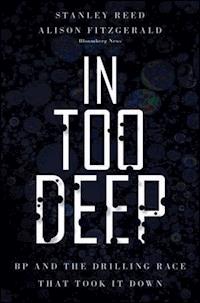
The truth behind the greatest environmental disaster in U.S. history In 2005, fifteen workers were killed when BP's Texas City Refinery exploded. In 2006, corroded pipes owned by BP led to an oil spill in Alaska. Now, in 2010, eleven men drilling for BP were killed in the blowout of the Macondo well in the Gulf of Mexico. What's next? In In Too Deep: BP and the Drilling Race That Took it Down, Stanley Reed?a journalist who has covered BP for over a decade?and investigative reporter Alison Fitzgerald answer not only that question, but also examine why these disasters happen to BP so much more than other large oil companies. * Places the blame on a corporate culture created by former BP CEO John Browne who was forced to resign in 2007 after he lied in court documents in a case involving his gay lover * Details a BP built on risk-taking and cost-cutting * Examines the past, present, and future of BP In August 2010, BP successfully "killed" the company's damaged deepwater well. But, the environmental fallout and public relations campaign to rebuild the brand are just beginning. In Too Deep details why BP, why now, and what's next for this oil giant.
Sie lesen das E-Book in den Legimi-Apps auf:
Seitenzahl: 352
Veröffentlichungsjahr: 2010
Ähnliche



















Contents
Cast of Characters
Authors’ Note
Prologue
Chapter 1: Night of Horror, Day of Triumph
Chapter 2: The Oil Lord
Chapter 3: Agents of Empire
Chapter 4: The Big Kahuna of the Gulf
Chapter 5: Money, Politics, and Bad Timing
Chapter 6: Lord Browne’s Long Goodbye
Chapter 7: Riding the Throughput Curve
Chapter 8: Tony Hayward Comes Up Short
Chapter 9: Disaster on the Horizon
Chapter 10: BP Struggles to Survive
Epilogue
Acknowledgments
Notes
About the Authors
Index
Since 1996, Bloomberg Press has published books for financial professionals, as well as books of general interest in investing, economics, current affairs, and policy affecting investors and business people. Titles are written by well-known practitioners, BLOOMBERG NEWS® reporters and columnists, and other leading authorities and journalists. Bloomberg Press books have been translated into more than 20 languages.
For a list of available titles, please visit out Web site at www.wiley.com/go/bloombergpress.
Copyright ©2011 by Stanley Reed and Alison Fitzgerald. All rights reserved.
Published by John Wiley & Sons, Inc., Hoboken, New Jersey.
Published simultaneously in Canada.
No part of this publication may be reproduced, stored in a retrieval system, or transmitted in any form or by any means, electronic, mechanical, photocopying, recording, scanning, or otherwise, except as permitted under Section 107 or 108 of the 1976 United States Copyright Act, without either the prior written permission of the Publisher, or authorization through payment of the appropriate per-copy fee to the Copyright Clearance Center, Inc., 222 Rosewood Drive, Danvers, MA 01923, (978) 750-8400, fax (978) 646-8600, or on the Web at www.copyright.com. Requests to the Publisher for permission should be addressed to the Permissions Department, John Wiley & Sons, Inc., 111 River Street, Hoboken, NJ 07030, (201) 748-6011, fax (201) 748-6008, or online at http://www.wiley.com/go/permissions.
Limit of Liability/Disclaimer of Warranty: While the publisher and author have used their best efforts in preparing this book, they make no representations or warranties with respect to the accuracy or completeness of the contents of this book and specifically disclaim any implied warranties of merchantability or fitness for a particular purpose. No warranty may be created or extended by sales representatives or written sales materials. The advice and strategies contained herein may not be suitable for your situation. You should consult with a professional where appropriate. Neither the publisher nor author shall be liable for any loss of profit or any other commercial damages, including but not limited to special, incidental, consequential, or other damages.
For general information on our other products and services or for technical support, please contact our Customer Care Department within the United States at (800) 762-2974, outside the United States at (317) 572-3993 or fax (317) 572-4002.
Wiley also publishes its books in a variety of electronic formats. Some content that appears in print may not be available in electronic books. For more information about Wiley products, visit our web site at www.wiley.com.
Library of Congress Cataloging-in-Publication Data:
Reed, Stanley, 1950–
In too deep : BP and the drilling race that took it down / Stanley Reed, Alison Fitzgerald.
p. cm.—(Bloomberg; 137)
Includes index.
ISBN 978-0-470-95090-6 (hardback); ISBN 978-1-118-02319-8 (ebk.); ISBN 978-1-118-02320-4 (ebk.); ISBN 978-1-118-02321-1 (ebk.)
1. BP Deepwater Horizon Explosion and Oil Spill, 2010. 2. Oil wells—Mexico, Gulf of—Blowouts. 3. BP (Firm) I. Fitzgerald, Alison. II. Title.
TD427.P4R39 2011
363.738'20916364—dc22
2010045651
For Katherine, Katy, and Matt.
—SR
For Drew, with tons of love, and Nikita, Elijah, and Forrest, the greatest kids on earth.
—AF
For the thing which I greatly feared is come upon me, and that which I was afraid of is come unto me.
I was not in safety, neither had I rest, neither was I quiet; yet trouble came.
Job 3:25–26
Cast of Characters
BP Executives
John BrowneCEO, 1995–2007Tony HaywardCEO, 2007–2010Robert DudleyCEO, October 1, 2010–presentAndy InglisHead of BP Exploration and Production, 2007–2010David I. RaineyVice President, Gulf of Mexico ExplorationCindy A. YeildingExploration Manager, Gulf of Mexico ExplorationDeepwater Horizon Workers
Michael WilliamsChief Electronics Technician for Transocean Ltd.Stephen BertoneChief Engineer for Transocean Ltd.Doug BrownChief Mechanic for Transocean Ltd.Jimmy HarrellOffshore Installation Manager, Transocean Ltd.Donald VidrineWell Site Leader, BP PLCRobert KaluzaWell Site Leader, BP PLCWashington, D.C.
Barack ObamaPresident of the United StatesCongressman Bart StupakChairman of the Subcommittee on Oversight and Investigations, House Energy and Commerce CommitteeCongressman Henry WaxmanChairman of the House Energy and Commerce CommitteeOthers
Mikhail M. FridmanOne of Russia’s richest men, chairman of Alfa Group and TNK-BPBrent CoonPlaintiff’s lawyer in Beaumont, Texas, who led the lawsuits against BP after the company’s Texas City refinery explodedDave SenkoConstruction Manager, J.E. Merit Constructors, a subsidiary of Jacobs Engineering Group Inc.Authors’ Note
Both of us will likely remember 2010 as our BP and Gulf of Mexico year. We spent months reporting on and writing about the aftermath of the April 20 explosion and subsequent oil spill. Alison Fitzgerald tracked down survivors and relatives of the victims and attended many of the hearings trying to understand what caused the fatal accident. She dug through documents, read transcripts, and spent time with lawyers and investigators who were already familiar with BP. Bloomberg dispatched Stanley Reed from London to rural Louisiana to try to make contact with BP’s senior executives. He wound up having dinner with CEO Tony Hayward in a restaurant in Houma, where BP was coordinating its cleanup effort.
The two of us came to the story from very different perspectives. Reed, a Middle East and oil specialist, had been covering BP and other oil companies for more than a decade, mostly as the London bureau chief of BusinessWeek magazine. Over the years he had spent hours with BP’s influential CEO, John Browne, traveling with him to Russia and dining at his home. He also knew Browne’s successor, Tony Hayward, well and had even spent time with the man who was to be Hayward’s heir, Robert Dudley. He had been out to BP’s pride and joy in the Gulf, the Thunder Horse platform, less than a year before. He had spent a day in Houston with BP’s Gulf explorers, hearing them explain how they found oil in what they said was the trickiest patch of geology in the world. Fitzgerald, a Washington-based investigative reporter, hadn’t had as much contact with the oil industry. She was assigned to the story so that she could bring to bear her sleuthing skills, vast range of Washington contacts, and knowledge of the regulatory and political spheres.
We were drawn to the story by shock and sorrow over the violent deaths of the Deepwater Horizon rig workers, as well as dismay over the extraordinary tide of pollution that spewed from the stricken well. We wanted to know why this tragic incident had occurred under the watch of BP and not another company such as ExxonMobil.
We found that there was in fact a reason.
The story behind the Macondo blowout is more than a story about technical failures or human error. The root cause, we found, may lie in BP’s particular corporate culture, which depends on and even celebrates calculated risk taking. The company’s corporate DNA is different from its competitors, where engineering principles dominate. BP is more of a financial culture. BP is very creative at finding oil and persuading governments to open their doors. But it is sometimes less good at everyday operations.
The Deepwater Horizon disaster was not the company’s first large-scale industrial accident. Five years before, 15 workers had died in a massive explosion at a BP refinery called Texas City just outside of Houston. There were other close calls as well.
Today’s BP was created by the combination of several major oil companies that were packaged together in a merger spree by Lord Browne. Browne pushed the stodgy BP to be a growth company and became one of the most admired CEOs of his time. He saw that there was big money to be made by putting companies together, wringing out costs, and investing in their best prospects. He took advantage of a rare moment in history when nations long off-limits to western companies suddenly opened their doors. The question is whether he went too fast and failed to pay close enough attention to integrating the merged companies and ensuring that their operations—pipelines, refineries, and production platforms—were up to standards. Hayward himself said near the end of Browne’s tenure that BP needed to slow down.
Browne also may not have foreseen all the consequences of his drive to improve financial performance. When put under pressure, people sometimes make poor choices that compromise safety. From the information that has emerged so far, that is what happened in the blowout. People in a hurry made bad decisions. They convinced themselves that a dangerously defective well was safe.
The oil industry is inherently dangerous because it works with volatile substances under pressure. Companies need to be constantly vigilant to prevent accidents. Slipups kill people, sometimes many people. Tragically, that is what happened both at Texas City and on the Deepwater Horizon.
In closing, we would like to remember those who died:
Deepwater Horizon, April 20, 2010
Jason Anderson
Aaron Dale Burkeen
Donald Clark
Stephen Curtis
Gordon Jones
Roy Wyatt Kemp
Karl Kleppinger
Blair Manuel
Dewey Revette
Shane Roshto
Adam Weise
Texas City Refinery, March 23, 2005
Glenn Bolton
Lorena Cruz-Alexander
Rafael “Ralph” Herrera Jr.
Daniel J. Hogan III
Jimmy Ray Hunnings
Morris “Monk” King
Larry Wayne Linsenbardt
Arthur Galvan Ramos
Ryan Rodriguez
James Warren Rowe
Linda Marie Hammer Rowe
Kimberly Smith
Susan Duhan Taylor
Larry Sheldon Thomas
Eugene White
Prologue
July 27, 2010, was a fine day for a corporate execution in London. Television vans filled the parking bays across from a quiet, fenced park with high trees, located outside the British Petroleum Public Liability Company’s (BP PLC) tan, brick headquarters. The cameras were there to see the giant oil company’s CEO, Tony Hayward, take the fall for the Gulf of Mexico disaster that had killed 11 men, spilled an estimated 4.9 million barrels of oil, and made the company a pariah in the United States—its most important market. Indeed, what had occurred under Hayward had jeopardized the future of the entire oil industry in the Gulf and brought BP itself close to the abyss.
A handful of reporters, many of whom had covered BP for years, were invited inside. Soon, three men joined them in a meeting room sparsely furnished with wooden chairs and a handsome wooden table created by the Queen’s grandson, Viscount Linley, whose expensive, handmade furniture was admired by Hayward’s predecessor, John Browne. Hayward made the rounds, shaking hands. Then he and his newly appointed successor, Robert Dudley, flanked the company’s tall, elegantly-dressed Swedish Chairman, Carl-Henric Svanberg, who announced that, by mutual agreement with the board, “Tony is stepping down and Bob is taking over.” Svanberg said he was sad.
Hayward’s swaggering, gaffe-plagued effort to lead BP’s response to the spill had made him a figure of scorn and ridicule in the United States. The New Yorker magazine even satirized him as “Chef Tony,” author of a cookbook with oily dishes such as “blackened prawns” and “thick-as-tar chocolate pudding.” Just months before, he was in command of one of the world’s largest and most profitable companies. BP was the Goldman Sachs of the oil industry, as one veteran executive said: cutting edge and always on top. In what had been a slow-to-change industry, it was a company that was innovative and on-the-move, playing on the political and technological frontiers.
As CEO, Hayward had been like a chief of state, roving the world on a corporate jet, feted everywhere BP had operations, from the royal palaces of the Gulf sheikdoms to the Kremlin. Now, just three years into his job, he was being made to walk the plank, thanks to some disastrous misjudgments by people drilling what should have been a relatively simple oil well. Up until early July, Hayward had some hope of surviving in his job, but activist board members thought his staying on would be toxic to BP’s future. Many people inside BP thought the company and Hayward were victims of bad luck because the accident could have happened to anyone. But in an industry that claims all accidents are preventable, this one hadn’t been prevented. In fact, many industry insiders say it happened to BP for a reason, and that it was years in the making. After a string of industrial accidents and close calls, BP executives, including Hayward, hadn’t learned the lessons that presented themselves from repeated investigations. The board, one BP official said, was determined that there would be no reward for failure.
This book presents the story of BP’s meteoric rise and then Hayward’s and the company’s sudden fall. The tumble was especially shocking because Hayward had tried to banish the mishaps that wrecked the last years of his predecessor, John Browne. Lord Browne was the CEO whose mega-deals and outspokenness on climate change had raised BP’s public profile. But like Browne, whose tenure ended badly in 2007, Hayward wound up being fodder for the television cameras and photographers waiting to record his downfall. Being CEO of what many consider Britain’s most important company has its drawbacks as well as benefits.
Asked if he thought he had been unfairly judged—after all, he had been tossed out even before BP published its own investigation of the incident—Hayward sounded almost Shakespearean. He said, “I think, frankly, what is fair or unfair is not the point. The fact is that I did lead the response and, as a consequence, I became the public face of BP; and as a consequence of that I was demonized and vilified. And the fact is that BP cannot move on as a company in the United States with me as its leader. It is not possible, and that is the reality.”
Dudley, Hayward’s successor, who grew up in Mississippi and has a more natural affinity for the Gulf, faces a future full of unknowns, especially in the United States, the company’s most important center of operations. “It is not our intention to exit the U.S.,” he said, “Nor do we believe we will not be able to operate there.” But what proposition BP now has to offer governments that control access to resources, investors, and, indeed, its own employees is in question. As Amy Myers Jaffe of the James A. Baker III Institute for Public Policy at Rice University put it: “If you were a politician, would you want to be responsible for giving BP a lease?”
Chapter 1
Night of Horror, Day of Triumph
Mike Williams just finished a day of routine maintenance on the offshore drilling rig Deepwater Horizon. Short on sleep, because today was the day he was rotating from the night to day shifts, Williams was testing and repairing electrical equipment, then filled in some overdue paperwork. By 9:30 that night, he was in his electronics shop, talking to his wife on the phone. Williams was the chief electronics engineer on the rig, which was in the middle of the Gulf of Mexico drilling a well for the oil giant BP PLC. He’d been away for about 10 days and had another 10 to go before he’d be heading home.
Through the phone Williams’ wife heard someone over a loudspeaker announce that gas levels on the Horizon were high. “Do you need to go take care of that?” she asked her husband. He downplayed the importance of the warning. “We’d gotten them so frequently that I’d become immune to them,” Mike Williams said afterward. “I didn’t even hear them anymore, especially with this well. With this well, we were getting gas back all the time.”
Lesen Sie weiter in der vollständigen Ausgabe!
Lesen Sie weiter in der vollständigen Ausgabe!
Lesen Sie weiter in der vollständigen Ausgabe!
Lesen Sie weiter in der vollständigen Ausgabe!
Lesen Sie weiter in der vollständigen Ausgabe!
Lesen Sie weiter in der vollständigen Ausgabe!
Lesen Sie weiter in der vollständigen Ausgabe!
Lesen Sie weiter in der vollständigen Ausgabe!
Lesen Sie weiter in der vollständigen Ausgabe!
Lesen Sie weiter in der vollständigen Ausgabe!
Lesen Sie weiter in der vollständigen Ausgabe!
Lesen Sie weiter in der vollständigen Ausgabe!
Lesen Sie weiter in der vollständigen Ausgabe!
Lesen Sie weiter in der vollständigen Ausgabe!
Lesen Sie weiter in der vollständigen Ausgabe!




