


Erhalten Sie Zugang zu diesem und mehr als 300000 Büchern ab EUR 5,99 monatlich.
- Herausgeber: Corvus
- Kategorie: Gesellschafts- und Liebesromane
- Sprache: Englisch
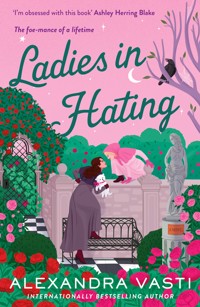
The foe-mance of a lifetime... Celebrated authoress Lady Georgiana Cleeve has achieved fame and fortune. Unfortunately, she's also acquired an enemy: the enigmatic Lady Darling, whose spine-tingling plots appear to be pulled straight from Georgiana's own manuscripts. What's a stubborn, steely writer to do? Unmask her rival, of course. But the unmasking doesn't go according to plan - because Lady Darling is actually Cat Lacey, the butler's daughter and object of Georgiana's very secret, very embarrassing teenage infatuation. Cat Lacey has spent a decade clawing her family out of poverty. The last thing she needs is to be distracted by the stunning(ly pretentious) Lady Georgiana Cleeve. But Cat can't seem to escape her infuriatingly beautiful rival-including at the eerie manor where they both plan to set their next books. The plot unexpectedly thickens, however, when the novelists find themselves trapped in the manor together. In between ghostly moans and spectral staff, Cat and Georgiana come face-to-face with real danger: the scorching passion that's been haunting their rivalry all along.
Sie lesen das E-Book in den Legimi-Apps auf:
Seitenzahl: 439
Veröffentlichungsjahr: 2025
Das E-Book (TTS) können Sie hören im Abo „Legimi Premium” in Legimi-Apps auf:
Ähnliche
















Praise for Alexandra Vasti
LADIES IN HATING
“A pure delight. This historical romance has it all—secret crushes, Gothic manors, enmity, queer yearning, revolutionaries changing the game, steam, and did I mention the queer yearning? I’m obsessed with this book.”
—Ashley Herring Blake, USA Today bestsellingauthor of Delilah Green Doesn’t Care
“Full of charm, wit, sass, sapphic swoons, and deep affection, Vasti’s Ladies in Hating absolutely sparkles. The historical detail, paired with Vasti’s marvelous dialogue and twisty plot, produces a delightfully fun romp that’s full to bursting with queer joy, thoughtful portrayals of diverse families, and beautiful romance. Truly a delight from fantastic start to fabulous finish.”
—Emma R. Alban, USA Todaybestselling author of Don’t Want You Like a Best Friend
“What a joy! Cat and Georgiana’s tale makes for an absolute treat of a book: full of banter, yearning, combustible chemistry, and a healthy amount of Gothic spookiness and murder. A near-perfect addition to the sapphic histrom genre.”
—Freya Marske, USA Today bestselling author of Swordcrossed
“Ladies in Hating is the gay Gothic rom-com of my dreams, suffused with Vasti's usual, sincere affection: for her characters, and for her readers.”
—Alix E. Harrow, New York Times bestsellingauthor of Starling House
EARL CRUSH
“Bridgerton at its sexiest . . . Crush? Ha. I’m in love with the earl!”
—Eloisa James, New York Times bestselling author of Viscount in Love
“Wildly delightful! With Earl Crush, Alexandra Vasti has crafted a marvelously funny and sexy read featuring a brawny Scottish earl, zebras, and a feminist heroine ahead of her time. This belongs on every romance reader’s keeper shelf!”
—Joanna Shupe, USA Todaybestselling author of The Duke Gets Even
“Sexy, kind, and full of adventure . . . Alexandra Vasti is an immense talent, and I look forward to reading everything she writes until the end of time!”
—Naina Kumar, USA Today bestselling author of Say You’ll Be My Jaan
“With her deft hand for writing witty banter, endearing characters, and smoking-hot chemistry, Alexandra Vasti’s Earl Crush will enchant readers and establish her as a breakout star of historical romance!”
—Liana De la Rosa, USA Today bestselling author of Isabel and The Rogue
“This historical spy caper has plenty of sexy fun and terrific banter, all in a fast-moving plot.”
—Booklist (starred review)
NE’ER DUKE WELL
“All hail a new (and most welcome) voice in the historical romance space . . . Vasti writes with a warm, whimsical voice, underscoring her hysterical interludes and cutting asides with a deep well of emotions.”
—Entertainment Weekly
“A gem of a Regency, with dazzling banter and more than the usual amount of charm.”
—Olivia Waite, The New York Times Book Review
“The kind of romance you want to wrap around yourself like a blanket.”
—NPR
“As hot as it is heartfelt, this will have historical romance fans hooked.”
—Publishers Weekly (starred review)
“Ne’er Duke Well is a delightful, quicksilver romp with unforgettable characters that readers will be rooting for from start to finish.”
—Deanna Raybourn, New York Times bestselling author of theVeronica Speedwell series
“An irresistible delight from a remarkable new talent . . . Vasti has quickly earned her place on my list of favorite writers.”
—India Holton, USA Today bestselling author of The Ornithologist’sField Guide to Love
THE HALIFAX HELLIONS SERIES
“These stories are hot, smart, funny, and charming as hell—much like the Hellions themselves. I’ve read them each twice.”
—Alix E. Harrow, New York Times bestselling author of Starling House
“Delightful, truly scrumptious—like if Lisa Kleypas and Tessa Dare had a sexy baby. Alexandra Vasti is my favorite writer, full stop.”
—Mazey Eddings, USA Today bestselling author of Late Bloomer
“I’m forever in awe of Alexandra Vasti’s talent.”
—Sarah Adler, USA Today bestselling author of Happy Medium
ALSO BY ALEXANDRA VASTI
Ne’er Duke Well
Earl Crush
HALIFAX HELLIONS NOVELLAS
In Which Margo Halifax Earns Her Shocking Reputation
In Which Matilda Halifax Learns the Value of Restraint
In Which Winnie Halifax Is Utterly Ruined
First published in paperback in the United States in 2025 by St Martin’s Publishing Group, an imprint of Pan Macmillan
First published in paperback in Great Britain in 2025 by Corvus, an imprint of Atlantic Books Ltd.
Copyright © Alexandra Vasti, 2025
The moral right of Alexandra Vasti to be identified as the author of this work has been asserted by her in accordance with the Copyright, Designs and Patents Act of 1988.
All rights reserved. No part of this publication may be reproduced, stored in a retrieval system, or transmitted in any form or by any means, electronic, mechanical, photocopying, recording, or otherwise, without the prior permission of both the copyright owner and the above publisher of this book.
No part of this book may be used in any manner in the learning, training or development of generative artificial intelligence technologies (including but not limited to machine learning models and large language models (LLMs)), whether by data scraping, data mining or use in any way to create or form a part of data sets or in any other way.
This novel is entirely a work of fiction. The names, characters and incidents portrayed in it are the work of the author’s imagination. Any resemblance to actual persons, living or dead, events or localities, is entirely coincidental.
A CIP catalogue record for this book is available from the British Library.
E-book ISBN: 978 1 80546 403 7
Corvus
An imprint of Atlantic Books Ltd Ormond House
26–27 Boswell Street
London
WC1N 3JZ
www.atlantic-books.co.uk
Product safety EU representative: Authorised Rep Compliance Ltd., Ground Floor, 71 Lower Baggot Street, Dublin, D02 P593, Ireland. www.arccompliance.com
For Mary Wollstonecraft (the blueprint!), for Caroline Lamb, for Eleanor Butler and Sarah Ponsonby: for messy, brave, brilliant, complex women who wrote fiercely, who loved extravagantly, who lived.
And for Matt, without whom this book would not exist. (True of all the books, in fact—but this one especially.)
Content note: This novel contains references to past domestic violence, parental death, food insecurity, and homophobia. It also includes light supernatural elements.
Chapter 1
From the celebrated authoress of Minerva’s Tomb and Wightwick Priory, a new tale, entitled The Bride of Ottaviano, possessed of the same wit, daring, and sensation . . .
—from an anonymously published review inTHE LONDON CRITIC,1822
As a matter of principle, Lady Georgiana Cleeve did not object to ghosts. The haunting, when it came, was perfectly tolerable.
When the Baronessa Branciaroli pulled back the curtain to reveal the portrait of her desiccated lover, Georgiana did not bat an eyelash. When the last will and testament of the barone was uncovered beneath his tomb, Georgiana gritted her teeth and nodded along.
But when the barone’s daughter’s identity was finally revealed, Georgiana snapped her iced biscuit in half, thus decorating the table in a spray of lavender crumbs.
“What did you say?”
Across the tea table, her mother gave a delicate wince.
Georgiana attempted to modulate her tone from piercing to a more decorous mildly outraged. “What name was that?”
Edith Cleeve, the dowager Countess of Alverthorpe, raised her pince-nez again to look at the newspaper in her hand, which featured a lengthy summation of the recently published Gothic novel The Bride of Ottaviano—including the book’s ghosts, portraits, and barone’s secret daughter. “Alba Margherita, it says here.”
Georgiana tossed the remains of her biscuit down onto her white china plate and leapt to her feet. “Alba Margherita! Curse the woman. Damn her sideways!”
Edith raised her elegant blond brows in Georgiana’s direction, a gentle chastisement which Georgiana refused to acknowledge. She strode closer to her mother and plucked up the paper, her gaze flicking over the effusive review. “Alba Margherita. The barone’s daughter. The bloody bride. How is she doing it again?”
Georgiana tossed the newspaper back down on the table and started to pace.
The Bride of Ottaviano was the latest in a series of lurid supernatural novels that had roared into the public eye four years ago. Authored by the improbably monikered “Lady Darling,” the novels had captured the public imagination, gone into second and third and sometimes eleventh printings, and bewitched thousands of gleeful British readers.
As an author of Gothic novels herself, Georgiana was not disturbed by the instantaneous celebrity of another writer. In fact, the situation was much the opposite—she cheered the success of the genre. She delighted in the vociferous clamorings of the general readership for more female-authored novels of horror and romance, even if said author employed a truly ludicrous nom de plume.
She’d been happy for the woman. She’d directed several of her own loyal readers in Lady Darling’s direction.
Her happiness had veered slightly off course the following year.
In 1820, Lady Darling had put out a brand-new novel called The Witch in the Castle. It had appeared exactly one week before Georgiana’s own newest work. Which had been titled The Witch Castle.
It had been too late to change the name of her book. Stacks and stacks of the thing had already been bound, the title engraved in a thin layer of gilt. She had stared at them, piled in towers at her printer’s office, with a rising sense of deep professional dismay.
But it was fine. It was a coincidence. Such things happened. Georgiana had made herself shake off the tingle of dissatisfaction every time a critic confused the two novels, which was unfortunately more or less every time the books were mentioned. She’d forced herself to ignore the frisson of rivalry that had prickled her skin. She had even, in a fit of fellow feeling, acquired The Witch in the Castle herself.
(Not The Witch Castle, she had grumpily informed the clerk at the bookseller. She had written that one.)
Lady Darling’s latest novel had had little in common with her own—besides the witch and the castle—and had been, to Georgiana’s mingled delight and aggravation, extremely good. She had laughed aloud twice when she read it, and pressed one knuckle against her lips in horror at her own display.
The titles, she told herself, were a quirk of fate. Nothing more.
Except then it had happened again. Six months later, Georgiana had been leafing through a review of Lady Darling’s latest book—“rollicking,” the papers called it, and “exuberant”—only to discover that the two books shared not only their ruined abbey setting but also the first and last names of their protagonists, both of whom were christened Augusta Quirkle.
Augusta Quirkle! It wasn’t as though the name were particularly common.
Two coincidences seemed rather less like an accident of fate and more like intentional intrigue. Could the woman be altering her books to make them more like Georgiana’s?
It seemed implausible, to be sure. But out of an abundance of caution, Georgiana had kept the subject of her next work a secret from everyone except her printer and her mother. No one had seen the manuscript—which had made it all the more infuriatingly unlikely that her subsequent book and Lady Darling’s should come out within days of one another and somehow both feature the possibilities and perils of electric power.
Except Lady Darling’s had included an animate skeleton. Which was ridiculous—a skeleton could not be animated. Bones had no electrical properties.
The public, naturally, had loved it.
Georgiana had rather lost her head after that. She had marched down to Belvoir’s, the circulating library that was her single largest distributor, and demanded to know whether the owner—her close personal friend Selina, the Duchess of Stanhope—knew who the devil Lady Darling was.
Selina had directed an exasperatingly patient look at Georgiana. “Dearest,” she’d said, “I did not reveal your identity to the interested public. Do you truly think I would do so with hers?”
Yes! Georgiana had thought with a mental wail. Because we are friends! And because this woman is driving me mad!
Raw emotion was something Georgiana kept close to her chest, however, and so instead of wailing, she had pressed her lips together and nodded. “Of course. I should not have asked.”
She ought not have taken her troubles to Selina. Though they were close friends now, Georgiana could not forget that her own cowardice had nearly destroyed Selina’s library seven years ago. Though Selina did not seem to hold the memory against her, sometimes Georgiana could scarcely stand to enter the building, so closely did the recollection press upon her.
She had no business asking Selina for any favors.
Instead, she’d taken a very long walk around the park with her dog, Sir Francis Bacon, and attempted to talk some sense into herself.
Her sales had not flagged. If Lady Darling meant for their novels to compete with one another, she had not succeeded—the interest of the literate public was enough to support them both and more. What did it matter that their novels were repeatedly and serendipitously similar?
Except it did matter. To Georgiana.
Her novels were the only means she had of supporting herself and her mother. Her books had been the gateway to their independence from her late father. Her continued sales were critical. She and her mother kept a small, neat apartment in Bloomsbury, and by now also supported a single maid, whom Georgiana very much did not wish to abandon. She had some savings, to be sure, but not enough for them to live on for the remainder of their natural lives.
She needed her books. She needed her career. She did not need the competitive schemes of the so-called Lady Darling.
After the skeleton debacle, Georgiana had decided to wait the woman out. She kept her manuscript on her person at all times. She spoke of it to no one—not even her publisher, Jean Laventille, whom she trusted more or less with her life.
Let Lady Darling publish first this time! Then she, Georgiana, could scrub her manuscript of any similarities before it was printed and ensure that their latest works were entirely, completely, memorably distinct.
Which brought her to the present moment, her skirts whispering furiously along the floor as she stalked back and forth in front of the tea table, Bacon looking hopefully in the direction of the fractured biscuit.
“My heroine is named Alba! My Alba has a secret identity that is revealed at the end of the novel—her second name, Margherita, is the clue to her highborn origins. How could this Darling woman possibly know?”
This question was more or less rhetorical, but her mother made a decorous little sound, not quite a cough. “Are secret identities not . . . fairly common in the genre?”
Georgiana whirled so quickly that she nearly upset the tea table. Bacon cast her a disgruntled glance, and Edith pretended not to feed him a biscuit directly in front of Georgiana’s eyes.
“Of course they are. But the revelation of Alba’s second name is the climactic moment of the book—and oh God, I shall have to change her name on every single page, won’t I? Every cursed page. She is in every single sentence!”
“Surely not,” her mother protested. “Sometimes you must use a pronoun.”
“Are you not taking this seriously?” Georgiana demanded. “The woman is . . . is . . .”
“Yes?”
“I don’t know precisely. An agent of espionage and—and chaos. Perhaps she works for the Home Office. Perhaps she is bribing someone to rifle through my belongings!”
Edith looked unimpressed by this leap of logic. Her long slim fingers tapped once against the side of her plate and then promptly ceased, the tiny tic smothered as quickly as it had appeared. “Does that truly seem likely?”
“I don’t know! I know her name is not Lady Darling, for heaven’s sake. There are no Darlings in the peerage.” She had looked it up in Debrett’s, cursing in her head all the while.
“Georgie, my love,” her mother said. “Do you not publish under a nom de plume yourself?”
Georgiana groaned, flung herself back into her chair, and sent a resentful glance in the direction of her plate, which had been thoroughly cleared of biscuit fragments by the combined forces of her mother and her dog.
“There is something more going on here than meets the eye.” She took a single decided swallow of her tea and then placed her teacup back in the precise center of her saucer. “And I mean to find out what it is.”
Bacon shoved his wet nose against her calf, and she reached absently down to stroke the white fluff around his snout.
“Georgie,” her mother said. Her voice was soft, but there was a faint edge there, almost a tremor.
Georgiana looked up sharply.
Edith pressed her lips together, her mouth making a small thin line before she spoke. “You needn’t . . . do all of this, you know. For me.”
Georgiana’s heart clenched a bit at her mother’s words. For all that they’d lived alone together these past seven years, they rarely spoke of the circumstances that had conspired to bring about their independence.
“I am protecting my career.” She made her voice crisp, as though her mother’s words did not catch at the soft places in her heart. As though it were not her fault, after all, that they were alone.
“You are protecting me,” her mother said, “and you do not need to. I am so proud of you—you know that I am. But we need not rely solely upon your work. Your brother—”
“No.” She could not help the terseness of her tone, could not soften her sharp edges. “We do not need to contact Ambrose. Or Percy. I can handle this on my own.”
“I know you can,” her mother said patiently, “but I am trying to tell you that you do not need to. If we ask—”
“No,” Georgiana said, and she pushed back from the table to stand again. “No. I shall—I will talk to my publisher. I’ll find out who this Darling woman is and warn her off. There is no need to involve Ambrose or anyone else. I have everything under control.”
Edith let out a tiny breath that, in another woman, might have been a sigh. She touched her fingers to her neat blond coiffure, which was as immaculate as it had been that morning, when she had pinned it up herself. “Take care, Georgie, my love. Do not do anything rash.”
“I shan’t.” She made for the door, Bacon at her heels, and did not look back at her mother.
She would not do anything rash. She had used up her capacity for rashness when she was eighteen years old.
She had not yet stopped trying to make up for it.
Chapter 2
With exceeding slowness, Alba Blanche unfolded the letter. Her gaze fell upon the words, written in ink and engraved forevermore upon her heart: To my daughter, Alba Margherita Blanche Estelle . . .
—from the manuscript forMORNINGSTAR,extensivelyrevised by the author
As she hid in the shelter of a potted shrub behind Belvoir’s Library just before dawn, Georgiana wondered if she had—perhaps—tipped over the edge into rashness.
Iris Duggleby, her friend and unexpected co-conspirator, pulled her cloak more firmly around herself. It was November, and dark, and unpleasantly cold. Iris’s nose, just visible from beneath her hood, was the color of garden rhubarb.
“Do you know,” Iris said to the alley at large, “we could be in our beds right now.”
“Yes.”
“Underneath the covers. Where it is warm.”
Georgiana bit her lip. “I know this may seem a bit untoward.”
Iris tucked her hands into her armpits to warm them. “I like untoward. This is bordering on outlandish. Remind me why we are here at this hour?”
“You did not need to accompany me. I told you, I—”
Iris waved a hand, winced, then stuck it back beneath her arm. “Yes, yes. You told me. I heard you. And yet here I am.”
Georgiana felt a stab of guilt at Iris’s visible shivers, at her very presence in the alley. She had not intentionally brought her blunt, abstracted friend into the project of ascertaining Lady Darling’s identity. Iris was an antiquities scholar. While she possessed a marked facility for languages and considerable knowledge of Etruscan coins—Georgiana thought it was coins, though it might have been urns or maybe bowls—she was not particularly well-versed in the realm of scandalous novels.
But Iris was a friend of long standing. Though her continued association with Georgiana after the revelation of Georgiana’s novels had meant the loss of many social invitations—and likely some potential suitors—Iris had been stubbornly determined to keep up her friendship with Georgiana anyway. Spinsters, she’d said blithely, have the freedom to do as we like.
And when Georgiana had outlined her ridiculous plan for how to unmask her rival, Iris had blinked, nodded, and then insisted upon joining her.
“I have spent the last fortnight trying to identify this Darling woman,” Georgiana began.
“This darling woman? I thought you did not like her.”
“What? No, I meant—” Georgiana’s words strangled themselves slightly in her throat, and she coughed and tried again. “It is her nom de plume.”
“This darling woman?”
“No—for heaven’s sake, Iris. Her pseudonym is Lady Darling. I am confident I have mentioned it before.”
“Have you?”
She was positive she had. She’d read The Bride of Ottaviano in the intervening fortnight and had discovered several more infuriating, inexplicable parallels, all of which she had related to Iris. The last time they’d been at Belvoir’s together, Georgiana was fairly certain she’d wielded the novel like a cudgel. “Of course I have. I—No. Never mind. It does not signify. What I am trying to say is that I have spent the last two weeks trying to track down this Lady Darling—”
“That is the most unlikely name.”
“I said the exact same thing! I—” She paused. “Are you doing this on purpose? To rile me?”
Iris’s face was very blank and very innocent. “I don’t know what you mean. I’m quite certain you’ve only mentioned Lady Darling once or twice to me before.”
“I’m not—”
“Once or twice an hour.”
It dawned on Georgiana, rather belatedly, that Iris was teasing her. She straightened the seams of her gloves and tried to pretend she was not blushing. As she did, she looked again down the shadowed alley behind Belvoir’s where she and Iris had stationed themselves.
Georgiana’s own foray into scandalous novels had begun a decade ago. At the time, her late father’s attentions had focused primarily upon her two older brothers. Georgiana had wanted it that way—it was preferable by far for the earl’s gaze not to linger too long upon one. But when she’d turned fifteen, her father had begun to talk about Georgiana’s launch into society: the debut that would lead to her marriage and make her someone else’s burden to bear.
And for perhaps the first time in her life, Georgiana had revolted. Her rebellion, as was her wont, had been executed very quietly and with as much secrecy as possible. Tucked away in her bedchamber, she had written six novels and then sold them all, for a sum that had seemed astounding at the time, and had turned out to be barely enough.
She would not be handed off like a possession. She would not let her personhood become subsumed by a man’s, all control of her own future denied to her. She would not do it.
But when the time had come for her to make her debut, she had not yet saved quite enough money to declare her independence. Instead, forced in front of the ton, she’d playacted the empty-headed fool so no one would ever suspect her secret. It had been then that she’d discovered her talent for creating characters went beyond the page. She had a knack for voices and accents; she had spent so long watching from the margins that she could take on another person’s mannerisms with the same ease that she changed her frock.
She had disguised herself as a charwoman when she had brought her manuscripts to Jean Laventille to print. When she’d researched incarceration for Septimus’s Tower, she’d convincingly played the role of newspaper journalist. And when she’d visited half a dozen family tombs in Derbyshire to write The Mesmerist, she’d adopted the guise of a fresh-faced country lass in search of the dastardly fellow who had abandoned her mother.
In her attempt to unmask Lady Darling, she’d been forced to resurrect her talent for disguise. She’d turned up incognito at Lady Darling’s own publisher, and the bank Belvoir’s used, and the newspaper that had most recently reviewed The Bride of Ottaviano—but all to no avail. The secret of the novelist’s identity was closely guarded.
A fact which Georgiana would be more sympathetic to if Lady Darling did not represent a threat to her career, her independence, and the continued security of her own blasted mother.
She’d finally made some progress when she struck up a conversation about Lady Darling with Belvoir’s assistant gardener. The boy—no more than eighteen—had seemed rather transfixed by Georgiana’s countenance. She was just starting to feel guilty about ensorcelling the poor lad when his gaze had dropped to her extremely modest bosom and his face had fallen.
She’d smiled even more resplendently then, done dramatic and unforgivable things with her eyelashes, and promptly scraped every morsel of information she could from the boy upon the subject of Lady Darling. After some dithering, he’d informed her that on the first Saturday of each month, someone appeared at the library’s back door to fetch the novelist’s correspondence. At dawn.
Georgiana’s commitment to the project was such that she now awaited both the sun and the mysterious caller deep within the predawn back alley.
It might be a maidservant or a woman of business, of course. But then again—dawn. It was a peculiar time to visit a library, to be sure.
Beside her, Iris’s teeth had begun to chatter. “Are you entirely certain this is n-necessary?”
Georgiana quashed another flare of guilt. “I’m not certain at all. I told you when you first asked that I could handle this situation alone. You do not need to be here.”
“N-not my accompaniment, you ninny. I should certainly like to witness the great unmasking. I meant all this sneaking about in the shadows. Could you not send her a note? Or have your publisher send her a note?”
“No,” Georgiana said again. “I don’t need . . .”
She hesitated. It would sound foolish, she knew, how ferociously she clung to her independence.
But she could not reason her way out of her feelings. She had brought others into her secrets before and had hurt them through her cowardice. She would not do so again.
“I have to do it myself,” she said finally. “I want to speak to her directly. I—”
There was a hint of movement in the shadows at the end of the alley, and Georgiana’s whole body came to attention in an instant.
“Shh,” she whispered. “There she is.”
She pulled Iris back to the relative seclusion of a relocated potted shrub—a small piece of assistance from the obliging gardener—and waited as the cloaked figure crept cautiously down the alley toward them. In the gray suggestion of dawn, Georgiana could discern very little about the person, whose hood was pulled down low. It did seem to be a woman, based on the generous shape of her figure beneath her cloak. But her face was utterly obscured.
As they watched, the woman came to the back door of Belvoir’s and knocked softly, a little one-two-one pattern. The door came open immediately.
Iris nudged Georgiana with a surprisingly sharp elbow. “Ought you—” she whispered.
Georgiana shushed her friend with a finger to her lips and a quick jerk of her head. Wait.
Was it Lady Darling? Or merely an associate of hers? Georgiana did not know. If they revealed themselves too soon, the woman might deny everything. But if they could make out her conversation—hear how the person at the door addressed her—perhaps they might have tangible evidence with which to confront her.
Unfortunately, over the next several minutes, no revelations presented themselves. Though the woman had lowered her hood, she’d turned her back on Georgiana and Iris in the shrubbery. The brief conversation between the unknown woman and the Belvoir’s employee was held in whispers low enough that Georgiana could not make out any intelligible phrases.
As she watched the mysterious visitor converse with whomever was inside the library, the first few discernible rays of wintry sun illuminated the alley. The woman’s cloak wasn’t black—it was more of a worn, well-washed gray. The hem, Georgiana could see, had been picked and rerolled to repair it; it was just slightly too short.
Perhaps this wasn’t Lady Darling. Surely Lady Darling would have enough money from the sales of her gallingly excellent books to afford a new cloak.
The door closed. Her conversation seemingly finished, the woman stepped back. She raised her hands to draw her hood over her hair, but just before she did, the light shifted, and a sunbeam caught upon her face.
Georgiana froze.
The woman’s hair was dark. Her mouth was a decadent curve, as red as wine and twice as intoxicating. Her nose was long and her chin was sharp, and Georgiana knew that if she were close enough to see, the woman’s eyes would be deep enough to drown in.
If she smiled, her face would light the alley. Georgiana remembered.
The woman secured her hood and turned her back to them again. Her hips swayed as she walked away—her figure had changed, she had changed. God, somehow she was even more now, more extravagant, more irresistible—
“Georgie,” Iris whispered. “If you want to go, go now, or else she’s going to get away!”
Georgiana realized she had stopped breathing. She sucked in a frantic gulp of air and plastered herself against the wall, deeper into the shadows. “No,” she gasped. “No, never mind. I’ve made a mistake.”
“What on earth—are you all right?”
Iris’s voice was low, just above a breath, but somehow, it did not matter.
Somehow, the woman heard.
She spun toward them. Her hood fell back, revealing that mobile face, that opulent mouth. “Who’s there?”
Georgiana did not move. She could not. Her legs were blocks of ice. Her throat had closed.
Catriona Rose Lacey—for it was she, there was no doubt of it, even from a distance of five feet and nine years—shoved her hand into her reticule. “Reveal yourself! I have a pistol, and I’m not afraid to use it.”
Chapter 3
Beware, for I am fearless and therefore powerful.
—from Catriona Lacey’s private copy ofFRANKENSTEINby Mary Wollstonecraft Shelley
Cat Lacey’s fingers were shaking as she closed them around the letters she’d just stuffed into her bag.
Oh God. Oh sainted Margaret. She did not have a pistol. What the devil was she going to do if some footpad attacked? Throw her correspondence at him? Bury him in a shower of reader notes and bills of sale?
She lifted her chin and projected a confidence that she absolutely did not feel. “Out with it,” she said. “Who are you, and why are you spying on me?”
Very slowly, two figures emerged from their hiding place behind the shrubbery. Cat cursed herself—she ought to have noticed that that shrub was not usually placed there!
Although, on the other hand, the day she started growing suspicious of shrubbery was perhaps the day she needed to retire from her current occupation.
As the two would-be spies edged closer—one had her hands upraised as if to underscore her total lack of threat—Cat attempted to make sense of the sight before her.
The probably-not-footpads appeared to be two well-dressed women. The one with her hands up was a head shorter and built like a Renaissance Venus, with black glossy hair spilling out in all directions from beneath her hood.
The taller one had ice-blond hair drawn back from her face. She was all cheekbones and elegant lines, her lips parted, her brilliant blue eyes inexplicably terrorized.
She was . . .
Cat’s mouth fell open. “Lady Georgiana?”
Georgiana closed her mouth. Licked her lips. Then croaked, “Catriona.”
It was she, though Cat certainly wouldn’t have recognized her from the strangled rasp of her voice.
She had changed in the near-decade since Cat had last seen her. She’d been a lovely teenager, but she was extraordinary now, almost overpowering in her beauty. Her features were sharper, more patrician, somehow even more restrained than they had been back then.
Back when—back when—
Cat’s mouth moved before the thought was fully realized in her brain. “Lady Georgiana, what on earth are you doing here?”
In an alley. Behind London’s most scandalous library. At dawn.
She could not make any of those things square with what she knew of Lady Georgiana Cleeve.
The dark-haired woman was looking up at her companion in bemusement. “You know her?”
“Yes,” Georgiana said. Her voice still sounded strangled. “I—she was—”
“My father was Lady Georgiana’s butler,” Cat said crisply. “At the Alverthorpe country estate.”
Cat had grown up in Wiltshire, had been just fourteen when her father had taken the job at Woodcote Hall. It had almost seemed a dream at first—the big beautiful manor, the library she might sneak into if she stayed up very late or woke very early indeed.
And then it had not seemed such a dream after all. In time.
But she recalled Lady Georgiana—the daughter of the house, quiet, almost desperately reserved. She remembered the notes that Georgiana had made in the margins of some of the books in the library: her tiny, delicate hand, the perspicacity of her observations. Cat had suspected that Lord Alverthorpe did not know precisely what his daughter was reading from the library.
He certainly did not know that his butler’s daughter sometimes found her way to the same.
Was Georgiana . . . a patron of Belvoir’s? And if so, what was she doing here at dawn behind a shrub?
Georgiana seemed to have recovered her powers of speech and movement. She was tugging very lightly on her friend’s cloak. “Lovely to see you again, Catriona. We’re off to—ah—to—”
Her friend stood firm, despite the increasingly urgent yanks Georgiana was delivering to her outer garment. “Wait. Wait. I thought we were here to—”
“No,” Georgiana said. “We weren’t.”
“Yes,” said Cat. “Why are you here?”
“Busy morning,” Georgiana said desperately. “Lots to do. Books to deliver. Shrubs to . . . trim.”
The friend directed an appraising glance toward Cat and her reticule. “Do you really have a pistol in there? And, by the by, are you the Gothic novelist Lady Darling?”
Cat coughed.
Georgiana’s face, a pale flawless oval, went even paler. “You don’t have to answer that. We were just going, really, weren’t we, Iris?”
“Were we? Because I was under the impression that you were here to identify this woman—which you have—and present to her your concerns—which you decidedly have not.”
Cat stood straighter, rattled despite her best intentions. Her identity as Lady Darling was a secret that had been thus far easy for her to keep, given that Catriona Lacey was a fairly anonymous figure herself. But she had her reasons for keeping her authorial career separate from her private life.
She had her brother and his career to think of, and she did not want anyone to associate him with her scandalous choices.
“I can see that you have come here with some preexisting knowledge,” she said flatly. “What do you want from me?”
Were they after blackmail?
Surely not. The Alverthorpe earldom was blessed with riches in abundance. It had been the Lacey family whose straits had been desperate. Whose fragile security had been so easily toppled.
“Nothing,” Georgiana said. “I want nothing. I—”
“Do you mean to unmask me to the public, then? Have you some prejudice against the genre?” Her temper began to rise despite herself, her voice growing louder.
She would not let anyone put Jem in danger. Not even herself.
“No!” Georgiana’s lashes fluttered, then stilled. “Of course not. I would never do that.”
“What then—”
“I am Geneva Desrosiers,” Georgiana said. “You must know that. Surely everyone in London knows who I am by now.”
Cat blinked. She stared up into Georgiana’s extraordinary face, which looked a trifle greenish now—though perhaps that was a trick of the light.
“You,” she managed, “are . . .” She blinked again, more rapidly, as if to resolve the Lady Georgiana of her memory with the one standing before her now, declaring outrageous things by the light of the newly risen sun. “You are Geneva Desrosiers?”
Georgiana’s body had gone very still, her posture all frozen perfection. “Yes,” she said. “I am.”
Cat could not make sense of it. Georgiana Cleeve was the Gothic novelist Geneva Desrosiers? It seemed impossible.
No—it was impossible. Cat had been reading Geneva Desrosiers’s novels for nearly a decade. If Georgiana was Geneva Desrosiers, she must have begun writing before Cat and her family had even left Woodcote. She could not have been more than fifteen or sixteen.
“How?” Cat said. “How can you be?”
Georgiana’s face was so determinedly expressionless that Cat almost missed her shiver of emotion—would have missed it, in fact, if she hadn’t been staring at Georgiana in frank astonishment. Georgiana’s lips compressed, and her face registered the tiniest flash of—
What was it? Anger? Resentment?
“I don’t know why it should be so hard to believe,” Georgiana said stiffly. “You are a novelist yourself. I presume you are not surprised that a woman can write of the full spectrum of human experience and even beyond it. There is no reason for you to act shocked.”
“It’s not that”—for God’s sake, she was the last person in the world to cast judgment upon what women could and could not do—“but . . . why? Why would you do it?”
Cat knew why she had done it.
Four years ago, when she had brought out her first book, her family had been balanced on a wire, one tiny disaster away from toppling off into poverty and desperation. She had done it for the money. She had done it so that Jem would never have to live a hair’s breadth from ruin again.
She thrust the memories away and waited for Georgiana’s answer.
It did not prove satisfying.
“My reasons are my own,” Georgiana said finally. The flash of indignation had gone from Georgiana’s expression, leaving behind an icy severity that Cat found almost intimidating.
Cat thrust up her chin, because she refused to be outmatched. “I don’t understand it. You have no need for money or fame. You are the daughter of an earl, for heaven’s sake.”
“Things have changed,” Georgiana said. Her voice was clipped.
“Those are not the sorts of things that change. Your birth, your position—”
“I assure you,” Georgiana said tersely, “they do.”
Cat found herself briefly at a loss for words.
This frosty, forbidding stranger was Lady Georgiana Cleeve? She could remember the girl in ringlets, for heaven’s sake, curled up in a window seat with her book, positioned half behind the drapes.
But—well. She supposed it was true. Much could change in a decade. Cat knew that as well as anyone.
When she spoke again, her voice had softened with the blunted edge of her shock. “Lady Georgiana—Miss Desrosiers—what are you doing here at Belvoir’s? Why have you tracked me down?”
A ghost of an expression passed across the carved ivory of Georgiana’s face. Cat could not quite make it out.
Some part of her brain—a distant and perhaps not entirely sane part—registered that Lady Georgiana had a handful of pale freckles outlining the restrained shape of her mouth.
“You must have noticed,” Georgiana said finally, “that there have been a number of similarities in our recent works.”
Cat’s brows drew together as she took in Georgiana’s words. “I—what? Do you mean The Witch in the Castle? That was over two years ago, and my publisher said it was nothing to worry about.”
“The Witch in the Castle,” repeated Georgiana, “to begin with. And then there is the matter of our protagonists with identical names, and our books organized around galvanic theory, and our—”
“Wait,” said Cat. “What? Our what?”
Their books had similarities? Notable ones?
How had she not known of it? Why hadn’t her publisher told her?
Cat had been an enthusiast of the Gothic genre for years—she’d read probably a dozen of Geneva Desrosiers’s books back before she’d started to pen her own. But since she’d taken up her quill, she simply had not had the time to read. There was her frantic writing at night and her second job at a pie shop during the day—plus Jem’s tutoring, and the cares of the household, and the occasional demands of the body to eat and sleep. She had not encountered Geneva Desrosiers’s most recent releases, and her publisher, a grim-faced woman named Helen Vanhoven, had not mentioned them.
Cat felt odd and sick as she took in Georgiana’s revelation.
Was—was this the reason for Cat’s sudden and inexplicable success as a novelist? That her books were similar to someone else’s?
She had wondered, sometimes, how it could be possible—that she, a woman of no formal education, of no special connection or genius, could have achieved so much unanticipated public regard. She had wanted to believe that she was talented and amusing, but this sudden revelation caught at her deepest fears and tugged hard.
Perhaps it had been a fluke all along.
Perhaps her success—her security—could vanish the way it had come, as sudden as the dousing of a candle.
She felt laid open, hideously vulnerable. Her throat was tight.
“The protagonists,” Georgiana was saying, “can perhaps be explained by the time we spent at Woodcote Hall—together—but the rest . . .”
There had been the faintest hesitation before she said together, and she trailed off and bit her lip.
Of course she would hesitate, Cat thought grimly. They had not been together at Woodcote. Their lives had not been at all the same. Georgiana had been the youngest child, the recipient of every privilege.
Cat had been the butler’s daughter.
“Our protagonists?” Cat asked. “What do you mean?”
“Augusta Quirkle. She was in your 1821 novel—and mine—”
Cat was somehow once again taken aback. “Augusta Quirkle? You named your protagonist after one of the dairymaids?”
Georgiana licked her lips. “Evidently so did you.”
“I was one of the maids. I can’t believe you even remember her name—”
“Of course I do,” Georgiana said. “I remember everything.”
And then—as though she had said something untoward, although Cat couldn’t imagine what it might be—Georgiana went pink to her hairline and clamped her mouth closed.
Cat shook her head. “I don’t understand what you’re trying to tell me. Our books have some similarities, and so you tracked me down here to—what? Threaten to unmask me?”
“No! Of course not. I already told you, I would never do such a thing.”
“Then why?”
Georgiana’s face tightened, the hint of vulnerability in her blush tamped ruthlessly down. “To tell you to stop.”
“Stop what? Stop writing?” Cat could not do that. Her writing was everything—her job at the pie shop made up a bare fraction of her income now. She needed her books. She needed the money for their house and their food and for Jem’s damned cursed fragile future.
“No,” Georgiana said. “To stop stealing my ideas.”
There was a moment of choked silence as Cat absorbed the words and the insult therein. “Stealing your ideas?” she repeated numbly. “You think that I have—that I have been—”
She could not even complete the sentence.
Georgiana Cleeve thought that she, Cat, had been stealing from her?
As though she could not come up with her own plots? As though she had not labored night after night, her head fuzzy with exhaustion and her lower lip chewed raw—as though she, a butler’s daughter, could not read and research and imagine something clever on her own?
And the fact that it had crossed her mind as well—the instantaneous flash of self-doubt, her constant, pernicious insecurity—caught like a wick inside her and started to burn.
She licked her lips. “Stealing your ideas,” she repeated flatly. “What a remarkably high opinion of yourself you seem to have, Lady Georgiana.”
Her Ladyship flinched ever so slightly, but set her jaw. “It is an objective truth that—”
“It is an objective truth,” Cat said, “that your Witch Castle book appeared after mine. If one of us is lacking in originality, Lady Georgiana, have you considered the fact that it might be yourself?”
Georgiana reared back as if stung. “I had never even heard of your book when I wrote The Witch Castle—”
“And you cannot imagine that the same was true for me?” She felt hot and off-balance as she stared into Georgiana’s exquisite, infuriating face. “No. Of course not. Has your fame gone to your head, or have you always imagined yourself to be the center of the universe?”
Georgiana’s lips compressed into a thin line, and her eyes were a very clear light blue in the morning sun. When she spoke, her voice was tight, her accent as polished and brittle as glass. “Your novels contain similarities to mine that cannot be explained by mere coincidence. Whatever you are doing to make that happen, I require you to stop.”
“You require me?” Cat almost wanted to laugh. “I assure you, your ladyship, the days when you could require anything of me are long since passed.”
“Nevertheless—”
“No,” Cat said. “No.” She could be clipped too, and firm and poised and deliberate, even if her blood was pounding in her ears. “If similarities do exist—and you seem far more familiar with my novels than I am with yours—they are there by coincidence or by virtue of our shared pasts.”
“It is not possible—”
“No,” Cat said again, and—damn it. Her voice wobbled, just a touch, on the word.
What would happen to her, if Lady Georgiana took her accusations to the public? What danger could Georgiana’s aspersions pose to Cat’s career?
To Jem’s future?
Cat bit down hard on her lip. She would not let that happen. “I have not read any of your books since well before I published The Witch in the Castle,” she said, “and I do not intend to. If you are so concerned about your own uniqueness, perhaps you might spend your mornings in the production of original plots—not in hiding behind a shrub.”
“I am not—”
But Cat ignored her. “I have to go to work now. I assume you are vaguely familiar with the notion.” She jerked her head in a nod at Georgiana—she would rather chew off her arm than curtsy at this particular juncture—and then at Georgiana’s companion. Her voice, thank God, came out clear and cold. “I trust you will not trouble me on this matter again.”
Chapter 4
Cat Lacey. Catriona Lacey. Catriona Rose Lacey of Woodcote Hall.
—from the private journal of Georgiana Cleeve, written in 1812 and then hastily destroyed
Georgiana watched helplessly as Cat Lacey vanished around the corner, her hood thrown over her head and her body vibrating with outrage.
Georgiana felt as though she’d been struck in the head with a post. Or, no—she felt as though she’d been rapped upon the nose with a rolled-up paper, like a naughty dog. She felt scolded. She felt chastened. She felt—she felt—
Oh God. Oh dear God. Lady Darling was Cat Lacey.
It both made sense and did not make sense. It explained some coincidences, to be sure—Augusta Quirkle’s name, for one, but also the village of Little Pucklechurch in both of their electricity books, and their matching droopy-mustached parsons this year. But their shared memories did not explain their near-identical titles nor their similar plots. It did not explain bloody Alba Margherita, whom Georgiana had spent hours of time and pots of ink painfully renaming. There had been no Alba Margherita at Woodcote Hall.
That was what she had meant to say to Lady Darling. She’d had an itemized list in her mind of parallels to prove that the woman was up to no good.
Except then Lady Darling had appeared, and Georgiana’s brain had been promptly and comprehensively ravished. She scarcely knew what she had said. She’d barely been able to get the words out past numb lips.
It was unsporting, that was what it was. The woman had no right to appear after a decade, lit from behind and glowing in the dawn like some incandescent and deliciously corporeal fantasy.
No. No. Cat Lacey was not a fantasy. Georgiana did not fantasize about her. She did not think of her, not anymore, not since she’d been fifteen and hopelessly infatuated, practically obsessed with—
Iris waved a hand directly in front of Georgiana’s nose.
Georgiana blinked. Dear Lord. She was still staring at the place where the woman’s feet had trod.
“Ah,” she managed, “yes?”
“I said, ‘Selina is here and wants to know if you’d like to come in for tea.’ Thrice.”
Tea sounded nice. Hot. Bracing. Perhaps it might restore some portion of her wits. “All right,” she said faintly.
“All right,” Iris echoed.
There was a brief pause.
“The, ah”—Iris’s voice was slightly smothered—“the door is this way. You shall probably have to turn around.”
Georgiana drew a single, moderated breath and ordered herself very firmly to calm down.
Selina stood just inside the threshold at the back entrance of Belvoir’s. It was still early, but the library was the duchess’s darling, as precious to her as a child, and so it was not surprising that she was here shortly after dawn.
Her expression was distinctly censorious as she took in Iris and Georgiana lurking in her back alley.
Georgiana hoped pathetically that the tea service might come with brandy.
Selina ushered them upstairs to her office, where a tray appeared—Georgiana was not sure how, Selina’s powers of command always seemed faintly supernatural—and the story of their morning affair was unraveled.
Mostly by Iris. Georgiana did not yet seem to have recovered the ability to speak.
“Wait,” Selina said. “I don’t understand. You knew Lady Darling—but you did not know that you knew her?”
“That’s more or less the way of it.”
Honestly, she had scarcely known Cat back at Woodcote Hall. They had not been friends. Georgiana could count on two hands the number of times they had spoken together—in fact, adolescent Georgiana had kept a private record of exactly that, occasionally decorated with very, very small hearts.
She felt her soul shrivel at the ten-year-old memory.
“And she was the daughter of the butler at your family’s estate?”
“Yes.” She had been. Before Georgiana’s father had thrown them out and Georgiana had done nothing to stop it.
Selina’s brows made a very skeptical line, and she waved a hand in Georgiana’s general direction. “So why is your face . . . like that?”
“Like what?” Georgiana managed.
“Carmine.”
“Is it because there is a perfectly rational explanation for your conspiracy?” Iris inquired. She patted Georgiana’s hand sympathetically. “Do not be embarrassed. I thought it suspicious as well.”
Georgiana removed her hand and allowed it to briefly cool the fire in her right cheek. “No. No, dash it. This doesn’t explain things. There are still too many coincidences.” Her brain seemed to be very slowly grinding back to life after its catastrophic failure in the alley. “Too many pieces do not fit.”
Selina leaned back in her chair. “What do you mean?”
“Some of the names of people and places in my books were drawn from my past, I admit. But others came from my own research—my recent research. The ruined monastery that Lady Darling describes in Wightwick Priory is exactly like the one I traveled to Little Baddow to write about in Orphan of Midnight. I spent sixteen hours interviewing a Florentine chemist to write the electricity book—”
“That’s not so long,” put in Iris. “I spent that much time just last week attempting to translate four words in Etruscan.”
Selina placed her fingers delicately over her mouth, which Georgiana knew perfectly well meant she was hiding a laugh.
“Thank you, Iris,” Georgiana managed.
“Perspective,” Iris said innocently, “is always helpful.”




