


16,99 €
Mehr erfahren.
- Herausgeber: John Wiley & Sons
- Kategorie: Geisteswissenschaft
- Sprache: Englisch
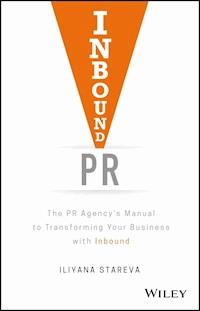
The digital era's new consumer demands a new approach to PR Inbound PR is the handbook that can transform your agency's business. Today's customer is fundamentally different, and traditional PR strategies are falling by the wayside. Nobody wants to feel "marketed to;" we want to make our own choices based on our own research and experiences online. When problems arise, we demand answers on social media, directly engaging the company in front of a global audience. We are the most empowered, sophisticated customer base in the history of PR, and PR professionals must draw upon an enormous breadth of skills and techniques to serve their clients' interests. Unfortunately, those efforts are becoming increasingly ephemeral and difficult to track using traditional metrics. This book merges content and measurement to give today's PR agencies a new way to build brands, evaluate performance and track ROI. The ability to reach the new consumer, build the relationship, and quantify the ROI of PR services allows you to develop an inbound business and the internal capabilities to meet and exceed the needs of the most demanding client. In this digital age of constant contact and worldwide platforms, it's the only way to sustainably grow your business and expand your reach while bolstering your effectiveness on any platform. This book shows you what you need to know, and gives you a clear framework for putting numbers to reputation. * Build brand awareness without "marketing to" the audience * Generate more, higher-quality customer or media leads * Close the deal and nurture the customer or media relationship * Track the ROI of each stage in the process Content is the name of the game now, and PR agencies must be able to prove their worth or risk being swept under with obsolete methods. Inbound PR provides critical guidance for PR growth in the digital era, complete with a practical framework for stimulating that growth.
Sie lesen das E-Book in den Legimi-Apps auf:
Seitenzahl: 218
Veröffentlichungsjahr: 2018
Ähnliche



















CONTENTS
Cover
Title Page
Copyright
The New World of Inbound PR: A Foreword
Modernizing Public Relations and Marketing: A Foreword
Introduction
About the Author
Acknowledgments
Chapter 1: Getting the Basics: PR and Inbound
What Is Public Relations?
What Is Inbound?
Content: The Glue between Inbound and PR
Chapter 2: PR and Measurement
The History of Measurement in Public Relations and Communications
Inbound Marketing and Measurement
The Future of PR Measurement
Chapter 3: Inbound PR
Why You Need Inbound PR
The Inbound PR Concept
Benefits of the New Inbound PR Model
Why PR Agencies Need to Adopt Inbound PR
Chapter 4: How to Do Inbound PR
The Inbound PR Methodology
How to Run an Inbound PR Campaign
Inbound Media Relations
The Inbound PR Newsroom
How to Create Fascinating Content
The Art of Inbound Storytelling
Chapter 5: Generating New Business with Inbound PR
Practicing What You Preach
The Importance of Positioning
How to Create Your Agency's Positioning Strategy
How to Do Lead Nurturing and Fill Your Sales Funnel
Chapter 6: Delivering Inbound PR to Clients
Defining Inbound PR Services
Packaging Inbound PR Services
Developing Inbound PR Capabilities
Delivering Inbound PR Services
Conclusions and Key Success Factors
Appendix
The ABCs of Inbound PR
References
Index
End User License Agreement
List of Tables
Table 4.1
Table 4.2
List of Illustrations
Figure 1.1
Figure 1.2
Figure 3.1
Figure 4.1
Figure 4.2
Figure 4.3
Figure 4.4
Figure 4.5
Figure 5.1
Guide
Cover
Table of Contents
Begin Reading
Chapter 1
Pages
iii
iv
vii
viii
ix
x
xi
xii
xiii
xiv
xv
xvi
xvii
xviii
xix
xx
1
2
3
4
5
6
7
8
9
10
11
12
13
14
15
16
17
18
19
20
21
22
23
24
25
26
27
28
29
30
31
32
33
34
35
36
37
38
39
40
41
42
43
44
45
46
47
48
49
50
51
52
53
54
55
56
57
58
59
60
61
62
63
64
65
66
67
68
69
70
71
72
73
74
75
76
77
78
79
80
81
82
83
84
85
86
87
88
89
90
91
92
93
94
95
96
97
98
99
100
101
102
103
104
105
106
107
108
109
110
111
112
113
114
115
116
117
118
119
120
121
122
123
124
125
126
127
128
129
130
131
132
133
134
135
136
137
138
139
140
141
142
143
144
145
146
147
148
149
150
151
152
153
154
155
156
157
158
159
160
Inbound PR
The PR Agency's Manual to Transforming Your Business with Inbound
Iliyana Stareva
Cover design: Wiley
Copyright © 2018 by John Wiley & Sons, Inc. All rights reserved.
Published by John Wiley & Sons, Inc., Hoboken, New Jersey.
Published simultaneously in Canada.
No part of this publication may be reproduced, stored in a retrieval system, or transmitted in any form or by any means, electronic, mechanical, photocopying, recording, scanning, or otherwise, except as permitted under Section 107 or 108 of the 1976 United States Copyright Act, without either the prior written permission of the Publisher, or authorization through payment of the appropriate per–copy fee to the Copyright Clearance Center, 222 Rosewood Drive, Danvers, MA 01923, (978) 750–8400, fax (978) 646–8600, or on the web at www.copyright.com. Requests to the Publisher for permission should be addressed to the Permissions Department, John Wiley & Sons, Inc., 111 River Street, Hoboken, NJ 07030, (201) 748–6011, fax (201) 748–6008, or online at www.wiley.com/go/permissions.
Limit of Liability/Disclaimer of Warranty: While the publisher and author have used their best efforts in preparing this book, they make no representations or warranties with respect to the accuracy or completeness of the contents of this book and specifically disclaim any implied warranties of merchantability or fitness for a particular purpose. No warranty may be created or extended by sales representatives or written sales materials. The advice and strategies contained herein may not be suitable for your situation. You should consult with a professional where appropriate. Neither the publisher nor the author shall be liable for damages arising herefrom.
For general information about our other products and services, please contact our Customer Care Department within the United States at (800) 762–2974, outside the United States at (317) 572–3993 or fax (317) 572–4002.
Wiley publishes in a variety of print and electronic formats and by print–on–demand. Some material included with standard print versions of this book may not be included in e–books or in print–on–demand. If this book refers to media such as a CD or DVD that is not included in the version you purchased, you may download this material at http://booksupport.wiley.com. For more information about Wiley products, visit www.wiley.com.
Library of Congress Cataloging-in-Publication Data
Names: Stareva, Iliyana, author.
Title: Inbound PR : the PR agency's manual to transforming your business with inbound / Iliyana Stareva.
Description: Hoboken : Wiley, 2018. | Includes bibliographical references and index. |
Identifiers: LCCN 2017039797 (print) | LCCN 2017041284 (ebook) | ISBN 9781119462279 (pdf) | ISBN 9781119462255 (epub) | ISBN 9781119462217 (hardback)
Subjects: LCSH: Marketing. | Selling. | Customer relations. | Public relations. | BISAC: BUSINESS & ECONOMICS / Public Relations. | BUSINESS & ECONOMICS / Marketing / General. | BUSINESS & ECONOMICS / Sales & Selling.
Classification: LCC HF5415 (ebook) | LCC HF5415 .S7473 2017 (print) | DDC 658.8–dc23
LC record available at https://lccn.loc.gov/2017039797
The New World of Inbound PR: A Foreword
Respond to this statement with a “yes” or “no”: The job of a public relations agency is to get ink and airtime from the media.
For decades, the correct response was yes, because we didn't have any choice.
Back in the day, the only way to easily communicate with your public was to use mainstream media and analysts as your mouthpieces. So the public relations department and the agencies they employed spent a great deal of effort convincing editors, reporters, and analysts that your company was one worth writing about. Prior to gaining the ability to self-publish content, there wasn't an efficient way for organizations to communicate directly to the public, so we were stuck with using the media as our mouthpiece.
That's exactly what I did for nearly a decade. As the vice president of marketing for several different technology companies, I had to work with agencies to pitch our story to the media. Occasionally, we got mentioned in a newspaper or magazine article or got airtime on television or radio. But it was really hard work and damned expensive.
Today, the correct response to my statement is an emphatic no!
In our new world of real-time engagement, there are so many other ways to communicate with your publics. There has been an explosion of channels and content that organizations can use to reach their audience directly with valuable online content: videos; e-books; white papers; photos; infographics; social networks like Facebook, LinkedIn, and Snapchat; and more. Now we reach buyers directly, and they are eager to share our content.
However, many PR professionals still operate as if their only conduit is mainstream media. Most agencies still only use the traditional press release and pitch strategy.
If your organization operates in this outdated way, you've got to change the way you do business. Fortunately, you are reading the right book to help guide you with that transition.
Iliyana Stareva comes from the PR trenches. She worked in PR agencies in several countries and personally implemented many of the ideas you will read in these pages. This is no academic tome; instead, it offers practical and proven advice for reaching customers directly.
Iliyana is currently Global Partner Program Manager at HubSpot, an inbound marketing and sales software company. I've seen Iliyana in action because I serve on the advisory board of HubSpot. I frequently encounter her smart blog posts and social networking posts. In her work at HubSpot, she's met with the leaders of several hundred agencies, and she draws from those interactions to make this book perfectly positioned to help agencies make the transition.
In this new world, which Iliyana calls inbound PR, smart public relations pros realize they have a tremendous opportunity to communicate directly with their publics. They are transforming themselves and their agencies into content creators. And they are helping their clients grow their businesses.
I use these ideas myself and they work!
—David Meerman Scott
Marketing and public relations strategist, entrepreneur, and best-selling author of 10 books, including The New Rules of Marketing & PR and Newsjacking
www.WebInkNow.com
@dmscott
Modernizing Public Relations and Marketing: A Foreword
The role of the old is to inspire the young. But often the young inspire the old.
This book is about an innovative application of modern public relations. But it's also a young woman's story about innovation, motivation and hard work.
I first met Iliyana Stareva in Dublin in October 2015. I sought her out on a visit to the city after reading her blog, and seeing her work at HubSpot on the inbound PR model. I'm a long-time fan of Iliyana's blog. She uses it as a means of thinking out loud, and sharing ideas. She's earned a reputation as a forward thinking practitioner in marketing and public relations. Iliyana has used her blog to help develop her thinking. She's generous in publishing her ideas, and as a result has built a community that supports her work through conversation and sharing. It's a highly effective form of learning that requires both bravery and humility, characteristics which Iliyana possesses in abundance.
I first learned about inbound PR from Iliyana's blog. It's a means of identifying and understanding an audience or public and using content to start a conversation. It's made possible thanks to a growing industry of data, media and tools, to help understand behavior on the internet and social web. Inbound PR seeks to build a relationship based on an organization meeting a need rather than creating a need. It lies at the heart of the difference between public relations and marketing. It's a subtle but important point of difference. The internet is full of spam and unwanted marketing content. Inbound PR enables an individual or organization to build relationships and trust, and influence behavior. It's a highly effective form of lead generation in business-to-business or professional services, although its application is by no means limited to this sphere.
The inbound PR model has been stress tested in Iliyana's day job at HubSpot where she helps agencies around the world get to grips with the tools they need to execute content marketing campaigns. She's a regular speaker at HubSpot events, and has joined the international speaker circuit in the footsteps of the likes of Seth Godin, David Meerman-Scott and Brian Solis to share her ideas. She has written extensively for a variety of industry publications, including #FuturePRoof and Spin Sucks.
In Dublin, we talked about how Iliyana could develop her thinking and writing on inbound PR into a book. I followed up after our meeting with a list of potential publishers. It's a testament to Iliyana's drive and motivation that 18 months later she sent me a proof of Inbound PR, and the news that she'd landed a publishing deal with Wiley. Inbound PR codifies the model that Iliyana devised, and describes its application in practice. The book is written very much in the style of her blog. It's clear, concise and highly informative. You'll have no problem in applying her teaching in your work.
I couldn't be more proud of Iliyana for what she's achieved.
—Stephen Waddington
Partner and Chief Engagement Officer, Ketchum
Visiting Professor, Newcastle University
Introduction
I come from a public relations (PR) background. I spent three years working in PR agencies across Germany and the United Kingdom. I loved it but I saw the flaws, too, and so I moved away from the industry, transitioning into something more modern: inbound marketing and agency business consulting.
It turns out I was wrong. For two and a half years, I consulted over 200 agencies in my role as a Channel Consultant at HubSpot—the inbound marketing and sales software as a service pioneer—and I realized that I'm never getting away from PR. I still researched it and I still wrote about it. I still saw the flaws and I still wanted to fix them.
Thankfully, I saw a way. A way that can transform the public relations industry. A way that can transform the PR agency model.
It started with a simple realization: the way we make decisions has fundamentally changed, regardless of whether that concerns our personal or our professional lives. We've become a lot more sophisticated and we feel empowered to go online, do our research, talk to friends, read recommendations, tweet at companies with questions, and demand answers to our problems through the content that we find. We don't want to be marketed at; we want the freedom to choose, based on our own online experiences.
Content is the name of the buying game today.
And who's better suited to create fascinating content and use it to engage with the public than PR practitioners?
Marketers, advisers, and digital professionals struggle with content creation, but they are good at numbers, data, and measurement—something PR professionals are still at odds with.
Enter inbound PR, where content meets measurement and helps PR people show the real return on investment (ROI) of their efforts in the new digital era.
So, there are two main reasons why inbound is the perfect fit for PR:
PR people excel at content creation.
PR people suck at measurement.
PR professionals are the best content creators. They are natural storytellers—this is how it has been since the first press release. Writing and communication skills have been at the forefront of PR practitioners' skillsets, but not so much for marketing, advertising, or digital agency professionals.
On the other hand, PR people are very bad at measurement. Showing the tangible results of their efforts in a way that makes sense to the bottom line has been the single biggest challenge for PR since its very beginning.
Especially in the digital era, you can't be using outputs or metrics such as advertising value equivalents (AVEs) or impressions; you must be able to measure outcomes and show the real impact on the business that is often defined by an increase in sales.
Inbound makes measurement possible; however, it doesn't work without content.
By now, you as a PR agency owner who is struggling to take your agency to the next level are hopefully hooked, so let me ask you some questions:
Do you blog?
Do you use social media?
Do you have a landing page on your website?
How much time do you invest in doing PR for your own agency or communications team?
Let me take a guess the answers:
Hmm, when we have time.
Yes, but mainly just to curate or share our own stuff.
No, no time for that and what's the point.
We just don't have time because we are too busy with client work.
Now you might be thinking, “Why do I even need any of that? We have our clients, our team is busy, we can't invest time and money into something that won't bring us much results.”
This is the number one challenge for agencies—we don't have time for our own PR and marketing.
I know agency life, and believe me, I sympathize with the workload, and I know how demanding clients can be. But for me, not having time is an excuse. Think of it this way: you really want to lose weight, so you need to fix up your diet and work out five times per week. However, you are super busy at work and at home, so you know that to achieve your goal you need to develop some new routines and adjust your daily lifestyle. That includes finding or better yet making the time for working out and preparing healthy food and snacks. There are two possible scenarios here: you find excuses and don't make the time and so you don't see any results, but you are still frustrated and angry as nothing is happening; or you've made a conscious choice to change and make the time (for example, through calendar planning) and you are seeing some fantastic progress.
As a PR agency owner or CEO, which one will you choose: being stuck in the state where you've always been, or will you embrace change?
I hope it's the latter because doing your own PR with your own content and promoting it on your own channels is the best thing you could ever do for your team or agency. Why? Because inbound PR can help you build brand awareness, generate leads (customer or media), nurture them, close them as customers or publishers, and then delight them to retain them with even better services, stories, and strong relationships. Most importantly, you'll be able to track the ROI of all those activities. And once you can do this for your agency, then you'll be able to develop the inbound PR services and the internal capabilities to deliver them for clients. That's how you'll grow your PR business in the twenty-first century.
This book is about you. Just as inbound is.
In a typical inbound fashion, each chapter will educate you on particular topics that all build upon each other so that you can move from learning to doing.
In Chapter 1, we'll look at the definitions of public relations and inbound marketing, what the two disciplines do and where the similarities are. We'll also see what binds them. We'll lay a foundation of common knowledge.
Chapter 2 is dedicated to PR's biggest challenge—measurement—and covers the current status quo, the history of communications measurement, how measurement works with inbound, where the opportunity for PR lies, and what the future of PR measurement looks like.
In Chapter 3, I'll take you on the journey of how I came up with the inbound PR concept, its definitions and benefits, and why you as a PR agency (or any communications agency) should adopt it.
Once we have this theory covered, I'll introduce you to the inbound PR methodology in Chapter 4 and offer you a lot of practical advice and tips on how to run inbound PR campaigns, how to create remarkable content, and how to tell inbound stories. This chapter has a strong focus on how to work with journalists, influencers, and media people in an inbound way as well as how to create inbound PR newsrooms.
Chapter 5 will delve into the importance and development of a strong positioning strategy for your agency that will then ultimately help you generate new business, nurture leads, and close the leads in your sales funnel.
Finally, in Chapter 6, we'll cover how to define and package inbound PR services into 12-month client retainers and how to develop the knowledge, capabilities, and skills your people need to be able to deliver inbound PR and to drive client results.
PR is ripe for transformation. Are you ready to embark on the inbound PR journey?
About the Author
Iliyana Stareva lives and breathes inbound marketing and PR for agencies. Iliyana spent three years in the PR industry throughout Germany and the United Kingdom, establishing the presence of some of the largest fast-moving consumer goods brands in the world in those markets. She was then recruited by HubSpot—the leading marketing and sales software as a service pioneer—to become one of its first agency business consultants in Dublin, Ireland, where she helped dozens of marketing, content, PR, and web agencies double or triple their revenues. It was during that time that Iliyana developed the inbound PR concept.
Earning rapid promotions at HubSpot, Iliyana is now Global Partner Program Manager, focused on aligning HubSpot's expanding global teams and helping agency partners grow within the program.
Iliyana is also the author of Social Media and the Rebirth of PR: The Emergence of Social Media as a Change Driver for PR (2013) and Social Media—Key for Sustainability Communications (2013).
Iliyana spends her free time dancing salsa or writing about inbound PR, inbound marketing, and agency business on her blog at www.iliyanastareva.com.
Acknowledgments
Huge thanks to my family for the support provided when I was writing this, especially to my mom, Teodora Stareva, for always encouraging me and being there for me.
Special thanks to Stephen Waddington for getting the idea in my head to write a book about inbound PR.
Chapter 1Getting the BasicsPR and Inbound
What Is Public Relations?
Whenever we try to explain a term, we tend to start with the textbook definitions that students learn when they go to university.
Public relations (PR) certainly is a mystery to many people, including some working in the industry or studying it.
The Public Relations Society of America which is the leading PR organization in the world, defines public relations as “the strategic communication process that builds mutually beneficial relationships between an organization and its publics” (PRSA, 2017).
The Chartered Institute of Public Relations the other leading PR body based in the United Kingdom—argues that “public relations is the discipline which looks after reputation, with the aim of earning understanding and support and influencing opinion and behavior. It is the planned and sustained effort to establish and maintain goodwill and mutual understanding between an organization and its publics” (CIPR, 2017).
Now admittedly, these two definitions are a bit hard to grasp as they entail a number of buzzwords such as “mutually beneficial,” “influencing,” “goodwill,” and so on.
If you read Guy Kawasaki's book The Macintosh Way (1989, 123), you'll see a quote by Jean-Louis Gassee—a former Apple executive—explaining that advertising is saying that you're good, whereas PR is getting someone else to say that you're good.
This definition is easier to grasp, right?
It doesn't tell us exactly what PR people do, but at least it strengthens the point that PR is concerned with organizational reputation and building meaningful and positive relationships between various audiences.
For most of its existence, dating back to the beginning of the twentieth century, PR has mainly dealt with media relations, events, reputation, crisis management, and investor relations. In fact, for a very long time public relations and media relations (or publicity) have been considered synonymous, where PR people write press releases and send them to journalists who then use those press releases to write stories for their publications and media outlets—newspapers, magazines, TV, radio, and so on.
Many are under that same assumption today, which is what has been driving PR's own reputation.
But with the emergence of digital technology and its mass adoption, this understanding is outdated, because PR is not just media relations—and it shouldn't be just media relations.
Heavily relying on the media and pitching them press releases has been the traditional view of PR, but with the growth of digital media, the need for an intermediary—the media—to spread the information has diminished. PR can now engage directly with customers, prospects, investors, and any stakeholder group using online channels to send key messages through various means such as articles, blog posts, e-books, social media, comments, and video.
Digital is the reason why the arsenal of PR activities has increased enormously. Media relations can simply be one of those activities. More and more PR people are now responsible for generating leads as well as nurturing them to help sales close new business. They do this by making use of content marketing (e-books, whitepapers, reports, videos, podcasts, webinars, blog posts), e-mail marketing, social media, search engine optimization (SEO), blogger relations, influencer relations, online reputation management, crisis communications, and more.
But the problem with the PR industry has always been this: it's been too slow to adapt to changes and jump on the bandwagon of new technological developments. This happened with social media a few years back when the use of social channels was just starting to peak. Many felt that PR should be the owner of social because PR pros are the people who build mutually beneficial relationships with communities—basically what social media is all about. Unfortunately, PR was a bit too slow and so social media agencies arose, advertising agencies won social media awards, and so on. A similar thing happened with SEO as well, but let's not get into that here.
The reality is that PR needs to reinvent itself. PR needs to change the widespread perception that it's just about media relations. It needs to show that it's able to grow, adapt, and adjust for the digital economy and show sustainable results to clients. Because if PR continues to stick with the conventional ways of thinking, it's not going be relevant or important.




