


7,49 €
Mehr erfahren.
- Herausgeber: Open Book Publishers
- Kategorie: Fachliteratur
- Sprache: Englisch
Infrastructure Investment in Indonesia: A Focus on Ports presents an important and original collation of current material investigating the efficient facilitation of major infrastructure projects in Indonesia and Australia, with an emphasis on infrastructure investment and a focus on port planning and development.
This interdisciplinary collection—spanning the disciplines of engineering, law and planning—draws helpfully on a range of practical and theoretical perspectives. It is the collaborative effort of leading experts in the fields of infrastructure project initiation and financing, and is based on international research conducted by the University of Melbourne, Universitas Indonesia and Universitas Gadjah Mada.
The volume opens with a macroscopic perspective, outlining the broader economic situations confronting Indonesia and Australia, before adopting a more microscopic perspective to closely examine the issues surrounding major infrastructure investment in both countries. Detailed case studies are provided, key challenges are identified, and evidence-based solutions are offered. These solutions respond to such topical issues as how to overcome delays in infrastructure project initiation; how to enhance project decision-making for the selection and evaluation of projects; how to improve overall efficiency in the arrangement of project finance and governance; and how to increase the return provided by investment in infrastructure. Special focus is given to proposed improvements to the portal cities of Indonesia in the areas of major infrastructure project governance, policies, engagement, operation and processes.
By rigorously investigating the economic, transport, finance and policy aspects of infrastructure investment, this book will be a valuable resource for policy makers and government officials in Indonesia and Australia, infrastructure investment organisations, and companies involved in exporting services between Indonesia and Australia. This book will also be of interest to researchers and students of infrastructure planning and financing, setting a solid foundation for subsequent investigations of financing options for large-scale infrastructure developments.
Das E-Book können Sie in Legimi-Apps oder einer beliebigen App lesen, die das folgende Format unterstützen:
Veröffentlichungsjahr: 2019
Ähnliche



















Infrastructure Investment in Indonesia
Infrastructure Investment in Indonesia
A Focus on Ports
Colin Duffield, Felix Kin Peng Hui and Sally Wilson
https://www.openbookpublishers.com
© 2019 Colin Duffield, Felix Kin Peng Hui and Sally Wilson.
This work is licensed under a Creative Commons Attribution 4.0 International license (CC BY 4.0). This license allows you to share, copy, distribute and transmit the text; to adapt the text and to make commercial use of the text providing attribution is made to the authors (but not in any way that suggests that they endorse you or your use of the work). Attribution should include the following information:
Colin Duffield, Felix Kin Peng Hui and Sally Wilson, Infrastructure Investment in Indonesia: A Focus on Ports. Cambridge, UK: Open Book Publishers, 2019, https://doi.org/10.11647/OBP.0189
In order to access detailed and updated information on the license, please visit, https://doi.org/10.11647/OBP.0189#copyright
Further details about CC BY licenses are available at, https://creativecommons.org/licenses/by/4.0/
All external links were active at the time of publication unless otherwise stated and have been archived via the Internet Archive Wayback Machine at https://archive.org/web
Updated digital material and resources associated with this volume are available at https://doi.org/10.11647/OBP.0189#resources
Every effort has been made to identify and contact copyright holders and any omission or error will be corrected if notification is made to the publisher.
ISBN Paperback: 978-1-78374-821-1
ISBN Hardback: 978-1-78374-822-8
ISBN Digital (PDF): 978-1-78374-823-5
ISBN Digital ebook (epub): 978-1-78374-824-2
ISBN Digital ebook (mobi): 978-1-78374-825-9
ISBN XML: 978-1-78374-826-6
DOI: 10.11647/OBP.0189
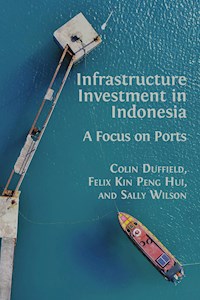
Cover image: Unnamed Road, Juanga, Morotai Sel., Kabupaten Pulau Morotai, Maluku Utara, Indonesia, Morotai Selatan. Photo by Rizky Arief at Unsplash, https://unsplash.com/photos/msAY2oBDXHI
Cover design: Anna Gatti.
Contents
Acknowledgements
xv
Preface
xix
Foreword
xxiii
Author biographies
xxix
Editors
xxix
Chapter Authors
xxx
1.
Infrastructure Investment in Indonesia — The Economic Context
1
C. F. Duffield, R. Duffield, and S. Wilson
1.0
Introduction to Indonesia
1
1.1
Government
2
1.1.1
National
2
1.1.2
Regional
2
1.2
Population
3
1.3
Economy
4
1.3.1
Investment
6
1.4
Infrastructure
6
References
10
2.
Infrastructure Planning, Challenges and Risks
15
C. F. Duffield, R. Duffield, and S. Wilson
2.0
Introduction
15
2.1
Infrastructure Plans
15
2.1.1
National Plans, Agencies and Institutions
15
2.1.1.1
Bappenas and Bappenda
16
2.1.1.2
Master Plan for the Acceleration and Expansion of Indonesian Economic Development 2011–2025 (MP3EI)
17
2.1.1.3
National Long-term Development Plan 2015–2025 (Rencana Pembangunan Jangka Panjang Nasional abbreviated to RPJPN)
19
2.1.1.4
Committee for Acceleration of Priority Infrastructure Delivery
21
2.1.1.5
Indonesian Maritime Doctrine 2014
24
2.1.2
International Plans
25
2.1.2.1
ASEAN (Association of Southeast Asian Nations) Connectivity Agenda
25
2.1.2.2
APEC (Asia-Pacific Economic Cooperation) Connectivity Blueprint 2015–2025
25
2.1.2.3
Master Plan of ASEAN Connectivity (MPAC) 2025
26
2.1.2.4
21st Century Maritime Silk Road Initiative
26
2.1.2.5
Indonesia-Malaysia-Thailand Growth Triangle Implementation Blueprint 2012–2016
27
2.2
Challenges, Risks and Issues Affecting Infrastructure Processes and Development in Indonesia
28
2.2.1
Issues and Risks
28
2.2.1.1
Corruption
34
2.2.1.2
Environmental Risks
35
2.2.1.3
Land Acquisition
35
2.2.1.4
Transaction law
37
2.2.1.5
Public Private Partnership (PPP) Process
37
2.2.1.6
Political Instability
39
2.2.1.7
Regulatory and Legal Uncertainty
39
2.2.1.8
Lack of Projects
40
2.2.1.9
Insufficient Human Capital
40
2.2.1.10
Bureaucracy
41
2.2.1.11
Economic Outlook
42
2.2.1.12
Foreign Currency
43
2.2.1.13
Dispute Resolution
43
2.2.2
Research into Barriers to Doing Business in Indonesia and Australia
43
References
47
3.
Funding and Financing Infrastructure: Indonesia and Australia
53
C. F. Duffield, R. Duffield, and S. Wilson
3.0
Introduction
53
3.1
Potential Sources of Infrastructure Financing
54
3.2
Discussion of the Specific Financing Scenarios
56
3.2.1
Direct Governmental Financing
56
3.2.1.1
Indonesia Infrastructure Guarantee Fund (IIGF)
58
3.2.1.2
P.T Sarana Multi Infrastruktur (Persero) (PT SMI)
59
3.2.1.3
Indonesia Infrastructure Finance (PT IIF)
59
3.2.1.4
Viability Gap Fund (VGF)
60
3.2.1.5
Land Funds
60
3.2.2
Direct Company Facilitation
60
3.2.3
Foreign Direct Investment (FDI)
61
3.2.4
Public Private Partnerships
64
3.2.5
Special Economic Zones or Preferential Concessional Loans
65
3.2.6
Asset Recycling
67
3.2.7
Discussion
69
3.3
The Market’s View as to How to Best Finance Port Infrastructure Projects: Indonesia and Australia
70
3.3.1
Introduction
70
3.3.2
Do the Current Government Policies Support and Facilitate Investment?
70
3.3.3
Is There Sufficient Finance to Meet the Development Demand in a Timely Manner?
71
3.3.4
Priority Areas Requiring Investment
72
3.3.5
Research Relevance to Funding and Finance
75
3.4
Concluding Remarks
80
References
82
4.
Efficient Facilitation of Major Infrastructure Projects
85
C. F. Duffield, F. K. P. Hui, and V. Behal
4.0
Background and Context
85
4.1
Risk Allocation and Management
89
4.2
Delivery of Infrastructure Projects: Indonesia
90
4.2.1
Jakarta Sewerage System (JSS)
91
4.2.2
West Semarang Drinking Water Supply
92
4.2.3
National Capital Integrated Coastal Development
94
4.2.4
Bontang Refinery
96
4.2.5
Umbulan Springs Drinking Water Supply Project
98
4.3
Delivery of Infrastructure Projects: Australia
99
4.3.1
Channel Deepening Project, Victoria
100
4.3.2
M.7 Motorway, New South Wales
101
4.4
Benchmark Practices
103
4.4.1
Comparative Analysis
106
4.4.2
Findings
109
References
109
5.
Port and Hinterlands
113
J. Black and V. Roso
5.0
Introduction
113
5.1
Methodology
116
5.2
Literature Review Intermodal Terminals — Concept of Dry Ports
117
5.3
Sydney’s Container Ports — History
119
5.4
Port Botany Container Terminals
122
5.5
Multi-modal Transport Access to Port Botany
128
5.6
Hinterland Intermodal Logistics Centres
133
5.6.1
Port Botany’s Inland Terminals Pre-2010
133
5.6.2
Chullora Intermodal Terminal
136
5.6.3
Macarthur Intermodal Shipping Terminal (MIST)
136
5.6.4
Cooks River Intermodal Terminal (St Peters)
137
5.6.5
Yennora Intermodal Terminal
137
5.6.6
Villawood Terminal (Leightonfield)
138
5.6.7
Enfield Intermodal Logistics Centre
138
5.7
Moorebank Intermodal Terminal — Detailed Case Study of Dry Port
139
5.8
Funding and Financing Port, Terminals and Transport Access
144
5.9
Conclusions
146
References
149
6.
Comparative Efficiency Analysis of Australian and Indonesian Ports
155
F. K. P. Hui, C. F. Duffield, A. Chin, and H. Huang
6.0
Introduction
155
6.1
Literature Review
157
6.1.1
Logistics and Port Efficiency
157
6.1.2
Indonesia
158
6.1.2.1
Port of Surabaya
158
6.1.2.2
Port of Jakarta
159
6.1.3
Australia
160
6.1.3.1
Port of Melbourne
160
6.1.3.2
Port of Botany, Sydney
161
6.1.3.3
Port of Fremantle
161
6.1.4
China
162
2.1.4.1
Port of Shanghai
162
6.1.5
Data Envelopment Analysis (DEA)
162
6.1.6
Private Sector Involvement
163
6.1.7
Current Knowledge Gap
163
6.2
Methodology
164
6.2.1
Data Envelopment Analysis (DEA)
164
6.2.2
Input and Output Variables
164
6.2.2.1
Crane Rate
164
6.2.2.2
Ship Rate
164
6.2.3
Mathematical Formulation of DEA
165
6.2.4
Returns to Scale Structure
166
6.2.5
Scale Efficiency
167
6.3
Results and Findings
167
6.3.1
Data Analysis
167
6.3.1.1
Port
167
6.3.1.2
Container Terminal
169
6.3.2
Efficiency Comparison Based on DEA Result
170
6.3.2.1
Port
170
6.3.2.2
Comparison of Container Terminals
172
6.4
Discussion
175
6.4.1
Indonesia
175
6.4.2
Australia
179
6.4.3
Opportunities for Future Research
181
6.5
Conclusion
181
References
182
7.
Innovation in Port Development
187
S. Wahyuni
7.0
Introduction
187
7.1
Port Strategic Development
189
7.2
Case Study TAMA (Japan)
192
7.2.1
Financial Resources
194
7.2.2
Five-year Action Plans
195
7.3
Conclusion
202
References
8.
Revealing Indonesian Port Competitiveness
205
S. Wahyuni, A. Azadi Taufik, F. K. P. Hui
8.0
Introduction
205
8.1
Literature Review
208
8.2
Methodology
212
8.2.1
Focus Group Discussions and In-Depth Interviews
213
8.3
Results and Discussion
213
8.4
Conclusions
223
References
224
9.
Initial Investigation into the Effectiveness of Australian Ports’ Governance and Management Structures
227
H. Al-Daghlas, F. K. P. Hui, and C. F. Duffield
9.0
Introduction
227
9.1
Literature Review
228
9.1.1
Australian Ports Reform
228
9.1.2
International Private Investment in Australia
230
9.1.3
Factors Influencing Asset Recycling in Australia
233
9.1.4
Typical Management Structure
234
9.2
Methodology, Results and Discussion
235
9.2.1
Factors Which Bring Improvement to Governance/Policy in Ports
235
9.2.2
Factors Acting as Obstacles to Governance/Policy in Ports
239
9.2.3
Factors Which Help Improve Management Structures in Ports
240
9.2.4
Factors Which Hindered Improvement of Management Structures in Ports
242
9.2.5
Significance and Future Research
243
9.3
Conclusion
243
References
244
10.
Alternative Ways to Finance Major Port Projects
247
W. W. Galih and R. Prijadi
10.0
Introduction
247
10.1
Literature Review
249
10.1.1
The Public Procurer Perspective: Public Private Partnerships vs. Traditional Procurement
249
10.1.2
The Private Sponsor Perspective: Corporate Finance vs. Project Finance
251
10.2
Research Methodology
255
10.3
Results and Case Study
257
10.3.1
Survey Results
257
10.3.2
Case Study of NPCT-1
262
10.3.2.1
The Existing Financing Arrangement Overview
264
10.3.2.2
Existing Scenario Simulation Under Different Per Rates And Capital Structures
266
10.3.2.3
Alternative Scenario Overview
269
10.3.2.4
Alternative Scenario Simulation Under Different Capital Structures
270
10.4
Discussion
272
10.4.1
Indonesian Domestic Banking Finance for Port Infrastructure Projects
273
10.4.2
Government Fiscal Support for Public Private Partnership Projects
275
10.4.2.1
Availability Payment
275
10.4.2.2
Viability Gap Fund
276
10.4.2.3
Government Guarantee
276
10.5
Conclusion
276
References
278
11.
The Critical Importance of Land Transport when Considering Port Development
281
D. Parikesit, S. Basalim, and W. W. Wibowo
11.0
Introduction
281
11.1
Land Transport and Port Access: International Literature
283
11.1.1
Regionalisation, Vertical Integration and Spatial Control of Commodities’ Flow
287
11.1.2
Intermodalities and Multi-Mode Operation of Ports: Organisational and Structural Linkage between a Port and its Hinterland
290
11.1.3
Traffic Congestion in and Around Ports
293
11.2
Case studies of Indonesian Ports
296
11.2.1
Case I: The Need to Manage Land Use and the Local-Through-Access Traffic Separation for Tanjung Priok Port in Jakarta
296
11.2.1.1
Congestion around the Port of Tanjung Priok and the Failure to Comply with Land-Use Regulations
298
11.2.1.2
Reactivation of Railway Access to Port Terminal
300
11.2.1.3
The Development of Dedicated Toll Access
300
11.2.1.4
Ensuring Control of Inbound and Outbound Traffic: Pelindo II Corporate Actions
302
11.2.2
Case II: Importance of Rail Traffic to Support Efficient Operation of Belawan Port, North Sumatera
305
11.2.2.1
Sei Mangkei Special Economic Zone (SEZ) and Connectivity to Belawan Port: Railway Experience
308
11.2.2.2
Belawan-Kuala Tanjung Port System and the Design of Access Traffic
310
11.2.3
Case III: Pelindo III Green Port Terminal of Teluk Lamong, Surabaya
311
11.2.3.1
The Design and Private Sector Initiative for Inter Terminal Freight Transport within Tanjung Perak Port
314
11.2.3.2
Competing Port Terminals and the Opportunity to Manage Container Traffic among Terminals
318
11.3
Lessons Learned from the Literature and Case Studies
318
11.3.1
Importance of Land Connectivity in Ensuring Lower Logistics’ Costs
318
11.3.2
Road versus Rail Connectivity to Ports, and the Role of Government Support for Commercial Rail Operations
320
11.3.3
Managing Land Uses around Ports
321
References
321
12.
Potential Infrastructure Enhancements for Ports and Cities
327
C. F. Duffield, S. Wahyuni, D. Parikesit, F.Hui, and S. Wilson
12.0
Overview and Conclusions
327
12.1
Future Research
336
12.2
Lessons Learnt and Policy Implications
338
Appendix
343
Research Methodology: Efficient Facilitation of Major Infrastructure Projects
343
1.0
Introduction and Methodology
343
1.1
Research Forum
344
1.2
Online Surveys
345
1.2.1
Development of the Online Surveys
345
1.2.2
Conduct of the Online Survey
346
1.3
Focus Group Discussions
347
1.4
In-Depth Interviews
348
1.5
Response Rates
349
1.5.1
Australia — Online survey
349
1.5.2
FGD — Australia
349
1.5.3
Indonesia — Online survey
349
1.5.4
FGD — Indonesia
350
1.5.5
In-Depth Interviews — Indonesia
350
List of Illustrations and Tables
351
Acknowledgements
This book is based on the collaborative international research conducted between The University of Melbourne, Universitas Indonesia and Universitas Gadjah Mada, on project initiation in ports and infrastructure projects in Indonesia and Australia. The editors would firstly like to acknowledge the generous funding and support from the Australia-Indonesia Centre (AIC) which made this possible. This funding came in the form of the Small Grant, Rapid Start Grant and a Strategic Research Grant. Special thanks must be given for the support received from the AIC’s Research director Dr Richard Price and Research Manager Megan Power, and the Administrative team: Katrina Reid, Rebecca Hateley, Dr Maria Platt and Samantha Croy.
In Indonesia, the small grant received from the AIC and the travel support and case study materials provided by the Indonesian Infrastructure Initiative (IndII) group of Australia Aid is gratefully acknowledged. Special thanks for the support provided by Lynton Ulrich and Nur Hayati of IndII during the study. Aspects of this monograph have also been informed by direct communication with the Indonesian Co-ordinating Ministry for Economic Affairs. Also, special thanks for the inputs from Dr Luky Eko Wuryanto (who at the time was Deputi Bidang Koordinasi Infrastruktur dan Pengembangan, Kemenko Perekonomian), Dedy Supriadi Priatno (who at the time was Deputi Bidang Prasarana dan Sarana, Kementerian PPN/BAPPENAS — the key planning ministry) and Dr Hermanto Dardak (Wakil Menteri, Kementerian Pekerjaan Umum), as well as the staff at IndII who convened the meetings held with these senior Indonesian Officials.
A special mention goes to then Minister Robb (Australian Government) and then Premier Napthine (Victorian Government) for including the research team on trade delegations to Indonesia, and to Steve Richards of Aurecon for involving the research team in executive meetings with senior Indonesian Officials.
We thank Emeritus Professor John Black from the University of New South Wales, Professor Graeme Hodge from Monash University and Professor Danang Parikesit from Universitas Gadjah Mada for their valuable input at the academic workshop conducted in Melbourne in the early stage of the research. Professor John Black also contributed an entire chapter (Chapter 5) on port hinterland to this research monograph.
The editors would like to acknowledge the leadership of Associate Professor Sari Wahyuni, the co-lead for the Strategic Research Project in organising many of the tedious research activities such as the numerous stakeholder meetings and discussions in Jakarta, Indonesia. As the project co-lead, Associate Professor Sari also contributed two chapters (Chapters 7 and 8) to the research monograph. We also acknowledge the time, support and advice of our team member, Professor Danang Parikesit. As a senior academic and a policy expert, Professor Danang was instrumental in providing direction for research in Indonesia as well as valuable inputs in discussions. Professor Danang contributed a solid chapter on the critical importance of land transport in Indonesia (Chapter 11).
The editors would also like to acknowledge the input of all postgraduate research student contributions, Vijayshree Behal for her contribution to Chapter 4, Andrew Chin and Hanlong Huang for their co-contributions to Chapter 6, Haya Al-Daghlas for her contribution to Chapter 9, Waskitha Galih for his co-contribution to Chapter 10 and Said Basalim for his co-contribution to Chapter 11. We also wish to acknowledge research assistant Regina Duffield for her contribution to Chapters 1 to 3. In addition, we thank Vijayshree, Haya, Waskitha and Said for their assistance with the focus group discussions (FGDs).
We would also like to thank our colleagues at Institute Technologi Sepuluh Nopember (ITS), Dr Hera Widyastuti and Dr Saut Gurning and their colleagues for their support in arranging meetings with stakeholders during the Surabaya phase of the Strategic Research Project. Special mention to Bernardus Djonoputro of Deloitte Indonesia for his generous advice on the conduct of research in Indonesia.
We would also like to thank Dr Dewanti and Wiratno Wahyu Wibowo from the Centre for Transportation and Logistics Studies, Universitas Gadjah Mada for their assistance with the project.
We are extremely grateful to the participants of the focus group discussions held in Jakarta, Indonesia and Melbourne, Australia, survey participants, conference participants, interview participants in both Surabaya and Jakarta, in particular to management and staff of Pelindo II and Pelindo III, Teluk Lamong Port, Port of Tanjung Priok and the Terminal Pertikimas Surabaya. Special thanks must also go to the contribution from Sri Bagus from Bappenas, the Indonesian National Planning Agency and Dr Salusra Widya from LKPP, the Indonesian National Procurement Agency for their inputs and support, and Dr Nofrisel,Director of Operation and Development, PT Bhanda Ghara Reksa (Persero)BGR Integrated Logistics Solution. This has contributed to the rich pool of research data collected for the project.
In Australia, we acknowledge the contribution of the management and staff of the following port organisations who have given up so much of their time to support and participate in our research: Port of Melbourne (Don Fosdyke), DP World Melbourne (Vlad Jotic) and VICT, Ports Australia (Michael Gallagher), and The Chartered Institute of Logistics and Transport in Australia (CILTA) and the Supply Chain and Logistics Association of Australia (SCLAA) for their support in advertising the online survey. Their involvement has contributed to the research. In addition to the participants mentioned previously, special thanks also to the following for their presentations at the Port Competitiveness and Financing Workshop and Conference held in Melbourne on the 4–6 April 2018 including Mark Switkowski, Stan Roche (Austrade), Michael Tuckfield, Venkat Naidu (AECOM) and Leith Doody (former Australian Trade commissioner).
We also want to acknowledge University staff and postgraduate students both in Australia and Indonesia who have helped in various phases of the research that were organised as part of the bigger research project: from Melbourne — Dr David Wilson and Dr Kim Hassall; postgraduate students who took on various roles as Research Assistants — from Australia — Hanif Arief Wisesa, Putri Fatkhiyatul Ulya, Praditya Hadi Prabowo, Lydwina Adhisty, Steffen Utama, Garinata Sabatini Trema, Shabrina Austin Ghaisani, Bisma Anugerah Subarno, Renold Partogi Lumbantoruan (Togi), and Elisa Mackowiak (intern from France), and Andrew Grisinger as a student during his post graduate study — and from Indonesia: Aditya Ridwan Nasution and Prisca Lidya Patty.
Finally, we acknowledge the support of our department leaders, Professor Abbas Rajabifard and Enterprise Professor Greg Foliente at The University of Melbourne for their continued support in promoting Engineering Management research.
Preface
Leith Doody1 and Bernardus Djonoputro2
© L. Doody and B. Djonoputro, CC BY 4.0 https://doi.org/10.11647/OBP.0189.13
For Indonesia to join the top ten major global economies club by 2025, the average GDP per capita per annum would need to rise from USD 3,000 today to USD 15,000 and GDP per se to a heady USD 4.5 trillion (nearly five times the current GDP). It would need to do so in the space of less than ten years.
To achieve this a two-pronged approach will be required: acceleration, and expansion. Underpinning such development is the need for strengthened connectivity not only throughout the archipelago, but also the Association of Southeast Asian Nations (ASEAN). Additionally, such development requires the strengthening of human resources capability, as well as the smart use of science and technology.
Growth Centres, connectivity and infrastructure are considered the main building blocks of Indonesia’s economic corridors. This connectivity needs to be developed through ICT and ebusiness, improved logistics through transport and refined business policies — practices and processes such that international trade and investment grows commensurate with expectations. Currently logistics costs in Indonesia are a crippling 25% of GDP. Critical infrastructure needs and areas for improvement include: roads, seaports (ferries and container and bulk trade), airports, public transport via a modern metro system and connected rail freight routes. Underpinning these productivity improvements is the need for clean water, reliable energy and electricity and better access to social infrastructure such as hospitals and schools.
In a call to action, Pak Suryo Sulisto, former Chairman of Kadin and indeed a major driver for improved infrastructure in Indonesia, at an AusAid event held at the Indonesian Centre for Infrastructure Workshop on 10 July 2014, bluntly stated:
Indonesia today has the highest logistics costs in Asia, which costs the country billions of dollars in losses… Unless we can build world class infrastructure, we will not be competitive and will lose out not only to the likes of China but also the Philippines…
The impediments and constraints are real: a lack of financing and funding, a propensity for major natural disasters such as earthquakes, volcanic eruptions and tsunamis, along with major congestion on transport routes and dated/poorly maintained vehicles using these networks.
Indonesia is not alone in facing infrastructure difficulties. In Australia, the need for additional funding to underpin the pipeline of identified nationally significant infrastructure projects remains a challenge. Infrastructure Australia’s CEO, Mr Phil Davies, recently reflected on the infrastructure project list updated in March 2018 (this included $55bn worth of projects, with $25bn worth of ongoing projects moved off the list) with his observation that “governments and oppositions need to be more disciplined around proper planning, evaluating all available options, and seeking the solutions with positive cost-benefit ratios prior to a funding announcement”.3
The impediments to achieving adequate infrastructure in Australia have numerous similarities to those mentioned previously: a lack of funding, the need for policy reform such that Australia’s productivity can improve, and a tyranny of distance that imposes growing pressures on major cities but leaves rural and remote communities with inequitable access to infrastructure services. There are also numerous natural disasters in the form of floods, bushfires and cyclones.
The articles presented in this book provide a valuable resource for policy makers in Indonesia and Australia as they insightfully explore economic, transport, policy and finance aspects of infrastructure investment.
We commend this book to those who are passionate advocates of finding practical solutions to creating sustainable infrastructure and successful business relationships between Indonesia and Australia. The creation of such infrastructure and business relationships would contribute to a more sustainable growth between our two great nations, who are significant and complementary economies and the closest of neighbours.
1 Ex Australian Trade and Investment Commissioner and Minister to Indonesia.
2 Director Asia, Deloitte.
33 Bagshaw, E 2018. ‘Infrastructure chief says government and business have failed to deliver for Australians’, 24 June, Sydney Morning Herald, https://www.smh.com.au/politics/federal/infrastructure-chief-says-government-and-business-have-failed-to-deliver-for-australians-20180622-p4zn7a.html.
Foreword
© C. F. Duffield, F. K. P. Hui, and S. Wilson, CC BY 4.0 https://doi.org/10.11647/OBP.0189.14
This monograph charts the research undertaken by the policy and finance team within the infrastructure cluster of the Australia-Indonesia Centre (AIC). The research conducted was an international collaboration between The University of Melbourne, Universitas Indonesia and Universitas Gadjah Mada into project initiation in ports and infrastructure projects in Indonesia and Australia, with funding and support from the AIC. An outline of the research approach and collaboration is provided in the paper titled ‘Collaborative international industry-university research training in infrastructure projects: an Australian-Indonesian case study’ by Hui et al. 2018.1
The material presented in this monograph relates to research into efficient facilitation of major infrastructure projects, with an emphasis on infrastructure investment and a focus on port planning and development. Prominence was initially given to examining infrastructure investment in Indonesia and then relating this to the infrastructure environment in Australia. This approach has contributed to a better understand of how Indonesia and Australia can improve infrastructure investment and more particularly investment that enhances how ports function.
The lessons learnt in port infrastructure projects can also be broadly applied to large infrastructure projects. Efficient initiation and facilitation processes in rail infrastructure, road infrastructure, water infrastructure or energy infrastructure are also needed especially when these projects compete for the same pot of government funds.
The outline of the monograph is as follows:
Chapter 1: Infrastructure Investment in Indonesia — The Economic Context.
Authors: Professor Colin F. Duffield, Regina Duffield, Dr Sally Wilson
The first chapter sets the scene for infrastructure investment in Indonesia from an economic perspective. It takes into consideration the country’s geography, its government, its growing population, its economy, and its investment and infrastructure needs.
Chapter 2: Infrastructure Planning, Challenges and Risks.
Authors: Professor Colin F. Duffield, Regina Duffield, Dr Sally Wilson
The second chapter briefly outlines relevant national and international plans and initiatives to assist with infrastructure investment and development in Indonesia. It then presents and discusses the challenges, barriers, risks and issues associated with delivering the required infrastructure necessary to underpin the economic growth and reform strategies for Indonesia. The chapter then presents some results from a survey of port executives, government officials, financiers and consultants undertaken in both Indonesia and Australia into efficient facilitation of major infrastructure projects with a focus on port planning and development.
Chapter 3: Funding and Financing Infrastructure: Indonesia and Australia.
Authors: Professor Colin F. Duffield, Regina Duffield, Dr Sally Wilson
The third chapter explores the financing mechanisms available and funding required to support infrastructure investment in Indonesia. The Australian situation is also considered. A range of alternate investment approaches are explored as well as priority areas for investment in Indonesia and Australia. The relative effectiveness of various financing methods are explored from the perspective of Indonesian and Australian respondents to the port planning and development survey.
Chapter 4: Efficient Facilitation of Major Infrastructure Projects
Authors: Professor Colin F. Duffield, Dr Felix Kin Peng Hui, Vijayshree Behal
The fourth chapter considers the processes involved in implementation of major infrastructure projects. It identifies the theoretical processes to instigate projects and compares them to the real-world practices that are being implemented in Indonesia and Australia with a focus on case study examples. A comparison with the Gateway review process undertaken for implementation of major infrastructure projects in Australia is presented.
Chapter 5: Port and Hinterlands: The Combined Infrastructure Costs of Seaports, Intermodal Terminals and Transport Access, Port Botany, Sydney.
Authors: Emeritus Professor John Black, Associate Professor Violeta Roso
The fifth chapter commences with a review of the literature on intermodal terminals (dry ports). It then examines the symbiotic relationships between port and hinterland, including investment costs (in current Australian dollars using an inflation calculator), with an historical case study that focuses on Port Botany in Sydney, Australia’s second largest container port. The historical backdrop is important for researchers to understand the social, economic and environmental effects of port locational decisions on its hinterland. Specifically, the development of Port Botany has been associated with environmental and social conflicts due to landside constraints and community action. The problem of increasing container volumes handled in seaports requires adequate land to be available nearby or in the immediate hinterland for port-associated functions with efficient inland multi-modal transport access. The relevance to Indonesian ports is discussed.
Chapter 6: Comparative Efficiency Analysis of Australian and Indonesian Ports.
Authors: Dr Felix Kin Peng Hui, Professor Colin F. Duffield, Andrew Chin, Hanlong Huang
A comparative analysis of Australian and Indonesian port efficiency is presented in the sixth chapter. The analysis utilises the Data Envelope Analysis model to quantify and measure the efficiency of ports, focusing on port and container cargoes. Ports included in the benchmarking included major Australian, Indonesian and Chinese international ports. International benchmarking of port facilities provides an opportunity to identify areas for improvement.
Chapter 7: Innovation in Port Development: The Quad Helix Model.
Author: Associate Professor Sari Wahyuni
The seventh chapter presents a comprehensive case study from Japan on how an Academic-Business-Community-Government plus bank partnership can be nurtured to create innovation through various strategies, including engagement with key stakeholders for local industrial vitalization, analysis for new industries, support for creating an industrial vitalization plan, and support for collaboration with other regions.
Chapter 8: Revealing Indonesian Port Competitiveness: Challenge and Performance.
Authors: Associate Professor Sari Wahyuni, Alif Azadi Taufik, Dr Felix Kin Peng Hui
The eighth chapter considers Indonesian port competitiveness. It notes that the Indonesian government is in the midst of planning broad policies and strategies concerning maritime and port development and has recently provided a reform package to improve logistics in the country to improve the supply chain. Results from focus group meetings, a detailed questionnaire and in-depth interviews with key port industry stakeholders and financial bodies in Indonesia are presented. Problematic factors contributing to port problems were identified from the perspective of research participants. The chapter identifies important aspects of port competitiveness: government support, business support and operational performance. Despite general support towards the government policies in facilitating port investment, there seems to be a substantial gap between policy expectation and policy realisation.
Chapter 9: Initial Investigation into the Effectiveness of Australian Ports’ Governance and Management Structures.
Authors: Haya Al-Daghlas, Dr Felix Kin Peng Hui, Professor Colin F. Duffield
The ninth chapter considers effectiveness of port governance and management structures in Australia. It briefly reviews Australian port reform, before considering private, local and international investment in Australia; the make-up of investors in major city ports in Australia; and the need to carefully assess foreign investment in critical infrastructure. Asset recycling in Australia is discussed. Factors identified from focus group discussions (in Australia) with key port stakeholders that help improve or act as obstacles to governance/policy, and that help improve or hinder management structures in ports, are also presented.
Chapter 10: Alternative Ways to Finance Major Port Projects: Seaports in Indonesia.
Authors: Waskitha W. Galih, Associate Professor Ruslan Prijadi
Various alternatives of port infrastructure project financing are explored in the tenth chapter. The insights and perspectives of various Indonesian seaport industry stakeholders on financing of infrastructure projects are presented from findings from an online survey, focus group discussions and in-depth interviews conducted in Indonesia. A detailed case study of the New Priok Container Terminal One (NPCT-1) is used to illustrate how different scenarios of financing schemes would affect the project risks allocation, and the project value itself. The first scenario examines the project’s current financing structure — the contractual relationships between the project company, its sponsors, lenders and the government. The second scenario is built under a what-if assumption where the project is assumed to be financed under a Public Private Partnership (PPP) scheme with an annuity availability payments feature.
Chapter 11: The Critical Importance of Land Transport when Considering Port Development: the Case of Three Indonesian Ports.
Authors: Professor Danang Parikesit, Said Basalim, Wiratno Wahyu Wibowo
The eleventh chapter discusses the intricate relationship between ports and their hinterland and the critical importance of land transport when considering port development. The chapter considers the integration between a port and an industrial area. Multimodal operations of ports are discussed through a comprehensive review of the international literature which considers the following issues: regionalisation and spatial control, structural and organisation challenges of multi-mode port operation, and the disruption of land access to ports. Three Indonesian port case studies are then presented: Belawan Port in Medan, North Sumatera; Tanjung Priok Port in Jakarta; and Tanjung Perak/Teluk Lamong Port Terminal in Surabaya. The case studies touch on a variety of issues: traffic congestion in and around ports; control of inbound and outbound traffic at ports; empty trips; land-use management and local-through access traffic separation; dedicated toll access; the use of inland waterways as an alternative transport mode; dedicated rail service from an industrial area/special economic zone; expansion of rail services; use of intermodal systems; IT solutions; the green port concept; inter terminal freight transport; infrastructure that can guarantee efficient freight movement. The chapter concludes with several policy recommendations.
Chapter 12: Potential Infrastructure Enhancements for Ports and Cities: Conclusions, Future Research and Policy Concepts.
Authors: Professor Colin F Duffield, Associate Professor Sari Wahyuni, Professor Danang Parikesit, Dr Felix Kin Peng Hui, Dr Sally Wilson
The final chapter of this research monograph draws together key points from each of the chapters. It summarises key findings from the research and poses questions that would benefit from future/further research.
The compilation of this research monograph highlights the importance of collaborative international research as a model for capacity building and knowledge transfer. This research monograph has been a true collaborative venture between the research partners from The University of Melbourne in Australia, and Universitas Indonesia and Universitas Gadjah Mada in Indonesia. It has built goodwill between the research participants and has resulted in strengthened professional relationships and increased engagement between the university research partners. The collaborative approach also enabled greater engagement with key port stakeholders within both countries and enhanced the understanding of the common problems faced by both countries.
Author Biographies
Editors
Colin Duffield is Professor in Engineering Project Management and Deputy Head of the Department of Infrastructure Engineering at The University of Melbourne. He is also a fellow of the Law School and formerly a Director of Infrastructure Australia. Colin has extensive experience in the governance of long-term contracts and the interaction between policy, technical matters, risk management, financing and contractual arrangements as they apply to infrastructure. Colin has been involved in infrastructure delivery for public and private clients; an advisor to projects on risk and project structuring; and an independent reviewer and researcher of major engineering contracts.
Dr Felix Kin Peng Hui is a Senior Lecturer and Academic Specialist in the Department of Infrastructure Engineering at The University of Melbourne, and he teaches engineering management and marketing management to engineers at postgraduate level. He has a diverse industry background having spent more than 25 years at senior levels in manufacturing of machine tools, precision engineering, semiconductors, and infrastructure. He has also consulted widely to organisations seeking continuous improvements to optimise their operational efficiency. His research interests are in the areas of operational process optimisation, operational efficiency, lean systems, organisational development, and change management for sustainability. Dr Hui is a registered professional engineer and is also Fellow of the Institute of Managers and Leaders, ANZ.
Dr Sally Wilsonis a Research Fellow in the Department of Infrastructure Engineering at The University of Melbourne working with Professor Colin Duffield and Dr Felix Hui on the study into infrastructure policy and finance as part of the Infrastructure Cluster Agenda of the Australia-Indonesia Centre. She is a consultant pharmacist with wide experience as a clinical pharmacist in the hospital and community sectors. She has worked as a Research Fellow in the Department of Epidemiology and Preventive Medicine at Monash University and on numerous interdisciplinary programs and projects in primary care. She has broad experience in healthcare service-based research and has recently been Project Manager on a National Health and Medical Research Council study. She has previously assisted on a major infrastructure study in the Department of Infrastructure Engineering at The University of Melbourne related to the Victorian Regional Rail Project.
Chapter Authors
John Black was appointed as the Foundation Professor of Transport Engineering at the University of New South Wales (UNSW), Sydney in 1984 and is now an Emeritus Professor. Since 1968 his research has included all modes of transport and their economic, social and environmental impacts. He has an extensive record of the supervision of Indonesian higher degree students from 1974 to the present. Since 1978 he has worked as a researcher and consultant in Indonesia that includes: leading capacity building for Bina Marga on the 10-year Indonesian steel bridge replacement program funded by the Australian Government: co-director (with Professor Danang Parikesit) of reform in the transport sector and Public Private Partnerships funded by the Australian-Indonesian Governance Research Partnership; advisor to PT SMI on the Jakarta-airport rail link.
Violeta Roso is an Associate Professor at Department of Technology Management and Economics, Chalmers University of Technology, Gothenburg, Sweden, where she is also Director of Doctoral studies. She has been researching dry ports since 2003 and today is the leading researcher within the subject with numerous highly cited publications. Violeta has acted as a visiting academic at the University of New South Wales (UNSW) in Sydney, Australia; and at the University of North Florida (UNF), Florida, USA. She supervises PhD and Master’s students, and teaches Master’s and postgraduate courses.
Danang Parikesit is a Professor of Transportation Engineering in the Department of Civil and Environmental Engineering at Universitas Gadjah Mada. Former policy advisor to the Minister of Public Works (2010–2014), Professor Parikesit is currently appointed by the Government of Indonesia as the Head of the Indonesia Toll Road Authority. He is also a commissioner of the PT Pelni, an Indonesia state owned shipping company.
Associate Professor Sari Wahyuni, Faculty of Economics and Business, University of Indonesia is the founder of the South East Asian Journal of Management and currently serves as the President of the Indonesian Strategic Management Society. She was the Director of the University of Indonesia’s Institute of Management and Associate Professor of International Business at Nottingham University, Malaysia Campus. Sari is also a consultant for many multinational companies and government bodies in Indonesia. Her research interests are in strategic management, especially on regional economic development, national competitiveness, international business strategy, strategic alliances, human resources, international negotiations.
Ruslan Prijadi is Associate Professor of corporate finance in the Department of Management, Faculty of Economics and Business, Universitas Indonesia.
Haya Al-Daghlas is a PhD candidate in the Department of Infrastructure Engineering at The University of Melbourne. Haya obtained her BSc. In Civil Engineering from the University of Jordan in 2009. In 2016 Haya completed her Master’s degree in Engineering Project Management at The University of Melbourne/School of Engineering, with first-class honours. Haya has worked in the field of engineering project management for several years and she was recently appointed as a member of the Board of Directors at Melbourne Maritime Heritage Network.
Regina Duffield is a biomedicine graduate from The University of Melbourne and was a research assistant in the Department of Infrastructure Engineering at The University of Melbourne.
Vijayshree Behal is a Master of Engineering (Civil with Business) graduate from the Department of Infrastructure Engineering, The University of Melbourne, and was a student at the time of the project.
Andrew Chin, and Hanlong Huangare Master of Engineering (Civil) graduates from the Department of Infrastructure Engineering, The University of Melbourne, and were students at the time of the project.
Said Basalim is a PhD Candidate in the Civil Engineering Department, Transport Engineering at Universitas Gadjah Mada. Said is also a lecturer in the Faculty of Engineering at the University of Tanjungpura in West Kalimantan.
Waskitha Weninging Galih is a Master of Management student at Universitas Indonesia in the Faculty of Law.
Wiratno Wahyu Wibowo is a researcher in the Centre for Transportation and Logistics Studies (Pustral) at Universitas Gadjah Mada. Wiratno is an associate researcher of Professor Danang.
Alif Azadi Taufik was a student in the Department of Management, Faculty of Economics and Business, Universitas Indonesia.
1 Hui, F, Duffield, C, Wahyuni, S, Parikesit, D, and Wilson, S 2018, ‘Collaborative international industry-university research training in infrastructure projects: an Australian-Indonesian case study’, 42nd Australasian Universities Building Education Association (AUBEA) Conference 2018: Educating Building Professionals for the Future in the Globalised World, September 26–28, pp. 48–57.




