


16,99 €
Mehr erfahren.
- Herausgeber: John Wiley & Sons
- Kategorie: Fachliteratur
- Sprache: Englisch
Sales teams have the potential to do great work.
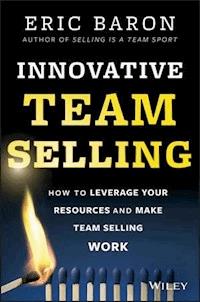
Most sales teams do not devote enough energy to meeting dynamics and process awareness. The skills related to this are critical components of effective teamwork, collaboration and innovation, both internally and externally. Innovative Team Selling places the focus squarely on what will actually make team selling work within organizations large and small. It outlines how to help your teams master new skills in five specific categories: interpersonal, communication, presentation, problem solving, and facilitation. Author Eric Baron also explores the challenging issue of leveraging resources to develop innovative solutions for clients in order to compete effectively in a globalized economy.
- Offers actionable strategies and techniques to improve collaboration, innovation and team processes
- Demonstrates how to put the right members on the sales call, and how to leverage their expertise before, during and after the call
- Explores in depth how teams can work effectively on a day-day-day basis to outperform their competition
- Author Eric Baron is founder of The Baron Group and is a highly acclaimed public speaker and has spoken to hundreds of organizations, trade associations and industry groups throughout his career; he is also an adjunct professor at Columbia Business School where he teaches his very popular course, Entrepreneurial Selling Skills to second year MBAs
Innovative Team Selling shows you how to lead and participate in teams that work together effectively; strategize prior to the client meetings; make successful team sales calls; and debrief honestly to determine how to learn and grow from the experience.
Das E-Book können Sie in Legimi-Apps oder einer beliebigen App lesen, die das folgende Format unterstützen:
Seitenzahl: 440
Veröffentlichungsjahr: 2013
Ähnliche



















Contents
Cover
Praise for Innovative Team Selling
Title Page
Copyright
Dedication
Introduction
Chapter 1: The Celebration, or Why We Need Sales Teams
Why Sales Teams?
The Human Factor
Chapter 2: Meetings, Bloody Meetings
So What's the Problem?
The Interactive Meeting Model
Chapter 3: Easy to Say; Hard to Do . . . Very Hard
The Importance of Establishing an Agenda
Setting the Ground Rules
Intentions
Treatment of Suggestions
The Use of Questions
Hidden Agendas
Control
Involving Team Members Remotely
And Finally
Chapter 4: So Who Does What and When?
The Role of the Sales Function
Content versus Process
Meeting Roles and Responsibilities
Enter the Facilitator
The External Meeting
Chapter 5: Now, Let's Get Creative
The Task
Let's Discuss It . . . but Not Too Much
Let the Games Begin
A Time to Judge
Finally, the Solution
Chapter 6: Adding Structure to the Process
Position the Session
Analyze the Problem
Generate Alternatives
Evaluate the Selected Ideas
Ideation Techniques
State the Solution
Chapter 7: Getting Our Acts Together
Roles and Responsibilities
So Let's Rehearse
Chapter 8: It's All About Connecting
Credibility
Sensitivity
Empathy
Before the Meeting
During the Meeting
After the Meeting
Trust
Visibility
Chapter 9: You Mean We Have to Sell, Too?
Doesn't Everybody Know This?
The Value Pyramid
Chapter 10: Positioning . . . A Key Ingredient in Understanding Needs
You can't do it all at once
Is It Happening Out There?
Salespeople as Problem Solvers
Turning Sales Teams into “Needs Development Teams”
It All Starts with Positioning
Chapter 11: Just One More Question (or Ten), If You Will, Please
Preparing the Client for Questioning
Asking the Appropriate Questions
The Content Perspective
The Process Component
The Pre-Cluster Statement
Chapter 12: Are They Sales Teams or Needs Development Teams?
Listen for the Needs and Opportunities
Another Way to Look at Needs
Sales Teams and Needs
So How Do You Do This?
Chapter 13: Is Anybody Listening?
The Problem
A Historical Perspective
Speed Kills
Bringing It All Together: Reviewing What You Learned
Chapter 14: The Big Day
It's All about Differentiation
Chapter 15: Okay, So How Do We Do All That?
The Presentation Model
The Specific Benefit
Making Outstanding Presentations
Airtime Distribution
The Unsolicited Idea
And in Conclusion . . .
Chapter 16: What Do You Mean You Don't Like It?
Acknowledge the Objection
Elaboration
Reframing
Address the Need
Invite Others
It's Really Problem Solving
Airtime Distribution—Again
Sales Teams Rule
Chapter 17: Bringing Home the Bacon
The Assumptive Close
Big “C” and little “c”
Enter the Four W's
Chapter 18: One Last Time: It's All About Differentiation
Differentiating the Sales Team
Some Parting Thoughts
About the Author
About the Baron Group
Acknowledgments
Index
Praise for Innovative Team Selling
“I have worked with Eric Baron for more than 25 years—as a colleague, as a client of his, and as a co-consultant. The insights in this book are extremely valuable—in particular in the current world, where team selling of complex customer propositions becomes both more central and more challenging at the same time. Bringing together an understanding of consultative selling, team dynamics, and leadership is a powerful combination that will help many teams to dramatically enhance their effectiveness. This book is a powerful tool for anyone who seeks to enhance the effectiveness of selling in today's environment.”
—David A. Nadler, PhD Vice Chairman Marsh & McLennan Companies (Author of Champions of Change and Building Better Boards)
“Fully leveraging sales resources is critical for businesses to succeed in today's dynamic, global economy. Eric Baron explains, in Innovative Team Selling, how sales teams can collaborate to derive innovative solutions to help their clients solve their business problems.”
—R. Glenn Hubbard Dean and Russell L. Carson Professor of Finance and Economics Columbia Business School
“Individuals can obviously do great work, but high-performing teams consistently produce better results. Innovative Team Selling explores how sales teams can collaborate to develop innovative solutions for their clients. We've successfully worked with Eric Baron and his team to deliver these concepts to our client-facing professionals. I'd encourage any organization that believes in team selling to consider what Eric has to say.”
—Karen Peetz President BNY Mellon
“Eric Baron and his team have helped me dramatically change cultures at Bankers Trust, Bank One, Citigroup, and AmSouth. Training sales teams to collaborate, leverage each other's expertise, and tap into their creativity will impact any sales organization and help them perform beyond their expectations. It is in your interest to learn how to apply the concepts outlined in Innovative Team Selling.”
—Geoffrey von Kuhn Managing Director of a large New England family office and former Head of U.S. Private Bank, Citicorp
“As Worldwide Training Director at Ogilvy & Mather, I relied on Eric Baron and his team to train our people around the world in collaboration, innovation, creative problem solving, and consultative selling. I am delighted to see him combine all this in Innovative Team Selling. This book's how-to skills and the understanding that supports them are practical, relevant, and often unique. If you work with clients, you'll benefit from reading this book.”
—Fred Lamparter former Worldwide Training Director, Ogilvy & Mather
“I have worked with Eric Baron for over 25 years and seen firsthand how powerful his approach is. Collaboration and teamwork are the pillars that support successful sales organizations. Innovative Team Selling is a must read for professionals in virtually any customer focused business.”
—Chuck Sulerzyski President & CEO Peoples Bank Marietta, Ohio
“Sales professionals in the biopharmaceutical industry must collaborate with their internal resources every day. Innovation and teamwork must become the norm. The skills, techniques, and approaches outlined in Innovative Team Selling are very applicable to our industry and others. Eric Baron and his team have a solid understanding of what it takes to make team selling work. Anyone in sales or sales support can benefit from this book.”
—Chuck Bucklar Vice President, North American Commercial Operations BioMarin Pharmaceutical, Inc.
Cover image: Matches © James Brey/iStockphoto
Cover design: C. Wallace
Copyright © 2013 by Eric Baron. All rights reserved.
Published by John Wiley & Sons, Inc., Hoboken, New Jersey
Published simultaneously in Canada
No part of this publication may be reproduced, stored in a retrieval system, or transmitted in any form or by any means, electronic, mechanical, photocopying, recording, scanning, or otherwise, except as permitted under Section 107 or 108 of the 1976 United States Copyright Act, without either the prior written permission of the Publisher, or authorization through payment of the appropriate per-copy fee to the Copyright Clearance Center, 222 Rosewood Drive, Danvers, MA 01923, (978) 750–8400, fax (978) 646–8600, or on the web at www.copyright.com. Requests to the Publisher for permission should be addressed to the Permissions Department, John Wiley & Sons, Inc., 111 River Street, Hoboken, NJ 07030, (201) 748–6011, fax (201) 748–6008, or online at www.wiley.com/go/permissions.
Limit of Liability/Disclaimer of Warranty: While the publisher and author have used their best efforts in preparing this book, they make no representations or warranties with the respect to the accuracy or completeness of the contents of this book and specifically disclaim any implied warranties of merchantability or fitness for a particular purpose. No warranty may be created or extended by sales representatives or written sales materials. The advice and strategies contained herein may not be suitable for your situation. You should consult with a professional where appropriate. Neither the publisher nor the author shall be liable for damages arising herefrom.
For general information about our other products and services, please contact our Customer Care Department within the United States at (800) 762–2974, outside the United States at (317) 572–3993 or fax (317) 572–4002.
Wiley publishes in a variety of print and electronic formats and by print-on-demand. Some material included with standard print versions of this book may not be included in e-books or in print-on-demand. If this book refers to media such as a CD or DVD that is not included in the version you purchased, you may download this material at http://booksupport.wiley.com. For more information about Wiley products, visit www.wiley.com.
Library of Congress Cataloging-in-Publication Data:
Baron, Eric.
Innovative team selling: how to leverage your resources and make team selling work/Eric Baron.
pages. cm
Includes index.
ISBN 978-1-118–50225-9 (cloth); ISBN 978-1-118–64640-3 (ebk);
ISBN 978-1-118–64636-6 (ebk); ISBN 978-1-118–64550-5 (ebk)
1. Selling. 2. Sales management. 3. Teams in the workplace. I. Title.
HF5438.B265 2013
658.85—dc23
2012049845
In Memory ofSandi RotkoffWithout whom this never would have happened
Introduction
My first book, Selling Is a Team Sport, was published more than 10 years ago. The world has undergone monumental changes since its publication as technology, globalization, and unparalleled competition have made succeeding in business so much more difficult. Innovation is no longer a luxury; it's a necessity for every organization if they want to stay in the game and ahead of their competition. Effective sales teams who understand how to leverage their resources can contribute significantly to any organization as they address the challenges they encounter in this competitive environment.
Organizations are comprised of intelligent, talented, committed, and effective people. We all know that individuals can do great work. But teams outperform individuals. We know that intuitively, and there is tons of research to back that statement up. Of course, there are situations where an individual might outperform a team when given a specific task. But nobody is smart enough to always assign a task to the one right individual who will outperform the team. It just doesn't work that way. Teams do better than individuals, and when they work together well they can accomplish great things.
This is a book about how effective team selling works. Our emphasis is on innovation, collaboration, teamwork, differentiation, and leveraging resources. Sales teams have the potential to do remarkable things. They just need to learn how to reach their potential. The intent of this book is to provide the reader with skills, techniques, methodologies, and approaches that will enable their teams to work together more effectively and derive innovative solutions for their customers.
The process of successful team selling is essentially comprised of three distinct components. First is the dynamic of how the sales team works together internally to develop strategies, recommendations, and solutions that address their clients' needs. They must learn how to conduct outstanding meetings. To do this they need to understand concepts like meeting dynamics, facilitation, roles and responsibilities, generating and developing ideas, leveraging each other's expertise, managing conflict, and gaining commitment. The first half of the book focuses on this internal component of team selling.
Second is how a sales team works together to make outstanding team calls. This is the external component. Whether it's two people meeting a prospective client early in the process, several colleagues making a formal presentation, or many members of the sales team participating in a Finalist Presentation, they need to do this in a customer-focused way that is both memorable and unique. How sales teams present themselves, how they connect with their customers, how they work together, how they demonstrate understanding of the client's situation, how they tell their story, and how they build upon each other's comments all contribute to the impression they make. These factors significantly impact the likelihood of their success. The skills required to make outstanding team calls are what the second half of the book explores.
There is an important third overarching component that impacts the entire team selling process: the planning and coordination required in day-to-day interactions. Sales teams can't just come together when it's time to strategize or when it's time to visit the client. They need to consistently collaborate. They need to communicate on a daily basis. They need to be thinking about the customer all the time. When they get together, they need to review each member's understanding of the customer's needs and look for unique ways to address those needs. The teams have to consistently leverage the collective expertise of the organization. They need to listen to different points of view. They need to plan and rehearse prior to their client visits. And they must always be held accountable—to the customer, to the organization, and to each other. This, too, will be discussed throughout the book.
This book is about improving the process behind selling as a team. You will see, as we investigate innovative team selling, that process refers primarily to how individuals work together. Whether it's with your colleagues, your teammates, your customers, your friends, or your children, how you interact greatly impacts whatever you hope to accomplish. What you have to say, or what you suggest, or even what you think is often dwarfed by the way you interact. Most of the information about team selling that is currently in the marketplace discusses what teams need to do, how they are comprised, and what their goals and objectives should address. That is important information. But there isn't much out there about how they do it. That's what we will explore together.
For sales teams to reach their potential, it is critical to understand the power of process awareness. Whether they are planning for a presentation, working together in developing a strategy, problem solving to derive innovative solutions, or meeting with their clients, how they interact drives everything. Unfortunately, process rarely gets the attention it deserves.
Ralph Waldo Emerson said, “What you are speaks so loud I cannot hear what you say.” This exemplifies the power of process. Sales teams can work effectively and efficiently, both internally and externally to derive creative, innovative solutions for their clients. Adding process sensitivity to the sales team's toolbox enables them to work like a well-oiled machine when they attack problems, uncover needs, and pursue opportunities. Understanding the importance of process enables teams to tell their story in a well orchestrated, beautifully coordinated, extremely polished and impressively professional manner that will differentiate them from their competitors every time.
In the 30-plus years that The Baron Group has been training sales professionals and sales managers, we have had the opportunity to observe tens of thousands of sales calls; some were in person, but most were in simulations on video. Participants in our programs practice the skills they learn by using cases we develop on video. As a result, we have acquired a body of knowledge that is based on what salespeople do, whether they are working internally or externally; whether it's face to face or on the phone; whether they are selling products or services; and whether they represent major corporations or smaller firms. We have learned much from them and as a result the concepts we teach are consistently tweaked, modified, or enhanced.
Early in our firm's evolution we won a job that we really had no right to win. We were too small, too young, and too inexperienced. But we won it. That happens sometimes, just as when you don't win jobs that you should have. The client told us that they selected us, not just because they liked our product, but because they liked how we worked together, how we gave the impression that we enjoyed each other, and how we demonstrated our ability to complement each other. There was more to it, of course, and our ability to demonstrate our understanding of their situation was huge, but the way we worked as a team played a big role in our winning that piece of business. I never forgot that, and much of what team selling is about can be summarized by that experience.
The Baron Group's roots trace back to Synectics® Inc., now called Synecticsworld. After earning a degree in chemical engineering, I worked for Union Carbide for eight years, holding positions in technical sales, sales management, and marketing. By accident I had the opportunity to work in the Personnel Development Laboratory (PDL), which was a group dedicated to training Carbide's sales professionals. The PDL was way ahead of its time back there in the 1970s, and we had the opportunity to work with people like Mac Hanan, Chet Karrass, Rosabeth Kanter, Earl Rose, and Barry Stein.
It was at PDL that I met Synectics and fell in love with the pioneering work they were doing in creative problem solving, innovative teamwork, and meeting management. I left Union Carbide to join Synectics, where I spent five wonderful years. It was at Synectics that I became intrigued with the notion of applying problem solving skills to the sales process. My colleague, Kate Reilly, and I left Synectics to found Consultative Resources Corporation (CRC) with Jonathan Whitcup in 1981. I left CRC to start The Baron Group in 1992, because my interest had evolved more toward team selling and relating innovation to the sales process.
When I wrote Selling Is a Team Sport, I introduced our sales process and demonstrated how sales teams could apply it to their day-to-day activities. I took the consultative selling model, built upon it by infusing it with problem solving skills and techniques, and demonstrated how by using it, sales teams could become more effective. But the book started with the selling model and related it to teams.
This book takes a very different approach in an effort to enhance the concepts and increase the uniqueness of the approach. Innovative Team Selling begins with the sales team, not the selling model. The early focus is on what the team needs to do to get its act together and do brilliant work. That is the starting point. So in essence this book turns everything upside down. Investigating sales teams and exploring how they can use sophisticated selling skills to do marvelous work is quite different from starting with the sales process and explaining how teams can effectively apply it. This reframing of team selling will be an exhilarating exercise and you will make many connections throughout the process.
With that in mind the book will once again take a hard look at some proven problem solving skills and explain how sales teams can use them to generate innovative solutions internally, and then leverage these concepts to impress their clients externally. It will explore meeting dynamics and introduce ways to use that knowledge with both colleagues and clients. And we will look at state-of-the-art selling skills that every member of the sales team can use whenever they interact with their customers.
To help accomplish this, a story is woven throughout the book. This fictitious story is about a sales team, led by their team leader, Sam Jamison. The team is comprised of 10 individuals from different functions. You will see how the team works together from the time they receive a Request for Proposal (RFP) that provides them with a marvelous opportunity, right through the day that they give their major presentation. You will see how Sam manages the team. You will observe the team as they strategize. You will watch them try to clarify the customer's needs. You will walk through their customer visits with them. You will see them rehearse before the big day. You will be there when they develop the big idea that helped them win the business. And you will even get a sense as to how they think and how they manage their own insecurities.
As you observe Sam and his team, you will benefit from watching them put into action what we have learned over the past three decades from the many outstanding salespeople with whom we have had the pleasure to work. Their story is based upon a real story. Everything they experience is based on actual situations, either our own or those of our clients. Their situations can apply to any organization regardless of their business, their size or their history. We made this example complicated, and it relates to a manufacturing company, but the dynamics can apply to any organization's sales opportunities.
Sales teams who understand how to use process as a tool to build relationships, understand their clients' needs, make great recommendations, and orchestrate both their internal and external meetings, will outperform their competitors every time.
You will notice as you read this book that we use the terms customer, client, buyer, and prospect interchangeably. We don't do that to confuse you. We do it to ensure that whoever reads this will be able to relate to the concepts we offer.
Every example we give, every anecdote we introduce, and every situation we include in the story about Sam Jamison's team is based on real events with only the names changed for obvious reasons. Everyone in our firm, including yours truly, has serious sales experience. We know what it is like to lose a job we should have won. We know what it's like to travel for hours only to learn that the customer can't see you. We know what it's like to be told you won a job only to have it go elsewhere for political reasons. We even know how it feels to be thrown out of someone's office—if not literally, at least figuratively. And, of course, we know how sweet it is to win new business, close deals, and emerge victorious.
So when you read this book, please keep in mind that it comes from people who have been there. Our research is based on experience, and the concepts we introduce have been tested in the best laboratory of them all—the real world.
I conclude by referencing my business partner for 12 years, David Hauer. He was with me during a critical period of our evolution and made significant contributions. David often referred to what we taught as “applied common sense.” The first few times I heard him use the term I didn't appreciate it and I shared that with him. But he continued to use it, and as time passed I realized he was right. Much of what we teach is common sense. I hope that, as you read this, you'll realize that much of what we say are things you either do, or know you can do, or realize you should do, but don't do as often as you'd like. Much of what we include are the things successful salespeople incorporate into their approach. This book will help make the principles associated with team selling practical, usable, manageable, and, yes, ways to apply what is really common sense.
Enjoy the experience.
1
The Celebration, or Why We Need Sales Teams
It was not your typical business dinner. The group was a bit more jubilant, bordering on being rowdy. They had just arrived and you could immediately sense that unlike similar events, the evening was getting off to a fast start. Usually the excitement builds at these kinds of dinners, but not tonight. The high-fives and fist pumps were flying around the room before people took off their coats.
Sam Jamison, the sales professional and team leader who had arranged for the team to celebrate their recent success, was glad he had requested a private room. He had a feeling that things could get noisy as the evening moved on. And why not? This was their evening. They earned it.
Lesen Sie weiter in der vollständigen Ausgabe!
Lesen Sie weiter in der vollständigen Ausgabe!
Lesen Sie weiter in der vollständigen Ausgabe!
Lesen Sie weiter in der vollständigen Ausgabe!
Lesen Sie weiter in der vollständigen Ausgabe!
Lesen Sie weiter in der vollständigen Ausgabe!
Lesen Sie weiter in der vollständigen Ausgabe!
Lesen Sie weiter in der vollständigen Ausgabe!
Lesen Sie weiter in der vollständigen Ausgabe!
Lesen Sie weiter in der vollständigen Ausgabe!
Lesen Sie weiter in der vollständigen Ausgabe!
Lesen Sie weiter in der vollständigen Ausgabe!
Lesen Sie weiter in der vollständigen Ausgabe!
Lesen Sie weiter in der vollständigen Ausgabe!
Lesen Sie weiter in der vollständigen Ausgabe!
Lesen Sie weiter in der vollständigen Ausgabe!
Lesen Sie weiter in der vollständigen Ausgabe!
Lesen Sie weiter in der vollständigen Ausgabe!
Lesen Sie weiter in der vollständigen Ausgabe!
Lesen Sie weiter in der vollständigen Ausgabe!
Lesen Sie weiter in der vollständigen Ausgabe!




