Table of Contents
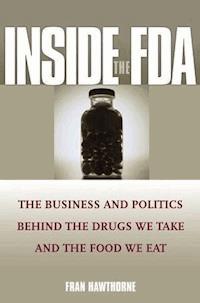
Title Page
Copyright Page
Dedication
Introduction
CHAPTER 1 - Case Study: Chasing Cancer
CHAPTER 2 - Beyond Science
CHAPTER 3 - The First 100 Years
CHAPTER 4 - “You D on’t Know Which Agency Is in Charge”
CHAPTER 5 - Truckloads of Paper
CHAPTER 6 - Case Study: The Return of Thalidomide
CHAPTER 7 - How Picky Is the FDA?
CHAPTER 8 - How Powerful Is Industry?
CHAPTER 9 - Case Study: The Death of Monica George
CHAPTER 10 - When Consumers Get Angry
CHAPTER 11 - A Political Pawn
CHAPTER 12 - FDA and DNA
CHAPTER 13 - The FDA Meets Madison Avenue
CHAPTER 14 - Frivolous Drugs?
CHAPTER 15 - The Next 100 Years
THE COST OF MEDICINE
PERFECT BODIES
THE WAY WE LIVE
TOBACCO AGAIN?
FIGHTING TERRORISM
CATCHING UP AFTER THE FACT
Acknowledgments
Notes
Bibliography
Index
Copyright © 2005 by Fran Hawthorne. All rights reserved.
Published by John Wiley & Sons, Inc., Hoboken, New Jersey Published simultaneously in Canada
No part of this publication may be reproduced, stored in a retrieval system, or transmitted in any form or by any means, electronic, mechanical, photocopying, recording, scanning, or otherwise, except as permitted under Section 107 or 108 of the 1976 United States Copyright Act, without either the prior written permission of the Publisher, or authorization through payment of the appropriate per-copy fee to the Copyright Clearance Center, Inc., 222 Rosewood Drive, Danvers, MA 01923, 978-750-8400, fax 978-646-8600, or on the web at www.copyright.com. Requests to the Publisher for permission should be addressed to the Permissions Department, John Wiley & Sons, Inc., 111 River Street, Hoboken, NJ 07030, 201-748-6011, fax 201-748-6008.
Limit of Liability/Disclaimer of Warranty: While the publisher and author have used their best efforts in preparing this book, they make no representations or warranties with respect to the accuracy or completeness of the contents of this book and specifically disclaim any implied warranties of merchantability or fitness for a particular purpose. No warranty may be created or extended by sales representatives or written sales materials. The advice and strategies contained herein may not be suitable for your situation. You should consult with a professional where appropriate. Neither the publisher nor author shall be liable for any loss of profit or any other commercial damages, including but not limited to special, incidental, consequential, or other damages.
For general information on our other products and services, or technical support, please contact our Customer Care Department within the United States at 800-762-2974, outside the United States at 317-572-3993 or fax 317-572-4002.
Wiley also publishes its books in a variety of electronic formats. Some content that appears in print may not be available in electronic books. For more information about Wiley products, visit our Web site at www.wiley.com.
Library of Congress Cataloging-in-Publication Data
Hawthorne, Fran.
Inside the FDA : the business and politics behind the drugs we take and the food we eat / Fran Hawthorne.
p. cm.
Includes bibliographical references.
ISBN 0-471-61091-7 (cloth)
1. United States. Food and Drug Administration. 2. Pharmaceutical policy—United States. 3. Food adulteration and inspection—United States. I. Title.
RA401.A3H39 2005
3 53.9’98’0973—dc22
2004022067
To the generations: my parents, Lillian and Edward Hawthorne, and my children, Mallory and Joey
Introduction
The Holiday Inn in Bethesda, Maryland, is an unassuming stucco building tucked sideways off a slow commercial street, across from a Pizza Hut, a gas station, and a mini-mart. You enter from the side driveway and climb up a wide, curving staircase to reach the Versailles II ballroom on the second floor.
On a sunny February morning in 2004, as week-old snow lingered in piles at the edge of the sidewalk, it was standing room only in that ballroom. Some three hundred people had come—parents, grandparents, siblings, and friends, bearing posters and white satin ribbons—to talk to the United States Food and Drug Administration about the medicine that had killed someone they loved.
The long room was decorated in shades of beige and blue, with textured beige wallpaper, beige-and-brown carpeting in a fleur-de-lis motif, and a turquoise ceiling studded with 16 crystal chandeliers. At one end, three tables had been arranged in a large “U” for the two panels of 36 outside experts who had been summoned to advise the FDA, along with a few agency staffers. Facing them were rows of burgundy-and-purple brocade chairs, a battery of TV cameras, and a microphone for the audience.
They came from Rhode Island and California, from Texas and Colorado, Arizona and Pennsylvania. Most of them were middle-aged, the men in business suits, the women in nice slacks. One mother quoted the Book of Revelations; another wore a button supporting Democratic Senator John Edwards for president. A 10-year-old girl read an Archie comic book, while a boy of about six played with his GameBoy. In the hall outside the ballroom, one blonde woman asked another, “Was your daughter suicidal?”
They came with tales of the anguish and horror that they and their families had lived through after a teenage son, daughter, grandchild, or friend had started taking an antidepressant medication legally prescribed by their doctor and approved by the FDA. While on the medication, the teenagers had killed themselves, or someone else, or tried to. The families blamed the drugs, and they wanted the FDA to do something to prevent more horror stories.
Tom and Kathy Woodward. Their 17-year-old daughter Julie had hung herself in the garage six months earlier, after seven days on Zoloft.
Terri Williams. Her 14-year-old son Jacob had hung himself in the attic with a belt while taking Prozac. A friend held up a picture of Jacob in his football uniform.
Corey Baadsgaard with his father, Jay. Corey had used first Paxil, then Effexor. Then he woke up in a juvenile detention center one morning. Apparently, he had carried a hunting rifle to school and held his class hostage, but he didn’t remember any of that. “These drugs are hell. Look what they’ve done to my son!” Jay Baadsgaard shouted, his voice hoarse. He strode out of the ballroom, slamming the door behind him.
Glenn McIntosh. His daughter Caitlin hung herself in the girls’ bathroom in her middle school when she was 12; she had been using Paxil and Zoloft. She had been a straight-A student and had hoped to be a veterinarian.
Eileen and Todd Shivak. Their 11-year-old son Michael had taken Paxil. He was still alive. But he had tried to slash his wrists in class, had run in front of a moving car, and was now afraid of doctors, teachers, and police. “His peers think of him as a freak,” the Shivaks said.
One after another, more than 60 people spoke.
The medications had all been approved by the FDA years ago, starting in 1988, for adults. Millions of people said the pills had saved them from unbearable depression, anxiety, compulsive behavior, panic attacks, and stomach pains. Yet the medicines had been controversial almost from the start, because of their ability to alter people’s moods and personality so powerfully. Almost 13 years earlier the FDA had convened a similar meeting of outside experts to discuss whether these pills led to suicidal tendencies in adults; some of the same people now in the audience at the Holiday Inn had been there, too. Back then, emotions had been so intense that the chairman of the advisory panel had worn a bulletproof vest. The Church of Scientology had condemned Prozac. A small study by two Harvard researchers had seemed to show that people on Prozac were prone to suicidal thoughts, and patients and their families had sued Eli Lilly and Company, the manufacturer of the drug. In 1989 a Kentucky printing press operator named Joseph Wesbecker had killed eight co-workers plus himself with an assault rifle and wounded a dozen others a few weeks after he started taking Prozac. The FDA panel back then recommended further research. Still, the FDA had decided that the drugs were beneficial and safe for most people, based on the weight of scientific studies, and should stay on the market.
For patients under 18, there was the added concern about how these powerful chemicals might affect brains that were still developing. Children’s brain chemistry is different from that of adults. So even if the drugs were completely safe for adults and helped ease their depression, that did not mean they were necessarily safe or helpful for children. Only Prozac had ever been officially authorized as an antidepressant for this age group. Studies on the other drugs (most of them belonging to a class known as selective serotonin reuptake inhibitors, or SSRIs) had not clearly shown that they worked significantly better than a placebo, or fake drug.
Nevertheless, doctors could legally prescribe any of the medications for any age, and they did: The usage rate for children under 18 jumped more than threefold from the early 1990s to 2001, according to a study by Washington State University; the FDA reported that almost 11 million prescriptions for that age group were written in 2002.
If there was no sure proof that the SSRIs were effective for youths, neither had any clinical trials on patients clearly and definitively demonstrated that the medications increased the risk of suicide—or at least, that was what the medical community believed. The companies that produced the drugs, anxious not to lose this rich market, insisted that the families’ stories were only anecdotal—though heartbreaking—aberrations. What made things even more difficult to sort out was that the patients taking the pills were unhappy to begin with, by definition, and might have tended toward suicide with or without the medications. It was also hard to define what to consider a “suicide attempt.” Slapping yourself on the head? Stabbing yourself with a pencil during an exam? For that matter, even as the use of the antidepressants had been rising, the overall rate of teenage suicide in the United States had dropped in the late 1990s. So maybe the pills were actually helping to reduce the number of suicides.
The FDA had issued a warning specifically about Paxil in June 2003 after the drug’s manufacturer, GlaxoSmithKline, submitted studies that showed a higher level of what might be suicidal thoughts and incidents among adolescents and younger children taking that drug, compared with patients taking a placebo. (Most of the data about Paxil was not made public, and the New York state attorney general, Eliot Spitzer, sued GlaxoSmithKline a year later for withholding the trial results.) In October came a stronger FDA warning about the whole group of antidepressants. The warnings did not forbid doctors from using these medicines, however. There still seemed to be no definitive proof, either that the drugs led to an increased risk of suicide, or that any drug but Prozac worked in youngsters. The FDA commissioned Columbia University to conduct yet another study. Meanwhile, in December, the British equivalent of the FDA took a stronger step, warning doctors in the United Kingdom to shun all antidepressants but Prozac for children.
Most of the speakers at the Holiday Inn called for stricter labels on the drugs, and some urged that only trained specialists, not generalists or pediatricians, should be allowed to prescribe them. Some demanded an outright ban. They wanted the FDA to protect their children. Yet many of them were skeptical that the regulators would.
Dawn Rider exuded an air of competence and confidence; she was a tall woman with a bright red jacket and long, thick, dark hair. Her 14-year-old son had died after taking Prozac. Then her husband was given Paxil to help him cope with the death, and his attempt to withdraw from that drug destroyed their marriage, she told the crowd in the ballroom. During the lunch break, I asked her what she hoped the FDA would do.
“I don’t have a lot of faith in the FDA,” she replied. “There’s too much sway from the pharmaceutical industry.” She pointed particularly to the fact that Mitchell E. Daniels Jr., a former Lilly executive, had been the White House budget director and was running for the Republican nomination for governor of Indiana. (He would later be elected.) And somehow it was only Lilly’s drug Prozac that had been approved for children. “I was sitting there, watching them [on the FDA panel] today. I almost noticed bored expressions.”
“It’s clear that the FDA is a political entity,” Tom Woodward told the three dozen panelists. “Under the Bush administration, the FDA is putting the drug industry over the interests of the public.”
The FDA?
The Food and Drug Administration, the agency that was created in 1906 to make sure that Americans were never again poisoned en masse the way Upton Sinclair described in his novel The Jungle? That poll after poll has always shown is one of the most trusted arms of the entire government?
For almost a century, the FDA has been the Good Housekeeping seal of approval, the Nobel Prize, and Ivory soap (99 and percent pure) combined. No medicine or medical device can be sold in the United States unless the FDA pronounces that it is safe and that it works. No packaged food can make health claims unless its label is approved by the FDA. Americans count on this agency to make sure that we have a steady stream of wonderful new pills that are potent and perfectly safe at the same time, as well as a supermarket full of goodies that we can gobble up without worrying about food poisoning. We also count on this government agency to be on our side against powerful drug and food companies and to resist political pressure. We trust the FDA so that we do not have to stop and read the label of every can of soup and bottle of aspirin we buy. In fact, we pretty much assume that it will protect us from everything short of nuclear war.
Undoubtedly, most Americans do not completely understand how this influential government office works. We probably overstate its clout in some categories, like restaurants, and don’t realize how far its power extends into other areas, like microwave ovens and pet food. Some people think it tests every drug that is sold, and or that it inspects all food products. (Neither of these is true.) Still, we know the basics: If the FDA lets us down, we are not just personally disappointed, betrayed, and angry. We could be dead.
To say you have lost faith in the FDA is like saying motherhood and apple pie have gone rotten—literally, in fact, since the FDA is supposed to ensure that apple pie is safe to eat if you buy it prepackaged from the supermarket. (Not if you eat it in a restaurant, however.)
So how could this mighty agency that we have relied on for a century mess up so badly? Why didn’t it catch the suicide problem before it ever approved the first SSRI? How can it be legal for doctors to give teenagers drugs that the FDA never approved for kids? Why didn’t the FDA know about the GlaxoSmithKline studies? The parents who came to the Holiday Inn had once trusted the FDA to keep their children safe. And it had failed them.
Before I started covering health care as a reporter and editor at Institutional Investor magazine in the early 1990s, I probably had more or less the same vague knowledge of the FDA that most Americans do. Luckily, I never had much reason to be concerned with the products it oversees. I come from a healthy, long-lived family, and my husband, my kids, and I have rarely needed a prescription except for the occasional antibiotic. Nor have I had to be a caretaker for my parents or other aging relatives who do take a lot of medication. As for the “F” in FDA, well, I’ve always worried more about the calories in my food than any contaminants.
Once I began writing about the pharmaceutical industry and health insurance, I got to meet the FDA that the drug companies know. To these companies, it is the all-powerful, arbitrary, nitpicky naysayer that keeps their desperately needed medicines off the market until they run a zillion unnecessary tests to prove things they already proved. The agency is unreliable, one week saying it wants to help manufacturers get their products out to patients quickly, then the next week panicking after too many reports of dangerous side effects. It is mysterious; there is no way of knowing just what a company must do to move its product past the regulatory box-checkers. At best, the FDA is a bunch of bureaucrats who mean well but are scared to be the first to approve something new. Most of all, the agency must be obeyed. It is almost impossible to get through a 10-minute interview with a pharmaceutical executive without hearing at least one complaint or fear about the FDA.
Of course that is a one-sided view, and the other side can overwhelm you as soon as you walk into an advisory committee hearing, such as the one at the Holiday Inn. There were so many stories at that hearing that I stopped taking notes. It was too much suffering, too many horrible new examples, one after another, without enough time to absorb the horror of the first ones. And it was painful to be there, to picture my own kids’ faces—to be too lucky. The drug companies were wrong; the problem was not that the FDA was keeping good medicines off the market in order to enforce overly stringent rules. The problem was clearly that the FDA had given in too easily to the drug companies’ pressure, had skimped on its due diligence, and had let dangerous products into the marketplace.
I wondered how it felt to be one of the FDA staffers listening to those stories at the Holiday Inn, knowing that maybe something you had done had caused a family so much pain. A few weeks after the hearing, I asked Dr. Robert J. Temple that question. Heavyset and a bit shorter than average, with longish salt-and-pepper hair that flips over his collar, a thick mustache, round eyeglasses, and thick dark eyebrows, Temple is the FDA’s associate director of medical policy and its resident expert on clinical drug trials. He started working at the agency in 1972, just as it was in the midst of laying out the scientific processes that would define modern drug testing, and he has been in the midst of it ever since. In his job capacity, Temple was one of the three dozen people at the U-shaped table, though he was not a member of the advisory panels and could not vote on any recommendations. He gave a short laugh at my question. “They’re very moving stories,” he replied calmly. “The fundamental problem,” and he leaned forward as though to share a secret, “is you don’t know whether in fact their attribution is correct. Long before there were antidepressants, people committed homicides and suicides. It’s well known that depression is a cause of suicide.”
In other words, yes, the families’ tales were sad, but heartbreak is not scientific proof. Just because someone takes Pill A and then commits Act B, that does not prove that A caused B. What else was happening in the person’s life that could have led to Act B? What had other people done when they were taking Pill A? The FDA could not base its decisions on emotion. First and foremost, before worrying about drug companies’ profits, before even worrying about consumers’ anxieties or medical needs, the FDA had to look at the science.
Maybe. But as a reporter at newspapers in California and New Jersey over the years and as the former political reporter for Institutional Investor, I have spent enough time covering politics at the local, state, and federal levels to know that the FDA’s decisions could not always be purely scientific. The FDA is a government agency. Its commissioner is appointed by the president. Its budget and commissioner have to be approved by Congress. Its officials can be hauled before a congressional committee for interrogation at any time. Its major decisions are usually vetted by the Department of Health and Human Services, if not the White House. On top of all that, the FDA regulates the industry—pharmaceuticals—with the most powerful lobbying force in Washington, D.C. Of course all those players try to influence FDA decisions on issues they care about, and of course, the FDA gives in when the pressure is too great. If there are three hundred parents whose children become violent after taking drugs like Paxil and those three hundred parents shout loud enough, Congress, the White House, the pharmaceutical industry, and the FDA will hear. Marion Goff of Rhode Island, one of the parents at the Holiday Inn, knew exactly what she was doing when she brought a friend to the hearing—Stephanie Chafee, wife of Republican senator Lincoln Chafee.
Chafee stood nearby, silently, while Goff told the FDA experts how one of her twin daughters, then age nine, had taken Zoloft and Paxil. Goff had once found the girl on the window ledge, with one leg already out the window. The girl had also tried to stab herself repeatedly.
And there is a lot more to the FDA jigsaw puzzle. Now that I was covering health care, I naturally began noticing constant references to the FDA in the news, even in the most unlikely articles. The agency warned pregnant women against using sophisticated ultrasound equipment to take “souvenir” pictures of embryos. Blood banks complained that the FDA was making them ask too many questions of potential donors, about AIDS, West Nile disease, and SARS. A factory in China, certified by the FDA to manufacture ingredients for various medicines, was dumping untreated chemical waste. Cell phone users wanted the FDA to find out if their phones might cause brain cancer. Was there anything the agency didn’t regulate? Indeed, it seemed to have its finger in many of the most controversial and important pies at the American supper table: genetic engineering of plants and animals, abortion, mad cow disease, obesity, drug prices, cloning, Baby Boomer vanity drugs, illegal steroid use by athletes, drug ads on TV.
How could I fit something this huge into a single book?
As it turned out, perhaps the grieving parents at the Holiday Inn should not have been so cynical. At the conclusion of the hearing that afternoon, the two scientific advisory committees recommended that the FDA immediately issue stronger warnings to doctors about the risks to children, without waiting for Columbia University to complete its analysis. In its official decision a month and a half later, the agency went even further. First, it asked the manufacturers themselves to place warnings right on package labels, which were more likely to be seen by doctors and patients on an ongoing basis. It also put out a health advisory to physicians and other caregivers to “closely monitor all patients being placed on therapy with these drugs for worsening depression and suicidal thinking,” especially at the beginning of treatment—all patients, not just children.
This was pretty impressive. The FDA really listens to ordinary people, acts fast, and bucks the big drug companies. The New York Times claimed the new warnings were a break with the FDA’s normal, more cautious procedures, because there was no clear-cut evidence of danger from “well-controlled” human trials.
But then several newspapers reported that, in fact, even before the hearing at the Holiday Inn, the FDA did have such evidence—and kept it hidden. In studying data from more than 4,000 participants in clinical trials, an FDA drug safety analyst, Dr. Andrew D. Mosholder, said he found that children on antidepressants were almost twice as likely to become suicidal as those on placebos. The agency refused to let him testify about his findings at the hearing and never showed the panelists his report, however. With the incident hitting newspaper headlines across the country, the chairman of the Senate Finance Committee, Charles Grassley of Iowa, launched an investigation that came up with further charges of FDA manipulation. “You don’t just ask someone to clam up,” the senator told the Wall Street Journal. “If there’s any doubt, they ought to put out the caution to the public at large.” All that was on top of the Paxil trial results that GlaxoSmithKline and the FDA had kept from the public.
So had the FDA actually tilted in favor of the pharmaceutical companies by squelching reports critical of their drugs, even while it seemed to be listening to the patients?
Well, that was not necessarily the case, either. Bob Temple, the expert on clinical trials, told reporters that Mosholder’s report was “premature” because too much of the underlying data was unreliable—for instance, some of the supposed examples of suicide attempts were vague and might not have been real attempts. He said the FDA did not want to spread unsubstantiated fears, thereby discouraging severely depressed people from getting treatment that might help them. And FDA officials claimed the law did not allow them to reveal GlaxoSmithKline’s proprietary trial results. Even before I had a chance to ask, Dr. Steven Galson, the acting head of the FDA’s Center for Drug Evaluation and Research, insisted in an interview with me that “stories that we’re somehow suppressing people, that’s the farthest from the truth.”
Later that summer, the Columbia University report did back up Mosholder’s findings, but only after digging into the data more deeply. Finally, another meeting of outside experts in September called for yet stricter warning labels, and the FDA officialdom agreed to implement those changes. In fact, the agency said it would even go back and reanalyze its data on adult suicidal behavior. Temple admitted that all the clinical trials, taken together, seemed to show “an increase in suicidal thinking and action.”
At a hearing soon afterwards, members of Congress from both parties pounded on the FDA for hiding Mosholder’s report and other information. “The FDA’s lack of cooperation,” declared Congressman Joe L. Barton of Texas, “leaves me wondering whether this is sheer ineptitude or something far worse.” “No agency charged with the public health should have behaved with such indifference to the public safety as is evidenced in this case,” intoned Congressman Peter Deutch of Florida. The House and Senate both launched investigations.
Two more possibilities, then. Maybe the brouhaha over the Mosholder report proved that the FDA truly operates the way Temple described it, as an ivory tower of pure science. It is so careful and so insistently scientific that, even under tremendous pressure from consumers, the press, and politicians, it will not issue half-baked announcements until it has all the facts. And if new data cast doubt on its previous findings, it is so scientifically pure that, rather than stonewall, it will pore through all of its research yet again.
Or maybe, like any institution, it just tried to cover up its own mistakes.
Protector of the consumer? Pawn of industry? Pure scientists? Political plaything?
Now I really needed to write this book. I had to put all the jigsaw pieces together and decide what the FDA is—this sprawling, scientific, political, nitpicky, pioneering, admired, feared, detested, trusted agency.
CHAPTER 1
Case Study: Chasing Cancer
Garo Armen, Russ Herndon, Pramod Srivastava, and Renu Gupta started practicing at nine in the morning on the day after Labor Day, 2003. They gathered in a small, green-carpeted conference room just off the seven-floor atrium of the DoubleTree hotel in Rockville, Maryland, half an hour outside Washington, D.C. Across from their room, bathed in the atrium’s soft yellow light, three small waterfalls trickled down an indoor stone wall.
Okay, what would the reviewers from the Food and Drug Administration be likely to ask when they met that afternoon?
The four of them worked for a New York City company called Antigenics Inc., one of countless new, small firms trying to use a niche of biotechnology to tackle cancer. Srivastava and Gupta, both born in India and deeply interested in philosophy, were the scientists. Herndon was the businessman, outgoing and boyish-looking. Armen was pretty much everything: CEO, co-founder, fundraiser, public spokesman, elder statesman, and driving force.
Antigenics’ particular approach was based on work that Srivastava had begun as a graduate student 25 years earlier at the Centre for Cellular and Molecular Biology in Hyderabad, India. That work focused on a kind of protein known as heat-shock proteins, or stress proteins, which are found in all cells of all living organisms, including cancer cells. Under normal circumstances, these proteins play a major role in transporting another kind of protein called antigens within a cell (and thus they have an even more colorful nickname, chaperones). Antigens, for their part, stimulate the body’s immune system to respond to infection or disease. In theory, you could extract and purify the heat-shock proteins that had chaperoned an antigen that stimulated a response to a certain cancer. Then the extracted heat-shock proteins could be made into a vaccine that would contain some trace of that specific antigen and its cancer—the “antigenic fingerprint” of that cancer. If a patient got that vaccine, unique to his or her cancer, the immune system might be reprogrammed to home in on cancer cells bearing the antigenic fingerprint. It would not prevent anyone from getting cancer, but it could stop the cancer from spreading.
That was the theory, anyway. A number of universities and research institutes in the United States and Europe were also studying the heat-shock protein process, and so far the buzz about Antigenics among scientists and on Wall Street was cautiously positive. The vaccine, which was called Oncophage, had already proved itself in animal experiments, in tests for safety, and even in the first stage of clinical trials on cancer patients. A trial of colorectal cancer patients had just reported some good news about survival rates. Now 650 people with kidney cancer and 350 with skin cancer were participating in further tests at more than 130 sites around the world.
As soon as doctors removed a patient’s tumor, the specimen was frozen in dry ice and rushed to Antigenics’ labs in Woburn and Lexington, Massachusetts, both near Boston. There, scientists had 24 hours in which to extract the heat-shock proteins—they needed a minimum of seven grams of tumor—and process them into a vaccine. For the next three weeks the vaccines were tested for purity, sterility, and composition. Finally, at least four vials were flown back to each patient and injected—one a week for four weeks, then biweekly. The stuff looked like a small glass of Sprite.
Lesen Sie weiter in der vollständigen Ausgabe!
Lesen Sie weiter in der vollständigen Ausgabe!
Lesen Sie weiter in der vollständigen Ausgabe!
Lesen Sie weiter in der vollständigen Ausgabe!
Lesen Sie weiter in der vollständigen Ausgabe!
Lesen Sie weiter in der vollständigen Ausgabe!
Lesen Sie weiter in der vollständigen Ausgabe!
Lesen Sie weiter in der vollständigen Ausgabe!
Lesen Sie weiter in der vollständigen Ausgabe!
Lesen Sie weiter in der vollständigen Ausgabe!
Lesen Sie weiter in der vollständigen Ausgabe!
Lesen Sie weiter in der vollständigen Ausgabe!
Lesen Sie weiter in der vollständigen Ausgabe!
Lesen Sie weiter in der vollständigen Ausgabe!
Lesen Sie weiter in der vollständigen Ausgabe!
Lesen Sie weiter in der vollständigen Ausgabe!
Lesen Sie weiter in der vollständigen Ausgabe!
Lesen Sie weiter in der vollständigen Ausgabe!