


88,99 €
Mehr erfahren.
- Herausgeber: John Wiley & Sons
- Kategorie: Geisteswissenschaft
- Sprache: Englisch
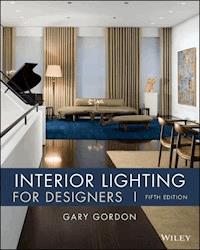
This revised edition of the successful primer thoroughly covers fundamentals of lighting design, and also serves as a handy reference for professional designers. The Fifth Edition is more comprehensive than ever, with new information on LED, energy efficiency, and other current issues. In addition, it includes more information for drawing ceiling floor plans and the application of designs to specific types of interiors projects. Considered a "key reference" for the Lighting Certified exam, no other text combines both technical and creative aspects of lighting design for beginners and novice designers.
Sie lesen das E-Book in den Legimi-Apps auf:
Seitenzahl: 425
Veröffentlichungsjahr: 2015
Ähnliche




















INTERIOR LIGHTING
FOR DESIGNERS
FIFTH EDITION
GARY GORDON, FIES, FIALD, LC
ILLUSTRATIONS BY GREGORY F. DAY, LC
Cover image: © Paul Warchol Cover design: Wiley
This book is printed on acid-free paper.
Copyright © 2014 by Gary Gordon. All rights reserved.
Published by John Wiley & Sons, Inc., Hoboken, New Jersey. Published simultaneously in Canada.
No part of this publication may be reproduced, stored in a retrieval system, or transmitted in any form or by any means, electronic, mechanical, photocopying, recording, scanning, or otherwise, except as permitted under Section 107 or 108 of the 1976 United States Copyright Act, without either the prior written permission of the Publisher, or authorization through payment of the appropriate per-copy fee to the Copyright Clearance Center, 222 Rosewood Drive, Danvers, MA 01923, (978) 750-8400, fax (978) 646-8600, or on the web at www.copyright.com. Requests to the Publisher for permission should be addressed to the Permissions Department, John Wiley & Sons, Inc., 111 River Street, Hoboken, NJ 07030, (201) 748-6011, fax (201) 748-6008, or online at www.wiley.com/go/permissions.
Limit of Liability/Disclaimer of Warranty: While the publisher and author have used their best efforts in preparing this book, they make no representations or warranties with the respect to the accuracy or completeness of the contents of this book and specifically disclaim any implied warranties of merchantability or fitness for a particular purpose. No warranty may be created or extended by sales representatives or written sales materials. The advice and strategies contained herein may not be suitable for your situation. You should consult with a professional where appropriate. Neither the publisher nor the author shall be liable for damages arising herefrom.
For general information about our other products and services, please contact our Customer Care Department within the United States at (800) 762-2974, outside the United States at (317) 572-3993 or fax (317) 572-4002.
Wiley publishes in a variety of print and electronic formats and by print-on-demand. Some material included with standard print versions of this book may not be included in e-books or in print-on-demand. If this book refers to media such as a CD or DVD that is not included in the version you purchased, you may download this material at http://booksupport.wiley.com. For more information about Wiley products, visit www.wiley.com.
Library of Congress Cataloging-in-Publication Data
Gordon, Gary
Interior lighting for designers / Gary Gordon FIES, FIALD, LC ; Illustrations by Gregory F. Day, LC. -- Fifth Edition. pages cm Includes index. ISBN 978-0-470-11422-3 (cloth); ISBN 978-1-118-41506-1 (ebk); ISBN 978-1-118-41771-3 (ebk) 1. Electric lighting. 2. Lighting, Architectural and decorative. I. Title. TK4175.G67 2013 729'.28--dc23 2013018922 978-0-470-11422-3
to
Caryl Becker Gordon and Robert Neil Gordon,
with gratitude for their unwavering support
“Light is the key to well-being.”
—Le Corbusier
CONTENTS
Preface
Acknowledgments
Introduction
Part I: Design Factors
1: The Lighting Design Process
2: Perception and Vision
Visible Light
The Eye and Brain
Brightness Perception
Color Perception
3: Light and Health
Photobiology and Nonvisual Effects
The Circadian Pacemaker
Melatonin Suppression
The Aging Eye
Light Therapy
Assisted-Living and Eldercare Facilities
Dynamic Electric Lighting
4: Psychology of Light
Emotional Impact
Degrees of Stimulation
Degrees of Brightness Contrast
The Three Elements of Light
Subjective Impressions
Notes
5: Patterns of Brightness
Brightness versus Luminance
Direction and Distribution of Light
Surface Finishes and Reflectances
Three-Dimensional Form
Glare and Sparkle
6: Color of Light
Color Temperature
Color Rendering
Subjective Impressions
Surface Finishes and Color of Light
7: Measurement of Light
Quantitative Illumination
Part II: Light Sources
8: Daylight
Daylight Design
Shading Devices
Glazing Materials
Quantity of Interior Daylight
9: Filament Sources
Lamp Shapes
Lamp Bases
Filaments
Light Output
Tungsten-Halogen Lamps
Lamp Types
Low-Voltage Lamps
U.S. Legislation
Colored Light
10: Low-Intensity Discharge Sources
Fluorescent Lamps
Lamp Characteristics
Health and Safety Concerns
11: High-Intensity Discharge Sources
Mercury Vapor Lamps
High-Pressure Sodium Lamps
Metal Halide Lamps
Lamp Characteristics
Dimming
Low-Pressure Sodium Lamps
Notes
12: Solid-State Lighting
LEDs
Use in Interiors
Organic Light-Emitting Diodes
13: Auxiliary Equipment
Ballasts
Drivers
Transformers
Part III: Interior Illumination
14: Light Control
Control of Light Direction
Glare Control
15: Luminaires
Housings
Light and Glare Control
Decorative Luminaires
Emergency and Exit Luminaires
16: Sustainable Design
Integrating Light and Architecture
Visual Clarity
Architectural Surfaces
Task Lighting
Ambient Lighting
Lighting Three-Dimensional Objects
Balance of Brightness
Successful Solutions
17: Design Verification Methods
Recommended Illuminance Values
Surface Reflectance
Illuminance Calculations
Postoccupancy Evaluation
18: Electricity and Lighting Controls
Principles of Electricity
Switch Control
Dimming Control
Digital Lighting Controls
Energy-Management Controls
19: Documentation
Construction Documents
Epilogue
Quality of Life
Appendix
References
Glossary
Index
Color Plates
End User License Agreement
List of Tables
Appendix
Table 1
Table 2
Table 3
Table 4
Table 5
Table 6
Table 7
Table 8
Table 9
Table 10
Table 11
Table 12
Table 13
Table 14
Table 15
Table 16
Chapter 13
Table 13.1
List of Illustrations
Chapter 2
Figure 2.1 Visible light is a narrow region of the total electromagnetic spectrum, which includes radio waves, infrared, ultraviolet, and X rays. The physical difference is purely the wavelength of the radiation, but the effects are very different. Within the narrow band to which the eye is sensitive, different wavelengths give different colors. See also Color Plate 7.
Figure 2.2 The law of refraction (Snell’s law) states that when light passes from medium A into medium B, the sine of the angle of incidence (
i
) bears a constant ratio to the sine of the angle of refraction (
r
).
Figure 2.3 Cross section of the human eye.
Figure 2.4 Forming an image with a pinhole.
Figure 2.5 Forming an image with a lens. The lens shown is a pair of prisms; image-forming lenses have curved surfaces.
Figure 2.6 Loss of accommodation of the lens of the eye with aging.
Figure 2.7 The retina.
Figure 2.8 Necker cube. When you stare at the dot, the cube flips as the brain entertains two different depth hypotheses.
Figure 2.9 Ambiguous shapes. Is it a vase or two faces in profile?
Figure 2.10 Simultaneous contrast.
Figure 2.11 The Purkinje shift.
Chapter 3
Figure 3.1 The neural pathway of the circadian pacemaker (dark).
Figure 3.2 The neural pathway of the circadian pacemaker (light).
Chapter 4
Figure 4.1 Patterns of light and shade establish brightness contrast.
Figure 4.2 Low-contrast lighting.
Figure 4.3 Low-contrast lighting.
Figure 4.4 High-contrast lighting.
Figure 4.5 High-contrast lighting.
Figure 4.6 Overhead downlighting, low intensity.
Figure 4.7 Peripheral wall lighting, all walls.
Figure 4.8 Overhead diffuse lighting, low setting.
Figure 4.9 Combination: overhead downlighting + end walls.
Figure 4.10 Overhead diffuse lighting, high intensity.
Figure 4.11 Combination: overhead downlighting, overhead diffuse lighting, + end walls.
Figure 4.12 Impressions of spaciousness (large-small).
Figure 4.13 Impressions of perceptual clarity—public space.
Figure 4.14 Impressions of pleasantness.
Chapter 5
Figure 5.1 The seven directions and distributions of light.
Figure 5.2 Concentrated downward (direct) distribution.
Figure 5.3 An example of concentrated downward distribution.
Figure 5.4 Diffuse downward (direct) distribution.
Figure 5.5 An example of diffuse downward distribution.
Figure 5.6 Concentrated upward (indirect) distribution.
Figure 5.7 An example of concentrated upward distribution.
Figure 5.8 An example of concentrated upward distribution with the light source placed farther from the illuminated surface.
Lesen Sie weiter in der vollständigen Ausgabe!
Lesen Sie weiter in der vollständigen Ausgabe!
Lesen Sie weiter in der vollständigen Ausgabe!
Lesen Sie weiter in der vollständigen Ausgabe!
Lesen Sie weiter in der vollständigen Ausgabe!
Lesen Sie weiter in der vollständigen Ausgabe!
Lesen Sie weiter in der vollständigen Ausgabe!
Lesen Sie weiter in der vollständigen Ausgabe!
Lesen Sie weiter in der vollständigen Ausgabe!
Lesen Sie weiter in der vollständigen Ausgabe!
Lesen Sie weiter in der vollständigen Ausgabe!
Lesen Sie weiter in der vollständigen Ausgabe!
Lesen Sie weiter in der vollständigen Ausgabe!
Lesen Sie weiter in der vollständigen Ausgabe!
Lesen Sie weiter in der vollständigen Ausgabe!
Lesen Sie weiter in der vollständigen Ausgabe!
Lesen Sie weiter in der vollständigen Ausgabe!
Lesen Sie weiter in der vollständigen Ausgabe!
Lesen Sie weiter in der vollständigen Ausgabe!
Lesen Sie weiter in der vollständigen Ausgabe!
Lesen Sie weiter in der vollständigen Ausgabe!
Lesen Sie weiter in der vollständigen Ausgabe!
Lesen Sie weiter in der vollständigen Ausgabe!
Lesen Sie weiter in der vollständigen Ausgabe!
Lesen Sie weiter in der vollständigen Ausgabe!
Lesen Sie weiter in der vollständigen Ausgabe!
Lesen Sie weiter in der vollständigen Ausgabe!
Lesen Sie weiter in der vollständigen Ausgabe!
Lesen Sie weiter in der vollständigen Ausgabe!
Lesen Sie weiter in der vollständigen Ausgabe!
Lesen Sie weiter in der vollständigen Ausgabe!
Lesen Sie weiter in der vollständigen Ausgabe!




