


123,99 €
Mehr erfahren.
- Herausgeber: John Wiley & Sons
- Kategorie: Fachliteratur
- Sprache: Englisch
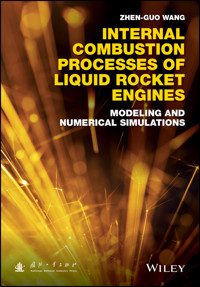
This book concentrates on modeling and numerical simulations of combustion in liquid rocket engines, covering liquid propellant atomization, evaporation of liquid droplets, turbulent flows, turbulent combustion, heat transfer, and combustion instability. It presents some state of the art models and numerical methodologies in this area. The book can be categorized into two parts. Part 1 describes the modeling for each subtopic of the combustion process in the liquid rocket engines. Part 2 presents detailed numerical methodology and several representative applications in simulations of rocket engine combustion.
Sie lesen das E-Book in den Legimi-Apps auf:
Seitenzahl: 582
Veröffentlichungsjahr: 2016
Ähnliche



















INTERNAL COMBUSTION PROCESSES OF LIQUID ROCKET ENGINES
MODELING AND NUMERICAL SIMULATIONS
Zhen-Guo Wang
National University of Defense Technology, Changsha, China
This edition first published 2016© 2016 National Defense Industry Press. All rights reserved.
Published by John Wiley & Sons Singapore Pte Ltd, 1 Fusionopolis Walk, #07-01 Solaris South Tower, Singapore 138628, under exclusive license granted by National Defense Industry Press for all media and languages excluding Chinese and throughout the world excluding Mainland China, and with non-exclusive license for electronic versions in Mainland China.
Registered OfficeJohn Wiley & Sons Singapore Pte Ltd, 1 Fusionopolis Walk, #07-01 Solaris South Tower, Singapore 138628
For details of our global editorial offices, for customer services and for information about how to apply for permission to reuse the copyright material in this book please see our website at www.wiley.com.
All Rights Reserved. No part of this publication may be reproduced, stored in a retrieval system or transmitted, in any form or by any means, electronic, mechanical, photocopying, recording, scanning, or otherwise, except as expressly permitted by law, without either the prior written permission of the Publisher, or authorization through payment of the appropriate photocopy fee to the Copyright Clearance Center. Requests for permission should be addressed to the Publisher, John Wiley & Sons Singapore Pte. Ltd., 1 Fusionopolis Walk, #07-01 Solaris South Tower, Singapore 138628, tel: 65-66438000, fax: 65-66438008, email: [email protected].
Wiley also publishes its books in a variety of electronic formats. Some content that appears in print may not be available in electronic books.
Designations used by companies to distinguish their products are often claimed as trademarks. All brand names and product names used in this book are trade names, service marks, trademarks or registered trademarks of their respective owners. The Publisher is not associated with any product or vendor mentioned in this book. This publication is designed to provide accurate and authoritative information in regard to the subject matter covered. It is sold on the understanding that the Publisher is not engaged in rendering professional services. If professional advice or other expert assistance is required, the services of a competent professional should be sought.
Limit of Liability/Disclaimer of Warranty: While the publisher and author have used their best efforts in preparing this book, they make no representations or warranties with respect to the accuracy or completeness of the contents of this book and specifically disclaim any implied warranties of merchantability or fitness for a particular purpose. It is sold on the understanding that the publisher is not engaged in rendering professional services and neither the publisher nor the author shall be liable for damages arising herefrom. If professional advice or other expert assistance is required, the services of a competent professional should be sought.
Library of Congress Cataloging-in-Publication data applied for
ISBN: 9781118890028
A catalogue record for this book is available from the British Library.
Preface
Liquid rocket engines are the main propulsion system for a spacecraft. The widespread applications of liquid rocket engines in the future demands further studies of combustion mechanisms in liquid rocket engines to improve their performance. Numerical modeling of the combustion process can improve our understanding of the incorporated physical mechanism and help in the design of liquid rocket engines. Since the 1970s, numerical simulations of combustion in liquid rocket engines have developed into a new interdisciplinary subject involving computational fluid dynamics, computational heat transfer, computational combustion, software design, and flow visualization. Owing to its significance in engine design, this new subject has attracted many researchers. With the rapid development of computer techniques and numerical methods, numerical modeling and simulations of atomization and combustion in liquid rocket engines will become an ever important research area.
The author has dedicated himself to the area of Aeronautical and Astronautical Science and technology since the 1980s. The present book is based on the teaching and supervision of undergraduate and postgraduate students in the past 30 years. The book highlights the advanced research work in the field of combustion modeling in liquid rocket engines, such as liquid propellant atomization, evaporation of liquid droplets, turbulent flows, turbulent combustion, heat transfer, and combustion instability. All these will contribute to our understanding of the combustion mechanism and to the improvement of combustion modeling, facilitating numerical simulations of combustion process in liquid fuelled engines.
The book consists of eight chapters. Chapter 1 describes the configuration and fundamentals of liquid rocket engines, and presents an overview of numerical simulations of combustion in liquid rocket engines. Chapters 2–7 detail the modeling of combustion sub processes in liquid rocket engines, i.e., atomization modeling, evaporation modeling, turbulence modeling, combustion modeling, heat transfer modeling, and combustion instability modeling. Chapter 8 presents a full description of numerical models for combustion, numerical methodology for governing equation solution, and grid generation. Finally, three applications are run to demonstrate the capability of the numerical models to predict the combustion process in liquid rocket engines.
1Introduction
A liquid rocket engine, which is also called a liquid propellant rocket engine, is a chemical rocket engine using liquid chemicals (liquid propellant) as the energy source and the working fluid. Liquid rocket engine technology has drawn researchers’ attention and been quite a hot topic in aerospace and aeronautic research during the last 70 years. In the short long history of human aviation, i.e., from the A-4 engine of the German V2 missile, to the F-1 engine of the U.S. lunar landing rocket “Saturn 5” and further to reusable space shuttle main engines, every milestone event is closely linked with the progress made in liquid rocket engine technology. Because liquid rocket engines have the characteristics of high specific impulse, repeatable starting, arbitrary working hours setting, multiple usage, adjustable thrust, etc., they are bound to occupy the dominant position in the area of aerospace propulsion long into the future.
The liquid rocket engine uses liquid fuels as the propellant. In a liquid rocket engine, the liquid chemical propellants combust in the combustion chamber and produce very high pressure gas. The gas is accelerated when it flows downstream through the nozzle and produces impulse, i.e., thrust, for the aircraft. There are several types of liquid propellants. The scheme, structure, ignition and thermal protection, etc. of the liquid rocket engine have a close relationship with the characteristics of the propellants used by the engine system.
The expansion of liquid rocket application requires more in-depth studies on the basic theory and design method of the liquid rocket engine. Numerical simulation of the combustion process in a liquid rocket engine is also an important research direction. This chapter introduces the basic configuration and working process of liquid rocket engines, and then discusses the main objective and research method of the numerical simulation of the combustion process in a liquid rocket engine.
Lesen Sie weiter in der vollständigen Ausgabe!
Lesen Sie weiter in der vollständigen Ausgabe!
Lesen Sie weiter in der vollständigen Ausgabe!
Lesen Sie weiter in der vollständigen Ausgabe!
Lesen Sie weiter in der vollständigen Ausgabe!
Lesen Sie weiter in der vollständigen Ausgabe!
Lesen Sie weiter in der vollständigen Ausgabe!
Lesen Sie weiter in der vollständigen Ausgabe!
Lesen Sie weiter in der vollständigen Ausgabe!




