


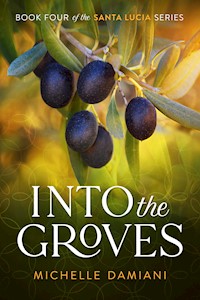
8,49 €
Mehr erfahren.
- Herausgeber: Michelle Damiani
- Kategorie: Gesellschafts- und Liebesromane
- Sprache: Englisch
Rumors. Romance. And more than a little espresso.
Santa Lucia has seen a lot of changes, and they’ve made life for the villagers harder than they ever imagined. Creating a working vineyard. Parenting a teenage daughter. Romance with the mayor. Being gay in a quintessential Italian village. None of these are easy, and everyone is feeling the pressure as their annual festival nears.
The villagers are back for one last
passeggiata through the flower-lined alleys of Santa Lucia. Swapping gossip at the local café has never been so delicious until a storm of secrets threatens the village’s very survival.
With the rain beginning to fall and the wine turning to vinegar in the barrels, can the villagers bring themselves back into the wavering blue light of Santa Lucia?
"I absolutely loved the continuation of this story! I have literally fallen in love with Santa Lucia and these characters and was so happy to have another view into their lives. The writing is so well done in these books that I feel like I know the characters and the places."
"Beautiful view into small village Italian life. As a native Italian I find the books accurately describe the tightly-knit neighborhoods that are typical of my country, where everybody knows your name and your business."
"I can’t believe that I’ve devoured this series feeling such an intricate part of Santa Lucia."
"Damiani spins an engaging, exciting plot with wonderful characters and hauntingly evocative details of place and season."
Das E-Book können Sie in Legimi-Apps oder einer beliebigen App lesen, die das folgende Format unterstützen:
Veröffentlichungsjahr: 2020
Ähnliche














For the people of Spello, who welcomed us home
A Note on the Italian
Italian words in the text are followed by the English translation or can be understood by context. For interested readers, there is a glossary in the back of this book.
Cast of Characters
Main Characters
Chiara ·The owner of Bar Birbo, she therefore hears all the rumors and secrets
Edo ·Chiara’s nephew who lives with her and helps at Bar Birbo, he recently acknowledged to himself and others that he is gay
Luciano ·A retired schoolteacher who lost his daughter and wife, which drove him to lose himself
Vito ·Luciano's brother
Enrico ·Luciano'snephew
Massimo ·Father to Margherita, he was once married to Giulia, Luciano’s daughter who died. A year later, he married Isotta, Giulia’s virtual twin.
Livia ·Massimo’s relation, she comes to help with Margherita after Anna’s death
Pietro ·Livia’s husband and a restaurant owner, he purchases the burnt-out L’Ora Dorata
Leo & Sonia ·Livia and Pietro’s twins who just graduated from high school and find work in Santa Lucia
Anna ·Massimo’s mother
Elisa ·An 11-year-old girl who struggled in school until Luciano began tutoring her. She is Fatima’s best friend.
Fatima ·A 12-year-old immigrant girl from Morocco, injured in an accidental fire during the village festa at the castello. She is Elisa’s best friend.
Salma ·Fatima's mother
Omar ·Fatima's father
Ava ·The daughter of a florist, she is Santa Lucia’s guerrilla gardener and perennially unlucky in love
Fabio ·Ava's brother
Alessandro ·The owner of the derelict castle, newly arrived to Santa Lucia
Madison ·His very American wife
Fabrizio ·A writer from Bologna, he and Chiara recently began a relationship
Francy ·Fabrizio brings Francy to Santa Lucia
Villagers
Magda ·Moved to Santa Lucia from Germany years ago with her husband who has since disappeared in Thailand
Bea ·Santa Lucia’s source of fresh eggs and fresh gossip
Antonella ·Bea's granddaughter
Patrizia ·Chiara’s best friend who helps her husband, Giuseppe, in his butcher shop
Giuseppe ·Patrizia’s husband and the maker of Santa Lucia’s famous chicken sausages
Sauro ·Santa Lucia’s baker
Giovanni ·The joke-telling owner of the little shop on the piazza
Fabio ·Ava’s brother and her opposite In almost every way. He accused both the gay tourists and Santa Lucia’s immigrants for starting the fire
Salvia ·Ava’s mother
Concetta ·Elisa’s mother
Arturo ·Older villager who is sure his French wife is cheating on him
Rosetta ·The school principal
Paola ·The owner of the fruit and vegetable market
Marcello ·The town cop, his mother is desperate for him to get married and give her a grandchild
Bruno ·A cantankerous old farmer
Riccardo · A lawyer, he’s a one-time resident of Santa Lucia, who now lives in Spoleto
Autumn
The one-eyed dog stopped on Via Romana. Abruptly he sat and, under the ever-watchful gaze of Santa Lucia’s beloved Madonna, he began scratching his left ear. Salami rinds and mandarino peels scattered across the street.
Scritch scritch scritch.
His leg thumped down as his attention caught on activity outside L’Ora Dorata, Santa Lucia’s lone trattoria. The dog cocked his head as if trying to make sense of the warping light, rippling in waves. That whispering blue light, distorted like ancient windows bulging as the sand settles ever lower.
Could the dog see anything, though, his lone functioning eye obscured by a fall of what might have once been cream-colored fur? On Carosello, Santa Lucia’s town dog, forever in quest to find scraps left for more beloved creatures, that fur was dingy. Almost grey.
The dog leaped up as if the bells of San Nicola had suddenly clanged. He peered into Bar Birbo. The waxed wooden door shut tight. No humans within to offer him a plastic tray of leftovers. He gazed up the street, toward the macelleria. A stop that often proved good for a pork bone.
Nose quivering, he gazed down the street again, toward the piazza and the wending warren of streets below. He contemplated this route past the playground, the cemetery, to his olive tree. Ancient. Gnarled. So ancient and gnarled it had the appearance of a fastidious woman at a party, lifting her skirts to avoid dragging mud. Leaving a little hovel below whispering branches, just right for a one-eyed dog.
As if realizing his tardiness to a prearranged rendezvous, the dog spun around and trotted up the steps. Cresting the stairs, he tossed a look at the women billowing cloth over an enormous table. The fabric smelled of endless seasons of charring wood, of feasts long forgotten. The tablecloth filled the sky like the sun, all goldenrod yellow. The women laughed as the cloth settled. The dog studied them for another moment, as they carried tureens and platters to the table.
Heaping quantities of food. Delicate, fragrant. Fresh. No scraps for him. Not yet.
Hearing voices from deep in the groves, the dog cut through the courtyard, through the breezeway, past the kitchen garden, filled with sunset-hued globes of winter squash surrounded by waving wildflowers to decorate tables across Santa Lucia. Carosello nosed through the dirt, aware that sometimes kitchen scraps found their way into compost.
At a sudden burst of swallows, wheeling across the achingly blue sky, the dog started, forelegs spread as if in play, an eggshell clinging to his muzzle. He stared after the birds, pirouetting together, in a dance that must make no sense to a small dog in a small town. His eyes followed the swallows, as they wove together beams of light into a curtain, a fall of dapper aquamarine. The dog’s head roved back and forth for a moment before he shook the eggshell off his stubby whiskers.
Taking a faint path, he entered the groves. The dog brushed against wild mint, fennel, and fenugreek. Green and toasty smells rose all around him, obscuring for a moment the stale grease smell of his fur.
Carosello lifted his muzzle, testing the breeze. Left and right, he jogged, always toward the sound of humans. There they stood now, calling over the vines to each other. Divided from him by a rock wall. He trotted around the wall, looking for a tumble of rocks that marked the entrance.
The dog started to enter, to join the fray, wondering if scraps of panini might be left about, as they often were during the olive harvest. He stopped and sat, watching.
The people within the walled enclosure wielded flashing implements. Wresting huge bunches of grapes from the vines, they tossed them into waiting wooden crates. A voice warbled, and as the rest of the workers caught the melody, a song rose over the vines. A man’s voice threaded among and between the others, a golden cord, holding the song together.
The voices soared along with the breeze. And the one-eyed dog carried on, picking his way past the brambles to enter the olive groves. The light seemed to part, to allow him entrance. As his tail waved like a ragged flag, the curtain closed behind him with a boom audible enough to make the swallows shiver and the workers in the grapevines look up in confusion, before they laughed, their voices rising into that hallowed blue light of Santa Lucia.
Bea pushed open the door to Bar Birbo. “Buongiorno, Chiara! You recover from the vendemmia?”
Bar Birbo’s owner, Chiara, laughed in lieu of a response as she brushed the caramel-colored hair from her forehead. “Ciao, Bea. Cappuccino stamattina?”
Bea heaved her impressive bulk onto a stool. “Sì, grazie.”
Chiara bustled behind the counter, grinding beans, opening a carton of milk as she spoke over her shoulder. “I thought you would be there.”
Harrumphing, Bea reached for the sugar packets. “I’m too old for that. Paid my dues.”
Frothing the milk, Chiara smiled. “Luciano was there.”
Bea shook her sugar packet. “No surprise. He wouldn’t miss it. All those beloved children in one place.” She lowered her voice. “How are they?”
Chiara served Bea her cappuccino. “It’s hard to say. Sometimes they laugh and play and it’s easy to forget. But then one of them cries, and it’s a chain reaction.”
“Poor babies. What an ordeal.” Bea tipped sugar into her cappuccino. “No word on Massimo I suppose.”
Chiara shook her head. “Nothing. And I’m sure Isotta and Ava would love to know if he died in the shipwreck.”
Bea snorted and stirred her coffee.
Laughing, Chiara said. “I know, after Magda’s husband came back from the dead . . . ”
Bea used her spoon to gesture at Chiara. “Not her husband. His twin. Keep up, Chiara.”
Chiara raised her hand to greet Patrizia as she said, “Keeping up has become complicated.”
Patrizia hung her sweater, then turned to the women. “You talking about Gustav? Or Karl, I mean?”
Bea took a sip of her caffè, muttering, “I’ve never seen twins so identical.”
Patrizia asked, “How was the vendemmia?”
Chiara began grinding more coffee beans. “A glorious day. Bruno stopped by and said he couldn’t believe the vines produced so many grapes, given that no one ever sprayed them. That soil.”
Nodding, Bea said. “My husband says the same. Mildew can’t get a foothold in sandy soil.” She thought for a moment. “Did Ale get the grapes typed?”
Chiara shook her head. “A professor from the University of Perugia comes next week.”
Patrizia mused. “Maybe they’re French?”
Bea frowned and turned toward her. “French? Why French?”
Patrizia shrugged. “Or from across the Adriatic, Croatia or something. They have to be from somewhere far away if Bruno doesn’t recognize them.”
Bea grumbled. “Or from a long time ago. You know the stories.”
Patrizia accepted her cappuccino with a smile. “You had great weather. I hope it holds up for the olive harvest.”
The bell over the door rang as Magda strode in. “Cappuccino, Chiara, per favore.”
Chiara nodded. “Subito.”
Magda examined the women’s expressions. As the faces slid away, peering at the grappa or the faded posters on the walls, she harrumphed. “You talking about me?”
Bea snorted. “Not for the past few minutes.”
As Chiara said, “Can you be surprised?”
Magda’s face creased into a rare grin. “No.”
Bea threw her head back in laughter.
Magda peered into the pastry case. “Chiara, does one of those cornetti have apricot jam?”
Chiara nodded, her eyes on the coffee dribbling into the heavy white cup.
Nodding, Magda said, “I’ll have one.” She sat at the bar and waited. Feeling eyes on her, she glanced at Bea and Patrizia. “What?”
Bea let out an explosion of air. “What do you mean, what? What happened to that awful man? Did they take him back to Germany?”
In a softer voice, Patrizia said, “We’ve been worried about you.”
A hint of Magda’s old glower crossed her face, but seeing the genuine concern shining in Patrizia’s eyes, the unaccustomed serious expression on Bea’s, she breathed deeply. “I’m glad it’s over.”
Chiara used the antique silver tongs to select a cornetto with a generous fall of sugar. Sliding it on a plate, she said, “What a relief for you.”
“No.” Magda reached for a napkin. “I mean, yes . . . a relief to get that imposter out of my house. Out of our town.” The women watched her every word. Magda’s old hard edge prickled in the face of their interest. But then she nodded to herself. “But there’s also a . . . liberation.”
Bea’s eyes glinted. “You did look pretty satisfied at the restaurant opening. Dancing with the mayor.”
Patrizia put a hand on Bea’s. “Now, Bea . . . ”
Bea laughed.
Magda narrowed her eyes. “Dante was being polite.”
Patrizia and Chiara smiled at each other.
Magda’s face grew stony, and Chiara realized she had to get this conversational ship out of rocky waters. “Did you see Fatima leave, at the opening?”
Magda leaned forward. “I can’t believe her parents let her go. Modeling! In Milan! I can’t even count how many Muslim edicts that must go against.”
Chiara shook her head. “Luciano told me at the vendemmia, apparently her agent has worked with girls like Fatima before. She has a reputation as strict, exacting. This may be what Fatima needs. A new path.”
Patrizia gazed out the window at the Madonna, ethereal in her azure niche, spangled with fading gold stars. Slowly she said, “And being here, it’s been so hard for her family. Maybe a new start is what they all need.”
Magda grumbled. “Their new start is not what I need. Now I need to hire a new cleaning woman.”
Patrizia ignored Magda. “I hope they all find what they’re looking for.”
The women all gazed toward Via Romana, as if expecting promise to land right in the street—bright, shiny, and clear as morning.
Isotta shifted her weight, moving young Jacopo to her other shoulder. “I’m sorry you have to leave again.” She tried to keep the longing out of her voice. She had assumed that sometime in the two weeks between L’Ora Dorata’s opening and the vendemmia, she’d have tamed her heart’s tendency to lurch at the sight of Luciano’s nephew. But on the contrary, she found her eyes also searching for Enrico, drinking him in as if she’d been parched for days.
How, oh how, had she wasted so much time thinking him attractive only as a friend? She tried to hang on to Ava’s reasoning, that Isotta’s entanglement with Massimo blinded her to Enrico’s potential. It didn’t ease Isotta’s regret, though she appreciated the effort.
Enrico put the last of the lenses in his bag. “I know. It was a quick visit. But I have to get back—”
“To Carla. Yes, I know.”
Enrico smiled awkwardly. “To work, I was going to say. But yes,” he added gently. “That, too.”
Isotta fought back a fierce wish that this Carla would evaporate off the face of the earth. Surely, without her, Enrico would rediscover the affection he’d once had for her, Isotta? She’d searched for some sign of lingering feeling, but the space between them had chilled like bedsheets past noon. She blushed at the thought of bedsheets, dipping her nose against Jacopo’s hair, letting it tickle her face. She stammered, “I wanted to say . . . I wanted to thank you. When the children went missing, you spent so much time here. I don’t think I ever told you how much I appreciated it.”
He nodded politely. “Anyone would have done the same.”
Isotta doubted that, but thinking about Enrico, his goodness, made her heart skip. To cover it, she added, “How nice of the university to give you the time off. Especially with your just starting.”
“Since I’m focusing on research this semester, they didn’t mind. Next semester when I’m teaching, I don’t think the university would be so understanding.”
“Glad the kidnapping happened the first semester then.” Oh my God, Isotta thought. Had she ever been less articulate? To cover her embarrassment, she cleared her throat. “How long is the drive?”
“To Urbino? About two hours. Not too bad.”
Isotta gestured to the boxes scattered around the living room. “So you’ll be back soon then, right? To record the rest of these?”
His fingers grazed the papers stacked in the box on the table. “Absolutely. Thank goodness Luciano held onto them. What a remarkable find.”
“And here I’d been begging him to declutter,” she grinned. “Aren’t you lucky he pretended not to hear me.”
“Indeed,” Enrico said. “In fact, I believe there may be enough here for a paper.”
Isotta looked around doubtfully. “Really? About what?”
Gesturing more empathically, Enrico went on, “A new take on the story of the Jewish diaspora in war-time Italy. Why the experience impacted a unique subset of families and how they persevered. Did they rely on Catholic groups to support them? Jewish congregations? Where did they find resources, houseroom?”
As he stopped speaking, Isotta flushed, aware of how her eyes had been trained on his every movement. Focusing on the way his animation transformed what she once considered ordinary features as much as on his prospective research.
Was it her imagination, or did something flicker in his eye, a twitch of a smile? Realizing how long she’d been staring at his face, she startled and asked, “And Carla, is she a historian too?”
He cocked his head. “Carla? No.”
“But she teaches at the university?”
“No. She manages the history department, but she doesn’t teach.”
Isotta didn’t know why this information came as palpable relief. She waited for him to go on, but he stood and patted his pockets.
“Well, Isotta, a great vendemmia and it’s been lovely to see you.”
“Oh! We can walk you to the parking lot. Let me find his carrier . . . ” She scanned the room.
But Enrico shook his head. “No time, I’m afraid. I have a meeting with the head of my department.” He paused, running his hands again over the edges of the boxes. “You’ll keep writing?”
“Writing?” She looked confused for a moment. “Oh! The children’s book. I’d forgotten all about that with figuring out the next move. I can’t come back here, I’d have to share a room with both children. And Massimo’s . . . ” she shivered. “That’s a last resort.”
Shrugging on his coat, Enrico said, “I suspect Ava and Ale would love for you to stay at the castello. It’s felt more like a party than a recuperation.”
Isotta nodded. “But it’s not sustainable to have us all sleeping in the breakfast room forever. Ale will eventually have guests.”
“I’m sure he has a plan for that.”
“Or at least Ava does.”
Enrico grinned. “Indeed.” He hesitated before dropping a kiss on each of Isotta’s cheeks. “Take care of yourself, Isotta.”
Tears sprung to her eyes. “I will. You, too.” She blurted out, “You’ll be back for the cinghiale festival? You haven’t lived until you’ve tasted Umbrian wild boar stew, cooked all day over an open fire.”
He chuckled. “I’ll try.”
Isotta smiled. “And bring Carla! We’d love to meet her.”
Enrico studied Isotta for a moment. “It’s a few weeks away. We’ll see.”
Bruno shook his head. “Non va bene.”
Ale stopped pouring the inky grape juice from their vats into the waiting barrel. Glancing up at the old farmer, he asked, “What do you mean?”
“The barrels.”
Ale regarded the wooden barrels. The ones he had spent all weekend scrubbing. He couldn’t believe how tenaciously grape-must clung to wood. The smell had not been a treat.
Bruno gestured with his chin. “I will get you barrels. A winery across the valley sells outdated ones at a good price. Plenty of mileage.”
Ale shrugged. “These are free.”
“But—”
Ale cut him off. “Look, Bruno, I appreciate your help. I do. But I don’t think you understand. I have no money. No money for barrels, no money for rootstock. If planting those clippings doesn’t work to get new vines going, this vineyard will only last as long as the current vines do.” What he didn’t say . . . oh, what he didn’t say. If he couldn’t succeed, what kind of man was he? How could he convince Ava to one day join her life to his if he couldn’t make a simple thing like wine work? He had to, and that was that.
“But, the wild—”
“Seriously, Bruno. I don’t want to talk about it anymore. These barrels are fine. I cleaned them myself.”
Bruno ran his hands over the stubble growing on his weathered cheeks and regarded Ale doubtfully.
Ale ignored him as he finished pouring the juice in the barrel. He straightened and sprinkled the purple surface with yeast. “I got the yeast you suggested. So you see? I’m not a total buffoon.”
His face impassive, Bruno said, “Have you been punching down the caps?”
Ale nodded. “They never knew what hit them. I’ve been a punching fiend.”
Bruno raised his eyebrows seriously.
Sighing, Ale said, “I know about the caps. I did my homework.”
“Because if you don’t do it well, you’ll get bacteria growing on the skins and also you’ll lack tannins and color since the must— “
“Bruno, I believe that’s the longest sentence I’ve heard you utter.”
Bruno didn’t answer as he lifted a canister of the grape juice and poured it into a barrel. He paused and lowered his nose to the wood, sniffing inconspicuously. “Non va bene.” He muttered.
Perhaps Ale didn’t hear him, since he said, “The guy from the University of Perugia comes Thursday, to type the mystery grapes. I hope it’s not too late to press them. Should I add them to barrels of wine I have going, or make wine solely from those? Single denomination, or whatever?”
Bruno frowned. “It depends.“
“I know, I know. Just making conversation.”
Bruno looked at him quizzically. As if he’d never heard such a ludicrous concept.
Elisa poked at her breakfast.
Ava watched and said, “Elisa, you need to eat.”
“I don’t have to stay the whole day, right? You promised.”
“Just an hour.”
“And if Margherita cries before that, you’ll come get me?”
Ava flinched at the storm brewing on Elisa’s face. “Elisa . . . “
“No!’ Elisa shouted, her voice shaking. “Promise! You have to promise you won’t let—”
“Elisa, please calm down.” Ava didn’t know what made her say the exact thing that never worked.
“Don’t tell me what to do! You can’t tell me what to do!”
“I’m sorry! I don’t want you getting wound up! You have a big day ahead of you.”
“An hour! You said an HOUR!”
Ava turned to gather her breath, tucking her hair behind her ears over and over. She turned back to find Elisa glaring. Softly she said, “Only an hour. I promise. Margherita can handle it, we’ve been working on it. She might not like it, but she’ll see you in an hour and then she’ll learn that she’ll always see you again.” Ava didn’t add that maybe Elisa could learn the same.
Elisa glowered at her yogurt cake.
“Tell you what. After I drop you off at school, I’ll head straight to the playground. So Margherita has two people looking after her. Then we’ll all come get you from school.”
“Where’s Isotta?”
“She’s napping with Jacopo. He woke up early, his sleep is still all over the place.“
“Well, obviously. Massimo never let us—”
Ava grew still. Might Elisa reveal anything, anything about her month on the road?
Elisa pushed her plate aside. “Let’s get this over with.”
They stepped outside into the castle courtyard and stood for a moment, watching the fog drift through the valley. Ava reached for her daughter’s hand. “The view is incredible from here, isn’t it?”
Elisa didn’t answer.
Faltering, Ava asked. “Do you miss staying with Nonna and Nonno?”
Elisa shrugged. “I just like not moving.” She hitched her backpack higher on her shoulders and stepped down the stairs that led to Via Romana. Ava watched Elisa’s thin frame, the knot in her hair where she neglected to brush. Ava remembered how many knots Elisa had when she first returned to Santa Lucia. It had taken hours to brush them, to gently tease the hairs apart. The work should have been onerous perhaps, but with the fire crackling in the grate, and Isotta nursing Jacopo in the rocking chair as Margherita played with the paper dolls Elisa made her, while Ale and Enrico and Edo bustled about the table, putting out lamb stew and still-warm focaccia sent over by Sauro the baker, the time had been idyllic. Ava wished they could live in that bubble forever. Where nothing bad could happen.
As Elisa’s head disappeared down the stairs, Ava raced to catch up. They walked together in silence through the piazza and to the door of the middle school.
Elisa sighed in resignation. She gave Ava another baleful glance. “One hour.”
“One hour. If you aren’t here, I’ll come up myself to grab you.”
Despite herself, Elisa smiled. “You would not.”
Ava shrugged, her eyes wide. “Don’t underestimate me.”
Elisa chuckled a little at the image. She let herself get swirled in with the assembling students. A few girls yelped, throwing their arms around Elisa and enveloping her, pulling her into the building.
Ava stood for several minutes, watching the last of the children evaporate into the middle school. The bell rang. Still, Ava watched. Waiting.
The piazza cleared of parents.
Ava watched. Waiting.
The bells of San Nicola tolled the hour, slowly, resolutely, deep with the tenor of generations. Ava looked up as if waking from a daze. Her eyes followed the birds darting across the sky. That sky. Was it always so lilting, wavering, blue upon blue?
She strolled down the hill, passing her parents’ home. Her home, too, up until a few weeks ago when the children returned. Once the children tolerated separation . . . should she and Elisa move back with her parents? She hadn’t known until she left how free she could feel without her parents’ scrutiny and her brother’s constant campaign of insults and criticisms.
Ava knew her parents grumbled at the unseemliness of their daughter living with a man, but really . . . could it be called “living” with Ale, when they all slept on mattresses strewn around the great room? The presence of so many prevented anything more daring than a swift kiss goodnight. And sometimes holding hands as they fell asleep, their mattresses snug against each other.
Not that Ava wanted more. Not yet. She needed to make sure she and Ale fit together now.
She heard the swing before she spied Luciano pushing Margherita higher, higher. The little girl’s laughter carried like birdsong, her curls trailing behind her as she reached up, up with her toes.
Luciano smiled at Ava’s approach. “Buongiorno, Ava. I trust Elisa made it to school?”
“Barely.”
Luciano waited.
But Ava just sighed.
Nodding, Luciano said, “She asks for Elisa every few minutes. But tolerates my answer that Elisa will be back soon.”
Ava nodded. “Probably because of your idea to take them into the groves one-at-a-time for gradually increasing periods.”
He cocked his head. “I wish I could take credit. But I believe it was Bea.”
Ava darted a look at Luciano. She opened her mouth to speak, but then closed it again.
“Yes, cara?”
“I . . . I want to . . . apologize.”
He smiled, his eyes behind their thick lenses creasing. “And what terrible offense did you commit?”
“We haven’t talked about it . . . I couldn’t, with the children missing . . . ” Ava stammered. “But . . . Massimo betrayed your daughter with me. Even if Giulia never knew. It’s an insult to her—”
Luciano held out a hand. “Stop.”
“I’ve felt awful, dirty and mean, for years. When I let myself think about it, anyway.”
Luciano shook his head. “Massimo betrayed my daughter. As he betrayed your innocence. You did nothing, cara, except get wounded in the process. I regret that no one had their eyes on you.”
Ava’s eyes swam with tears. “My parents had their hands full. With my brother.”
“Fabio certainly took up a lot of space.”
“He still does.” Ava thought for a moment. “You don’t blame me?”
Luciano turned from pushing Margherita, letting her laughter dapple like sunlight around them. “You, cara? How could I?”
The sun slipped behind the inky blue hills, rimming them briefly with a bold magenta line. For a moment, the landscape resembled a collage of postcards, cut out and glued together to increase the drama of the scene. The villagers didn’t notice as they drifted into L’Ora Dorata.
For years, they had viewed the trattoria as a place for tourists. A hodgepodge of culinary influences that attempted to appeal to every possible visitor, and therefore appealed to none. Not having a local option in Santa Lucia, villagers ate at home. Or, for special occasions, they ventured into Girona.
Now, they surged forward, eager to taste the flavors of their childhoods, long forgotten. Rumor had it that on tonight’s menu would be pasta with a rabbit ragù. Not tomato-based, but rather a white sauce, heady with the scent of wild thyme and layered with the richness of local pecorino.
The stone walls of the restaurant filled, almost overflowed, with burbling voices. Pietro, the man responsible for L’Ora Dorata’s renaissance, crossed his arms and smiled, unable to believe his luck. Quickly, he skipped his fingers across the iron bar he’d nailed behind the register.
He turned to greet Ale and Ava, entering with Elisa. He wondered how in the world they’d been able to separate Margherita from Elisa, but as he approached their table, he heard Elisa whine, “What if she wakes up?”
Ava said, “Then Isotta will tell her you stepped out for a few minutes and you’ll be right back.”
“And she’ll text you.”
They must have had this conversation before.
Ava sounded drained. “And she’ll text me.”
More than once.
Elisa’s shoulders sagged, but she took out her sketchbook without a word. Pietro glanced at her work, which had matured during her month-long kidnapping. Her lines were, if anything, more sure. She equivocated not at all, her hand sweeping over the page. He wondered if she’d had access to art supplies during her absence. Her thin frame certainly suggested she hadn’t had enough food.
He reminded himself to tell the chef to load her plate well.
Ava turned to Arturo at the next table and asked him about the begonias he’d purchased at her father’s flower shop. Arturo shrugged. “My wife can’t keep them watered. You know she’s so wrapped up—”
“Having an affair. Yes, I know,” Ava said with a tired smile.
Arturo leered. “Speaking of affairs, I suppose you know about the mayor and Magda?”
Ava sighed. “That’s a rumor, Arturo. As you well know.”
Arturo nodded greedily. “Well, his children heard about this ‘rumor’ and I understand they are not pleased.”
Ava drew back a touch. “You told them, didn’t you? You can’t resist making trouble.”
Arturo blanched. “I only told Mauro. He told the rest.”
Ava sighed and turned back to her table. “Oh, Arturo.”
“What?” He lifted his arms.
Ava shook her head. Raising her voice, she asked, “Ale, are you getting the rabbit ragù?”
Ale blinked and then gazed from Arturo to Ava with a shaky grin. Ava’s parents were joining them, weren’t they? He’d counted on them footing the bill for dinner. His mind turned to his wallet, with proverbial moths flitting out of it. He shifted uncomfortably while working to maintain his confident smile. At the sight of Ava’s parents strolling into L’Ora Dorata, he heaved a sigh of relief.
Meanwhile, Arturo grumbled and turned back to his bocce league, joining them in ripping chunks of bread and tossing back great gulps of the rough country wine they preferred with their salumi.
Ava greeted her parents and caught sight of Bea, now entering the restaurant with her family. A grin plastered across her face, Bea announced, “It’s my birthday! My children insisted I not make dinner.”
“Auguri, Bea,” Ava said before adding cheekily, “Now why did you never teach your children to cook for you?”
Bea laughed. “I tried!”
Ava chuckled. “I think it was all a ploy to keep them coming to your house every night for dinner.”
Bea and her family laughed and continued to their table. Catching sight of the enormous vase of flowers, Bea pushed past the rest of the customers, barely acknowledging Marcello, Santa Lucia’s favorite police officer, dining with his parents.
Marcello joined his family in calling “Auguri” to Bea, but he didn’t pay attention to their passing. Until his vision caught on Bea’s granddaughter.
Wasn’t it just a moment ago that Antonella had been a girl in a pinafore and braids? And now . . . he couldn’t take his eyes off her liquid brown eyes, deep as the swimming hole he and his friends dove into to refresh on a summer day. He watched as Antonella cut through the room like sharp scissors through yielding fabric. A girl no longer, she seemed all woman—feminine, strong . . . and mesmerizing.
Unaware of Marcello following her with his eyes, Antonella sidled past her grandmother to continue her conversation with her father about her job in Girona at a product consulting firm. The secretarial work had been a bore, but she’d just found out that a senior marketing agent had taken a shine to her and requested her as his assistant. Antonella felt sure that now she’d get her foot in the business world.
She never noticed Marcello’s gaze trained on her. Even as her grandmother and Marcello’s mother winked at each other across the bustling restaurant.
Dante shook his head. “He won’t tell me, Magda.”
Magda grumbled before accepting her cappuccino from Chiara. “I’m sure he told you. You just delight in having all the information.”
Dante laughed, his hand on his chest. “Me?”
“Yes! You love keeping me in the dark.”
His voice lowered, “I do no such thing, Magda, and you know it. Perhaps—”
“This isn’t my sugar!” She glared at the offending blue packet she’d ripped open.
Chiara nodded. “Regular sugar is right there, Magda—”
“I know!” She snatched up a white packet.
Dante leaned closer to Magda. “Seriously, Magda. I promise. Ale hasn’t told me anything about the professor’s visit.”
“You introduced Ale to him. You must know if the mystery grapes have value.”
“I don’t.”
“I don’t want to stop you if you’re enjoying the repartee,” Chiara smiled, scooping up the discarded packet of diet sugar. “But the wine expert got the flu, and they rescheduled. For next week.”
Magda glared. “How do you know?”
“They stopped in last night before dinner and Ale mentioned it because he’s concerned about the grapes over-ripening in the delay. He’s also feeling sure the expert will tell him the mystery grapes are useless. He’s distracting himself by working on one app project after another.”
Magda looked mollified. “Oh.”
Dante tentatively touched her hand.
Magda shook her head. “I’m still cross with you.”
Dante’s eyes widened. “But why? What did I do?”
Magda’s brow contracted in fury. “I don’t know, but I’m sure there’s something.” Her glare faltered, and she began chuckling.
Dante laughed as well, and soon they were both in merry peals of laughter.
Edo, entering the bar from the upstairs apartment, watched them for a moment before glancing quizzically at Chiara. She shrugged, rolling her eyes heavenward. He grinned, and they had to look away from each other to keep from laughing.
The sun hesitated in the sky, filling Santa Lucia with extra shimmer. Ava and Isotta reclined on the lawn chairs, watching Elisa and Margherita chase each other as the day waned. Neither mother could figure out how the ball figured into their game.
Ava nodded toward Jacopo, asleep in the crook of Isotta’s arm. “Do you want help getting into him into his crib?”
“No.”
Ava smiled. “You want to hold him as long as possible.”
Isotta’s eyes stung with tears. “Yes.”
Ava turned back to Elisa and Margherita, who had flopped on the grass. “I know what you mean.”
They watched for a few moments, the fall breeze drifting across their cheeks. A bird darted across the tapestry of the sky, an echo of the swallows that had chased each other south with the approach of cooler weather.
Isotta seemed to wake up from a dream. She smiled at Ava. “How are you, my friend?”
Ava lifted her hands to re-knot the hair at the nape of her neck. “It doesn’t feel real. We went from all those days of worrying and dreading and needing, needing at such a basic level, you know?”
“Elemental, yes.”
“Now they’re all here. Back. And our life is filled. Not just with the glorious chaos of children, but all these . . . ”
“Obligations.”
“Yes! Everyone has their endless trying questions. About Elisa. About moving back home. About my brother, who seems to have taken Elisa’s return as an invitation to return to his old habits.” She sighed. “Everywhere I turn. Noise.”
“I know what you mean. Tonight, the quiet . . . it feels a little magic.”
As the breeze increased in strength, the tips of the olive trees swayed. Elisa noticed this and bolted upright before relaxing her body to bend like the trees. Margherita watched intently before spreading her arms and tilting from side to side, a kite caught in a swirl of wind. The girls lifted their arms high, letting their fingers drift in and out of the fading light.
Ava’s breath caught. “They are so damn beautiful.”
“I can’t believe I never guessed they were sisters.”
“Really? They look so different.”
“Only because of Margherita’s black curls,” Isotta said. “Look at their upturned noses, the shape of their eyes, the set of their chin. Just like—”
“I know.”
Isotta faltered. “I wish we knew.”
“What happened to him? Me too.”
“Luciano tells me he’s sure he’s dead.”
“Ale says the same.”
“So does everyone.”
Ava said, “I’ll believe it when I see it.”
Isotta nodded. After a moment, she faltered, “Us being at the castle . . . ”
“Sì?”
“You know what they say about fish smelling after three days. We’re over three weeks.”
Ava grinned. “Are you the fish in this scenario?”
Isotta didn’t hear her. “And right when you and Ale . . . ”
Ava reached over the expanse between the two chairs and rested her hand on Isotta’s arm, letting her fingers brush against Jacopo’s foot propped up at a ridiculous angle as the boy slept deeply. “Isotta. Please. I want you here. It’s good for me. And the children . . . ”
Isotta lowered her eyes. “It’s good for me, too.” She watched Elisa and Margherita as their tree-like swaying morphed into some kind of dancing game. “But at some point, we need to move on.”
“I suppose.” Ava frowned. “I’m sure Luciano is eager to have you back.”
Isotta worried her lip between her teeth. “I don’t know if I can move back in with Luciano.”
Ava sat up straight, her eyes blazing. “What?”
“Two bedrooms? I can’t sleep in one room with both children. Not for long, anyway.”
Ava frowned. “How did his parents live there with three children?”
Isotta smiled. “They made it work. And right now it sounds blissful. Waking up to the sound of their breathing.”
“To reach out and touch them when they’re restless.”
Isotta nodded. “But practically speaking. It can’t be that way forever.” Her lip trembled, “I can remodel Massimo’s house with his money. Only . . . ”
“Living in Massimo’s house reminds you of moving to enemy camp?” Ava offered.
“Esatto,” Isotta nodded, grateful. “Besides, dividing the children . . . they’re siblings, shouldn’t they live together?”
Ava sat up straight. “Why are we ruling that out?”
“Ava.”
“No, listen. This place has plenty of space. In the next month, we’ll move the passito grapes into their barrels—”
“Already?”
Ava shrugged. “According to Bruno, the mystery grapes are reaching their pinnacle of sweetness.” She shook her head, “Anyway, that room is huge. With some cash and time and labor, we can turn it into a suite of rooms.”
Isotta hesitated. “It’s a lot to ask of Ale—to let part of his birthright indefinitely, to have a single mother live under his roof. Even if I pay for rent and renovations.”
Ava nodded. “We need to consider it. Ale’s not talking about it, but I know the financial situation is stressful for him. This might resolve a few problems.”
Nodding thoughtfully, Isotta said, “I’ll know next week how much money I’m getting. If there’s enough . . . but Ava, how would you feel with Massimo’s money dribbling into the castello like this?”
Ava clasped Isotta’s hand. “There’s a funny rightness to it.”
“Professore, welcome, welcome! Thank you for coming,” Ale called as the gentleman from the University of Perugia stepped out of his Fiat.
“Gaetano, please,” smiled the professor, adjusting his peacock blue scarf around his neck. His head swiveled as he took in the view. “Such a spot of heaven you discovered!”
Ale chuckled. “It’s quite a story.”
Gaetano’s eyes behind his chunky black-framed glasses widened. “I’d be most interested.”
Ale gestured to the town arch. “Do you want to see the vines first, or the grapes?”
“They aren’t . . . ”
Ale shook his head. “With the delay, Bruno, my, er, associate, suggested we remove the grapes from the vines and dry them to make—”
“A passito, yes, of course. An inspired notion. I do apologize for not being able to arrive for our initial appointment. Unavoidable.” At Ale’s nod of understanding, Gaetano said, “Let’s see the vines. I’m desperately curious about what kind of soil you have that you’d be able to get any grapes whatsoever without spraying.”
As they walked, Ale explained the history of the vineyard as well as he could, Gaetano peppering him with questions. Only some of which Ale could answer. Blushing, he said, “Bruno is meeting us at the castello. He’ll be of better help.”
“And a castello! What a fascinating story, Signor Bardi.”
“Ale, please.”
Gaetano ducked under an olive branch to arrive into a clearing, where a tumbling rock wall enclosed the vines. At the sight of a sunbeam breaking free and illuminating the vineyard, Gaetano breathed reverentially. “Magnificent. The slope, ideal. And perfect for sun exposure.” He squinted. “Is the light always this . . . ” He looked back at Ale in confusion. “I’m sorry. I rarely fail to find words. Descriptive language is my backbone. But this . . . ”
Ale nodded. “I know what you mean. I don’t notice it anymore, but when I first arrived, it hit me like a force.”
“Like a force,” Gaetano murmured appreciatively. He nodded to himself. “All right then, Ale. Let’s see your vines.”
Once in the vineyard, Ale led Gaetano to the corner. “Bruno couldn’t recognize them . . . but he’s local, maybe hasn’t had too much exposure to grapes from outside the region. And we’re so close to Le Marche, I thought, perhaps—”
Gaetano shook his head, his arm up to request silence. Murmuring to himself, he ran his fingers over the veins of a leaf, then down the ragged sides. He stepped back, examining the flow of the vines. Without a word, he pulled out his phone and began taking photographs. Looking up, he said, “I hope you won’t mind—”
“Not at all. Whatever you need.” Ale watched the man work, alighting like a butterfly over the leaves, the vines, the soil. Hands in his pockets, Ale crossed his fingers. He wanted this to succeed. He needed this to succeed. He’d sunk so much time, so much energy, so much hope into these vines. They couldn’t fail him. His thoughts turned to the wine resting in barrels at the castello. According to wine blogs, it would soon be time to taste. The thought left him breathless. He imagined Ava’s flashing eyes as she sipped the fruit of his labor, before leaning in to kiss him with breath perfumed by his wine. The image cracked, and he pictured her face, sour and petulant, as she shoved it away, complaining it tasted like funky vinegar. As all his ambition circled the drain. He wished one of his app ideas would pan out, at least a little. It would take the pressure off this wine business.
Ale startled at Gaetano’s words. “May I take a leaf with me?’
“Absolutely. But this vine isn’t that unusual, is it?”
“At the very least, it’s unusual for this area, Signor Bardi. That’s all I can say with certainty at this point.”
Ale started to correct the formal terminology and then decided against it. “Would you like to see the grapes?”
“Please.”
As Ale led the way back through the groves he said, “You’ll be able to identify the varietal, even though they’ve been drying for over a week?”
“Undoubtedly.”
They walked in silence until they crested the hill and arrived at the castello. Ale waited for Gaetano to make a noise of appreciation, but at the pause in their journey, Gaetano only said, “The grapes, if you please, Signore.”
Ale nodded and strode to the drying room.
Bruno stood at the threshold, cap in hand.
Gaetano met him, hand outstretched. They had a few moments of whispered conference while Ale stood awkwardly. Then Bruno ushered Gaetano into the room. Feeling uncomfortable, Ale filled the silence. “You can see I’ve got barrels of wine from the other grapes over there. We think this used to be a ballroom, or perhaps a receiving room of some kind. In any case, it’s big and airy, and Bruno thought it would be good for drying our mystery grapes for passito.”
Gaetano stared at the grapes drying in a sea across the floor. “Net?”
Ale nodded. “Bruno said I could borrow his straw mats, but I Googled and found that nets from the olive harvest work just as well. And that I had, here at the castello.”
Gaetano regarded Ale with curiosity before kneeling to pick up a bunch of slightly shriveled grapes. Ale started to explain that Bruno claimed they had at least another couple of months to dry and sweeten before pressing and fermentation turned them into dessert wine.
But at the serious gleam in Gaetano’s eye, Ale said nothing.
Gaetano nodded to himself, muttering. He took photos, pressed a grape between two fingers and tasted. Ale lost track of Gaetano’s examinations.
Finally, Gaetano stood. His face serious, he said, “Unless I’m much mistaken, Signor Bardi, this grape you have inadvertently discovered in your vineyard is the Prescia variety. Lost to the region in the 1800s when a louse obliterated the vines. But not, it appears, your stock.”
Ale’s mouth fell open. “The 1800s? But vines can’t last that long.”
“Vines can’t. But many of our noblest varieties, Sagrantino to name a local example, have been in existence since the time of the Roman Empire. I refer you to Pliny the Elder, whose documentations serve as our treatise on ancient vines. As the vines themselves age, they lose their vigor, which is why we propagate, either by grafting onto hardy rootstock or, if the soil is good, directly into the ground. Your soil is exceptionally well suited—”
“Bruno told me that.”
“Did he? Well, then. That knowledge informs our understanding of your vineyard. Perhaps unaware of the rarity of their grapes, previous owners kept the vines growing. They look to be nearing their demise—”
“Bruno told me that, too.”
Gaetano nodded and turned to Bruno. “What prompted you to turn these grapes into passito?”
Bruno ran a hand over his grizzled face. “I tasted them. Seemed good for passito.”
“Well said.” Gaetano beamed. “Signor Bardi. You must trust your friend Bruno here. He seems to know quite a good deal.”
Bruno frowned and gazed out toward the groves.
Chuckling, Gaetano said, “Now, make a good passito with these grapes, and you’ll have winemakers clamoring to buy your clippings to plant in their own vineyards.”
Ale rubbed his thumb. “Can’t you tell the winemakers? Get them interested—”
Gaetano laughed aloud. “I’m afraid marketing is outside my skillset. Make a good passito, Signor Bardi. Make a good passito and people will line up for a taste of this history.”
“Buongiorno, Magda! You’re looking refreshed this morning.”
Magda nodded. “Thank you, Chiara. I’ll never again underestimate the power of sleeping in a house without a convict snoring in the next room.”
Chiara chuckled. “Everything back to normal?”
Frowning, Magda said, “Nothing will ever be normal. Not ever again. Do you not know that?”
Chiara darted a look at Magda over her shoulder as the coffee dripped into the thick, white cup.
“No, things can’t ever go back to normal.” Magda tipped her chin onto her hand. “For years, I lived in a kind of purgatory. Was Gustav alive? Dead? It weighed me down. Now I’m free. Not just of Karl, thank God. But of that half-life.”
As she foamed the milk, Chiara asked. “I’m not following. I mean, you still don’t know where Gustav is, do you?”
Magda shook her head. “Not with any certainty. But I learned that when Karl escaped, the German police looked into Gustav’s disappearance, in case Karl joined his brother. They discovered a story circulating through Bangkok about a German man who died years ago in a boating accident. The police suspect Karl learned the same story. It’s what emboldened him to come here.”
“And Gustav’s parents?”
“Grieved him long ago. They knew he’d come home if he were alive.”
Chiara set the cappuccino in front of Magda.
Magda sighed. “I’m returning Gustav’s money to his parents.”
“That’s . . . that’s generous.”
Magda said, “It’s the least I can do. I see now, in a way I didn’t before, that he was a good man.”
Chiara smiled faintly. “Compared to his brother.”
“Especially compared to his brother.” Magda reached for the sugar. “But you don’t have to play innocent, Chiara. Everyone loved Gustav.”
“Well . . . ”
“After living with Karl, I understand. Gustav loved this town and that made him lovable. I’ve seen Gustav as a horrible person for years. I had to. Now I see he was a good person trapped in a bad marriage. Trapped with me.”
“Oh, Magda.” Chiara instinctively clasped Magda’s hand and then winced, expecting Magda to pull her hand back with a remark. Instead, Magda squeezed Chiara’s hand.
Magda said, “I’ve been trapped with me for years. I know it’s no picnic.”
Chiara smiled sadly, “Magda . . . ”
Magda paused, stirring her cappuccino until the bubbles deflated. “And with that, I feel complete. That part of my life is over. Now, I’ve decided to begin.”
“Begin?”
“And you should do the same, Chiara. Begin.”
Chiara narrowed her eyes.
Magda smiled indulgently. “All these years, you soak up our secrets, without ever divulging your own.”
Paling, Chiara said softly, “I have no secrets.”
Magda patted her hand. “Of course you do. You’re more transparent than you think you are.”
The bell over the door jingled merrily as a group of tourists walked in and stopped, gazing around with wide eyes, in the way of tourists unfamiliar with the idiosyncrasies and dynamics of Italian bars.
Dante rehearsed the festival preparations. He counted and recounted the fire extinguishers, checked every open flame like a nervous mother. Rubbing his hand across his forehead, he wondered for the hundredth time if he’d been right to acquiesce to Magda’s insistence that the festival must be held at the castello. He wouldn’t have given in at all, if she hadn’t dragged Ale to him by the elbow so the castle owner could tell him that he’d be delighted to host the sagra. It would be magnificent advertising.
Each day since, Magda had ordered a different villager to tell Dante how having the sagra at the castello would ease their memories of shrieks shattering the night air. He suspected Magda badgered more than one of these villagers into this opinion, but he couldn’t deny their fervor. Or the fact that last year’s festival had been a tremendous success up until the fire torqued the sagra into something nightmarish. The crumbling castello as a wild backdrop, the moon rising and spreading ripples of silver across the olive trees. It had been a scene of surpassing beauty.
For better or for worse, the castle no longer crumbled. But it still offered a flavor of old Umbria. Only now it appeared neat and trim, with its village-sized turret and the arrow slits marching like soldiers beneath the parapet. How lucky that Ale had repaired the derelict loggia before he left Madison and lost his money. There wasn’t another wooden balustrade like it in Umbria. Or even Italy. Too bad the plans of a fresco behind it didn’t come to fruition. Though the sunflower yellow wall did work quite well.
As Dante scanned the scene, he had to admit that the castello fit just right with the rising scent of cinghiale roasting even now on the spit, guarded by farmers standing around and sipping new wine, as if observation were paramount to the process.
Dante sniffed the air. He couldn’t smell the spice-scented vin brulé, so the women must not yet have prepared the mulled wine. He wondered if they would require an extension cord. Last year, without access to power, what did they use? Sterno, maybe? Dante began pacing.
He stopped as a group of workers carried an enormous cauldron up the stairs. Behind them came Giuseppe and other volunteers, heaving enormous tubs of wild boar that had been soaking in white wine, then red wine with herbs and garlic. Ready now for simmering over an open flame.
Crossing his arms, Dante nodded to himself. Charming! Artists, farmers, and craftsmen set up their stands as the scent of warming oil to fry brustegnolo, the flatbread scattered with scented sugar, rose into the air. He smiled, watching as Ava and Elisa made their way toward them.
Elisa stopped at a stand with renderings of olive trees, while Ava joined Dante. “I’m already hungry. How long will the stew take?”
Dante glanced at Giuseppe and his son-in-law, stirring with a long-handled spoon that resembled a paddle. “A few hours.”
Ava groaned.
Elisa rushed up. “Did you see those paintings?”
Ava smiled and put an arm around her. “I did, but—” Elisa’s shout of “Fatima!” silenced Ava’s words. Elisa tore across the castle lawn to the stairs, where Fatima stood, arms wrapped around herself as she peered into the crowd. Fatima’s face creased in a grin at the sight of Elisa.
Dante said, “That’s Fatima? How could she have changed so much in a month?”
Ava didn’t answer, just took in Fatima’s poise, the way her ordinary clothes seemed to hang differently. She didn’t look as if she’d lost weight—she’d always been thin—but nonetheless she seemed . . . willowy. The age difference between her and Elisa fairly creaked.
Elisa didn’t seem to notice as she tugged Fatima toward the stands. Fatima seemed uncomfortable. As if she’d been forced into pants outgrown last season.
Ava stood on tiptoe to see over the rising tide of shoulders. “Her parents aren’t here.”
Dante made a non-committal noise, his attention caught by a surge of flame from the roasting boar.
Ava tugged his elbow. “Dante. Don’t you understand? They left because they couldn’t make a life here. Those lovely people . . . ” Her breath caught, remembering all those times she’d knocked on their door to remind Elisa to come home and had a plate of something warm and savory thrust into her hands. She’d never been able to communicate well with Fatima’s family. Hadn’t even known that Salma spoke much English until the celebration of L’Ora Dorata’s opening, when it seemed half the town spilled from the restaurant into the piazza.
After Fatima had left with Valentina’s driver, Ava had seen the tears in Salma’s eyes and slipped her hand in Salma’s. Salma had seemed surprised at first, but squeezed back. Turning to Ava, she’d said, “I know it’s ridiculous. We’ll join her tomorrow. But even so . . . she’s leaving us.”
At Ava’s stunned expression, Salma had offered her a faltering grin. “Your daughter is a treasure. I always meant to tell you.”
That was it for conversation before Omar had recalled Salma to his side to gather their things and head home.
Ava tugged Dante’s elbow again. “Dante? Are you hearing me?”
“Yes. Of course, I am. A sad situation, to be sure, but what can be done about it?”
“They needed jobs. They needed to feel safe. Fatima’s brothers, their friends, you heard how they were harassed.”
He frowned sympathetically. “Such a shame.”
“Dante! You’re the mayor!”
“Those boys got beat up in Girona, not here.” He pushed his chest out.
Ava grumbled, “It could just as easily have been here.”
Dante ignored her. “As for work, I’m afraid you don’t know what a mayor does, Ava. Finding jobs for residents is beyond the scope of our job description. It’s sad, of course, one wishes to be more helpful, but it’s too late now. They’ve left.”
“You know there are others. There’s that family that lives just off the main road. They’re thinking of following, leaving too. They need to live, Dante! They deserve a chance! After coming all this way—”
“There you go again, Sister.” Fabio appeared at her elbow. “Putting your nose where it doesn’t belong.”
“Fabio.” Ava recoiled. “What are you doing here?”
He shrugged, his eyes wide. “Am I not part of Santa Lucia?”
She grumbled while Fabio turned to Dante. “I hope you are humoring my sister, Dante. Everyone knows it’s better to support your own people over outsiders.”
Ava glared at her brother. “Who said anything about supporting outsiders more?”
Fabio said, “I don’t hear you arguing on behalf of anybody else. And don’t you remember the fire last year? Do you want more of those assaults?” Ignoring her yelp of protest, Fabio turned to Dante. “I’ve been meaning to talk to you about that, Dante. You need to assign a councilman in charge of policing, the immigrants especially. Don’t you think—”
Dante patted his shoulder. “I never like to get between quarreling siblings. Now, if you’ll excuse me. I very clearly told the basket weaver to sit far from the roasting cinghiale.”
Ava spun on her heel, away from Fabio who was now glowering at Dante. She scanned the crowd, looking for Elisa and Fatima, but lost sight of them amid the rising tide of villagers. Everyone seemed intent on being the first to arrive. Long before the festival was due to begin, the castle lawn stood filled with laughter, conversation, and the scent of simmering stew. The preparations advanced far more quickly, with so many hands to open tables, cover them with cloths, and spread wares.
Women ventured into the groves, returning with handfuls of olive boughs to stand into bottles on each table.
Ava blinked.
The olive boughs. Were they . . . twinkling? Like fairy lights? She shook her head, and the sparkling subsided. Must have been her vision. Perhaps without knowing it, she’d gazed into the sun for too long as it slipped over the mountains.
Tourists arrived, joining the villagers at the tables.
Dante was not the only one stalking the perimeter, studying each stall, looking for errant sparks. But every shred of flame—heating oil, bubbling fat, licking the haunch of cinghiale being turned on the spit—every flame behaved.
At the edge of the festivities, Dante almost ran into Magda, standing in the dark. “Magda? Why are you over here by yourself?”
Magda ran her hands over her arms. “People seem to be having a good time.”
“It’s a wonderful sagra.”
“I guess I was right.”
Dante grinned, his teeth flashing in the half-light. “You sound surprised.”
“Allora,” she breathed. “You never know.”
“Yes, we do. You are always, always right.”
“Always?”
Dante shrugged expansively. Drifting his hand over Magda’s arm, he said, “Now come. Join the party.”
Magda hesitated. Her words halting, she said, “Last year . . . I remember. Vale waved at me, but then I realized it wasn’t me he wanted, it was Stella. I left. Alone. And later, that’s when you found them. Vale and Stella.”
Dante shifted his weight.
“That’s why you didn’t want to have the sagra here.”
Still, Dante said nothing, just scanned the festival-goers drifting like shadows.
“I’m sorry, Dante. I’m sorry that happened. And I’m sorry I didn’t think of it.”
Dante smiled and took her hand. “In the magic of the evening, that feels long ago. Now. Let’s join the party.”
“All right, lovebirds,” Bea commanded as she stepped into Bar Birbo’s morning light. “That’s enough of that!”
Fabrizio gave Chiara a swift kiss on the cheek before chuckling and taking his coffee to the little table where he spread his newspaper. Edo brought him his cornetto with a smile.
Bea nodded as if in confirmation before she settled on a stool. “Cappuccino, Chiara, per favore.”
Chiara nodded and within moments the bar filled with the scent of grinding beans.
The bell over the door tinkled, announcing Livia’s entrance. Livia paused to survey the bar before hanging her smart coat on the rack. Seeing Bea still wearing hers, she said, “I’ll hang that for you, Bea.”
Bea clucked. “No, thank you, dear. I run cold. In fact, I might just take yours.”
The chortle of foaming milk rang through the bar as Livia greeted Fabrizio. “Buongiorno, Fabrizio. I haven’t seen you since the opening.”
He leaned back with a smile. “No, I’ve been wrapping up work in Bologna.”
As Chiara handed Bea her cappuccino, Livia asked for a caffè and then turned back to Fabrizio. “I heard you write mysteries.”
“Yes, that’s true. Though I’m thinking of experimenting, trying something new.”
Livia looked stern. “Fabrizio, you’ll need to bear in mind that when writers change genres they lose readership, and thus, income. I have many good friends in the writing world, so I fancy myself a bit of an expert.”
Fabrizio inclined his head. “I appreciate the advice.”
Livia insisted. “I know how little authors earn. You can’t afford to take risks—”
“Has anyone heard about our little Fatima? When will we see her on magazine covers?” Edo interjected.




