


4,99 €
Mehr erfahren.
- Herausgeber: Michelle Damiani
- Kategorie: Lebensstil
- Sprache: Englisch
It’s time to discover the world…together.
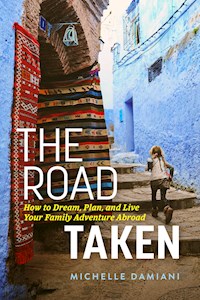
Author and clinical psychologist Michelle Damiani weaves together her story of a family year in an Italian village with the captivating experiences of 36 other contributors to create
The Road Taken: How to Dream, Plan, and Live Your Family Adventure Abroad, the definitive manual for parents who crave the family-bonding and horizon-broadening of an international expedition.
Whether you want to spend a season catching lizards together in a remote jungle or a year making friends in a French village or an extended stretch circumnavigating the globe,
The Road Taken will—
- shatter the myth that only trust fund babies can afford the global adventure of a lifetime by offering practical strategies to make money abroad
- inspire families to think outside the box and discover which experiences would be meaningful for them
- demystify the visa process and guide families to their new home
- share principles grounded in child psychology so parents can help their children with the inevitable transition adjustment like homesickness, culture shock, and anxiety
- describe the adventages and disadvantages of various educational options, including worldschooling, boatschooling, roadschooling as well as the more traditional local schools or international schools, and even hybrids of these
- embolden parents to step bravely into the unknown of possible hardships like language learning and medical issues and travel snafus
- offer comprehensive information on everything from banking to phones to what to do with your mail
“Who knew there was a practical guide to making magic?”
“You may want to start packing your bags.”
“I thoroughly enjoyed The Road Taken and recommend it to anyone thinking of moving abroad or just armchair dreaming...”
“This book will open your mind about what is achievable and it will inspire you with how travel can strengthen family bonds and family understanding of the world.”
“Made me wish I’d moved abroad when my kids were younger, but really put some ideas in my head about retirement!
Das E-Book können Sie in Legimi-Apps oder einer beliebigen App lesen, die das folgende Format unterstützen:
Veröffentlichungsjahr: 2020
Ähnliche


















To David, who gave me theidea.
And for my mother, who taught me
that an idea is anopportunity.
Contents
Introduction
Dreaming
1. Deciding to Go
John’s Story · The Life of Franki
Contributors’ Stories·When It’s Time
2. Your Child’s Response
Tania’s Story·It’s a Family Adventure
Contributors’ Stories·Involving Your Children
3. Dealing with Opinions
Sarah’s Story·Brushing off Other People’s Narratives
Contributors’ Stories·Dealing with Judgment
4. Choosing Your Adventure
Alisha’s Story·Off-Beat Destinations
Contributors’ Stories·Creating a Journey
Planning
5. Financing Your Adventure
Part One · The Big Potatoes
Part Two · The Smaller Potatoes
Julie’s Story·The How of How to Do It
Contributors’ Stories·How to Finance the Adventure of a Lifetime
6. What to do with your Home
Kate’s Story·Exchanging a Home for a Travel-Ready Lifestyle
Contributors’ Stories·Leaving Home Behind
7. Visas: the Sticky Wicket
Sarah’s Stories·The Trouble with Visas
Contributors’ Stories·Acquiring Visas
8. Making Money while Abroad
Gabriella’s Story·How We Afford Our Life in Mexico
Contributors’ Stories·Generating Revenue
9. How to Find a Spot to Unpack
Estelle’s Story·Creating a Cross-Generational Home in Le Marche
Contributors’ Stories·Picking a Homebase
10. When to Go
Allyson’s Story·Remembering a Childhood Year in Brussels
Contributors’ Stories·Timing Travels
11. Should you take your pet?
Heather’s Story·Moving our Dogs to Italy
Contributors’ Stories·Taking (or Leaving) Your Pet
12. How to Educate Your Child While Abroad
Allison’s Story·The World is Our Classroom
Contributors’ Stories·Choosing an Educational Path
13. Packing your Bags
Kenzie’s Story·Boxing up My Life
Contributors’ Stories·What to Bring
Living
14. Culture Shock
Jerry’s Story·The Seven Lies of Living Cross-Culturally
Contributors’ Stories·Adjusting to a New Normal
15. Learning the Language
Rachel’s Story·Language Connections
Contributors’ Stories·Language
16. How to Integrate
Part One · Meeting People
Part two · Values and Volunteering
Lisa’s story·Forming Global Connections
Contributors’ Stories·Integrating into New Communities
17. School Days
Nell’s Story·Schooling in a French Village
Contributors’ Stories·The School Experience
18. Medical Care
The Lewis Family’s Story·The Worst Moments
Contributors’ Stories·Seeking out Medical Care
19. Coping with Homesickness
Heather’s Story·When Homesickness Spirals
Contributors’ Stories·Homesickness and Loneliness
20. Saving Money While Abroad
Sara’s Story·Traveling within Travels
Contributors’ Stories·How to Save Money
21. Staying Connected to Your Old Life
Heather’s Story·Keeping up the Fiction
Contributors’ Stories·Connecting and Letting Go
22. Parenting Abroad
The Wagoners’ Story·How Our Parenting Changed
Contributors’ Stories·Parenting on Foreign Soil
23. The Daily Routine
Nicolas’s Story·How to Wait
Contributors’ Stories·The Day Abroad
24. A Spot of Advice
Naomi’s Story·The Value of a Good Goodbye
Contributors’ Stories·What We Wish We Knew Beforehand
Coming Home
25. Rose, Thorn, and Bud
Lisa’s Story·How to Backpack the World with Four Teenage Girls
Contributors’ Stories·Processing the Experience
26. How We Change
Jennifer’s Story·How Weathering Storms Shifts Perspective
Contributors’ Stories·The Journey Changes Us
27. Reverse Culture Shock (It's Real)
Nitsa’s Story·Repatriation
Contributors’ Stories·Returning Home
28. Final Thoughts
Contributors
Resources
Afterword
Acknowledgments
About the author
I shall be telling this with a sigh
Somewhere ages and ages hence:
Two roads diverged in a wood, and I—
I took the one less traveled by,
And that has made all the difference.
—Robert Frost
Introduction
In the summer of 2012, my husband and I moved to an Italian hill town with our three children and two cats. That sentence reads like the beginning of a story, but absent are the chapters that prefaced that turning point in our lives. From nurturing the germ of the idea to deciding where to live to saving money to getting a visa, the prologue to our move was rife with confusion and obstacles.
I never considered that our prologue would be of interest to anyone, until I wrote a book about our year abroad and the questions started rolling in. How did we find Spello? How did we find an apartment? How did we choose a school? How did our kids learn the language? How did we meet those endearing locals?
It was a challenge to respond to readers because I couldn’t in good conscience tell them how to mimic our experience. Our experience was special precisely because it was ours, and we made it from scratch. If we had followed someone else’s blueprint, we would have built somebody else’s house. I didn’t want to dissuade anyone from reaching for a family adventure, but at the same time, I wanted people to see beyond the rosy streets of Spello to design their own dream.
Right around then, my mentor Dave told me I needed to write a how-to book about moving abroad. As I was telling him about how I wanted to help people figure out their own path, it dawned on me that if I wrote a book that included various voices, it might inspire readers to reach beyond my story, or any one story, and instead realize that the possibilities were endless. Maybe by breaking down the conceptions of what mainstream society expects of families, I could empower parents to write their own story.
The Road Taken was born.
Via social connections (virtual and actual), I sought out families from different countries who had different adventures for different amounts of time. Thus, in this book you will read about a family that settled in Morocco for seven years and another that currently lives there. You will read about families that use travel as their children’s prime teacher by worldschooling, others that enrolled their children in International Schools, and some that utilized the local public or private schools. You will read about a cross-generational family that settled on Italy’s eastern edge and a family with four teen daughters that backpacked around the world. You will read about families that sailed through oceans and families that RVed through Europe.
The Road Taken is divided into the sections Dream, Plan, Live, and Coming Home. Each section is further divided into chapters. For each chapter, I’ll tell my story, then share a contributor essay on the topic, followed by passages from fellow travelers to flesh out the details and demonstrate the variety of possible approaches. For example, in the “Working Abroad” chapter of the Planning section, I offer information on how to create revenue while living overseas. Then Gabriella will share her experience with creating businesses that support her family’s life in Mexico. After that, you’ll read passages from contributors relaying their stories of funding their journeys. My goal here is to illustrate that there isn’t one right way to go about this process, so you can give your own ideas wing.
If you are fascinated by a contributor’s story, I encourage you to flip to the Appendix where I’ve included biographies of all our fellow adventurers. Some chose to be anonymous and use a pseudonym or their blog name in lieu of their actual name, but all of them have a blurb for you to learn more.
It’s true, there are other books out there about how to move abroad. Most of them are specific to a particular destination and are not geared towards families. Those books presuppose that you already know what you want to do for your adventure. In The Road Taken, we welcome readers who crave ideas for possible adventures as well as those who already have their visa paperwork completed.
While we will offer you a wealth of practical information, our main goal is to give you the confidence you need to blaze your path. Through my career as a clinical psychologist working with families and children, I’ve developed a way of approaching both joy and suffering that I believe can be of help for families contemplating a leap. Because as exciting as that leap is, it will inevitably include its challenges. I want you armed with strategies for how to approach resistance, how to listen to your children without sagging under the weight of their fear, how to be mindful of the changes you can expect in your family, how to keep a sense of wonder and perspective.
The road lies open ahead, so put on your dreaming hat and buckle up.
I can’t wait to see where your adventure takes you.
Part One
Dreaming
1 · Deciding to Go
How do you decide to make the leap into the arms of a family adventure? If you’re waiting for an invitation from the universe, chances are you’ll be waiting until you hit senility and can hallucinate that golden ticket. No, the decision to go seems to be equal parts desire, timing, openness, honesty, and daring. It’s a kind of magic really, which explains why my favorite part of listening to expat stories is the retelling of this moment in time. Expats get a misty look in their eye, some details of that moment are oddly hazy, while others are in sharp relief.
When I asked contributors about the moment when flirting with dreaming became dancing with dreaming, they often spoke of a defining moment, but from those that went into greater detail, it’s clear to me that the seeds for this adventure were sown long before.
The stirrings of my own desire to create a different life likely began in utero, as I was born in Panama to a French mother and a father who grew up on the US-Mexico border. But in more conscious terms, my wanderlove teed off with my taking a semester off of college to backpack through Europe. The trip was pivotal in all the ways one imagines—I lived on $20 usd per day, I became self-reliant, I practiced flexibility, and I met fascinating people.
When I was in the Cinque Terre (a totally different scene 30 years ago, before Rick Steves exposed its charm), I glommed on to a group of Australian women. In my eyes, they were Amazons. They told me that my country was going to hell in a hand basket, and I cheerfully agreed. They mocked me for my inability to use Celsius, and I chuckled warmly. They offered their Vegemite, and I convinced myself it was manna from heaven.
One day, we hiked to a secluded beach for the day. By the time the sun was thinking about setting, we looked up at the peachy clouds framing the hill we’d have to clamber back up and decided we wanted none of it. An abandoned train tunnel beckoned—nice and flat, and sure to lead where we were going. It was the kind of foolish decision that marks the youthful backpacking experience—like taking strangers up on their offer to go to a Peter Gabriel concert together because they seemed to enjoy the Black Forest cake in Salzburg as much as you do, or obligingly sharing your personal details and itinerary with a stranger in the train line in Paris who ends up sneaking into your compartment through a window, or yelling the few words of German you know at a drug peddler in Lisbon so that he stops following you while boasting about his wares in English (yes, these all happened to me).
In any case, we shrugged, somebody got out their “torch,” and we plunged into pressing blackness. Suddenly unsure, we found ourselves whispering. Was there an end to this darkness? The track appeared unused, but could a train be even now hurling towards us? Our ears stretched, our eyes stretched. Suddenly, the woman behind me began to sing.
Not just some ditty or commercial jingle.
No, she sang an aria. An aria that filled the tunnel, redoubling the sweetness of her voice. We lifted our shoulders and strengthened our steps until we turned the corner and discovered light.
Turns out she was an opera singer in Sydney.
That evening, over a splurge of pasta slick with pesto and a crisp white wine, the Aussies told me that taking a year off of life is completely expected in Australia. Everyone goes on the “dole” at some point or another. The government essentially pays for people to take that time off. They were using it to travel.
Wow.
A country that valued widening horizons so much that people are allowed, nay, encouraged to pack their bags and stamp their passport.
The idea dropped and settled in my brain.
I thought, I’d really like to take a year to travel someday.
But then I went to graduate school and got married and had three children, and it sort of seemed like someone else’s dream.
I spent years convincing myself that the desire to live abroad was a stupid one. I would flip through high school and college “where are they now” books (in the days before Facebook, if anyone can quite remember that) and search for people who had lived abroad. When I found stories of former classmates who had lived the life I’d once envisioned, I told myself that they probably had a rubbish time. They undoubtedly had medical horrors and divorces and no sense of identity.
As hard as I tried to bat the notion away, it kept flicking back to the edges of my consciousness—a sparkly ball the kitten in me desperately wanted permission to chase. My husband, Keith, and I would talk about moving abroad for a spell, then drop it and move on.
A few months after Gabe, our third child, was born, Keith and I celebrated our anniversary with an evening out. We toasted each other with glasses of prosecco and gazed out over the rolling Virginia hills. I bit my lip and asked if he remembered the dream we’d had years before of living abroad. He said yes. I’m not sure if I even uttered the next words aloud, but suddenly we were speaking the language of dreams. Tentatively at first, and then with increasing excitement and wonder. Could we do this? With children? Was it possible?
By the time we’d finished dinner and drained the last of the Italian red, we had a rough plan.
Five years.
We’d go in five years.
We’d live off Keith’s income so we could put mine in savings. We’d save and save. We would do it. Gabe would be in kindergarten, Siena would be in fifth grade, and Nicolas in ninth, but with his September birthday he was on the young side for his grade, and we could likely opt to put him in his final year of middle school.
A lot happened between the time we strolled starry-eyed out of that restaurant and five years later when we stepped into our new home in Spello, Italy. I’ve lost track of the times I was sure Italy would never happen. Or the number of times I complained about our restricted lifestyle, and doubted it was worth it. And there were plenty of bleak moments when I convinced myself Italy was a pipe dream; growing up meant releasing pipe dreams and settling into lives of convenience meals and back-to-school nights.
But we did it.
You can, too. Here are stories of other families, just like you, and how they decided to take the plunge.
The Life of Franki
John’s Story
It had always been a dream of mine to roam around Europe in an old VW combi. Time, marriage, job, and kids took over, and at some point, I gave up on that quest. Then one day, in a work meeting, it hit me like a face-slap. My health was shot, my work had become my social life, I was away for five months a year, and my kids had turned four and two and I’d barely noticed. Most of all, I wondered what happened to that guy who once rode on bus rooftops across Africa, stowed away on a cargo plane over the Amazon. What happened to the guy who once vowed to live a life of adventure, yet now was chained to its treadmill? As soon as that meeting was over, I raced home and sprang it on my wife that we should re-spark our travel dreams and take off, kids’n’all. We jumped on the idea before logic got in the way.
Our goal was to reconnect as a family by wandering through Europe. Our first step was purchasing a vehicle; after that, we’d work out the path as we went. The wine-induced day we pressed “send” on the computer to whiz twenty grand over the ‘net to Holland to buy an old seven-berth Fiat Frankia motorhome was both terrifying and exulting. Affectionately dubbing our new home “Franki,” we took off, aimlessly, with no real plan, eventually hacking our way through 30 countries. Through East and West Europe, to the Arctic Circle, Morocco, Turkey, and back, we rolled along for 40,000 kilometers.
The first four weeks were tough, like a breaking-in period. We’d gone from a big house where everyone had their own room to suddenly being wedged together in this rolling can on wheels where we all ate, slept, and peed. Personal space became a decadence from a previous era, and this took some serious adjustment. We got through by sheer perseverance, some selective time-out, plus the fact that we’d bought the machine and had no other choice. By week three, I would have gratefully pulled out. By week five, we discovered a whole new groove and the trip surged from there. For anyone who asks, I say, “Hang-in; it gets better!”
Our two kids were under five when we set off, so they were still waking in the night and keeping us alert with their not-so-endearing squeals. The upside of their young age was that they happily had no input into our itinerary. They were more interested in playgrounds, gelato, and their bunk bed “cubby-houses” than the great cities of Europe.
To make the voyage easier on the kids, we dedicated ourselves to slow travel. We had entire days of “nothing,” in which they could chill. We routinely took long morning, afternoon, and tea breaks while on the road, and while we made the decision to slow travel for them, it became an unforeseen blessing for all of us, as we immersed ourselves in our experience.
The utter freedom of the road meant we were like cats chasing a light, bounding off to anywhere that seemed of interest, with no set plan, almost on a daily basis. We traveled old school, without Internet, carrying Europe-wide road maps, a Lonely Planet guide book, and a camping guide to get around. Whipping into tourist information offices soon after entering each country provided additional details on new sights and camping spots. East Europe and North Africa in particular were constantly evolving, and our guide books were out of date within six months.
It’s funny how thoroughly we grew into our new life. Franki broke down in Croatia, and while she was being fixed, we moved into a cheap one-bedroom flat. On entering the apartment, after months in a camper, I instantly hugged the full-sized fridge as though it was a long-lost lover. We watched TV obsessively, cooked chicken in an oven because we could, and had multiple hot showers—all extravagances not available in the RV.
Partway through our apartment vacation, my son Callum approached my wife, Mandy, and asked, “Mummy, when are we going home?” Mandy and I were instantly terrified he was homesick for material stuff. Just as we thought our whole trip was about to crumble, he added, “When do we go home to Franki?”
For our kids, home was no longer a place of bricks and mortar and all the things we owned, but in our van, where we were together.
We met a lot of older people on the road, “grey nomads,” who continually repeated a similar story: Their great regret was that they worked so hard during their kids’ early years, often hardly seeing them, and now that they had the bounty of time, their kids were gone. If they could change one thing, they would have restructured their lives to spend time with their children.
This was my wife’s and my greatest mutual takeaway from our journey, and it became our new challenge when we returned to the “real world.” I never wanted to forget the feeling of lying in the sand of the Sahara Desert at night, my kids making sand angels beside me. In that moment, I realized that I had once been an absent father and was now connected with my children beyond my wildest aspirations.
We returned with a committed vision to change how we lived together as a family—trying to harness the connectedness we had achieved in “the life of Franki.” Putting that into action, however, was a challenge, when jobs and bills and schooling entered the equation. So, we did the only thing possible—we went on another road trip, this time to devise a plan for how we wanted to live our lives, and how jobs and kids would sit within that, not the other way around.
The radical changes we subsequently made wrenched us away from our previous life. We sold our house and downsized to wipe out our mortgage, ensuring we would no longer be chained to big jobs to survive. Our year in Franki taught us that simple living was achievable, if we were willing to fight for it. We bought our freedom from the rat race and haven’t looked back.
When It’s Time
Contributors’ Stories
Heather · Lived in Italy for two years
I grew up in the Midwest, dreaming of travel. I collected maps and read as many travelogues as I could get my hands on. I obsessed about walking through Florence, dreamed of living in Boston, imagined visiting the Rocky Mountains with my future family of eight. But my dad had his own business and money was always tight, so we never even took a family vacation until I was in college.
When I got married, my husband, Chris, and I discussed visiting Europe. But with having kids and paying off school loans, we didn’t make a plan, and the dream languished. Then, ten years ago, Chris flew to Belgium for work, and I tagged along so we could take a detour and finally get to Italy.
Over the years, we returned to Italy several times, our love for it growing with each visit. Back in Idaho, I was working for a radio station and getting burned out. I longed for a change. Then one day, Chris came home and asked me how I felt about moving to Milan for two to three years. I didn’t even hesitate. It was an immediate HECK YES! He had waited until it was a sure thing before telling me since he realized that once I knew, I would be in planning mode 24/7. He was right.
Canada-to-France · Lives in France
We always dreamed of living abroad, probably a side effect of watching too many episodes of House Hunters International. My husband and I both work from home, so we can work from anywhere, but we assumed we couldn’t follow our dream until our daughter went to University. Then Easter 2015, while enjoying a family vacation in Cuba, we met a family volunteering their way through the country. They had sold everything, put everything on hold to commit to a one-year journey with their 12-year-old daughter. Their story sparked our interest, and we told them about our idea of moving abroad. They vigorously encouraged us to do it NOW—forget about later, life is too short, and moving abroad would give our daughter an invaluable experience. Since we had time on our hands as we sipped mojitos at the pool bar, my husband and I toyed with possibilities. We had a busy life in Canada with a house in the suburbs and a cottage on a ski hill—could we give it up? We discussed how we could do it, and also where we could go. My husband suggested France. Since I am French and my daughter went to a French-speaking school, the language transition wouldn’t be so difficult...and from there, we had a plan!
Nica · Sailed the Caribbean
On our fifteenth wedding anniversary, Jeremy and I went out for dinner. The conversation started with “Hey, let’s get an air conditioner for Calypso since all we’re doing with the boat is sleeping aboard at the dock, and summer on the Chesapeake is hot hot hot hot.” By the time dinner was over, we were leaving for the Bahamas in nine months. We changed the wording from “Why should we?” to “Why NOT?” and that forced us to consider all the obstacles differently. House? Rent it. School? Homeschool. Jobs? Quit. We already had a boat, and already knew what would be required for an extended sail. I had recently told my boss I wasn’t coming back the next year, so it was only a matter of Jeremy being confident he could reenter the workplace on our return. Really, it was more a matter of realizing that we were ready for a change, and the uncertainties of heading off were less scary than just staying put.
Tania · Road-tripping through Europe
We traveled with our three daughters quite a bit while my husband, Matt, was working in Europe for the US State Department. But we dreamed of someday taking an entire year to travel with our girls. After moving back to the States, we decided it was time to take that gap year. Matt needed a career change, and we were eager to start our own business.
We had decided to combine our passion for travel and our passion for storytelling to create a company that tells stories to teach kids about other cultures and countries. We called it Around the World Stories.
We started planning for the trip about a year before leaving. We turned our bedroom into a planning room, with maps hanging everywhere. We had huge sheets of paper with endless to-do lists hanging around the house—everything from destination ideas to notes about visas to picking the proper shoes for everyone. We knew we’d have to be pretty lean, which was not easy. To top everything off, we’d welcomed a dog into our family, and there was no way we were going without her.
We decided on thirteen countries to visit and then planned around various factors like weather, festivals, and seasonal activities like skiing in the Alps and biking along the Danube. Our general plan was to spend about one month in each country—homeschooling the kids and working at the same time. We wanted to grow closer as a family by experiencing travel and learning together.
We weren’t ready in many ways, but I don’t think one can ever be truly ready.
Nell · Lived in France for one year
I grew up in Richmond, Virginia, which in the 60s was not the hip city it is now but a deeply provincial Southern backwater. In 1971, my mother took our family on a trip to France and Italy. I was eleven and had never tasted good bread before, never eaten a fresh cherry, never seen women with unshaved legs. The world opened up with a violent, ecstatic CRACK! and my relationship to my country (and myself) changed forever. In some deep way, I was home. I found myself returning to Europe again and again. I always ended a vacation vowing I’d one day live in Europe. I wanted to see if the connection I felt was a shallow one, just about the croissants. Or something bigger.
Once I had children, I was filled with a desire to give them the best of my own childhood. That trip to Europe I took as a child was tops on my list. So I started travel-scheming when they were newborns. We took two summer trips to France when they were toddlers (easier than it sounds!). Finally I decided it was time to take the leap.
I didn’t bother about the where too much. I knew there were many right answers. I chose France over Italy simply because I kinda-sorta spoke French, and I had heard that French schools were better. But doubtless Italy would have been equally glorious—there are so many right places, and luck is certainly part of the equation.
Astrid · preparing to worldschool
We talked about slow-traveling for several years. Even so, the idea didn’t evolve into an actual plan until we attended the Family Adventure Summit in Penticton, British Colombia in September 2017. At the summit, we met families that were actually doing long-term slow travel, and we decided to commit to making this lifestyle our reality. When we returned to Seattle, we picked July 2018 as our take off date.
We are planning to do a gap-year style trip, where we spend an extended amount of time in different locations, but eventually intend to return to the US. So far, we have plans to stay in Costa Rica, Mexico, and Indonesia. We plan to rent apartments and live like the locals. My husband will primarily be working, and I plan on doing some consulting work while we worldschool our kids.
Naomi · Lived in India and Singapore for four years
I was born in Nebraska and lived my early childhood days in a blip of a town surrounded by cornfields and rolling hills. Our idea of adventure was big and exciting, but it was always contained in the expanse of how far we could explore before being called home for dinner.
As adults, my husband and I moved to Ohio with our three children. I suffered quite a bit from the long winters, and grew increasingly depressed, unhappy, and lethargic. One day my husband came home and asked what I thought about moving to India for eight to ten years. It sounded the opposite from the gray and dreary Cleveland days, so I said, “Why not? I’m up for anything!”
My husband solidified his employment a few weeks later, and I immediately started planning. We brought home armfuls of library books, and I started researching life in India. For three months after he left, I solo-parented our 3-, 6-, and 14-year old children, while preparing to sell our home and move our entire existence across the ocean. In retrospect that to-do list seems crazy, but it shows it can be done!
Sara · Lived in Morocco for seven years
Pre-family, I was a professional dancer. I always loved the adventure of finding my way around new cities, discovering my new grocery store and gym, and experiencing what the city had to offer. When I was 23, I was hired by the Chinese Government to teach musical theatre dance in Beijing. I loved every moment of it.
Once I met my husband, traveling moved to the back burner as we headed into a direction of “responsibility” and “stability.” We were buying an apartment and planting roots. Travel seemed frivolous. We had traveled to Europe when we got engaged and again for our honeymoon, and we always said, “Wouldn’t it be great to live abroad?!” But we never knew how that would work out.
We didn’t plan on turning our lives upside down. But when my husband received a job offer in Morocco, we went from digging into our careers to researching what language Moroccans speak. Two weeks after we accepted the offer, we had sold our apartment and most of our belongings and were living in Morocco with a toddler and baby.
Because we were open to the idea of living abroad, we recognized the open door and flung ourselves through it. Over time, I’ve watched friends get job offers that include travel and heard them explain how they couldn’t accept them, often due to fears or notions of what determines the “right” job. We refused to limit ourselves in this way. Instead, we saw the opportunity like winning the lottery, a chance to turn everything we knew on its side and get a taste of the high we felt on our previous travels. We reasoned that the kids were young enough that there was no risk to their education. Even if it was terrible, we’d just move back to the States and it would still have been a life-changing experience. For that reason we had to do it.
2 · Your Child’s Response
Kids will exhibit a variety of responses when you tell them the family is going to up sticks. It’s important to remember that—like any aspect of childrearing—nothing lasts. Travel enthusiasm can wax and wane, so don’t get wrapped up in having your children’s opinion define your reality. Just because they are reluctant to go doesn’t mean they have secret information that it’s a bad idea. And just because they are enthusiastic doesn’t mean it’s going to be nonstop ponies and cupcakes with rainbow sprinkles.
In addition, if you’ll allow me to put on my child psychologist hat for a moment, when you tell your children they are going to move abroad, that’s a whole lot to process. Children just don’t have what it takes to quickly assimilate such a big piece of news. So even if they react with joy or horror, they are likely to go right back to playing with their Legos. That doesn’t mean they don’t care or that they’ve experienced short-term memory loss. Rather, it means they are shelving the news to process in digestible chunks. The next day, when your son is in the bath, he may ask, apropos of nothing, “Who will be sleeping in my bed when I’m gone?” Or your daughter may pipe up from the backseat, “Will I get to eat Chinese food every day in China?”
There isn’t a right way to process; each child will do it differently. Your job is to be matter-of-fact and treat all their questions, concerns, and anticipations as if they are important, while not getting attached to them as being prophetic or durable. So give them space to talk and feel. Don’t tell them not to be nervous. Nobody ever changed his feelings on being commanded to. Those feelings just go underground. If they confess that they are scared to go to school with people who don’t speak English, tell them, “Of course you are. It’s a scary thing until you get used to it.” If they say they can’t possibly leave their best friend behind, assure them that leaving is always difficult. Don’t cheerlead, or wheedle them with promises of daily gelato, or make it okay for them. They’ll make it okay for themselves, given time and space to do so. Simply reassure them that their feelings are normal and a natural response to a big adjustment, that you are glad they are expressing themselves, and that you trust them to deal with the hard stuff, because they always do.
Listen, I’m not going to sugar-coat this for you: There will likely be times when the transition is hard on your children. They’ll need you as a soft place to land. So starting now, be that. Hear them and acknowledge their feelings as valid. That way they’ll go into the adventure knowing that when the chips are down, they can rely on you for support.
Now, you may not ask your kids for their opinion, but understand their limitations. It’s important to not think of this as “obstructing your vision” but rather “opening your focus.” I remember our first trip to Rome with two children. We were spending so much time on playgrounds, and I had the thought (a dangerous one, to be sure), “What would we be doing right now if we didn’t have kids?” But quickly images of those leisurely strolls through museums became blurred with the certainty that this experience was not worse, just different, and in some ways richer. We were surrounded by Roman families, the tang of Italian was all around us, we traveled more slowly, more deliberately, we stopped to wonder at the most minor of rocks at the Forum. Children change the way we travel, children change the way we live, and that can be a good thing.
This is all to say, take your children’s reactions to the idea of this adventure with a grain of salt. And a few rainbow sprinkles.
It’s a Family Adventure
Tania’s Story
In our pre-children lives, traveling abroad was relatively easy. We watched movies on the flight, read books on the beach, met locals in pubs, and spontaneously explored our surroundings. But eighteen years and three kids later, we knew things were going to be different. There would be a whole new set of priorities, considerations, and challenges, but also countless memories filled with more joy than we could have envisioned as young travelers.
Before we began planning the destinations for our road trip through Europe, we had to discuss what to pack. The girls’ idea of what constituted a necessity was not the same as mine. My inner dictator wanted to decree what we were bringing and where we were going, but instead we opted for the democratic approach. For our adventure to be successful, the girls needed to feel that their opinions mattered, that they weren’t held hostage to their parents’ dream. So I stepped back and listened to my children, rather than educating them on what a “real traveler” packed. It was easier to let go once Matt and I realized that though we were old hands at moving, this was the first time our children would leave good friends, a house they considered home, and even our minivan that they’d lovingly named. Letting them choose what they carried was critical to easing their transition.
After deciding which toys, mementos, and stuffed animals were joining us, we moved straight to an important subject—birthdays. It seemed like a great starting place to activate their enthusiasm for the journey ahead. So we opened up the map and told them to choose where to celebrate their birthdays. We ordered them to think big. They enthusiastically considered their options. Our 14-year-old knew she wanted to do an adventure sport so chose skydiving outside Amsterdam. Our 11-year-old decided on Playmobil Fun Park outside Nuremberg, Germany. Our 8-year-old wanted to be surprised, so we chose a trip to Efteling, a theme park in the Netherlands complete with a fairy tale forest.
As we continued to plan together, we read H.C. Andersen’s fairy tales, Pippi Longstocking, Paddington. We excitedly talked about what we’d do, the history there, the stories that belong to each city. We also turned Friday movie night into “trip research,” watching movies like The Sound of Music for the Alps and Salzburg, Ratatouille and A Cat in Paris for France, and The Secret Life of Walter Mitty—a great family movie to inspire wanderlust.
Once we were on our journey, we ceded more decision power to the children, because they genuinely had great ideas. We never would have gone skiing in Andorra if our eldest hadn’t suggested it. And we might never have gone to Cornwall if our other daughter hadn’t wanted to make English-speaking friends. We explored caves, snorkeled, went paragliding, and visited Heidi’s mountain in Switzerland, all because of our girls’ suggestions.
We homeschooled the kids on the road, but our eldest asked to attend a school in Germany to improve her German and see what school there would be like. It’s something that never would have occurred to me, and I was so proud of her for stepping out of her comfort zone. We found a Waldorf School in Hannover that was more than happy to take her for a month, and it was a memorable and wonderful experience.
Traveling, for us, is about experiencing new places together as a family. When we let our kids be part of it—to contribute, to explore, to learn—they grow in ways greater than we thought possible. In the end, taking the time to involve the kids throughout the process made our travels a true family adventure.
Involving Your Children
Contributors’ Stories
Heather · Lived in Italy for two years
When we told our kids that we were moving to Italy, they were immediately on board. They had never been to Europe and were so excited. That excitement lasted until about seventy-two hours after we arrived in Milan and reality set in.
Nica · Sailed the Caribbean
When we first told our children we going sailing for nine months in the Bahamas and Dominican Republic, they both let us know that they’d be staying home. Neither Jeremy nor I come from families where children are consulted in big decisions, so it never occurred to us to involve the kids other than telling them the plans. We did, however, incorporate their needs by, for instance, making sure we arranged our sailing schedule so that we could meet up with other family boats.
Susan · Remembering moving to Singapore as a child
My father was posted to Singapore as part of his career. We had about three months’ notice, just enough time to pack our belongings. I did NOT want to go. Brought up on a diet of Enid Blyton books, I pleaded to be left behind and allowed to go to boarding school. My parents insisted I was too young. As it happens, I was sent to boarding school at a later age and did not enjoy it at all.
Cheryl · RV-ing through Europe
My kids are too young to be involved in the planning, but they definitely influence how we travel. At their age, backpacking would be too stressful and flying would be too expensive. So we settled on traveling in a motorhome; that way we don’t spend money and time hunting for accommodations. Plus, the kids still have the security of our “bit,” a Scottish term for home.
Melissa · Preparing to leave for Spain
We’ve been prepping the kids for the past two years. I think they are a mix of nervous and excited. We have friends who moved to Germany, so I share stories of those kids learning German to reassure my kids that they can learn Spanish quickly. I homeschool my oldest, so there’s no attachment to schooling for him, but my daughter, who is in traditional school, has a few reservations about leaving. But she’s left a school before and survived, so hopefully she’ll have that experience to give her confidence.
Kirsty · Road-tripped Through Northern Africa and Central Asia from her adopted home in Abu Dhabi
The kids were six and eight when we set off and we involved them in making choices on what they wanted to see, where they wanted to go, booking accommodations, and finding places to visit. They enjoyed taking ownership of aspects of the planning. They were both quite opinionated about where to spend their birthdays—in the end we had three birthdays in Morocco and one in Iran.
Lisa · Backpacking around the world
We involved our four daughters in both the planning and the execution of this global backpacking year. We figured they would be more willing travelers if they got a say in the process. They aren’t always interested in the finer details, and that’s okay. We hold frequent family round tables about destinations, experiences, as well as accommodations and flights (our eldest now loves researching flights). We trained our daughters to read maps, understand GPS systems, decipher weather forecasts, and investigate attractions. They have also learned how to research transportation—trains, buses, Uber, etc—by downloading apps, Googling sites, and reading reviews.
As our daughters mature, they ask us how we can afford 365 days of travel. After all, everyone back home assumes we had a windfall. Yes, it’s expensive and can be a slog sometimes. But this journey together is worth every cent, every argument, every lonely moment. Just as a picture is worth a thousand words, our experience is worth everything with regards to connection, resilience, and understanding ourselves and others. Not to mention the exposure to different people and cultures.
Oh, and the answer to my daughter’s question is this: This year was possible because we made sacrifices based on our priorities. When we focus on what we truly value, rather than what society or advertisers decide we should be valuing, we can realize our dreams. It’s a lesson that I hope will be with them forever.
3 · Dealing with Opinions
Your decision to take your family on the adventure of a lifetime is like everyone else’s Rorschach test. That is, the way they react to it says a lot about them. Friends and family who cheer for you are probably living their own dream (whatever that looks like for them) and so are happy to support you in living yours. Those who grumble and judge are likely not as satisfied with their own choices. Those that point out the dangers are likely scared themselves. You get the idea.
It seems the universal reaction burgeoning expats receive when they announce an impending move is, “You are so brave, I could never do that.” With or without a contemptuous glance.
That pronouncement will make you feel foolish and weak. After all, you know you aren’t brave. It’s just that the part of you that wants to change your life is bigger than the part of you that’s fearful. In that moment, I want you to remember that just opening yourself to this possibility means that you are strong and brave and creative and in tune with yourself. And also, it’s not crazy to consider changing your life for no real reason other than “I want to.” People who don’t get it are people whose craving for a paradigm shift is smaller than their need for stability or their fear of change.
That’s okay.
I’m not saying you are on the side of the angels because there isn’t one right way to do life. What I am saying is that other people’s reactions are indicative of their own calculus, not yours. There are plenty of people who share your longing to feel the pinpricks of adventure around the corner. You have their stories here in the pages of this book. I hope you use that as a bulwark, to hold you up when other people’s judgment threatens to drag you down.
Because you’ll get it:
“You’re taking your kids out of school? Won’t that put them behind in math?”
“Don’t you worry about how it’ll impact their odds for college admission?”
“Won’t they miss their friends?”
“Won’t you be lonely?”
“Isn’t it selfish to disrupt your kid’s life?”
“Won’t it take a chunk out of your retirement? Isn’t that financially irresponsible?”
“But they aren’t fluent in the language—what will they do at school? How will they make friends?”
Right now, I want you to go to the mirror and practice your Italian, “Boh,” the ubiquitous shrug that Italians do with their arms outstretched that means, “I don’t know, and it will be fine.” When I wrung my hands and worried aloud with Italians at our local bar about how hard public school would be for my children, they smiled and cocked their head and said, “Boh. Piano, piano, e tutto bene.” Slow, slow, and everything will be well, one step at a time. Boh. It’s a good gesture to practice. The kind of thing I hate when my kids use it to answer my question of, “Did you bring home your math homework?” but an excellent response to a question or comment that has no real answer.
Even when loved ones meant to be kind, their responses often struck an odd chord with me. For instance, I felt prickly and weird when friends told me that they admired me. I’m a pleaser by nature, so I’d rather be liked than admired. I wish I could say I’ve outgrown this quirk now that I’m solidly veering towards 50-years-old, but it is still present. In fact, this time around, I’ve noticed that I avoid telling people that we’re planning a year around the world (Oh, did I not tell you that? Looks like that avoidance runs deep). So when it comes up because we’re discussing anything related to the year 2020, I’m distinctly uncomfortable.
With our year in Italy, I had plenty of friends laugh off the dream with an airy, “Oh, you guys. Always planning something. You’ll never go through with it.” Now that we’ve done it, people believe us, and yet I’m the one waving my own hand, “You never know what will happen. But that’s the current plan.”
I don’t hedge because I’m afraid of losing face by not following through or because I cower in the face of disapproval. I hedge because I don’t want anyone’s admiration or awe, or really any of their thoughts and feelings about my plans. I assume people will have judgments about it, positive or negative, and I really don’t care. I’m not interested in unpacking their baggage, so I have learned to put up the boundary. Not my circus, not my monkeys.
As you’ll read in the contributors’ stories, my experience of having to grapple with other people’s reactions is universal. Everyone you know will have an opinion. That’s okay. After all, you living your dream makes them confront their own lives, and they have to deal with that in their own way. It’s not your job to make it easy for them, and it’s not your job to force them to reflect authentically. More than once I was tempted to blurt out, “Isn’t it possible you think it’s a dumb idea because you are afraid of admitting your own dream?” It is your job to own your experience. So sing it from the rooftops, or keep it as private as the beginning of pregnancy, or anywhere in the middle. There’s no right way to do it, as long as you are being honest with yourself.
I would add that, like telling your children, it’s important to listen to people, without necessarily accepting their truth as universal truth. Friends and family may have important information that you had not considered, like about factoring in the cost of International School or about a recent outbreak in drug-related violence in the region you are considering. It makes sense to take in offered wisdom. But ultimately, you decide what’s right for your family.
I trust you to do that. I hope your loved ones can do the same. And if they can’t, I hope you can find the resolve to not let that butcher your fun.
Brushing Off Other People’s Narratives
Sara’s Story
People make so many assumptions about our experience living in Morocco. That I covered my hair (I didn’t). That because Morocco is a developing country, we must have lived on a grand estate (our incomes were measly compared to the wealth we saw all around us). That I was brave. That last one is the most surprising to me. I’m not brave, I’m just me, and I always have faith that things will work out.
Our families never understood why we moved away for seven and a half years. They know we’re free spirits, but they don’t get why we’d choose to miss out on life in the United States. I never felt that way. I am so much richer for my life in Morocco.
Part of the richness was the nearness of other countries to explore. We took so many family trips that travel became routine, and we could jet off with just two small duffel bags. If my daughter had a book and my son found a stick, then everyone would be entertained even in the most arduous travel moments.
Somewhere around our fourth year in Morocco, I began to realize that when my husband was traveling for work, I didn’t need to remain home with the kids. I began taking them to Europe on my own. We visited Paris (four times!), Ireland, London, and Edinburgh. At this point the kids were becoming more interested in history, so our adventures grew to include historical sites. By visiting the Tower of London, Versailles, and Edinburgh Castle, they experienced first hand the history they read about in books. This forever changed how they learn.
After all those solo trips with the kids, I began to wonder what it would be like to live in Bali for a few months. When I mentioned my idea to my husband, he encouraged me to pursue it. I had become a confident traveler, and my husband and I never wanted to stop each other from fulfilling dreams. If that meant that I traveled with the kids alone, so be it.
We fielded quite a few questions from people who wondered how I could travel without my husband. But we trusted our strength as a couple, and knew that society’s notion of a good marriage had no bearing on our choices. After all, we had already picked up the kids and moved them to a developing country. What was one more disillusionment of the American cultural expectation of family?
Dealing with Judgment
Contributors’ Stories
Naomi · Lived in India and Singapore for four years
At the time we left the United States, I felt incredibly supported and, at the same time, incredibly misunderstood. Surface-level friends came out of nowhere clamoring for connection in the weeks before our departure. Looking back on it, I get that our moving to India would be the closest many of our acquaintance would come to a similar experience. It felt like I was behind a glass wall, with many eyeballs peering in—waiting to see what happened next.
Nica · Sailed the Caribbean
Since we’d done sailing vacations pre-children, our family was supportive. For years, they have listened to us wax rhapsodic about sailing, and Jeremy’s mom and dad had planned to set off on their own cruising adventure before his dad unexpectedly passed away. To be honest, I think our families were more surprised that we came back than that we left.
People did ask how we could possibly give up our jobs. They wondered how we’d manage on a small boat. The concept of sailing at night was impossible to fathom. They wanted to know if we’d be stopping anywhere, or if we were just going to be sailing all the time.
The hardest thing for people to grasp, other than the space limitations that we whole-heartedly embrace, is the speed with which we do not move through the world. A 60-mile day in the Intracoastal Waterway is a long day of boring (you hope) motoring, perhaps punctuated by dolphins. It’s not an hour jaunt to Richmond undertaken flippantly. The level of planning we do as sailors in terms of weather, anchorages, and safety is hard for non-cruisers to comprehend.
Canada-to-France · Lives in France
People judged us for moving to France. We left Canada because we wanted to change our pace of life. We wanted to experience more time with each other and experience new adventures while traveling. Not everyone understands that wanderlust. Most people are so buried in their busy, over-scheduled, day-to-day lives that they cannot imagine leaving it all behind for a simpler existence. But I envisioned it and went after it, and am grateful.
John · RV-ed through Europe
I’m glad we ignored everybody who told us that traveling in a camper with small kids would be terrible. In general, there was very little support from others for our quest. We had to deliberately avoid the “dreamstealers” as we had enough of our own doubts without adding their premonitions of doom. As it happens, the only thing I would do differently would be to worry less about the trip and how the kids would adjust. It was an awesome experience.
Kirsty · Road-tripped Through Northern Africa and Central Asia from her adopted home in Abu Dhabi




