


16,99 €
Mehr erfahren.
- Herausgeber: John Wiley & Sons
- Kategorie: Geisteswissenschaft
- Sprache: Englisch
This introductory textbook offers a concise and lucid account of the main developments in contemporary feminist thinking, and demonstrates the centrality of feminist thought to all areas of intellectual enquiry.
In a wide-ranging discussion, Evans argues that most accounts of the world since the Enlightenment have been constructed in terms of a distinction between the public and the private which excluded women. Using both historical and more recent examples, she examines the breadth and complexity of feminist thinking, focusing on key themes such as the body, representation, engendering knowledge, and the relationship between women and the state.
Evans argues that feminist thought seeks less to add to existing theory than to re-theorize the social and symbolic worlds; no contemporary account of these worlds, she suggests, is complete without a discussion of the implications of gender difference.
This book offers a clear and coherent guide to contemporary feminism for students of women's studies, gender studies, sociology, social theory and literary theory.
Sie lesen das E-Book in den Legimi-Apps auf:
Seitenzahl: 303
Veröffentlichungsjahr: 2013
Ähnliche

















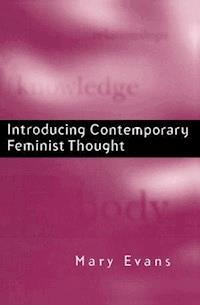
Introducing Contemporary Feminist Thought
Mary Evans
Polity Press
Copyright © Mary Evans 1997
The right of Mary Evans to be identified as author of this work has been asserted in accordance with the Copyright, Designs and Patents Act 1988.
First published in 1997 by Polity Press in association with Blackwell Publishers Ltd.
Reprinted 2005
Polity Press
65 Bridge Street
Cambridge CB2 1UR, UK
Polity Press
350 Main Street
Malden, MA 02148, USA
All rights reserved. Except for the quotation of short passages for the purposes of criticism and review, no part of this publication may be reproduced, stored in a retrieval system, or transmitted, in any form or by any means, electronic, mechanical, photocopying, recording or otherwise, without the prior permission of the publisher.
Except in the United States of America, this book is sold subject to the condition that it shall not, by way of trade or otherwise, be lent, re-sold, hired out, or otherwise circulated without the publisher’s prior consent in any form of binding or cover other than that in which it is published and without a similar condition including this condition being imposed on the subsequent purchaser.
ISBN 0-7456-1475-2
ISBN 0-7456-1476-0 (pbk)
ISBN 978-0-7456-6623-5 (ebook)
A CIP catalogue record for this book is available from the British Library.
Library of Congress Cataloging-in-Publication Data
Evans, Mary, 1946–
Introducing contemporary feminist thought / Mary Evans.
p. cm.
Includes bibliographical references and index.
ISBN 0–7456–1475–2. — ISBN 0–7456–1476–0
1. Feminist theory. I. Title
HQ1190.E92 1997
97–559
305.42'01–dc21
CIP
Typeset in 11 on 13 pt Sabon
by Wearset, Boldon, Tyne and Wear.
Printed and bound in Great Britain by Marston Book Services Limited, Oxford
This book is printed on acid-free paper.
For further information on Polity, visit our website: www.polity.co.uk
Contents
Acknowledgements
Introduction
1 Enter Women
2 Public and Private: Women and the State
3 Engendering Knowledge
4 Representation
5 The Body
6 Feminism and the Academy
7 Worlds of Difference?
Notes
Bibliography
Index
Acknowledgements
I was fortunate to receive a great deal of help from other people in writing this book and preparing it for publication. Andrew Winnard and Pamela Thomas at Polity were helpful and sympathetic editors. Sue Sherwood and Carole Davis were endlessly patient with revisions to the text, and from Pat Macpherson, Jan Montefiore, Anne Seller, Mary McIntosh and Janet Sayers I received careful and critical advice. I am deeply grateful to all of them.
Introduction
The focus of this book is, as the title indicates, contemporary feminism. But the account of feminism presented here is explicitly that of a feminism with close, not to say fundamental, links to the academy and the academic ‘form’ of feminism, ‘Women’s Studies’. As such the book is not about Women’s Studies, but in many cases readers will recognize issues and themes that are common currency in Women’s Studies courses. Contemporary feminism, particularly in the West, is very much a creature with important academic roots. Indeed, one of the many freedoms that feminism has helped to create is the sense of the legitimacy of explicitly personal and subjective material within the academy. It was not, as many feminists have pointed out, that the personal and the subjective were not features of the academy, but they were often disguised as ‘objectivity’ and the ‘real facts’. These apparently objective truths were objective in so far as they were constructed and legitimated by the most powerful group within the Western academy, a group that it is impossible to describe in any terms other than white, male and middle class. So powerful was the hold of this section of the population on teaching and research in higher education that different views and experiences, particularly and crucially views and experiences from outside that group, were seldom, if ever, given space or credence.
But while saying this, what has to be said at the same time, and said emphatically, is that whilst this dominant culture was in many ways exclusive and narrow, it also contained its own dissent, difference and distinction. It is thus that in engagement with the intellectual past there is a constant need both to maintain scepticism about its judgements and retain respect for its achievements. Equally, we have to develop new ways of discussing and debating the central issues of our culture. ‘The master’s tools’, wrote Audré Lorde in one of the best-known feminist interventions about the academy, ‘will never dismantle the master’s house’. And as she went on to say, ‘this fact is only threatening to those women who still define the master’s house as their only source of support’.1
Those ‘master’s tools’ to which Audré Lorde referred are a constant, if sometimes hidden, feature of the following pages. It was with inspiration from Marx, Freud and Foucault (amongst others) that feminists constructed radical re-readings and reinterpretations of our social and emotional worlds. Yet at the same time, and crucially, no engagement with these figures would have occurred if diverse women, from Simone de Beauvoir to Audré Lorde, had not resisted and rejected the nature of the master’s house that those theoretical tools had constructed. Here, therefore, is the suggestion that the master’s tools have been used to good effect by feminists, and that dialogue and debate with post-Enlightenment political and social theory is a central element of contemporary feminism.2 But, at the same time, two provisos remain: the first is that the figures who have been most inspirational to feminism have been figures from traditions of dissent in Western culture. The triumvirate mentioned above all stood, in various ways, for a rejection of bourgeois, conventional thought. Their radicalism may not have contained a radicalism about relations between women and men, but at the same time it contained a vision of human emancipation and human equality that remains important to this day. For those millions of women whose lives are curtailed and blighted by the incessant greed of global capitalism and its voracious demands for low paid labour, Marx’s critique of capitalism remains relevant. Indeed, the importance of retaining a knowledge of the dynamic of class relations in capitalism needs stressing in a culture that increasingly emphasizes identities of consumption rather than production.
So the intellectual past should not sit like a dead weight on our shoulders, but should be used – with scepticism and even irreverence – to understand the present. It is in resisting the authority of the academy that feminism has shown itself to be powerful, and in the further demonstration that the master’s house is often not worth defending. Carole Pateman has pointed out ‘the sexual contract’ that lies at the heart of Western ideas of citizenship, just as Sasha Roseneil has documented the possibilities of feminist political action.3 Both writers, and others working in the same tradition of non-complicity with the academic past, have illuminated the ways in which understanding informs and strengthens action. The purpose of this book is to suggest some of the main ways in which a feminist understanding of the world can disturb and disrupt conventional assumptions. Those ‘conventional assumptions’ may, in some cases, be apparently academic or theoretical, but a premise of the discussion here is that the boundaries between the academic/theoretical and the ‘real’ world are not firm and fixed. On the contrary, ‘higher knowledge’ is a major force in the organization of our daily, routine lives. Whilst we may not always recognize the origin or the meaning of the imperatives that we follow, they are a crucial part of our lives.
It should therefore be apparent that what is questioned in the literature reviewed here is the tradition of universalistic assumptions in the West. Indeed, it is a central thesis of the pages that follow that knowledge is deeply gendered, in terms of both who produces it and – more significantly – what is produced. It is not that there is women’s knowledge and men’s knowledge, as earlier feminist accounts of intellectual life have suggested, but that gendered assumptions are inter-woven into the fabric of our culture. Unpicking the strands of gendered bias is thus a crucial task for feminists: what follows is hopefully a guide to the ways in which the manifest inadequacies of what has so far passed for universal knowledge might be rejected in favour of more truly representative accounts of the world.
1
Enter Women
Let me begin this book with an autobiographical comment: when I went to university in 1964 there was no such thing as an explicitly feminist presence. Indeed, there were not very many women in universities, let alone women teaching a subject explicitly and unreservedly about women. At my alma mater (the London School of Economics) there were about eight male undergraduates for every female, and to say that the culture was vigorously masculine would be no exaggeration. The politics, the economics and the sociology that I was taught were all about the public world and the world of men. It simply did not occur to anyone, myself included, that it might be important to consider questions of gender in our discussions. Women, when they were mentioned at all, had a poor academic press from my left-wing (or at least Labour-voting) teachers, since women, it was stated, were more likely to vote Conservative than men. In those days of the white hot heat of Harold Wilson’s Technological Revolution, anyone who stood in the way of the achievement of a meritocratic and technocratic social democracy was not to be trusted.
But women were as essential to young (and old) men in 1964 as they have ever been, and just as women barely appeared in the academic curriculum, so they were central to non-academic discussions. In the early 1960s, the rules of sexual relationships were being re-written, and my generation grew older within a set of shifting ideas about sexual behaviour. The Pill had just begun to be widely available, and widely discussed, and thus to a young, cosmopolitan cohort of students, it really did appear as if sexual intercourse, together with the Beatles, had been invented in 1964. Philip Larkin’s ironic, and wry, poem about the changing moral climate of the 1960s (‘Sexual intercourse began/In nineteen sixty-three’)1 caught some of the atmosphere of the time; what it left out was the resistance of women to the male construction of the new standards and the sheer confusion of the time, as differences of generation became politicized in a way unique to the post-war world. Into this mêlée older voices occasionally intervened; I remember the famous Agony Aunt Evelyn Home sweeping all before her in a vivid denunciation of sexual liberalization as defined by men. Faced with an audience almost exclusively made up of young men, determined to mock this determined advocate of pre-marital chastity, Evelyn Home argued a case for women that was seldom heard in the portals of our lecture theatres.
However persuasive her oratory, Evelyn Home could not change or prevent the shifts in ideas – and, of course, in behaviour – that took place in the following decade. Sex and sexuality became an explicit part of the agenda of the West, and by 1970 the rules and expectations that had governed the early 1960s had either disappeared or begun to disappear. As numerous histories of the 1960s have pointed out, by the end of the decade sexual codes had changed, ‘permissiveness’ had arrived and the explicit discussion of sexuality had become part of the lingua franca of the West.2 Inevitably, a generation grew up believing that it had invented sex and, as firmly, believing that the past had been one long dark history of the repression of sexuality. Sexual ‘freedom’, the sexually explicit and sexual availability became synonymous with an expectation of personal liberation and the pursuit of individual happiness. Older voices (on all sides of the political spectrum) could point out that having heterosexual sex was nothing particularly novel and offered as much a lack of freedom as it did the promise of freedom, but these voices were often dismissed as ‘Puritan’, or even worse ‘up-tight’.
This re-invention of sexuality took place, for the West, within the context of political systems still dominated by East-West rivalry and a fear of the threat of Soviet Communism as great as any in the 1950s. Indeed, one essential and salient point about the 1960s is that the national and inter-national politics of the decade, rather than the politics of inter-personal relations, were still locked into the dynamic of the early twentieth century and the West’s terror of Communism. What brought the political and the personal together for many in the 1960s was the polarization of political opinion about the intervention of the United States in Vietnam. On the one hand, the 1960s had seen the rapid decolonization of the old Western empires, whilst on the other, the world’s major power carried out a massive, and essentially imperial, engagement in a non-Western country. The political legitimacy of the West, which had been saved by the victory over German fascism, now came under fire for its own authoritarianism, and, as some commentators saw it, its own version of fascism.3
The question of Vietnam thus became a rallying cry for a generation, just as the Spanish Civil War had been a focus in the 1930s. Because the United States had become the power of the West in the years after 1945, its politics became the dominating factor for all its allies. But since Vietnam was not the only issue which beset the United States in the 1960s, other questions – particularly about race and sexuality – rapidly became internationally significant. The Civil Rights movement in the United States dramatized relations between races in a way previously unknown in the post-war years, whilst the Black Power movement that developed from the struggle for civil rights transformed Western thinking about the construction of racial identities. The politics of the 1960s were dominated by confrontational issues, in which the ideological hegemony of the United States was shattered by internal and external opposition. As the North Vietnamese, the Black Panthers and the student revolutionaries of 1968 pointed out, the military power of the United States might be absolute, but that still left a great deal to discuss and negotiate about the order and the agenda of the social world.4
These turbulent politics, and this stormy decade, left its mark on countries and governments just as assuredly as it made, and often un-made individual lives. For once, the Western academy was intimately and directly involved in these political upheavals. Campuses across the United States were the sites of organized protest about government policy in Vietnam whilst European universities, particularly in France, gave rise to the resurgence of highly critical accounts of government policies. The definitive European case remains that of the Sorbonne, where the domestic arrangements (that is male access to the accommodation of female students) of a new campus at Nanterre became the point of contention that brought a government to crisis and threatened the stability of a whole society. Thus did sex and politics in the 1960s join together to form an explosive mix that radically destabilized both social institutions and social assumptions. The ‘new’ interpretation of the world in 1968 was for political and sexual liberation and against the war in Vietnam. A counterculture, which at any other time might have been simply a shift in the behaviour of a generation, acquired not just a political meaning but also a real political power.
Into these events, and within these events, came a further current which arguably has had a more important long-term impact on social life than the protest movements of the 1960s. The current was that of feminism, and the claim by women for their right to self-determination and personal autonomy. It was, like any social movement, complicated and often contradictory, riddled with dissent and fired with messianic zeal. Feminism was in no sense ‘new’ to the twentieth century, but it assumed, in the 1960s and the 1970s, a new urgency and a new radicalism that made it a product of its times. If every generation has to re-invent the wheel – or tends to believe that it has just invented the wheel – so feminism in the West in the 1960s and 1970s took some time before it recognized its history and the longevity of the struggle that it represented.
The history of the ‘resurgence’ of feminism (as it is often described) in the 1960s has now been fully documented both in fiction and non-fiction. Of all the accounts written of the coming of feminism and the coming to feminism of a new generation, one of the most vivid about the United States is Sara Davidson’s Loose Change, which captures both some of the excitement and the chaos (whether sexual or intellectual) of the time.5 But to identify that novel as a representative account of second wave feminism carries with it a set of assumptions about feminism, which requires immediate comment. The novel is set in the United States, and is about white, middle-class women who came to feminism through and within the academy. It is not about the world, and worlds, outside that assumptive world, and indeed the novel ends on a note of integration: the characters, having made their protests and lived their lives of adolescent rebellion, become re-integrated into a white, professionally successful, middle-class world.
What has to be recognized, and the point of introducing this novel into a discussion about feminism, is that feminism was always, and is still, a form of protest by women about their exclusion from full citizenship in Western, bourgeois society. Western, post-Enlightenment feminism essentially took issue with the construction of citizenship by that world – a form of citizenship that originally (and still to a certain extent today) excluded women, not necessarily through conscious intention or conscious decision, but through the non-thinking assumption that the people in the public world were all male. Indeed, in many situations and many contexts the term ‘people’ has actually been interpreted as exclusively male. Thus, from the beginning of the nineteenth century, the dominant (although by no means the only) tradition within feminism was one that fought for the extension to women of those rights (for example the vote and access to the professions and higher education) automatically enjoyed by men. Yet even in saying this, what requires comment is that the men with whom women are comparing themselves are white and middle class. No feminist campaigned for entry to the world of the relatively under-privileged manual worker, anymore than the point of comparison in feminist campaigns in the West were the disenfranchised and racial minorities. In her work on the ‘hidden’ feminism of working-class women, the British historian Sheila Rowbotham has reminded us that working-class women have a long history of campaigning for their rights (particularly for Trade Union representation and equal workplace rights), but the thrust of her long and distinguished work has been to make the point that, in talking about feminism, we must be aware of its complexity and its different meaning for women in different classes and countries.6
Thus the first point we have to establish in a discussion of feminism is that the term ‘feminism’ in the 1990s needs more careful consideration than it received in the heady days of the late 1960s and early 1970s. Feminism has become more complex in its traditions, and the very word now demands a measure of deconstruction if we are ever to tease out from it the various appeals that this diverse movement makes to different constituencies. But the very diversity of feminism’s appeal has given to it much of its creative energy; a movement that has always had both furious disputes and rock-solid agreements is one that allows difference and debate. At times the degree of ‘allowance’ has occasionally been stretched to breaking point, but what remains is the central, and crucial, organizing principle that gender difference is an essential part of any discussion of the social or symbolic world. Thus between those within and outside feminism is the fundamental division that those within feminism see the world – at least in part – in terms of gender divisions, whilst those outside feminism either refuse or reject the impact of gender difference on individual lives.
It was that assertion of difference, of the radically different experiences of the world of women and men which gave contemporary Western feminism its first great rallying-cry in the late 1960s. The great past of Western feminism – the tradition of Mary Wollstonecraft, Simone de Beauvoir and many others – was known, but only slowly re-discovered.7 What was said, by Germaine Greer, Kate Millett, Sheila Rowbotham and Shulamith Firestone (and again – and as ever in the history of feminism – many others), was that contemporary sexual politics denigrated and degraded women, and that this denigration took many forms.8 Reading and reviewing this literature some twenty-five years after its publication still reveals the vitality of the work: at the same time what is now striking about it all is its concern with the West, and its narrowly defined and constructed set of social assumptions. A major target for many of the writers (and this was true in particular of Greer and Millett) was Western culture – in all its forms. A major focus was ‘high’ culture, but feminists were equally vociferous in attacks on denigratory aspects of ‘popular’ culture such as the Miss World contest. Sexual Politics, Kate Millett’s account of the misogyny of a group of Western writers is definitively about the inadequacies of Western literature. Similarly, Germaine Greer’s The Female Eunuch, whilst being in part a critique of misogyny was also deeply in debt to high bourgeois culture. Whilst Greer was for more heterosexual sexuality (at that point in her career) Millett was advocating a more cautious attitude to heterosexuality, an attitude that was eventually to emerge as explicit lesbianism.9
These works of non-fiction (and Greer and Millett in particular had close formal links to the academy) were matched by a flowering of feminist fiction.10 In part, some of this fiction was a rediscovery of the possibilities of the female bawd, and bawdiness. (Erica Jong, for example, belongs to this tradition and her Fear of Flying epitomised what was seen as female sexual liberation.) But the factor that united the fiction and the non-fiction was, more often than not, a furious plea for women’s autonomy, and particularly their sexual autonomy. The sexual revolution was found to be, as far as women were concerned, deeply inadequate since the form of sexuality that it prioritized was both heterosexuality and a form of heterosexuality that took for granted male sexual desire for women. The rejection of this organizing perception became a key element of early 1970s feminism: in part the rejection was about the rejection of heterosexuality per se (and the United States in particular saw the emergence of a powerful and vital lesbian literature of which Jill Johnston – the author of Lesbian Nation – was perhaps the best known writer) but it was also about the more complex rejection of a particular form of heterosexuality in which women ‘succumbed’ to ‘natural’ male desire. As was soon pointed out by gay men, this set of assumptions trapped men, quite as much as women, within a straight-jacket of expectations about sexual behaviour. Thus the frantic heterosexuality of the late 1960s was rapidly taken to task by both women and men for the limits, rather than the extended possibilities, that it imposed on human actions.
In the cluster of best-selling feminist works of the early 1970s there is a rich vein of fury at misogyny and a general determination to persuade women to self-realization. Two key slogans that emerged from this time and this literature were ‘the personal is the political’ and ‘sisterhood is powerful’. (The latter was also the title of a collection of essays by Robin Morgan.)11 Both slogans implicitly endorsed the idea that women were universally oppressed and exploited, and that only through a recognition of this common situation could women change the structures that oppressed them. An argument of Engels, that in marriage women are the proletariat and men the bourgeoisie, was one that had much currency, even outside circles sympathetic to Marxism.12 For some feminists, any participation in a heterosexual relationship carried with it inevitable exploitation; this was a situation, it was asserted, in which negotiation was neither possible nor desirable. From this theoretical position, in which the major organizing dynamic of human history was men’s hostility to women, it was inevitable that its adherents would interpret all history and all social relations in terms of war between the sexes. ‘Women Only’ bookshops, cafés and living space became the practical results of this interpretation of the world, and within it differences between women became vastly less important than the common cause of women against men.
This theoretical position, to which the label ‘radical lesbian’ or ‘radical feminist’ is sometimes attached is associated with the writings of women such as Sheila Jeffreys and Mary Daly.13 It is a position of engaging coherence, in that social divisions become very simple, indeed positively singular and can be identified in terms of gender divisions. At the same time, this very theoretical position also became the point at which other feminists began to offer interpretations of the social position of women that called into question solidarity and – most important – similarity between women, and offered instead ideas about difference and lack of common cause. The crucial arguments here were about race and class; in the early 1970s, Marxists offered readings of Marx and Engels that subsumed the sex war to the class war; the times were changing, but not changing enough for the great theoretical systems of the modern world to give way easily to ideas that seemed to complicate, rather than illuminate.
This reference – to the ‘great theoretical systems of the modern world’ – is the point at which the emergence of contemporary feminism has to be situated not just in terms of a changing culture in the West, but in terms of a shift in our theoretical understanding of the world. Thus two major changes have to be noted if we are to situate feminism accurately. The first is the globalization of the late-twentieth-century world, the second is the shift from modernity to post-modernity. The first involves us in rethinking our perceptions of nationality and ethnicity; we still have national identities, but the meaning of these identities becomes increasingly negotiable (as the post-1989 world demonstrates) and increasingly unstable as global markets, and a global economy unite countries and cultures in ever closer ties. The nature of these ties is frequently exploitative, ‘the North’ (as prosperous industrialized countries are termed) takes unremittingly from ‘the South’ in a way that has changed little from the days of blatant nineteenth-century imperialism. Thus to think about women in terms of race now involves far more than thinking about racial divisions within societies; it involves thinking about racial divisions and distinctions between societies quite as much as within national boundaries. To assume, for example, that ‘women of colour’ necessarily constitute a political group distinct from white women would now be thought an oversimplification. We recognize that the differences between, say, women of Palestine and women of Israel might be considerable in political terms but limited in terms of the material difference between both groups of women and women in, for example, the Sudan. Who is united with whom, and for what reason, has come to be acknowledged as an almost impossibly complex question.
What the above seems to imply is that feminism has now reached such a point of fragmentation that few of the old certainties about sisterhood and unity have any meaning. In one sense this is true, and the movement slogans of the early 1970s (‘sisterhood is powerful’ for example) now have a dated and a problematic ring to them. Nevertheless, around certain issues (abortion is one of the most obvious instances) women continue to organize across class and racial lines. Equally, just as feminist theorists have begun to be sceptical about the usefulness of the category of ‘woman’, so international agencies have initiated debates and programmes that call for the empowerment and the education of women.14 In these programmes (such as that launched in 1994 in Cairo on Family Planning by the United Nations) the term ‘women’ was used with an inclusiveness that has long disappeared from general use in Western feminist circles.
The exception to this shift is, of course, the ‘women’ in Women’s Studies. In this context, women remain a clear and obvious category, an explicit assertion that in the academic context at least there are similarities and common causes that tie women together. In the past ten years attempts have been made to contest the term ‘Women’s Studies’, and to substitute for it the term ‘Gender Studies’. Considerable controversy has been generated by the suggestion that Women’s Studies somehow speaks to the past, in which gender differences were not recognized. Further, it is asserted that the term ‘gender’ rather than ‘women’ alerts students and teachers alike to the complexity of issues relating to relations between the sexes. Women, it is pointed out, do not live or act in a world from which men are absent; what it is therefore essential to study, this argument continues, is the dynamic of relations between the sexes.15
There is considerable appeal in this argument in that at first sight it seems to offer a way out of the impasse of studies that concentrate exclusively on women, without reference to a larger context, or to one peopled by men as well as women.16 Yet at the same time, what we can set against this appeal are two salient factors: first, that the very term ‘Women’s Studies’ is a constant, and constantly politicizing, reminder that women have been, until relatively recently, largely excluded from the academic curriculum both as subjects and as agents. Until the 1970s it is possible to say that on the whole (and there were of course important exceptions) Western universities taught little that was explicitly about women. In a sense, it also has to be said that the same universities taught little that was explicitly about men. The problem was that the human subject (as the anthropology text book which begins with the sentence ‘People in all societies have wives’ attested) was simply assumed to be male. The most often cited example of the academic implications of this idea was that of the question of work. In 1970 it was taken-for-granted that work meant paid work, generally performed by men, outside the home. The idea – and the assumptions behind it – was spectacularly shattered by numerous feminist writers, who pointed out that work was very often unpaid, equally often performed by women and absolutely socially essential.17 The British writer Ann Oakley was amongst those who demonstrated the contribution women made to any economy in their unpaid work.18 On the other side of the Channel, Christine Delphy demonstrated that the contribution of women to family businesses was as essential as it was generally unrewarded.19 In the case of France, Delphy’s work led to the recognition of women’s work by the French government; in Britain, the award of allowances to ‘carers’ has its origins in the passionate vigour of feminist writing in the early 1970s about work.
Hence ‘work on work’ provided for feminists a very real instance of the way in which it is crucial to identify women per se in debates and discussions, since without this identification, it is all too easy for women to disappear and for the human actor to be assumed to be uniformly male. Making explicit the unpaid work done by women in the home (and indeed in other contexts as well) made it possible to open up discussions about caring, about development policies that ignored or marginalized women, about emotional as well as material work and, indeed, the history of work itself.20 In this latter context, the extension of ideas about work made possible the re-thinking of ideas about the public and the private and the nature of citizenship. But in the early 1970s many of these developments were in the future; the debates at the time took the form of argument about the contribution of women’s unpaid work to the accumulation of surplus labour, the documentation of women’s work and their part in the construction of industrial society and radical interventions about the social construction of skill (and with that, of course, the reward system of the West).21
It is, as always, difficult (and dangerous) to single out names of individuals who contributed to these debates. The meetings of feminists that took place throughout the West (for example, the Conference at Ruskin College in 1971) were attended by hundreds of women whose names never appeared in print, but who nevertheless made significant contributions to the debates, not least through the sense of urgency and solidarity that their presence created. ‘Being there’ was a major part played by a whole generation of women. Yet whilst making this claim for the place in history of those who created a sustained enthusiasm, there emerged from that generation many women who were to make a singular and lasting contribution to debates about gender and the lived experience of women. It is difficult to single out individuals, but those who made distinctive contributions included (on the British side of the Atlantic) Sheila Rowbotham, Sheila Jeffreys, Veronica Beechey and Juliet Mitchell. In the United States, Kate Millett, Shulamith Firestone, Adrienne Rich and Audré Lorde made interventions of great power and originality, as did, in France, Hélène Cixous and Luce Irigaray.22 As justification for this list, rather than another, I would offer the explanation that what these women did was to develop in certain crucial ways the feminist tradition. For example, two of the best known feminists of the 1970s in the West were Betty Friedan and Germaine Greer. In The Feminine Mystique (first published in 1963) and The Female Eunuch (first published in 1970) Betty Friedan and Germaine Greer wrote texts that captured the public imagination and inspired considerable comment. Yet Friedan and Greer’s books (as Maggie Humm’s exemplary Feminisms makes clear) can be placed firmly within existing traditions in feminism: Betty Friedan’s account of the malaise of white, middle-class, educated women living in the suburbs of the United States is a plea for more women to receive more education that fits exactly into a long tradition of liberal Western feminism.23 To read Mary Wollstonecraft’s A Vindication of the Rights of Woman at the same time as Friedan demonstrates that the singularity and similarity of the Enlightenment vision could easily span differences of continents and a hundred-and-fifty years. Equally, Germaine Greer’s account, in The Female Eunuch, of the emasculation of women by patriarchy is fuelled by the same energy as the women writers of the seventeenth and eighteenth century who protested at the sexual limitations placed upon them. The right to sexual desire by women had been an issue long before Greer.
Thus some of the writing which appeared in the early 1970s spoke as much to earlier traditions as to emerging ones. That there was a feminist tradition in the West – and has been since well before the Enlightenment – has always been known, and feminists of the 1970s were not the first to point out that for centuries women had campaigned for autonomy and for those social rights restricted to men. Campaigning organizations such as, in Britain, the Fawcett Society had long histories of intervention in social and public policy. However, what distinguishes the writers listed above (Rowbotham et al.) from others is that they seized on two ideas which are profoundly radical in their implications and have enormous significance for anyone interested in the question of the construction of knowledge. The first issue that these women identified is that sexual difference has far more profound effects on human thought than has so far been imagined: it was not, therefore, a question about what men thought, but how men thought. The second issue identified at this time was the assertion that differences of gender manifested themselves in all aspects of behaviour.
In the early 1970s many of the ills of the West, and its intellectual assumptions, were grouped together under the term ‘Patriarchy’. This idea – and the relevance of the idea – was hotly debated at the time, but even amongst those who were most suspicious about its applicability there was a general acceptance of the idea that in all societies and in all cultures men dominated the public world and through this domination controlled and defined the behaviour of women.24




