


123,99 €
Mehr erfahren.
- Herausgeber: John Wiley & Sons
- Kategorie: Fachliteratur
- Serie: Wiley Series in Computational Mechanics
- Sprache: Englisch
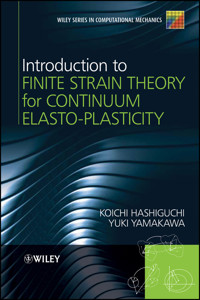
Comprehensive introduction to finite elastoplasticity, addressing various analytical and numerical analyses & including state-of-the-art theories
Introduction to Finite Elastoplasticity presents introductory explanations that can be readily understood by readers with only a basic knowledge of elastoplasticity, showing physical backgrounds of concepts in detail and derivation processes of almost all equations. The authors address various analytical and numerical finite strain analyses, including new theories developed in recent years, and explain fundamentals including the push-forward and pull-back operations and the Lie derivatives of tensors.
As a foundation to finite strain theory, the authors begin by addressing the advanced mathematical and physical properties of continuum mechanics. They progress to explain a finite elastoplastic constitutive model, discuss numerical issues on stress computation, implement the numerical algorithms for stress computation into large-deformation finite element analysis and illustrate several numerical examples of boundary-value problems. Programs for the stress computation of finite elastoplastic models explained in this book are included in an appendix, and the code can be downloaded from an accompanying website.
Sie lesen das E-Book in den Legimi-Apps auf:
Seitenzahl: 402
Veröffentlichungsjahr: 2012
Ähnliche

















Contents
Cover
Series
Title Page
Copyright
Preface
Series Preface
Introduction
Prominence of the finite strain elasto-plasticity theory
Chapter 1: Mathematical Preliminaries
1.1 Basic Symbols and Conventions
1.2 Definition of Tensor
1.3 Vector Analysis
1.4 Tensor Analysis
1.5 Tensor Representations
1.6 Eigenvalues and Eigenvectors
1.7 Polar Decomposition
1.8 Isotropy
1.9 Differential Formulae
1.10 Variations and Rates of Geometrical Elements
1.11 Continuity and Smoothness Conditions
1.12 Unconventional Elasto-Plasticity Models
Chapter 2: General (Curvilinear) Coordinate System
2.1 Primary and Reciprocal Base Vectors
2.2 Metric Tensors
2.3 Representations of Vectors and Tensors
2.4 Physical Components of Vectors and Tensors
2.5 Covariant Derivative of Base Vectors with Christoffel Symbol
2.6 Covariant Derivatives of Scalars, Vectors and Tensors
2.7 Riemann–Christoffel Curvature Tensor
2.8 Relations of Convected and Cartesian Coordinate Descriptions
Chapter 3: Description of Physical Quantities in Convected Coordinate System
3.1 Necessity for Description in Embedded Coordinate System
3.2 Embedded Base Vectors
3.3 Deformation Gradient Tensor
3.4 Pull-Back and Push-Forward Operations
Chapter 4: Strain and Strain Rate Tensors
4.1 Deformation Tensors
4.2 Strain Tensors
4.3 Compatibility Condition
4.4 Strain Rate and Spin Tensors
4.5 Representations of Strain Rate and Spin Tensors in Lagrangian and Eulerian Triads
4.6 Decomposition of Deformation Gradient Tensor into Isochoric and Volumetric Parts
Chapter 5: Convected Derivative
5.1 Convected Derivative
5.2 Corotational Rate
5.3 Objectivity
Chapter 6: Conservation Laws and Stress (Rate) Tensors
6.1 Conservation Laws
6.2 Stress Tensors
6.3 Equilibrium Equation
6.4 Equilibrium Equation of Angular Moment
6.5 Conservation Law of Energy
6.6 Virtual Work Principle
6.7 Work Conjugacy
6.8 Stress Rate Tensors
6.9 Some Basic Loading Behavior
Chapter 7: Hyperelasticity
7.1 Hyperelastic Constitutive Equation and Its Rate Form
7.2 Examples of Hyperelastic Constitutive Equations
Chapter 8: Finite Elasto-Plastic Constitutive Equation
8.1 Basic Structures of Finite Elasto-Plasticity
8.2 Multiplicative Decomposition
8.3 Stress and Deformation Tensors for Multiplicative Decomposition
8.4 Incorporation of Nonlinear Kinematic Hardening
8.5 Strain Tensors
8.6 Strain Rate and Spin Tensors
8.7 Stress and Kinematic Hardening Variable Tensors
8.8 Influences of Superposed Rotations: Objectivity
8.9 Hyperelastic Equations for Elastic Deformation and Kinematic Hardening
8.10 Plastic Constitutive Equations
8.11 Relation between Stress Rate and Strain Rate
8.12 Material Functions of Metals
8.13 On the Finite Elasto-Plastic Model in the Current Configuration by the Spectral Representation
8.14 On the Clausius–Duhem Inequality and the Principle of Maximum Dissipation
Chapter 9: Computational Methods for Finite Strain Elasto-Plasticity
9.1 A Brief Review of Numerical Methods for Finite Strain Elasto-Plasticity
9.2 Brief Summary of Model Formulation
9.3 Transformation to Description in Reference Configuration
9.4 Time-Integration of Plastic Evolution Rules
9.5 Update of Deformation Gradient Tensor
9.6 Elastic Predictor Step and Loading Criterion
9.7 Plastic Corrector Step by Return-Mapping
9.8 Derivation of Jacobian Matrix for Return-Mapping
9.9 Consistent (Algorithmic) Tangent Modulus Tensor
9.10 Numerical Examples
Chapter 10: Computer Programs
10.1 User Instructions and Input File Description
10.2 Output File Description
10.3 Computer Programs
Appendix A: Projection of Area
Appendix B: Geometrical Interpretation of Strain Rate and Spin Tensors
Appendix C: Proof for Derivative of Second Invariant of Logarithmic-Deviatoric Deformation Tensor
Appendix D: Numerical Computation of Tensor Exponential Function and Its Derivative
D.1 Numerical Computation of Tensor Exponential Function
D.2 Fortran Subroutine for Tensor Exponential Function: matexp
D.3 Numerical Computation of Derivative of Tensor Exponential Function
D.4 Fortran Subroutine for Derivative of Tensor Exponential Function: matdex
References
Index
WILEY SERIES IN COMPUTATIONAL MECHANICS
Series Advisors:
René de Borst
Perumal Nithiarasu
Tayfun E. Tezduyar
Genki Yagawa
Tarek Zohdi
Introduction to Finite Strain Theory for Continuum Elasto-PlasticityHashiguchi and YamakawaOctober 2012Nonlinear Finite Element Analysis of Solids and Structures: Second editionDe Borst, Crisfield, Remmers and VerhooselAugust 2012An Introduction to Mathematical Modeling: A Course in MechanicsOdenNovember 2011Computational Mechanics of DiscontinuaMunjiza, Knight and RougierNovember 2011Introduction to Finite Element Analysis: Formulation, Verification and ValidationSzabó and BabuškaMarch 2011This edition first published 2013 © 2013, John Wiley & Sons Ltd
Registered officeJohn Wiley & Sons Ltd, The Atrium, Southern Gate, Chichester, West Sussex, PO19 8SQ, United Kingdom
For details of our global editorial offices, for customer services and for information about how to apply for permission to reuse the copyright material in this book please see our website at www.wiley.com.
The right of the author to be identified as the author of this work has been asserted in accordance with the Copyright, Designs and Patents Act 1988.
All rights reserved. No part of this publication may be reproduced, stored in a retrieval system, or transmitted, in any form or by any means, electronic, mechanical, photocopying, recording or otherwise, except as permitted by the UK Copyright, Designs and Patents Act 1988, without the prior permission of the publisher.
Wiley also publishes its books in a variety of electronic formats. Some content that appears in print may not be available in electronic books.
Designations used by companies to distinguish their products are often claimed as trademarks. All brand names and product names used in this book are trade names, service marks, trademarks or registered trademarks of their respective owners. The publisher is not associated with any product or vendor mentioned in this book. This publication is designed to provide accurate and authoritative information in regard to the subject matter covered. It is sold on the understanding that the publisher is not engaged in rendering professional services. If professional advice or other expert assistance is required, the services of a competent professional should be sought.
Library of Congress Cataloging-in-Publication Data
Hashiguchi, Koichi. Introduction to finite strain theory for continuum elasto-plasticity / Koichi Hashiguchi, Yuki Yamakawa. p. cm. Includes bibliographical references and index. ISBN 978-1-119-95185-8 (cloth) 1. Elastoplasticity. 2. Strains and stresses. I. Yamakawa, Yuki. II. Title. TA418.14.H37 2013 620.1′1233–dc23 2012011797
A catalogue record for this book is available from the British Library.
Print ISBN: 9781119951858
Preface
The first author of this book recently published the book Elastoplasticity Theory (2009) which addresses the fundamentals of elasto-plasticity and various plasticity models. It is mainly concerned with the elasto-plastic deformation theory within the framework of the hypoelastic-based plastic constitutive equation. It has been widely adopted and has contributed to the prediction of the elasto-plastic deformation behavior of engineering materials and structures composed of solids such as metals, geomaterials and concretes. However, the hypoelastic-based plastic constitutive equation is premised on the additive decomposition of the strain rate (symmetric part of velocity gradient) into the elastic and the plastic strain rates and the linear relation between the elastic strain rate and stress rate. There is no one-to-one correspondence between the time-integrations of the elastic strain rate and stress rare and the energy may be produced or dissipated during a loading cycle in hypoelastic equation. Therefore, the elastic strain rate does not possess the elastic property in the strict sense so that an error may be induced in large-deformation analysis and accumulated in the cyclic loading analysis. An exact formulation without these defects in the infinitesimal elasto-plasticity theory has been sought in order to respond to recent developments in engineering in the relevant fields, such as mechanical, aeronautic, civil, and architectural engineering.
There has been a great deal of work during the last half century on the finite strain elasto-plasticity theory enabling exact deformation analysis up to large deformation, as represented by the epoch-making works of Oldroyd (1950), Kroner (1959), Lee (1969), Kratochvil (1971), Mandel (1972b), Hill (1978), Dafalias (1985), and Simo (1998). In this body of work the multiplicative decomposition which is the decomposition of the deformation gradient into the elastic and plastic parts, introducing the intermediate configuration obtained by unloading to the stress free-state, was proposed and the elastic part is formulated as a hyperelastic relation based on the elastic strain energy function. Further, the Mandel stress, the work-conjugate plastic velocity gradient with the Mandel stress, the plastic spin, and various physical quantities defined in the intermediate configuration have been introduced. The physical and mathematical foundations for the exact finite elasto-plasticity theory were established by 2000 and the constitutive equation based on these foundations – the hyperelastic-based plastic constitutive equation – has been formulated after 2005. However, a textbook on the hyperelastic-based finite elasto-plasticity theory has not been published to date.
Against this backdrop, the aim of this book is to give a comprehensive explanation of the finite elasto-plasticity theory. First, the classification of elastoplasticity theories from the view-point of the relevant range of deformation will be given and the prominence of the hyperelastic-based finite elastoplasticity theory will be explained in Introduction. Exact knowledge of the basic mechanical ingredients – finite strain (rate) tensors, the Lagrangian and Eulerian tensors, the objectivity of the tensor and the systematic definitions of pull-back and push-forward operations, the Lie derivative and the corotational rate – is required in the formulation of finite strain theory. To this end, descriptions of the physical quantities and relations in the embedded (convected) coordinate system, which turns into the curvilinear coordinate system under the deformation of material, are required, since their physical meanings can be captured clearly by observing them in a coordinate system which not only moves but also deforms and rotates with material itself. In other words, the essentials of continuum mechanics cannot be captured without the incorporation of the general curvilinear coordinate system, although numerous books with ‘continuum mechanics’ in their title and confined to the rectangular coordinate system have been published to date. On the other hand, knowledge of the curvilinear coordinate system is not required for users of finite strain theory. It is sufficient for finite element analyzers using finite strain theory to master the descriptions in the rectangular coordinate system and the relations between Lagrangian and Eulerian tensors through the deformation gradient, for instance. This book, which aims to impart the exact finite strain theory, gives a comprehensive explanation of the mathematical and physical fundamentals required for continuum solid mechanics, and provides a description in the general coordinate system before moving on to an explanation of finite strain theory.
In addition to the above-mentioned issues on the formulation of the constitutive equation, the formulation and implementation of a numerical algorithm for the state-updating calculation are of utmost importance. The state-updating procedure in the computational analysis of elasto-plasticity problems usually requires a proper algorithm for numerical integration of the rate forms of the constitutive laws and the evolution equations. The return-mapping scheme has been developed to a degree of common acceptance in the field of computational plasticity as an effective state-updating procedure for elasto-plastic models. In the numerical analysis of boundary-value problems, a consistent linearization of the weak form of the equilibrium equation and use of the so-called consistent (algorithmic) elasto-plastic tangent modulus tensor are necessary to ensure effectiveness and robustness of the iterative solution procedure. A Fortran program for the return-mapping and the consistent tangent modulus tensor which can readily be implemented in finite element codes is provided along with detailed explanation and user instructions so that readers will be able to carry out deformation analysis using the finite elasto-plasticity theory by themselves.
Chapters 1–7 were written by the first author, Chapter 8 by both authors, and Chapters 9 and 10 by the second author in close collaboration, and the computer programming and calculations were performed by the second author based on the theory formulated by both authors in Chapter 8. The authors hope that readers of this book will capture the fundamentals of the finite elasto-plasticity theory and will contribute to the development of mechanical designs of machinery and structures in the field of engineering practice by applying the theories addressed in this book. A reader is apt to give up reading a book if he encounters matter which is difficult to understand. For this reason, explanations of physical concepts in elasto-plasticity are given, and formulations and derivations/transformations for all equations are given without abbreviation for Chapters 1–8 for the basic formulations of finite strain theory. This is not a complete book on the finite elasto-plasticity theory, but the authors will be quite satisfied if it provides a foundation for further development of the theory by stimulating the curiosity of young researchers and it is applied widely to the analyses of engineering problems in practice. In addition, the authors hope that it will be followed by a variety of books on the finite elasto-plasticity.
The first author is deeply indebted to Professor B. Raniecki of the Institute of Fundamental Technological Research, Poland, for valuable suggestions and comments on solid mechanics, who has visited several times Kyushu University. His lecture notes on solid mechanics and regular private communications and advice have been valuable in writing some parts of this book. He wishes also to express his gratitude to Professor O.T. Bruhns of the Ruhr University, Bochum, Germany, and Professor H. Petryk of the Institute of Fundamental Technological Research, Poland, for valuable comments and for notes on their lectures on continuum mechanics delivered at Kyushu University. The second author would like to express sincere gratitude to Professor Kiyohiro Ikeda of Tohoku University for valuable suggestions and comments on nonlinear mechanics. He is also grateful to Professor Kenjiro Terada of Tohoku University for providing enlightening advices on numerical methods for finite strain elasto-plasticity. He also thanks Dr. Ikumu Watanabe of National Institute for Materials Science, Japan, for helpful advices on numerical methods for finite strain elasto-plasticity. The enthusiastic support of Dr. Keisuke Sato of Terrabyte lnc., Japan, and Shoya Nakaichi, Toshimitsu Fujisawa, Yosuke Yamaguchi and Yutaka Chida at Tohoku University in development and implementation of the numerical code is most appreciated. The authors thank Professor S. Reese of RWTH Aachen University, Professor J. Ihlemann and Professor A.V. Shutov of Chemnitz University, Germany, and Professor M. Wallin of Lund University, Sweden for valuable suggestions and for imparting relevant articles on finite strain theory to the authors.
Koichi Hashiguchi Yuki Yamakawa February 2012
Series Preface
The series on Computational Mechanics is a conveniently identifiable set of books covering interrelated subjects that have been receiving much attention in recent years and need to have a place in senior undergraduate and graduate school curricula, and in engineering practice. The subjects will cover applications and methods categories. They will range from biomechanics to fluid-structure interactions to multiscale mechanics and from computational geometry to meshfree techniques to parallel and iterative computing methods. Application areas will be across the board in a wide range of industries, including civil, mechanical, aerospace, automotive, environmental and biomedical engineering. Practicing engineers, researchers and software developers at universities, industry and government laboratories, and graduate students will find this book series to be an indispensible source for new engineering approaches, interdisciplinary research, and a comprehensive learning experience in computational mechanics.
Over the last three decades, the finite strain theory for elasto-plasticity has been extensively developed to provide very precise descriptions of large elasto-plastic deformations. These theoretical developments have been augmented with robust computational methods, which provide accurate solutions to the corresponding boundary-value problems. Deep mathematical and physical knowledge of related continuum mechanics is required to learn the theory, which is difficult for students, engineers and even researchers in the field of applied mechanics, to capture in depth.
This book is one of the first introductory books to address finite strain elasto-plasticity theory, where the mathematical and physical foundations are comprehensively described. In particular, the representation of physical quantities in convected (curvilinear) coordinate systems is employed, which is required for the substantial interpretation of basic concepts, such as pull-back and push-forward operations and convected (Lie) derivatives, that is, the general objective rate in continuum mechanics. Furthermore, all the mathematical derivations and transformations of equations are shown without any abbreviation, explaining the numerical method for the finite elasto-plasticity in detail.
In addition, a Fortran program for the stress-update algorithm based on the return-mapping scheme and the consistent (algorithmic) tangent modulus tensor, which can readily be implemented in finite element codes, is appended with a detailed explanation and user instructions, so that the readers will be able to implement the numerical analysis on the basis of the finite elasto-plasticity theory without difficulty.
It is our hope that the readers of this book will contribute to the improvement of mechanical design of machinery and structures in the field of engineering by adopting and widely using the basic ideas of the finite elasto-plasticity theory and the corresponding numerical methods introduced in this text.
Introduction
Prominence of the finite strain elasto-plasticity theory
This book addresses the finite strain elasto-plasticity theory, abbreviated as the finite elastoplasticity. Then, the prominence of finite strain elasto-plasticity theory and the necessity of its incorporation to deformation analysis is first reviewed by comparing with the infinitesimal elasto-plasticity theory, abbreviated as the infinitesimal elastoplasticity, prior to the detailed explanation of the finite elastoplasticity in the subsequent chapters.
Elastoplasticity theory is classified from the view point of relevant range of deformation as follows:
Lesen Sie weiter in der vollständigen Ausgabe!
Lesen Sie weiter in der vollständigen Ausgabe!
Lesen Sie weiter in der vollständigen Ausgabe!
Lesen Sie weiter in der vollständigen Ausgabe!
Lesen Sie weiter in der vollständigen Ausgabe!
Lesen Sie weiter in der vollständigen Ausgabe!
Lesen Sie weiter in der vollständigen Ausgabe!
Lesen Sie weiter in der vollständigen Ausgabe!
Lesen Sie weiter in der vollständigen Ausgabe!
Lesen Sie weiter in der vollständigen Ausgabe!
Lesen Sie weiter in der vollständigen Ausgabe!
Lesen Sie weiter in der vollständigen Ausgabe!
Lesen Sie weiter in der vollständigen Ausgabe!
Lesen Sie weiter in der vollständigen Ausgabe!
Lesen Sie weiter in der vollständigen Ausgabe!




