


92,99 €
Mehr erfahren.
- Herausgeber: John Wiley & Sons
- Kategorie: Fachliteratur
- Serie: Wiley-Scrivener
- Sprache: Englisch
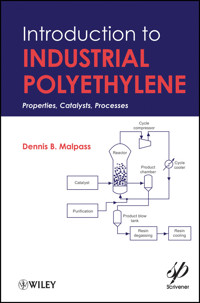
Demystifies the largest volume manmade synthetic polymer by distillingthe fundamentals of what polyethylene is, how it's made and processed,and what happens to it after its useful life is over. Endorsement for Introduction to Industrial Polyethylene "I found this to be a straightforward, easy-to-read, and useful introductory text on polyethylene, which will be helpful for chemists, engineers, and students who need to learn more about this complex topic. The author is a senior polyethylene specialist and I believe we can all benefit from his distillation of knowledge and insight to quickly grasp the key learnings." --R.E. King III; Ciba Corporation (part of the BASF group) Jargon used in industrial polyethylene technology can often be bewildering to newcomers. Introduction to Industrial Polyethylene educates readers on terminology commonly used in the industry and demystifies the chemistry of catalysts and cocatalysts employed in the manufacture of polyethylene. This concise primer reviews the history of polyethylene and introduces basic features and nomenclatures for this versatile polymer. Catalysts and cocatalysts crucial to the production of polyethylene are discussed in the first few chapters. Latter chapters provide an introduction to the processes used to manufacture polyethylene and discuss matters related to downstream applications of polyethylene such as rheology, additives, environmental issues, etc. Providing industrial chemists and engineers a valuable reference tool that covers fundamental features of polyethylene technology, Introduction to Industrial Polyethylene: * Identifies the fundamental types of polyethylene and how they differ. * Lists markets, key fabrication methods, and the major producers of polyethylene. * Provides biodegradable alternatives to polyethylene. * Describes the processes used in the manufacture of polyethylene. * Includes a thorough glossary, providing definitions of acronyms and abbreviations and also defines terms commonly used in discussions of production and properties of polyethylene. * Concludes with the future of industrial polyethylene.
Sie lesen das E-Book in den Legimi-Apps auf:
Seitenzahl: 178
Veröffentlichungsjahr: 2010
Ähnliche


















Scrivener Publishing3 Winter Street, Suite 3Salem, MA 01970
Scrivener Publishing Collections Editors
Publishers at ScrivenerMartin Scrivener ([email protected])Phillip Carmical ([email protected])
Copyright © 2010 by Scrivener Publishing LLC. All rights reserved.
Co-published by John Wiley & Sons, Inc. Hoboken, New Jersey, and Scrivener Publishing LCC, Salem, Massachusetts. Published simultaneously in Canada.
No part of this publication may be reproduced, stored in a retrieval system, or transmitted in any form or by any means, electronic, mechanical, photocopying, recording, scanning, or otherwise, except as permitted under Section 107 or 108 of the 1976 United States Copyright Act, without either the prior written permission of the Publisher, or authorization through payment of the appropriate per-copy fee to the Copyright Clearance Center, Inc., 222 Rosewood Drive, Danvers, MA 01923, (978) 750–8400, fax (978) 750–4470, or on the web at www.copyright.com. Requests to the Publisher for permission should be addressed to the Permissions Department, John Wiley & Sons, Inc., 111 River Street, Hoboken, NJ 07030, (201) 748–6011, fax (201) 748–6008, or online at http://www.wiley.com/go/permission.
Limit of Liability/Disclaimer of Warranty: While the publisher and author have used their best efforts in preparing this book, they make no representations or warranties with respect to the accuracy or completeness of the contents of this book and specifically disclaim any implied warranties of merchantability or fitness for a particular purpose. No warranty may be created or extended by sales representatives or written sales materials. The advice and strategies contained herein may not be suitable for your situation. You should consult with a professional where appropriate. Neither the publisher nor author shall be liable for any loss of profit or any other commercial damages, including but not limited to special, incidental, consequential, or other damages.
For general information on our other products and services or for technical support, please contact our Customer Care Department within the United States at (800) 762–2974, outside the United States at (317) 572–3993 or fax (317) 572–4002.
Wiley also publishes its books in a variety of electronic formats. Some content that appears in print may not be available in electronic formats. For more information about Wiley products, visit our web site at www.wiley.com.
For more information about Scrivener products please visit www.scrivenerpublishing.com.
Cover design by Russell Richardson.
Library of Congress Cataloging-in-Publication Data:
ISBN 978-0-470-62598-9
Printed in the United States of America
10 9 8 7 6 5 4 3 2 1
Contents
Preface
List of Tables
List of Figures
Chapter 1 Introduction to Polymers of Ethylene
1.1 Genesis of Polyethylene
1.2 Basic Description of Polyethylene
1.3 Types and Nomenclature of Polyethylenes
1.4 Molecular Weight of Polyethylenes
1.5 Transition Metal Catalysts for Ethylene Polymerization
Chapter 2 Free Radical Polymerization of Ethylene
2.1 Introduction
2.2 Free Radical Polymerization of Ethylene
2.3 Organic Peroxide Initiators
Chapter 3 Ziegler-Natta Catalysts
3.1 A Brief History of Ziegler-Natta Catalysts
3.2 Definitions and Nomenclature
3.3 Characteristics of Ziegler-Natta Catalysts
3.4 Early Commercial Ziegler-Natta Catalysts
3.5 Supported Ziegler-Natta Catalysts
3.6 Prepolymerized Ziegler-Natta Catalysts
3.7 Mechanism of Ziegler-Natta Polymerization
Chapter 4 Metal Alkyls in Polyethylene Catalyst Systems
4.1 Introduction
4.2 Aluminum Alkyls in Ziegler-Natta Catalysts
4.2.1 Reducing Agent for the Transition Metal
4.2.2 Alkylating Agent for Creation of Active Centers
4.2.3 Scavenger of Catalyst Poisons
4.2.4 Chain Transfer Agent
4.3 Magnesium Alkyls in Ziegler-Natta Catalysts
4.3.1 R2Mg for Production of Supports
4.3.2 R2Mg as Reducing Agent
4.4 Lithium Alkyls
4.5 Organoboron Compounds
4.6 Zinc Alkyls
4.7 Safety and Handling of Metal Alkyls
Chapter 5 Chromium Catalysts
5.1 Chromium Catalysts Supported on Metal Oxides
5.2 Basic Chemistry of Phillips Catalysts
5.3 Generations of Phillips Catalysts
5.4 Union Carbide Chromium Catalysts
5.5 Mechanism of Polymerization with Supported Chromium Catalysts
Chapter 6 Single Site Catalysts
6.1 Introduction
6.2 Metallocene Single Site Catalysts
6.2.1 Non-metallocene Single Site Catalysts
6.3 Cocatalysts for Single Site Catalysts
6.3.1 Methylaluminoxanes
6.3.2 Arylboranes
6.3.3 Other Cocatalysts for Single Site Catalysts
6.4 Mechanism of Polymerization with Single Site Catalysts
Chapter 7 An Overview of Industrial Polyethylene Processes
7.1 Introduction
7.2 High Pressure Processes
7.2.1 Autoclave Process
7.2.2 Tubular Process
7.3 Slurry (Suspension) Process
7.4 Gas Phase Process
7.5 Solution Process
7.6 Combined Processes
Chapter 8 Downstream Aspects of Polyethylene
8.1 Introduction
8.2 Additives
8.3 Melt Processing
8.4 Markets
8.5 Environmental
Glossary
Trade Name Index
Index
Preface
Polyethylene is, by a wide margin, the largest volume synthetic polymer made by mankind. As of this writing, about 77 million metric tons are produced annually and the growth rate is expected to continue at about 5% per year into the foreseeable future. Within the three minutes or so it takes to read this preface, over 400 tons of polyethylene will have been manufactured. It is produced in various forms on 6 continents and its applications are ubiquitous in daily life, from the trash bag you placed on the curb this morning to Uncle Fred’s artificial hip.
This book is primarily intended as an introductory text for chemists, engineers and students who wish to gain an understanding of the fundamentals of the commercially important polymers and copolymers of ethylene. The reader is assumed to have had a modicum of training in chemistry but little prior knowledge about polyethylene. I also intend it to be useful as a complement to courses on polymer chemistry. This book will answer essential questions such as:
What are the types of polyethylene and how do they differ?
What catalysts are used to produce polyethylene and how do they function?
What is the role of cocatalysts in polyethylene production?
What processes are used in the manufacture of polyethylene?
What is the fate of polyethylene after its useful life is over?
Jargon used in industrial polyethylene technology can be bewildering to newcomers. This text will educate readers on terminology in common use in the industry and demystify the chemistry of catalysts and cocatalysts employed in the manufacture of polyethylene. I have employed several techniques to make the text user friendly A thorough glossary is included in the appendix. The glossary not only provides definitions of acronyms and abbreviations, but also concisely defines terms commonly used in discussions of production and properties of polyethylene. An extensive index with liberal cross-referencing enables the reader to find a topic quickly.
Chapter 1 is used to review the history of polyethylene, to survey quintessential features and nomenclatures for this versatile polymer and to introduce transition metal catalysts (the most important catalysts for industrial polyethylene). Free radical polymerization of ethylene and organic peroxide initiators are discussed in Chapter 2. Also in Chapter 2, hazards of organic peroxides and high pressure processes are briefly addressed. Transition metal catalysts are essential to production of nearly three quarters of all polyethylene manufactured and are described in Chapters 3, 5 and 6. Metal alkyl cocatalysts used with transition metal catalysts and their potentially hazardous reactivity with air and water are reviewed in Chapter 4. Chapter 7 gives an overview of processes used in manufacture of polyethylene and contrasts the wide range of operating conditions characteristic of each process. Chapter 8 surveys downstream aspects of polyethylene (additives, rheology, environmental issues, etc.). However, topics in Chapter 8 are complex and extensive subjects unto themselves and detailed discussions are beyond the scope of an introductory text.
I must take this opportunity to express my appreciation to friends and associates who made constructive suggestions on the content of this book. Thanks to Drs. James C. Stevens and Rajen Patel (of The Dow Chemical Company in Freeport, TX) for their comments on the product descriptions and single-site catalysts. Dr. Roswell (Rick) E. King III (of Ciba, now part of BASF, in Tarrytown, NY) and Dr. Brian Goodall reviewed portions of the text and provided recommendations for improvement. Dr. Malcolm J. Kaus of ExxonMobil directed me to several outstanding literature discussions on catalyst and process technologies and kindly provided a reprint of a conference paper on the ExxonMobil high pressure process for polyethylene. Dr. James Strickler (of Albemarle Corporation in Baton Rouge, LA) helped with valuable suggestions about the chapter on metal alkyls. I am indebted to Drs. Balaji B. Singh and Clifford Lee of Chemical Marketing Resources, Inc. (Webster, TX) who shared information on markets and fabrication methods. Drs. Bill Beaulieu and Max McDaniel (of Chevron Phillips) reviewed information on “Phillips Catalysts” and instructed me on the intricacies of these mysterious catalysts. People mentioned above made suggestions that I found very helpful and tried to meld into the text. However, any residual errors are solely my responsibility. Finally,. I would like to thank my publisher Martin Scrivener for the invitation to write this book and for his help in getting it published.
In closing, I would be remiss if I did not acknowledge my former colleagues at Texas Alkyls, Inc. (now Akzo Nobel) with whom I toiled for more than 30 years producing and marketing the metal alkyls that are so crucial to the polyolefins industry. The experiences and knowledge acquired during those years contributed mightily to the foundations for this book. However, my former coworkers at Texas Alkyls shall remain anonymous, for the list would be far too long.
I hope the reader will find the text informative on the fundamental aspects of industrial polyethylene.
Dennis B. MalpassMarch 8, 2010
List of Tables
Chapter 1 Introduction to Polymers of Ethylene
Table 1.1 IUPAC names of selected polymers and copolymers of ethylene
Table 1.2 Classification of selected polyethylenes
Table 1.3 Polyethylene catalysts containing transition metals
Chapter 2 Free Radical Polymerization of Ethylene
Table 2.1 Key organic peroxide initiators for LDPE
Chapter 4 Metal Alkyls in Polyethylene Catalyst Systems
Table 4.1 Comparative cost of selected trialkylaluminum compounds
Chapter 5 Chromium Catalysts
Table 5.1 Generations of Phillips catalysts
Chapter 6 Single Site Catalysts
Table 6.1 Contrasting characteristics of single-site and Ziegler-Natta catalysts
Chapter 7 An Overview of Industrial Polyethylene Processes
Table 7.1 Features of key industrial polyethylene processes
Table 7.2 Typical operating features of autoclave processes for LDPE
Table 7.3 Typical operating features of tubular processes for LDPE
Table 7.4 Typical operating features of slurry/suspension processes for LLDPE and HDPE
Table 7.5 Typical operating features of gas phase processes for HDPE and LLDPE
Table 7.6 Typical operating features of solution processes for LLDPE and HDPE
Chapter 8 Downstream Aspects of Polyethylene
Table 8.1 Comparison of selected film properties of LDPE and LLDPE
Table 8.2 Top 10 global producers of polyethylene in 2006
Lesen Sie weiter in der vollständigen Ausgabe!
Lesen Sie weiter in der vollständigen Ausgabe!
Lesen Sie weiter in der vollständigen Ausgabe!
Lesen Sie weiter in der vollständigen Ausgabe!
Lesen Sie weiter in der vollständigen Ausgabe!
Lesen Sie weiter in der vollständigen Ausgabe!
Lesen Sie weiter in der vollständigen Ausgabe!
Lesen Sie weiter in der vollständigen Ausgabe!
Lesen Sie weiter in der vollständigen Ausgabe!
Lesen Sie weiter in der vollständigen Ausgabe!
Lesen Sie weiter in der vollständigen Ausgabe!
Lesen Sie weiter in der vollständigen Ausgabe!
Lesen Sie weiter in der vollständigen Ausgabe!




