


63,99 €
Mehr erfahren.
- Herausgeber: John Wiley & Sons
- Kategorie: Fachliteratur
- Sprache: Englisch
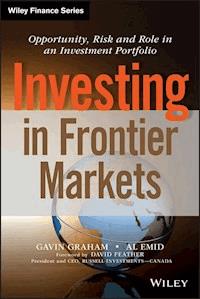
The only comprehensive guide to reaping big returns investing in the hottest new growth markets This book makes a compelling case that, just as today's well-rounded portfolio includes emerging market funds, tomorrow's well-rounded portfolio will include frontier market funds. More importantly, it alerts you to the vast opportunities and potential pitfalls of investing in frontier markets while providing expert advice and guidance on how to research and invest in the most promising frontier growth markets. Widely considered to be the next emerging markets, frontier markets, such as those of certain sub-Saharan African, Eastern European, Asian, and Central and South American countries, are showing strong signs of reaching economic critical mass. If you are an investor on the lookout for authoritative, actionable information on the next big investment opportunity, this book is for you. * Provides sector-by-sector analyses that let you assess opportunities and risks in each frontier market * Provides strategies and tools for determining the most efficient methods for executing, monitoring, and exiting investments * Guides you through the wide diversity within frontier markets, showing how to differentiate countries on the basis of economic development and wealth distribution and other factors
Sie lesen das E-Book in den Legimi-Apps auf:
Seitenzahl: 426
Veröffentlichungsjahr: 2013
Ähnliche



















Table of Contents
Title Page
Copyright
Acknowledgments
Foreword
Chapter 1: Introducing Emerging and Frontier Markets
Emerging Markets
Frontier Markets
Chapter 2: Frontier Markets by Region
Measures Used in this Chapter
Asia
Africa
Eastern Europe
Latin America
Middle East and North Africa (MENA)
Exotic Frontier Markets
Chapter 3: Volatility: Not the Same as Risk
Lessening Volatility in Emerging and Frontier Markets
Correlations to Other Markets (and Lack Thereof)
Structural Reasons for Higher Volatility
Chapter 4: Solid Investment Information vs. Media Images
The Middle East: Not All in Conflict
Vietnam: A Long-Term Bet
Kenya: A Slow Reduction in Risk
Kazakhstan: Borat Painted the Wrong Picture
Bangladesh: Not a Basket Case
Serbia: A Promising Candidate
Sierra Leone: No Longer War Torn
Conclusion
Chapter 5: Economic Strengths of Emerging and Frontier Markets
Returns from Emerging Markets
The Lack of Correlation between GDP Growth and Equity Returns
Chapter 6: Past Emerging Market Upheavals and What They Can Teach Frontier Market Investors
Argentinean Default of 2001
Mexican Devaluation of 1995
Asian Meltdown of 1997–98
Russian Debt Default of 1998
Brazilian Devaluation of 1999
The Place of Fixed Income in the Emerging and Frontier Equation
Chapter 7: The Global Investment Landscape: Why Developed Markets Appear Unattractive at Present
Canada
The United States
Europe
Chapter 8: Online Trading in Emerging and Frontier Markets and Why It's a Bad Idea
The Dangerous Appeal of Going It Alone
The Risks of Online Trading
Professional Advisors and Online Trading
Chapter 9: The Changing Role of Financial Advisors
Responding to Increased Challenges after the Financial Crisis of 2008–09
Accepting Volatility
Coping with Increased Reliance on Financial Advisors
Convincing Hesitant Clients
Chapter 10: Different Ways to Invest in Frontier Markets: ETFs, ADRs, Local Stocks and Closed-end Mutual Funds
Exchange-Traded Funds
Regional Funds
Sector Funds
Single-Country Funds
Multinational Companies with Large Emerging Market Exposure
Frontier Market American Depository Receipts
Global Frontier Funds
Conclusion
Appendix: Frontier Market Open-end Funds as of May 2013
Global Frontier Funds
Emerging European Ex-Russia Funds
African Funds
Middle East and North Africa (MENA) Funds
Index
Copyright © 2013 by Gavin Graham and Al Emid
All rights reserved. No part of this work covered by the copyright herein may be reproduced or used in any form or by any means— graphic, electronic or mechanical— without the prior written permission of the publisher. Any request for photocopying, recording, taping or information storage and retrieval systems of any part of this book shall be directed in writing to the Canadian Copyright Licensing Agency (Access Copyright). For an Access Copyright license, visit www.accesscopyright.ca or call toll free 1-800-893-5777.
Care has been taken to trace ownership of copyright material contained in this book. The publisher will gladly receive any information that will enable them to rectify any reference or credit line in subsequent editions.
Wiley publishes in a variety of print and electronic formats and by print-on-demand. Some material included with standard print versions of this book may not be included in e-books or in print-on-demand. If this book refers to media such as a CD or DVD that is not included in the version you purchased, you may download this material at http://booksupport.wiley.com. For more information about Wiley products, visit www.wiley.com.
National Library of Canada Cataloguing in Publication Data
Graham, Gavin, author Investing in frontier markets : opportunity, risk and role in an investment portfolio / Gavin Graham, Al Emid.
Includes index. Issued in print and electronic formats. ISBN 978-1-118-55632-0 (bound); ISBN 978-1-118-55634-4 (ebk); ISBN 978-1-118-55633-7 (ebk)
1. Investments, Foreign–Developing countries. I. Emid, Al, 1946-, author II. Title.
HG5993.G73 2013 332.67′3091724 C2013-904326-8 C2013-904327-6
Production Credits
Cover design: Wiley
Cover image: iStockphoto
Printer: Friesens
Editorial Credits
Executive editor: Karen Milner
Managing editor: Alison Maclean
Production editors: Pamela Vokey and Melissa Lopez
John Wiley & Sons Canada, Limited.
6045 Freemont Blvd.
Mississauga, Ontario
L5R 4J3
Acknowledgments
I would like to thank the editors at John Wiley & Sons for their unstinting support of this book and their understanding of how authors go about their tasks. Notwithstanding the obvious fact that authors work in words, defining the relationship between publishers, editors and authors reminds one of trying to answer questions such as “How high is up?” and “What is the meaning of life?”—but in the right set of circumstances, the relationship works well. Fortunately we had those circumstances in crafting this book.
I would also like to thank all of the individuals in the United States, Canada and in emerging and frontier markets for freely giving their time and expert knowledge—and for their patience with what might have seemed like endless back checking.
I would also like to thank those sources who for different reasons I have not specifically named here but whose counsel I valued while shaping the text.
Finally, I would certainly like to extend special thanks to Steve Spector, JD, MLS, for his comprehensive research and appreciation of the intricacies of emerging and frontier markets investing.
Al EmidSeptember 2013
I would like to thank first of all my wonderful wife, Perianne, without whose help and support my portion of this book would not have been written.
I would also like to thank Don Loney, our original editor at John Wiley, who had the belief that the market was ready for a book on frontier markets, and David Feather, President and Chief Executive Officer at Russell Investments Canada, who had the vision to support the idea. I would also like to thank Xavier Rolet, Chief Executive Officer of the London Stock Exchange Plc, who kindly spent some time to discuss its role in acting as a gateway for frontier markets companies.
Lastly, I would like to thank the various fund managers and experts who provided insight into the frontier markets and their approach to investing in them.
Gavin GrahamSeptember 2013
Foreword
Throughout history, frontiers have represented unexplored opportunities, untapped potential, the promise of riches and the lure of discovery.
For today's investors, frontier markets can offer all that and more. They can offer the chance to invest in some of the fastest-growing economies in the world, most with young, vibrant populations and substantial natural resources. They can open a window to new cultures and new industries. And they can help diversify a portfolio and offer the opportunity for enhanced returns.
In this book, authors Gavin Graham and Al Emid outline the potential that investing in frontier markets can hold for investors. Graham, a noted expert on emerging markets, and Emid, one of Canada's foremost writers on investing, have created a comprehensive study on how investors can benefit from gaining exposure to this new market segment.
They conclude, and Russell Investments agrees, that frontier markets are a logical next step for investors who have already discovered how investments in emerging markets can enhance returns and potentially lower a portfolio's overall risk. They believe that since globalization has had numerous economic benefits for emerging markets, it will likely have the same impact on frontier markets over time.
True, investing in frontier markets also holds risks—many of the countries considered frontier markets are politically unstable, can be influenced by strong governmental control over natural resources and industries, and have economies that are vulnerable to sudden shifts in global trends. Moreover, these markets are often less transparent, less liquid and more volatile even than emerging markets.
But many of the more established emerging markets—Brazil, Russia, India and China—were considered frontier markets not so long ago. They now contain some of the largest companies in the world, have been integrated into the world economy and—importantly—have provided investors with returns that have frequently outpaced those from the developed market economies. Indeed, these countries, known collectively as the BRIC nations, have generally better fiscal accounts, balances of trade and growth prospects than their developed market counterparts.
As Graham and Emid show in this book, the MSCI Emerging Markets (Free) Index delivered a return of 13.4 percent p.a. in the decade ending October 2012, compared with the MSCI World Index of developed markets, which gained 5.61 percent p.a. in the same period. Russell research found similar results over the longer term: despite greater volatility, since the late 1980s emerging markets produced the best returns among the asset classes analyzed, and since 1988, emerging markets have outperformed Canadian and U.S. equities by a wide margin. Given demographic trends, growing urbanization, rapid industrialization, increased trade flows and other factors, there is potential for continued outperformance from emerging markets.
Russell Investments believes that frontier markets are now essentially where emerging markets were back in the 1980s—relatively unexplored opportunities with great potential. The success that emerging markets have had over the past 30 years is the promise that today's frontier markets now hold.
Moreover, frontier markets show a similarly low correlation with Canadian and U.S. equities as emerging markets did in their infancy. According to Russell research, prior to the global financial crisis in 2008, the rolling correlation was generally below 0.30, and similar to emerging markets, even negative at times. While the crisis caused correlation to briefly spike to over 0.60, it has since trended toward its historical range of 0.20 and lower. However, it would not be surprising for correlations to have episodic spikes due to ongoing macroeconomic uncertainty.
Frontier markets also have very low correlation with other asset classes, making this asset class a great diversifier in traditional portfolios. In fact, the highest correlation exhibited among the asset classes that Russell analyzed with frontier markets is with the international Russell Developed ex-North America Index, at 0.44. In addition, while it would be expected that frontier markets exhibit a strong positive relationship with emerging markets, surprisingly, our analysis shows that has not been the case. The correlation between frontier and emerging markets was 0.41.
Today's frontier markets run the gamut from tiny, agrarian Laos to oil-rich, populous and vibrant Nigeria. They span the globe, including countries in Latin America, the Caribbean, Africa, Asia and Eastern Europe and represent a diverse group of cultures. They are also a growing economic force.
The 40 frontier markets in the MSCI and S&P indices represent 14 percent of global population and 7 percent of global gross domestic product (GDP) on a purchasing power basis (PPB). Expanding that definition to include the exotic frontier markets, such as Myanmar, Iran and Saudi Arabia, frontier markets represent 25 percent of global population and 11 percent of global GDP.
These fledgling emerging markets offer high-growth potential and have attractive valuations compared to the more established emerging markets. They have attracted risk-embracing investors who want to gain access to the relatively untapped potential offered by these countries. Because of this, a new market segment is being established.
We hope the arguments contained in this book will spark the reader's interest in exploring the potential of emerging and frontier markets.
Russell Investments has been at the forefront of growing investor interest in frontier markets. In the United States, it created the Russell Frontier Index and launched a Frontier Market Pool in 2010. Russell Investments Canada established a frontier market mandate in the Russell Emerging Markets Pool in April 2011.
David Feather President and Chief Executive Officer Russell Investments Canada September 2013
Chapter 1
Introducing Emerging and Frontier Markets
Over the last decade, returns from developed markets have been effectively zero or negative. In the 10 years ending on December 31, 2012, the Morgan Stanley Capital International Developed World Index returned 5.4 percent annually in U.S. dollars in nominal terms. This extremely disappointing record has been accompanied by enormous volatility, giving investors the worst of both worlds—not only have they effectively not made any money in real terms, but they have experienced moves in the markets that have not been seen since the Great Depression of the 1930s.
Over the same period, emerging markets—defined as those countries with a Gross Domestic Product (GDP) per capita of less than US$12,476 (2012) and which are represented by the MSCI Emerging Markets (Free) Index—have delivered 13.7 percent annually in U.S. dollars, more than doubling an investor's initial investment. There are several reasons for this massive outperformance of more-developed markets by less-developed markets, the most important of which were the low and attractive valuations of the developing as opposed to developed markets at the beginning of the decade. Reasons also include their faster rate of GDP growth, younger populations, higher levels of savings and lower levels of government and personal debt. The growth and success of emerging markets will likely be repeated by the next generation of emerging economies—the frontier markets.
This book examines the factors contributing to the performance of emerging and frontier markets and dispenses practical advice for those considering investing in frontier markets. It defines emerging markets and frontier markets and discusses differences between them, explores the diversity of frontier markets and establishes why it is important to differentiate between regions and between individual countries within regions. Furthermore, it considers the risks inherent in investing in such markets, including poor liquidity and regulation, political instability and inadequate financial reporting, and suggests how to manage these risks. It also explains the importance of distinguishing between the popular image of countries and regions and what is actually happening “at ground level.”
Investing in Frontier Markets enumerates the key benefits developed market investors can accrue by investing in frontier markets, namely diversification, a low correlation with developed markets and the strong likelihood of frontier markets mirroring the development path followed by longer-established emerging markets, thus delivering strong returns to investors with long-term horizons. The book goes on to examine some of the problems faced by emerging markets during their period of rapid development over the last 15 years. It also looks at the changing role of financial advisors and how they can help position frontier markets in an investor's portfolio and the pitfalls of attempting to “go it alone” when investing in emerging and frontier markets, for example, by using online investing.
Lesen Sie weiter in der vollständigen Ausgabe!
Lesen Sie weiter in der vollständigen Ausgabe!
Lesen Sie weiter in der vollständigen Ausgabe!
Lesen Sie weiter in der vollständigen Ausgabe!
Lesen Sie weiter in der vollständigen Ausgabe!
Lesen Sie weiter in der vollständigen Ausgabe!
Lesen Sie weiter in der vollständigen Ausgabe!
Lesen Sie weiter in der vollständigen Ausgabe!
Lesen Sie weiter in der vollständigen Ausgabe!
Lesen Sie weiter in der vollständigen Ausgabe!
Lesen Sie weiter in der vollständigen Ausgabe!
Lesen Sie weiter in der vollständigen Ausgabe!




