


41,99 €
Mehr erfahren.
- Herausgeber: John Wiley & Sons
- Kategorie: Fachliteratur
- Serie: Wiley Finance Editions
- Sprache: Englisch
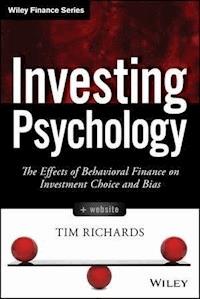
Discover how to remove behavioral bias from your investment decisions For many financial professionals and individual investors, behavioral bias is the largest single factor behind poor investment decisions. The same instincts that our brains employ to keep us alive all too often work against us in the world of finance and investments. Investing Psychology + Website explores several different types of behavioral bias, which pulls back the curtain on any illusions you have about yourself and your investing abilities. This practical investment guide explains that conventional financial wisdom is often nothing more than myth, and provides a detailed roadmap for overcoming behavioral bias. * Offers an overview of how our brain perceives realities of the financial world at large and how human nature impacts even our most basic financial decisions * Explores several different types of behavioral bias, which pulls back the curtain on any illusions you have about yourself and your investing abilities * Provides real-world advice, including: Don't compete with institutions, always track your results, and don't trade when you're emotional, tired, or hungry Investing Psychology is a unique book that shows readers how to dig deeper and persistently question everything in the financial world around them, including the incorrect investment decisions that human nature all too often compels us to make.
Sie lesen das E-Book in den Legimi-Apps auf:
Seitenzahl: 469
Veröffentlichungsjahr: 2014
Ähnliche



















The Wiley Finance series contains books written specifically for finance and investment professionals as well as sophisticated individual investors and their financial advisors. Book topics range from portfolio management to e-commerce, risk management, financial engineering, valuation and financial instrument analysis, as well as much more. For a list of available titles, visit our Web site at www.WileyFinance.com.
Founded in 1807, John Wiley & Sons is the oldest independent publishing company in the United States. With offices in North America, Europe, Australia and Asia, Wiley is globally committed to developing and marketing print and electronic products and services for our customers' professional and personal knowledge and understanding.
Investing Psychology
The Effects of Behavioral Finance on Investment Choice and Bias
TIM RICHARDS
Creator of the Psy-Fi Blog (www.psyfitec.com)
Cover image: ©iStochphoto.com/AmandaRuch ©iStochphoto.com/fatido Cover design: Wiley
Copyright © 2014 by Tim Richards. All rights reserved.
Published by John Wiley & Sons, Inc., Hoboken, New Jersey. Published simultaneously in Canada.
No part of this publication may be reproduced, stored in a retrieval system, or transmitted in any form or by any means, electronic, mechanical, photocopying, recording, scanning, or otherwise, except as permitted under Section 107 or 108 of the 1976 United States Copyright Act, without either the prior written permission of the Publisher, or authorization through payment of the appropriate per-copy fee to the Copyright Clearance Center, Inc., 222 Rosewood Drive, Danvers, MA 01923, (978) 750-8400, fax (978) 646-8600, or on the Web at www.copyright.com. Requests to the Publisher for permission should be addressed to the Permissions Department, John Wiley & Sons, Inc., 111 River Street, Hoboken, NJ 07030, (201) 748-6011, fax (201) 748-6008, or online at www.wiley.com/go/permissions.
Limit of Liability/Disclaimer of Warranty: While the publisher and author have used their best efforts in preparing this book, they make no representations or warranties with respect to the accuracy or completeness of the contents of this book and specifically disclaim any implied warranties of merchantability or fitness for a particular purpose. No warranty may be created or extended by sales representatives or written sales materials. The advice and strategies contained herein may not be suitable for your situation. You should consult with a professional where appropriate. Neither the publisher nor author shall be liable for any loss of profit or any other commercial damages, including but not limited to special, incidental, consequential, or other damages.
For general information on our other products and services or for technical support, please contact our Customer Care Department within the United States at (800) 762-2974, outside the United States at (317) 572-3993 or fax (317) 572-4002.
Wiley publishes in a variety of print and electronic formats and by print-on-demand. Some material included with standard print versions of this book may not be included in e-books or in print-on-demand. If this book refers to media such as a CD or DVD that is not included in the version you purchased, you may download this material at http://booksupport.wiley.com. For more information about Wiley products, visit www.wiley.com.
Library of Congress Cataloging-in-Publication Data:
Richards, Tim, 1961- Investing psychology : the effects of behavioral finance on investment choice and bias / Tim Richards. pages cm.—(Wiley finance series) Includes bibliographical references and index. ISBN 978-1-118-72219-0 (cloth) 1. Investments—Psychological aspects. 2. Finance—Psychological aspects. I. Title. HG4515.15.R53 2014 332.601′9–dc23
2013050096
To Skyla, Alexa, and Hallie; for being there always, as I will always be here for you.
CONTENTS
Preface
CHAPTER 1 Sensory Finance
Beating the Bias Blind Spot
Illusory Pattern Recognition
Superstitious Pigeons—and Investors
The Super Bowl Effect: If It Looks Too Good to Be True, It Is
Your Financial Horoscope: Forecasting and the Barnum Effect
Uncertainty: The Unknown Unknowns
Illusion of Control
Stocks Aren't Snakes
Herding
Availability
Assuming the Serial Position
Hot Hands
Financial Memory Syndrome
Attention!
The Problem with Linda
Representation
The Seven Key Takeaways
Notes
CHAPTER 2 Self-Image and Self-Worth
The Introspection Illusion
Blind Spot Bias, Revisited
Rose-Colored Investing
Past and Present Failures
Depressed But Wealthy
Disposed to Lose Money
Loss Aversion
Anchored
Two Strangers
Hindsight's Not So Wonderful
Deferral to Authority
Emotion
Black Swans
Dirty Money, Mental Accounting
A Faint Whisper of Emotion
Psychologically Numbed
Martha Stewart's Biases
Retrospective
Annual Returns
Nudged
Mindfulness
The Seven Key Takeaways
Notes
CHAPTER 3 Situational Finance
Disposition vs. Situation
Beauty Is in the Eye of the Investor
Angels or Demons?
Merely Familiar
Lemming Time
Story Time
Wise Crowds?
Adaptive Markets
George Soros's Reflexivity
Grow Old Quickly
Speaking Ill
The Power of Persuasion
SAD Investors
Sell in May . . .
The Mystery of the Vanishing Anomalies
Tweet and Invest
Fire!
The Rise of the Machines
The Seven Key Takeaways
Notes
CHAPTER 4 Social Finance
Conform—or Die
Groupthink
Motivated Reasoning
Polarized
A Personal Mission Statement: Social Identity and Beyond
Gaming the System
You've Been Framed
Behavioral Portfolios
Dividend Dilemmas
The Language of Lucre
Embedded Investing
Financial Theory of Mind
Trust Me, Reciprocally . . .
Akerlof's Lemons
The Peacock's Tail
Facebooked
Be Kind to an Old Person
The Seven Key Takeaways
Notes
CHAPTER 5 Professional Bias
Mutual Fund Madness
Is Passive Persuasive?
Losing to the Dark Side
Forecasting—The Butterfly Effect
Forecaster Bias
Feminine Finance
Trading on a High
Marriage and Money
Muddled Modelers
CEO Pay—Because They're Worth It?
Corporate Madness
Buyback Brouhaha
Oh No, IPO
Your 6 Percent Self-Inflicted Trading Tax
Expert Opinion?
Avoid the Sharpshooters
The Seven Key Takeaways
Notes
CHAPTER 6 Debiasing
Numbers, Numbers, Numbers
Losing Momentum
Mean Reversion
Short Shift
Diworsification
Disconfirm, Disconfirm
Reverse Polarization
Expected Value
Investing in the Rearview Mirror
Living with Uncertainty
Sunk by the
Titanic
Effect
Changing your Mind
Love Your Kids, not Your Stocks
Cognitive Repairs
Satisficing
The Seven Key Takeaways
Notes
CHAPTER 7 Good Enough Investing
#1: The Rule of Seven
#2: Homo Sapiens, Tool Maker
#3: Meta-Methods
#4: Be Skeptical
#5: Don't Trust Yourself
#6: Self-Control Is Key
#7: Get Feedback
A Behavioral Investing Framework
Step #1: Making It Personal
Step #2: Build an Investing Checklist
Step #3: Write It Down
Step #4: Diarize Reviews
Step #5: Get Feedback
Step #6: Do Autopsies
Step #7: Update Adaptively
The Worst Offenders
Tools
The Mechanics of Investing
The Seven Key Takeaways
Notes
CHAPTER 8 A Few Myths More
Myth 1: Money Makes Us Happy
Myth 2: Everyone Can Be a Good Investor
Myth 3: Numbers Don't Matter
Myth 4: Financial Education Can Make You a Good Investor
Myth 5: I Won't Panic
Myth 6: Debt Doesn't Matter
Myth 7: I Can Get 7 Percent a Year from Markets
Myth 8: Inflation Doesn't Matter
Myth 9: Everyone Has Some Good Investing Ideas, Sometime
Myth 10: I Don't Need to Track My Results
The Seven Key Takeaways
Notes
CHAPTER 9 The Final Roundup
Notes
About the Companion Website
About the Author
Index
End User License Agreement
List of Illustrations
Chapter 1
FIGURE 1.1
The Müller-Lyer Illusion
FIGURE 1.2
The Müller-Lyer Illusion as a 3D Perception
FIGURE 1.3
+ Sign
Chapter 7
FIGURE 7.1
Seven Stages of Behavioral Investing Framework
Guide
Cover
Table of Contents
Preface
Chapter
Pages
ii
iii
iv
v
xiii
xiv
xv
1
2
3
4
5
6
7
8
9
10
11
12
13
14
15
16
17
18
19
20
21
22
23
24
25
26
27
28
29
30
31
32
33
34
35
37
38
39
40
41
42
43
44
45
46
47
48
49
50
51
52
53
54
55
56
57
58
59
60
61
62
63
64
65
66
67
68
69
70
71
72
73
74
75
76
77
78
79
80
81
82
83
84
85
86
87
88
89
90
91
92
93
94
95
96
97
99
100
101
102
103
104
105
106
107
108
109
110
111
112
113
114
115
116
117
118
119
120
121
122
123
124
125
126
127
128
129
131
132
133
134
135
136
137
138
139
140
141
142
143
144
145
146
147
148
149
150
151
152
153
154
155
156
157
159
160
161
162
163
164
165
166
167
168
169
170
171
172
173
174
175
176
177
178
179
180
181
182
183
184
185
187
188
189
190
191
192
193
194
195
196
197
198
199
200
201
202
203
204
205
206
207
209
210
211
212
213
214
215
216
217
218
219
220
221
222
223
224
225
227
229
231
232
233
234
235
236
237
238
239
240
Preface
As we move forward through the twenty-first century, it's more and more important for investors to understand the unconscious drivers that affect the way they make decisions about money because increasingly we're being left to fend for ourselves. It wasn't so long ago that retirees could look forward to a comfortable old age supported by employee sponsored, defined benefit pension plans and a generous social security system. Those days have gone, and more often than not we're being left to make our own investing decisions using 401(k) plans and other individually managed accounts.
At the same time, a vast expansion of the financial services industry has put us in charge of many more financial decisions—no longer are we limited in how much we can borrow by a wise old bank manager, but we are left to decide how much we can repay—and we must take the consequences when these decisions go wrong. This is especially so as a huge industry has grown up to exploit our biases, in order to part us from our money. The securities industry is a gigantic machine for extracting money from ordinary investors, and does so in a way that makes it all seem perfectly reasonable.
All this is happening as lifespans are lengthening due to improvements in medical care and a better understanding of healthy living. So the decisions we make about our money will determine whether our lengthening old ages are played out in comfort or misery. Learning how, and why, we make these decisions, and how we can improve them, should be a priority for all of us.
Although we've been given greater freedom of choice than ever before, we've not been granted any greater wisdom, or given any training about how to proceed. That's what this book is about, how to use the opportunity we've been given, how to avoid the traps set by our own minds and by those people who want to exploit them. It's a fascinating journey and one, I believe, that will leave you with a permanent advantage over those who don't choose to join us.
Although this is a book with a serious purpose, and is full of carefully chosen academic research to illustrate the points that I want to make, it is not, I hope, a seriously difficult read. Writing an important book that no one reads because it's too difficult and clever would be missing the point: unless this material is accessible to investors and their advisers, it can't help them. Equally, though, I'd urge you not to be fooled by the often light-hearted tone—this is a book with a very serious purpose—to help us figure out how to overcome the enemy within, our own brains. Because if we can't, then we will end up being seriously impoverished.
The book is divided into nine chapters, the first four of which deal with particular aspects of the behavioral flaws that drive us to throw our money at people who are already rich. This is a whistle-stop tour of dozens of different types of behavioral biases, which intends to kick away any illusions you have about yourself and your investing abilities and trample them into the dust.
We start by looking at how our senses often fool us into thinking that there are things going on out there, when they're actually only going on in our heads. Our brains are attuned to the world around us, and they function in a way that gives us the best chance of survival; but these behaviors are often not appropriate when we're investing. Believing that we can influence or even predict markets in a desperate attempt to keep our brains happy is a one-way ticket to penury.
The second chapter looks at how our feelings of self-image and self-worth impact our investing behavior. Far from being careful, emotionless analyzers of financial data, most of us are as concerned about whether it looks like we're good investors as whether we actually are. Above all, we're horribly overoptimistic about our investing talents, and we go to great care to avoid proving that we're wrong: none of which is designed to improve our finances.
We then move onto the tricky subject of situation—the nasty fact that how we invest depends not on rock-solid objective facts but is dependent on the situation we find ourselves in. Sometimes this situation is environmental, sometimes it's other people, but if we're not on our guard it will always influence our investing approach, and usually not in a good way.
The fourth chapter delves into the complex area of social interaction, and the ways that different forms of group behavior can change our investing decisions. It's possible to get people to change their minds simply by modifying the way we ask a question, and this is exploited by a wide range of different influencers, from politicians to corporate managements. We're social animals, and we're very susceptible to social pressures, even though we don't always realize it.
You might think that the various professionals in the securities industry would be better able to resist these different types of behavioral pressure but, as Chapter 5 discusses, the truth is somewhat different. Although many professionals are more capable of managing their biases than private investors, they're exposed to a range of different incentives—and incentives can change behavior, often in ways that aren't in our interests. By all means use a professional money manager, but make sure you know how to manage them.
Although the study of behavioral finance is over 40 years old, in many ways it's still in its infancy and, although increasingly we know what to look for, the techniques for dealing with the problems are lagging behind. In the next chapter we look at some investing methods and how they relate to behavioral bias and discuss some techniques that can be used to help debias our investing decision making. Perhaps the biggest takeaway is that bias will always be with us—it's when we think we've got it cracked that we're most at risk.
In Chapter 7 we develop these ideas around investing methods and debiasing techniques into a method, or rather a methodology, to affect cognitive repairs—in essence, to shore up our dodgy defenses with a method that forces us step-by-step to consider the main issues. Above all, though, this approach is one that emphasizes change rather than stasis—what works today may not work tomorrow and learning to deal with that is a major component in dealing with behavioral issues.
Many of our biases are actually justified by what I describe as myths—ideas that have taken hold of our minds and have become accepted truths. In Chapter 8 I identify a bunch of these and show why we need to question everything. All too often what we believe to be true is not, and refusing to accept any idea unquestioningly is a habit we need to get into if we're going to improve our investing decision making.
Finally, in the last chapter, I round all of this up into seven key takeaways—but I'd urge you not to jump to the end. In this case the journey is every bit as important as the destination, because if you don't know why you need to behave in a certain way you'll never understand what you need to do when the situation you're in changes. And, in investing, the situation changes all the time.
So, let's get started. Let's go meet the enemy: our own brains.
CHAPTER 1Sensory Finance
Wandering around inside the average investor's mind is very much like taking a tourist bus around Wonderland with the White Rabbit as a guide. Much that we think is obviously true turns out to be false and much self-evident nonsense is rather closer to reality than we could ever have thought.
We're going to start our tour in a place where everyone can “definitely” tell the difference between truth and falsehood, by looking at the way our senses interact with the world around us. Our ability to interact with the world and to learn from it allows us to extrapolate into the future, to make predictions and then to act on those predictions.
Unfortunately, the skills that serve us so well in everyday life combine to betray us in the topsy-turvy world of investing and finance. Our sensory system may keep us alive, but that's no guarantee it's going to make us rich.
Lesen Sie weiter in der vollständigen Ausgabe!
Lesen Sie weiter in der vollständigen Ausgabe!
Lesen Sie weiter in der vollständigen Ausgabe!
Lesen Sie weiter in der vollständigen Ausgabe!
Lesen Sie weiter in der vollständigen Ausgabe!
Lesen Sie weiter in der vollständigen Ausgabe!
Lesen Sie weiter in der vollständigen Ausgabe!
Lesen Sie weiter in der vollständigen Ausgabe!
Lesen Sie weiter in der vollständigen Ausgabe!
Lesen Sie weiter in der vollständigen Ausgabe!
Lesen Sie weiter in der vollständigen Ausgabe!
Lesen Sie weiter in der vollständigen Ausgabe!




