


65,99 €
Mehr erfahren.
- Herausgeber: John Wiley & Sons
- Kategorie: Fachliteratur
- Serie: Wiley Finance Editions
- Sprache: Englisch
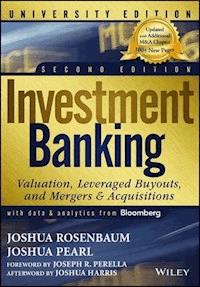
Investment Banking, UNIVERSITY EDITION is a highly accessible and authoritative book written by investment bankers that explains how to perform the valuation work at the core of the financial world. This body of work builds on Rosenbaum and Pearl's combined 30+ years of experience on a multitude of transactions, as well as input received from numerous investment bankers, investment professionals at private equity firms and hedge funds, attorneys, corporate executives, peer authors, and university professors. This book fills a noticeable gap in contemporary finance literature, which tends to focus on theory rather than practical application. It focuses on the primary valuation methodologies currently used on Wall Street--comparable companies, precedent transactions, DCF, and LBO analysis--as well as M&A analysis. The ability to perform these methodologies is especially critical for those students aspiring to gain full-time positions at investment banks, private equity firms, or hedge funds. This is the book Rosenbaum and Pearl wish had existed when we were trying to break into Wall Street. Written to reflect today's dynamic market conditions, Investment Banking, UNIVERSITY EDITION skillfully: * Introduces students to the primary valuation methodologies currently used on Wall Street * Uses a step-by-step how-to approach for each methodology and builds a chronological knowledge base * Defines key terms, financial concepts, and processes throughout * Provides a comprehensive overview of the fundamentals of LBOs and an organized M&A sale process * Presents new coverage of M&A buy-side analytical tools--which includes both qualitative aspects, such as buyer motivations and strategies, along with technical financial and valuation assessment tools * Includes a comprehensive merger consequences analysis, including accretion/(dilution) and balance sheet effects * Contains challenging end-of-chapter questions to reinforce concepts covered A perfect guide for those seeking to learn the fundamentals of valuation, M&A , and corporate finance used in investment banking and professional investing, this UNIVERSITY EDITION--which includes an instructor's companion site--is an essential asset. It provides students with an invaluable education as well as a much-needed edge for gaining entry to the ultra-competitive world of professional finance.
Sie lesen das E-Book in den Legimi-Apps auf:
Seitenzahl: 577
Veröffentlichungsjahr: 2013
Ähnliche


















Contents
Cover
Contents
Series Page
Title Page
Copyright
Dedication
Instructor and Student Resources
INSTRUCTOR RESOURCES
STUDENT RESOURCES AVAILABLE FOR PURCHASE
About the Authors
CONTACT THE AUTHORS
Foreword
Acknowledgements
Introduction
STRUCTURE OF THE BOOK
VALUECO SUMMARY FINANCIAL INFORMATION
PART One: Valuation
CHAPTER 1: Comparable Companies Analysis
SUMMARY OF COMPARABLE COMPANIES ANALYSIS STEPS
STEP I. SELECT THE UNIVERSE OF COMPARABLE COMPANIES
STEP II. LOCATE THE NECESSARY FINANCIAL INFORMATION
STEP III. SPREAD KEY STATISTICS, RATIOS, AND TRADING MULTIPLES
STEP IV. BENCHMARK THE COMPARABLE COMPANIES
STEP V. DETERMINE VALUATION
KEY PROS AND CONS
ILLUSTRATIVE COMPARABLE COMPANIES ANALYSIS FOR VALUECO
CHAPTER 1 QUESTIONS
CHAPTER 2: Precedent Transactions Analysis
SUMMARY OF PRECEDENT TRANSACTIONS ANALYSIS STEPS
STEP I. SELECT THE UNIVERSE OF COMPARABLE ACQUISITIONS
STEP II. LOCATE THE NECESSARY DEAL-RELATED AND FINANCIAL INFORMATION
STEP III. SPREAD KEY STATISTICS, RATIOS, AND TRANSACTION MULTIPLES
STEP IV. BENCHMARK THE COMPARABLE ACQUISITIONS
STEP V. DETERMINE VALUATION
KEY PROS AND CONS
ILLUSTRATIVE PRECEDENT TRANSACTION ANALYSIS FOR VALUECO
CHAPTER 2 QUESTIONS
CHAPTER 3: Discounted Cash Flow Analysis
STEP I. STUDY THE TARGET AND DETERMINE KEY PERFORMANCE DRIVERS
STEP II. PROJECT FREE CASH FLOW
STEP III. CALCULATE WEIGHTED AVERAGE COST OF CAPITAL
STEP IV. DETERMINE TERMINAL VALUE
STEP V. CALCULATE PRESENT VALUE AND DETERMINE VALUATION
KEY PROS AND CONS Pros
ILLUSTRATIVE DISCOUNTED CASH FLOW ANALYSIS FOR VALUECO
CHAPTER 3 QUESTIONS
PART Two: Leveraged Buyouts
CHAPTER 4: Leveraged Buyouts
KEY PARTICIPANTS
CHARACTERISTICS OF A STRONG LBO CANDIDATE
ECONOMICS of LBOs
PRIMARY EXIT/MONETIZATION STRATEGIES
LBO FINANCING: STRUCTURE
LBO FINANCING: PRIMARY SOURCES
LBO FINANCING: SELECTED KEY TERMS
LBO FINANCING: DETERMINING FINANCING STRUCTURE
CHAPTER 4 QUESTIONS
CHAPTER 5: LBO Analysis
STEP I. LOCATE AND ANALYZE THE NECESSARY INFORMATION
STEP II. BUILD THE PRE-LBO MODEL
STEP III. INPUT TRANSACTION STRUCTURE
STEP IV. COMPLETE THE POST-LBO MODEL
STEP V. PERFORM LBO ANALYSIS
ILLUSTRATIVE LBO ANALYSIS FOR VALUECO
CHAPTER 5 QUESTIONS
PART Three: Mergers & Acquisitions
CHAPTER 6: Sell-Side M&A
AUCTIONS
NEGOTIATED SALE
CHAPTER 6 QUESTIONS
CHAPTER 7: Buy-Side M&A
BUYER MOTIVATION
ACQUISITION STRATEGIES
FORM OF FINANCING
DEAL STRUCTURE
BUY-SIDE VALUATION
MERGER CONSEQUENCES ANALYSIS
ILLUSTRATIVE MERGER CONSEQUENCES ANALYSIS FOR THE BUYERCO / VALUECO TRANSACTION
CHAPTER 7 QUESTIONS
Solutions Manual
CHAPTER 1 ANSWERS AND RATIONALE
CHAPTER 2 ANSWERS AND RATIONALE
CHAPTER 3 ANSWERS AND RATIONALE
CHAPTER 4 ANSWERS AND RATIONALE
CHAPTER 5 ANSWERS AND RATIONALE
CHAPTER 6 ANSWERS AND RATIONALE
CHAPTER 7 ANSWERS AND RATIONALE
Afterword
Bibliography and Recommended Reading
Index
End User License Agreement
List of Exhibit
Introduction
EXHIBIT I.I ValueCo Summary Historical Operating Data
EXHIBIT I.II ValueCo Summary Projected Operating Data
EXHIBIT I.III ValueCo Summary Historical Balance Sheet Data
Chapter 01: Comparable Companies Analysis
EXHIBIT 1.1 Comparable Companies Analysis Steps
EXHIBIT 1.2 Comparable Companies Analysis—Trading Multiples Output Page
EXHIBIT 1.3 Business and Financial Profile Framework
EXHIBIT 1.4 Summary of Financial Data Primary Sources
EXHIBIT 1.5 Sample Comparable Company Input Page
EXHIBIT 1.6 Calculation of Equity Value
EXHIBIT 1.7 Calculation of Fully Diluted Shares Outstanding Using the Treasury Stock Method
EXHIBIT 1.8 Calculation of Fully Diluted Shares Outstanding Using the If-Converted Method
EXHIBIT 1.9 Incremental Shares from If-Converted Versus Net Share Settlement
EXHIBIT 1.10 Calculation of Enterprise Value
EXHIBIT 1.11 Effects of Capital Structure Changes on Enterprise Value
EXHIBIT 1.12 Gross Profit Margin
EXHIBIT 1.13 EBITDA and EBIT Margin
EXHIBIT 1.14 Net Income Margin
EXHIBIT 1.15 Historical and Estimated Diluted EPS Growth Rates
EXHIBIT 1.16 Return on Invested Capital
EXHIBIT 1.17 Return on Equity
EXHIBIT 1.18 Return on Assets
EXHIBIT 1.19 Implied Dividend Yield
EXHIBIT 1.20 Leverage Ratio
EXHIBIT 1.21 Capitalization Ratio
EXHIBIT 1.22 Interest Coverage Ratio
EXHIBIT 1.23 Ratings Scales of the Primary Rating Agencies
EXHIBIT 1.24 Calculation of LTM Financial Data
EXHIBIT 1.25 Calculation of LTM 9/30/2012 Sales
EXHIBIT 1.26 Calendarization of Financial Data
EXHIBIT 1.27 Calendarization of Sales
EXHIBIT 1.28 Reported Income Statement
EXHIBIT 1.29 Adjusted Income Statement
EXHIBIT 1.30 Equity Value Multiples
EXHIBIT 1.31 Enterprise Value-to-EBITDA and Enterprise Value-to-EBIT
EXHIBIT 1.32 Enterprise Value-to-Sales
EXHIBIT 1.33 Selected Sector-Specific Valuation Multiples
EXHIBIT 1.34 Selected Enterprise Value-to-EBITDA Multiple Range
EXHIBIT 1.35 Valuation Implied by EV/EBITDA
EXHIBIT 1.36 Valuation Implied by P/E – Share Price
EXHIBIT 1.37 Valuation Implied by P/E – Enterprise Value
EXHIBIT 1.38 List of Comparable Companies
EXHIBIT 1.39 Comparable Companies Analysis—Trading Multiples Output Page
EXHIBIT 1.40 General Information Section
EXHIBIT 1.41 Selected Market Data Section
EXHIBIT 1.42 Calculation of Fully Diluted Shares Outstanding Section
EXHIBIT 1.43 Equity Value
EXHIBIT 1.44 Balance Sheet Data Section
EXHIBIT 1.45 Enterprise Value
EXHIBIT 1.46 Reported Income Statement Section
EXHIBIT 1.47 Adjusted Income Statement Section
EXHIBIT 1.48 Cash Flow Statement Data Section
EXHIBIT 1.49 LTM Return on Investment Ratios Section
EXHIBIT 1.50 LTM Credit Statistics Section
EXHIBIT 1.51 Trading Multiples Section
EXHIBIT 1.52 Growth Rates Section
EXHIBIT 1.53 ValueCo Corporation: Benchmarking Analysis – Financial Statistics and Ratios, Page 1
EXHIBIT 1.54 ValueCo Corporation: Benchmarking Analysis – Financial Statistics and Ratios, Page 2
EXHIBIT 1.55 ValueCo Corporation: Comparable Companies Analysis—Trading Multiples Output Page
EXHIBIT 1.55(a) ValueCo Corporation: Trading Multiples Output Page for Equity Research Analysts and Equity Investors
EXHIBIT 1.56 ValueCo Corporation: Implied Valuation Range – Enterprise Value
EXHIBIT 1.57 ValueCo Football Field Displaying Comparable Companies
APPENDIX 1.1 Bloomberg “Relative Valuation” Comparable Companies Analysis (RV<GO>)
APPENDIX 1.2 Bloomberg Functions for Business and Financial Profile
APPENDIX 1.3 Bloomberg Company Classification Browser (CCB<GO>)
APPENDIX 1.4 Bloomberg BEst Consensus Estimates (EEB<GO>)
APPENDIX 1.5 Bloomberg Coverage Dashboard (IBNK<GO>)
APPENDIX 1.6 Bloomberg Industries Comparable Analysis for Basic & Diversified Chemicals (BI<GO>)
Chapter 02: Precedent Transactions Analysis
EXHIBIT 2.1 Precedent Transactions Analysis Steps
EXHIBIT 2.2 Precedent Transactions Analysis Output Page
EXHIBIT 2.3 Primary SEC Filings in M&A Transaction—U.S. Issuers
EXHIBIT 2.4 Transaction Information by Target Type
EXHIBIT 2.5 Precedent Transactions Input Page Template
EXHIBIT 2.6 Press Release Excerpt for All-Cash Transaction
EXHIBIT 2.7 Press Release Excerpt for Fixed Exchange Ratio Structure
EXHIBIT 2.8 Calculation of Offer Price per Share and Equity Value in a Fixed Exchange Ratio Structure
EXHIBIT 2.9 Fixed Exchange Ratio – Value to Target and Shares Received
EXHIBIT 2.10 Press Release Excerpt for Floating Exchange Ratio Structure
EXHIBIT 2.11 Floating Exchange Ratio – Value to Target and Shares Received
EXHIBIT 2.12 Press Release Excerpt for Cash and Stock Transaction
EXHIBIT 2.13 Calculation of Offer Price per Share and Equity Value in a Cash and Stock Transaction
EXHIBIT 2.14 Calculation of Enterprise Value
EXHIBIT 2.15 Equity Value Multiples
EXHIBIT 2.16 Enterprise Value Multiples
EXHIBIT 2.17 Calculation of Premium Paid
EXHIBIT 2.18 Press Release Excerpt Discussing Synergies in a Strategic Acquisition
EXHIBIT 2.19 Synergies-Adjusted Multiple
EXHIBIT 2.20 Initial List of Comparable Acquisitions
EXHIBIT 2.21 Press Release Excerpt from the Announcement of the Pearl/Rosenbaum Transaction
EXHIBIT 2.22 Excerpt from Rosenbaum's Proxy Statement
EXHIBIT 2.23 Input Page for the Acquisition of Rosenbaum by Pearl
EXHIBIT 2.24 General Information Section
EXHIBIT 2.25 Calculation of Equity and Enterprise Value Section
EXHIBIT 2.26 Calculation of Fully Diluted Shares Outstanding Section
EXHIBIT 2.27 Equity Value
EXHIBIT 2.28 Enterprise Value
EXHIBIT 2.29 Rosenbaum's Reported Income Statement Section
EXHIBIT 2.30 Rosenbaum's Adjusted Income Statement Section
EXHIBIT 2.31 Cash Flow Statement Data Section
EXHIBIT 2.32 LTM Transaction Multiples Section
EXHIBIT 2.33 Premiums Paid Section
EXHIBIT 2.34 Rosenbaum's Annotated Price/Volume Graph
EXHIBIT 2.35 Precedent Transactions Analysis Output Page
EXHIBIT 2.36 ValueCo's Implied Valuation Range
EXHIBIT 2.37 ValueCo Football Field Displaying Comparable Companies and Precedent Transactions
APPENDIX 2.1 Example of Custom Transaction Search Criteria using Bloomberg M&A Analysis (MA<GO>)
APPENDIX 2.2 List of BuyerCo Acquisitions from 2000–2012, Sorted by Announce Date using Bloomberg M&A Analysis (MA<GO>)
Chapter 03: Discounted Cash Flow Analysis
EXHIBIT 3.1 Discounted Cash Flow Analysis Steps
EXHIBIT 3.2 DCF Analysis Output Page
EXHIBIT 3.3 Free Cash Flow Calculation
EXHIBIT 3.4 EBIT to FCF
EXHIBIT 3.5 Current Assets and Current Liabilities Components
EXHIBIT 3.6 Calculation of Net Working Capital
EXHIBIT 3.7 Calculation of a YoY Change in NWC
EXHIBIT 3.8 Calculation of DSO
EXHIBIT 3.9 Calculation of DIH
EXHIBIT 3.10 Calculation of Inventory Turns
EXHIBIT 3.11 Calculation of DPO
EXHIBIT 3.12 Calculation of WACC
EXHIBIT 3.13 Steps for Calculating WACC
EXHIBIT 3.14 Optimal Capital Structure
EXHIBIT 3.15 Calculation of CAPM
EXHIBIT 3.16 Unlevering Beta
EXHIBIT 3.17 Relevering Beta
EXHIBIT 3.18 CAPM Formula Adjusted for Size Premium
EXHIBIT 3.19 WACC Formula
EXHIBIT 3.20 Exit Multiple Method
EXHIBIT 3.21 Perpetuity Growth Method
EXHIBIT 3.22(a) Implied Perpetuity Growth Rate (End-of-Year Discounting)
EXHIBIT 3.22(b) Implied Perpetuity Growth Rate (Mid-Year Discounting, see Exhibit 3.26)
EXHIBIT 3.23(a) Implied Exit Multiple (End-of-Year Discounting)
EXHIBIT 3.23(b) Implied Exit Multiple (Mid-Year Discounting, see Exhibit 3.26))
EXHIBIT 3.24 Discount Factor
EXHIBIT 3.25 Present Value Calculation Using a Year-End Discount Factor
EXHIBIT 3.26 Discount Factor Using a Mid-Year Convention
EXHIBIT 3.27 Enterprise Value Using Mid-Year Discounting
EXHIBIT 3.28 Equity Value
EXHIBIT 3.29 Share Price
EXHIBIT 3.30 Iteration Function in Microsoft Excel
EXHIBIT 3.31 Calculation of Implied Share Price
EXHIBIT 3.32 Sensitivity Analysis
EXHIBIT 3.33 ValueCo Summary Historical Operating and Working Capital Data
EXHIBIT 3.34 ValueCo Historical and Projected Sales
EXHIBIT 3.35 ValueCo Historical and Projected COGS and SG&A
EXHIBIT 3.36 ValueCo Historical and Projected EBITDA
EXHIBIT 3.37 ValueCo Historical and Projected EBIT
EXHIBIT 3.38 ValueCo Projected Taxes
EXHIBIT 3.39 ValueCo Historical and Projected Capex
EXHIBIT 3.40 ValueCo Historical and Projected Net Working Capital
EXHIBIT 3.41 ValueCo's Projected Changes in Net Working Capital
EXHIBIT 3.42 ValueCo Projected FCF
EXHIBIT 3.43 ValueCo Capitalization
EXHIBIT 3.44 CAPM Formula
EXHIBIT 3.45 Average Unlevered Beta
EXHIBIT 3.46 ValueCo Relevered Beta
EXHIBIT 3.47 ValueCo Cost of Equity
EXHIBIT 3.48 ValueCo WACC Calculation
EXHIBIT 3.49 ValueCo Weighted Average Cost of Capital Analysis
EXHIBIT 3.50 Exit Multiple Method
EXHIBIT 3.51 Implied Perpetuity Growth Rate
EXHIBIT 3.52 Perpetuity Growth Rate
EXHIBIT 3.53 Implied Exit Multiple
EXHIBIT 3.54 Present Value Calculation
EXHIBIT 3.55 Enterprise Value
EXHIBIT 3.56 Equity Value
EXHIBIT 3.57 ValueCo DCF Analysis Output Page
EXHIBIT 3.58 ValueCo Sensitivity Analysis
EXHIBIT 3.59 Sensitivity Analysis on Sales Growth Rates and EBIT Margins
EXHIBIT 3.60 ValueCo Football Field Displaying Comparable Companies, Precedent Transactions, and DCF Analysis
APPENDIX 3.1 Reported Historical Figures and Consensus Estimates via Bloomberg Financial Analysis (FA<GO>)
APPENDIX 3.2 Bond Quote and Informational Overview from Bloomberg Bond Description Function (DES<GO>)
APPENDIX 3.3 U.S. Treasury Interpolated Benchmark Monitor (USTI<GO>)
APPENDIX 3.4 Historical Raw Beta and Adjusted Beta as Calculated by Bloomberg (BETA<GO>)
APPENDIX 3.5 Bloomberg WACC Analysis (WACC<GO>)
Chapter 04: Leveraged Buyouts
EXHIBIT 4.1 LBO Fundamentals
EXHIBIT 4.2 Key Participants
EXHIBIT 4.3 Characteristics of a Strong LBO Candidate
EXHIBIT 4.4 IRR Timeline
EXHIBIT 4.5 IRR Timeline Example
EXHIBIT 4.6 How LBOs Generate Returns
EXHIBIT 4.7 How Leverage Is Used to Enhance Returns
EXHIBIT 4.8 Scenario III Debt Repayment Timeline
EXHIBIT 4.9 Scenario IV Debt Repayment Timeline
EXHIBIT 4.10 General Ranking of Financing Sources in an LBO Capital Structure
EXHIBIT 4.11 Average LBO Purchase Price Breakdown 2003 – 2012
EXHIBIT 4.12 Average Sources of LBO Proceeds 2003 – 2012
EXHIBIT 4.13 Global LBO Volume and Number of Closed Deals 2003 – 2012
EXHIBIT 4.14 Average LBO Credit Statistics 2003 – 2012
EXHIBIT 4.15 Bank Debt
EXHIBIT 4.16 ABL Borrowing Base Formula
EXHIBIT 4.17 High Yield Bonds
EXHIBIT 4.18 Mezzanine Debt
EXHIBIT 4.19 Comparison of Bank Debt and High Yield Bonds
EXHIBIT 4.20 Summary of Selected Key Terms
EXHIBIT 4.21 Contractual Subordination
EXHIBIT 4.22 Structural Subordination
EXHIBIT 4.23 Call Schedules
EXHIBIT 4.24 Bank Debt Covenants
EXHIBIT 4.25 High Yield Bond Covenants
EXHIBIT 4.26 Bank Debt Term Sheet
EXHIBIT 4.27 Explanation of Bank Debt Term Sheet
EXHIBIT 4.28 High Yield Bond Term Sheet
EXHIBIT 4.29 Explanation of High Yield Bond Term Sheet
EXHIBIT 4.30 Illustrative Sector Leverage Dynamics
EXHIBIT 4.31 Recent LBO Transactions > $1 Billion Purchase Price
EXHIBIT 4.32 Leveraged Loan New Issue Volume 2003 – 2012
EXHIBIT 4.33 High Yield New Issue Volume 2003 – 2012
EXHIBIT 4.34 Leveraged Loan Spreads by Ratings Category 2010 – 2012
EXHIBIT 4.35 High Yield Index by Ratings Index 2010 – 2012
APPENDIX 4.1 Bloomberg Screening Tool for LBO Candidates—Transaction Ideas (IBTI<GO>)
Chapter 05: LBO Analysis
EXHIBIT 5.1 LBO Analysis Steps
EXHIBIT 5.2 LBO Model Transaction Summary Page
EXHIBIT 5.3 Pre-LBO Model Steps
EXHIBIT 5.4 ValueCo Pre-LBO Income Statement
EXHIBIT 5.5 ValueCo Pre-LBO Balance Sheet
EXHIBIT 5.6 Income Statement Links
EXHIBIT 5.7 Balance Sheet Links
EXHIBIT 5.8 Investing Activities
EXHIBIT 5.9 Financing Activities
EXHIBIT 5.10 Cash Flow Statement Links to Balance Sheet
EXHIBIT 5.11 Steps to Input the Transaction Structure
EXHIBIT 5.12 Purchase Price Input Section of Assumptions Page 3 (see Exhibit 5.54) – Multiple of EBITDA
EXHIBIT 5.13 Purchase Price Assumptions – Offer Price per Share
EXHIBIT 5.14 Financing Structures Input Section of Assumptions Page 3 (see Exhibit 5.54)
EXHIBIT 5.15 Sources and Uses Links to Balance Sheet
EXHIBIT 5.16 Balance Sheet Adjustments
EXHIBIT 5.17 Term Loan B, Senior Notes, and Equity Contribution
EXHIBIT 5.18 Cash on Hand
EXHIBIT 5.19 Purchase ValueCo Equity
EXHIBIT 5.20 Goodwill Created
EXHIBIT 5.21 Repay Existing Debt
EXHIBIT 5.22 Financing Fees
EXHIBIT 5.23 Steps to Complete the Post-LBO Model
EXHIBIT 5.24 Forward LIBOR Curve
EXHIBIT 5.25 Cash Available for Debt Repayment (Free Cash Flow)
EXHIBIT 5.26 Revolving Credit Facility Section of Debt Schedule
EXHIBIT 5.27 Term Loan Facility Section of Debt Schedule
EXHIBIT 5.28 Senior Notes Section of Debt Schedule
EXHIBIT 5.29 Debt Schedule
EXHIBIT 5.30 Pro Forma Projected Income Statement—EBIT to Net Income
EXHIBIT 5.31 Pro Forma ValueCo Income Statement
EXHIBIT 5.32 Pro Forma Total Liabilities Section of Balance Sheet
EXHIBIT 5.33 Pro Forma Total Shareholders’ Equity Section of Balance Sheet
EXHIBIT 5.34 Pro Forma ValueCo Balance Sheet
EXHIBIT 5.35 Pro Forma Financing Activities Section of Cash Flow Statement
EXHIBIT 5.36 Pro Forma ValueCo Cash Flow Statement
EXHIBIT 5.37 Steps to Perform LBO Analysis
EXHIBIT 5.38 Summary Financial Data, Capitalization, and Credit Statistics
EXHIBIT 5.39 Calculation of Enterprise Value and Equity Value at Exit
EXHIBIT 5.40 Investment Timeline
EXHIBIT 5.41 Returns at Various Exit Years
EXHIBIT 5.42 IRR Sensitivity Analysis – Entry and Exit Multiples
EXHIBIT 5.43 IRR Sensitivity Analysis – Exit Multiple and Exit Year
EXHIBIT 5.44 ValueCo Football Field Displaying Comparable Companies, Precedent Transactions, DCF Analysis, and LBO Analysis
EXHIBIT 5.45 LBO Model Pages
EXHIBIT 5.46 ValueCo LBO Transaction Summary
EXHIBIT 5.47 ValueCo LBO Income Statement
EXHIBIT 5.48 ValueCo LBO Balance Sheet
EXHIBIT 5.49 ValueCo LBO Cash Flow Statement
EXHIBIT 5.50 ValueCo LBO Debt Schedule
EXHIBIT 5.51 ValueCo LBO Returns Analysis
EXHIBIT 5.52 ValueCo LBO Assumptions Page 1
EXHIBIT 5.53 ValueCo LBO Assumptions Page 2
EXHIBIT 5.54 ValueCo LBO Assumptions Page 3
APPENDIX 5.1 Bloomberg Forward Analysis of 3 Month Libor Projections (FWCV<GO>)
Chapter 06: Sell-Side M&
EXHIBIT 6.1 Valuation Paradigm
EXHIBIT 6.2 Advantages and Disadvantages of Broad and Targeted Auctions
EXHIBIT 6.3 Stages of an Auction Process
EXHIBIT 6.4 Sample Teaser
EXHIBIT 6.5 Confidential Information Memorandum Table of Contents
EXHIBIT 6.6 Sample Management Presentation Outline
EXHIBIT 6.7 Intralinks Data Room Document Index
EXHIBIT 6.8 First Round Bids Summary
EXHIBIT 6.9 Key Sections of a Definitive Agreement
EXHIBIT 6.10 Advantages and Disadvantages of a Negotiated Sale
APPENDIX 6.1 Bloomberg Private Company Screening (PSCR<GO>)
APPENDIX 6.2 Bloomberg Private Equity Fund Search (PEFS<GO>)
Chapter 07: Buy-Side M&A
EXHIBIT 7.1 Supply Chain Structure
EXHIBIT 7.2 Debt vs. Equity Financing Summary—Acquirer Perspective
EXHIBIT 7.3 Calculation of Deferred Tax Liability
EXHIBIT 7.4 Calculation of Goodwill
EXHIBIT 7.5 Present Value of Annual Tax Savings for Asset Write-Up for Buyer
EXHIBIT 7.6 Deal Structures—Stock Sale vs. Asset Sale
EXHIBIT 7.7 Comparison of Subsidiary Acquisition Structures
EXHIBIT 7.8 Summary of Primary Deal Structures
EXHIBIT 7.9 ValueCo Football Field for Enterprise Value
EXHIBIT 7.10 DCF Analysis—Present Value of Expected Synergies
EXHIBIT 7.11 ValueCo Football Field for Share Price
EXHIBIT 7.12 Analysis at Various Prices
EXHIBIT 7.13 Contribution Analysis
EXHIBIT 7.14 Merger Consequences Analysis Transaction Summary Page
EXHIBIT 7.15 Purchase Price Assumptions
EXHIBIT 7.16 Sources and Uses of Funds
EXHIBIT 7.17 Calculation of Goodwill Created
EXHIBIT 7.18 Annual Depreciation and Amortization from Write-Ups
EXHIBIT 7.19 Deferred Tax Liability (DTL) Amortization
EXHIBIT 7.20 Links to Balance Sheet
EXHIBIT 7.21 Balance Sheet Adjustments
EXHIBIT 7.22 Capitalization and Credit Statistics Analysis
EXHIBIT 7.23 Accretion/(Dilution) Calculation from EBIT to EPS
EXHIBIT 7.24 Scenario I: 50% Stock / 50% Cash Consideration
EXHIBIT 7.25 Scenario II: 100% Cash Consideration
EXHIBIT 7.26 Scenario III: 100% Stock Consideration
EXHIBIT 7.27 Accretion / (Dilution) Sensitivity Analysis
EXHIBIT 7.28 M&A Model Pages
EXHIBIT 7.29 Merger Consequences Analysis Transaction Summary Page
EXHIBIT 7.30 Pro Forma Income Statement
EXHIBIT 7.31 Pro Forma Balance Sheet
EXHIBIT 7.32 Pro Forma Cash Flow Statement
EXHIBIT 7.33 Pro Forma Debt Schedule
EXHIBIT 7.34 Pro Forma Capitalization and Credit Statistics
EXHIBIT 7.35 Accretion / (Dilution) Analysis
EXHIBIT 7.36 Assumptions Page
EXHIBIT 7.37 BuyerCo Standalone Income Statement
EXHIBIT 7.38 BuyerCo Standalone Balance Sheet
EXHIBIT 7.39 BuyerCo Standalone Cash Flow Statement
EXHIBIT 7.40 BuyerCo Standalone Debt Schedule
EXHIBIT 7.41 BuyerCo Standalone Assumptions Page 1
EXHIBIT 7.42 BuyerCo Standalone Assumptions Page 2
EXHIBIT 7.43 ValueCo Standalone Income Statement
EXHIBIT 7.44 ValueCo Standalone Balance Sheet
EXHIBIT 7.45 ValueCo Standalone Cash Flow Statement
EXHIBIT 7.46 ValueCo Standalone Debt Schedule
EXHIBIT 7.47 ValueCo Standalone Assumptions Page 1
EXHIBIT 7.48 ValueCo Standalone Assumptions Page 2
APPENDIX 7.1 Bloomberg Supply Chain Analysis (SPLC<GO>)
Guide
Cover
Contents
Start Reading
Pages
ii
iii
iv
v
xiii
xiv
xv
xvii
xviii
xix
xx
xxi
xxii
1
2
3
4
5
6
7
8
9
11
13
14
15
16
17
18
19
20
21
22
23
24
25
26
27
28
29
30
31
32
33
34
35
36
37
38
39
40
41
42
43
44
45
46
47
48
49
50
51
52
53
54
55
56
57
58
59
60
61
62
63
64
65
66
67
68
69
70
71
72
73
74
75
76
77
78
79
80
81
82
83
84
85
87
88
89
90
91
92
93
94
95
96
97
98
99
100
101
102
103
104
105
106
107
108
109
110
111
112
113
114
115
116
117
118
119
120
121
122
123
124
125
126
127
128
129
131
132
133
135
136
137
138
139
140
141
142
143
144
145
146
147
148
149
150
151
152
153
154
155
156
157
158
159
160
161
162
163
164
165
166
167
168
169
170
171
172
173
174
175
176
177
178
179
180
181
182
183
185
184
186
187
188
189
191
192
193
194
195
196
197
199
200
201
202
203
204
205
206
207
208
209
210
211
212
213
214
215
216
217
218
219
220
221
222
223
224
225
226
227
228
229
231
232
233
234
235
236
237
238
239
240
241
242
243
244
245
246
247
248
249
250
251
252
254
253
255
256
257
258
259
260
261
262
263
264
265
266
267
268
269
270
271
272
273
274
276
275
277
278
279
280
281
282
283
284
285
286
287
288
289
290
291
292
293
294
295
296
297
298
299
300
301
302
303
304
305
306
307
308
309
311
312
313
315
316
317
318
319
320
321
322
323
324
325
326
327
328
329
330
331
332
333
334
335
336
337
340
341
342
343
344
345
346
347
348
349
351
352
353
355
356
357
358
359
360
361
362
363
364
365
366
367
368
369
370
371
372
373
374
375
376
377
378
379
380
381
382
383
384
385
386
387
388
389
390
391
392
393
394
395
396
397
398
399
400
401
402
403
404
405
406
407
408
409
410
411
412
413
414
415
416
417
418
419
420
421
423
424
425
426
427
428
429
430
431
432
433
434
435
436
437
438
439
440
441
442
443
444
445
447
449
450
451
452
453
Founded in 1807, John Wiley & Sons is the oldest independent publishing company in the United States. With offices in North America, Europe, Australia and Asia, Wiley is globally committed to developing and marketing print and electronic products and services for our customers’ professional and personal knowledge and understanding.
The Wiley Finance series contains books written specifically for finance and investment professionals as well as sophisticated individual investors and their financial advisors. Book topics range from portfolio management to e-commerce, risk management, financial engineering, valuation and financial instrument analysis, as well as much more.
For a list of available titles, visit our Web site at www.WileyFinance.com.
Investment Banking
Valuation, Leveraged Buyouts, and Mergers & Acquisitions
SECOND EDITION
JOSHUA ROSENBAUM
JOSHUA PEARL
FOREWORD BY JOSEPH R. PERELLA
AFTERWORD BY JOSHUA HARRIS
Cover design: WileyCover image: (Stock Board) © David Pollack / Corbis; (Gold Texture) © Gyro Photography / amanaimagesRF / Jupiter Images; (Arrow) © arahan-Fotolia.com
Copyright © 2013 by Joshua Rosenbaum and Joshua Pearl. All rights reserved.
Published by John Wiley & Sons, Inc., Hoboken, New Jersey.First Edition published by John Wiley & Sons, Inc. in 2009.Published simultaneously in Canada.
No part of this publication may be reproduced, stored in a retrieval system, or transmitted in any form or by any means, electronic, mechanical, photocopying, recording, scanning, or otherwise, except as permitted under Section 107 or 108 of the 1976 United States Copyright Act, without either the prior written permission of the Publisher, or authorization through payment of the appropriate per-copy fee to the Copyright Clearance Center, Inc., 222 Rosewood Drive, Danvers, MA 01923, (978) 750-8400, fax (978) 646-8600, or on the Web at www.copyright.com. Requests to the Publisher for permission should be addressed to the Permissions Department, John Wiley & Sons, Inc., 111 River Street, Hoboken, NJ 07030, (201) 748-6011, fax (201) 748-6008, or online at www.wiley.com/go/permissions.
Limit of Liability/Disclaimer of Warranty: While the publisher and author have used their best efforts in preparing this book, they make no representations or warranties with respect to the accuracy or completeness of the contents of this book and specifically disclaim any implied warranties of merchantability or fitness for a particular purpose. No warranty may be created or extended by sales representatives or written sales materials. The advice and strategies contained herein may not be suitable for your situation. You should consult with a professional where appropriate. Neither the publisher nor author shall be liable for any loss of profit or any other commercial damages, including but not limited to special, incidental, consequential, or other damages.
For general information on our other products and services or for technical support, please contact our Customer Care Department within the United States at (800) 762-2974, outside the United States at (317) 572-3993 or fax (317) 572-4002.
Wiley publishes in a variety of print and electronic formats and by print-on-demand. Some material included with standard print versions of this book may not be included in e-books or in print-on-demand. If this book refers to media such as a CD or DVD that is not included in the version you purchased, you may download this material at http://booksupport.wiley.com. For more information about Wiley products, visit www.wiley.com.
ISBN 978-1-118-65621-1 (cloth); ISBN 978-1-118-28125-3 (cloth + models);ISBN 978-1-118-47220-0 (paper); ISBN 978-1-118-41985-4 (ebk);ISBN 978-1-118-42161-1 (ebk); ISBN 978-1-118-69505-0 (ebk)
In loving memory of Ronie Rosenbaum, an inspiration
for strength and selflessness.
—J.R.
To the memory of my grandfather, Joseph Pearl, a Holocaust
survivor, for his inspiration to persevere and succeed.*
—J.P.
*
A portion of the authors' royalties will be donated to The Blue Card Fund aiding destitute Holocaust survivors—
www.bluecardfund.org
.
Instructor and Student Resources
Written to reflect today's dynamic market conditions,Investment Banking, University Edition skillfully:
Introduces students to the primary valuation methodologies currently used on Wall Street
Uses a step-by-step how-to approach for each methodology and builds a chronological knowledge base
Defines key terms, financial concepts, and processes throughout
Provides a comprehensive overview of the fundamentals of LBOs and an organized M&A sale process
Presents new coverage of M&A buy-side analytical tools—which includes both qualitative aspects, such as buyer motivations and strategies, along with technical financial and valuation assessment tools
Includes a comprehensive merger consequences analysis, including accretion/(dilution) and balance sheet effects
Contains challenging end-of-chapter questions to reinforce concepts covered
INSTRUCTOR RESOURCES
An extensive support package, including print and online tools, helps instructors maximize their teaching effectiveness. It offers useful supplements for instructors with varying levels of experience and different instructional circumstances. These resources can be accessed at Wiley's Global Education website by searching the book title or by visiting http://www.wiley.com/WileyCDA/WileyTitle/productCd-1118472209.html.
Instructor resources include:
Lecture Notes.
Full PowerPoint presentation for each chapter to help guide classroom instruction, including key topics, equations, and exhibits—over 325 slides in total.
Test Bank.
Over 500 questions and answers available in Microsoft Word and as a computerized test bank. The computerized test bank is available through Respondus (
Respondus.com
) and is a powerful tool for creating and managing exams. It can be printed or published directly to ANGEL, Blackboard, Desire2Learn, eCollege, WebCT, and other eLearning systems. Questions are presented in multiple choice and true/false format.
Solutions Manual.
The solutions manual includes detailed solutions to end of chapter questions.
Case Studies with Video Commentary.
14 University of Virginia, Darden School of Business case studies complete with companion video commentary by the authors. The video commentary presents an overview of the case material and key issues to address.
Image Gallery.
Each exhibit in the
University Edition
is available for instructors in PowerPoint format.
Valuation Models.
Five templates and five completed models, along with user guides for the valuation methodologies discussed in the book, including:
– Comparable Companies
– Precedent Transactions
– DCF Analysis
– LBO Analysis
– Merger Consequences Analysis
STUDENT RESOURCES AVAILABLE FOR PURCHASE
Workbook
The Investment Banking Workbook is designed for use both as a companion to Investment Banking, Second Edition, as well as on a standalone basis. The workbook provides a mix of multi-step problem set exercises, as well as multiple choice and essay questions—over 400 questions in total. It also provides a comprehensive answer key that aims to truly teach and explain as opposed to simply identify the correct answer. Therefore, the answers themselves are an effective learning tool. The completion of this comprehensive guide will help ensure the achievement of your professional and educational milestones.
Focus Notes
Investment Banking Focus Notes provides a comprehensive, yet streamlined, review of the basic skills and concepts discussed in Investment Banking, Second Edition. The Focus Notes are designed for use as a companion to the main book as well as a standalone study program. This text serves as a one-stop resource in an easy-to-read-and-carry format that serves as a perfect reference material for a quick refresher.
Focus Notes seeks to help solidify knowledge of these core financial topics as true mastery must be tested, honed, and retested over time. It is the ultimate self-help tool for students, job seekers, and existing finance professionals, as well as in formal classroom and training settings.
About the Authors
JOSHUA ROSENBAUM is a Managing Director at UBS Investment Bank in the Global Industrial Group. He originates, structures, and advises on M&A, corporate finance, and capital markets transactions. Previously, he worked at the International Finance Corporation, the direct investment division of the World Bank. He received his AB from Harvard and his MBA with Baker Scholar honors from Harvard Business School.
JOSHUA PEARL is an investment analyst at Brahman Capital Corp. Previously, he structured and executed leveraged loan and high yield bond financings, as well as leveraged buyouts and restructurings as a Director at UBS Investment Bank in Leveraged Finance. Prior to UBS, he worked at Moelis & Company and Deutsche Bank. He received his BS in Business from Indiana University's Kelley School of Business.
CONTACT THE AUTHORS
Please feel free to contact JOSHUA ROSENBAUM and JOSHUA PEARL with any questions, comments, or suggestions for future editions at [email protected].
Foreword
Mark Twain, long known for his critical views of formal education, once wisely noted: “I never let my schooling interfere with my education.”
Twain's one-liner strikes at the core of investment banking, where deals must be lived before proper knowledge and understanding can be obtained. Hard time must be spent doing deals, with complexities in valuation, terms, and negotiations unique to every situation. The truly great firms and dealmakers have become so by developing cultures of apprenticeship that transfer knowledge and creativity from one generation to the next. The task of teaching aspiring investment bankers and finance professionals has been further complicated by the all-consuming nature of the trade, as well as its constantly evolving art and science.
Therefore, for me personally, it's exciting to see Joshua Rosenbaum and Joshua Pearl take the lead in training a new generation of investment bankers. Their work in documenting valuation and deal process in an accessible manner is a particularly important contribution as many aspects of investment banking cannot be taught, even in the world's greatest universities and business schools. Rosenbaum and Pearl provide aspiring—and even the most seasoned—investment bankers with a unique real-world education inside Wall Street's less formal classroom, where deals come together at real-time speed.
The school of hard knocks and of learning-by-doing, which was Twain's class-room, demands strong discipline and sound acumen in the core fundamentals of valuation. It requires applying these techniques to improve the quality of deals for all parties, so that deal makers can avoid critical and costly mistakes, as well as unnecessary risks. My own 35+ years of Wall Street education has clearly demonstrated that valuation is at the core of investment banking. Any banker worth his salt must possess the ability to properly value a business in a structured and defensible manner. This logic and rationale must inspire clients and counterparties alike, while spurring strategic momentum and comprehension into the art of doing the deal.
Rosenbaum and Pearl succeed in providing a systematic approach to addressing a critical issue in any M&A, IPO, or investment situation—namely, how much is a business or transaction worth. They also put forth the framework for helping approach more nuanced questions such as how much to pay for the business and how to get the deal done. Due to the lack of a comprehensive written reference material on valuation, the fundamentals and subtlety of the trade are often passed on orally from banker-to-banker on a case-by-case basis. In codifying the art and science of investment banking, the authors convert this oral history into an accessible framework by bridging the theoretical to the practical with user-friendly, step-by-step approaches to performing primary valuation methodologies.
Many seasoned investment bankers commonly lament the absence of relevant and practical “how-to” materials for newcomers to the field. The reality is that most financial texts on valuation and M&A are written by academics. The few books written by practitioners tend to focus on dramatic war stories and hijinks, rather than the nuts-and-bolts of the techniques used to get deals done. Rosenbaum and Pearl fill this heretofore void for practicing and aspiring investment bankers and finance professionals. Their book is designed to prove sufficiently accessible to a wide audience, including those with a limited finance background.
It is true that we live in uncertain and volatile times—times that have destroyed or consumed more than a few of the most legendary Wall Street institutions. However, one thing will remain a constant in the long-term—the need for skilled finance professionals with strong technical expertise. Companies will always seek counsel from experienced and independent professionals to analyze, structure, negotiate, and close deals as they navigate the market and take advantage of value-creating opportunities. Rosenbaum and Pearl promulgate a return to the fundamentals of due diligence and the use of well-founded realistic assumptions governing growth, profitability, and approach to risk. Their work toward instilling the proper skill set and mindset in aspiring generations of Wall Street professionals will help establish a firm foundation for driving a brighter economic future.
JOSEPHR. PERELLA
Chairman and CEO, Perella Weinberg Partners
Acknowledgments
We are deeply indebted to the numerous colleagues and peers who provided invaluable guidance, input, and hard work to help make this book possible.
We would like to highlight the contributions made by Joseph Gasparro toward the successful revision and production of the second edition of this book. His contributions were multi-dimensional and his unwavering enthusiasm, insights, and support were nothing short of exemplary. In general, Joe's work ethic, creativity, “can-do” attitude, and commitment to perfection are a true inspiration. We look forward to great things from him in the future.
Joseph Meisner's technical insights on M&A buy-side and sell-side analysis were invaluable for the book's second edition, as was his unique ability to marry the academic with the practical. His technical knowledge and experience is impressive, and he is able to distill the essence of a situation and express himself in layman's terms. He is the consummate M&A professional as well as a true friend and asset to those around him.
Jeffrey Groves provided us with valuable contributions on updating and expanding the leveraged buyouts content. Jeff is a highly skilled and experienced leveraged finance professional with a soft client touch and his pulse on the market. Daniel Plaxe was also helpful in enriching our LBO content with his technical and precise approach. Vijay Kumra made a valuable contribution to our updated M&A content, providing practical and grounding insights to help preserve the accessibility of a highly complex and technical topic.
We also want to reiterate our thanks to those who were so instrumental in the success of the first edition of Investment Banking. The book could never have come to fruition without the sage advice and enthusiasm of Steve Momper, Director of Darden Business Publishing at the University of Virginia. Steve believed in our book from the beginning and supported us throughout the entire process. Most importantly, he introduced us to our publisher, John Wiley & Sons, Inc. Special thanks to Ryan Drook, Michael Lanzarone, Joseph Bress, and Benjamin Hochberg for their insightful editorial contributions. As top-notch professionals in investment banking and private equity, their expertise and practical guidance proved invaluable. Many thanks to Steven Sherman, Eric Leicht, Greg Pryor, Mark Gordon, Jennifer DiNucci, and Ante Vucic for their exhaustive work in assisting with the legal nuances of our book. As partners at the nation's leading corporate law firms, their oversight helped ensure the accuracy and timeliness of the content.
We'd like to thank the outstanding team at Wiley. Bill Falloon, acquisition editor, was always accessible and the consummate professional. He never wavered in his vision and support, and provided strong leadership throughout the entire process. Our publishers Joan O'Neil and Pamela van Giessen continue to champion our book both internally and externally. Meg Freeborn, development editor, worked alongside Bill on the editorial side. Tiffany Charbonier, editorial assistant, worked diligently to ensure all the administrative details were addressed. Mary Daniello, production manager, facilitated a smooth production process. Sharon Polese, marketing manager, helped us realize our vision through her creativity and foresight.
We also want to express immeasurable gratitude to our families and friends for their encouragement, support, and sacrifice during the weekends and holidays that ordinarily would have been dedicated to them.
This book could not have been completed without the efforts and reviews of the following individuals:
Jonathan Ackerman,
UBS Investment Bank
Mark Adler,
Piper Jaffray
Kenneth Ahern,
University of Southern California, Marshall School of Business
Marc Auerbach,
Standard & Poor's/Leveraged Commentary & Data
Carliss Baldwin,
Harvard Business School
Kyle Barker,
Kodiak Building Partners
Ronnie Barnes,
Cornerstone Research
Joshua Becker,
Versa Capital Management
Joseph Bress,
The Carlyle Group
Stephen Catera,
Siris Capital Group
Thomas Cole,
Citigroup
Eric Coghlin,
UBS Investment Bank
Lawrence Cort
Aswath Damodaran,
New York University, Stern School of Business
Thomas Davidoff,
University of California Berkeley, Haas School of Business
Victor Delaglio,
Province Advisors
Jennifer Fonner DiNucci,
Cooley Godward Kronish LLP
Wojciech Domanski,
ICENTIS Capital
Ryan Drook,
Deutsche Bank
Chris Falk,
Florida State University, College of Business
Erza Faham,
Baruch College
Heiko Freitag,
Anschutz Investment Company
Mark Funk,
EVP & CFO, Mobile Mini, Inc.
Joseph Gasparro,
Bank of America Merrill Lynch
Masha Girshin,
Pace University, Lubin School of Business
Andrew Gladston,
Maquarie Capital
Peter D. Goodson,
University of California Berkeley, Haas School of Business and Columbia Business School
Peter M. Goodson,
Eminence Capital
Mark Gordon,
Wachtell, Lipton, Rosen & Katz
Gary Gray,
Pennsylvania State University, Smeal School of Business
Jeffrey Groves,
UBS Investment Bank
David Haeberle,
Indiana University, Kelley School of Business
John Haynor,
Jefferies & Company
Milwood Hobbs,
Natixis Securities
Benjamin Hochberg,
Lee Equity Partners, LLC
Alec Hufnagel,
Kelso & Company
Jon Hugo,
Deutsche Bank
Roger Ibbotson,
Yale School of Management
Cedric Jarrett,
Deutsche Bank
John Joliet,
Moelis & Company
Tamir Kaloti,
Deutsche Bank
Michael Kamras,
Credit Suisse
Kenneth Kim,
State University of New York at Buffalo, School of Management
Eric Klar,
White & Case LLP
Kenneth Kloner,
UBS Investment Bank
Philip Konnikov,
UBS Investment Bank
Vijay Kumra,
UBS Investment Bank
Alex Lajoux,
National Association of Corporate Directors, Coauthor of “The Art of M&A” Series
Ian Lampl,
Department of Treasury, Office of Financial Stability
Michael Lanzarone, CFA,
Société Générale
Eu-Han Lee,
Indus Capital Advisors (HK) Ltd.
Franky Lee,
Providence Equity Partners
Eric Leicht,
White & Case LLP
Jay Lurie,
International Finance Corporation (IFC)
David Mayhew,
Deutsche Bank
Coley McMenamin,
Bank of America Merrill Lynch
Joseph Meisner,
RBC Capital Markets
Steve Momper,
University of Virginia, Darden Business Publishing
Kirk Murphy,
MKM Partners
Joshua Neren,
J.P. Morgan
Paul Pai,
BMO Capital Markets
James Paris,
BMO Capital Markets
Dan Park,
Foros Group
Daniel Plaxe,
Pioneer Funding Group, LLC
Gregory Pryor,
White & Case LLP
David Ross,
Bank of America Merrill Lynch
Ashish Rughwani,
Dominus Capital
David Sanford,
Scout Capital
Arnold Schneider,
Georgia Tech College of Management
Mustafa Singaporewalla,
Bank of America Merrill Lynch
Steven Sherman,
Shearman & Sterling LLP
Andrew Shogan,
Deutsche Bank
Emma Smith,
Deutsche Bank
David Spalding,
Dartmouth College
Andrew Steinerman,
JP Morgan
Matthew Thomson
Robb Tretter,
Bracewell & Giuliani LLP
John Tripodoro,
Cahill Gordon & Reindel LLP
Ante Vucic,
Wachtell, Lipton, Rosen & Katz
Siyu Wang, CFA,
TX Investment Consulting (China)
Chris Wright,
Crescent Capital Group
Jack Whalen,
Kensico Capital
Additionally, we would like to highlight the efforts of the students from Baruch College's Investment Management Group who were invaluable in the production of our university ancillary materials:
Omotola Atolagbe
Mohammad Awais
Albert Balasiano
Ricky Chang
Dennis Chin
Lailee Chui
Shokhrukh Erkinov
MinYe Feng
Gregory Flores
David Hung
Olgi Kendro
Dimitris Kouvaros
Jenny Lee
Omair Talib Marghoob
Sharmin Pala
Vivek Kumar Rohra
Aleksey Schukin
Maksim Soshkin
Isreal Suero
Svetlana Vileshina
Antonio Viveros
Lily Wen
Hugh Yoon
Introduction
In the constantly evolving world of finance, a solid technical foundation is an essential tool for success. Due to the fast-paced nature of this world, however, no one has been able to take the time to properly codify the lifeblood of the corporate financier's work—namely, valuation. We have responded to this need by writing the book that we wish had existed when we were trying to break into Wall Street. Investment Banking: Valuation, Leveraged Buyouts, and Mergers & Acquisitions, Second Edition is a highly accessible and authoritative book written by investment bankers that explains how to perform the valuation work at the core of the financial world. This book fills a noticeable gap in contemporary finance literature, which tends to focus on theory rather than practical application.
In the aftermath of the subprime mortgage crisis and ensuing credit crunch, the world of finance is returning to the fundamentals of valuation and critical due diligence for mergers & acquisitions (M&A), capital markets, and investment opportunities. This involves the use of more realistic assumptions governing approach to risk as well as a wide range of valuation drivers, such as expected financial performance, discount rates, multiples, leverage levels, and financing terms. While valuation has always involved a great deal of “art” in addition to time-tested “science,” the artistry is perpetually evolving in accordance with market developments and conditions. As a result, we have updated the widely adopted first edition of our book with respect to both technical valuation fundamentals as well as practical judgment skills and perspective. We have also added a comprehensive and highly technical chapter on buy-side M&A analysis.
The genesis for this book stemmed from our personal experiences as students seeking to break into Wall Street. As we both independently went through the rigorous process of interviewing for associate and analyst positions at investment banks and other financial firms, we realized that our classroom experience was a step removed from how valuation and financial analysis are performed in real-world situations. This was particularly evident during the technical portion of the interviews, which is often the differentiator for recruiters trying to select among hundreds of qualified candidates.
Faced with this reality, we searched in vain for a practical how-to guide on the primary valuation methodologies used on Wall Street. At a loss, we resorted to compiling bits and pieces from various sources and ad hoc conversations with friends and contacts already working in investment banking and private equity. Needless to say, we didn't feel as prepared as we would have liked. While we were fortunate enough to secure job offers, the process left a deep impression on us. In fact, we continued to refine the comprehensive preparatory materials we had created as students, which served as the foundation for this book.
Once on Wall Street, we both went through mandatory training consisting of crash courses on finance and accounting, which sought to teach us the skill set necessary to become effective investment bankers. Months into the job, however, even the limitations of this training were revealed. Actual client situations and deal complexities, combined with evolving market conditions, accounting guidelines, and technologies stretched our knowledge base and skills. In these situations, we were forced to consult with senior colleagues for guidance, but often the demands of the job left no one accessible in a timely manner. Given these realities, it is difficult to overstate how helpful a reliable handbook based on years of “best practices” and deal experience would have been.
Consequently, we believe this book will prove invaluable to those individuals seeking or beginning careers on Wall Street—from students at undergraduate universities and graduate schools to “career changers” looking to break into finance. For working professionals, this book is also designed to serve as an important reference material. Our experience has demonstrated that given the highly specialized nature of many finance jobs, there are noticeable gaps in skill sets that need to be addressed. Furthermore, many professionals seek to continuously brush up on their skills as well as broaden and refine their knowledge base. This book will also be highly beneficial for trainers and trainees at Wall Street firms, both within the context of formal training programs and informal on-the-job training.
Our editorial contributors from private equity firms and hedge funds have also identified the need for a practical valuation handbook for their investment professionals and key portfolio company executives. Many of these professionals come from a consulting or operational background and do not have a finance pedigree. Furthermore, the vast majority of buy-side investment firms do not have in-house training programs and rely heavily upon on-the-job training. This book will serve as a helpful reference guide for individuals joining, or seeking jobs at, these institutions.
This book also provides essential tools for professionals at corporations, including members of business development, finance, and treasury departments. These specialists are responsible for corporate finance, valuation, and transaction-related deliverables on a daily basis. They also work with investment bankers on various M&A transactions (including leveraged buyouts (LBOs) and related financings), as well as initial public offerings (IPOs), restructurings, and other capital markets transactions. Similarly, this book is intended to provide greater context for the legions of attorneys, consultants, and accountants focused on M&A, corporate finance, and other transaction advisory services.
Given the increasing globalization of the financial world, this book is designed to be sufficiently universal for use outside of North America. Our work on cross-border transactions—including in rapidly developing markets such as Asia, Latin America, Russia, and India—has revealed a tremendous appetite for skilled resources throughout the globe. Therefore, this book fulfills an important need as a valuable training material and reliable handbook for finance professionals in these markets.
STRUCTURE OF THE BOOK
This book focuses on the primary valuation methodologies currently used on Wall Street, namely comparable companies analysis, precedent transactions analysis, discounted cash flow analysis, and leveraged buyout analysis. These methodologies are used to determine valuation for public and private companies within the context of M&A transactions, LBOs, IPOs, restructurings, and investment decisions. They also form the cornerstone for valuing companies on a standalone basis, including an assessment of whether a given public company is overvalued or undervalued. As such, these fundamental skills are just as relevant for private equity and hedge fund analysis as for investment banking. Using a step-by-step, how-to approach for each methodology, we build a chronological knowledge base and define key terms, financial concepts, and processes throughout the book.
We also provide context for the various valuation methodologies through a comprehensive overview of the fundamentals of LBOs and M&A transactions. For both LBOs and M&A, we discuss process and analytics in detail, including walking through both an illustrative LBO and M&A analysis as would be performed on a live transaction. This discussion also provides detailed information on an organized M&A sale process, including key participants, financing sources and terms, strategies, milestones, and legal and marketing documentation.
Furthermore, we address the importance of rigorous analysis based on trusted and attributable data sources. In this book, we highlight several datasets and investment banking tools from Bloomberg, a leading provider of business and financial data, news, research, and analytics. The Bloomberg Professional¯ service is a mainstay throughout the investment banking community, as it is an important tool for performing the depth of company and industry due diligence necessary to ensure successful transaction execution.
This body of work builds on our combined experience on a multitude of transactions, as well as input received from numerous investment bankers, investment professionals at private equity firms and hedge funds, attorneys, corporate executives, peer authors, and university professors. By drawing upon our own transaction and classroom experience, as well as that of a broad network of professional and professorial sources, we bridge the gap between academia and industry as it relates to the practical application of finance theory. The resulting product is accessible to a wide audience—including those with a limited finance background—as well as sufficiently detailed and comprehensive to serve as a primary reference tool and training guide for finance professionals.
This book is organized into three primary parts, as summarized below.
Part One: Valuation (Chapters 1–3)
Part One focuses on the three most commonly used methodologies that serve as the core of a comprehensive valuation toolset—comparable companies analysis (Chapter 1), precedent transactions analysis (Chapter 2), and discounted cash flow analysis (Chapter 3). Each of these chapters employs a user-friendly, how-to approach to performing the given valuation methodology while defining key terms, detailing various calculations, and explaining advanced financial concepts. At the end of each chapter, we use our step-by-step approach to determine a valuation range for an illustrative target company, ValueCo Corporation (“ValueCo”), in accordance with the given methodology. The Base Case set of financials for ValueCo that forms the basis for our valuation work throughout the book is provided in Exhibits I.I to I.III.
Chapter 1: Comparable Companies Analysis
Chapter 1 provides an overview of comparable companies analysis (“comparable companies” or “trading comps”), one of the primary methodologies used for valuing a given focus company, division, business, or collection of assets (“target”). Comparable companies provides a market benchmark against which a banker can establish valuation for a private company or analyze the value of a public company at a given point in time. It has a broad range of applications, most notably for various M&A situations, IPOs, restructurings, and investment decisions.
The foundation for trading comps is built upon the premise that similar companies provide a highly relevant reference point for valuing a given target as they share key business and financial characteristics, performance drivers, and risks. Therefore, valuation parameters can be established for the target by determining its relative positioning among peer companies. The core of this analysis involves selecting a universe of comparable companies for the target. These peer companies are benchmarked against one another and the target based on various financial statistics and ratios. Trading multiples—which utilize a measure of value in the numerator and an operating metric in the denominator—are then calculated for the universe. These multiples provide a basis for extrapolating a valuation range for the target.
Chapter 2: Precedent Transactions Analysis
Chapter 2 focuses on precedent transactions analysis (“precedent transactions” or “transaction comps”), which, like comparable companies, employs a multiples-based approach to derive an implied valuation range for a target. Precedent transactions is premised on multiples paid for comparable companies in prior transactions. It has a broad range of applications, most notably to help determine a potential sale price range for a company, or part thereof, in an M&A or restructuring transaction.
The selection of an appropriate universe of comparable acquisitions is the foundation for performing precedent transactions. The best comparable acquisitions typically involve companies similar to the target on a fundamental level. As a general rule, the most recent transactions (i.e., those that have occurred within the previous two to three years) are the most relevant as they likely took place under similar market conditions to the contemplated transaction. Potential buyers and sellers look closely at the multiples that have been paid for comparable acquisitions. As a result, bankers and investment professionals are expected to know the transaction multiples for their sector focus areas.
Chapter 3: Discounted Cash Flow Analysis
Chapter 3 discusses discounted cash flow analysis (“DCF analysis” or the “DCF”), a fundamental valuation methodology broadly used by investment bankers, corporate officers, academics, investors, and other finance professionals. The DCF has a wide range of applications, including valuation for various M&A situations, IPOs, restructurings, and investment decisions. It is premised on the principle that a target's value can be derived from the present value of its projected free cash flow (FCF). A company's projected FCF is derived from a variety of assumptions and judgments about its expected future financial performance, including sales growth rates, profit margins, capital expenditures, and net working capital requirements.
The valuation implied for a target by a DCF is also known as its intrinsic value, as opposed to its market value, which is the value ascribed by the market at a given point in time. Therefore, a DCF serves as an important alternative to market-based valuation techniques such as comparable companies and precedent transactions, which can be distorted by a number of factors, including market aberrations (e.g., the post-subprime credit crunch). As such, a DCF plays a valuable role as a check on the prevailing market valuation for a publicly traded company. A DCF is also critical when there are limited (or no) “pure play” peer companies or comparable acquisitions.
Part Two: Leveraged Buyouts (Chapters 4 & 5)
Part Two focuses on leveraged buyouts, which comprise a large part of the capital markets and M&A landscape due to the proliferation of private investment vehicles (e.g., private equity firms and hedge funds) and their considerable pools of capital, as well as structured credit vehicles. We begin with a discussion in Chapter 4 of the fundamentals of LBOs, including an overview of key participants, characteristics of a strong LBO candidate, economics of an LBO, exit strategies, and key financing sources and terms. Once this framework is established, we apply our step-by-step how-to approach in Chapter 5 to construct a comprehensive LBO model and perform an LBO analysis for ValueCo. LBO analysis is a core tool used by bankers and private equity professionals alike to determine financing structure and valuation for leveraged buyouts.
Chapter 4: Leveraged Buyouts
Chapter 4 provides an overview of the fundamentals of leveraged buyouts. An LBO is the acquisition of a target using debt to finance a large portion of the purchase price. The remaining portion of the purchase price is funded with an equity contribution by a financial sponsor (“sponsor”). In this chapter, we provide an overview of the economics of LBOs and how they are used to generate returns for sponsors. We also dedicate a significant portion of Chapter 4 to a discussion of LBO financing sources, particularly the various debt instruments and their terms and conditions.
LBOs are used by sponsors to acquire a broad range of businesses, including both public and private companies, as well as their divisions and subsidiaries. Generally speaking, companies with stable and predictable cash flows as well as substantial asset bases represent attractive LBO candidates. However, sponsors tend to be flexible investors provided the expected returns on the investment meet required thresholds. In an LBO, the disproportionately high level of debt incurred by the target is supported by its projected FCF and asset base, which enables the sponsor to contribute a small equity investment relative to the purchase price. This, in turn, enables the sponsor to realize an acceptable return on its equity investment upon exit, typically through a sale or IPO of the target.
Chapter 5: LBO Analysis
Chapter 5 removes the mystery surrounding LBO analysis, the core analytical tool used to assess financing structure, investment returns, and valuation in leveraged buyout scenarios. These same techniques can also be used to assess refinancing opportunities and restructuring alternatives for corporate issuers. LBO analysis is a more complex methodology than those previously discussed as it requires specialized knowledge of financial modeling, leveraged debt capital markets, M&A, and accounting. At the center of LBO analysis is a financial model, which is constructed with the flexibility to analyze a given target under multiple financing structures and operating scenarios.
As with the methodologies discussed in Part One, LBO analysis is an essential component of a comprehensive valuation toolset. On the debt financing side, LBO analysis is used to help craft a viable financing structure for the target on the basis of its cash flow generation, debt repayment, credit statistics, and investment returns over the projection period. Sponsors work closely with financing providers (e.g., investment banks) to determine the preferred financing structure for a particular transaction. In an M&A advisory context, LBO analysis provides the basis for determining an implied valuation range for a given target in a potential LBO sale based on achieving acceptable returns.




