


Erhalten Sie Zugang zu diesem und mehr als 300000 Büchern ab EUR 5,99 monatlich.
- Herausgeber: The Lilliput Press
- Kategorie: Geisteswissenschaft
- Sprache: Englisch
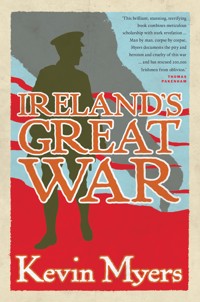
Here, name by name, parish by parish, province by province, Kevin Myers details Ireland's intimate involvement with one of the greatest conflicts in human history, the First World War of 1914 to 1918, which left no Irish family untouched. With this gathering of his talks, unpublished essays and material distilled from The Irish Times and elsewhere, Myers lays out the grounds of his research and findings in Connaught, Leinster, Munster and Ulster. He revisits the main theatres of war in Europe – The Somme, Ypres and Verdun, the war at sea and Gallipoli. He documents these bloody engagements through the lives of those involved, from Dublin to Cork, Sligo to Armagh, to the garrison towns of Athy, Limerick, Mullingar and beyond. In Ireland's Great War Myers uncoils a vital counter-narrative to the predominant readings in nationalist history, revealing the complex and divided loyalties of a nation coming of age in the early twentieth century. This remarkable historical record pieced together the neglected shards of Ireland's recent past and imparts a necessary understanding of the political process that saw Sinn Féin's electoral victory in 1918 and the founding of the Irish Free State. By honouring Ireland's forgotten dead on the centenary of the Great War. Myers enables a rediscovery of purpose that will speak to future generations.
Sie lesen das E-Book in den Legimi-Apps auf:
Seitenzahl: 466
Veröffentlichungsjahr: 2015
Das E-Book (TTS) können Sie hören im Abo „Legimi Premium” in Legimi-Apps auf:
Ähnliche



















ireland’s great war
Kevin Myers
the lilliput press
dublin
Contents
Map of the Western Front
Introduction
1. Opening Shots
2. Sligo and the Great War
3. Athy in the Great War
4. Kilkenny Families and the Great War
5. Kerry in the Great War
6. Armagh and the Great War
7. The Mound
8. Gallipoli
9. Business in Great Waters: Jutland
10. ‘Billy Gray, Billy Gray, will you not come to me?’ Ireland and the Somme
11. Verdun: Where No Birds Sing
12. The Leinster Regiment
13. Francis Ledwidge, An Address
14. Robert Gregory: Airman
15. Glasnevin Cemetery
16. From An Irishman’s Diary
I. REMEMBRANCE SUNDAY
II. ST COLUMBA’S COLLEGE AND THE GREAT WAR
III. SHOT AT DAWN
IV. WILLIE REDMOND
V. WILLIAM ORPEN
VI. MENIN GATE AND MARY MCALEESE
VII. EUROPE’S CIVIL WAR
APPENDIX:Fatalities Amongst NCOs & Enlisted Men in Irish Infantry Regiments, 1914–1918
Sources and Acknowledgments
To the Forgotten Soldiers of Ireland, 1914–18
Map of the Western Front
by Tim O’Neill
Introduction
The first time I went looking for the Memorial Gardens for the Irish dead of the Great War, almost no-one in Kilmainham seemed to know where they were. The year was 1979, sixty years on from the Treaty of Versailles and after the meeting of the First Dáil, and the first shootings of the ‘Anglo-Irish War’ (in which both sides were of course Irish). In 1919 Europe had gone one way, and independent Ireland had gone another, the journey of the latter taking it to a condition of utter amnesia about the very war that was central to its foundation-myths. For without the Great War, there could have been no Easter Rising, and no gallant allies to support it. Yet it had nonetheless been completely forgotten, and so totally that not merely had people forgotten, but they’d forgotten that they’d forgotten. So complete was the eradication of any knowledge of Irish involvement in the war, that yards away from the great park to honour Ireland’s war dead, no-one admitted to knowing of its existence.
Or maybe they just didn’t think of it as a park, because by that time it had been turned into an urban tip-head, with Dublin Corporation lorries disgorging the city’s rubbish onto vast mounds of spoil. A score or more tinkers’ caravans were parked on the edges of the park, and alongside them were the rusting hulks of scrapped cars. Piebald ponies grazed in the foot-high weeds, children scavenged through the waste, and Lutyens’ great granite columns were covered with graffiti. In the muck, almost invisible, lay the two elegant granite obelisks meant to represent lapidary candles, now felled, and almost invisible.
The plinth beneath the memorial obelisk declared then, and declares still, that 49,400 Irishmen died in the Great War. This foundation-falsehood has survived the decades, and is even now being recited as a fact by government ministers. It is simply could not be true, for with casualty-rates running at 11 per cent, this would imply that 500,000Irish had served – out of an island of under four million. However, the figure is an interesting example of how an attractive myth – 49,400 gives the appearance of ‘fact’, because it is so close to 50,000, yet scrupulously isn’t – survives deconstruction.
As I cycled away from the tiphead that the park had now become, I made a vow to do what I could to get it turned into a decent park again. The first thing I had to do was to get the facts right – so I spent months going through the Memorial Records that had been compiled in the early 1920s – at a staggering cost (then) of £5000 – to assess who was actually Irish amongst that 49,400. The records had been put together under a committee led by Eva Bernard, of a prominent unionist family, and it seemed that – to put it mildly – she wanted to maximize Ireland’s involvement in the war, and thereby maximize Ireland’s devotion to the union. So, the memorial records counted as Irish anyone who had served in an Irish regiment, regardless of where they were from. Admittedly, the question of who is Irish is not easily resolved. Many Irish people – such as Willie RedmondMP, who was born in Liverpool – cannot be called non-Irish simply because of their place of birth. Infuriatingly, one primary source for the Memorial Records – and for all subsequent analysis of this time – ‘Officers Died in the Great War’ – unlike the companion volumes, ‘Soldiers Died in the Great War’ – does not give the place of birth of the men it lists.
The figure I came up with, first published in a feature article inThe Irish Timesin November 1980 (see ‘Opening Shots,’ p.19) was roughly 35,000. Such is the power of the press, and of my colossal influence therein, that this figure of 35,000 has had absolutely no impact whatever. Quite simply, people still prefer the mythic – and perhaps Vedic: who knows? – number of 49,400. But having since discovered the disgraceful War Office pension-saving policies of discharging injured soldiers from the army, and then not counting their deaths from war-related injuries as meriting a place inSDGWorODGW, I feel 35,000 is too low. Furthermore, it is now clear that the military bureaucracy – like the War Graves Commission, a generally meticulous organization determined to honour the dead – was sometimes overwhelmed by the scale of the catastrophes confronting it. And this is understandable, for it had to record the same basic details for every single dead man: name, rank, number, regiment, battalion, cause of death, date of death, location of death, place of birth, place of residence, place of enlistment, decorations and former regiment. That is at least 240,000 separate facts for the 20,000 dead of the first day of the Somme alone, and without a pause for counting, because on the second day, there were 1438 dead, and on the third, 2338, and on the 135th day, 13 November, there were 2504 dead; and from 1 July to 13 November, covering the duration of the Somme, there were 122,466 British dead alone, yielding at least 1,469,592 details to be recorded inS/ODGW. How does any organization, using just clerks with fountain pens and paper, manage such a feat, while all able-bodied men are being sent off to war? So, allowing for such human failings, I would now confidently say Ireland’s war-dead number 40,000.
Glimpsing such appalling statistics is, however, like a doctor peeling back a bandage, noticing a wound but then smelling gas-gangrene, for there’s far worse than you can see. It has been the besetting sin of belligerent Anglophone countries, in which community Ireland has now claimed full membership, to see matters only through their own experiences. On 22 August 1914, the very day that the 2nd battalion, the Royal Irish Regiment suffered their first casualties near Mons, 27,000 blue-coated, red-trousered French soldiers were killed, in the first day of the ‘Battle of the Frontiers’. The cult of the uninhibited offensiveál’outrancewas now treading out its daily harvest of garnered youth through the wine-press of war. By29 August French losses totalled 260,000, with 75,000 dead. The British army never had a week like that or even a month in the entire war.
Consider the night-assault by the Ottoman army, starting on Christmas Eve 1914, at Sarikamish high in the Caucasus. At minus 35 degrees Celsius, the troops had been ordered to discard their greatcoats and backpacks for greater speed. Some 25,000 men disappeared in the advance, and those not butchered by the waiting Russians froze to death in the rout that followed. The Russians found 30,000 bodies in the snow, and another 25,000 wounded apparently dragged themselves away and perished on the mountainside. That is, over 50,000 men froze to death over a just a couple of nights. Come the spring thaw, the wolves of the Caucasus grew exceeding fat.
Sacrifices like this could only have been possible if human attitudes, and especially those of men, were unrecognizably different from what we know today. This was true of all nations. Ludwig Frank, a Socialist Deputy in the Reichstag, who had feverishly (and successfully) lobbied for his party to abandon its pacifist policies and support of the war, wrote on 23 August: ‘I am happy; it is not difficult to let blood flow for the Fatherland, and to surround it with romanticism and heroism.’
Frank was a Jew, and was the only Reichstag Deputy to die in the war, whereas three IrishMPs – two nationalist and one unionist – were to die. (Lt Tom Kettle of the Dublin Fusiliers who is often cited as anMPwas no longer a member of the House of Parliament when he was killed at the Somme.) Even that most clinical of Austrians, and Frank’s fellow-Jew, Sigmund Freud, admitted to the almost insuperable power of what he called the ‘libido’ that he felt for his homeland. Yet what perhaps distinguishes Ireland most from all of the subject territories in what, after all, was an imperial war, or rather, wars, was its exemption from conscription. Poles were especially lucky, for, depending on where they lived, members of an extended family could be forced to fight for the Romanov Tsar and the Hohenzollern Kaiser and the Habsburg Emperor. On mobilization, Czech conscripts marched away bearing (the rather-Czech) banners, declaring, ‘We are marching against the Russians and we do not know why.’ They were not the only unhappy soldiers that summer. Dublin gunners on exercise in Athlone in early August 1914, demonstrated, in uniform, against the Bachelors Walk shootings in Dublin, but they of course were not conscripts. Moreover, public anger at the shootings seems to have been largely dissipated with the public enquiry that followed within a fortnight, and which resulted in the now forgotten dismissal of the Deputy Head of theDMPwho had illegally mobilized the army, and in the instatement of policemen who had mutinied rather than obey what they considered illegal orders. The only political demonstrations of Irish soldiers from that point onwards were by groups of uniformed Dublin Fusiliers in the pubs and streets of Naas in September 1914, celebrating the passage of the Home Rule Bill into law. These nationalists would then of course serve and die for crown for which many felt little or no loyalty, and would duly be forgotten by all.
Readers of the pages that follow might be forgiven for criticizing any apparent lack of analysis of the motives of the Irish soldiers who served. This is not a careless omission so much as an admission of utter incapacity. I am quite unable to explain my own motives for almost any aspect of my life, including this book: it would therefore be slightly presumptuous of me to impute motives to long-dead Irishmen of whose culture and personal circumstances I know nothing. Indeed, it cannot be repeated enough how different people were, even in European ‘democracies’ (though no real democracy would exist in Europe until after the war). Most working-class people lived in tenements without privacy or personal privies, washed seldom, ate no fruit, were cold from September to April, shared a toilet with a hundred strangers and used scraps of newspaper if they were ‘well-to-do’, and their imaginations if they weren’t, wore filthy, shit-encrusted underwear (if they wore any at all) and for much of winter lived in the dark, which they shared with vermin, bodily and rodential.
In those tenements, as in the great houses of Rathmines and Rathgar, and the Georgian palaces of the gentry, lived another matter for general omission from this selection of thoughts on the Great War. It is the women: the mothers, the wives, the sisters, the sweethearts, whose tale is still untold, and indeed might never properly now be told, such was the silence about grief – through reticence, pride, social status, illiteracy or nationalism – that governed so much Irish life. I have referred to some of the women: to Agnes Montresor, who lost both her father and her new husband within a couple of days early in the war; to Mrs Bruce, lover of Henry Desmond O’Hara; to Kathleen Shine who lost all three of her sons, and Agnes Collins, who lost four of hers. In no way, however, could that satisfy my own expectations of how properly to convey any sense of a woman’s grief, bereavement, loss and emptiness, never mind those of a women’s group. Quite simply, it is beyond my power to talk about the emotions these women must have felt.
I am reminded of a woman in Rathgar whose brother Reggie had been wounded in the war. Her name was Violett – two t’s – and poor Reggie (my reason for visiting) was well beyond any useful interview. After I had spent an hour trying to talk with him, she and I had a cup of tea, and I made to go. But we stayed talking at her front door, on the high granite stoop of her house on Frankfort Avenue.
She told me how she had lost her fiancé Nigel in the battle that had maimed Reggie.
‘I don’t wish to be rude,’ she said, ‘but my bowels were never right after the telegram arrived. Never. A terrible impediment. I couldn’t really trust myself to go out. So you see, I know so little. These days, of course, Nigel and I would have … you know … but we were God-fearing folk, very proper. So we never. Anyway, I never had a boyfriend after that – just as well, really, because Reggie was never right again after he got home. And he couldn’t hold down a job. So I looked after him. God’s will, I suppose. We have a little money put by. Just a little.’
Her social life consisted solely of attending Rathgar Presbyterian Churchon Sunday mornings, sometimes with Reggie, sometimes not, the only time she had the confidence to stray far from a lavatory. Most of her family and friends had emigrated; now the pair of them lived in decaying gentility in a house that smelt of urine and mothballs.
‘I must be going,’ I said. ‘It’s been a real pleasure.’
I leaned down and kissed her cheek, and she reeled in astonishment. She was silent for a moment or so.
‘No man has kissed me, even like that, since my Nigel kissed me goodbye at Kingstown,’ she whispered.
He died in 1917; it was now 1980.
So, no I cannot do justice to the feelings of women in the war. I have neither the emotional clarity, the imaginative powers nor the language to undertake such a task. I confess my guilt, and move on. However, I feel a little more confident when dealing with the many trite and commonplace judgments on how stupidly the war was conducted. For this was a new kind of war, that was begun with cavalry and four years later was finished with computer-ranged artillery, tanks directed by radio-equipped spotter aircraft, while ground-attack aircraft ranged deep behind enemy lines, dive-bombing targets of opportunity. TheBlitzkriegwas born in 1918, after four years fighting that had begun with dragoons’ sabres along the Sambre, and in those forty-eight months, every single general, battalion commander, platoon subaltern, section leader, from top to bottom, was a novice, and the only lessons that could be learnt were through the grievous expenditure of human life. The alternative, against an adamant foe – and all the participants were certainly that – was unilateral surrender, and such capitulation is not in the nature of great or imperial powers. One can deplore this fact, just as one can the vileness of human nature, but not usefully.
It was a depressing reminder of the Irish appetite to find themselves the most oppressed people ever that one of the first manifestations of an awareness that the Irish had served in the war was when our political classes started campaigning for the British to ‘pardon’ the executed Irish. Now I confess I have a certain proprietorial interest in this subject: aided by the researches of those two admirable men, Julian Putkowski and Julian Sykes, in1989 I published the first ever list of Irish soldiers who had been executed (see ‘Shot at Dawn.’ p.220). I could never have predicted that a political class that had come into existence on a campaign of murdering often unarmed and helpless policemen, and which had assured the safety of the fledgling institutions of new state by ‘executing’ – ie murdering – seventy-seven captives, might now get exercised about the deaths of a few British soldiers who happened to be Irish.
The first execution of a British soldier (an Englishman, actually) occur-red within two weeks of the first outbreak of fighting. Contrary to much mythology, the British army had in general fought extremely badly in its first encounters with the Germans; the mix of a battalion consisting of between 40 per cent regulars and 60 per cent reservists simply didn’t work. The reservists were often unfit, slow and reluctant to do anything, except hobble homeward on blistered feet. Armies are not nursing homes. They will employ any device to make their men fight, including murder: 10 per cent of all executed soldiers were not even represented at their trials, three of which are dealt with in this volume.
The issue of the executed Irish is not as simple as nationalists/republicans today apparently believe. In the new wartime divisions, two men of the 16th (Irish) Division were executed; both of them in Northern battalions, and certainly one of them, Wishart, was a Protestant. Four men of the 36th (Ulster) Division were executed. That means all six of these war-time recruits were northerners, and certainly five of them were Protestants. Looking at the executions from a regimental point of view, five of the executed came from the Royal Inniskilling Fusiliers, five from the Royal Irish Rifles and two from the Royal Irish Fusiliers – that is, twelve from Northern regiments. Eight men from the southern regiments were executed during the war, three Dublin Fusiliers, three Leinsters and two Munsters. The execution of poor James Daly in 1920 in India, for leading a munity in which an innocent man was killed, quite simply does not belong in the same category as wartime executions for desertion, which is a far lesser crime. However, the really large question over the executions is raised by the 29th Division, in which there were never more than three Irish battalions, more often two, out of initially twelve battalions, more latterly nine: six of the eight executions were of men from Irish battalions, a grossly disproportionate number. However, the initial charges were brought by the men’s own officers, who were themselves usually Irish, which complicates matters somewhat. Were Irish officers more unforgiving than officers from Britain? In the absence of more work on the subject, I simply cannot say.
Initially when looking at this unbearably painful subject, I suspected the anti-Irish hand of Lieutenant General Aylmer Hunter-Weston, who had commanded the 29th Division in Gallipoli, before passing command to Lieutenant General H. de Lisle, a well-known savage, but still answerable to Hunter-Weston, commanding officer ofVIIICorps. I am grateful to Julian Putkowski for the following story, about one particular Irish-English soldier from Yorkshire.
On 19 August 1917 nineteen-year old Gunner William Casey, from Sheffield, married Margaret Connor at St Mary’s Catholic Church, Newcastle upon Tyne. She was eight months’ pregnant, and Gunner Casey had deserted his unit at the Front to ensure that the baby would be born in wedlock. On returning to his Royal Field Artillery unit, he was tried by Field General Court Martial for what was a capital offence. Margaret Casey, who was illiterate, persuaded her mother to write a letter to Casey’s commanding officer, pleading for clemency. The letter was read out to the court and after news of the proceedings reached General Sir Aylmer Hunter Weston, he wrote to Margaret Connor.
Allow me as the commander of the Army Corps in which your husband is serving to send you a cheque with which to buy a wedding present … your husband’s Court-Martial happened to come to my notice, & though of course his commanding officer had no option but to try him for the very heinous offence of being absent without leave & the Court Martial on the evidence had no other course but to condemn him and sentence him to severe punishment, yet, I am glad to say, it has been possible to commute the sentence and suspend its execution. So your Husband will not be punished. I rejoice that when he was forced with the necessity of committing a fault, your Husband had no hesitation in choosing that fault which would bring punishment to him and not to you. You fully realise, I hope, that in coming home thus to marry you he ran a very great risk of being found guilty of desertion & being shot; so he faced death for your sake.
Though I do not know him personally, I feel sure he must be a fine fellow & a good soldier, & I congratulate you very heartily on having gained his love. He went through much and took great risks in doing the right thing & coming home to marry you. I respect him for doing this & coming back again to do his duty straightway thereafter, & I am certain that you will always remember his fine qualities & this great proof of his love for you, and that you will make him a real good wife… I feel confident that you must be a really nice woman, and I think he is a lucky man to have you for a wife.
Send your husband my greetings and best wishes for his success as a soldier.
No stereotype survives a letter such as that, complete with a cheque; nor their aftermath, for General Hunter-Weston took his own life in 1940. Moreover, I repeat, armies are not nursing homes. In August 1914 the French government accorded its military authorities the unquestioned right to use the death penalty whenever necessary. On 1 September, after some French units had broken under fire, the French Ministry for War instructed officers to carry out death penalties within twenty-four hours of any offence, with no trial needed. That autumn, faced with the very real prospect of his army collapsing and the last corner of his country capitulating, King Albert of the Belgians issued an Order of the Day that declared that any soldier who fled the battlefield would be shot by special marksman posted to the rear, whose duty was solely that; officers claiming to be sick would be court-martialled, and general staff officers shirking their duties would instantly posted to the front line.
Since executions have become something of an obsession both in Ireland and in Britain, it is worth remembering that during the war, one hundred and forty thousand men deserted from a British army totalling seven million. Twenty thousand British soldiers were convicted of offences carrying the death penalty. Three thousand were sentenced to death. Three hundred and twelve were shot. By contrast, 493RICmen were shot by theIRA, 1919–22, and 77IRAprisoners shot by Free State firing squads, 1922–23. People who justify such killings are perhaps on slightly questionable ground when they complain about executions by the British.
Perceptions of the war, and not just in Ireland, have in recent decades been almost hopelessly contaminated by an entertainment industry that prefers spurious fiction to sober fact. First World War generals – who actually managed to inflict military defeats on the Germans and sent them packing across the Rhine, to be followed by an allied army of occupation – are still widely seen as being legitimate target for lampooning in a way that contemporary politicians, and later generations of British generals that had achieved no such victories, are not. The wanton lies of agitprop theatre such asOh What a Lovely War!and of theBlackaddertelevision caricature, have a ready market, which is in itself a cultural curiosity: for though it cannot be healthy to worship war, it cannot be much healthier to revere such falsehoods. Yet these perceptions are as widespread as those other caricatures, ‘the lions led by donkeys’, and ‘chateaux generals’. No German generals ever accused the British army of being led by donkeys: how could they, who had lost the war? As for chateaux generals, well that’s exactly where generals should be – behind the lines, just like Henry Ford then, or Bill Gates today. Nonetheless,over one hundredBritish generals were killed in the Great War.
The war poets are another matter, because they have been hopelessly traduced by subsequent politico-critics who have often imposed a pacifist or left-wing agenda on their words. For the most part, these men were warrior-bards; they were sensitive humans who were aware of the barbarism of war, yet nonetheless served as bravely as possible in a cause that they thought right. The most cherished of them all, Wilfred Owen, won a Military Cross for seizing a German machinegun, turning it on its former owners, and killing them. His biographers have usually turned this into ‘capturing them’. Our own Francis Ledwidge (see elsewhere in this volume) is a fine example of the warrior-bard, for he expressed so many of the conflicting emotions of the thinking man engaged in a righteous war. Naturally, Irish cultural republicanism, while implicitly denying the very existence of the main body of his wartime poetry, nonetheless conscripted his‘Lament for Thomas MacDonagh’,as if that was his poetic and moral essence. It wasn’t. He was proud to be a soldier in the allied cause.
It is too late now to retrieve
A fallen dream, too late to grieve,
A name unmade, but not too late
To thank the gods for what is great;
A keen-edged sword, a soldier’s heart
Is greater than a poet’s art
And greater tha a poet’s fame
A little grave that has no name,
Whence honour turns away in shame.
The war, after all, was actually being fought in Belgium and France, which had not generously lent some neutral jousting-ground for the two sides to test their imperial martial prowess, but instead were the unwilling hosts to a war of both conquest and liberation. Now, one can certainly argue that the liberation of those lands was not worth the dreadful price that was paid. That very valid point does not – and cannot – answer, the questions that follow: what would have become of Europe if Germany had been allowed to hold onto the conquered territories of Belgium, with all its ports looking out onto the North Sea, and much of the industrial heartland of France? Perhaps, even more serious, what would Germany have been like if the barbarous war of conquest launched by the Kaiser and his military caste had triumphed? Are such people sated by victory, or made hungrier? And how else does one explain the ferocity of the worst battle on the Western Front, Verdun, where France was fighting for the survival of itself as country, and Germany was fighting against a defeat which, it knew –considering its many crimes in the conquered territories – would result in a ruinous settlement?
After Irish independence, the political heirs of the insurgency were mixed in their attitude to the ex-servicemen. Kevin O’Higgins, one of whose brothers Michael Aloysius was killed in France with the 2nd Leinsters, and another, Jack, served as surgeon-commander on Admiral Beatty’s flagshipHMSLion, was both conciliatory but adamant: ‘No-one denies the sacrifice and no-one denies the patriotic motives which induced the vast majority of those men to join the British army to take part in the Great War, and yet it is not ontheirsacrifice that this state is based, and I have no desire to see it suggested that it is.’
Every single one of those assertions could be contested. Many republicans did – and furthermore would increasingly – deny that the very term ‘sacrifice’ could apply to those who had served in a foreign army which they had themselves (if only intermittently) fought. Many within republicanism most emphatically did deny the patriotic motives of those who had served the crown, as did, at the time, Sean Lemass – an attitude for which, some forty years later, he was to regret and also offer, rather generously, public contrition. As for the third assertion, I would maintain that it was the very evidence that so many nationalists had served the crown in the Great War that made the creation of an independent state, on boundaries agreed by John Redmond in 1915, tolerable for the British. I am, I accept, on challengeable grounds here. Either way, given the bipolarity of the British imperial psyche, it was surely better for the Irish to address, and be addressedby,the malleable democratic pole than the purblind imperial one, which, almost without blinking, in the summer of 1920had lost the lives of over eight thousand of its own soldiers in the subjugation of the new-found imperial booty that was Mesopotamia. Moreover, the Treaty was largely being negotiated on the British side by a leadership that had supported the Home Rule Bill, and was also aware of the losses nationalist Ireland had suffered in the Great War. The faith inthatIreland must have generated a goodwill in the heart of the democratic pole that outweighed any military threat that was posed to the ruthless imperial pole by the likes of Tom Barry and Dan Breen. It was this latter pole to which Lloyd George was (and not very obliquely) referring when he effectively finished the Treaty talks with his promise (flourishing an admonitory envelope), ‘If I send this letter, it is war, and war within three days.’
However, post-independence Ireland was not composed solely of Kevin O’Higgins, as he himself was to discover. Several county councils, including Wexford, Cork and Tipperary, voted not to employ ex- servicemen, and also, in a particularly noble gesture, even to withhold all educational-scholarships from their children. Thousands of unionists, unwilling to stay in a state created by the violence that had claimed so many of their own number, departed, causing a housing slump in their former strongholds of Rathgar, Rathmines and Pembroke. Since up to 40 percent of allIrish-borninfantrymen – it varied with the regiment: higher in the west than in the east – were themselves emigrants who had been recruited in Britain, to where, presumably, they would have returned after the war, and since diminished job-opportunities at home would have caused higher emigration amongst returned ex-servicemen, the number of veterans remaining to participate in Irish life, and most of all,to tell their story, must have been disproportionately far smaller than the Irish experience of war actually merited.
So, though 1920s Ireland was deeply aware of the losses in the war, and – as Keith Jeffrey pointed out in his wry study on the subject,Ireland and the Great War(Cambridge, 2000), 20,000 veterans paraded in front of50,000 people in Dublin on Armistice Day in 1924, and the British Legion announced that it had sold half a million poppies in Dublin. As for this last figure, I rather think it compares with the highly creative statistic of ‘49,400 war-dead’. Yet over time, it simply became firstly unfashionable, and then impossible, for ex-servicemen to speak out. The redoubtable Jack MoyneyVCtold me that he had long since learnt to keep his mouth shut unless utterly sure of his company. When I first tried to get veterans of the war to discuss their experiences, some told me that they were in fear of their lives from theIRA. Absurd though that might now seem, that was the culture that had emerged. Moreover, neither schools nor universities – not even Protestant-ones, or Trinity, which between them must have lost a thousand officers killed – broke ranks with the emerging nationalist orthodoxy of silence. In a land that was most comfortable with an all-embracing consensus, forgetting the missing 40,000, and the equally accomplished vanishing-trick with the 200,000 that survived, proved to be relatively easy. Official Ireland had no problem studiously not knowing about the uncomfortable part of its history: and southern Protestants meekly went along with the new fiction, reserving their memories for the semi-secret rites of Remembrance Sunday, and the poppy discreetly sported under the overcoat. When I started writing about the Irish and the Great War, andrepeatedly, inThe Irish Times, the then editor Douglas Gageby sent his deputy, Ken Gray, to ask me to desist.
I readily agreed to do just that – the moment when the Irish state acknowledged the dead of the war.
‘Good man,’ whispered Ken, patting me on the shoulder, and returning to put some gloss on my reply, Douglas Gageby – who, to be fair, never spiked a single column on the issue, even though he heartily disliked what I was doing. Perhaps he thought that my efforts were in vain and quixotic – and for good reason, for it is hard now to convey the utter ignorance that was the norm. When I spoke to a women’s group in Killester in Dublin in 1990 about the Irish in the Great War, not a single person in the room was aware that Killester had orginally been founded in the 1920s as a home for ex-servicemen; likewise in Athy, a garrison town that had about one hundred men killed in the war, but by 1993, when I went to discuss its role in the war, the local sheet was blank, the slate wiped clean: I could have been talking to Peruvians about their granddads’ time in Flanders.
The transformation since then has been extraordinary. Right across Ireland, community-groups have been striving to re-discover the hitherto-forgotten names of the local war-dead of a century ago. That phenomenal beast, the Irish collective memory, has been stirred from its artificial slumbers, and alert and keen once again, is examining its inner recesses, as tales whispered long ago are compared with the written record.
It is almost impossible to exaggerate the raw power of this amazing memory. At around the time of my trip to Killester I came across the grave of forty-seven-year old Private Thomas Carthy, Royal Irish Regi-ment, killed in April 1915, in Poelcappelle Cemetery in Belgium. The cemetery register said he was the husband of Mary Carthy, of 34 River Street Clonmel. I wrote to the occupants of that house, asking if they knew what had happened to the Carthy family. In due course I got a letter from a woman in Nenagh who was the great-grand-niece of Thomas Carthy. She told me the family history. The Carthys were poor, small-town Protestants, and her great grandmother had been Carthy’s youngest sister. That girl was already married when Carthy died, but with a new name, address and religion, having become a Catholic on marrying and later moving to Nenagh.
Such is the might of the Irish collective memory, which through the long dark centuries of dispossession cherished the tales of the Fianna and Knights of the Red Branch, and helped, not always constructively, the Ireland of the twentieth century. Now, one hundred years on from the war that everyone once forgot, it is reminding us that amnesia in Ireland can sometimes be no more than a deep morning mist on an entire landscape of personal knowledge, which yet might yield before the warming sunlight of honesty and disclosure.
1.Opening Shots
11 November 1980
The first shots to be heard in Europe by a British soldier in the First World War came from the carbine of Corporal E. Thomas of the Royal Irish Dragoon Guards. He thus opened accounts for a conflict that would devastate the manhood of the British empire and, to an unrecognized degree, of Ireland. Four years and three months later Corporal W. Ellison of the Royal Irish Lancers, who had been at Mons with Thomas, was killed as his picket of Royal Irish Lancers seized a canal bridge not far from where Thomas had fired his shots. He was the last outright British fatality of the war. A fellow lancer, Thomas Farrell, from Navan, was fatally wounded, and died the next day. The two lamentable events, the start and the finish, are commemorated by plaques in Mons. Ironically, unlike some 35,000 Irishmen, Thomas survived the war that he, if only symbolically, began.
It is one the curiosities of history that most people believe that the stories of German atrocities in Belgium were a fiction got up by British propaganda. This is simply not true. German soldiers did actually shoot priests as an example to the rest of the population of the conquered lands. In Tamines they shot and bayonetted to death 384 men, women and children – the youngest three weeks of age. At Seillies 50 civilians were shot, at Aershot 150, at Audenne 110, and at Dinant 664. All of these killings were in cold blood. But the deed that shocked the world was the sacking and burning of the medieval city of Louvain and the random killings of hundreds of its citizens long after it had surrendered to the German army.
This was what turned Tom Kettle in favour of the war effort, and the loveable Willie RedmondMP, who was far too old to join up but managed to get a commission in the Royal Irish regiment in order to be able to tell young men: ‘Don’t go, butcomewith me.’
Unionists throughout the country, north and south, gave generously, but so did nationalists. In all 108 Dohertys, 182 O’Neills, 200 Ryans, who could belong to either identity, were killed. So too were 40 Patrick Byrnes, who were probably all of nationalist stock.
The professional and footballing community of Dublin formed the famous ‘D’ Company of 7th battalion Royal Dublin Fusiliers. They were the cream of the Dublin middle classes, and included someGAAplayers as well as the better-known rugby players. One of the original ‘D’ Company, Lieutenant C. Paul, of Howth Road, Dublin, was to bring back the dying Willie Redmond during the battle of Messines. Paul was then a member of the Royal Irish Rifles attached to the 36th Ulster Division. Within a short time he too would be dead.
John Redmond was passionately pro-war, and the Redmondite National Volunteers flocked to the Colours. So too did the poor of Dublin’s city centre, Summerhill and Gardiner Street in particular. For such people, a soldier’s income of 9 shillings a week, plus separation allowance for his family, was a small fortune. In a world in which one child in six died before the age of one, the hardship of military life apparently seemed a small disincentive.
And sometimes soldiers’ motives were not always clear. One recruit for the Leinster Regiment kept bawling, ‘To hell with them bloody French anyway.’ A large number of under-age boys managed to join, and wangle their way to the front. James Rathband, from Gardiner Street, Dublin, was such a volunteer, and was killed on the Somme at the age of sixteen in 1916.
The strange thing about those days was that much of the animosities of the recent past had died down. National Volunteer andUVFbands would parade together through the towns of Donegal or Down. Crime just about ceased everywhere. Magistrate after magistrate took the bench in empty courts: likewise High Court judges regularly donned the gloves of White Assizes. ‘It was formerly an army of occupation,’ quipped Tom Kettle of theRIC. ‘Now, owing to the all but complete disappearance of crime, it is an army of no occupation.’
By November 1914 120 fishermen’s houses had provided the Royal Navy with 156 men, and 165 National Volunteers from Manorhamilton were already at the Front. Youghal had 800 men at the Front, Castlebar 100, and from the Athy area it was reported that 1600 men had joined the British army.
Of course recruitment was proportionately highest in Ulster. Between August1914 and October 1916, of the 130,241 recruits in Ireland, almost 67,000 came from Ulster. They were by no means all unionists. Thousands of nationalists joined the Connaught Rangers, the Leinsters and the Royal Irish Regiment, and the 36th Ulster Division was never wholly unionist or Protestant. Moreover, recruitment remained more successful in Britain, and some Irish service battalions were amply filled with Englishmen – Yorkshire men in the Munsters and West Countrymen in the Leinsters. Even the 36th Ulster Division needed topping up with English and Scottish recruits. However, Irish recruitment was by no means confined to Ireland. Roughly 40 per cent of Irish infantry recruits were of Irish-born living in Britain.
Most of these men are listed in ‘Ireland’s Memorial Records’, which contain the name of 49,400 men killed in the Great War. However, these records are not very accurate. Some 11,000 of the men listed in the eight volumes are stated to have been born outside Ireland. Generally, then, these men may be said to be not Irish, though the rule cannot be hard and fast. Willie Redmond, for example, was born in Liverpool, and presumably there must be a fair and incalculable number of Irishmen like him.
The non-Irish lists are swelled by the fact that Irish cavalry regiments were Irish in name only. The unfortunate Ellison, for example, came from York, and the extraordinarily fortunate Thomas came from a London family. Also included in the Memorial records are the dead of the nominally Irish regional regiments in England, such as the Tyneside, London and Liverpool Irish. Most of these men had no real connection with Ireland.
Another category of names in the Memorial Records is even harder to decode. Some 7240 men are given no birthplace. One such is Tom Kettle, whose Irishness is unquestionable, another is John Kipling, Rudyard’s son, of whom the opposite could be said.
About 31,000 Irishmen born in Ireland are reported to have been killed in the war. It is difficult to be more precise than that, because not merely did Eva Bernard, the compiler, allow great latitude in her definition of ‘Irish’, she allowed great latitude in her definition of the First World War. This included civilians killed in the 1916 Rising, perhaps a legitimate inclusion, since its instigators had proclaimed the Germans as ‘their gallant allies’. But many soldiers have been listed twice. And there are anomalous cases that defy explanation. William Jennings Bryan, accorded no birthplace, rank or unit, and who died in Colorado Springs in 1916, is in the Memorial, as is Demosthenes Guilgault, of the Royal Canadian Mounted Rifles, who died of heart failure in Canada in 1919. So is Henry Beddowes, ex-Dublin Fusilier, and Richard Smythe, who drowned in 1919 while bathing, respectively, in Dublin Bay and off Jaffa.
There are some listings that are doubtful on other counts, such as ‘Daniel Collins, rank Private or Corporal, Connaught Rangers, died of wounds, April 29th, 1915 or April 29th, 1916, born New York or Ireland’, or ‘Thomas Curran, died at home, December 17th 1915, or killed in action France, March 21st 1916.’ That these are open to later clarification does not reduce the uncertainty they bring to the Bernardmodus operadni.
One more complication. Some who are listed who would probably not thank you for calling them Irish, Kitchener of Khartoum from his watery grave being one, though admittedly he always felt his Kerry birthplace gave him an understanding of Irishness, though not an empathy with it.
There can be no doubt, however, that about 35,000 Irishmen died in the Great War. Ireland’s Memorial Records, their margins decorated by Harry Clarke’s sombre, sinuous designs, therefore make terrible reading, as brother follows brother, with consecutive numbers, to the grave.
When war broke out, 51,000 Irishmen were serving soldiers or reservists. They had no choice but to fight. The 250,000-odd men, though this figure is still unclear, who joined them were volunteering to fight. Of the 35,000 or so Irishmen who died for little Belgium, for Ulster, for Home Rule, for the King or his shilling, one in sixteen died on the first day on the Somme, 1 July1916. About the same number died in the Gallipoli campaign.
The story of the 36th Ulster Division at the Somme needs no retelling. It is part of the Orange folklore, occurring as it did on the anniversary of the battle of the Boyne. However, the stories about the men of the division donning Orange sashes before they went into action is almost certainly a post-battle myth with no foundation in fact.
Other myths are not remotely baseless. So, it is doubtful whether, apart from specific and obvious occasions, such as the outdoor relief work during the Famine, or during the closing weeks of the battle of Stalingrad, that so many people have been so miserable for so long as were the soldiers of all the armies on the Western Front.
‘The men stood motionless in water up to their waists for two days and nights without food and on relief marched out if they were capable of movement.’ – ‘It was not advisable to grope in the slime. The substratum was chiefly rotting corpses.’ – ‘Bent double with cold, streaming with water from the waist down, and caked with mud from the waist up, strong men would sob like children.’
Thus run three descriptions by Irish officers on a routine winter duty. Sanitation often consisted of using empty bully-beef tins, with the contents being thrown into no man’s land only to ooze back with the mud that slid constantly into the trenches.
The 2nd battalion, the Royal Irish Regiment, was effectively twice wiped out in the war, as was the 2nd battalion, the Royal Munster Fusiliers. On one day in October 1914 50 per cent of all British army deaths on the Western Front were of Irishmen, and there were probably some forty-five days in which the Irish dead and fatally wounded numbered over a hundred. The 1st Leinsters lost 2000 men during the war: its full strength was seldom more than 800. At ‘V’ Beach near Sed El Barrh, in the Dardanelles, near-catastrophe awaited the Dublin and Munster Fusiliers. A naval flier, Commander Sampson, reported that the bay was red with blood. It was Irish blood.
It was reported later in the campaign that men of the 10th Irish Division captured a woman sniper in Gallipoli and she was shot. It is impossible to separate barrack-room myth from military bravado or the truth. ‘There was a Hun on the end of my bayonet,’ reported one Irish officer in Belgium, ‘but I fired and he dropped off.’ AnNCOreported: ‘We got at close quarters with them. Some fled, the others put up their hands. We spared none.’
Interestingly enough, censors did not see fit to remove such material from the newspapers of the time. War seldom elevates the human soul.
Saxon regiments on the Western Front were often rebuffed in their attempts to befriend men of the Leinsters. After one failed truce effort a German peered over his parapet: ‘A bullet between the eyes soon settled his hash, and no truce,’ reported the regimental historian with grisly satisfaction. Andrew Dunne, father of five serving soldiers, received a communication from Buckingham Palace on the deaths of three of them; it ended: ‘Their Majesties congratulate Mr Dunne on having been able to send so many sons to the war.’
‘All honour to those who found recruits, trained them, and sent them out, qualified for saving the skins of fools,’ observed one Irish officer when it was all over.
Recruitment actually increased in the immediate aftermath of the 1916 Rising, in large part put down by Irish garrison troops, who were also among the first casualties, perhaps explaining their keenness to seek revenge. It was a Royal Irish sniper who shot and wounded James Connolly, and men of the regiment seized the tricolour from theGPO.
The whole ghastly mess became even more complicated in the wake of the executions. So concerned was the British about the loyalty of Irish regiments that in 1917 they were all withdrawn from Ireland. That year Ireland lost the poet Francis Ledwidge, who had joined the Inniskilling Fusiliers to prove, among other things, that he was not pro-German. But as with most motives, his were mixed: his sweetheart had got pregnant by another man, and later died in childbirth, along with the baby. Ledwidge was killed on the first day on Third Ypres, an epic of futile horror that even today defies proper description, in which one by one all Irish regiments fought. Then in March 1918 the Germans broke through the allied lines and almost destroyed the 16th Irish Division. One battalion was left with just three men.
The end of the war did not bring peace to all Irish soldiers. Some Irish units were sent off to fight the Bolsheviks, others to occupy Istanbul or Cologne – so much for Little Belgium – and those Irishmen who returned home found themselves amid the rising tide of another war. By 1919 248,000 ex-soldiers were back in Ireland. A few joined theIRA, others theRIC, the Black and Tans and Auxiliaries; yet others joined the A, B and C Specials in the North. Scores of ex-servicemen were murdered by theIRAfor the crime of having served the crown. In time many joined the Free State Army, and in doing so, effectively decided who was to win the Civil War. However, most veterans elected not to fight in any more wars.
They are almost gone now, largely forgotten in their own country, the hundreds of thousands of Irishmen who left these shores to fight other people’s battles. But the dilemma that nationalists like Ledwidge felt has found its laureate in Seamus Heaney and these closing stanzas of his ‘In Memoriam Francis Ledwidge’, moved in childhood by the cold bronze of a Portrush war memorial:
In you, our dead enigma, all the strains
Criss-cross in equilibrium
And as the wind bores thrugh this vigilant bronze
I hear again the sure confusing drum
You followed from Boyne water to the Balkans
But miss the twilit note your flute should sound.
You were not keyed or pitched like those true-blue ones
Though all of you consort now underground.
2.Sligo and the Great War
In early 1914, a little working class girl called Mary Pilkington ran into the path of a car in Thomas Street, Sligo, breaking several ribs and badly injuring her hand. The driver Henry L’Estrange, and his passenger, CaptainW.H. Parke, sub-sheriff of the County of Sligo, brought the injured girl to her modest home in Distillery Lane.
Three years before that incident, the local regiment, the 2nd battalion, Connaught Rangers, were brigaded with the 2nd Royal Sussex Regiment in Dublin; and this presumably was how young Geoffrey Russell Fenton, of Ardaghowen, son of the Crown and Peace Officer for the County of Sligo, first met Agnes Millicent Montresor, daughter of the Sussex’s commanding officer, Lt Colonel Ernest Montresor. The Montresors lived in some splendour in an apartment in Hampton Court Palace. For Irish gentry, this was a good marriage indeed.
Courtship in those days must always have been a rather parlous business, but the wooing of the daughter of the commanding officer of a regiment with whom one’s own battalion is brigaded must have constituted shark-infested waters. One way or another, Geoffrey Fenton was able to pursue his prize, and to win her. The couple were married in a quiet ceremony in London in September 1912. Eighteen months later the scion of another grand house was to encounter a young woman of a drastically different background.
On the declaration of war, both the Sussex and the Connaughts, with Millicent’s father and husband in their respective places, rushed to the front. By August 1914, as elsewhere in Ireland, the Volunteer movement in Sligo was split overwhelmingly in favour of the National Volunteers:4000 as compared to the 280 of what was loosely called the Sinn Féin faction. The National Volunteers were heavily dependent on the enthusiasm and the military skills of army reservists, and it was these very talents that were to rob theINVof its most important men as they were called up for wartime service. Initially, support in Sligo for the allied cause was very strong. Local priests and politicians denounced the German atrocities in Belgium, and such they were, for they were not the invention of British propagandists, though these certainly elaborated upon what was a solid body of truth.
Thus we read that on 10 September 1914, ‘A most enthusiastic meeting for the purposes of recruiting for Lord Kitchener’s army was held in Collooney. Organized by Captain Bryan CooperDL, it was attended by all creeds and classes. Captain Cooper said that Sligo was asked to raise one battalion, and 350 of the 1000 required had joined. (Cheers) He had volunteered for the Connaught Rangers. And if local men wanted to join him, he’d be only too glad to help.’
Michael Gallagher county councillor, seconded by Mr Alexander Slim, proposed the motion: ‘That we are fighting a just war for the vindication of the rights of small nations, and the sacredness of Treaties, and we shall carry it on until the arms of the allies are victorious and the future peace of Europe assured.’
Reverend J. DoyleCC, supporting the resolution, considerably broadened the scope of the war beyond the Schlieffen Plan, asserting that if the Germans won, they’d even stop the old age pensions and land reform, not in Belgium but Ireland. If ever the British empire had fought a war stamped with the hallmark of justice it was the war in which the Irish and English soldiers were engaged on the Continent, he proclaimed, and they all hoped that the Germans would get such a licking that they would never again be in a position to endanger the peace of Europe. Canon McCormick then supported the motion, which was passed unanimously
Bryan Cooper separately announced that all rents below £10 a year would be waived for the families of volunteers, and above that, £10 would be deducted. Appeals to claim to the concession were to be made to Mr L’Estrange, who would drive recruits to Boyle in his now perhaps infamous car.
Meanwhile theBEFwas facing the almost irresistible juggernaut of the German right hook through Belgium. Only a naïve adherence to treaty obligations, and the impetuosity of the continentally inexperienced could have allowed the British Expeditionary Force to be exposed to being outflanked and even annihilated by such overwhelmingly greater forces. The first horsed skirmishes near Mons on 22 August that were almost redolent of ten centuries of cavalry war gave way to ferocious infantry clashes the next day, as von Kluck’s First Army fixed theBEF, while it was being simultaneously outflanked. Retreat was inevitable.
Millicent’s father and husband were mobilized in August 1914. On 14 September, Millicent’s father was killed in action and, six days later, so too was her husband. Neither body was ever found. The two of them are commemorated at La Ferte Sous Joucerre Memorial.




