


Erhalten Sie Zugang zu diesem und mehr als 300000 Büchern ab EUR 5,99 monatlich.
- Herausgeber: The Lilliput Press
- Kategorie: Geisteswissenschaft
- Sprache: Englisch
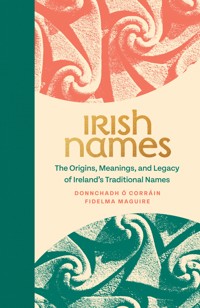
Irish Names is a fascinating exploration of Ireland's rich naming heritage, offering nearly nearly a thousand authentic names drawn from the annals, genealogies, mythology and historical literature of early medieval Ireland. Carefully curated by esteemed scholars Donnchadh Ó Corráin and Fidelma Maguire, this book is both a practical resource for name selection and a cultural treasure trove. Each entry includes historical context, linguistic origins, meanings, anglicised forms, and connections to saints, kings or legendary figures. From the noble strength of Áed to the poetic elegance of Áine, Irish Names reveals the cultural depth and historical resonance behind traditional Irish names. With thoughtful commentary and a comprehensive index, this volume is essential for anyone interested in Irish heritage, genealogy, or the enduring power of names to carry identity across generations.
Sie lesen das E-Book in den Legimi-Apps auf:
Seitenzahl: 278
Veröffentlichungsjahr: 2018
Das E-Book (TTS) können Sie hören im Abo „Legimi Premium” in Legimi-Apps auf:
Ähnliche




















Irish Names
DONNCHADH Ó CORRÁIN
FIDELMA MAGUIRE
THE LILLIPUT PRESS DUBLIN
forTiarnán&Saorla,Gormlaith&Aengus
Contents
Title PageDedicationPREFACE TO THE LILLIPUT EDITIONINTRODUCTIONHOW TO USE THIS BOOKABCDEFGILMNOPRSTUIndex of Variant FormsNOTE ON SOURCESAbout the AuthorCopyright
PREFACE TO THE LILLIPUT EDITION
This book is intended as a selection of Irish names for children. In the ten years since it was written there have been noticeable changes in naming patterns. There are two trends, and both lead to a greater diversity of names.
Firstly, names have become more international. There has been a tendency to use continental or at least exotic forms of names already well established here in more familiar forms, e.g. Karen, Annemarie, Karl, Marc, Ivan. This is middle-class and reflects the outward-looking European-minded attitudes now fashionable for some time. And films, soap-operas and TV series play their part.
Secondly, Irish names in the original forms or with minimal anglicization have made great progress. We hope we have helped. Class lists show that among boys now in school in urban Cork Irish names, as first or second names, make up about half of all given names, but the number will vary greatly from class to class and from group to group and there are regional and minority patterns. The range is narrow: Brian, Finnbar (Barry), Kieran, Kevin, Niall, Conor, Brendan, Colm, Diarmaid, Dónal, Aidan and Rory are by far the most popular. However, boys’ names tend to be strongly conservative, though Patrick (and with it Pádraig) is in sharp decline.
Not so girls’ names. These are highly innovative and the variety, from sources of all kinds, is much greater. Irish names make up 30 to 35 per cent of our samples. Far the most popular Irish name is Aoife – almost twice as common as its nearest competitor, Emer. Other very popular names: Deirdre, Fiona, Órla(ith), Sinéad, Niamh, Ciara, Clíona, Dearbhail. In a sample of 416 primary-school children there are only 14 Marys (including all forms of the name) – our statement that it is borne by one in four of the women of Ireland is quickly going out of date – but there are 20 Aoifes, 12 Emers, 10 Deirdres and 11 Fionas. In this sample there is not a single example of Bridget (Bríd) in any of its many forms (it is in rapid decline everywhere) and there is only one Nóirín, as against 7 Julies, 7 Nicolas, 6 Michelles and 3 Lorraines. Novelty on all sides!
It would not be right to draw too many firm conclusions from these figures, but it seems that names are changing rapidly. The history of Irish names is complex and often bewildering, and there is a lot of research to be done. We would be glad of information on rare or obscure Irish names and unique ‘translations’. Recently, for example, our good friend Foxy John O’Moriarty of Dingle was able to tell us that Seanchán was a hereditary name amongst the O’Moriartys. They later translated it as Jonathan.
Belatedly, we should like to thank K.W. Nicholls who drew generously on his unique knowledge of the records to help us with names in the late medieval and early modern periods.
CarraiganDúin,Spring1990
D.Ó C. F.M.
INTRODUCTION
The early Irish had an extraordinary variety of personal names. Indeed, some twelve thousand names are recorded in the early sources. Yet only a handful of names drawn from a rich heritage are in current use in Ireland. Thousands of them fell out of fashion at a very early period. In the later middle ages the range of names in general use was greatly narrowed and when English became the dominant language of the country, common English, biblical and classical names frequently replaced native ones. This book contains just under a thousand Irish names selected from the annals, genealogies, mythology and historical literature of early medieval Ireland. We have also admitted a number of borrowed names which were once (or still are) well established here, some introduced by early Irish clerics, some by the Anglo-Normans. Any selection poses problems of choice and we have attempted to follow some principles. For instance, we have tried to include all the most popular native names in use in Gaelic Ireland down to the nineteenth century together with their variant forms and their sometimes odd translations into English. We have also included rarer and more obscure names for different reasons: because they were (or are) traditionally attached to particular families, because they are the names of once famous saints, kings or heroes, because many of them are euphonious and may appeal to people for their sound or sense.
Irish names are enjoying an increasing popularity and we have tried to encourage that fashion because we believe that names carry cultural values and have powerful historical associations. Above all we have tried to extend the range of Irish names currently available by drawing on the rich record of the past, much of which remains unpublished or hidden from the general public in scarce or expensive scholarly books. We have also tried to deepen appreciation of Irish names by giving their historical and family associations, the surnames which derive from them, the famous people in mythology and history who bore them and, where possible, their meaning. We have noted which names were borne by Irish saints and the associations and feast-days of these saints.
Because of the sheer abundance of Irish names, borrowed ones have only been sparingly admitted. Recent borrowings, exotic variants and fancy-names have been almost totally excluded in favour of those which have been established here for centuries. Even then, we have had to be highly selective. For example, the vast bulk of the new names brought into this country first by the Normans, and later by the English, belong to the common fund of western European names. Many of these have been omitted because they can be found in any good dictionary of names. However, a large number of those which took firm root here, developed Irish forms or have interesting associations are included.
In one language, with the passage of time, names develop many variant forms and spellings. In Ireland, with the widespread replacement of Irish by English in the nineteenth century and before, change was even more marked. People substituted English names for Irish or made unusual, not to say bizarre, translations which differ from time to time and from place to place. This poses the problem of finding a standard form, a problem which we cannot say we have solved satisfactorily. We have decided to use an alphabetical order and have given first and as head-word the older Irish form, second the modern Irish form or forms, and third the various anglicised forms and translations where they exist. In that way, all the various forms of each name are placed together under one head-word and the index is designed to refer the reader to the appropriate head-word in each case. Examples are given below in the section ‘How to use this book’.
Irish names are constructed in a number of different ways. Some contain a single element, others two or more elements linked closely to form a compound or just loosely joined together. Aed,Lug,Cian are examples of the first type; Murchad,Donnchad,CúUlad,MáelMuire examples of the second type. While the ultimate meaning of some names is self-evident, many others are extremely obscure. As Professor M.A. O’Brien has said: ‘unlike an ordinary word the meaning of which can be determined, a name has no meaning’. We do not, for example, call a child John because it means in Hebrew ‘Jehovah has favoured’, nor do we associate this meaning with a person so called in everyday life. Likewise, a girl is not called Rose because of the meaning of the name– it is derived from Old German hros ‘a horse’. A name rapidly becomes a label with many more powerful associations than its meaning, which generally fades into the background. The meanings suggested in this book are, in many cases, no more than educated guesses. Many names may have been borrowed from earlier languages completely unknown to us and may simply have been given a Celtic form. Had we no knowledge of Irish and the change from Irish to English in Ireland, who could guess that Cud derives from Conchobar,Barney from Brian,Dolty from Dubaltach, and Nappy from Finnguala? Yet a scholar dependent on English alone could suggest obvious, highly uncomplimentary, and, as we know, totally wrong meanings for these names. Nonetheless, the original meaning of some names appears to be clear enough.
A large class of names is derived from colours: bán ‘white’ (Báine, Bánán); ciar ‘black, dark’ (Ciar, Ciarán, Ciarnat, Ciarmac, Ciardae), corcc ‘red, crimson’ (Corcc, Corccán); crón ‘saffron-coloured, yellow, swarthy’ (Crónán, Crónéne, Cróinsech); donn ‘dun, light-brown’ (Donn, Donnchad, Donngal); dub ‘black’ (Dubán, Dubacán, Donndubán, Súldubán); finn ‘bright, white’ (Finn, Finnsech, Finnétan, Finnguala); flann ‘blood-red’ (Flann, Flannacán, Flannán, Flannat); glas ‘green to greyish blue’ (Glass, Glaisne, Glassán); gorm ‘dark, swarthy, black’ (Gormán, Gormlaith); lachtna ‘milk-coloured’ (Lachtna, Lachtnán); ruad ‘red-haired’ (Ruadán, Ruadacán, Ruaidrí); temen ‘dark’ (Temnén). In early Ireland there were social nuances attached to colours. Dubhaltach Mac Firbhisigh, the seventeenth-century antiquary and genealogist writes: ‘Everyone who is fair-skinned, brown-haired, bold, honourable and daring … is of the true Gaeil. Everyone who is fair-haired, honourable, tall and musical … is of the Tuatha Dé Danann (the god-folk). Everyone who is black-haired, vociferous, ill-doing, tale-telling, vulgar, stingy and mean … is of the Fir Bolg (here meaning the original pre-Gaelic inhabitants of Ireland)’. In Irish literature generally the bright colours are considered to be noble, aristocratic and indeed beautiful, for brightness of skin and hair is very much part of the ancient Irish ideal of beauty in men and women. We do not know if these notions had any effect on name-giving.
Another very large class of names is formed from the names of animals and living things. Cú ‘wolf, hound’ is one of the most frequent elements in names. The hound was the symbol of bravery and nobility in early Ireland and is very clearly distinguished from the mata ‘dog, cur’, a term of abuse and derision if applied to a person. The element cú(con) is present in hundreds of Irish names: Conall ‘strong as a wolf or hound’, Conamail ‘wolf-like’, Conchobar ‘wolf-lover’, Conmacc, Macc Con ‘son of the wolf’, Cú Mara ‘sea-hound’, Cú Ulad ‘hound of the Ulstermen’, Cúán, Conán ‘hound’. In Ireland, the wolf was a tabu animal and terms other than his name were used to describe him e.g. fáelchú ‘howling hound’, fáelán ‘the howler’, cúallaid ‘the wild hound’ and mactíre ‘son of the land’. These in turn became personal names. The bear was also a tabu animal in Ireland as in other European countries and the names for the bear art and mathgamain gave rise to such personal names as Art, Artán, Artucán, Mathgamain, Mathgen. Other animal names in use were: banb ‘sucking pig’ (Banbán, Banbnat), bran ‘raven’ (Bran, Branán), brocc ‘badger’ (Broccán, Broicsech), crimthann ‘a fox’ (Crimthann, Crimthannán), cuilén ‘whelp’ (Cuilén), dam ‘deer’ (Damán, Damnat, Damairne), elit ‘hind’ (Eiltíne), ech ‘steed’ (Eochu, Eochaid, Echen, Echmarcach), fiad ‘deer’ (Fiadnat), fuinche ‘scald-crow’, here equated to the war-goddess (Fuinche), géis ‘swan’ (Gelgéis), magor ‘salmon’ (Magor), mucc ‘pig’ (Muiccíne), odor ‘otter’ (Mac Uidir, Odrán), rón ‘seal’ (Rónán, Rónnat); os ‘deer’ (Oissíne, Osnat), ség ‘hawk’ (Ségéne, Ségnat); sord ‘ram’ (Sord).
Other names derive from what must have originally been nicknames describing more general personal characteristics: Ágdae ‘contentious’, Aicher, ‘swift, sharp’, Báeth ‘vain, foolish’, Becc ‘little’, Béoán ‘lively lad’, Cáem ‘beloved, beautiful’, Cass ‘curly-haired’, Cennétig ‘ugly head, rough head’, Cennselach ‘overbearing’, Dímmusach ‘proud’, Dian ‘swift’, Duaibsech ‘melancholy’, Fachtna ‘malicious’, Lonngargán ‘fierce and eager person’ – to name but a few that come to mind. On occasion, these are combined with other elements to make compound names: e.g. Báethgalach,Beoaéd,Finncháem,Beccenech,Diangalach,Cassán and others.
Still other names derive from words describing various offices, functions and social positions. Amongst these we may cite flaith ‘a lord’ (Flaithem, Flaithbertach, Flaithrí), tigern ‘lord, warlord’ (Tigernán, Tigernach, Fortchern, Cathchern, Lug-thigern, rí ‘king’ (Rígán, Rian, Laechrí), bard ‘poet’ (Barddán, Rígbarddán), cléirech ‘cleric’ (Cléirech, Cléirchíne), manach ‘monk’ (Manchán, Mainchíne), goba ‘smith’ (Goba, Gobbán, Goibniu, Gobnat). Some reflect riches in lands or goods (Sétach, Selbach, Cétach, Tírech, Toicthech) whilst others, indeed, indicated that their original bearers held no high social rank. Some names derive from the names of dynasties or family-groups: Connachtach, Cú Chonnacht from Connachta, the descendants of Conn who gave their name to the province of Connaught; Ultán from Ulaid, the ancient dynasty which gave its name to the province of Ulster, Laígsech from Lóigis, the dynasty which gave its name to the district of Laois. True locatives, names derived from place-names, are very rare in Irish except in the form of loose compounds, e.g. Cú ‘hound’ by metaphor ‘outstanding warrior’ + placename, or Dub ‘dark man’ + placename. Cú Bladma ‘hound of Slieve Bloom’, Cú Faifne ‘hound of Faffand’ (an area in ancient Offaly), Dub Emna ‘dark man of Emain Macha’ may serve as examples.
The Irish, as most peoples, distinguish sharply between male and female names. I have, however, noticed that the following are common to both sexes: Ailbe, Aine, Barrfind, Cellach, Columb, Feidlimid, Finn, Flann, Macha, Móen, Medb, Mongfind, Séigíne. More surprisingly, there are examples of the (normally) male names Gormmán, Máel Bracha, Máel Étig, Máel Meda, and Máel Muire being applied to women. With few exceptions, all names ending in -án, -éne and -íne are masculine. These may be frequently turned into female names by substituting -nat or -sech e.g. Aedán: Aednat, Beccán: Beccnat, Biccíne: Biccsech, Breccán: Breccnat, Cáemán: Cáemnat, Ciarán: Ciarnat, Crónán: Cróinsech, Crommán: Cruimmsech, Donnán: Duinnsech, Damán: Damnat, Dúnán: Dúnsech, Gobbán: Gobnat, Lugán: Luigsech, Oissíne, Ossnat. Quite a number of female names are compounds containing the (element) word flaith as a second element, e.g. Coblaith, Tailefhlaith, Túathfhlaith and many others. The word flaith means both ‘sovereignty’ and ‘sovereign, prince’ in Irish. It must have originally meant ‘queen, princess’ in female names but at an early period it seems to have come to be regarded as an ending for feminine names. Compare the pairs Dúnfhlaith: Dúnán, Gormlaith: Gormmán, Sáerlaith: Sáerán, Túathfhlaith: Túathán, (Túathal, Túathgal). Similarly, the word tigern ‘lord’, always masculine in the literature, occurs in feminine names where it must mean lady e.g. Cáeltigern, Caíntigern.
Since Irish society was a patriarchal society and since most of our historical records concern themselves with the activities of men rather than women, far fewer women’s names are preserved and this will be evident to the reader of this book. Fashions in names varied from age to age and apparently from sex to sex. Certainly, women seem to have been far readier to borrow foreign names. In the later middle ages Mór is by far the most popular female name, followed closely by Sadb and Gormlaith;Finnguala appears next, followed by the borrowed name Sibán;Derbforgaill,BenMide,Bébinn and the borrowed names, Caiterína (in its various forms) and Margrég (Margaret) are next in popular favour. However, very early names e.g. Étaín, Medb, Taillte, Ailbe and others remained in use. If we may judge from earlier sources, Sadb,Cacht,Mór,Gormlaith and Orlaith were the five most popular names in twelfth-century Ireland.
The development of early Irish names, their etymologies, hypocoristic (pet-name) forms, back-formations, shortened forms and derivatives is a matter of much fascination for the scholar and the historian; their forms and origins conceal much of the history of Ireland within them; and from them derive the vast majority of the surnames in use in Ireland today. Names themselves and the giving of them, if we may judge from early literature and folk-tradition alike, have always been a matter of lively interest both to their bearers and to those who gave them. With the revival of interest in Gaelic Ireland at the beginning of the century and with the Anglo-Irish literary movement, there was naturally a renewed interest in Irish personal names, the majority of which had been swept away in the language change of the nineteenth century. As a result a limited number of the older (and, one may add, rarer) personal names, e.g. Cáemgen (Kevin), Brénainn (Brendan), Iarlaithe (Jarlath) etc. came into use again. However, apart from some remarkable articles in the GaelicJournal1, some papers in the less accessible Celtic journals, and Patrick Woulfe’s Irishnamesforchildren2 little has been made available on Irish personal names. It might be added that the subject has not attracted the scholarly attention which it deserves. It is hoped that the present volume may serve as an introduction, however inadequate, to the riches of Irish personal names.
Bishopscourt, 1980
D.Ó C. F.M.
1. J.C. Ward, ‘Irish personal names I. Co. Donegal’, GaelicJournal, ix, no. 104 (Feb. 1899) 319–21; P.T. McGinley, ‘Irish personal names II. Co. Antrim’, ibid., no. 105 (Mar. 1899) 344–5; S. Ó hAnnabháin, ‘Irish personal names. Oirghialla.’, ibid., no. 119 (1900) 565–7; A. Ó Ceallaigh, ‘Irish Christian names’, ibid., xi, no. 135 (Dec. 1901) 197–205.
2. Patrick Woulfe, Irishnamesforchildren (Dublin: Gill 1923); reprinted 1967, revised edition (by Gerard Slevin) with preface and some additions, 1974. Ronan Coughlan, Irishchristiannames (London and Edinburgh: Johnston and Bacon 1979) is quite unreliable and inaccurate on many points.
HOW TO USE THIS BOOK
ArrangementofNames The book is arranged inalphabetical order. Generally, in the case of each entry, the name is first given in its early Irish form. This is followed by a colon, after which the modern Irish form is given. If there are a number of forms, this is indicated. This is followed by a guide to the pronunciation of the name, enclosed in round brackets. There is an indication as to whether the name is masculine, feminine or common followed by the meaning or derivation of the name – in so far as it is known. The length of the entry on each name varies with the importance of the name and the amount of information available about it. All names prefixed by an asterisk (*) are borrowed names. The index should be consulted for names which cannot be found at first glance, for variant forms of names and for anglicisations of Irish names. To take some examples:
Noreen will not be found in alphabetical place under this form because it is not an Irish form or the oldest form. Turn to the index. The reader is directed to Onóra, the oldest Irish form, under which all the variant forms are given.
Aonghus will not be found in alphabetical place under this form because it is not the older form of the name. Turn to the index. You are directed to Oengus, the earlier form, where the information needed is given.
Your name is Hannah. No entry is found under that name. Turn to the index. You find yourself directed to three names: Áine,Onóra,Sibán. Look them up and you find that Hannah has been used as a form of each of these names.
Pronunciation The guide to pronunciation given in parenthesis generally refers to the modern Irish form. It gives only a very approximate indication of the correct pronunciation(s). For more exact information, a good speaker of Irish should be consulted. If the earlier form of the name is found attractive, we see no good reason why the reader should not pronounce it as he feels fit. The pronunciation of Old Irish is uncertain anyway and Irish medieval scribes, it may be added, treated the forms (and pronunciations) of names with great freedom. In Irish, the stress (which is strong) generally falls on the first syllable. Vowels in later syllables, unless they are long, are pronounced very lightly. The following hints will help the reader in using the pronunciation guides.
(a) is roughly equivalent to English law
(e) is roughly equivalent to English veil
(ī) is roughly equivalent to English fee
(ō) is roughly equivalent to English show
(ū) is roughly equivalent to English rood
(ei) is roughly equivalent to English vine
(ow) is roughly equivalent to English owl
(ch) is roughly equivalent to Scottish loch
In Irish, short vowels are simply shortened forms of the long vowels. In this pronunciation guide short u (u) is rendered as unstressed a (a).
Irish consonants have two qualities: palatal and non-palatal (velar). Palatalisation is produced by raising the front of the tongue towards the hard palate. All palatalised consonants are indicated by the symbol’, e.g. Crónsech (which has palatal (n) and (s) is represented as krōn’-s’ach.
ConventionsofSpelling The following conventions are followed. The form macNéill usually refers to the standard Irish for ‘son of Niall’, whereas MacNéill refers to the Irish form of the surname of which MacNeill,McNeill are anglicisations. The uses of ua/Ua and ó/Ó are analagous. In classical Irish mac followed by a vowel becomes mag or meg. The standard middle Irish plural of mac is meic. From the 9th century onwards, surnames began to be formed by prefixing mac or ua/ó (grandson) to the father’s or grandparent’s name. (Uí is the plural of Ua.)
A
*AARON m. The name of the brother of Moses and high-priest of Israel. It was borrowed from the Bible and used sparingly by early Irish churchmen. St Aaron, a British martyr, was put to death at Newport in south Wales in the reign of Diocletian. The name is very rare in continental sources.
*ABAIGEAL f. In the Bible Abigail is the name of the wife of Nabal and, after his death, of King David. It was very common in Ireland in the nineteenth century especially in the form Abaigh (abī). In the south it was used as a genteel ‘translation’ of the native name Gobnat (which see).
ÁBARTACH: ÁBHARTACH (āv-art-ach) m. This name was in use among the Uí Iffernáin (Heffernans) of Dál Cais amongst others. In the Finn-tales Ábartach is the father of the beloved of the warrior Gáel. The name gives the modern surname O Haverty.
ABBÁETH: ABAOTH (a-bē) m. Meaning perhaps, ‘lustful’. A rare name in use among the early Leinstermen.
ABBÁN: ABÁN (ab-ān) m, ‘little abbot’. The name of a Leinster-born hermit saint of the late sixth or early seventh century. According to tradition, he baptised St Finnian of Clonard. His feast-day is 27 October.
*ABÉL m. The name of the biblical Abel which was borrowed by early Irish clerics such as the monks Abél of Emlagh in Meath (†747), Abél of Portumna (†754) and the scribe Abél who was slain by Viking raiders in 922.
ABLACH: ABHLACH (av-lach) f. Perhaps meaning ‘having apple-trees, like an apple-tree’. The best-known bearer of the name was an Ulster princess and mother of Eochaid mac Fiachnai, King of Ulaid (†810).
*ABNER m. The name of the biblical Abner, cousin of Saul and commander of his army. It was borrowed by such early Irish clerics as Abner, abbot of Emly (†760) and Abner, abbot of Killeigh (†827), but it never became popular.
ACHALL (achal) f. A mythological name borne by the daughter of the legendary warrior Cairbre Nia Fer. She died of sorrow when the Ulster hero Conall Cearnach slew her brother and, according to legend, gave her name to the hill of Achall near Tara.
ACCOBRÁN: ACOBHRÁN (akav-rān) m, ‘desirous’. The name of a saint of Kilrush, Co Clare, whose feast-day is 28 January. The name may be a translation of Latin Desiderius.
*ÁDAM: ÁDHAMH (āv,ā-ū) m. The biblical Adam, borrowed first by clerics but later used more generally. Among others, the name was borne by the historian Ádam Ua Cianáin (†1373), and it gave rise to the Cork surname Ó hÁdhaimh.
ADOMNÁN: ADHAMHNÁN (ū-nān) m, timorous one. Generally anglicised Eunan or Onan. The best-known bearer of the name was Adomnán, abbot of Iona and author of a famous biography of St Colmcille, who died in 704. He is patron of the diocese of Raphoe and his feast-day is 23 September.
ADAMRAE: ÁMHRA (āv-ra) m, ‘very wonderful’. A very rare name which occurs in the early genealogy of the O Lohan (Loghan, Loughan, Duck) family of Westmeath.
*ADDUCC: ADAG (ad-ag) m, a diminutive of Adam. In thirteenth-century England Adam, with its diminutives Add,Adkin,Atkin etc., was one of the two or three most common names and, in its various forms, it became fairly common in Ireland as a result of the Norman invasion.
ADNACH: ADHNACH (ei-nach) m. This name occurs in the early pedigrees of the leading Munster families, the Dál Cais and the Eóganacht. It was also borne by a saint of the Airgialla who settled in Leittir Dalláin in Tír Eógain.
ADNÁR: ADHNÁR (ei-nār) m, ‘very modest’. The name of an early Leinster saint.
ÁED: AODH (ē) m, ‘fire’. Cognate with Latin aedes,aestus and with the Gaulish Aedui, it was the commonest of all names in use in early Ireland and is now everywhere anglicised Hugh, a name with which it has no connection. Among the many kings and nobles who bore the name were Áed Sláne, high-king (†607), Áed mac Ainmerech, high-king who was slain by the Leinstermen in 601, Áed Allán, high-king (†613) and Áed Bennán, king of West Munster (†619), of whom the poet sang ‘When he rattles his shield he scatters his enemies.’ There were some twenty saints of the name among whom were St Áed mac Bricc of the royal race of the Southern Uí Néill, St Áed, bishop of Lisgoole, on Lough Erne, whose feast-day is 25 January and St Áed, bishop of Sletty, Co Carlow, who died in 699 and whose feast-day is 7 February. The name gave rise to a very large number of surnames, e.g. O Hea, Hayes, Hay, Hughes, McHugh, MacCue, McCoy, etc. In the form Hugh the name is still found in most Donegal families and there is scarcely a family of the O Donnells which has not a Hugh. The diminutive Hughie is very common in the north.
ÁEDAMMAIR: AODHAMAIR (ē-amir’) f, derived from Áed. The name of a virgin saint whose feast-day is 18 January. The alternative form Adamair also occurs and this was the name of Guaire Aidne, king of Connacht.
ÁEDACH: AODHACH (ē-ach) m, derivative of Áed. A saint whose feast-day is 9 April.
ÁEDÁN: AODHÁN (ē-ān) m, diminutive of Áed. This was a relatively common name in early Ireland, both for clerics and laity. It was borne by some twenty-one saints among whom were St Áedán of Louth whose feast-day is 1 January, St Áedán, abbot of Lismore, whose feast-day is 16 March, and St Áedán of Aghara, near the river Inny in Roscommon, whose feast-day is 11 April. Perhaps the most famous bearer of the name was Áedán, the missionary sent by Iona to christianise the north of England and who founded the monastery of Lindisfarne. The name is commonly anglicised Aidan and Edan and was revived in England in the nineteenth century. In Ireland, Aidan is commonly used as a form of Máedóc (which see).
ÁEDGAL: AODHAL (ē-al) m. Meaning, perhaps, ‘one possessing the prowess of (the god) Aed’. This early name is in use in the pedigrees of the Leinstermen and the Déisi.
ÁEDGEN: AOIDHGHEAN (ī-an) m. Meaning, perhaps, ‘born of Aed’ or ‘born of fire’. Among the bearers of this name were St Áedgen, bishop and abbot of Fore, who died in 771 and whose feast-day is 1 May and Áedgen, bishop and scribe of Kildare(†865). The Old Irish name Áedgna is similar in formation and meaning.
ÁEDLUG: AODHLUGH, AOLÚ (ē-lū) m. A combination of Áed and the god-name Lug. This name was relatively common among the early inhabitants of Kerry. It was also borne by a saintly abbot of Clonmacnoise whose feast-day is 26 February.
ÁEDNAT: AODHNAIT (ē-nit’) f, the female form of Áedán (above). It was borne by a St Áednait whose feast-day is 10 November. It is anglicised Enat,Ena and Eny.
ÁEDUCÁN: AODHAGÁN (ē-gān) m, diminutive of Áed. It is anglicised Egan. This name was widely used in early Ireland and gave rise to the surname Mac Aodhagáin (Mc Egan) – the outstanding legal family of medieval Ireland. It was also the name of the last great Munster poet Aodhagán Ó Raithile.
*AFFIATH m. The name of the biblical Japhet, one of the sons of Noah. It was borrowed by a number of early Irish clerics such as Affiath, abbot of Moville (†743), and Affiath, bishop of Armagh (†794), but it never became popular.
*AFFRAIC f. A borrowing of the name Africa. It was borne by two abbesses of Kildare in the eighth and ninth centuries. It was also the name of the daughter of Godred, King of the Isle of Man, who married John de Courcy and founded a Cistercian monastery in the Ards, Co Down.
ÁGACH: ÁGHMACH (āch) m, ‘contentious, warlike’. The name of one of the Fomorians, legendary sea-borne raiders and enemies of the Tuatha Dé Danann.
ÁGDAE: ÁGHDHA, ÁGA (ā-ga) m, ‘contentious, warlike’. A relatively rare name which occurs in the early pedigrees.
AÍ: AOI (ī) m and f, ‘poetic inspiration, learning’. There was a legendary Aí mac Ollamon whose name means ‘inspiration, son of master poet’. The best-known female bearer of the name was Aí Arduallach (‘Aí the Arrogant’), daughter of Finn, who refused to marry the king of Scotland or any other man who was not Irish.
AÍBGRÉNE: AOIBHGRÉINE (īv-gr’ēn’e) f, ‘radiance of the sun, ray of sunshine’. This name could be anglicised Evegren. In Irish saga she is the daughter of Noíse and the tragic heroine Deirdre.
AÍBELL: AOIBHEALL (ī-v’al) f, ‘radiance, spark, fire’. One of the old Irish goddesses. According to some legends she is a supernatural lady who lives in the fairy-mound of Craig Liath near Killaloe, Co Clare, and who appeared to Brian Boru on the eve of the battle of Clontarf. In other stories there is mention of Aíbell, daughter of the Ulster warrior Celtchar mac Uithechair, and of Aíbell Grúadsolus (‘Aíbell of the bright cheeks’) who is daughter of the king of Munster. The name always retained its pagan associations.
AÍBINN, OÉBFINN, AÉBFHINN: AOIBHINN (ī-vin’) f, ‘beautiful sheen, fair radiance’. This name could be anglicisedEavan. It was borne by the mother of St Énna of Aran and by a number of princesses including the daughter of Donnchad, royal prince of Tara, who died in 952.
AÍBNAT, AÉBNAT, OÉBNAT: AOBHNAIT (īv-nit’) f, ‘radiant girl’. This name could be anglicised Eavnat. It was borne by a saint of Laois whose feast-day is 31 January.
AIBNE: AIBHNE (ev’-n’e) m. In the later middle ages this name occurs among the Meic Lochlainn (McLoughlins) and Uí Chatháin (O Kanes) of Donegal and Derry. In more recent times, it was common among the O Kanes, O Brallaghans, Bradleys, Brodies and O Mullins of the same area. It has been anglicised Eveny and earlier Aveny.
AICCLECH: AIGLEACH (ag’l’ach) m. Meaning, perhaps, ‘cautious, ready’. A rare name used among the early inhabitants of Kerry and Kilkenny.
AICHER: AICHEAR (e-har) m. Meaning, probably, ‘sharp, keen, fierce’. The name was borne by one of the ancestors of the Uí Ógáin (Hogans) of Dál Cais. Aicher was also the ancestor of the Uí Aichir (O Hehirs) of Clare, most of whom came originally from Limerick. In the Finn-tales, Aicher is one of the musicians of the Fianna. The name could be anglicised Ehir.
AÍFE: AOIFE (ī-f’e) f, ‘pleasant, beautiful, radiant (goddess)’. This ancient name, which the scholar T.F. O Rahilly associates with the Gaulish goddess, Esuvia, is borne by many of the legendary heroines of early Irish literature: Aífe, daughter of Belchú and wife of the Ulster hero Conall Cearnach; Aífe, daughter of Russ Failge and queen to a legendary king of Leinster; Aífe Foltfhind (‘of the fair hair’), daughter of the king of Ulster; Aífe Derg, daughter of the King of Connacht who, according to story, had her marriage arranged by St Patrick himself. The name has been anglicised Eva, a name with which it has no connection.
AILBE: AILBHE (al’-v’e) m and f. Very probably connected with the old root albho- ‘white’ and with Gaulish Albiorix ‘world-king’. Among the famous legendary and historic women who bore the name are Ailbe, daughter of the fairy king, Midir; Ailbe Grúadbrecc (‘of the freckled cheeks’), daughter of Cormac mac Airt, who, according to the Fenian warrior Caílte, was one of the four best women of her time who ever lay with a man in Ireland; Ailbe, daughter of the high-king Máel Sechnaill I and mother of Cerball, warrior-king of Ossory. As a male name Ailbe occurs in both pagan and Christian contexts. A legendary Ailbe of the Tuatha Dé Danann gave his name to a sea-inlet in Corcu Duibne. Another is said to have voyaged in search of the Land of Promise. According to the Finn-tales twelve warriors of the Fianna bore the name Ailbe. There are two saints of the name, Ailbe mac Rónáin, a saint of Cenél Conaill, whose feast-day is 30 January and the much better known Ailbe, bishop of Emly, whose feast-day is 12 September. It is anglicised incorrectly as Albert and Bertie.
AILCHÚ (al’-chū) m. Meaning, possibly, ‘gentle hound’. This relatively uncommon name was borne by two eighth-century




