


3,49 €
Mehr erfahren.
- Herausgeber: Open Book Publishers
- Kategorie: Fachliteratur
- Sprache: Englisch
It is fashionable to criticize economic theory for focusing too much on rationality and ignoring the imperfect and emotional way in which real economic decisions are reached. All of us facing the global economic crisis wonder just how rational economic men and women can be. Behavioral economics — an effort to incorporate psychological ideas into economics — has become all the rage.This book by well-known economist David K. Levine questions the idea that behavioral economics is the answer to economic problems. It explores the successes and failures of contemporary economics both inside and outside the laboratory. It then asks whether popular behavioral theories of psychological biases are solutions to the failures. It not only provides an overview of popular behavioral theories and their history, but also gives the reader the tools for scrutinizing them.Levine’s book is essential reading for students and teachers of economic theory and anyone interested in the psychology of economics.
Das E-Book können Sie in Legimi-Apps oder einer beliebigen App lesen, die das folgende Format unterstützen:
Veröffentlichungsjahr: 2012
Ähnliche



















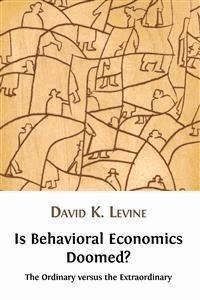
IS BEHAVIORAL ECONOMICS DOOMED?
David K. Levine is John H. Biggs Distinguished Professor of Economics at Washington University in St. Louis. He is currently serving as President of the Society for the Advancement of Economic Theory. He is also a fellow of the Econometric Society, an Economic Theory Fellow, a research associate of the NBER, and of the Federal Reserve Bank of St. Louis, managing editor of NAJ Economics, and co-director of the MISSEL laboratory. His scientific research is supported by grants from the National Science Foundation. He is the author of Against Intellectual Monopoly (with Michele Boldrin) and Learning in Games (with Drew Fudenberg) and the editor of several conference volumes. He has published extensively in professional journals, including The American Economic Review, Econometrica, The Review of Economic Studies, The Journal of Political Economy, The Journal of Economic Theory, The Quarterly Journal of Economics, and The American Political Science Review. Levine’s current research interests include the study of intellectual property and endogenous growth in dynamic general equilibrium models, models of self-control, of the endogenous formation of preferences, institutions and social norms, learning in games, evolutionary game theory, virtual economies, and the application of game theory to experimental economics. At the graduate level, his teaching focuses on economic dynamics; at the undergraduate level, he teaches intermediate level microeconomics, focusing largely on elementary game theory.
IS BEHAVIORAL ECONOMICS DOOMED?
The Ordinary versus the Extraordinary
David K. Levine
Open Book Publishers CIC Ltd.,
40 Devonshire Road, Cambridge, CB1 2BL, United Kingdom
http://www.openbookpublishers.com
© 2012 David K. Levine
Some rights are reserved. This work is licensed under a Creative Commons Attribution-ShareAlike 3.0 Unported License.
This license lets others remix, tweak, and build upon the work even for commercial purposes, as long as they credit the author of the work and license their new creations under the identical terms. Details of allowances and restrictions available at:
http://creativecommons.org/licenses/by-sa/3.0/deed.en
As with all Open Book Publishers titles, digital material and resources associated with this volume are available from our website:
http://www.openbookpublishers.com/product/77
ISBN Hardback: 978-1-906924-93-5
ISBN Paperback: 978-1-906924-92-8
ISBN Digital (pdf): 978-1-906924-94-2
ISBN e-book (epub): 978-1-906924-95-9
ISBN e-book (mobi): 978-1-906924-96-6
Cover image: Joan M. Mas
http://www.flickr.com/photos/dailypic/2072852387/in/photostream
Typesetting by www.bookgenie.in
All paper used by Open Book Publishers is SFI (Sustainable Forestry Initiative), PEFC (Programme for the Endorsement of Forest Certification Schemes) and Forest Stewardship Council (FSC) certified.
Printed in the United Kingdom and United States by Lightning Source for Open Book Publishers
Contents
Acknowledgements
Introduction
Does Economic Theory Work?
Why Is the World so Irrational?
Does Economic Theory Fail?
You Can Fool Some of the People…
Behavioral Theories I: Biases and Irrationality
Behavioral Theories II: Time and Uncertainty
Learning and Friends
Conclusion: Psychology, Neuroscience and Economics
References
Index
To Milena Davidson-Levine and Catharina Tilmans
Acknowledgements
I owe an immeasurable intellectual debt to my coauthors Michele Boldrin, Drew Fudenberg, Salvatore Modica, Zacharias Maniadis, Tom Palfrey, and Jie Zheng with whom I’ve worked, discussed and debated the issues discussed here for many years. Tim Sullivan encouraged me to write this up in the form of a book, and took the time to read and comment on the first draft. Dr. Rupert Gatti, economics editor of Open Book Publishers, Dr. Alessandra Tosi and two exceptional referees have enormously improved that original draft. Juan Block proofread the book – for sense as well as typos – and provided the index.
This book originated as a Max Weber lecture presented at the European University Institute. Much of it was written while on sabbatical leave in the Economics Department there. I am grateful to the EUI and the Economics Department. I also owe a special debt of gratitude to the Max Weber program and to Ramon Marimon, Karin Tilmans and the Weber fellows for the invitation to speak, for a very constructive presentation, and for encouragement and assistance in writing up the lecture.
I have presented variations of this lecture in various venues including FUR, the NYU Experimental Workshop, the Neuroeconomics Meetings and the Milan Neuroeconomics Conference. I am grateful to Glenn Harrison, Guillame Frechette, and Colin Camerer for those invitations and to them and the meeting participants for helpful comments and criticism. Like Guillame and Colin, Rosemarie Nagel disagrees with practically everything written here – but her constant provocation has resulted in a much more coherent book. In the other dimension – Charlie Plott’s work in a direction similar to mine has been an example and an inspiration.
Although we may disagree – hopefully with respect – I could not have written this book without my many behavioral, neuroscientific and psychological friends. George Ainslie, Gary Charness, Ernst Fehr, Paul Glimcher, Len Green, Joel Myerson, David Laibson, Camillo Padoa-Schioppa, Drazen Prelec, Aldo Rustichini and Klaus Schmidt have through their careful research contributed to my understanding of behavioral economics.
I am also grateful to my daughter Milena Davidson-Levine, to Catharina Tilmans and to my many students both graduate and undergraduate at Washington University in St. Louis. To the outstanding faculty there and the fine research organization at the Federal Reserve Bank of St. Louis I am also indebted for constant feedback and support.
Finally, I would like to thank the National Science Foundation and grants SES-03-14713 and SES-08-51315 for financial support.
1. Introduction
Under these conditions, the erotic relation seems to offer the unsurpassable peak of the fulfillment of the request for love in the direct fusion of the souls of one to the other. The boundless giving of oneself is as radical as possible in its opposition to all functionality, rationality, and generality. It is so overpowering that it is treated “symbolically”: as a sacrament. The lover realizes himself to be rooted in the kernel of the truly living, which is eternally inaccessible to any rational endeavor. He knows himself to be freed from the cold skeleton hands of rational orders, just as completely as from the banality of everyday routine. Max Weber, 1958
Even Max Weber – one of the early proponents of the social analysis of rational man – recognized the essential irrationality of emotions such as love. Today it has become so very fashionable to criticize economic theory for focusing too much on rationality and ignoring the imperfect and emotional way in which decisions are reached in the “real world.” Psychologists and other social scientists have been especially vocal in their dismay. A bright new group of behavioral economists has picked up the criticism:
Economics traditionally conceptualizes a world populated by calculating, unemotional maximizers that have been dubbed Homo economicus. The standard economic framework ignores or rules out virtually all the behavior studied by cognitive and social psychologists. This “unbehavioral” economic agent was once defended on numerous grounds: some claimed that the model was “right”; most others simply argued that the standard model was easier to formalize and practically more relevant. Behavioral economics blossomed from the realization that neither point of view was correct. (Thaler and Mullainathan, 2010)
The authors go on to point out how modern economics is based on a foundation of sand.
The standard economic model of human behavior includes three unrealistic traits – unbounded rationality, unbounded willpower, and unbounded selfishness – all of which behavioral economics modifies.
Those who have read about – and who has not? – the current economic crisis may wonder indeed just how rational an economic man or woman might be. Behavioral economics has become the modern rage. Is, therefore, rational economic man – homo economicus – dead? Has the economics profession moved on to recognize the true irrationality of humankind? Nothing could be further from the truth.
Strangely, the criticisms that have caused behavioral economics to blossom are nothing new. Writing in 1898 Thorstein Veblen wrote sarcastically of rational economic man as
a lightning calculator of pleasures and pains, who oscillates like a homogenous globule of desire of happiness under the impulse of stimuli.
Students of economic history can argue about whether Veblen’s description of homo economicus is an accurate reflection of economics as it was practiced then – it is definitely not an accurate reflection of economics as it is practiced today. For starters, while mainstream economics does indeed presume unlimited self-control, it does not presume unlimited rationality or unbounded selfishness. The paradigmatic man (or more often these days woman) in modern economics is that of a decision-maker beset on all sides by uncertainty. Most important, the central focus of economics is on how successful we are in coming to grips with that uncertainty.
Remarkably, for a long period of time during the 1960s and 1970s, irrational economic man dominated economics. It was the abysmal failures of the “neoclassical synthesis” leading to absurd and costly failures of economic policy – I am old enough to remember waiting in long lines to buy gasoline – that led to the modern and much-criticized theory of rational expectations. The fact is that irrational economic man is a poorer description of how we behave than that of a “lightning calculator of pleasures and pains.” As Robert Lucas wrote in 1995, in many ways the rational expectations model was a reaction to
[t]he implicit presumption in these… models [of irrational man]… that people could be fooled over and over again.
Modern economics is not the theory imagined by critics – including apparently some Nobel Prize winning economists – who are unfamiliar with it. The theory used by working economists is far more sophisticated and successful than is generally imagined. The fact that policy makers choose to ignore our warnings does not make us wrong. Weaknesses in economic analysis exist – but bear little connection to those cited by critics. My objective in this volume is to set the record straight by explaining some of the true successes and failures of both economics and behavioral economics.
To understand whether or not behavioral economics is doomed is to first ask the question whether mainstream economics has failed. If it has not, then surely behavioral economics is doomed. And mainstream economics has not failed. Existing economic theory in those situations of greatest interest to economists makes strong and robust predictions. Those predictions are borne out by the facts – in the laboratory as well as in the field.
In some situations less central to economics the theory makes weak predictions. These are also borne out by the facts – but the theory is less useful as it fails to narrow down the range of possibilities. It is here – in strengthening existing theory – that there exists a potential for behavioral ideas. Indeed – long before the term “behavioral economics” existed – many of the ideas discussed by “behavioral economists” had already been incorporated into mainstream economic models. Here I will tell the story of both the successes and failures.
“Wait!” you say. Does not the inability of economists to forecast the current economic crisis show that all you claim is false? How can you defend a science that has met with such an abysmal failure? In response I ask – do you condemn quantum mechanics as useless because it cannot predict simultaneously the location and velocity of subatomic particles? Because not only can it not do so – according to the theory it is impossible for it to do so. Just so: according to economic theory – for reasons I will elucidate – it is equally impossible to predict the timing of economic crises. Does that make us useless? If we can – and we certainly can – tell how economic crises can be avoided, how they can be mitigated, and how best to recover from them – then surely you ought to listen to what I have to say.
2. Does Economic Theory Work?
It is impossible to have an intelligent discussion of economics, of game theory, or of behavioral economics – let alone their successes and failures – without some idea of what they are about. Homo economicus is a far different creature than commonly imagined. Let us begin by examining this mythical construct more closely.
What is Game Theory?
The heart of modern “rational” economic theory is the concept of a non-cooperative or “Nash” equilibrium of a game. If you saw the movie A Beautiful Mind this theory – created by Nobel Laureate John Nash – is briefly described, albeit inaccurately. But to put the oxen before the cart, let us first describe what a game is. A game in the parlance of a game theorist or economist does not generally refer to a parlor game such as checkers or bridge, nor indeed to Super-Mario III. Instead, what economists call game theory psychologists more accurately call the theory of social situations. There are two branches of game theory, but the one most widely used in economics is the theory of non-cooperative games – I shall describe that theory here.
Lesen Sie weiter in der vollständigen Ausgabe!
Lesen Sie weiter in der vollständigen Ausgabe!
Lesen Sie weiter in der vollständigen Ausgabe!
Lesen Sie weiter in der vollständigen Ausgabe!
Lesen Sie weiter in der vollständigen Ausgabe!
Lesen Sie weiter in der vollständigen Ausgabe!
Lesen Sie weiter in der vollständigen Ausgabe!
Lesen Sie weiter in der vollständigen Ausgabe!
Lesen Sie weiter in der vollständigen Ausgabe!
Lesen Sie weiter in der vollständigen Ausgabe!
Lesen Sie weiter in der vollständigen Ausgabe!




