


14,99 €
Mehr erfahren.
- Herausgeber: Parkstone International
- Kategorie: Geisteswissenschaft
- Sprache: Englisch
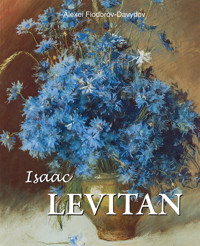
Isaac Levitan was one of the greatest landscape painters of the nineteenth century not only in Russian, but in European art as well. He created works of undying artistic merit. His art is for all time and for all people because it absorbed into itself the woes, the joys and the social realities of its age, because it converted that which men lived by into sublime works of art and translated the author’s emotions into lyrical images of his native land. At the end of the nineteenth century the landscape was one of the foremost genres in Russian painting. It was this influence that shaped Levitan’s art, an art fully and by right symbolic of the finest achievements of Russian landscape painting.
Das E-Book können Sie in Legimi-Apps oder einer beliebigen App lesen, die das folgende Format unterstützen:
Seitenzahl: 121
Veröffentlichungsjahr: 2019
Ähnliche




















Author: Alexei Fiodorov-Davydov
Layout:
Baseline Co. Ltd,
Vietnam
© Parkstone Press International, New York, USA
© Confidential Concepts, worldwide, USA
© Image-Barwww.image-bar.com
All rights reserved.
No part of this publication may be reproduced or adapted without the permission of the copyright holder, throughout the world. Unless otherwise specified, copyright on the works reproduced lies with the respective photographers, artists, heirs or estates. Despite intensive research, it has not always been possible to establish copyright ownership. Where this is the case, we would appreciate notification.
ISBN: 978-1-64461-879-0
Alexei Fiodorov-Davydov
Contents
HIS LIFE
LEVITAN AND HIS TIME
NOTES
LIST OF ILLUSTRATIONS
A
Above Eternal Rest, 1893-1894
After the Rain, Plyos, 1889
The Apiary, 1885
At the edge of the Mediterranean, 1890
At the Park, 1880
At the seaside. Crimea, 1886
At the water’s edge, early 1890s
Autumn day, Sokolniki, 1879
Autumn landscape with a church, 1890s
Autumn landscape with hunter, 1880
Autumn, 1896
B
Before the Thunderstorm, 1879
Before the Thunderstorm, 1889-1900
Birch Grove, 1885-1889
Boats, The Volga, 1889
C
Canal at Venice, (study), 1890
Cloudy Day. Stubble, 1890s
Cornflowers, 1894
Crimean Landscape, 1886
D
Deep Waters, 1892
Dusk. Moon, 1899
E
Early Spring, 1898
Evening Bells, 1892
Evening on the Volga, 1888
Evening, Boats on the Bank, late 1880s
Evening. Phyos the Golden, 1889
Evening. Train moving away, 1890s
F
Ferns in a forest, 1895
Field after Harvest
First greenery. May, (study), 1883
First greenery. May, 1888
Fog. Autumn, 1899
Forest. Sunny day,1883-1884
Fresh Wind, The Volga, 1895
G
Golden autumn. Hamlet, 1889
Gray Day, 1895
The Great Road Avenue of Birches, late 1897
H
The Haymaking, 1900
Haystacks. Twilight, 1899
High Waters, 1885
Horse-Drawn Sled in the Winter, 1860-1900
I
Illumination of the Kremlin, 1896
In the Holy Wood (Snegurocbka), 1885
In the Wild North, 1891
The Istra late afternoon, 1885
L
Lake Como, 1894
Lake. Barns on the edge of a wood (study), 1898-1899
The Lake. Rus,1899-1900
Landscape with a farm
Landscape with a River, undated
Last days of Autumn, 1894-1898
The last rays of the sun, 1899
Last Snow (study), 1895
Late Autumn, 1884-1888
Levitan. Late 1890s
M
March, 1895
Marsh at evening, 1882
May. The First Green (sketch), 1883
Meadow on the edge of a wood, 1898
Moonlit Night. Village, 1897
Mountain range, Mont Blanc (study)
Mountains. The Crimea, 1886
N / O
Near Bordiguera. Northern Italy, 1890
On the river Volga, 1888
Overgrown pond with grass, 1887
Overgrown pond, 1887
P
Path in the forest, 1881
Path, 1899
Q / R
Quiet Abode, 1890
Rainstorn, 1889
Ravine, 1898
S
Savinskaya Sloboda, 1884
Self-portrait, undated
Sheaves and a Village Beyond the River, 1881
Sheaves and a Village, 1881
The Silent Monestary, 1890
Snowbound Garden, 1880s
The Soura seen from the high bank, 1887
Spring Flood (sketch), c. 1897
Spring Flood, 1897
Spring in the forest, 1882
Spring time in italy, 1890
Stillness, 1898
Stormy Day, 1897
Summer evening. Fence, 1900
Sunny autumn day, 1897
Sunny Day, 1876-1877
Sunny day, 1898
Sunny day. Village, 1898
T
Trail in the forest. Ferns, circa 1895
Twilight, 1900
Twilight. Moon, 1899
V
Village Savvinskaya near Zvenigorod, 1884
The Vladimirka Road, 1892
Levitan. Late 1890s. Photography.
HIS LIFE
Isaak Levitan was one of the greatest landscape painters of the nineteenth century not only in Russian but in European art as well. He created works of undying artistic merit. His art is for all time and for all people because it absorbed into itself the woes, the joys and the social realities of its age because it converted that which men lived by into sublime works of art and translated the author’s emotions into lyrical images of his native land. At the end of the nineteenth century, the landscape was one of the foremost genres in Russian painting. It was this influence that shaped Levitan’s art, an art fully and by right symbolic of the finest achievements of Russian landscape painting.
Few materials pertaining to Levitan’s biography have survived. His personal archives (letters and probably documents too) were destroyed on his orders by his brother Adolf shortly before the artist’s death. Nonetheless, in broad outline, we know Levitan’s biography well enough. It is quite typical for an artist hailing from the lower-middle class (the raznochintsy) who paid his way through art school with “copper coins” and who achieved success and recognition on the strength of his talent alone but at the price of dire privation and gruelling toil.
Isaak Ilyich Levitan was born on August 30 (18 Old Style), 1860, in the little town of Kybartai (now Vilkaviskis District, Lithuanian SSR). His father was quite an educated man for his time who not only graduated from a rabbinical seminary but picked up a degree of secular education on his own as well, an education which, incidentally, included the mastery of German and French. This provided him with a living in Kovno (now Kaunas, Lithuanian SSR) where he gave private lessons and later worked as an interpreter for a French construction company then building a railway bridge in the vicinity.
At the beginning of the 1870s Ilya Levitan desirous, evidently, of finding more fertile fields for his abilities, moved with his family to Moscow. The large family (Isaak had an elder brother, Adolf, and two sisters) led a hand-to-mouth existence. For the young Levitan conditions became almost unbearable when his mother died in 1875 and his father two years later. The Moscow School of Painting, Sculpture and Architecture which Levitan entered in 1873 even waived his tuition “because of extreme poverty” and in recognition of his “singular success in art”. Levitan was homeless in Moscow, sleeping alternately in the homes of relatives or friends and sometimes even spending the night in the empty classrooms of the School. Now and then the School’s night watchman took pity on the youth and let him into his cubicle for the night; another watchman, who sold breakfasts on the side, would provide the lad with “up to five kopecks’ worth” of victuals on credit. Levitan’s good showing in the academic year of 1874-75 induced the School’s Board of Teachers to reward him with “a box of paints and brushes”. By that time the fledgeling artist was beginning to show a preference for landscape painting, and in the autumn of 1876, Alexei Savrasov took Levitan into his studio. In March 1877 two of Levitan’s canvases — Evening and Sunny Day. Spring — were displayed in the students’ section of the 5th Moscow Exhibition of the Society for Circulating Art Exhibitions, the largest and most influential creative association of realist artists in the country, active between 1870 and 1923 (also known as the Itinerants’ Society). Autumn Day.The Sokolniki Park, Levitan’s entry for his own School’s 2nd Students’ Exhibition of 1879-80, was purchased by Pavel Tretyakov, the founder of the Tretyakov Gallery in Moscow, which meant that the artist was beginning to achieve public recognition.
Sunny Day, 1876-1877. Oil on canvas, 53 x 40,7 cm. Private Collection.
Autumn day, Sokolniki, 1879. Oil on canvas, 63 x 50 cm. Galerie Tretiakov.
Before the Thunderstorm, 1879. Oil on canvas, 72 x 102 cm. Nizhy Novgorod State Art Museum.
Levitan’s years in the School coincided with its most fortunate period. Only towards the end of his studies there did a certain decline set in, but prior to that the School was referred to as the “Moscow Academy” and to a certain extent regarded as a counterbalance to the St Petersburg Imperial Academy of Arts in that the Moscow School was a freer and more progressive institution. Inside the School, the most advanced studio was Savrasov’s who believed implicitly in working in the open air and studying nature first hand. “Savrasov was blessed with an ability to arouse his pupils’ enthusiasm, and they, gripped by a passionate adoration of nature, banded into a closely-knit little group and worked tirelessly in the studio, at home and outdoors. With the first signs of spring, the whole studio would hurry out of town to admire amid the melting snows the beauty of reawakening life. When an oak flowered, Savrasov, elated, would run into the studio, announce the fact as though it were a momentous event and take his pupils out into the greening groves and fields again. The general animation prevented any of the studio’s pupils from getting their sleep, and the entire school looked on that studio with adoring eyes.”[1]
In addition to studying nature, Savrasov advised his pupils to draw on the experience of French plein-air painters of the Barbizon school whose works were long known and appreciated in Russia not only by artists but by collectors as well. Levitan used to copy the French pictures in the Tretyakov family’s collection, being particularly impressed with the painting of Corot.
The love of nature and the need to study it which Savrasov instiled in his pupils could not but be further strengthened by Vasily Polenov who joined the School’s staff in the autumn of 1882. At first, Polenov led a still-life class but soon took over the landscape studio too. Himself an excellent landscapist, one of the foremost Russian open-air artists in the second half of the nineteenth century, Polenov deeply influenced Levitan and his young contemporaries. He helped them develop a new approach to landscape painting, a new understanding of pleinairism. Levitan greatly admired Polenov’s Palestine studies, all superb examples of open-air painting, the first-ever instance in the history of Russian art of an on-Location sketch achieving the level of an independent work of art. At the Itinerant exhibition of 1885 Polenov’s Palestine studies produced an immense impression, contributing largely to the development of a new trend in landscape painting in the second half of the 1880s. Unfortunately, Levitan did not long profit from Polenov’s advice and guidance because in the autumn of 1883 the latter went abroad to do a series of open-air sketches for his painting Christ and the Woman Taken in Adultery. By that time Levitan, who had passed his examinations “in the sciences” for the fifth term and had two minor silver medals to his credit, naturally considered himself to have completed the School’s course and stopped attending classes. On Polenov’s return to Moscow, contacts between them were renewed, only now these were contacts between two artists of equal standing. In Polenov’s absence, the School’s Board rejected Levitan’s entry for the Big Silver Medal competition and the title of “commissioned artist” so that Levitan left the school with a diploma entitling him to work only as a teacher of art. His relations with the School were severed for many years to come, up to the day when he, by then a famous artist, again entered its doors as head of the landscape studio.
Autumn landscape with hunter, 1880. Oil on canvas, 93,8 x 68 cm. Kalinin art gallery, TVER.
Sheaves and a Village Beyond the River, 1881. Oil on canvas, 19,7 x 33,3cm. The State Russian Museum.
The Apiary, 1885. Oil on canvas, 51 x 38 cm. Private collection, Saint Petersburg.
Levitan’s creative endeavour coincided with a general upsurge in Russian artistic culture. The years of his formation as an artist — the first half of the 1880s — saw the creation of such masterpieces as Ivan Kramskoi’s Grief Inconsolable (1884), Ilya Repin’s Religious Procession in Kursk Province (1880-83) and Vasily Surikov’s The Boyarina Morozova (1881-87). Levitan developed as an Itinerant and was associated with the movement’s junior generation, the so-called “young Itinerants”. He was a contemporary of Mikhail Nesterov, Konstantin and Sergei Korovin, Alexei Stepanov, Vasily Baksheyev, and Abram Arkhipov. With some of them he studied together in the Moscow School of Painting, Sculpture and Architecture, with others, like Ilya Ostroukhov and Valentin Serov, he maintained friendly relations. Like Nesterov and Serov, Levitan was already beginning to evolve a new realism that went further than the realism on which he had been reared. Yet to the end of his days he did not break with the Itinerants, not even when he was exhibiting with the World of Art group. The World of Art (Mir Iskusstva), founded in the late 1890s, preached artistic individualism and “art for art’s sake”, but the work of its members often revealed realist tendencies. The new, emerging trend to which Levitan belonged should not, however, be identified with the World of Art, though in its early stages the society did attempt to draw into its orbit all that was young, novel and fresh.
That which Nesterov and Levitan aspired to was to a certain extent realised by the Union of Russian Artists, which came into being in 1903 and combined the traditions of the Itinerants with an interest in Impressionism. With all that, however, Nesterov never joined it, and it is doubtful whether Levitan would have either. Generally speaking, it would be incorrect to regard the evolution of Russian art at the turn of the century as a simple replacement of one trend, the Itinerant, by another, the World of Art school: this would be a gross oversimplification of the actual state of affairs. In the 1860s-1880s progressive art comprised a more or less integrated entity opposed to academism, a fact reflected in the creation of the Society for Circulating Art Exhibitions which was, in effect, the only major artistic association of the time and thus quite in tune with the tendencies then prevailing in Russian art.




