


16,99 €
Mehr erfahren.
- Herausgeber: John Wiley & Sons
- Kategorie: Fachliteratur
- Serie: Wiley Finance Series
- Sprache: Englisch
The recent turbulence in the global financial markets has drawn attention to an alternative system of financial intermediation: Islamic banking and finance, which has so far remained on the sidelines of the unrest.
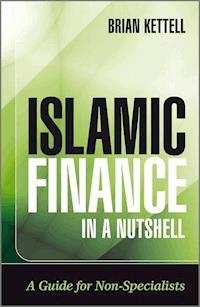
Islamic Finance in a Nutshell is a quick and easy guide to understanding the fundamentals of Islamic Finance and how the Islamic Financial markets work. Designed as a quick read for practitioners needing to pick up the basics of the industry, it will enable readers to understand the differences Islamic and Western finance.
Starting with the rise of Islamic finance, the book highlights the key areas which practitioners need to grasp to understand the marketplace including financial statement analysis, Sharia’a law, making money in the absence of interest and regulation. The book also provides readers with a basic guide to Arab terminology and a guide to the top financial institutions within the Islamic markets.
This is an ideal guide for anyone with an interest in how these financial markets work, but who do not want to be bogged down in complex and unnecessary terminology.
Sie lesen das E-Book in den Legimi-Apps auf:
Seitenzahl: 325
Veröffentlichungsjahr: 2011
Ähnliche















Contents
Cover
Half Title page
Title page
Copyright page
Introduction
What Is Islamic Banking?
Trends in Islamic Banking in Europe
While Islamic Finance Grows Rapidly in the GCC and Asia, What Is Its Prognosis in Europe?
The European Market Size and Scope
Customer Segmentation in Retail Islamic Banking
Islamic Banks: The Way Forward
Islamic Banks Going Forward: Challenges
Islamic Banks Going Forward: Solutions and Opportunities
Chapter 1: What Is Islamic Banking?
Conventional Bankers and Islamic Banking
So What Exactly Is Islamic Banking All about?
Chapter 2: If Islamic Banks Cannot Charge Interest
Murabaha Transactions
What Makes Murabaha Sharia’a Compliant?
Islam Treats Money and Commodities Differently
Sharia’a Rules Concerning Murabaha
Reasoning behind the Sharia’a Rules
Practical Examples of the Application of Murabaha
Comparison of Murabaha with Interest-Based Finance
Definition of Mudaraba
What Makes Mudaraba Sharia’a Compliant?
Sharia’a Rules Concerning Mudaraba
Practical Examples of Mudaraba
Comparison of Mudaraba with the Conventional Banking Equivalent
Definition of Musharaka
Sharia’a Rules Concerning Musharaka
Practical Examples of Musharaka
Comparison of Musharaka with the Conventional Banking Equivalent
Definition of Ijara
What Makes Ijara Sharia’a Compliant?
Practicalities of Implementing Ijara
Practical Examples of Ijara
What Are the Differences between an Ijara Lease Contract and a Conventional Lease?
Comparison of Ijara with the Conventional Banking Equivalent
Definition of Istisna’a
What Makes Istisna’a Sharia’a Compliant?
Practicalities of Implementing Istisna’a
Sharia’a Rules Concerning Istisna’a
Practical Examples of Istisna’a
Definition of Salam
Practicalities of Implementing Salam Contracts
Sharia’a Rules Concerning Salam
Parallel Salam: Opportunities and Complications
Comparison of Salam with the Conventional Banking Equivalent
Reference
Chapter 3: Sharia’a Law
What Is the Sharia’a?
Allah Is the Law Giver
The Sources of the Sharia’a
The Qur’an Is the Main Source of the Sharia’a
The Qur’an: the Primary Source of the Sharia’a
The Sunnah: The Secondary Primary Source of Sharia’a
What Is the Difference between the Qur’an and the Sunnah?
The Priority of the Qur’an Over the Sunnah
Ijma (consensus): The First Secondary Source of the Sharia’a
Qiyas (Analogical Reasoning): The Second Secondary Source of the Sharia’a
Chapter 4: Sharia’a Boards
What Are the Objectives of the Sharia’a?
Sharia’a: The Framework of Islamic Banking
Compliance with the Scheme of Sharia’a Laws
The Sharia’a Supervisory Board (SSB)
Function and Responsibilities
Sharia’a Boards: Roles and Scope of Responsibilities
Issues with the scholars
The Dubai Islamic Bank (DIB) Sharia’a Board
Qualifications Necessary to Become a Sharia’a Board Scholar
State Bank of Pakistan (SBP): Fit & Proper Criteria for Appointment of Sharia’a Advisors
Application of Sharia’a Principles to Banking and Investments
The Hadith on Eating Interest
Sharia’a Islamic Investment Principles
Sharia’a Conditions for Investment in Shares
Some Complications
Reference
Chapter 5: Financial Statement Analysis for Islamic Banks
Islamic Finance – The Background
Sources of Funds for Islamic Banks
Islamic Bank Current, Savings and Investment Accounts
Islamic Banking in the GCC
Appendix 5.1 Al Rajhi Banking and Investment Corporation
Appendix 5.2 Dubai Islamic Bank
Terminology
Appendix 5.3 Kuwait Finance House
Terminology
Appendix 5.4 Al Baraka Islamic Bank
Bank’s Share of Restricted Investment Accounts
Zakat
Earnings Prohibited by Sharia’a
Investment Risk Reserve (IRR)
Profit Equalisation Reserve (PER)
Return on Unrestricted Investment Accounts
Terminology
Appendix 5.5 Bahrain Islamic Bank
Chapter 6: The Islamic Banking Infrastructure
What Is the Role of the Financial Infrastructure?
The Islamic Financial Infrastructure
What Is the Ideal Islamic Infrastructure?
International Islamic Financial Infrastructure Institutions
What Are the Components of the Islamic Financial Infrastructure?
In Conclusion
Appendix 1: How Much Arabic Do You Need to Know to Work in the Islamic Banking Industry?
Appendix 2: The Top 500 Islamic Financial Institutions
Islamic Banking Crossword
Index
Islamic Finance in a Nutshell
Praise for Islamic Finance in a Nutshell
“This book provides an overview of Islamic banking as it’s being practiced, enabling the reader to understand the contours of the main instruments of Islamic banking. The first two chapters offer a concise and reader friendly description of the main contracts used by Islamic banks. In the third and fourth chapters, the author describes the sources of Sharia’a and the framework in which Islamic financial institutions are working.”
Muhammad Ayub, Director Research and Training, Riphah Center of Islamic Business, Riphah International University, Islamabad
“Brian Kettell has written a timely and important primer to Islamic finance. With conventional finance still groping towards a new paradigm in the wake of the financial crisis, Islamic finance presents, in many ways, a path to sounder banking practice. This book will arm newcomers to Islamic finance with the knowledge to ask the right questions and a key understanding of the fastest growing financial services sector in the world.”
Robin Amlôt, Managing Editor, Islamic Business & Finance
This edition first published by John Wiley & Sons Ltd in 2010
Copyright © 2010 Brian Kettell
Registered office John Wiley & Sons Ltd, The Atrium, Southern Gate, Chichester, West Sussex, PO19 8SQ, United Kingdom
For details of our global editorial offices, for customer services and for information about how to apply for permission to reuse the copyright material in this book please see our website at www.wiley.com
The right of the author to be identified as the author of this work has been asserted in accordance with the Copyright, Designs and Patents Act 1988.
All rights reserved. No part of this publication may be reproduced, stored in a retrieval system, or transmitted, in any form or by any means, electronic, mechanical, photocopying, recording or otherwise, except as permitted by the UK Copyright, Designs and Patents Act 1988, without the prior permission of the publisher.
Wiley also publishes its books in a variety of electronic formats. Some content that appears in print may not be available in electronic books.
Designations used by companies to distinguish their products are often claimed as trademarks. All brand names and product names used in this book are trade names, service marks, trademarks or registered trademarks of their respective owners. The publisher is not associated with any product or vendor mentioned in this book. This publication is designed to provide accurate and authoritative information in regard to the subject matter covered. It is sold on the understanding that the publisher is not engaged in rendering professional services. If professional advice or other expert assistance is required, the services of a competent professional should be sought.
ISBN 978-0-470-74861-9
A catalogue record for this book is available from the British Library.
Introduction
The ongoing turbulence in the global financial markets has drawn attention to an alternative system of financial intermediation, Islamic banking and finance. This sector has so far remained on the sidelines of the unrest. The sector has grown rapidly in recent years and this new found prominence has raised many questions as to what exactly is Islamic banking and how does it work. This short text, a nutshell, is designed to provide readers with an understanding of the central tenets of the industry.
Islam is not only concerned with the relationship between man and God but it is also a system of beliefs, justice, equity, fairness and morality, these being the values that underpin the entire Islamic way of life. These beliefs are governed by the body of Islamic principles generally referred to as Sharia’a, which is, not surprisingly, the basis for the creation of Islamic financial products.
Since the inception of Islamic banking, about three decades ago, the number and reach of Islamic financial institutions worldwide has risen significantly. Institutions offering Islamic financial services constitute a significant and growing share of the financial system in several countries. For example, the entire banking system of Iran is based on Islamic principles. Although Islamic banks are concentrated in the Middle East and Southeast Asia, there are also niche players in Europe and the United States. Islamic banking assets and assets under management are currently standing at over $800 billion. According to a recent study by a global management consulting firm, McKinsey, ‘The World Islamic Banking Competitiveness Report 2007/08: Capturing the Trillion Dollar Opportunity’, the value of Islamic banking assets and assets under management is expected to reach US$1 trillion by 2010, with Islamic banks growing more rapidly than the average banking sector in many countries.
The Islamic banking industry is in the midst of a phenomenal expansionary phase, exhibiting average annual growth rates of about 15 per cent in recent years. This rapid growth has been fuelled not only by surging demand for Sharia’a-compliant products from financiers from the Middle East and other Muslim countries, but also by investors around the world, thus rendering the expansion of Islamic finance a global phenomenon. Besides its wide geographical scope, the rapid expansion of Islamic finance is also taking place across the whole spectrum of financial activities, ranging from retail banking to insurance and capital market investments. But perhaps the most striking was the fast growth of sukuk (Islamic bonds), the most popular form of securitised credit finance within the industry. Sukuk issuance soared over the period 2001–2007 although it has fallen back more recently.
What Is Islamic Banking?
Sharia’a-compliant banking provides and uses financial services and products that conform to Islamic religious practices and laws which, in particular, prohibit the payment and receipt of interest. In practice, this means that instead of loans, Islamic banks use profit-and-loss sharing (PLS) arrangements, purchase and resale of goods and services, and the provision of services for fees. These principles all form the basis of Sharia’a-compliant contracts. In PLS modes, the rate of return on financial assets is not known or fixed prior to undertaking the transaction. In purchase-sale transactions, a mark-up is based on a benchmark rate of return, typically a return determined in international markets such as LIBOR (London Interbank Offered Rate, an internationally recognised reference interest rate).
Islamic banks also determine the return on deposits differently. In a commercial bank, the rate of return is set contractually (fixed in advance or tied to a reference rate) and does not directly depend on the bank’s lending performance. In an Islamic bank, the rate of return on a deposit is directly linked to the quality of the bank’s investment decisions. If the bank records profits then the depositor benefits. If, however, the bank records losses as a result of bad investments, depositors may lose some (or all) of their deposits. The contractual agreement between depositors and Islamic banks does not pre-determine any rates of return, it only sets the ratio according to which profits and losses are distributed between the parties to the deposit contract.
The fact that the Islamic banking model is different from the conventional model does not mean it is without risks. A majority of the relevant literature suggests that the risks posed by Islamic banks to the financial system differ in many ways from those posed by conventional banks. Risks unique to Islamic banks arise from the specific features of Islamic contracts, and the overall legal, governance, and liquidity infrastructure of Islamic finance. For example, PLS financing shifts the direct credit risk from banks to their investment depositors. But it also increases the overall degree of risk on the asset side of banks’ balance sheets, because it makes Islamic banks vulnerable to risks normally borne by equity investors rather than holders of debt.
In addition, because of their compliance with Sharia’a, Islamic banks can use fewer risk-hedging techniques and instruments (such as derivatives and swaps) than conventional banks. Moreover, most Islamic banks have operated in environments with less developed or non-existent interbank and money markets and government securities, and with limited availability of and access to lender-of-last-resort facilities operated by central banks. These differences have been reduced somewhat because of recent developments in Islamic money market instruments and Islamic lender-of-last-resort modes, and the more recent implicit commitment to provide liquidity support to all banks during exceptional circumstances in most countries.
In some ways, Islamic banks should be less risky than conventional banks. For example, Islamic banks are able to pass through a negative shock from the asset side (such as a worsened economic situation that causes lower cash flow from PLS transactions) to the investment depositors. The risk-sharing arrangements on the deposit side thus arguably provide another layer of protection to the bank, in addition to its book capital. Also, it could be argued that the need to provide a stable and competitive return to investors, the shareholders’ responsibility for negligence or misconduct (operational risk) and the more difficult access to liquidity put pressures on Islamic banks to be more conservative. Furthermore, because investors (depositors) share in the risks (and typically do not have deposit insurance), they have more incentive to exercise tight oversight over bank management. Finally, Islamic banks have traditionally held a larger proportion of their assets than commercial banks in reserve accounts with central banks or in correspondent accounts with other banks. So, even if Islamic investments are more risky than conventional investments, from a financial stability perspective, the question is whether or not these higher risks are offset by bigger buffers.
Trends in Islamic Banking in Europe
The UK has taken a major lead in Europe in promoting and encouraging Islamic banking activities but this has mainly focused on retail banking and only more recently on investment banking.
The Financial Services Authority (FSA), the UK banking regulator, has only authorised one Islamic retail bank, the Islamic Bank of Britain (IBB). Although other investors have looked into the retail banking arena, no other dedicated competitors have so far entered the retail market, mainly due to the level of investment required to acquire the critical mass of customers that are needed to ensure a retail bank is profitable.
The major hurdle for IBB and any new Islamic retail bank in the UK and Europe is creating banking products that are competitive with conventional products offered by other retail banks. Also, competitive product development provides opportunities for potential new entrants into the market to differentiate themselves and add competitive advantage against existing banks in the market.
More recently in the UK, there have been new Islamic investment banks authorised by the FSA including the European Islamic Investment Bank and the most recent entry, Gatehouse Bank. In total, there are five Islamic investment banks in the UK focusing on institutional investors in Europe and also looking to gain institutional funding from organisations in the Middle East. The Islamic investment banking sector in the UK has flourished enormously with other potential new entrants in the pipeline.
While Islamic Finance Grows Rapidly in the GCC and Asia, What Is Its Prognosis in Europe?
A considerable demand exists for Islamic banking products in Europe but to date, for a number of reasons including risk-aversion and conservatism, this need has gone largely unfulfilled.
The Islamic banking market continues to flourish around the world with current estimates suggesting that assets managed by Islamic banks are in excess of $800 billion – predominantly concentrated in the Middle East.
It is certainly a fact that there are sufficient Muslim investors and borrowers in both Islamic and non-Islamic countries to warrant the attention of traditional banks that seek to serve such clients and capture a potentially profitable slice of a still relatively untapped market. This is corroborated by the growth of Islamic finance in the US, which has a population of over 7 million Muslims.
The challenge for European financial institutions is how to leverage their banking knowledge and expertise in developing sufficient products and services that fulfil the requirements of their Islamic customer base whilst being compliant with Islamic finance principles.
The European Market Size and Scope
There are more than 15 million Muslims in Europe, of which 1.8 million are resident in the UK plus an additional 72 million in Turkey. There are 360,000 Muslim households in the UK alone.
The following table illustrates the potential market size in mainland Europe for an Islamic bank, as well as highlights the potential for extra-European expansion in countries such as Turkey.
Islamic banking in Europe will inevitably focus on both the retail and institutional customers as these are the two major dominant players in the market. As the table clearly illustrates there is a significant retail market opportunity in Europe for new retail banks, but in terms of sheer volume of transactions the institutional market provides the more lucrative opportunity for the Islamic banks.
Customer Segmentation in Retail Islamic Banking
Developing Sharia’a-compliant retail financial products can be complex, with a multitude of options available. Before embarking on such a route, it is paramount that the target customer base for the product is clearly defined and their needs and priorities are understood. As in European banking, where there is no ‘one size fits all’ approach to product development, the same can be said of Islamic banking, with an array of customer segments each with different product and service requirements as well as brand criteria.
In terms of products, a key differentiator between Islamic banking customer segments is the interpretation of what constitutes acceptable levels of Sharia’a compliance. The scale is divided between the more traditional and conservative customers on the one side, and those who seek higher levels of Islamic assurance on the other. Certain customer segments are willing to pay a premium for the most compliant Sharia’a products, whereas others will be more attracted to products that are only part Sharia’a compliant but offer a more competitive rate. Prior to designing a Sharia’a-compliant product concept, the requirements of the target customer segment should be clearly understood, and the resulting costs and benefits weighed.
In addition to the products, service requirement is another area that will differ between customer segments. Characteristics such as a customer’s age, education, lifestyle and desired relationship with the bank will determine these criteria. Delivering against these is a key element in the Islamic banking proposition and will differentiate banks, which otherwise might offer similar Sharia’a-compliant products.
Brand recognition is also a key factor that will differ between customer segments. Certain customer segments will only bank with brands that have a strong history and presence in Islamic countries, whereas other customer segments will be more willing to accept European brands with the right product and service propositions.
As with any new product development, prior to taking a Sharia’a-compliant product to market, the customer segments which form that market must be understood, their product, service and brand criteria defined, and the economic, technical and regulatory feasibility of delivering against them assessed. Only by doing this will banks be able to develop compelling propositions that provide the desired level of return.
Islamic Banks: The Way Forward
In the wider context, Islamic finance faces the perpetual challenge that it operates as a subset of conventional finance which is based on fundamentally different premisses. While this may be a limiting facet (in that Islamic financial institutions, for reasons of competitivity, must model their products after conventional models) Islamic financial institutions (IFIs) also have the capacity to innovate within this space. In a sense, the constraints can become boundaries that Islamic finance pushes against. Certainly, in the current context of well branded financial institutions failing the world over, IFIs should be able to showcase their own equitable forms of financing and risk sharing. This in turn may allow IFIs to influence the development of financial systems the world over.
In Europe, the UK is leading the charge to enact laws that embrace Islamic banking. It abolished double stamp duties that until recently hindered the purchase of a property under Islamic principles. The UK Government is reviewing other laws in order to soften the establishment and offering of Islamic banking products and naturally this has opened the doors for European banks to further their focus in this market.
In 2005, Lloyds TSB launched services that provided Sharia’a-compliant banking products to its existing retail customer base but, many argued, these products were merely white labelling an existing limited product range, and thus not competitive compared to conventional retail banking offerings in the UK. This was the first major activity from a European bank in this market and has encouraged other banks to evaluate their strategy and to take a closer look at the potential for this market.
European banks need to incorporate various aspects of traditional banking with Islamic banking concepts in order to fully capture the Islamic market in Europe. While being compliant with Islamic principles may initially be seen as a hurdle, the potential return and increase in customer base will inevitably outweigh any financial investments and commitments made by the bank.
Islamic Banks Going Forward: Challenges
The continuing rapid growth of demand for Islamic financial services is clearly good news for Islamic banks. At the same time, it also presents a variety of challenges. The banks need to invest in upgrading their credit risk management capabilities in line with the more complex and larger projects into which they are entering.
Despite the rapid growth, business models and products of Islamic banks are still rather homogeneous, while Sharia’a compliance amplifies risks stemming from product configuration and process implementation. The success of Islamic banking in recent years has produced too many Islamic banks with the same business model.
In addition, there is a large and diverse set of accounting standard differences across different jurisdictions. The development and setting of simple standard legal contracts is necessary in order to overcome the complexity and heterogeneity of current contracts. Furthermore, the deployment of IT systems that help monitor the fulfilment and visibility of processes on an end-to-end basis is crucial to facilitate the continuous monitoring of activities by Sharia’a scholars while eliminating the possibilities of non-compliance, which in some cases might render transactions invalid.
Liquidity risk management of Islamic banks is an important challenge and is constrained due to limited availability of tradable Islamic money market instruments and weak systemic liquidity infrastructure. At the moment, there is no Sharia’a-compliant short-term Islamic money market (less than one week maturity) in local currency or in US dollars, and Islamic repo markets have not yet developed. Islamic money markets with longer maturities, which are based on commodity Murabaha transactions (mark-up financing), sometimes suffer from unreliable brokers with low creditworthiness. Islamic banks also have a competitive disadvantage with conventional banks, as they deposit their overnight money with their domestic central bank interest free. The lack of liquidity and viable alternatives, combined with the competitive disadvantage, hamper the local Islamic banks and can even create a liquidity crisis.
Islamic Banks Going Forward: Solutions and Opportunities
Both risk managers and regulators are working to address the above challenges. To overcome the shortcomings of the Islamic money market, many investment banks are currently designing new complex products, compliant with Sharia’a law. It remains to be seen whether these new solutions will obtain widespread Sharia’a-compliant status in the Islamic finance community, and generate enough demand for a functional Islamic money market to develop.
Rapid developments are likely to continue. Financial institutions in countries such as Bahrain, the UAE and Malaysia have been gearing up for more Sharia’a-compliant financial instruments and structured finance – on both the asset and liability sides. At the same time, the leading financial centres, such as London, New York and Singapore, are making significant progress in establishing the legal and prudential foundations to accommodate Islamic finance side-by-side with the conventional financial system. Many of the largest Western banks, through their Islamic windows, have become active and sometimes leading players in financial innovation, through new Sharia’a-compliant financial instruments that attempt to alleviate many of the current constraints such as a weak systemic liquidity infrastructure. More conventional banks are expected to offer Islamic products, enticed by enormous profit opportunities, especially across the Middle East.
New product innovation is also driven by domestic banks’ interest in risk diversification. With a large number of new Islamic banks across the Middle East and Asia especially, diversification of products enables banks to offer a differentiated product mix to more sophisticated clients. A few banks are already active across different jurisdictions, and this trend is certainly going to continue in the near future, possibly with some consolidation.
On the regulatory front, the Islamic Financial Services Board (IFSB), an international standard-setting organisation based in Malaysia, has moved ahead with its efforts aimed at fostering the soundness and stability of the Islamic financial services industry through more standardised regulation. Globally accepted prudential standards have been adopted by the IFSB. These are designed to smoothly integrate Islamic finance with the conventional financial system. For instance, the adoption of the IFSB standards (somewhat akin to Basel II), which take into account the specificities of Islamic finance, ensures a level playing field between Islamic and conventional banks.
Chapter 1
What Is Islamic Banking?
Conventional Bankers and Islamic Banking
Ask a conventional banker exactly what is Islamic banking. He will mumble something about religion. He will then say well they cannot charge interest but they use something else which is the same thing. This ‘something else’, incidentally, is never defined. He will then move on to describe Islamic banking as being about smoke and mirrors. To conclude he will then profoundly announce that, with a few tweaks, it is what he does every day anyway. And that is the end of it.
If you push him to actually describe an Islamic financial instrument, and even worse if you actually use some Islamic terminology, Murabaha, Mudaraba etc, then his eyes will start to glaze over.
Frankly this stereotyped image is all too prevalent within the conventional banking world. In an endeavour to both enlighten conventional bankers and to broaden the understanding of Islamic banking principles this chapter will go back to basics and will highlight the key characteristics of Islamic banking which differentiate it from conventional banking.
As you will learn, Islamic banking is not about smoke and mirrors. It is in fact about banking based on Islamically-ethical principles which are, in many ways, very different indeed from conventional banking principles.
Islamic banking is not about smoke and mirrors
So What Exactly Is Islamic Banking All about?
Islamic financial institutions are those that are based, in their objectives and operations, on Qur’anic principles. They are thus set apart from ‘conventional’ institutions, which have no such religious preoccupations. Islamic banks provide commercial services which comply with the religious injunctions of Islam. Islamic banks provide services to their customers free from interest (the Arabic term for which is riba), and the giving and taking of interest is prohibited in all transactions. This prohibition makes an Islamic banking system differ fundamentally from a conventional banking system.
Technically, riba refers to the addition in the amount of the principal of a loan according to the time for which it is loaned and the amount of the loan. In earlier historical times there was a fierce debate as to whether riba relates to interest or usury, although there now appears to be a consensus of opinion among Islamic scholars that the term extends to all forms of interest.
The term riba, in Islamic law (the Sharia’a), means an addition, however slight, over and above the principal. According to the Federal Sharia’a Court of Pakistan, this means that the concept covers both usury and interest; that it applies to all forms of interest, whether large or small, simple or compound, doubled or redoubled; and that the Islamic injunction is not only against exorbitant or excessive interest, but also against even a minimal rate of interest. Financial systems based on Islamic tenets are therefore dedicated to the elimination of the payment and receipt of interest in all forms. It is this taboo that makes Islamic banks and other financial institutions different, in principle, from their Western conventional counterparts.
Financial systems based on Islamic tenets are therefore dedicated to the elimination of the payment and receipt of interest in all forms
There are a range of modern interpretations of why riba is considered haram (forbidden) but these are strictly secondary to the religious underpinnings.
The fundamental sources of Islam are the Holy Qur’an and the Sunnah, a term which in Ancient Arabia meant ‘ancestral precedent’ or the ‘custom of the tribe’, but which is now synonymous with the teachings and traditions of the Prophet Muhammad as transmitted by the relaters of authentic tradition (hadith). Both of these sources treat interest as an act of exploitation and injustice and, as such, it is inconsistent with Islamic notions of fairness and property rights. While it is often claimed that there is more than this to Islamic banking, such as its contribution towards economic development and a more equitable distribution of income and wealth, its increased equity participation in the economy, etc, Islamic banking nevertheless derives its specific raison d’être from the fact that there is no place for the institution of interest in the Islamic order.
This rejection of interest poses the central question of what replaces the interest rate mechanism in an Islamic framework. Financial intermediation is at the heart of modern financial systems. If the paying and receiving of interest is prohibited, how do Islamic banks operate? Here profit-and-loss sharing (PLS) principles come in, substituting profit-and-loss sharing for interest as a method of resource allocation and financial intermediation.
The basic idea underlying Islamic banking can be stated simply. The operations of Islamic financial institutions primarily are based on a profit-and-loss-sharing (PLS) principle. An Islamic bank does not charge interest but rather participates in the yield resulting from the use of funds. The depositors also share in the profits of the bank according to a predetermined ratio. There is thus a partnership between the Islamic bank and its depositors, on the one side, and between the bank and its investment clients, on the other side, as a manager of depositors’ resources in productive uses. This is in contrast with a conventional bank, which mainly borrows funds, paying interest on one side of the balance sheet, and lends funds, charging interest, on the other. The complexity of Islamic banking comes from the variety (and nomenclature) of the instruments employed, and in understanding the underpinnings of Islamic law.
An Islamic bank does not charge interest but rather participates in the yield resulting from the use of funds
Six key principles drive the activities of Islamic banks. These are:
1.the prohibition of predetermined loan repayments as interest (riba);
2.profit-and-loss sharing is at the heart of the Islamic system;
3.making money out of money is unacceptable. All financial transactions must be asset-backed;
4.prohibition of speculative behaviour;
5.only Sharia’a-approved contracts are acceptable;
6.the sanctity of contracts.
These principles, as applied to Islamic banking and finance, are set out below.
1 Predetermined Payments Are Prohibited
Any predetermined payment over and above the actual amount of principal is prohibited. Islam allows only one kind of loan and that is qard al hassan (literally ‘good loan’) whereby the lender does not charge any interest or additional amount over the money lent. Traditional Muslim jurists have construed this principle so strictly that, according to one Islamic scholar, “the prohibition applies to any advantage or benefits that the lender might secure out of the qard (loan) such as riding the borrower’s mule, eating at his table, or even taking advantage of the shade of his wall”. The principle derived from the quotation emphasises that any associated or indirect benefits which could potentially accrue to the lender are also prohibited.
2 Profit-and-Loss Sharing
The principle here is that the lender must share in the profits or losses arising out of the enterprise for which the money was lent. Islam encourages Muslims to invest their money and to become partners in order to share profits and risks in the business, instead of becoming creditors. Islamic finance is based on the belief that the provider of capital and the user of capital should equally share the risk of business ventures, whether these are manufacturing industries, service companies or simple trade deals. Translated into banking terms, the depositor, the bank and the borrower should all share the risks and the rewards of financing business ventures.
This is unlike the interest-based commercial banking system, where all the pressure is on the borrower: he must pay back his loan, with the agreed interest, regardless of the success or failure of his venture.
The principle, which thereby emerges, is that in order to try and ensure investments are made into productive enterprises Islam encourages these types of investments in order that the community may ultimately benefit. However, Islam is not willing to allow a loophole to exist for those who do not wish to invest and take risks but rather are intent on hoarding money or depositing money in a bank in return for receiving interest (riba) on these funds for no risk (other than the bank becoming insolvent).
Accordingly, under Islam, either people invest with risk or suffer loss by keeping their money idle. Islam encourages the notion of higher risks and higher returns and promotes it by leaving no other avenue available to investors. The objective here is that high-risk investments provide a stimulus to the economy and encourage entrepreneurs to maximise their efforts to make them succeed, with appropriate benefits to the community.
Risk-Sharing
As mentioned above one of the most important features of Islamic banking is that it promotes risk-sharing between the providers of funds (investors) and the user of funds (entrepreneurs). By contrast, under conventional banking, the investor is assured of a predetermined rate of interest.
In conventional banking, all the risk is borne by the entrepreneur. Whether the project succeeds and produces a profit or fails and produces a loss, the owner of capital is still rewarded with a predetermined return. In Islam, this kind of unjust distribution is not allowed. In pure Islamic banking both the investor and the entrepreneur share the results of the project in an equitable way. In the case of profit, both share this in pre-agreed proportions. In the case of loss, all financial loss is borne by the capital supplier with the entrepreneur being penalised by receiving no return (wages or salary) for his endeavours.
Emphasis on Productivity As Compared to Creditworthiness
Under conventional banking, almost all that matters to a bank is that its loan and the interest thereon are paid on time. Therefore, in granting loans, the dominant consideration is the creditworthiness of the borrower. Under profit-and-loss sharing (PLS) banking, the bank will receive a return only if the project succeeds and produces a profit. Therefore, it is reasoned, an Islamic bank will be more concerned with the soundness of the project and the business acumen and managerial competence of the entrepreneur.
3 Making Money Out of Money Is Not Acceptable
Making money from money is not Islamically acceptable. Money, in Islam, is only a medium of exchange, a way of defining the value of a thing. It has no value in itself, and therefore should not be allowed to generate more money, via fixed interest payments, simply by being put in a bank or lent to someone else.
The human effort, initiative, and risk involved in a productive venture are more important than the money used to finance it. Muslim jurists consider money as potential capital rather than capital, meaning that money becomes capital only when it is invested in business. Accordingly, money advanced to a business as a loan is regarded as a debt of the business and not capital and, as such, it is not entitled to any return (i.e. interest).
Muslims are encouraged to spend and/or invest in productive investments and are discouraged from keeping money idle. Hoarding money is regarded as being Islamically unacceptable. In Islam, money represents purchasing power, which is considered to be the only proper use of money. This purchasing power (money) cannot be used to make more purchasing power (money) without undergoing the intermediate step of being used for the purchase of goods and services.
4 Uncertainty Is Prohibited
Gharar (uncertainty, risk or speculation) is also prohibited.
Under this prohibition any transaction entered into should be free from uncertainty, risk and speculation. Contracting parties should have perfect knowledge of the counter values (goods received and/or prices paid) intended to be exchanged as a result of their transactions. Also, parties cannot predetermine a guaranteed profit. This is based on the principle of ‘uncertain gains’ which, on a strict interpretation, does not even allow an undertaking from the customer to repay the borrowed principal plus an amount designed to take into account inflation. The rationale behind the prohibition is the wish to protect the weak from exploitation. Therefore, options and futures are considered as un-Islamic and so are forward foreign exchange transactions, given that forward exchange rates are determined by interest rate differentials.
5 Only Sharia’a-Approved Contracts Are Acceptable
Conventional banking is secular in its orientation. In contrast, in the Islamic system, all economic agents have to work within the moral value system of Islam. Islamic banks are no exception. As such, they cannot finance any project which conflicts with the moral value system of Islam. For example, Islamic banks are not allowed to finance a distillery, a casino, a night club or any other activity which is prohibited by Islam or is known to be harmful to society.
6 Sanctity of Contracts
Many verses in the Holy Qur’an encourage trade and commerce, and the attitude of Islam is that there should be no impediment to honest and legitimate trade and business. It is a duty for Muslims to earn a living, support their families and give charity to those less fortunate.
Just as Islam regulates and influences all other spheres of life, so it also governs the conduct of business and commerce. Muslims have a moral obligation to conduct their business activities in accordance with the requirements of their religion. They should be fair, honest and just towards others. A special obligation exists upon vendors as there is no doctrine of caveat emptor in Islam. Monopolies and price-fixing are prohibited.
The basic principles of commercial Sharia’a law are laid down in four root transactions:
1.sales (bai), transfer of the ownership or corpus of property for a consideration;
2.hire (Ijara), transfer of the usufruct (right to use) of property for a consideration;
3.gift (hiba), gratuitous transfer of the corpus of property; and
4.loan (ariyah), gratuitous transfer of the usufruct of property.
These basic principles are then applied to the various specific transactions of, for example, pledge, deposit, guarantee, agency, assignment, land tenancy, waqf foundations (religious or charitable bodies) and partnerships.
Islam upholds contractual obligations and the disclosure of information as a sacred duty. This feature is intended to reduce the risk of asymmetric information and moral hazard. This is potentially a major problem for Islamic banks, and is discussed below.
What Is Asymmetric Information?
This can be defined as information that is known to one party in a transaction but not to the other.
The classical issue here is that some sellers with inside information about the quality of an asset will be unwilling to accept the terms offered by a less informed buyer. This may cause the market to break down, or at least force the sale of an asset at a price lower than it would command if all buyers and sellers had full information. This is known as the ‘lemon market’ problem in valuation. A lemon, in this context, refers to a poor quality asset.




