


Erhalten Sie Zugang zu diesem und mehr als 300000 Büchern ab EUR 5,99 monatlich.
- Herausgeber: Van Haren Publishing
- Kategorie: Fachliteratur
- Sprache: Englisch
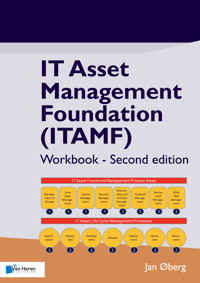
IT Asset Management Foundation (ITAMF) is a certification that validates a professional’s knowledge on managing the IT assets as part of an organization’s strategy, compliance and risk management. The content covered by the certification is based upon the philosophy of ITAMOrg, a membership organization and thought leader in IT Asset Management. The certificate IT Asset Management Foundation is part of the ITAMOrg qualification program and has been developed in cooperation with international experts in the field. This workbook will help you prepare for the IT Asset Management Foundation (ITAMF) exam and provides you with an overview of the four key areas of IT Asset Management: • Hardware Asset Management, including ‘mobile devices’; • Software Asset Management; • Services & Cloud Asset Management; • People & Information Asset Management, including ‘Bring Your Own Device’ (BYOD).
Sie lesen das E-Book in den Legimi-Apps auf:
Seitenzahl: 115
Veröffentlichungsjahr: 2020
Das E-Book (TTS) können Sie hören im Abo „Legimi Premium” in Legimi-Apps auf:
Ähnliche


















IT Asset Management Foundation (ITAMF) Workbook - Second edition
Other publications by Van Haren Publishing
Van Haren Publishing (VHP) specializes in titles on Best Practices, methods and standards
within four domains:
- IT and IT Management
- Architecture (Enterprise and IT)
- Business Management and
- Project Management
Van Haren Publishing is also publishing on behalf of leading organizations and companies: ASLBiSL Foundation, BRMI, CA, Centre Henri Tudor, CATS CM, Gaming Works, IACCM, IAOP, IFDC, Innovation Value Institute, IPMA-NL, ITSqc, NAF, KNVI, PMI-NL, PON, The Open Group, The SOX Institute.
Topics are (per domain):
IT and IT Management
ABC of ICT
ASL®
CMMI®
COBIT®
e-CF
ISO/IEC 20000
ISO/IEC 27001/27002
ISPL
IT4IT®
IT-CMFTM
IT Service CMM
ITIL®
MOF
MSF
SABSA
SAF
SIAMTM
TRIM
VeriSMTM
Enterprise Architecture
ArchiMate®
GEA®
Novius Architectuur
Methode
TOGAF®
Business Management
BABOK ® Guide
BiSL® and BiSL® Next
BRMBOKTM
BTF
CATS CM®
EFQM
eSCM
IACCM
ISA-95
ISO 9000/9001
OPBOK
SixSigma
SOX
SqEME®
Project Management
A4-Projectmanagement
DSDM/Atern
ICB / NCB
ISO 21500
MINCE®
M_o_R®
MSP®
P3O®
PMBOK ® Guide
Praxis®
PRINCE2®
For the latest information on VHP publications, visit our website: www.vanharen.net.
Colophon
Title:
IT Asset Management Foundation (ITAMF) – Workbook Second edition
Author:
Jan Øberg
Publisher:
Van Haren Publishing, ’s-Hertogenbosch-NL, www.vanharen.net.
ISBN Hard copy:
978 94 018 0716 6
ISBN eBook (pdf):
978 94 018 0717 3
ISBN ePUB:
978 94 018 0718 0
Edition:
Second edition, first impression, November 2020
Layout and Design:
Coco Bookmedia, Amersfoort-NL
Copyright:
© ITAMOrg and Van Haren Publishing, 2014, 2020
For more information about Van Haren Publishing, email us at: [email protected].
Copyright Notices
ITIL® is a registered trademark of AXELOS Limited.
ISO® is a registered trademark of the International Organization for Standardization.
COBIT® is a registered trademark of ISACA (previously known as the Information Systems Audit and Control Association).
No part of this publication may be reproduced in any form including printing, photocopying, microfilm or any other means without written permission by the publisher.
Although this publication has been compiled with great care, neither the author(s) nor the publisher accepts any liability for damages caused by any errors and/or imperfections in this publication.
List of figures and diagrams
Introduction
1 INTRODUCTION TO IT ASSET MANAGEMENT (ITAM)
1.1 Definition and goal of ITAM
1.2 Standards and best practicEs
1.3 ITAM models
Exam preparation: Chapter 1
2 HARDWARE ASSET MANAGEMENT (HAM)
2.1 Introduction to HAM
2.2 Identification and management of hardware assets
2.3 Best practices, tools and mobile devices
Exam preparation: Chapter 2
3 SOFTWARE ASSET MANAGEMENT (SAM)
3.1 Definition and objectives of SAM
3.2 The concept of compliance
3.3 The risks and costs related to software audits
Exam preparation: Chapter 3
4 SERVICES AND CLOUD ASSET MANAGEMENT (SEAM)
4.1 Definition and objectives of SEAM
4.2 The concept of Services and cloud computing
4.3 The practice of SEAM
4.4 Contracts and contract negotiation in SEAM
Exam preparation: Chapter 4
5 PEOPLE AND INFORMATION ASSET MANAGEMENT (PINAM)
5.1 Definition and objectives of PINAM
5.2 The guiding principles of PINAM
5.3 The practice of PINAM
5.4 Services and cloud: BYOD (Bring Your Own Device)
Exam preparation: Chapter 5
6 IT ASSET MANAGEMENT INTERFACES
6.1 The interfaces of IT Asset Management
6.2 IT Asset Management roles
Exam preparation: Chapter 6
Appendix A List of basic concepts
Appendix B About ITAMOrg
Appendix C Answer Key
Figure 1. The ITAM lifecycle
Figure 2. Positioning of ITAM
Figure 3. ITAM ECO system stakeholder map
Figure 4. The ITAM ‘Bermuda Triangle’
Figure 5. ITAM best practices
Figure 6. ITAM requirements for the management of assets
Figure 7. ITAM basic management system
Figure 8. ITAM process framework
Figure 9. The HAM lifecycle
Figure 10. Hardware Asset Management stakeholders
Figure 11. The hardware lifecycle process
Figure 12. SAM stakeholder map
Figure 13. SAM implementation roadmap
Figure 14. SAM tiered approach
Figure 15. SEAM ‘Triple Play’
Figure 16. SEAM lifecycle
Figure 17. SEAM and the worlds of the internal and external IT provider
Figure 18. PINAM and the other ITAM areas
Figure 19. PINAM areas for attention
Figure 20. ITAM ECO system and alignment
Figure 21. ITAM interface approach
Figure 22. IT Asset Manager’s central role
Figure 23. Daily operations involving assets
Figure 24. IT Asset Manager challenges
Figure 25. Challenges of related roles
IT Asset Management Foundation (ITAMF) is a certification that validates a professional’s knowledge on managing the IT assets as part of an organization’s strategy, compliance and risk management. The content covered by the certification is based upon the philosophy of ITAMOrg, a membership organization and thought leader in IT Asset Management.
The certificate IT Asset Management Foundation is part of the ITAMOrg qualification program and has been developed in cooperation with international experts in the field.
This workbook will help you prepare for the IT Asset Management Foundation (ITAMF) exam and provides you with an overview of the four key areas of IT Asset Management: Hardware Asset Management, including ‘mobile devices’; Software Asset Management; Services & Cloud Asset Management and People & Information Asset Management, including ‘Bring Your Own Device’ (BYOD).
The exam consists of 40 multiple choice questions with a pass mark of 65%. In this workbook, you will find several sample multiple choice questions, and to help increase your knowledge about IT Asset Management we have also included so-called ‘get it’ questions. You will find these questions at the end of each chapter. The exam requirements are specified at the beginning of each chapter, and the weight of the different exam topics is expressed as a percentage of the total.
ITAMOrg exam context
Source: ITAMOrg IT Asset Management Foundation preparation guide
Target group
IT Asset Management Foundation is intended for all key personnel in the organization involved in the IT lifecycle. Whilst this certification has an IT focus, it has been specifically designed for non-IT personnel in mind.
Specific roles/responsibilities could include (but are not limited to):
◾ General/business management
◾ IT manager
◾ Procurement manager
◾ Financial manager
◾ IT operations manager
◾ Project manager
◾ Process manager
◾ Contract manager
◾ Risk manager
◾ Business continuity manager
◾ Security manager
Competencese-Competence Framework (e-CF)
Introduction to IT Asset Management (ITAM): Exam requirements
1. Introduction to IT Asset Management (ITAM)
10%
1.1 Definition and goal of ITAM
1.2 Standards and best practices
1.3 ITAM models
◾ 1.1 DEFINITION AND GOAL OF ITAM
1.1.1 Defining ITAM
Information Technology Asset Management (ITAM) is the strategic management of IT-related assets throughout their lifecycles and is compiled of several best practice and business practices.
Figure 1. The ITAM lifecycle
ITAM is a set of business practices aligning financial, contractual and inventory areas to support the strategic decisions for the IT environment.
IT assets are all aspects of Technologies: software, hardware, people and information (documentation such as contracts and services) used in a business.
Information Technology Asset Management (ITAM) is divided in four key areas:
Hardware Asset Management (HAM): Management of the physical components of computers, mobile devices and networks from acquisition, implementation, process adjustments, deployment to disposal.
Software Asset Management (SAM): Managing the complete lifecycle of every software asset, involving cost control, documentation, licensing, redistribution, maintenance, etc.
Service and Cloud Asset Management (SEAM): SEAM is the management of the multiple platforms across physical, virtual and cloud environments with respect to the organizational needs in terms of storage, data protection, policies and availability.
People & Information Asset Management (PINAM): This discipline regards both people and information (data) as assets. The management of People and Information refers to data security, access policies and best practices with regard to knowledge and information sharing.
Figure 2. Positioning of ITAM
In the IT Asset Management ECO system, the best practice process framework closest to IT Asset Management (ITAM) is IT Service Management (ITSM: i.e. ITIL® & ISO/IEC 20000).
1.1.2 The purpose and objectives of ITAM
The four key objectives of IT Asset Management are value creation, alignment, leadership and assurance.
Value creation
Principles that support staying in compliance, i.e. ‘avoiding value destruction’ are: risk management, effectiveness, efficiency, value innovation and avoiding disruptive change.
Leadership
Principles that support leadership are: promoting a positive workplace culture, define clear roles and responsibilities (including matching authorities), creating awareness and involvement of all stakeholders.
Assurance
It needs to be made clear that assets fulfill a purpose and are connected to organizational objectives. This must be supported by implementing proper processes, embracing the principle of continual improvement and providing necessary resources.
Alignment
Alignment is made possible by creating an IT Asset Management ECO system. The best practice process framework that is closest to ITAM, and has many overlap areas with ITAM is IT Service Management (ITSM).
Benefits
The benefits of Information Technology Asset Management are:
◾ Improving the efficiency of existing resources;
◾ Financial management of IT assets;
◾ Information security;
◾ Compliance with legislation, regulations and standards;
◾ Creating awareness of IT business and strategy;
◾ Enable knowledge and decision making based on up-to-date information;
◾ Goals, motivations and drivers of in- and external stakeholders.
ITAM stakeholders: who needs to be involved?
For ITAM to become successful it is key to involve stakeholders across the organization, and on all levels. Examples of ITAM stakeholders are: business and IT management, legal and commercial, procurement, the financial department, IT operations and ‘last but not least’ end-users. Creating awareness and sharing knowledge with all stakeholders is indispensable. There also needs to be a good balance between the IT asset strategy and the needs of the organization. ITAM helps to overcome typical issues, such as having no long-time planning causing unnecessary expenses.
Figure 3. ITAM ECO system stakeholder map
Apart from all internal stakeholders mentioned above there are also various external stakeholders. Modern organizations are not isolated from the world. Apart from the obvious ones such as vendors and customers we also need to consider (local) government (general legislation) and governmental authorities governing all kinds of regulations. Furthermore, society has expectations with regard of the environment and social entrepreneurship. Figure 3 provides a concise map of stakeholders.
The ‘Bermuda Triangle’ of ITAM
In the section above we have seen that cooperation between stakeholders is a crucial aspect of ITAM. Another one is maintaining a balance between Requests, Purchasing and Deployment of assets. In ITAM this is called the ‘Bermuda Triangle’. The three areas mentioned here are governed by different departments or stakeholders, each with their own objectives and needs. When ITAM does not control the interaction between the three, a nasty storm may start brewing within the organization and ‘sink’ the ITAM ship
Table 1. Stakeholder roles and responsibilities (summary)
Stakeholder
Focus areas
Society
Legislation, regulations, directives, environment
Board of directors / corporate governance
Owners/shareholders, strategy/mission/vision, long term business planning, business value, financial, corporate governance
Management
Budgets/specific financial goals, implementation of strategy, process governance
Finance/purchase
Planning and controls of costs, budgets, financial forecasts, day-to-day financial processes, contacts negotiations and agreements
Legal
Legal management of contracts, ensuring adherence to regulations and directives, management of IPR
End-users
Users of IT and other business resources who wish to realize business goals and value. These stakeholders demand more from IT than in the past; e.g. Unified Communications And Collaboration (UCAC) and Bring Your Own Device (BYOD)
IT
IT strategy and planning, IT process management, IT service portfolio
Customers
Requirements: Privacy and data protection, user friendly solutions, value-for-money, service support
Partners
Data sharing, information security
Vendors/distributors
Sales of (supporting) solutions
Publishers
Copyright, licensing, IPR
Figure 4. The ITAM ‘Bermuda Triangle’
Different instruments can help ITAM to maintain control such as: a predefined IT catalogue, service portfolios, a well-maintained CMDB to ensure new introductions do not negatively affect the existing infrastructure, purchasing policies and procedures, management of licenses, etc.
◾ 1.2 STANDARDS AND BEST PRACTICES
Figure 5. ITAM best practices
1.2.1 ITAM best practices and related international standards
ISO/IEC 19770 family
Information technology - Software asset management & IT asset management.
Parts of the 19770 family:
◾ 19770-1: Processes and Tiered Assessment of Conformance; establishes a baseline for an integrated set of processes for Software Asset Management (SAM), divided into tiers to allow for implementing them and achieving recognition.
◾ 19770-2: Software Identification Tag; establishes specifications for tagging software to optimize its identification and management.
◾ 19770-3: Software Entitlement Tag; establishes a set of terms and definitions which may be used when discussing software entitlements (an important part of software licenses). It also provides specifications for a transport format which enables the digital encapsulation of software entitlements, including associated metrics and their management.
◾ 19770-5: Introduction and Vocabulary; provides an overview of the ISO/IEC 19770 family of standards, an introduction to IT asset management (ITAM) and software asset management (SAM), a brief description of the foundation principles and approaches on which SAM is based, and consistent terms and definitions for use throughout the ISO/IEC 19770 family of standards.
Other parts are presently under construction, and ISO.org has also launched a self-assessment tool for software asset management. (Source: ISO.org)
ISO 55000
Asset management - Overview, principles and terminology.
◾ ISO 55000 is the first set of International Standards for Asset Management.
◾ Enables an organization to achieve its objectives through an efficient, consistent and sustainable management of its assets.
◾ Provides an overview of asset management, its principles and terminology, and the expected benefits from adopting asset management.
IT Service Management (ITSM) best practice ITIL
◾ The most widely accepted approach to IT service management in the world.
◾ Provides a cohesive set of best practices, drawn from the public and private sectors internationally.
◾ Aligns IT services with the needs of business through a set of practices each covering an area of the service management lifecycle.
◾ Allows the organization to establish a baseline from which it can plan, implement and measure.
ISO/IEC 20000
ITIL is mapped in ISO/IEC 20000. This ISO standard recognizes the way that ITIL can be used to meet the requirements set out for the ISO/IEC 20000 certification and the interdependent nature with ITIL.




