


9,99 €
Mehr erfahren.
- Herausgeber: Profondo Rosso
- Kategorie: Geisteswissenschaft
- Sprache: Englisch
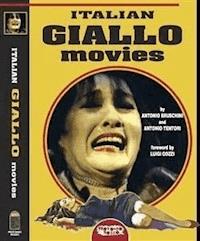
“Giallo” is the Italian word for “yellow” and this GIALLO term was used in the 1930s to describe the mystery-thriller novels published in Italy that were bound in instantly recognisable yellow covers. But this same GIALLO term has also been used from the early 1970s to definy the mistery/thriller movie genre wich has originated from Dario Argento’s THE BIRD WITH THE CRYSTAL PLUMAGE and DEEP RED. And this book is the definitive guide to Italian GIALLO movies, the darker side of Italian exploitation cinema: over two hundred sex and horror movies dealing with beautiful, scantily-clad females being menaced by knife-wielding maniacs...
Das E-Book können Sie in Legimi-Apps oder einer beliebigen App lesen, die das folgende Format unterstützen:
Veröffentlichungsjahr: 2013
Ähnliche


















ANTONIO BRUSCHINI and ANTONIO TENTORI
ITALIAN GIALLO MOVIES
Foreword and contributions by Luigi Cozzi
Translated by Roberto Curti
Copyright © 2013 by Profondo Rosso sas
Via dei Gracchi 260, Roma 00192
Tel. (+) (39) 063211395
All rights reserved
ISBN 9788895294827
www.profondorossostore.it
www.profondorossostore.com
INTRODUCTION
THE GOLDEN AGE OF ITALIAN GIALLO
by Luigi Cozzi
In 1969 I was doing my military service’s year and I managed to be transferred to the Capital. It had always been my wish to move to the Eternal City, because it was the city of movies,
the “Hollywood on the Tiber”, and that was what wanted to do with my life: making movies.
Since I also loved rock music, during the military service I got in touch with a weekly music mag which was very popular back then, Ciao2001. I provided articles and interviews with the major British and American rock stars, and after a few attempts I became a regular contributor to Ciao2001. Actually though, off all the stars I wrote about in my articles (Mick Jagger, John Lennon, Donovan, The Doors) I actually hadn’t met any in person. However, my pieces were not made up, mind you. Only, those were different times, there was no Internet and in Italy very few people knew about the British and American pop-rock world. So, to write my articles, I went to a couple of newspaper kiosks in Via Veneto where I bought the more recent U.S. and English magazines, and then I just translated and adapted the interviews with John Lennon, Jimi Hendrix, Hollies, Animals, Procol Harum and so on. Then I invented captivating titles (with such lines as “Enough!I’llstoptakingdrugs!” or “Imadeupmymind!Wesplitup!”) and sent my pieces to Ciao2001. And often those articles were published with huge titles on the mag’s cover and – believe it or not – I even got regularly paid. It was my only income, beside my meagre soldier pay.
One day something curious happened, and it marked a turning point in my life. I was about to finish my year in the army and would leave Rome for good in a couple of months. One evening, though, at the kiosk in Via Veneto I found an American magazine which featured two interviews with John Lennon and Paul McCartney. From their answers, even though they sounded perfectly normal at first glance, I realized there may be some huge differences of opinion between them, at least musically. So I thought it would be nice to write a piece for Ciao2001 and emphasize such contrast, of course exaggerating them a bit: that way, I could entitle my piece “The Beatles split up!” or “Lennon and McCartney no longer rubalong!”, and I was sure that with such a premise it would be surely accepted. And God knows how badly I needed money back then!
So it happened, and my piece was immediately bought and published on Ciao2001’s next issue, with the title “Breakingnews:theBeatlessplitup!”.
The mag was out on Monday, and that very Wednesday all news agencies gave the news that changed my life. TheBeatleshadreallysplitupforgood!
Since Ciao 2001 was the only magazine covering the news, it sold like hot cakes, while the head office was submerged by phone calls from newpaper and agencies, asking for further details, since apparently the magazine was very well informed about what was happening in London at the Fab Four headquarters!
In a couple of days I was summoned by the editor-in-chief, Saverio Rotondi. He congratulated me for the scoop (whose fortuity I cared not to mention…) and added that, since Ciao 2001 was about to get bigger, he needed a new editor, and I would be just the person for the job. In other words, he was offering me a job, and a monthly salary, plus separate retributions for all my articles.
That offer was like a dream: my problems were solved, and I didn’t need to get back to Milan. I could stay in Rome and support myself on my own. It was not a huge salary, about 40,000 liras a month, but for every piece I got 20,000 liras: if I managed to have a couple articles on each issue, I could get together an acceptable sum. Saving on extra expenses, I could make ends meet…
So I became one of Ciao2001’s in-house editors: the other one was Daniele Del Giudice, with whom I became very good friends and who today is one of Italy’s most respected writers. I was there for almost two years, then I left Ciao 2001 (even though reluctantly, as it was a wonderful job) to work with Dario Argento.
That’s how the second big event in my professional life in Rome happened, allowing me to become part of the golden age of Italian giallo.
I rented an attic in Montesacro, atop a huge building, which cost me exactly the 40,000 liras a month I earned at Ciao 2001, so I desperately needed extra cash, by selling articles to other mags as well, otherwise I literally couldn’t eat a daily meal. What’s more, being a movie fan, I still hoped I could manage to get into the movie business somehow.
However, I didn’t know anyone in the field, didn’t know what to do or who to ask to start as a scriptwriter. However, I decided I’d take the phone book and look for the names of some of the scriptwriters I admired. I found a few of them, while I got the others’ phone numbers from their production companies. I told them I was a journalist (the truth) and that I wanted to interview them (another truth, or rather, a part of it). Then I called these people: Freda, Margheriti, Gastaldi and Lenzi, and all agreed to meet me and answer my questions.
So I met all of them. Speaking with those people, and telling them I was a fan and wrote stories, more than once I got the question I craved for: “Whydon’tyousendmesomethingtoread?”
That’s how I sneaked into the movie biz – or rather, the scriptwriting one. It wasn’t difficult at all, as you see, and nowadays when somebody asks me the same question (“I write, but how could I get to know somebody who wouldread my stories?”) I tell them to follow my “method” – if we may call it so – which has the advantage of being direct, simple and rather effective – at least, in my case it worked.
That method also had another utility: besides allowing me to give my works to renowned scriptwriters and directors, it also brought me money: I sold the interviews to Ciao 2001 or other movie mags (such as Alfredo Castelli’s Horror), and the directors and scriptwriters I met were happy to get their interviews published.
We must not forget it was 1970: Italy’s most famous directors were Mauro Bolognini, Federico Fellini, Luchino Visconti, Mario Monicelli… whereas I went to see the films of Riccardo Freda, Antonio Margheriti, Mario Bava, Mario Caiano, Umberto Lenzi… these were considered Bor C-movie directors, and newspapers usually refused to give them more than a few lines, since their film were considered commercial junk, and nobody wanted to interview Freda or Bava, just to name two. So these filmmakers always met me with amazement and pleasure, and we talked for hours and hours, since I was the only Italian journalist who paid them attention. It’s a pity that my long interviews – which in the case of Freda, Bava and Margheriti turned into solid friendships that lasted years – were often cut to the bone. My original articles were very long and in-depth – my pieces on Bava, Freda and Margheriti were over 60 pages long! – and of course they couldn’t be published in their integral form. So what eventually came out was a three or four page summary, and since at that time photocopies were not a common thing, almost all of the extraordinary biographical material I collected got lost forever.
Anyway, I definitely had a good “nose”. The fundamental turning point of my career was when I first watched TheBirdwiththeCrystalPlumage, directed by the then debuting Dario Argento. The film was doing rather badly at the box office: the critics slanted it and the people just did not went to see it.
I saw it at the Empire movie theater in Rome, and I was amazed. I thought it was a wonderful picture and felt it represented a turning point in Italian – and worldwide – horror cinema. Its director, although unknown and a beginner, was just a brilliant filmmaker!
I immediately phoned the distributor’s press office and asked to interview the director. They were surprised since they thought it was just a B-movie of scarce importance, however I got the phone number of the society which produced the film, Seda, and found out that the director was the producer’s son.
I called Seda (an acronym of the initials “Salvatore e Dario Argento”) and the secretary passed me the producer. Salvatore Argento was surprised but pleased at my request: I was the very first journalist who wanted to meet and interview Dario Argento!
Salvatore – an extraordinary easy-going and nice man, whom I’ll always remember with great fondness, since as time passed he started to treat me almost like a son – arranged a meeting with Dario and that’s how our relationship began. We talked a lot and I wrote a long piece on him, which was published in a slightly different form on both Ciao2001 and Horror. The other movie mags I collaborated with rejected it, as TheBirdwiththeCrystalPlumage had been a flop initially, while between Dario and I a friendship was born, which lasted until today.
Dario asked me to write something for him, and I was lucky because I privileged his proposal to similar offers on behalf of Freda, Bava and Margheriti, even though he was the lesser known of the lot.
Several months later, with the release of CatO’NineTails, Dario became the new phenomenon of Italian cinema. His second film grossed a lot of money and the Italian giallo boom started – a thread reenforced by the rerelease of TheBirdwiththeCrystalPlumage (which this time had an incredible success) and the appearance of the first gialli which ripped off Argento’s style.
However, I was already writing Dario’s new film, his third giallo, which would become 4 FliesOnGreyVelvet, and other producers and filmmakers wanted to work with me… I became one of the most requested scripters around, and all happened in less than a couple of years after I had moved to Rome as a soldier!
The scriptwriting work for Dario Argento’s film was rather long but also very interesting, and it taught me whatever there was to know about writing a movie script. Argento was an extraordinary teacher, since he learnt his skills from another extraordinary master (whom he even used to make an impression of), Sergio Leone, the author of such unforgettable films as OnceUponaTimeintheWestandAFistfulof Dollars.
The title – 4FliesOnGreyVelvet – had been conceived by Dario, who kept it like a secret. He revealed it to me, of course, but added that he wasn’t sure what it meant: at the beginning, when we started to put down the storyline, Argento didn’t have a neat idea of the story. He just knew there had to be at least five or six murders, all very complex and brutal. We had to devise and stitch them together in a coherent plot.
That’s why we started out by working on the murder sequences. Dario gave me a number of mystery novels, namely Raymond Chandler’s TheLittleSister and Cornell Woolrich’s Black Alibi, and told me that inside there were crimes and/or situationds which he would like to put into his movie. Could that be done? And if so, how? I read all those books and started thinking about a way to use Dario’s favorite parts in our movie. Meanwhile, I gave Dario some more books to read, not only to see whether we could use some characters or scenes, but because I liked them and wanted to see if he would too.
So we put together a series of murders taken from several books (BlackAlibi in particular) and started stitching them together. Dario loved rock music, and thought the main character had to be a rock musician. So he came up with the idea that somebody was blackmailing him after the musician had committed a murder, albeit involuntarily. We started writing following that trace. Each wrote on his own, then we compared the results and chose the best parts. Dario then would rewrite the whole thing, improving on it enormously thanks to his very personal style. Then we met, commented on what we had and try to come up with further developments so as to put more murders in the story. We didn’t have the slightest idea on who would be the killer: we were literally moving blindly, just thinking that we had to choose the character who was definitely above suspicion.
However, neither Dario nor I liked one point, which made the writing very hard: it wasn’t good to have a character who’s blackmailed for a murder. Because it just wasn’t good to have a leading man who’s also a murderer. However, we needed that point in order to make the story work… until I came up with an idea: why not just have the hero think he’s committed a murder, while it was actually just a set up in order to frame him? This way, he would not be a culprit but a victim as well…
Dario almost kissed me when I proposed this idea, and we immediately added the change to the script: the character who’s been apparently killed by the hero returns halfway through the film, alive and well, eating a bowl of spaghetti. His death had just been a phony one, which he organized with the real murderer so as to blackmail the hero.
We kept on writing enthusiastically, and often went to the movies together, in order to capture other ideas in the films that we most liked. 4FliesOnGreyVelvet was almost finished, but still we didn’t have the slightest idea about who would be the murderer. The answer came to Dario by his friend, tv journalist Mario Foglietti, who one day gave him a story he wrote where a wife who doesn’t love her husband anymore starts persecuting him in secret, until the man almost dies. Reading the story, Dario realized he’d just found the ending: the killer was the hero’s wife!
Dario took just that idea from Foglietti’s story. However, it was enough to have Mario’s name included among the scriptwriters, even though he didn’t write a single line of the film… but it was just fair like that.
There were a couple more loose ends, though: how did the title 4FliesOnGreyVelvet fit into the movie? What kind of ending did we need for the film? Dario didn’t want the usual happy ending with the police showing up at the very last minute or the killer banally encountering her death. Then I had a couple of ideas: the first was that of the weird device which can read the last image that was impressed on a victim’s eye. And I told Dario that the image could be the titular four flies. In order to understand what the flies would actually be, I told him it could be the multiplied image of an oscillating medallion with a fly in it, which the woman carried on her neck.
Dario was crazy about the idea, and so we added those elements in the treatment (that is, the film’s full storyline written as if it was a short story, about 60 pages long): this way, the film’s title worked perfectly.
We only had the final scene left. Dario thought of a car accident as the cause of the killer’s death, but he wanted something that made it less obvious and banal. That’s where I got another idea: why not shoot the scene from the killer’s point of view? I imagined that the victim of a car accident lives those last seconds as a sort of very long agony: time collapses and slows down almost to a halt, and everything looks dilated in an almost supernatural way.
I suggested Dario use a special camera to shoot that scene, perhaps one of those scientific cameras that were used by research teams, working at a 1000 or 2000 fps speed instead of the usual 24. I saw that in several science fiction films and thought that to end the movie that way, with the windshield glass breaking in a thousand pieces floating in the air like a ballet, would be an innovative ending… and Dario agreed. He immediately put the idea into the film, and the scene became one of the most memorable and oft-quoted moments in his career.
While I was writing with Dario Argento and at the same time working at Ciao2001, I also rewrote many dialogue scenes for other films and gave a hand in a number of scripts. The giallo boom was at its peak, and there were a lots of thrillers being prepared in Rome. When Argento started filming 4FliesOnGreyVelvet, knowing that my desire was to become a director on my own, he asked me to be his assistant on the set, after his first a.d. Roberto Pariante. However, after a couple of weeks Argento and Pariante had an argument and I took the latter’s place. Dario seemed to like my work, since he kept me as his a.d. after the shooting ended, throughout post-production and editing.
Meanwhile, I had met many producers and took part in many projects. I kept working as a scriptwriter and started looking around to get the right chance for my film debut.
I wrote a couple of complete scripts with the late Enzo Ungari, who then ran Filmstudio and organized with me several pioneer Science Fiction retrospectives: he would later work with Bernardo Bertolucci on TheLastEmperor. Even though they never blossomed into films, I’ve always been proud of those scripts, to the point that a few years ago – to keep them from vanishing in the limbo of unfilmed scripts – I turned them into novels and published them, under my aka “Lewis Coates” in the monthly mag Giallissimo with the titles Quando piangeuninvestigatore (When a Detective Cries) and L’istintodellacaccia (Hunt Instinct).
However, what I remember best about this frantic season of Italian giallo is my experience with Dario Argento and the long and complex work we did together: he was a true master which formed me as a scriptwriter and director. And I remember the great friendship and esteem Dario showed towards me when he asked me to direct one of the four episodes in the TV series DoorIntoDarkness, which was conceived in 1972, shot in 1972 and aired in 1973.
Dario Argento also allowed me to debut as a director: in 1973 he and I, together with Enzo Ungari, had been in Milan to research on Dario’s new film, TheFiveDaysofMilan, and we got in touch with a small local producer, Giuseppe Tortorella, who had just made a film with Duccio Tessari (DeathOccurredLastNight) based on a Giorgio Scerbanenco novel and a crime film by Umberto Lenzi (GangWarInMilan). He wanted to make a giallo and met Dario to ask him some advice.
One of the first thing Dario told Tortorella was that if he wanted to make a good giallo he had to hire me as director!
Tortorella followed his advice, and I’ll always be grateful to Dario Argento, because on that occasion (and others as well in the following years) he proved that his altruism and generosity towards me went beyond a mere professional relationship. No one else, in my long career, ever fought for me with such total economical disinteredness as he did.
Tortorella and I worked on the project (Quandopiangeuninvestigatore, which in its original form was called Lasempliceartedeldelitto, The Simple Art of Murder, an obvious Chandler homage), but after many months, despite Argento’ continuous support, we didn’t get to find any distributor who would finance the film, and the project was shelved.
I had already returned to Rome, and after working with Dario on the FiveDaysofMilan script as well as a couple of projects that didn’t turn into a movie, Frankenstein and Fango, I got in touch with other producers, revisioning scripts and stories. Since I was considered Dario’s right hand, the kind of films I was offered were invariably gialli.
One day I was called by Carlo Infascelli, a producer-distributor who was making a film – TheBlackHand by Antonio Racioppi, starring Michele Placido and Lionel Stander, based on the story of Italian-American cop Joe Petrosino – but wasn’t satisfied at all with the script. Shooting had already begun, but Infascelli didn’t like what was being filmed: so he hired me to rewrite the script as it went along. In other words, I had to study the shooting schedule and see which scenes hadn’t been filmed yet, so as to change only those ones. I also had to change dialogue lines and characters’ actions, since the actors were also unsatisfied… and all this had to be done quickly, without altering the shooting plan!
Of course, my collaboration on The Black Hand was a mad experience – and Infascelli was an incredible character who looked like he belonged to the early days of cinema – but it was also lots of fun and well-paid. What’s more, he held me in high esteem, so much so that soon afterwards he called me on again to help him on the new film he was making. It was an Italian-German co-production, about a gangster who returns to Hamburg from the U.S. where he has spent many years. I invented the title, Ilredellamala (The King of the Underworld) and told him that the German script was too slow and weak. Infascelli told me that for the lead role he wanted Henry Silva, who was rather popular in that period, but Silva refused the film ‘cause he didn’t like the script either. Infascelli asked me to meet Silva and, since I spoke a good English, arrange with him the changes to be made so that he would accept the role. If I succeeded, he’d have me rewrite the whole script. I met Silva at the Parco dei Principi Hotel in Rome and after a couple of hours’ talk I managed to change his mind. Silva liked the changes I wanted to make to the story and to his character and eventually decided he would accept the role.
We shot the film, whose International title became BattleoftheGodfathers, in Germany, and alongside Henry Silva there were a couple of Italian actors I chose personally. Infascelli trusted me blindly, and I realized it was time for me to make my dream come true – that is, to finally direct a film on my own.
I remembered about Tortorella, the Milanese producer who wanted to make a movie with me but didn’t find the money. Since I knew that Infascelli was also a distributor, I put the two of them in touch, proposing to direct a movie for them. Both found my proposal interesting and worth their money.
However, we needed a story and a script. Infascelli, Tortorella and I all agreed to make a giallo Argento-style: it was early 1973 and we started looking for a story. Tortorella proposed a minor novel by Giorgio Scerbanenco, Almareconlaragazza, which had just been rereleased. He already made a film based on another Scerbanenco novel, and knew that he could buy the rights from his widow for a modest sum. I asked my friend Daniele Del Giudice, Ciao 2001’s other in-house editor with whom I was still in touch, to give me a hand.
Scerbanenco’s book was about two fools, a guy and a girl, who steal a car without knowing that there’s a dead body in the trunk. The two leave to the sea, and several accidents happen… however, the book was nothing much, it just was one of Scerbanenco’s lesser works, even though the author was one of Italy’s very best novelists of the last 50 years. So Daniele and I decided to use just the idea of the stolen car with the body in the trunk, and build a totally different story around it. I took inspiration from a Hitchcock film that Infascelli recently rereleased, DialMForMurder, starring Grace Kelly and Ray Milland. We took the idea of the husband who wants to get rid of his rich wife to get her money and hires a killer he met by chance, and also the character of the easy-going commissioner who understands everything since the beginning as well as the final trap for the culprit. What’s more, to save on the budget, I set most of the story in an abandoned house by the sea, where the two youngsters meet the hired killer, an idea I took from TheNeighbor, the TV movie I just did for Dario Argento’s series DoorIntoDarkness.
The producers loved the script Daniele and I wrote, and Tortorella thought that – since I just took an idea from Scerbanenco’s novel – it was useless to waste money on buying the rights. Therefore the name of Scerbanenco, a writer I liked very much, disappeared from the credits. The film was called Ilragno (The Spider), a great title which alluded to the spider’s web weaved by the husband to kill his wife. The title came from Riccardo Freda, who suggested it to me a couple of years earlier. Freda wanted to use it for a film he would make but the project was shelved, so I asked him permission to use the title.
Then, in late autumn 1973, we started shooting after many months’ delay due to casting difficulties. My original idea was to cast Ornella Muti and Alessio Orano as the two youngsters, while the young Swedish hitchhiker would be the gorgeous Gloria Guida, who wasn’t famous yet, while Giorgio Albertazzi and the great Gino Cervi were both in talks to play the commissioner. However, Infascelli decided to make a co-production with France to save on the budget, and everything got complicated: several characters had to be played by French actors, and so on.
That’s how we had to renounce to Ornella Muti, who had alread taken the role for a very low sum, and the same happened with Albertazzi and Cervi. We cast the French actor Antoine Saint John, a very good choice as he really had an extraordinary face, and looked like a real murderer! I had noticed him in Sergio Leone’s DuckYou,Sucker!, where he played the mean head of the Mexican militia, and strongly insisted for him in the role of the maniac. I always considered it a very lucky choice on my behalf. What’s more, Saint John was an extremely shy and meek person, the exact opposite of what he looked like, and we got along very well on set.
I also had a good working relationship with George Hilton, who was very popular for his Western roles back then: we managed to have him at a rather low salary because nobody wanted him to play in movies set in the present. As the female lead – the girl who is raped by the killer – I chose a Spanish actress, because after the attempts at raising a co-production with a French company failed Infascelli tried to put on a Spanish one. Then Ornella Muti became the first choice, since she was very well known in Spain, and the producer – who first rejected her – tried to have her back on board. Meanwhile, though, Ornella was busy with other, much more important films. I had to make do with a young and beautiful Spanish actress, Cristina Galbo, who had just starred in a zombie movie as well as in the wonderful Finishing School. Cristina lived in Rome, not far from me: she was married with the popular Western actor Peter Lee Lawrence and they had a baby: unfortunately her husband would die a few years later of a brain tumor.
However, all the attempts on behalf of Infascelli to set up a co-production – at first a French, than a Spanish one – which eventually did not succeed, caused severe delays… and so the story I had in mind, which was supposed to take place in the summer, with actors dressed with light clothing… well, we had to shoot it in Milan’s cold autumn, in cold interiors with no heating. The abandoned house where much of the story takes place was actually in the center of Milan, while the few exteriors were shot in Rapallo and along the ligurian coast. The rest was all shot in Milan: the police office was Tortorella’s home, the husband’s apartment, all painted in an absurd, delirious yellow, belonged to a couple of Tortorella’s friends, and so forth. The film was shot on a shoestring: we spent no more than 40 millions and shooting lasted four weeks.
The film features a personal reference to Dario Argento, a homage for the disinterested help he gave me to convince the producers. The killer’s lighter – an object which is discovered in the husband’s hands, thus proving his connection with the murderer: another nod to DialMforMurder, where there is a key instead… – has the initials D.A. on it.
We completed the editing and post-production in early 1974, and submitted the film to the board of censors: it was then that the title changed. Ilragno was banned: its release was prohibited by the censors as they found the film to be too immoral and violent.
This decision disappointed me quite a lot, because I just didn’t see it coming. However, to submit it to the board of censors again, the distributor had to change the title into TheKillerMustKillAgain… which still today I find absolutely horrible. What’s more, to get a v. m. 18 rating, we had to make several cuts: the scene where the killer rapes the girl while her boyfriend and the hitchhiker make love was cut, as well as a number of stabbings and some blood.
The only uncut copy of the film was the one I managed to keep, which still had the original title Ilragno… and that same copy was used for the first VHS release, since I gave it to the CGR label in the early ‘80s. Whereas the copy that was released on Ricordi was fullscreen (I shot the film in Techniscope). What’s more, it was horribly cut, and said scenes were missing.
However, if somebody asks why the name of Infascelli is not in the credits, even though he was fundamental in the making, that’s because when he saw the rough cut, he hated it, plain and simple. He was so disappointed and unsatisfied that he even wanted to reshoot a number of scenes. Whereas Tortorella though the film was very good and there was no need to reshoot anything. An argument between them followed, and eventually Tortorella bought Infascelli’s quote, excluding him from the film. Then Tortorella went looking for another distributor, causing even more delays. TheKillerMustKillAgain came out in theaters just in mid-’75. Today,Ilragno (or TheKillerMustKillAgain) is considered a cult movie and is unanimously considered one of the best Italian gialli ever, and I’m often asked why I didn’t shoot other films of that type. The reason, at this point, is probably obvious: I started that film in 1973 and saw it released just in mid-1975. Its genesis was very slow – too slow and hard, and since mid-‘74 I already got tired of it and was thinking about less exhausting and more commercially fruitful efforts. In September ’74 I started collaborating with Libra, a publisher, for the Science Fiction Film Festival which had an incredible success in January 1975. That extraordinary result pushed me towards distribution of sci-fi classics. What’s more, when it was released, TheKillerMustKillAgain did not do well at the box office and was ignored by critics, who considered it “asubproductoftheArgentothread”, whereas it was much more than that.
That’s why Ilragno was a disappointing experience which, even though is giving me many satisfactions years later, remained a one-of-a-kind adventure in my career. And I still don’t know whether nowadays I shall add the word “Luckily!”…
Chapter 1
IN THEBEGINNING
Italian giallo and thriller movies began to take their modern shape in the early Sixties with Mario Bava’s TheEvilEye (1962), followed by works of such filmmakers as Antonio Margheriti, Romolo Guerrieri and Umberto Lenzi.
The genre comes to the fore with the release of Dario Argento‘s debut TheBirdwiththeCrystalPlumage (1970), which – together with Argento’s following films, CatO’NineTails (1971) and 4Flies OnGreyVelvet (1971) – gave birth to a commercially fruitful and prolific thread. However, before the genre’s true birth with Bava and Argento, in the previous decades there were many films where the themes of suspense and fear were treated and solved within different contexts: whodunit comedies, crime dramas and spy yarns. We can’t really talk about real gialli nor thrillers, since for the most part those works lack the genre’s essential elements, starting with the character of the mysterious killer which will be sketched in Bava’s films and will definitely become prominent in Argento’s oeuvre.
Speaking of whodunit comedies and the thread which was started by Mario Camerini’s Giallo (1933), some titles worth noting are Joeilrosso (1938) by Raffaello Matarazzo, Staseraalle11 (1937) and L’ereditàincorsa (1940) both by Oreste Biancoli, Incantodimezzanotte (1940) by Mario Baffico, C’èunfantasmanelcastello (1942) by Giorgio Simonelli, Quartapagina (1943) by Nicola Manzari.
On the other hand, there were many crime dramas which contained typical giallo elements, even though it must be noted that these are stories about gangsters, cops and bandits, which are definitely far from the authentic giallo/thriller. Such are Lafrecciad’oro (1935), co-directed by Corrado D’Errico and Piero Ballerini, L’albergodegliassenti (1939) and Fumeriad’oppio (1940) both by Raffaello Matarazzo,IlsegretodivillaParadiso (1940) and Lapanteranera (1942) by Domenico Gambino, Sichiudeall’alba (1944) by Nino Giannini, Ilbandito (1946) by Alberto Lattuada, Ifalsari (1950) by Franco Rossi, Malavita (1951) by Rate Furlan, Lacittàsidifende (1951) by Pietro Germi, Ilbivio (1952) by Fernando Cerchio, Acqueamare (1954) by Sergio Corbucci, Ballatatragica (1955) by Luigi Capuano, Terroresullacittà (1957) by Anton Giulio Majano.
However, starting from the 1930s, the movies that can properly be defined as gialli are those where the element of tension and the mechanics of the story lead to the genre’s specific characters.
Many different filmmakers tried their hand with the genre: authors like Blasetti and Soldati, masters of popular genres like Matarazzo, Mastrocinque, Gentilomo and Mattoli, Malasomma, Palermi, Camerini and Leonviola.
Such films were usually set in a villa, the typical setting for such stories of murders and intrigue, but there were also a number of other settings such as courtrooms, trains, female boarding schools, boats, castles.
One of Italy’s very first gialli was Corted’assise (1930) by Guido Brignone, a courtroom drama about a complicated murder case. More strictly connected to thriller, Nunzio Mala somma’s L’uomodall’artiglio (1931) tells of a mysterious murderer on the loose in a city, who kills with an iron instrument. Alessandro Blasetti’s IlcasoHaller (1932) was a take on the classic Jekyll/Hyde theme, with a happy ending, while Amleto Palermi’s Iltrenodelle21,15 (1933) was set aboard a train, and Mario Camerini’s Giallo (1933) inaugurated a successful blend of comedy and whodunit. Other interesting films of the period are Raffaello Matarazzo’s Ilserpentea sonagli (1935), set in a boarding house for girls, and L’anonimaRoylott (1936) set in the industral world. L’orologioacucù (1938) by Camillo Mastrocinque, set in the early 1800s, was the story of an investigation which unmasks a murderer, while Traversata nera (1939) by Domenico Gambino was entirely set on a ship and L’ospitediuna notte (1939) by Giuseppe Guarino took place in a villa where a murderer is hiding. Giacomo Gentilomo’s comedy murder mysteries Brivido (1941) and Cortocircuito (1942) are worth noting as well: both were about a crime novelist who gets involved in real-life murders. Labbra serrate (1942, Mario Marroli) was more of an existential drama, while Ilnemico (1942, Guglielmo Giannini) was a spy giallo set in a villa. A one-of-a-kind film was Camillo Mastrocinque’s Lastatua vivente (1942), where a sailor gets crazy and is pushed to commit a murder by a woman who looks like his deceased wife. A Gothic mood was featured in Mario Soldati’s Malombra (1942), a gloomy tale of madness and murders based on Antonio Fogazzaro’s novel, while Ilcappellodelprete (1944, Ferdinando Poggioli) was inspired by Luigi De Marchi’s novel, and told the story of one man’s descent into madness after committing a murder. OmbresulCanalGrande (1951, Glauco Pellegrini) was a mystery based on a typical love triangle and set in Venice. Also worth noting are Antonio Leonviola’s courtroom giallo Ledueverità (1951) and L’accusadelpassato (1957), a Spanish co-production set in a castle and directed by Lionello De Felice.
This brief excursion on gialli made in Italy between the 1930s and the 1950s ends with the works of three masters of Italian cinema: Pietro Germi, Elio Petri and Bernardo Bertolucci.
Germi, who made the courtroom drama Il testimone (1945), directed and starred in TheFactsofMurder (1958), a masterpiece based on the novel QuerpasticciacciobruttodeviaMerulana by Carlo Emilio Gadda. Besides the interesting giallo plot, Germi – as the commissioner who investigates on a murder case – created a memorable melancholic and humane figure, whose sense of duty makes him go all the way to uncover the murderer.
Elio Petri, who helped create the crime genre with InvestigationofaCitizenAboveSuspicion (1970), directed L’assassino (1961), the symbolic story of a man who’s unjustly accused of murder, a fact leading him to think about his whole life.
Bertolucci helmed Lacommaresecca (1962), written by Pier Paolo Pasolini, set in the Rome’s underworld, whose story is centered on the murder of a prostitute. The investigations, in the degraded suburbs amidst criminality and lowlife, eventually lead to the discovery of the murderer, a psychopath.
Given the characteristics of the aforementioned gialli, it’s evident that Mario Bava’s TheEvil Eye was very far from such themes, since it privileged a narration almost entirely concentrated on tension and fear, according to elements which the director would perfect in his following films. The real Italian thriller was born first with Pietro Germi, then it grew with Bava, while it met a huge commercial success and popularity with Dario Argento, the filmmaker who invented a new, extraordinary way to visualize the mechanics of suspense and terror...
Chapter2
Lesen Sie weiter in der vollständigen Ausgabe!
Lesen Sie weiter in der vollständigen Ausgabe!
Lesen Sie weiter in der vollständigen Ausgabe!
Lesen Sie weiter in der vollständigen Ausgabe!
Lesen Sie weiter in der vollständigen Ausgabe!
Lesen Sie weiter in der vollständigen Ausgabe!
Lesen Sie weiter in der vollständigen Ausgabe!
Lesen Sie weiter in der vollständigen Ausgabe!
Lesen Sie weiter in der vollständigen Ausgabe!
Lesen Sie weiter in der vollständigen Ausgabe!
Lesen Sie weiter in der vollständigen Ausgabe!
Lesen Sie weiter in der vollständigen Ausgabe!
Lesen Sie weiter in der vollständigen Ausgabe!
Lesen Sie weiter in der vollständigen Ausgabe!
Lesen Sie weiter in der vollständigen Ausgabe!
Lesen Sie weiter in der vollständigen Ausgabe!
Lesen Sie weiter in der vollständigen Ausgabe!
Lesen Sie weiter in der vollständigen Ausgabe!
Lesen Sie weiter in der vollständigen Ausgabe!
Lesen Sie weiter in der vollständigen Ausgabe!
Lesen Sie weiter in der vollständigen Ausgabe!
Lesen Sie weiter in der vollständigen Ausgabe!
Lesen Sie weiter in der vollständigen Ausgabe!
Lesen Sie weiter in der vollständigen Ausgabe!
Lesen Sie weiter in der vollständigen Ausgabe!
Lesen Sie weiter in der vollständigen Ausgabe!
Lesen Sie weiter in der vollständigen Ausgabe!
Lesen Sie weiter in der vollständigen Ausgabe!
Lesen Sie weiter in der vollständigen Ausgabe!
Lesen Sie weiter in der vollständigen Ausgabe!
Lesen Sie weiter in der vollständigen Ausgabe!
Lesen Sie weiter in der vollständigen Ausgabe!
Lesen Sie weiter in der vollständigen Ausgabe!
Lesen Sie weiter in der vollständigen Ausgabe!
Lesen Sie weiter in der vollständigen Ausgabe!
Lesen Sie weiter in der vollständigen Ausgabe!
Lesen Sie weiter in der vollständigen Ausgabe!
Lesen Sie weiter in der vollständigen Ausgabe!
Lesen Sie weiter in der vollständigen Ausgabe!
Lesen Sie weiter in der vollständigen Ausgabe!
Lesen Sie weiter in der vollständigen Ausgabe!
Lesen Sie weiter in der vollständigen Ausgabe!
Lesen Sie weiter in der vollständigen Ausgabe!
Lesen Sie weiter in der vollständigen Ausgabe!
Lesen Sie weiter in der vollständigen Ausgabe!
Lesen Sie weiter in der vollständigen Ausgabe!
Lesen Sie weiter in der vollständigen Ausgabe!
Lesen Sie weiter in der vollständigen Ausgabe!
Lesen Sie weiter in der vollständigen Ausgabe!
Lesen Sie weiter in der vollständigen Ausgabe!
Lesen Sie weiter in der vollständigen Ausgabe!




