


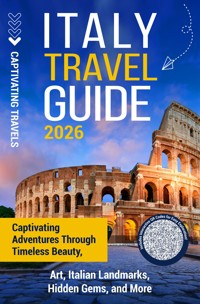
Erhalten Sie Zugang zu diesem und mehr als 300000 Büchern ab EUR 5,99 monatlich.
- Herausgeber: Captivating Travels
- Kategorie: Lebensstil
- Sprache: Englisch
Plan your ultimate Italy trip with this guide packed with easy-to-follow QR codes, maps, and over 100 images Discover the heart of Italy with a book that will make your journey smooth and memorable. From the ancient allure of Rome to Venice's charming canals, the artistic spirit of Florence, and the sunny coasts of the south, Italy offers an experience that engages every interest. This guide is your companion, guiding you to both famous sights and lesser-known places. Here's a fraction of what you can expect inside: - Deep Cultural Insight: Get to know Italy's history, people, and regions. Learn about Italian customs, local etiquette, and social traditions to help you connect with the country. - Easy Arrival and Movement: Find clear information on major airports and how to get around using Italy's train, bus, and local transport systems. - Detailed City Guides: Explore Rome, Florence, Venice, Milan, and Naples with dedicated chapters covering their main attractions, hidden spots, and neighborhoods. - Regional Discoveries: Journey through Tuscany's rolling hills, the peaceful Italian Lakes, the stunning Amalfi Coast, and the unique islands of Sicily and Sardinia. - Curated Must-See List: Benefit from a list of the Top 20 essential locations in Italy, highlighting important landmarks and special places. - Ready-to-Use Itineraries: Choose from suggested travel plans for 7, 10, or 14 days, designed for different interests, helping you organize your trip efficiently. - Capture the Beauty: Get advice on the best spots for photography across Italy's diverse landscapes and city scenes. - Speak Like a Local: Learn essential Italian phrases for common situations, making your daily interactions easier and more pleasant. - And much, much more! Ready to Experience Italy? This guide gives you the knowledge and tools to discover Italy's timeless beauty, rich art, and friendly culture. Click Add to Cart and start planning your unforgettable Italian adventure now!
Sie lesen das E-Book in den Legimi-Apps auf:
Seitenzahl: 93
Veröffentlichungsjahr: 2025
Das E-Book (TTS) können Sie hören im Abo „Legimi Premium” in Legimi-Apps auf:
Ähnliche












Italy Travel Guide
Captivating Adventures through Timeless Beauty, Art, Italian Landmarks, Hidden Gems, and More
Table of Contents
Title Page
Italy Travel Guide
Introduction: Embarking on an Italian Journey
Chapter 1: Get to Know Italy
Chapter 2: Arriving in Italy
Chapter 3: Rome, The Eternal City
Chapter 4: Florence & Tuscany, Cradle of the Renaissance
Chapter 5: Venice, The Floating City
Chapter 6: Milan & The Lakes, Fashion, Finance, and Alpine Beauty
Chapter 7: Naples & The Amalfi Coast, Sun-Drenched Shores and Ancient Wonders
Chapter 8: Sicily & Sardinia, Island Escapes and Ancient Mysteries
Chapter 9: The Italian Riviera & Cinque Terre, Colorful Villages and Coastal Trails
Chapter 10: Italian Culture, Customs, and Etiquette
Chapter 11: Top 20 Must-See Locations in Italy
Chapter 12: Suggested Travel Itineraries
Chapter 13: Best Places for Photography in Italy
Additional Chapter: Where to Eat & Stay – A Culinary & Accommodation Guide
Additional Chapter: Useful Italian Phrases (Basic Conversational Italian)
Appendix: Key Landmarks by Chapter
© Copyright 2025 - All rights reserved.
The content contained within this book may not be reproduced, duplicated, or transmitted without direct written permission from the author or the publisher.
Under no circumstances will any blame or legal responsibility be held against the publisher, or author, for any damages, reparation, or monetary loss due to the information contained within this book, either directly or indirectly.
Legal Notice:
This book is copyright protected. It is only for personal use. You cannot amend, distribute, sell, use, quote, or paraphrase any part, or the content within this book, without the consent of the author or publisher.
Disclaimer Notice:
Please note the information contained within this document is for educational and entertainment purposes only. All effort has been executed to present accurate, up-to-date, reliable, and complete information. No warranties of any kind are declared or implied. Readers acknowledge that the author is not engaging in the rendering of legal, financial, medical, or professional advice. The content within this book has been derived from various sources. Please consult a licensed professional before attempting any techniques outlined in this book.
By reading this document, the reader agrees that under no circumstances is the author responsible for any losses, direct or indirect, that are incurred as a result of the use of the information contained within this document, including, but not limited to, errors, omissions, or inaccuracies.
Disclaimer: While every effort has been made to ensure the accuracy and completeness of the information contained in this guide at the time of publication, travel conditions, prices, and business operations are subject to rapid change, particularly in dynamic economic environments. The author and publisher do not guarantee the current accuracy of all information and disclaim any liability for loss or damage incurred as a result of reliance on this material. Travelers are advised to verify information such as opening hours, prices, and availability directly with local sources before making plans.
Introduction: Embarking on an Italian Journey
The Colosseum in Rome.
Italy, known for its layered history and culture, invites travelers to explore everything from the ancient grandeur of Rome to the serene canals of Venice, the artistic heart of Florence, and the sun-drenched coasts of the south.
In this guide, we move beyond simple lists, offering a unique look at a popular travel destination, filled with all the information you need for a perfect holiday.
When to Visit Italy: A Seasonal Perspective
Venice, Italy.
Italy has distinct seasons, each offering a unique charm:
Spring (April to May):
Often considered one of the most favorable times for travelers to visit, spring in Italy has mild temperatures and fewer crowds compared to the peak summer months. These months offer several opportunities for exploring cities, hiking, and outdoor activities. While occasional rain showers can occur, particularly in early spring, pleasant, sunny days are common. This period strikes a balance between agreeable weather and manageable tourist numbers.
Autumn (September to October):
Similar to spring, autumn provides comfortable temperatures and fewer crowds. This is a particularly appealing time for culinary enthusiasts, as it coincides with grape harvests in wine regions and truffle festivals across the countryside. The shifting colors of the foliage add a rich dimension to Italy's diverse landscapes. Early autumn still offers opportunities for coastal enjoyment, especially in the south, before the cooler, wetter weather of late fall sets in.
Summer (June to August):
The peak tourist season brings long, sunny days and warm to hot temperatures, especially in central and southern Italy, where temperatures can regularly exceed 35∘C (95∘F). While ideal for coastal holidays, swimming, and outdoor festivals, major cities can be exceptionally crowded and less comfortable for extensive sightseeing. August sees many Italians take their annual holidays, which can result in some businesses closing, particularly in urban centers, while coastal and mountain resorts become exceptionally busy. If you choose summer, focusing on northern Italy or coastal areas might offer a more comfortable experience.
Winter (November to March):
The off-season offers the lowest rates and fewest crowds, particularly outside of the Christmas and New Year holidays. While temperatures are cooler, especially in the north where snow is common in Alpine regions, central and southern Italy often experience mild winters. Many coastal towns and resorts largely shut down. However, winter provides a unique opportunity to explore major cultural sites with a sense of tranquility, engage with locals, and experience festive traditions. It is also the prime season for winter sports in the Dolomites and other mountain ranges.
The best time to visit Italy depends on your priorities: avoid crowds and enjoy pleasant weather in spring or autumn; embrace the heat and coastal life in summer; or seek solitude and winter sports in the colder months.
A Guide Designed for Modern Exploration
Easy chapter guide for key areas in Italy
This guide has several practical features to help you make the most of your trip:
Full-Color Images:
Throughout the guide, you will find high-quality, full-color images that show the beauty of Italy. These visuals are sure to inspire your travels.
Maps:
These navigational tools will assist you in orienting yourself within cities, and planning your routes effectively, ensuring you can travel with confidence.
QR Codes for Key Resources:
For convenient, immediate access to supplementary information, we have integrated QR codes at relevant points within the text. Scanning these codes with your smartphone will direct you to up-to-date online resources.
Prepare for an unforgettable adventure. Italy awaits.
Chapter 1: Get to Know Italy
A welcoming street in Trastevere, Rome.
Italy, a boot-shaped peninsula reaching into the Mediterranean Sea, is a country of contrasts and enduring charm. Its identity is woven from ancient civilizations, artistic revolutions, regional loyalties, and a deep-seated passion for life.
Geography: A Land of Diverse Landscapes
The Apennine mountains.
Italy's geography is as varied as its history. To the north, the Alps form a formidable natural border, home to towering peaks, pristine lakes like Como and Garda, and a landscape that transforms with the seasons. South of the Alps, the vast Po River Valley stretches across northern Italy, forming the country's industrial and agricultural heartland.
The spine of the peninsula is dominated by the Apennine Mountains, which run nearly the entire length of Italy. These mountains create distinct regional identities, influencing everything from local dialects to culinary traditions. To the west, the Tyrrhenian Sea laps against rocky coasts and fertile plains, while the Adriatic Sea defines the eastern shores with its longer, sandy beaches.
Italy also includes two large islands: Sicily, a land of volcanic landscapes dominated by Mount Etna, ancient Greek temples, and a distinct culture; and Sardinia, known for its rugged coastline, untouched beaches, and unique prehistoric sites.
The coastline itself is extensive, offering a vast array of seascapes from the dramatic cliffs of the Amalfi Coast to the gentle stretches of the Adriatic. This geographical diversity means that within a relatively short distance, you can transition from snowy peaks to rolling hills, bustling cities to tranquil fishing villages, and fertile valleys to sunny plains.
A Glimpse into History: From Empire to Republic
Petroglyph in Valcamonica, Lombardy.
Luca Giarelli, CC BY-SA 4.0 <https://creativecommons.org/licenses/by-sa/4.0>, via Wikimedia Commons https://commons.wikimedia.org/w/index.php?curid=78843579
Italy's history dates back millennia and profoundly influenced Western civilization.
The story begins with ancient Rome, which rose from a small settlement on the Tiber River to eventually become the Roman Empire, dominating much of Europe, North Africa, and the Middle East. Its legacy is visible in the enduring structures of the Colosseum, the Pantheon, and countless aqueducts and roads that still crisscross the land. Roman law, language (Latin, the precursor to Italian), and administrative systems laid the groundwork for future societies.
Following the fall of the Western Roman Empire in 476 CE, Italy entered a period of fragmentation. The Middle Ages saw the rise of powerful city-states like Venice, Florence, Genoa, and Milan, which became centers of trade, banking, and political influence. These independent entities often vied for power, leading to a complex web of alliances and conflicts.
The Renaissance, flourishing from the 14th to the 16th centuries, marked a rebirth of art, science, and humanism, centered primarily in Florence. This era produced unparalleled masterpieces by artists like Leonardo da Vinci, Michelangelo, and Raphael, whose works continue to define our understanding of beauty and human potential. Other cities like Rome and Venice also experienced their own golden ages during this period.
Centuries of foreign domination followed, with various European powers controlling different parts of the peninsula. It wasn't until the 19th century that the Risorgimento, or "Resurgence," movement gained momentum. This period of political and social upheaval led to the unification of Italy in 1861, creating the modern nation-state we know today, with Rome eventually declared its capital.
Downtown Milan in the 60s.
https://commons.wikimedia.org/w/index.php?curid=20052127
The 20th century saw Italy navigate two World Wars, the rise and fall of fascism, and the establishment of the Italian Republic in 1946. Since then, Italy has emerged as a major economic and cultural force, balancing its rich heritage with modern innovation.
Climate: Understanding Italy's Seasons
Summer in Sardinia.
Gianni Careddu, CC BY-SA 3.0 <https://creativecommons.org/licenses/by-sa/3.0>, via Wikimedia Commons https://commons.wikimedia.org/w/index.php?curid=21121524
Italy has a varied climate across its regions. Generally, the country experiences a Mediterranean climate, characterized by hot, dry summers and mild, wet winters, especially along the coasts and in the south.
Northern Italy:
Experiences a more continental climate, with colder winters (including snow in mountainous areas and sometimes in cities like Milan) and hot, often humid summers.
Central Italy (including Rome and Florence):
Has temperate weather, with pleasant springs and autumns, hot summers, and mild but damp winters.
Southern Italy and the Islands:
Enjoy a classic Mediterranean climate, with long, intensely hot and dry summers, and short, mild winters. This region boasts more days of sunshine throughout the year.
While the general patterns hold, local variations due to altitude and proximity to the sea mean that temperatures and precipitation can differ significantly even within a short distance. Planning your visit according to your preferred activities and tolerance for heat or cold is always advisable.




