


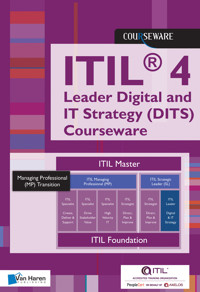
ITIL® 4 Leader Digital and IT Strategy (DITS) Courseware E-Book
Van Haren Learning Solutions a. o.
Erhalten Sie Zugang zu diesem und mehr als 300000 Büchern ab EUR 5,99 monatlich.
- Herausgeber: Van Haren Publishing
- Kategorie: Fachliteratur
- Sprache: Englisch
ITIL® 4 Leader Digital and IT Strategy (DITS) Courseware. ITIL® 4 DITS Is one of the two Strategic Leader (ITIL SL) modules. This module will concentrate on the alignment of digital business strategy with IT strategy. The module also incorporates how disruption from new technologies are impacting businesses in every industry and how company leaders are responding. The ITIL® 4 Leader: Digital and IT Strategy (DITS) module guide how the strategy should impact the design, delivery, and support of services throughout the service value chain of a company. This module advances the discussion around ITIL concepts to a corporate strategy level, by enabling IT and digital leaders to influence and drive strategic decisions, by creating a suitable digital strategy aligned to the wider cross-organizational goals. This module is therefore directed towards IT and business directors, heads of department, aspiring C-Suite professionals, and other senior business leaders who want to strategically position an organization against digital disruptors craft a digital vision, and build a robust long term strategy.
Sie lesen das E-Book in den Legimi-Apps auf:
Seitenzahl: 104
Veröffentlichungsjahr: 2021
Das E-Book (TTS) können Sie hören im Abo „Legimi Premium” in Legimi-Apps auf:
Ähnliche


















ITIL® 4 Leader Digital and IT Strategy (DITS) Courseware
Colophon
Title:
ITIL® 4 Leader Digital and IT Strategy (DITS) Courseware
Author:
Van Haren Learning Solutions
Publisher:
Van Haren Publishing, ‘s-Hertogenbosch
ISBN Hard Copy:
978 94 018 0731 9
Edition:
Second edition, first print, March 2021
Design:
Van Haren Publishing, ‘s-Hertogenbosch
Copyright:
© Van Haren Publishing 2021
For further information about Van Haren Publishing please e-mail us at: [email protected] or visit our website: www.vanharen.net
All rights reserved. No part of this publication may be reproduced, distributed, stored in a data processing system or Published in any form by print, photocopy or any other means whatsoever without the prior written Consent of the authors and publisher.
Publisher about the Courseware
The Courseware was created by experts from the industry who served as the author(s) for this publication. The input for the material is based on existing publications and the experience and expertise of the author(s). The material has been revised by trainers who also have experience working with the material. Close attention was also paid to the key learning points to ensure what needs to be mastered.
The objective of the courseware is to provide maximum support to the trainer and to the student, during his or her training. The material has a modular structure and according to the author(s) has the highest success rate should the student opt for examination. The Courseware is also accredited for this reason, wherever applicable.
In order to satisfy the requirements for accreditation the material must meet certain quality standards. The structure, the use of certain terms, diagrams and references are all part of this accreditation. Additionally, the material must be made available to each student in order to obtain full accreditation. To optimally support the trainer and the participant of the training assignments, practice exams and results are provided with the material.
Direct reference to advised literature is also regularly covered in the sheets so that students can find additional information concerning a particular topic. The decision to leave out notes pages from the Courseware was to encourage students to take notes throughout the material.
Although the courseware is complete, the possibility that the trainer deviates from the structure of the sheets or chooses to not refer to all the sheets or commands does exist. The student always has the possibility to cover these topics and go through them on their own time. It is recommended to follow the structure of the courseware and publications for maximum exam preparation.
The courseware and the recommended literature are the perfect combination to learn and understand the theory.
-- Van Haren Publishing
Other publications by Van Haren Publishing
Van Haren Publishing (VHP) specializes in titles on Best Practices, methods and standards within four domains:
- IT and IT Management
- Architecture (Enterprise and IT)
- Business Management and
- Project Management
Van Haren Publishing is also publishing on behalf of leading organizations and companies: ASLBiSL Foundation, BRMI, CA, Centre Henri Tudor, Gaming Works, IACCM, IAOP, IFDC, Innovation Value Institute, IPMA-NL, ITSqc, NAF, KNVI, PMI-NL, PON, The Open Group, The SOX Institute.
Topics are (per domain):
IT and IT Management
ABC of ICT
ASL®
CATS CM®
CMMI®
COBIT®
e-CF
ISO/IEC 20000
ISO/IEC 27001/27002
ISPL
IT4IT®
IT-CMFTM
IT Service CMM
ITIL®
MOF
MSF
SABSA
SAF
SIAMTM
TRIM
VeriSMTM
Enterprise Architecture
ArchiMate®
GEA®
Novius Architectuur
Methode
TOGAF®
Business Management
BABOK ® Guide
BiSL® and BiSL® Next
BRMBOKTM
BTF
EFQM
eSCM
IACCM
ISA-95
ISO 9000/9001
OPBOK
SixSigma
SOX
SqEME®
Project Management
A4-Projectmanagement
DSDM/Atern
ICB / NCB
ISO 21500
MINCE®
M_o_R®
MSP®
P3O®
PMBOK ® Guide
Praxis®
PRINCE2®
For the latest information on VHP publications, visit our website: www.vanharen.net.
Table of content
Reflection
Agenda
ITIL® 4: digital and IT strategy (DITS)
(6)
Introduction to digital and IT strategy
(13)
DITS Key terms & concepts
(24)
Summary
(53)
Questions & Answers
(54)
The strategy journey – What is the vision?
(62)
Summary
(88)
Questions & Answers
(89)
The strategy journey – Where are we now?
(94)
Summary
(113)
Questions & Answers
(114)
Introduction to case study
(117)
Assignment 1
(125)
The Strategy Journey – Where do we want to be? & how do we get there?
(132)
Summary
(165)
Summary
(198)
Summary
(216)
Questions & Answers
(217)
The strategy journey – Take action
(225)
Summary
(255)
Questions & Answers
(256)
The strategy journey – Did we get there?
(258)
Summary
(280)
Questions & Answers
(281)
Assignment 2
(283)
Assignment 3
(290)
The strategy journey – How do we keep momentum going?
(299)
Summary
(324)
Questions & Answers
(325)
Assignment 4
(328)
The 4 key capabilities – Digital leadership
(336)
Summary
(351)
Questions & Answers
(352)
The 4 key capabilities – Managing innovation and emerging technologies
(354)
Summary
(384)
Questions & Answers
(385)
The 4 key capabilities – Managing strategic risk
(388)
Summary
(409)
Questions & Answers
(410)
The 4 key capabilities – Structuring for digital business
(414)
Summary
(425)
Exam preparation
(427)
ITIL practices
(431)
Glossary
(479)
Sample Paper 1: Question Booklet
Sample Paper 1: Answers and Rationales
Sample Paper 2: Question Booklet
Sample Paper 2: Answers and Rationales
Syllabus
Self-Reflection of understanding Diagram
‘What you do not measure, you cannot control.’’ – Tom Peters
Fill in this diagram to self-evaluate your understanding of the material. This is an evaluation of how well you know the material and how well you understand it. In order to pass the exam successfully you should be aiming to reach the higher end of Level 3. If you really want to become a pro, then you should be aiming for Level 4. Your overall level of understanding will naturally follow the learning curve. So, it’s important to keep track of where you are at each point of the training and address any areas of difficulty.
Based on where you are within the Self-Reflection of Understanding diagram you can evaluate the progress of your own training.
Write down the problem areas that you are still having difficulty with so that you can consolidate them yourself, or with your trainer. After you have had a look at these, then you should evaluate to see if you now have a better understanding of where you actually are on the learning curve.
Timetable
Day 1
Introductions
DITS Key terms & concepts
What is the vision?
Where are we now?
Introduction to case & assignment 1
Day 2
Where do we want to be? & How do we get there?
Take action!
Did we get there?
Assignment 2
Assignment 3
Day 3
How do we keep momentum going?
Assignment 4
The 4 key capabilities
Exam preparation
ITIL Practices
Glossary
1) An organization is investigating locations for a new office.
What type of external factors should be analysed to ensure that potential future employees can integrate easily into the overall organization?
A. Political
B. Economic
C. Social
D. Legal
2) A cloud storage provider wants to develop a culture of innovation based on a high tolerance for disruption.
Which is the BEST approach for them to adopt?
A. Implement new communication technology that will sufficiently increase income to achieve a target set by the financial department
B. Implement many regular changes to the storage app and accept that some will fail but others will help to maintain their high market share
C. Invest in a new version of the storage app in order to avoid losing their position in the cloud storage market
D. Invest in new data centre infrastructure to maintain their goal of providing highly available and reliable cloud storage services
3) An organization has a number of legacy services that they need to maintain because of regulatory requirements. There are no plans to invest in improvements to these services. They plan to invest in some new services to support growing areas of the business.
What is the BEST reason for them to create and maintain a service portfolio?
A. To compare the business cases for the various new services, so that investment will be focused on these services, as required by the strategy
B. To compare the cost and value of each service in order to direct investment to where it is needed, even if this means investing in legacy services
C. To justify improvements to the legacy services in order to protect the key revenue streams of the organization
D. To provide information about customer and user experience to help plan improvements
4) Which BEST describes an organization’s vision?
A. It describes an organization’s reason to exist
B. It describes the value an organization aims to create
C. It describes specific strategic objectives and initiatives
D. It describes what an organization would like to become in the future
5) An IT service provider has defined value streams to create products and services. A senior manager wants to extend this work to create an operating model, and is writing a business case to support this.
Which is the MOST important benefit that the senior manager should include in the business case?
A.




