


18,99 €
Mehr erfahren.
- Herausgeber: John Wiley & Sons
- Kategorie: Geisteswissenschaft
- Serie: Key Contemporary Thinkers
- Sprache: Englisch
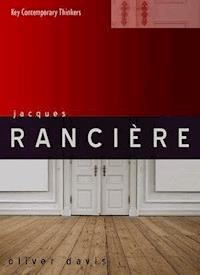
This book is a critical introduction to contemporary French philosopher Jacques Rancière. It is the first introduction in any language to cover all of his major work and offers an accessible presentation and searching evaluation of his significant contributions to the fields of politics, pedagogy, history, literature, film theory and aesthetics.
This book traces the emergence of Rancière’s thought over the last forty-five years and situates it in the diverse intellectual contexts in which it intervenes. Beginning with his egalitarian critique of his former teacher Louis Althusser, the book tracks the subsequent elaboration of Rancière’s highly original conception of equality. This approach reveals that a grasp of his early archival and historiographical work is vital for a full understanding both of his later politics and his ongoing investigation of art and aesthetics.
Along the way, this book explains and analyses key terms in Rancière’s very distinctive philosophical lexicon, including the ‘police’ order, ‘disagreement’, ‘political subjectivation’, ‘literarity’, the ‘part which has no part’, the ‘regimes of art’ and ‘the distribution of the sensory’.
This book argues that Rancière’s work sets a new standard in contestatory critique and concludes by reflecting on the philosophical and policy implications of his singular project.
Sie lesen das E-Book in den Legimi-Apps auf:
Seitenzahl: 434
Veröffentlichungsjahr: 2013
Ähnliche




















Table of Contents
Cover
Published
Title page
Copyright page
Preface
Acknowledgements
1 The Early Politics
From Pedagogy to Equality
Althusser’s lesson
Platonic inequality in Marx, Sartre and Bourdieu
Jacotot and radical equality
2 History and Historiography
Les Révoltes Logiques (1975–81)
The Nights of Labor: The Workers’ Dream in Nineteenth-Century France [1981]
The Names of History: On the Poetics of Knowledge [1992]
Conclusion
3 The Mature Politics
From Policing to Democracy
Politics and ‘the police’
Rancière’s structural account of democracy: the ‘wrong’ and the miscount
Political ‘subjectivation’
The aesthetic dimension of politics: the ‘division’ or ‘distribution’ of ‘the sensory’ (le partage du sensible)
Overall assessment of Rancière’s account of politics
4 Literature
‘What is literature?’
Writing, ‘literarity’ . . . and literature
Rancière as reader
5 Art and Aesthetics
Aesthetic experience and equality: with Kant and Gauny, against Bourdieu
The regimes of art
Film and film theory
Contemporary art, politics and community
Afterword
References
Index
Published:
Jeremy Ahearne, Michel de Certeau
Peter Burke, The French Historical Revolution: The Annales School 1929–1989
Michael Caesar, Umberto Eco
M. J. Cain, Fodor
Filipe Carreira da Silva, G. H. Mead
Rosemary Cowan, Cornel West
George Crowder, Isaiah Berlin
Maximilian de Gaynesford, John McDowell
Reidar Andreas Due, Deleuze
Matthew Elton, Daniel Dennett
Chris Fleming, Rene Girard
Edward Fullbrook and Kate Fullbrook, Simone de Beauvoir
Andrew Gamble, Hayek
Neil Gascoigne, Richard Rorty
Nigel Gibson, Fanon
Graeme Gilloch, Walter Benjamin
Karen Green, Dummett
Espen Hammer, Stanley Cavell
Christina Howells, Derrida
Fred Inglis, Clifford Geertz
Simon Jarvis, Adorno
Sarah Kay, Žižek
Stacy K. Keltner, Kristeva
Valerie Kennedy, Edward Said
Chandran Kukathas and Philip Pettit, Rawls
Moya Lloyd, Judith Butler
Philip Manning, Erving Goffman
James McGilvray, Chomsky
Lois McNay, Foucault
Dermot Moran, Edmund Husserl
Michael Moriarty, Roland Barthes
Stephen Morton, Gayatri Spivak
Harold W. Noonan, Frege
James O’Shea, Wilfrid Sellars
William Outhwaite, Habermas, 2nd Edition
Kari Palonen, Quentin Skinner
Ed Pluth, Badiou
John Preston, Feyerabend
Chris Rojek, Stuart Hall
William Scheuerman, Morgenthau
Severin Schroeder, Wittgenstein
Susan Sellers, Hélène Cixous
Wes Sharrock and Rupert Read, Kuhn
David Silverman, Harvey Sacks
Dennis Smith, Zygmunt Bauman
James Smith, Terry Eagleton
Nicholas H. Smith, Charles Taylor
Felix Stalder Manuel Castells
Geoffrey Stokes, Popper
Georgia Warnke, Gadamer
James Williams, Lyotard
Jonathan Wolff, Robert Nozick
Copyright © Oliver Davis 2010
The right of Oliver Davis to be identified as Author of this Work has been asserted in accordance with the UK Copyright, Designs and Patents Act 1988.
First published in 2010 by Polity Press
Polity Press
65 Bridge Street
Cambridge CB2 1UR, UK
Polity Press
350 Main Street
Malden, MA 02148, USA
All rights reserved. Except for the quotation of short passages for the purpose of criticism and review, no part of this publication may be reproduced, stored in a retrieval system, or transmitted, in any form or by any means, electronic, mechanical, photocopying, recording or otherwise, without the prior permission of the publisher.
ISBN-13: 978-0-7456-4654-1
ISBN-13: 978-0-7456-4655-8 (pb)
ISBN-13: 978-0-7456-5914-5 (Single-user ebook)
ISBN-13: 978-0-7456-5913-8 (Multi-user ebook)
A catalogue record for this book is available from the British Library.
The publisher has used its best endeavours to ensure that the URLs for external websites referred to in this book are correct and active at the time of going to press. However, the publisher has no responsibility for the websites and can make no guarantee that a site will remain live or that the content is or will remain appropriate.
Every effort has been made to trace all copyright holders, but if any have been inadvertently overlooked the publisher will be pleased to include any necessary credits in any subsequent reprint or edition.
For further information on Polity, visit our website: www.politybooks.com
Preface
Jacques Rancière, the philosopher of equality, is now in his eighth decade and interest in his work has never been greater. His singular intellectual project, which spans a daunting range of disciplines, has been steadily and patiently elaborated in numerous books, articles, lectures and interviews since the mid-1960s. While it would be misleading to suggest that he languished in complete obscurity after his contribution to Louis Althusser’s Reading Capital [1965],1 it is only really relatively recently that this professional philosopher has risen to public prominence in his own right in France and that his impact has begun to be felt in the English-speaking world. Within academia the opening decade of the millennium saw several high-profile international conferences devoted to Rancière’s work, a flurry of keynote addresses, an ever-diminishing time-lag between the appearance of his writing in French and its emergence in English translation, as well as translations into a number of other languages (including a recent Hindi translation of The Nights of Labor), a plethora of journal special issues and a growing tide of single-author studies and essay collections dedicated to aspects of his thought and his relationship with other thinkers. This, however, is the first book-length study by a single author, in any language, which is devoted entirely to Rancière’s thought and engages with all of his major interventions in and across the fields of politics, pedagogy, history, literature and aesthetics. At the time of writing, we are still in that particular moment in the reception of his work in the English-speaking world when editors and authors grapple to derive an adjective from his name (‘Rancierian’ will be used here) and translators seek to stabilize the English versions of his key terms. Perhaps it is fitting, if only trivially so, given Rancière’s critique of consensus, that little consensus has yet to emerge on these issues.
Bridging the gap between academia and the wider world are his invaluable interviews, a selection of which, running to over six hundred pages, was published in French last year, in 2009, under a title apt for an interviewee who has pursued and continues to pursue his intellectual project with indefatigable tenacity, Et tant pis pour les gens fatigués, And Too Bad for the Weary.2 Outside academia rumours continue to circulate of the influence of Rancière’s political thought over Ségolène Royal in particular, the former presidential candidate of France’s Socialist Party. And his work on aesthetics is now displayed prominently on the philosophy shelves of many a contemporary art bookshop and is rapidly becoming established as an essential point of reference for artists and curators.
Such an explosive moment in the reception of any thinker’s work is hazardous for aspiring explainers and not just because of the ordinary scholarly dangers of missing or failing to account for significant new material. The desire to promote work which one finds exceptionally enabling and transformative can easily give rise to the sort of unbalanced enthusiasm which eventually does it a disservice, particularly if that enthusiasm attracts the resentful attention of others less favourably disposed to the initial premises, the intentions and the manner of the thought in question and who, in rage, see fit to rubbish it. It then invariably takes years of painstaking sifting by fairer-minded commentators to set the record straight. This unfortunate pattern, which draws strength from the inherent conservatism of the academic establishment and the anti-intellectualism of the wider culture in Britain and the United States, has been repeated all too often in the reception of French-language philosophers from the Continental tradition whose work is taken up in the English-speaking world as French Theory: Sartre, Foucault, Althusser and Derrida, to name but four, have all shared a similar fate in this respect. If the tone in the main chapters which follow is sometimes more sober and the approach more directly contestatory than some other work on Rancière, this is my attempt to avoid the kind of overinflation which feeds that dispiriting pattern of reception. Yet at the same time I have tried to avoid replicating the no less disheartening cross-Channel division of labour identified by E.P. Thompson in his assessment of the relationship between French and English Marxism: ‘they propose and we object’.3 Nevertheless, for unalloyed enthusiasm and an unqualified statement of the importance of Rancière’s work, the reader will have to wait until the Afterword.
The hazards to aspiring explainers inherent in the explosive moment in its receptional lifetime at which Rancière’s thought has now arrived are compounded considerably by some of the specific asperities of a body of work which make it especially resistant to the kind of explanatory critical exposition offered in this book. I wish briefly to survey these here, in order to measure and acknowledge the particular presumptuousness of my undertaking and as a prelude to defending what I hestitate to call my method. First among those features of Rancière’s work which make it resistant to explanation is its own intense and principled suspicion of the very act of explaining. According to the nineteenth-century maverick pedagogue Joseph Jacotot, the subject of Rancière’s most seductive book, The Ignorant Schoolmaster [1987], explaining stultifies because it is premised on and perpetuates intellectual inequality between teacher and student.4 The detail of these claims and Jacotot’s radical pedagogical alternative will be examined in Chapter 1. The point I want to make here is more about the implications of the particular ways in which Rancière’s work as a whole fights to avoid the explanatory mode. His philosophical style, in the main, is declarative or assertoric rather than explanatory: even when he analyses an existing body of thought or discourse, as he does in his ongoing project on aesthetics, the analysis proceeds not by explaining but by proposing theses and constructively elaborating new conceptual configurations and frameworks of understanding.
Whereas explainers have explicitly to establish hierarchies, both at macro level in their selection and presentation of the material and at sentence level in their use of subordinating and co-ordinating structures, Rancière’s thinking and writing are egalitarian: parataxis, or juxtaposition, is his favoured linguistic and conceptual mode. Equality is not just declared by, but enacted in, the Rancierian sentence, which tends to eschew both hierarchizing constructions and qualifiers expressive of degree: the preponderance of on-or-off assertoric structures, notably ‘it is a question of’ and ‘it is not a question of’ (il s’agit de / il ne s’agit pas de), lends the thinking an impassioned drivennness at local level but makes systematization challenging, to say the least. And of course this is part of the point. Readers have responded to the very particular texture of Rancière’s work differently. I have analysed it elsewhere as a productive performance of textual, conceptual and affective irritability; Hayden White has expressed somewhat puzzled appreciation of its ‘aphoristic, almost oracular’ tone.5 Yet the crucial point is that the declarative approach, as practised by Rancière, differs decisively from the lecturely authoritarianism for which it can risk being mistaken in that it assumes the reader is on an equal footing and leaves him or her radically free before the thought, free to take it or leave it, free to disagree or remain unconvinced. Or free, as in my case, to rub against its grain by trying to explain it, even if the only explanation I can in all conscience hazard is one which explicitly disavows its own authority and assumes, from the outset, the equal capacity of any reader to make sense of the work, as well as his or her freedom to disagree with, or to remain unconvinced by, the reading I propose.
Explanation, in Rancière’s case, is also difficult for pragmatic, as well as ethical, reasons because of the sheer range of his work over so many disciplines and debates and the particular way his thought has of lodging itself in the interstices of discussions which are often already complex in their own right. As he has said himself, his books are ‘always forms of intervention in specific contexts’.6 But what exactly is an ‘intervention’? S/he who intervenes etymologically ‘comes between’. In normal English usage ‘intervention’ is seldom far from interference and readily implies meddling with something which could have been left alone, intruding to prevent things taking the course they might otherwise have taken. In French, however, and in English uses of the term which play on its resonances in that other language, such as Rancière’s in the article, first published in English, from which the above quote was taken, the scope of the verb intervenir and its noun intervention is wider in normal usage and more detached from the notion of obstructive interference. Indeed legitimate examples of interventions include not only short presentations at conferences and, historically, the act of speaking up for one of the parties in a courtroom, but in principle almost any act of interceding.7 The English ‘intervention’, as it is ghosted by its French intervention, is thus a term which is wide open and so already predisposed to egalitarian uses: given application, there is no debate, or issue, or arena, which is in principle off-limits to anyone. Rancière is by no means an autodidact, and few of us who have any first-hand experience of institutional education can meaningfully claim to be one; yet in his practice of the intervention, in this augmented bilingual sense, he renews with the nineteenth-century autodidact’s egalitarian (self-)confidence that, given need, desire and tenacity, knowledge is open to anyone and everyone.
That Rancière’s practice of the intervention gives rise to particular practical difficulties for would-be explainers is undeniable: often the discussions in which he intervenes are already formidably complex, particularly in the case of historiography, which I examine in Chapter 2. Moreover, his interventionary approach discourages attempts to systematize his work. I have tried in the pages which follow to strike a balance between recontextualization – resituating his work in the conceptual and political contexts with which it engages – and a recognition and exploration of the singularity of his work in its own terms. Since the practice of contextualization is itself problematized in Rancière’s work and overcontextualization is certainly ‘un-Rancierian’, for reasons which will become clear, again in Chapter 2, this book about Rancière cannot with any confidence claim to be Rancierian. In defence of my ‘method’, I hazard that it would be almost impossible to grasp the real originality and interest of Rancière’s singular project without some familiarity with the varied contexts in which it intervenes. Nevertheless, I make no exaggerated claims to have somehow overcome the plurality of these interventionary contexts and explained Rancière’s thought as a systematic unity. What I present instead is an explanatory and critical analysis of his thought’s emergence, its development and its major concerns, together with a provisional assessment of its value. I focus on what I judge to be the major texts, but part of what this means is that I focus on those texts which lend themselves to the kind of explanatory project I am undertaking: if the constraints of the task in hand mean I pass over quickly some of the more oblique or highly context-specific works, for instance Short Voyages to the Land of the People or Hatred of Democracy, this implies no judgment about either their intrinsic worth or their openness for other kinds of project than the one I am undertaking here.8
Here then is a sketch-map of the ground which will be covered. Chapter 1 is concerned with Rancière’s early politics and traces the emergence of his unique conception of equality from his critique of pedagogy. His break with former teacher Louis Althusser, his reflection on the egalitarian meaning of the events of May ‘68 and his penetratingly oblique reflection on the Marxist tradition of social criticism, in The Philosopher and His Poor [1983], are shown to be preparing the ground for the articulation of his distinctive conception of declarative equality in The Ignorant Schoolmaster [1987]. Chapter 2 discusses Rancière’s historical and historiographical work, his work in the archives of French nineteenth-century worker emancipation, alone and as part of the collective behind the groundbreaking journal Les Révoltes Logiques [1975–81]. The multifaceted politics of his practice of the archive are explored and related to his later and ill-understood historiographical treatise, The Names of History [1992]. The suggestion is that this book’s nuanced critique of historicism lays the epistemological foundation for the quasi-historical concepts invoked in his later and ongoing work on aesthetics. Chapter 3 tackles Rancière’s mature politics and covers his ground-clearing distinction between politics and ‘the police’, his structural account of democracy in terms of the ‘wrong’ and the ‘miscount’, his concept of political subjectivation and his analysis of the aesthetic dimension to politics. Splitting the politics into two chapters, ‘early’ and ‘mature’, and arranging them either side of the chapter on history, does not signal either a neo-Althusserian dogmatism of the ‘break’ or a wish to downplay the ‘early’ politics, but is rather an attempt to emphasize the singular shape which Rancière’s detour via the archives imparts to the developmental pattern of his thought.
Chapters 4 and 5 show how his political and historiographical writing inform his analysis of literature, art and aesthetics: Chapter 4 examines his work on verbal art, which serves both as a partial template for, and the first phase of, his ongoing project on art and aesthetics, the subject of Chapter 5. That chapter explains this project in terms of what I think are its twin aims: to provide an analytical framework for the understanding of art and aesthetic experience and to derive a non-reductive conception of the politics of art. The middle section of Chapter 5 analyses Rancière’s film criticism and film theory. The Afterword returns to reflect on the meaning of the exemplary singularity of Rancière’s work.
Notes
1 Where reference is made to the translation of a text, a date in square brackets refers to the date of publication of the first edition of the original, as opposed to the translation. Althusser et al., Lire le Capital (1st edn, Paris: Maspero, 1965).
2 Rancière, Et tant pis pour les gens fatigués: entretiens (Paris: Amsterdam, 2009). The translation given here is my own.
3 E.P. Thompson interviewed in MARHO [Mid-Atlantic Radical Historians’ Organization], Visions of History (Manchester: Manchester University Press, 1976), 17.
4 Rancière, The Ignorant Schoolmaster: Five Lessons in Intellectual Emancipation, tr. by Kristin Ross (Stanford: Stanford University Press, 1991), 4–8.
5 Davis, ‘Rancière and Queer Theory: On Irritable Attachment’, Borderlands 8, 2 (2009), special issue: Jacques Rancière on the Shores of Queer Theory, ed. by Samuel Chambers and Michael O’Rourke (http://www.borderlands.net.au/issues/vol8no2.html). Rancière, The Names of History: On the Poetics of Knowledge, tr. by Hassan Melehy with a Foreword by Hayden White (Minneapolis: University of Minnesota Press, 1994), xviii. For two further attempts to characterize the specific challenges of Rancière’s writing see Eric Méchoulan, ‘Sophisticated Continuities and Historical Discontinuities, Or, Why Not Protagoras’, in Gabriel Rockhill and Philip Watts (eds), Jacques Rancière: History, Politics, Aesthetics (Durham, NC: Duke University Press, 2009), 55–66, at 55 and James Swenson’s excellent, ‘Style Indirect Libre’, in Rockhill and Watts (eds), Jacques Rancière: History, Politics, Aesthetics, 258–72.
6 Rancière, ‘A Few Remarks on the Method of Jacques Rancière’, in Paul Bowman and Richard Stamp (eds), Parallax 15, 3 (2009), 114–123, at 114.
7 In this notice, for example, written by a member of the ticket-counter staff on the Paris metro called away to attend to some unspecified but presumably pressing incident, the term ‘intervention’ refers in a general way to their act of responding: ‘Désolé: un incident quelque part dans la station nécessite une intervention de ma part.’
8 Rancière, Short Voyages to the Land of the People, tr. by James Swenson (Stanford: Stanford University Press, 2003); Rancière, Hatred of Democracy, tr. by Steve Cocoran (London: Verso, 2006).
Acknowledgements
I would like to thank the University of Warwick for a term of research leave and to colleagues Emma Campbell, Siân Miles and Douglas Morrey for support both moral and intellectual. For help on specific points in relation to this book and my other work on Rancière, thanks also go to Jeremy Ahearne, Daniel Andersson, Sudeep Dasgupta, Nick Hewlett, Leslie Hill, Christina Howells, Hector Kollias and Adrian Rifkin. I am grateful to the Friedrich Wilhelm Murnau Stiftung for kindly granting permission to reproduce a still image from Murnau’s Herr Tartüff, and to Campement Urbain for their kind permission to reproduce an image from their project Je et Nous. Thanks finally to Wesley Gryk for stability and sustenance while this book took shape.
1
The Early Politics
From Pedagogy to Equality
This chapter traces the emergence of the central unifying concept in Rancière’s work, equality, from his reflections on pedagogy. These were shaped by his own experience of institutional education, as a student of Marxist philosopher Louis Althusser in the early and mid-1960s. He subsequently became one of his former teacher’s most trenchant critics; the May ‘68 revolt crystallized his objections to Althusser’s thought and much of Rancière’s work thereafter can broadly be understood as the attempt to give discursive form to the idea of radical equality implicit in May but unrecognized, at the time, by Althusser.
Rancière’s most suggestive reformulation of the concept of equality takes place in The Ignorant Schoolmaster [1987], a book about pedagogy. This chapter aims to show how the far-reaching positive conception of radical equality contained in that book emerges out of sustained critical reflection on, and polemical reaction against, the philosophical pedagogies (and pedagogical philosophies) of Althusser, Marx, Sartre and Bourdieu. Despite their reputation as pillars of the Left, Rancière argues that these thinkers share a repressive conception of pedagogical power and a commitment to the social privilege of intellect first articulated by Plato in Republic. As this chapter unfolds, Rancière’s critique of the pedagogy of inequality will be related to radical thinking about education from Latin America, Britain and the United States.
Althusser’s lesson
‘It is impossible to choose one’s beginnings,’ Louis Althusser once insisted, in typically vigorous italics, with reference to, and in commiseration with, the young Marx, whose university education was steeped in the ambient philosophy of German Idealism.1 With hindsight a similar remark could be made of the young Rancière’s encounter with Althusser in the 1960s, as his student. From the moment of his first presentation at Althusser’s seminar, in 1961, through his remarkably compliant contribution to [1965], the structuralist classic based on that seminar’s reading of Marx’s text, to the publication of his excoriating critique (1974), , Althusser was the figure of reference. I cannot offer an exhaustive account of Althusser’s work and its many vicissitudes here; however, because he is so decisive an influence, those features of his doctrine and philosophical style relevant to an understanding of Rancière’s work will be briefly outlined.
Lesen Sie weiter in der vollständigen Ausgabe!
Lesen Sie weiter in der vollständigen Ausgabe!
Lesen Sie weiter in der vollständigen Ausgabe!
Lesen Sie weiter in der vollständigen Ausgabe!
Lesen Sie weiter in der vollständigen Ausgabe!
Lesen Sie weiter in der vollständigen Ausgabe!
Lesen Sie weiter in der vollständigen Ausgabe!




