


9,99 €
Mehr erfahren.
- Herausgeber: 50Minutes.com
- Kategorie: Sachliteratur, Reportagen, Biografien
- Serie: Art & Literature
- Sprache: Englisch
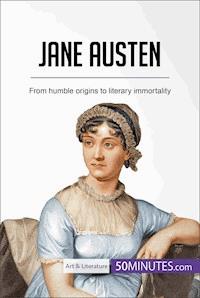
Keen to learn but short on time? Find out everything you need to know about the life and work of Jane Austen in just 50 minutes with this straightforward and engaging guide!
During her lifetime, Jane Austen lived in relative obscurity; she was the daughter of a clergyman and rarely ventured beyond the rural parish she called home. However, after her death she was revealed to be the author of several popular novels which had previously been published anonymously, and after a biography of her life was published by her nephew a few decades later, interest in her work surged anew. As the author of unusually realistic novels during a period when Romanticism and Gothic influences were in vogue, she provided unique insight into the lives of the landed gentry in the early 19th century, which was also a time when women’s voices were still a rarity in the literary world, and her gift for capturing the nuances of human relationships and emotions has proven timeless. She remains one of the most celebrated English novelists of all time.
In this book, you will learn about:
• Austen’s most famous works, including
Pride and Prejudice and
Emma
• The social, historical and literary context that influenced her writing style
• Her personal life, including her rural upbringing and untimely death
ABOUT 50MINUTES.COM | Art & Literature
The Art & Literature series from the 50Minutes collection aims to introduce readers to the figures and movements that have shaped our culture over the centuries. Our guides are written by experts in their field and each feature a full biography, an introduction to the relevant social, political and historical context, and a thorough discussion and analysis of the key works of each artist, writer or movement, making them the ideal starting point for busy readers looking for a quick way to broaden their cultural horizons.
Das E-Book können Sie in Legimi-Apps oder einer beliebigen App lesen, die das folgende Format unterstützen:
Seitenzahl: 37
Veröffentlichungsjahr: 2018
Ähnliche















Jane Austen
Born: 16 December 1775 in Steventon.Died: 18 July 1817 in Winchester.Context: Romanticism and the Gothic novel are in vogue, tensions between England and France are on the rise and the upheaval of the Industrial Revolution looms on the horizon.Notable works:Sense and Sensibility (1811), novelPride and Prejudice (1813), novelMansfield Park (1814), novelEmma (1815), novelNorthanger Abbey (1817), novelPersuasion (1817), novelAt first glance, Jane Austen appears to be no more than a normal, unassuming woman who lived in relative seclusion and favoured a simple, unpretentious literary style. However, appearances can be deceiving, and upon closer inspection her novels reveal an unparalleled gift for description and analysis. Although these talents brought her no recognition during her own lifetime, she has since become one of the most celebrated authors in British literary history.
Her work could be categorised with the sentimental novels which were popular at the time, or it could be a considered a forerunner of realism, which emerged in the following century. However, it is most accurate to say that Austen’s style was uniquely her own, and was based solely on her personal observations of humanity. Her refined, elegant novels aimed to paint an accurate, balanced portrait of the domestic environment she had grown up in, namely the world of the landed gentry, and combine an ironic view of the literary trends and current events of the time with extraordinarily insightful descriptions of human emotions, social relations and personal relationships.
Although her novels are unpretentious in style, they brim with charm and wit. In addition to their complex plots, which always reach a satisfying resolution, they feature a wide range of well-developed characters and social commentary, providing plenty of opportunities for humour and even satire. This perfectly balanced combination is the reason why Jane Austen remains one of the most widely read English-language authors not just in the United Kingdom, but throughout the world.
Context
A period of change and upheaval
Jane Austen lived during the reign (1760-1820) of King George III (1738-1820), which was a period of profound changes and widespread turmoil both in Europe and throughout the world.
The transition between the 18th and 19th centuries was a turbulent time in British history, which saw a great deal of political and socio-economic change and heralded even greater change to come. This upheaval began with the loss of Britain’s colonies in the Americas, a process which began in 1763 when American citizens rebelled against the taxes levied on them by the British government, which was attempting to replenish the coffers that had been emptied by the Seven Years’ War (1756-1763) against France. In 1775, this revolt escalated into the American War of Independence, which only ended when Britain officially recognised the United States of America as an independent country in 1783. The loss of its colonies dealt a heavy blow to the British economy and to the popularity of both the country itself and George III.
In the following years, Britain was embroiled in fresh conflict with France, this time in the form of the Napoleonic Wars (1803-1815), which ended with the defeat of Napoleon Bonaparte (1769-1821) in 1815, but left all of Europe, particularly Britain, in tatters. In 1811, George III’s son, the Prince of Wales and the future King George IV (1762-1830), was made regent due to his father’s declining mental health, which had left him unfit to rule. Unfortunately, the prince was prone to excess, and racked up enormous debts which emptied the national coffers. However, he was also a loyal patron of the arts, and his regency (1811-1820) and reign (1820-1830) were both characterised by a boom in artistic and intellectual activity. Although Austen held the king in low esteem because of his complacency and lack of self-control, she nevertheless dedicated an edition of her novel Emma to him, which was highly appreciated by the monarch.




