


9,99 €
Mehr erfahren.
- Herausgeber: 50Minutes.com
- Kategorie: Religion und Spiritualität
- Serie: History
- Sprache: Englisch
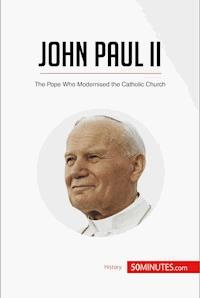
Keen to learn but short on time? Get to grips with the life of John Paul II in next to no time with this concise guide.
50Minutes.com provides a clear and engaging analysis of Pope John Paul II. In 1978, to widespread surprise, the Polish cardinal Karol Wojtyła was elected pope of the Roman Catholic Church. In the course of over 26 years as pope, he would modernise the Church and the papacy, making them more visible and accessible, and would play an important role in fighting totalitarianism across the world. His commitment to human rights and religious freedom make him a crucial figure of the 20th century.
In just 50 minutes you will:
• Find out about John Paul II’s early life and ecclesiastic career before becoming pope
• Analyse his contribution to modernisation of the Catholic Church and his role in promoting democracy and human rights across the world
• Learn about his frequently controversial and unpopular opinions on matters of traditional morality
ABOUT 50MINUTES.COM | History & Culture
50MINUTES.COM will enable you to quickly understand the main events, people, conflicts and discoveries from world history that have shaped the world we live in today. Our publications present the key information on a wide variety of topics in a quick and accessible way that is guaranteed to save you time on your journey of discovery.
Das E-Book können Sie in Legimi-Apps oder einer beliebigen App lesen, die das folgende Format unterstützen:
Seitenzahl: 26
Veröffentlichungsjahr: 2017
Ähnliche






John Paul II
Key information
Born: 18 May 1920 in Wadowice (Poland).Died: 2 April 2005 in Vatican City.Pontificate: 1978-2005.Canonisation: 27 April 2014.Main achievements:The modernisation of the Catholic Church and the implementation of the reforms of the Second Vatican Council.Major political influence during the fall of communist regimes in Eastern Europe in 1989.The development of a close relationship with Catholics across the world, with visits to 129 countries.The promotion of a social doctrine in favour of the defence of human rights and the fight against poverty.Introduction
“Do not be afraid. Open wide the doors for Christ. To his saving power open the boundaries of States, economic and political systems, the vast fields of culture, civilization and development” (Homily for the Inauguration of the Pontificate of John Paul II). John Paul II began his time as pope with this call for hope on 22 October 1978. His election as pope of the Catholic Church came as a great surprise to everyone, and in many respects he was a very unusual choice. He was the first non-Italian cardinal to take on the role for over four centuries, and came from the other side of the Iron Curtain. His native Poland had a deep-rooted Catholic tradition, but had fallen under the control of communism in 1944.
He soon made his mark on the position, effecting a major renewal of the role of pope. As a man of the Church, he was committed to promoting Christian identity, delivering a message of tolerance to as many people as possible, and rekindling interreligious dialogue. As a head of state, he employed his talent on the world diplomatic stage in order to persuade and sway totalitarian regimes, with a skill and energy that undoubtedly mark him out as one of the greatest popes of the 20th century.
The life of John Paul II
A late vocation
Karol Józef Wojtyła was born on 18 May 1920 in Wadowice, a small town in the Eastern European region of Galicia, near Krakow in the south of Poland. As a teenager, he had a passion for the theatre and wrote several plays, and he understood the dramatic power of speech from a very early age. Although he initially wanted to become an actor, he ended up enrolling at the Jagiellonian University to study humanities, specialising in Polish philosophy. When the universities were closed due to the Nazi occupation in 1939, he put on plays in secret, which he saw as a means of resistance. When he was forced to work in the Zakrzówek stone quarry, and then the Solway chemical factory in Krakow, he learnt about the hard manual work of labourers.
He decided to embark on an ecclesiastical career in 1942. He was first accepted into the clandestine seminary run by Prince Adam Sapieha (1876-1951), cardinal archbishop of Krakow, before becoming acquainted with spirituality and studying the works of Saint Louis-Marie Grignion de Montfort (French priest canonised in 1947, 1673-1716). He was ordained a priest on 1 November 1946. He continued his theological training at the Angelicum




