


Erhalten Sie Zugang zu diesem und mehr als 300000 Büchern ab EUR 5,99 monatlich.
- Herausgeber: UCD Press
- Kategorie: Geisteswissenschaft
- Serie: Classics of Irish History
- Sprache: Englisch
Davitt drafts on many topics while a prisoner in solitary confinement in Portland Convict Prison, 1881-3.
Das E-Book Jottings in Solitary wird angeboten von UCD Press und wurde mit folgenden Begriffen kategorisiert:
Irish history, Land League, Land War
Sie lesen das E-Book in den Legimi-Apps auf:
Seitenzahl: 528
Veröffentlichungsjahr: 2016
Das E-Book (TTS) können Sie hören im Abo „Legimi Premium” in Legimi-Apps auf:
Ähnliche



















JOTTINGS IN SOLITARY
CLASSICS OF IRISH HISTORY
General Editor: Tom Garvin
Original publication dates of reprinted titles are given in brackets
Walter McDonald, Some Ethical Questions of Peace and War
Standish James O’Grady, To the Leaders of Our Working People
P. S. O’Hegarty, The Victory of Sinn Féin (1924) (Centenary Classics edition, 2015)
Joseph Johnston, Civil War in Ulster (1999) (Centenary Classics edition, 2015)
Arthur Clery, The Idea of a Nation (1907)
Padraig de Burca & John F. Boyle, Free State or Republic? (1922) (Centenary Classics edition, 2015)
Mossie Harnett, Victory and Woe (2002) (Centenary Classics edition, 2015)
Robert Brennan, Ireland Standing Firm (1950)
William McComb, The Repealer Repulsed
Arthur Griffith, The Resurrection of Hungary (1904)
Thomas Fennell, The Royal Irish Constabulary
Eugene Davis, Souvenirs of Irish Footprints over Europe
Michael Davitt, Jottings in Solitary (ebook available, 2016)
George Moore, Parnell and His Island (1887) (ebook available, 2016)
Charlotte Elizabeth Tonna, Irish Recollections (1841/47 as Personal Recollections)
Oliver MacDonagh, Ireland: The Union and Its Aftermath (1968)
Standish James O’Grady, Sun and Wind
James Mullin, The Story of a Toiler’s Life
John Sarsfield Casey, The Galtee Boy: A Fenian Prison Narrative
William and Mary Ann Hanbidge, Memories of West Wicklow: 1813–1939 (1939)
A. P. A. O’Gara, The Green Republic (1902)
William Cooke Taylor, Reminiscences of Daniel O’Connell (1847)
William Bruce and Henry Joy, Belfast Politics (1794)
Annie O’Donnell, Your Fondest Annie
Joseph Keating, My Struggle for Life (1916)
John Mitchel, The Last Conquest of Ireland (Perhaps) (1858/9)
Maria Edgeworth, An Essay on Irish Bulls (1802)
Harold Gegbie, The Lady Next Door (1914)
Thomas Kettle, The Open Secret of Ireland (1912)
D. P. Moran, The Philosophy of Irish Ireland (1898–1900)
David W. Miller, Queen’s Rebels (1978)
Frank Frankfort Moore, In Belfast by the Sea
Ernie O’Malley, Rising Out: Seán Connolly of Longford (1890–1921) (Centenary Classics edition, 2015)
John Devoy, Michael Davitt: From the Gaelic American (ebook available, 2016)
Richard Twiss, A Tour in Ireland in 1775 (1776)
Wilfrid Ewart, A Journey in Ireland 1921 (1922)
Sir John Pope Hennessy, Sir Walter Ralegh in Ireland (1883)
Patrick Pearse, Short Stories (1917)
James Stephens, The Birth of the Fenian Movement
Charles Stewart Parnell, Words of the Dead Chief, compiled by Jennie Wyse-Power (1892)
John Joseph Horgan, Parnell to Pearse (1917)
Darrel Figgis, A Chronicle of Jails (1917) (Centenary Classics edition, 2015)
John Sarsfield Casey, A Mingling of Swans: A Cork Fenian and Friends ‘visit’ Australia
J. F. X. O’Brien, For the Liberty of Ireland at Home and Abroad
James Fintan Lalor, ‘The Faith of a Felon’ and Other Writings
Father S. Dinneen, Queen of the Hearth (1915)
Fanny Taylor, Irish Homes and Irish Hearts (1867)
JOTTINGS IN SOLITARY
Michael Davitt
edited byCarla King
UNIVERSITY COLLEGE DUBLIN PRESS
PREAS CHOLÁISTE OLLSCOILE BHAILE ÁTHA CLIATH
CONTENTS
Acknowledgements and Note on the Text
Introduction by Carla King
JOTTINGS IN SOLITARY
Synopsis of Data for an Autobiography
English Civilization
Ireland’s Share of the British Constitution as Seen in its Government and Parliamentary Franchise
Ireland’s Share of the British Constitution as Seen in its Government and Parliamentary Franchise (continued)
The Education of the Irish Citizen
The Education of the Irish Citizen (continued)
Christmas Day 1881
1st January 1882
Synopsis of our Parliamentary Representation
Random Thoughts on the Irish Land War
Random Thoughts on the Irish Land War: Difficulties in the Way of a Solution of the Irish Social Problem
Letter in Reply to that of Aunt Ellen’s
Random Thoughts on the Irish Land War
How Ireland Was Robbed of Her Parliament
My 36th Birthday
Notes
Index
ACKNOWLEDGEMENTS
I should like to thank the Board of Trinity College, Dublin for permission to publish MS 9639, ‘Jottings in Solitary’; to quote from MSS 9320 and 9534; and to reproduce the photograph of Davitt in MS 9649/11A on the cover of this book.
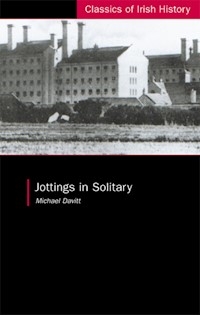
Mr R. Eldridge, Assistant Governor of Portland Young Offenders Institution and Mr David Legg, historian of Portland Prison, assisted in supplying the photograph of the Prison which appears on the front cover of the book.
My thanks also to the St Patrick’s College Research Committee for providing funding for a research trip to the Public Records Office and the British Library Newspaper Library in London. The staff of Trinity Manuscripts Library, St Patrick’s College Library, the Public Records Office, the British Library Newspaper Library, the National Library of Ireland, Trinity College Library and University College Library have been most helpful
Thanks are also due to my colleagues in the History Department in St Patrick’s College, especially to James Kelly for his invaluable assistance in reading and commenting on the introduction and footnotes. Others who helped in locating sources for references include Patrick M. Davitt, Mairead Dunlevy, Maria Luddy, Marian Lyons and John McColgan, for which I am very grateful.
Barbara Mennell has once again been a most patient and efficient editor. My son, Jonah, also deserves thanks for his unfailing good humour and for lending me his laptop.
NOTE ON THE TEXT
The manuscript of Jottings in Solitary was written by Michael Davitt in prison, without the assistance of dictionaries or many books of reference. It was never revised in this form for publication. I have endeavoured to retain as much as possible of the original text, including his spelling and punctuation, although for the sake of clarity and consistency some apostrophes and full stops have been added. Where names or terms were misspelled I have indicated this in the text. Davitt’s underlining of words has been rendered in italics.
Carla King
Dublin
May 2003
INTRODUCTION
Carla King
On Thursday, 3 February 1881 Michael Davitt and two others from the committee of the Land League, Thomas Brennan and Matthew Harris, were crossing O’Connell Bridge from the Land League offices on their way to lunch, when Davitt was approached by two detective officers1 and told that his presence was required in the Lower Castle Yard. He was taken first to Dublin Castle, where Chief Superintendent Williamson,2 who had arrived from England that morning, was waiting for him and read him the warrant for his arrest. Then he was brought by the mailboat Connaught, from Dun Laoghaire to Holyhead, travelling first class but under heavy guard.3 The government was extremely worried that there would be an attempt made to free him, so precautions were taken—two lines of police at Holyhead, a pilot engine preceded the train, and he was taken off at Willesden station, because it was feared that there would be demonstrations at Euston, and driven in a covered wagon to Bow Street Police Station. There he was formally identified, and after two nights at Millbank prison in London, he was sent on to Portland Prison in Dorset, where he was to remain for the next eighteen months.
This was the first move in a government crackdown on the leaders of the Land League. The Protection of Person and Property Bill had been introduced ten days earlier and the leaders were well aware that they might be arrested. 4 There seems to have been a feeling that 1881 would bring some kind of resolution to the conflict. Davitt’s comment in his diary at the close of the year 1880 was: “Eventful year just dying out. 1879 Education; 1880 Organisation; 1881 Result?”5 However, he did not appear to have expected his arrest before the Protection of Person and Property Act had passed into law,6 and he had to write to his friend, Tom Brennan, five days after his arrest with instructions to put his affairs in order.7 Indeed, there had been an assurance given by W. E. Forster, the Irish Chief Secretary, on 13 January that he had not broken the terms of his ticket of leave, which had released him in 1877.8
What had decided Forster and Gladstone, reluctantly, to re-imprison him was a build up of pressure behind the scenes.9 The government’s attempt to contain the deteriorating situation by imprisoning a handful of the leaders fell apart on 24 January, when the jury divided and failed to convict. The Land War was raging, but in addition to this the government had been made nervous by bomb threats. On 14 January there had been an attempt to blow up the Infantry Barracks in Salford, where arms were kept, injuring a passing woman and a child; the child later died. There were rumours of plots in Manchester and various precautions were taken wherever arms were stored. On 16 January, at a speech at Kilbrin in Cork, Davitt asserted that “the world will hold England responsible if the wolfdog of Irish-American vengeance bounds over the Atlantic at the very heart of the Power from which it is now held back by the influence of the Land League”. He was not advocating violence, but what the administration heard was the vivid phrase “the wolfdog of Irish-American violence” and it drew its own conclusions. Forster decided on 31 January that Davitt should be re-imprisoned and the wheels of the judicial system were put into motion immediately.10 Over the following months almost a thousand activists, including nearly all the leaders of the land movement, were imprisoned, among them Davitt’s lunch companions of 3 February, Brennan and Harris.
Davitt’s case was somewhat different from the other Land League leaders in that he had been released from a fifteen-year prison sentence in 1877 on a ticket of leave, having served over seven years. It now seemed as if he might have to serve out the second half of his term of imprisonment, which would have kept him in jail until 1885.
When news of Davitt’s arrest reached Westminster it provoked whoops of delight from the Conservative benches and howls of protest from the Nationalist side that resulted in thirty-six of their number being ejected from the House in a tumultuous scene.11 The party then met in one of the conference rooms of the parliament and, in a session that went on for three hours, decided how to respond to the crisis. For the third time that week the question came up as to whether the Irish MPs should withdraw from Westminster “for consultation with their constituents”—in effect a threat of abstention. The situation was already extremely tense as the Irish party had been vigorously obstructing the Protection of Person and Property bill. The sitting of 25 January had lasted twenty-two hours and on 31 January a sitting began which continued for forty-one hours and was only brought to a halt on 2 February by altering the rules of debate with the introduction of The Closure. As F. S. L. Lyons has pointed out, the scenes in the House were the outward manifestation of a tactical dispute within the Party. On 17 January, Parnell had stated publicly that the first arrest under the Protection of Person and Property Act would be the signal for a general rent strike, in which event the Home Rule MPs would return to Ireland to co-ordinate the campaign. This policy of “concentration” had been advocated by Andrew Kettle. Another line of action, “dispersion”, was proposed by Davitt, according to which Parnell should go to America to collect funds, others should stay in England and try to bring British public opinion round to support the struggle, and Dillon, Davitt and other Land League leaders should return to Ireland.12 As it turned out, neither plan was adopted. Davitt had not been arrested under the Protection of Person and Property Act but his seizure was deemed provocative none the less, and it could have provided the signal for an escalation of events. Here, then, was Parnell’s equivalent of the decision that faced Daniel O’Connell at Clontarf in October 1843.13 In the event he and his followers decided to stay and fight the coercion bill in Parliament. Asked by a Freeman’s Journal reporter on the day following Davitt’s arrest, whether the party would return to the House, his reply was: “If we consulted our own feelings we should retire, but we must do our duty.”14 The Irish party was deeply worried, nevertheless, about the effect of Davitt’s arrest, and was anxious that it not provoke a violent reaction in Ireland. To this end, it issued a manifesto calling on the Irish people at home and abroad “not to overstep by one inch the limits of constitutional and peaceable agitation”.15 At a special meeting of the Land League held in Dublin on Friday, 4 February, presided over by Dillon, who had replaced Davitt as Secretary of the League, resolutions were passed condemning the government’s action. However, Thomas Brennan called for restraint on behalf of the League’s supporters and a continuation of Davitt’s policy of peaceful protest.16
The government was also worried about the effects of Davitt’s arrest. Florence Arnold Forster reported in her diary on 3 February that the Lobby and corridors at Westminster were filled with police, who were also anxious to prevent a crowd gathering near the House.17
Strictly speaking, Davitt could have been returned to the hard labour conditions he had left in 1877, of which The Nation reminded its readers with extracts from his pamphlet prison life.18 However, he was now a major political figure. Opposition to his imprisonment became linked to general protest against the coercion bill. On 13 February, ten days after his arrest, a protest march, attended by a large crowd variously estimated at between fifteen and fifty thousand people, moved from Trafalgar Square to a meeting in Hyde Park where the three resolutions approved stated: “That we condemn coercion for Ireland”; “That the arrest of Mr Davitt, is mean, cruel and unjust”; and “That we censure the conduct of the Speaker and the Government in suppressing freedom of debate”.19 Further public meetings were held throughout Ireland and Britain, and letters of protest sent from local organisations of British Radical Liberals and even from the Gympie branch of the Land League in Queensland, Australia.20 Newspaper responses were predictably divided, but coverage of the arrest was considerable. Questions were asked in the House about the grounds for Davitt’s reimprisonment and the conditions under which he was held; a petition signed by 104 MPs, delivered on 11 February urged that he be treated as a first class misdemeanant.21 Davitt himself sent a petition to the Home Secretary, Sir William Harcourt, on 24 February vigorously protesting at his imprisonment and challenging its legality on the grounds that his release in December 1877 had in fact been an amnesty.22
Throughout his imprisonment, questions were raised concerning his health and the conditions under which he was held. These were in fact far more lenient than those he had experienced in his first term, but they did not match the relaxed conditions allowed to his associates in Kilmainham. For example, although he was allowed more visits than normal, they were still very strictly limited and most applicants were refused permission.23 He was clothed in prison dress, forbidden access to newspapers and only a portion of his mail seems to have reached him.24 However, he was given a cell in the prison infirmary, allowed to work in the garden, permitted a special diet and kept apart from the other prisoners. His treatment was not punitive; Harcourt’s biographer claims that John Bright described him as “the most humane Home Secretary he ever encountered”,25 and he had the support of the Prime Minister in favouring a relaxed policy towards Davitt. Despite this, it took seven months and several efforts before he was permitted writing paper on the advice of the prison doctor,26 and the prison governor was required to read everything he wrote. The provision of paper and pen was practically unheard of in the Victorian prison system and Sir Edmund Du Cane, the chairman of the directors of convict prisons, objected to the proposal and the precedent it might set.27
Davitt’s prison manuscript, which he wrote on the paper supplied to him by the prison authorities, consists of 358 pages of heavy blue prison notepaper written mostly on both sides in black ink. It is now kept in three files in the Manuscripts Department of the Trinity College Library, Dublin. Most of the pages are well preserved, although one is badly damaged and several have crumbled at the edges. Davitt was issued 20 sheets every two weeks and he generally dated his writings, the governor, George Clifton, initialling them after he had read them. In places the writing is continuous on the front and back of the pages but quite often Davitt wrote on a main theme on the front of the sheets and interspersed this with poetry, prayers, proverbs, observations or tables on the reverse. Most of the writing is quite legible, although there are a few places marked in this text where words were illegible, either because of the writing or damage to the paper.
What was Davitt’s purpose in writing all this? To begin with, he loved to write; contemporaries remembered him always with a pen in his hand. In part this was of necessity, as he wrote for his living. But as a rather solitary person, at times he carried on a dialogue with himself in his diaries, and there are elements of a diary in the Jottings. In addition, he was active by nature and probably found the enforced inactivity of his prison life extremely irksome. His solitary state while in prison did not have a punitive intention because he was allowed visitors, but there must have been times of considerable loneliness. And as quite a poor man, Davitt may have harboured thoughts of turning his enforced solitude to good use by writing a work he could sell. Significantly, he published a book, Leaves from a Prison Diary in 1885, which purported to be lectures delivered to a pet blackbird while in Portland, although that publication and the Jottings only overlap to some extent (see below).
In part Jottings and the first volume of Leaves from a Prison Diary belong to a series of prison memoirs that appeared in the late nineteenth century. John Mitchel, whose writings had exerted a profound influence on the younger Davitt, first published his Jail Journal in 1854. Two decades later, Jeremiah O’Donovan Rossa brought out his Prison Life (1874), an account of his dreadful mistreatment in Pentonville, Portland, Millbank and Chatham prisons.28 Davitt had already published an exposé of the conditions in Dartmoor and other prisons.29 But Jottings in Solitary is not a prison memoir as such, although there are elements of this in it. It is more a collection of writings and reflections that deal with a whole range of issues. Much of it could have been written by someone who had never been inside a prison, let alone written from inside one.
In some ways Jottings is a surprising manuscript. Having been arrested at the height of the Land League campaign, one might expect that this issue would have been uppermost in Davitt’s thoughts. In fact, he began to address it only in “Random Thoughts on the Irish Land War” on 11 January 1882, nearly a year after his imprisonment. It may be that he had found it too painful a subject to dwell upon, as he must have worried about how the movement he had built was faring as a consequence of the incarceration of its leadership (a little news of which had been conveyed to him). In any event, his matter was much broader.
Jottings in Solitary begins with a failed attempt at an autobiography, but Davitt offers us only a fragment of his earliest memories. There were to be other such efforts although he never in fact succeeded in writing his own life story.30 It is possible that as such a public figure, he wanted to preserve a part of his life as private, or simply that his own life story interested him less than analysis of the world around him. What he does give us, though, are some vivid early memories of his family’s Famine eviction, their resort to a workhouse, where they encountered its penal regulations, and the decision to leave again, on his mother’s refusal to be parted from her four-year-old son. This is followed by his description of a journey on a horse and cart to Dublin and emigration to Haslingden, where the family had to leave the house where they were staying because the young Michael contracted measles and the woman of the house did not want her own children to be exposed to infection. These recollections, burned into his early consciousness, provide an explanation for some of his later implacable hostility to the institution of landlordism. Moreover, his admission that his father would never later mention that the family had sought assistance in Swinford workhouse following their eviction provides a valuable insight into the veil of humiliated silence that surrounded Famine memory among many of its survivors.
From describing the Irish communities in Britain, Davitt moves to a discussion of early empires, the dispersion of peoples and the spread of religions. He begins by questioning why the British Empire was so unsuccessful in impressing either its civilisation or its religion on its subject peoples. His answer is that its influence was limited by its blatant pursuit of its own self-interest, which he illustrates by reference to the plunder of India by the East India Company. He is likewise critical of Britain’s “domestic civilization”, which he finds condemned by the increasing levels of pauperism and crime amid the wealth created by industrialisation. He singles out the inadequacy of its educational provision for the poor, and he quotes Joseph Kay’s assertion that if the land system were not improved “it would be wiser to get rid of every school in the country”, because educating the poor under such an inequitable system would only make them more aware of its injustice and serve to exacerbate social discontent. Standing in the way of the achievement of any real equality is the British class system that perpetuates poverty and gives a monopoly of political and administrative power to the aristocracy. Here we have Davitt looking wider than at Ireland alone, criticising the British Empire and the British class system. This placing of the Irish situation within the broader context of the British Empire was in line with the nationalism of Davis and Mitchel and it was to characterise Davitt’s nationalism throughout his life.31
Davitt next turns his attention to British foreign policy, where he questions the Empire’s self image as a friend of oppressed peoples, before examining the failure of British policy to anglicise Ireland. He points to the inability of British administrations over centuries either to separate the Irish people from the Catholic faith or to overcome Irish opposition to the landlord system. The only success of its policies has been in rooting out the Irish language, which he attributes more to the efforts of the Catholic Church between 1798 and the Famine than to the British administration.
Davitt’s next topic is “Secret Societies, ancient and modern”. He begins with the observation that: “Up to the date on the head of this sheet [4 October 1881] I have undergone eight years, five months and five days’ imprisonment as a convict, for a supposed connection with a Secret Society. If this penalty does not constitute me a reliable authority upon the subject at the head of this paper, it at least will supply one reason why I am interested in the enquiry it suggests . . .”. He continues:
My object is not to popularise, nor yet to pass sentence upon Secret Societies. I am aware that in many instances they have become as intolerable a tyranny as the greatest despot against which their mysterious power was ever directed; but I am also aware—and they must be blindly prejudiced indeed who have read history and will not admit—that the cause of popular liberty in almost every European country owes some measure of its success to the workings of those now generally condemned occult agencies.
He clearly intended in this section to move from a general examination of the history of secret societies in Europe to a critique of “the failure of Fenianism”. Thus he begins with a discussion of secret societies in general, tracing their origins to a reaction against oppression. Addressing the subject of assassination, which he describes as “the foulest crime which it is in the power of man to commit,” he offers a modest defence by noting that the commonest targets of assassinations are informers and that only a small proportion of the “scores of informers” who emerged in the state trials between 1865 and 1874 were assassinated. Returning to his main theme, Davitt embarks on an examination of Freemasonry, and the Illuminati32 and later to a discussion of the Philadelphic Society33 and its successor the Olympic Society the Tugenbund34 and the Carbonari in Italy. He never did get to the subject on which he was most qualified to write—the Fenians—perhaps owing to old habits of secrecy. But it suggests that Davitt was reassessing his old adherence to Fenianism, probably as part of the process of discarding it.35
A theme to which Davitt returned repeatedly was his critique of British government in Ireland. In this section of Jottings his concern was not so much with historical wrongs as with the operation of British rule in his own day. He offered a detailed refutation of the argument that Ireland had the same laws and was governed in the same way as England. On several pages he carefully compared and tabulated the discrepancies in electoral representation between English and Irish constituencies. He criticised class rule in Britain as well as Ireland, drawing here on Kay, Spencer and Henry George to illustrate “the enormous wrong which land monopoly has wrought and still inflicts upon the industrial population of G[rea]t Britain and Ireland”. His conclusion is that “the Nationalisation of the land, the only logical, just, final, and satisfactory settlement of the agrarian question of the present day must necessarily follow the education of the masses and meet the imperative wants of increasing population in these countries”.
Moving on to a discussion of the constitution as it pertained to Ireland, Davitt denied the claim that the Irish were naturally unruly by pointing out that in countries to which they emigrated they were generally law-abiding and peaceable citizens. Nor was unrest in Ireland attributable to alien domination in itself. It was, he claimed, the result of misrule by Dublin Castle, which he described as “the primary, if not the greatest factor in the discontent of our people, and a Depot of centralised despotism without a parallel in the government of any other civilised country”. This is his point of departure for a detailed critique of British government in Ireland, using the device of imagining the roles reversed, with the Irish being the dominant power in England.36
Central to Irish grievances against British rule was the maintenance of the Irish landlords and their supporters as a “garrison” in control of Irish administration, and it is his contention that as long as it remained, any effort to win the Irish to obedience to British rule would be “as ineffectual as would all endeavours to close and heal a wound in the human body while the barbed shaft would remain embedded in the sensitive flesh”. Addressing his arguments to “the serious and practical consideration of English statesmanship” (a reflection of his aspiration to build bridges between the Irish cause and a sympathetic section of British public opinion) he poses the question whether the maintenance of this “Garrison rule” and its inevitable accompaniment of unrest, distress and “morbid political excitement” was really in Britain’s best interest.
Davitt, who was largely self-educated, saw educational provision as an indispensable precondition for a more equal society. “The people of any country,” he declared, “will never really be the sovereign power of such country until ‘the ignorant masses’ thereof become ‘educated’ masses.” While recognising the advances that had been achieved he criticised the “miserably inadequate salaries” of Irish national school teachers, pointing out the large discrepancies in the pay rates of teachers in Ireland and their equivalents in England and Scotland, which led to the conclusion that “the education of the youth of Gt. Britain was entitled to more consideration at the Imperial Treasury and a higher degree of proficiency in its teachers than that of the youth of Ireland”.
One place that had offered the young Davitt the opportunity to further his education had been the Mechanics’ Institute in Haslingden. He favoured the extension of this kind of facility to Ireland as a means of improving the circumstances of poorer farmers and agricultural labourers. He advocated the setting up of a network of what he called People’s Institutes, based on the three hundred or so baronial districts of Ireland, which should be built as far as possible with local volunteer labour and paid for by a combination of a local tax of two pence per head of the population, voluntary subscription and funding from the Land League. Evening classes would provide instruction in improved methods of agriculture and better household management for farmers. Like so many of his contemporaries from all political backgrounds, Davitt was appalled by the dirt and demoralisation in which so many farming families lived, and urged the promotion of improvements such as the removal of dunghills from the doorways of houses, the construction of outhouses for animals to remove them from the living area, and the provision of windows and chimneys in cabins. It is quite striking how Davitt’s belief in the need to ensure more comfortable homes, educational facilities and agricultural advice coincided with the policies later fostered by leaders of the co-operative movement, such as Horace Plunkett and George Russell, although party politics ensured they remained firmly apart.37
Davitt envisaged the leadership in a campaign to educate the people being undertaken by the Land League, and he criticised the neglect of this topic by Irish politicians heretofore. Here we see an example of the point made by Philip Bull that the Land League and its successors, the Plan of Campaign and United Irish League, went far beyond simple land agitation to provide some of the functions of a proto-state.38 Emmet Larkin, in his studies of the Catholic Church in Ireland and its relationship with the nationalist movement, has also put forward the hypothesis that a “de facto Irish State” existed in the consciousness of the Irish population.39 The Land League and the United Irish League distributed relief to those suffering economic distress; normally the function of the government. League courts were established as people’s tribunals to arbitrate in disputes, the Ladies’ Land League undertook the teaching of Irish history to the young in its youth branches; and here Davitt was advocating the foundation of evening schools, not by the state or local government, as in Britain, but by the Land League. In a somewhat similar vein, it was Davitt in particular who had pressed for the Land League/Home Rule movement to seek to have its own candidates elected to the Poor Law Boards to take control of these bodies from the landlords. He had urged in December 1880 that the Land League should contest elections to the boards the following March. He was in prison by that time, but the elections were contested and nationalist representation considerably increased.40 He seems to have been keen to seize the opportunity for a peaceful expansion of a nationalist proto-state by the Land League. Of course, much of this vision was to be rendered unworkable by the abandonment of the Land League and Ladies’ Land League shortly after his release, but a few elements of it were to reappear in the Plan of Campaign and the United Irish League. His People’s Institutes were to remain a dead letter.
As a journalist and an acute observer of his own society, Davitt urged the need for a new study of human society and its functioning. He proceeded to sketch out his own ideas about how it could be done, dividing society’s interests and activities under the headings of order and progress. His discourse at this point is more abstract than is usual in his writings.
On 23 November Davitt began writing the section he called “Traits of Criminal Life and Character”. In his second long term of imprisonment, Davitt was generally isolated from the other prisoners, and so this is largely based on his observations during his first prison term, when he was serving a sentence of hard labour.
In the 1870s and 1880s, the treatment of prisoners permitted unprecedented levels of ferocity, which historians of the prison suggest mirrored society’s deep fears about social unrest and crime. Davitt was outraged by the harshness of the system which, he believed, systematically removed all human dignity. As with other contemporary prison memoirs, there was a concern to show the barbarity of the treatment of prisoners. But Davitt went further, to look at the prisoners themselves and ask what it was that made people into criminals. He also analysed the different types of crime, explaining how various types of confidence trick and swindle were carried out. His approach here is often humorous and anecdotal, demonstrating the sense of the ludicrous that he claimed sustained him through hardship. But there is an underlying concern with the question of how criminality could be reduced in society and how prisons might be transformed into institutions of rehabilitation rather than punishment.
This section of the Jottings was to form Volume 1 of his published version, Leaves from a Prison Diary. It aroused considerable interest when it was published in 1885.41 A modern authority on prison policy, Martin J. Wiener, has suggested that the book sounded a new note in prison policy, challenging the moral rationale of the prison and led the way for subsequent reformers.42
We are given another glimpse of Davitt’s appreciation of the absurd in his account of his own arrest, written in mockheroic style. It begins: “While crossing O’Connell Bridge Dublin in company with Tom Brennan and Matt Harris of Ballinasloe with no other intent against the peace of Society than what might be found in a resolution to subdue (temporarily) an appetite at a place of luncheon, I was met by an ‘old acquaintance’ who politely invited me to come and have a few words with a gentleman owning apartments in the Lower Castle Yard”. There follows an account of his journey to London and identification to ascertain “that I was really myself and not somebody else,” and his incarceration in Portland. It ends with the signature M. D. and W.822 (his prison number).
Davitt’s excursion into parody is followed by a close analysis of Irish parliamentary representation, based on a combination of the lists in Thom’s Directory and his detailed knowledge of both the representatives and their constituencies. This examination was undertaken in the light of an attempt by Parnell to introduce clearer definitions of membership of the Irish parliamentary party. On 27 December 1880, in a meeting in City Hall Dublin, it was resolved “that all home rule members should henceforward sit in opposition”.43 This presented the whiggish members with a clear alternative and on 16 January, just prior to Davitt’s imprisonment, a revolt led by William Shaw, MP for Cork County, had taken place, as a result of which twelve members formally seceded from the party. 44 Davitt’s aim in his table of constituencies and their representatives seems to be to ascertain which candidates should be replaced and where attention should be directed to strengthen the party’s representation. It shows up the weaknesses in the Irish party and some of the difficulties faced by the party’s leader, which Parnell vividly articulated to Andrew Kettle in 1885: “Does Davitt not know that I have to work with the tools that come to my hand? I have no choice. The men I would like to have won’t come, so I have to use the men who will.”45 For obvious reasons, this section could never have been published in Davitt’s lifetime but it does demonstrate his detailed knowledge of Irish politics. By chance, on 22 February, shortly after he wrote this, he was elected to Westminster to represent Meath, although he knew nothing of it until his release in May 1882, his visitors having been forbidden to discuss politics with him. His candidacy was rendered null by the fact that he was an undischarged felon,46 and his election was in effect a protest vote.47
From the subject of parliamentary representation Davitt turns to what he calls “Random Thoughts on the Irish Land War”, which he commenced on 11 January 1882. This was begun in response to a visit by Frances Sullivan the previous day. The American wife of A.M. Sullivan, MP for Meath, and herself a member of the executive committee of the Ladies’ Land League, Frances Sullivan had informed Davitt that Archbishop Croke had misrepresented him as expressing approval for the 1881 Land Act at their meeting the previous September. On hearing from the archbishop of the provision that arrears of rent would have to be paid before tenants could avail themselves of the act, Davitt had pointed out that this would automatically exclude some 300,000 small farmers unable to settle their arrears. He concluded that the Archbishop had misunderstood him.
This encouraged him to examine the land question. He began by asking on what possible grounds the continuation of the landlord system in Ireland could be defended, drawing for his critique on Joseph Kay’s Free Trade in Land, published in 1878.48 Davitt criticised British commentators for their ignorance of the realities of squalor and degradation suffered by the Irish tenants. He denounces landlordism in passionate terms, describing it as “a blasphemous interference with the providence of God”, and asks: “What power has given to Society or to a fraction of Society the right to make man miserable for no other crime than that of having come into being in obedience to the law of Nature? From whence the authority to make his life a burden, to starve him within reach of plenty, hover over his existence as if to snatch from his dreary path every semblance of hope and dash from his lips every draught of pleasure—to herd him or cast him forth shelterless like an animal, hunt him from off the land from which and upon which Nature intended him to live, and finally send him to the prison a criminal or to the grave a pauper?”
He points to the opportunity now presented to settle the land question and laments the “total want of tact which the leaders of the movement exhibited in neglecting, overlooking or despising the second, if not the most powerful and important factor in any settlement of an Anglo-Irish difficulty—English public opinion.” Here we see him expressing what was to become a central part of his policy in the 1880s and 1890s—the need to win the hearts and minds of the British public to support the Irish cause. He argues that in succeeding in portraying the Irish as lawless, the British press had been allowed to do the work of the landlords, and reinforced already existing anti-Irish prejudices. Continuing agrarian outrage only confirmed this image and was ultimately self-defeating. He particularly condemns the mutilation of animals, claiming that the operation of the Whiteboy Acts only served to encourage the practice because the owners of the animals could claim compensation, and in some cases inflicted injuries on their own stock in order to do so.
After some short excursions into other topics, Davitt returned to the land question and in particular to the issue of land nationalisation. His publicly declared support for land nationalisation was to become a major issue and a cause of difference between him and other nationalist leaders following their release in May 1882. He had read Henry George’s Progress and Poverty prior to his imprisonment, and was so impressed he undertook that the Land League would promote it on its publication in Britain. Apparently he read it twice more in Portland, although he did not have access to George’s pamphlet, The Irish Land Question, which was published while he was still in prison and was therefore not available to him.49 In the Jottings Davitt proposed a solution to the land problem that would buy out the landlords, using a public loan. Here he diverged from George’s policy of simply expropriating the landlords. While holding that “in strict justice they [the landlords] should not obtain their fares from Kingstown to Hollyhead”,50 he allowed that “as conventional justice” compensation would have to be paid. This would be done by the government taking out a loan of £140 million to pay off the landlords, which would be repaid at three per cent per annum by the Imperial Revenue then collected in Ireland by means of a land tax of ten per cent on all land values. Once the loan had been paid off, all civil and local government taxes could be abolished and the land tax would finance all government expenditure. Farmers would be secure, while only paying out the equivalent of one-half their present rents, whereas “all classes would be free from taxes, duties and rates, now imposed”. He went on to investigate both the arguments in favour of land nationalisation and the issue of annual public expenditure in Ireland to work out how a system of land nationalisation might be put in place. Nor was land nationalisation the only model that Davitt was considering. He gave a lot of attention to Joseph Kay’s Free Trade in Land, which, like J. S. Mill in The Principles of Political Economy,51 advocated the replacement of landlordism by peasant proprietorship. It is entirely characteristic that this discussion is interrupted by a short examination of the religions of the Japanese.
In mid-February Davitt turned his attention to Irish history, to mark the centenary of the Dungannon Convention. He alleged that the Dublin parliament had only ever been a parliament of the Pale, elected from the Irish Protestant Ascendancy and, even then, with two thirds of its members returned for pocket boroughs. Nevertheless, the progress made by the country during the eighteen years of legislative independence gave it, he argued, a disproportionate importance. Lamenting that there had been no Irish Washington, he drew on Alfred Webb’s Compendium of Irish Biography to examine the careers of Charlemont, Grattan and Flood.52 He then went on to discuss “How Ireland was robbed of her Parliament”, the background to the Act of Union.
There were some shorter items in the collection—drafts of letters,53 brief biographical accounts of William Lloyd Garrison and the sculptor John Henry Foley, a list of ladies’ precedence, and Jottings concludes with his entry on his birthday, 25 March, where he bemoans both the fact that he has reached the venerable age of thirty-six, and that he is recording it in prison. He was to spend just over a month more in prison but if there were more writings in that time, they have not survived.
In January 1882 Frances Sullivan, following a visit to Davitt in Portland, announced that he was working on a book. Henry George, who accompanied him to Scotland Yard on 11 May 1882 to collect his belongings a few days after his release, also referred to a manuscript of a book.54 And yet the book that was eventually published in 1885, entitled Leaves from a Prison Diary or Lectures to a “Solitary” Audience was substantially different from Jottings in Solitary.
To begin with, Leaves is a far more coherent document. Published in two volumes, the first is based closely on the section ‘Traits of Criminal Life and Character’. The second volume is substantially new material, although some of the same themes—education, poverty, crime prevention, state ownership of land, the iniquities of landlordism, inequalities between rich and poor, and the misgovernment of Ireland by “The Castle”—are familiar. More crucially, the content shows how much Davitt’s thought had matured in the intervening three years, and there are chapters on “The organisation of labour”, “State socialism,” “State ownership of the railways” and “Political justice: how the Anglo-Irish problem could be solved”. Taken as a whole, it is apparent that Davitt used volume 2 of Leaves to outline a programme of social reform that embraced land nationalisation and what he termed state socialism. In effect, it provides an outline of his political and social philosophy.
Apart from the development of Davitt’s ideas, there were other reasons for the differences between the two works. He needed to sell the book, so he simplified the structure to two broad themes: criminal life and comment on British and Irish social and political structures. To this end, he took out all the parts he presumably felt would be of less interest to the public.
One motif that Davitt introduced into Leaves was a pet bird he kept while in Portland, which had been rescued from the prison cat and given to him by the governor, George Clifton. The chapters of Leaves are described as lectures delivered to “Joe”, his “pet blackbird”, to whom he dedicated the book. Pauric Travers has suggested that the original bird was in fact a thrush, as Mrs Sullivan described, and that Davitt’s description of it as a blackbird was a salute to Parnell (described in popular song as the “blackbird of Avondale”).55
An additional reason for the difference between the manuscript and the book is that the political context had changed since 1882. For example, Davitt’s vision of an expanded role for the Land League was unworkable in a situation where the organisation no longer existed and its successor, the Irish National League, had become a tool of the parliamentarians. By 1885 Davitt was now predicting the formation of a Labour Party in Britain, although Gladstone’s conversion to Home Rule at the end of the year kept him loyal to the Liberals for some time after the foundation of the Independent Labour Party, in 1893.56
We can be reasonably certain that this was Davitt’s first lengthy piece of writing. It reflects his thinking at a time that was to mark a significant turning point both in his own life and for the movement he had begun. It demonstrates his wide reading,57 as well as his love of poetry and languages. The poems are in a range of languages: French, German, Italian, Spanish and Latin, and Davitt appears to have translated one poem by St Francis Xavier from English into Latin and another by the German poet, Uhland, from German into Italian. Jottings also illustrates Davitt’s developing interest in the wider world, one that was to increase over time, as well as an emerging critique of the British Empire and an understanding of the shared patterns of colonisation between Ireland and other countries that were to feature strongly in later years.
Davitt left prison a committed advocate of land nationalisation. His decision to proclaim his position in public speeches a month after his release was to distance him, to some extent, from the rest of the Irish movement.58 In his absence much had changed. The rent strike that Davitt had urged in January 1881 had been called the following October (too late in his view) and failed. Parnell had become convinced that the land war was unsustainable; he had decided not to revive the Land League and to focus his attention forthwith on constitutional politics based in Westminster.
Davitt was released on 6 May 1882, into a political context that had altered greatly from the one he had left eighteen months before. An exultant Parnell told him, in the train to London, that: “We are on the eve of something like Home Rule. Mr Gladstone has thrown over coercion and Mr Forster and the government will legislate further on the land question.”59 He did not tell him what Davitt was to discover to his shock several days later —that the price was to be the discontinuation of the movement he had founded. But by that time the Phoenix Park murders had taken place, and some of the political ground had already been lost.
The eighteen months of Davitt’s imprisonment had also seen profound changes in British political life. The events in Ireland had effectively split the Radical wing of the Liberal Party, into a moderate wing, occupied by figures such as John Bright, John Morley and Joseph Chamberlain, not liking coercion but feeling that in the circumstances it was inescapable, and a more left-wing faction, represented by Joseph Cowen, Charles Bradlaugh and Henry Labouchère, who continued to oppose it. What happened in 1881 was a rallying of the furthest left of the Radicals and socialists around the anti-coercion movement. Socialism in Britain had been quiescent in the 1870s and although Marx and Engels had, in the 1860s and 1870s urged co-operation between the British working class and the Irish, this did not take place until 1881. In late 1880 a weekly paper, The Radical, was established in London by a working man, Francis William Soutter, and a publisher, Samuel Bennett.60The Radical, throughout its short life (it folded in July 1882), was consistently supportive of anti-coercion and of the left of radicalism. In December 1880 Soutter had travelled to Ireland to investigate the land war for himself, where he met Davitt, Parnell, Egan and others. Soutter and Bennett tried unsuccessfully to visit Davitt in prison in October 1881. When United Ireland was raided and shut down,61 Soutter and Bennett brought out the next three issues and helped to distribute the New York-based Irish World when the government tried to curtail its sale.62 Apart from Irish issues the Radical ran frequent articles on land nationalisation and women’s suffrage. Those in the forefront of the anti-coercion movement, trying to bring together Radicals and Irish included T. P. O’Connor, Soutter, Helen Taylor (John Stuart Mill’s stepdaughter, who took an active part in supporting the Ladies’ Land League), Joseph Cowen and another former Chartist, Charles Murray. At the same time, it was suggested that a more defined organisation of what was termed “advanced Radicalism” should be formed. Led by Cowen and H. M. Hyndman (translator of Marx’s Das Kapital into English), this became the Democratic Federation, later the Social Democratic Federation, one of the strands from which the British Labour Party was later to emerge. So by the time Davitt was released from Portland, signs of rapprochement between Irish and British radicals had begun to emerge.
This edition of Davitt’s Jottings in Solitary has been edited to around one half of its original length in order to adhere to the Classics of Irish History format. The material omitted includes poetry, sayings, Davitt’s account of Classical societies, his survey of secret societies, his examination of Japanese religion, tables of political representation, sketches of the lives of William Lloyd Garrison and John Henry Foley, a table of ladies’ precedence, a note on John Ruskin’s opinion of the Irish and the drafts of all but one of his letters. The longest section omitted is that on “Criminal Life and Character”, which was closely reproduced in Leaves from a Prison Diary. The main criterion used in the selection was to include the longer, more coherent pieces that illustrate Davitt’s working out of particular themes. The only lengthy sections left out are his discussion of secret societies, which is based on his reading rather than his experience or original thought, and his examination of “Criminal Life and Character”. The omission of Davitt’s choice of poetry is regrettable, but the other shorter writings were considered to be of less interest to the general reader than the more detailed expositions of his thought contained in the longer pieces. Davitt’s later writings were to be more polished but what is here published for the first time provides us with glimpses of the early crystallization of his ideas and the impressive range of his intellectual curiosity.
JOTTINGS IN SOLITARY
Portland Convict Prison, Sept 12th 1881
Ná mol na cain tú féin
Neither praise nor dispraise thyself
Is fearr clú ná conac
Character is better than wealth
SYNOPSIS OF DATA FOR AN AUTOBIOGRAPHY
I have more than once been requested by friends who believe my life to have been more fruitful of events and adventures than it really has been, to write my biography. Having had something of greater moment to occupy my time during the three years and forty-six days between my release from Dartmoor Convict Prison to my re-arrest in Dublin on the 3rd of Feb. last than to sit down and write out a “history of myself”, I have deferred the task until my old “friend” misfortune has placed more time at my disposal than I know how to usefully occupy.
I was born on the 25th of March 1846, in the parish of Straide—between Castlebar and Swinford—in the country of Mayo, Ireland, and am consequently in my thirty-sixth year at this time of writing. My father, Martin Davitt, though of the small farmer class, had received a tolerably good education for a working man in Ireland in his day—so near the time of the penal laws.1 Besides a fair proficiency in the rudimentary branches of learning, he was well read in Ancient, Irish, and American history; and was the best Sennacus, or Irish storyteller I ever heard. To his narrative of the French Expedition to Killala under Gen. Humbert (in the time of his father)2 the achievements of Patrick Sarsfield Earl of Lucan,3 his repetitions of the prophecies of St. Columcille (in which he was a firm believer)4 and to his vivid accounts of the horrors of the Great Famine of ’47 and ’48 in which himself and young family were sufferers, I owe whatever of patriotic feeling I may have for Ireland and all the hatred I feel for its chief curse—Landlordism.
My Mother, whose maiden name was Catherine Kielty, was born in the parish of Turlough—almost beneath its still perfect Round Tower—near Straide; and was also belonging to the same class as that of my father.5 Being a Davitt, also, on her mother’s side, I may consider myself of that ilk, “to the backbone,” as the saying is. So far as pedigree or family history is concerned, I believe I may say with one of Napoleon’s generals, “Mon Ancêtre? C’est Moi!”—Still the origin of the clan Mac Dhivaidth—the Irish pronunciation of the name—is neither obscure nor unnoticed in Irish history. Mac Dhivaidth (Son of David or, Davidson) denotes a descendant from Sir David O’Dogherty, Chief of Inishowen in the County of Donegal,6 the ancestor of Sir Cahir of that name who, resenting an insult offered him by the English Governor of Londonderry Sir George Paulet (in 1608) “with the aid of his foster brother Hugh and Felim MacDavitt and their retainers, marched on Derry, when the town was taken, sacked, and burned, the governor Paulet falling amongst the first victims”.7 The rebellion of Sir Cahir and his subsequent defeat and death must have scattered part of the clan MacDavitt from their district of Inishowen and caused them to migrate down the western coast as far as Mayo—from some member of which part I am no doubt a descendent.
My mother though unable to read or write English—and for the greater part of her life not capable of speaking it near as well as her native tongue—was nevertheless a woman of great natural intelligence, being gifted with a remarkably accurate memory, great discernment of character and habits of unremitting industry. Her command of the Keltic tongue was perfect, and her delight in speaking it even after she had resided in England a score of years was such that all her children acquired whatever knowledge they possess of their native language from hearing her speak it while residing in that country—we all having left Ireland too young to remember much of our childhood there. She was very fond of enforcing a command or clinching an argument with one of our beautiful Irish proverbs—so rich in philosophic truth, sound morality and poetic sentiment—the frequent use of which by the people of the west of Ireland, I may add in their conversation, has had no little share in keeping alive the tongue in which Ossian sang and the Brehons wrote our ancient laws, until the present generation of Irishmen have been compelled to recognise their national tongue and make some little effort to effect its revival. Being a woman of vigorous imagination, earnest Christian feeling and strong human sympathies, the scenes of which she in common with my father had to witness during the progress of the great Famine left an impression of such deep horror on her mind that she could not through life get rid of the frightful picture which widespread suffering had imprinted upon her memory.
Being like my father thoroughly Irish in feeling and sentiment and having a healthy hatred of Sassanach rule, my Nationalist training was in consequence of the most orthodox character.
Of our home and condition previous to emigrating to England I know only what I have heard my parents relate in after years. At the time of my birth, just at the commencement of the famine, we were, as I often heard them remark, in “easy circumstances”—though the fact of my father being but a tenant-at-will was not calculated to make such circumstances very “easy”. Three or four milch cows, a male donkey, pig and some sheep constituted I believe the stock of his small holding. When Public Relief works were started for the district between Castlebar and Straide he was appointed an overseer of roads. This position was taken from him in the midst of the famine and conferred upon a jealous neighbour. Thrown back upon the scanty means of his small holding, with entire failure of its produce and a family of six persons to support, it became a difficult matter to weather the storm of starvation which desolated Mayo in the years 1848-9.8 Of positive hunger I do not think we had any experience; but undoubtedly “hard pinching” must have been the case when almost everything we possessed had to be disposed of to procure the mere necessaries of life—which at that time consisted of yellow or Indian meal, sans milk or other luxury whatever! In the summer of 1850 while my father was in England—whither he had gone for the first time to “earn the rent” as a Harvestman—our landlord came down with a demand for both rent and arrears. Some arrangement was made by which we were left in possession for another twelve months at the expiration of which time, failing I believe to wipe off all arrears, we were one morning thrown out on the roadside and our little house and home pulled down before our eyes by the reigning institution; the “Crowbar Brigade”. I was then but four and a half years old yet I have a distinct remembrance (doubtless strengthened by the frequent narration of the event by my parents in after years) of that morning’s scene: The remnant of our household furniture flung about the road, the roof of our house falling in and the thatch taking fire, my mother and father looking on with four young children—the youngest only two months old—adding their cries to the other pangs which must have agitated their souls at the sight of their burning homestead! Twenty-nine years after I took part in another scene of a different nature on the same spot—but upon which the home of my early childhood no longer stood. A grave near the valley of the far off Susquehannah [sic




