


1,99 €
Mehr erfahren.
- Herausgeber: Ali Ribelli Edizioni
- Kategorie: Geisteswissenschaft
- Sprache: Englisch
For centuries, the life-story of Giulia Gonzaga was treated as the fable of a damsel in distress. Truly, the Countess of Fondi was a key figure in the Italian Protestant Movement. The profound devoutness of a young and well-educated woman; the intrigues of the Italian aristocracy of the day; and the relentless witch-hunt of the Roman and Spanish Inquisition are among the pieces that form the extraordinary mosaic of Giulia Gonzaga’s true story.
Das E-Book können Sie in Legimi-Apps oder einer beliebigen App lesen, die das folgende Format unterstützen:
Veröffentlichungsjahr: 2020
Ähnliche




















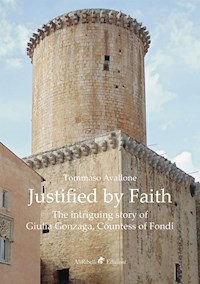
Justified by Faith. The intriguing story of Giulia Gonzaga, Countess of Fondi
by Tommaso Avallone
Publishing director: Jason R. Forbus
ISBN 978-88-33465-28-9
Published by Ali Ribelli Edizioni, 2020©
Essays – History
www.aliribelli.com – [email protected]
Any reproduction of this book is strictly forbidden, even partially, with means of
any kind, without the clear authorization of Editor.
Tommaso Avallone
Justified by Faith
The intriguing story ofGiulia Gonzaga, Countess of Fondi
AliRibelli Edizioni
Contents
About the author
Introduction
Memories of a young man
Ch. 1
Child of nobility
Ch. 2
Arranged Marriage
Ch. 3
Life Changing Tragedies
Ch. 4
Admirer and Protector
Ch. 5
Deadly Surprise Attack on Sperlonga
Ch. 6
Barbarossa and the Ottoman Empire under Sultan Suleiman
Ch. 7
Barbarossa’s Attack on Fondi
Ch. 8
Court Jesters and Sycophants
Ch. 9
Holy Alliance
Ch. 10
Secret Life
Ch. 11
Feeling Weary
Ch.12
Hero or Villain
Ch.13
Roman Inquisition
Epilogue
Unresolved Mysteries
Bibliography
About the author
Tommaso Avallone was born in Gaeta, Italy. He immigrated to America in 1961 when he was twelve years old. In 1971 he graduated from St. John Fisher College in New York State with a BA degree in Political Science. Upon graduation, he taught social studies at a Catholic middle school and eventually landed his “dream job” as a U.S. federal law enforcement investigator. After a long and decorated career as a civil servant, Avallone retired in 2004 and now spends much of his time studying history and enjoying family time.
“Peace is the beauty of life. It is sunshine. It is the smile of a child, the love of a mother, the joy of a father, the togetherness of a family. It is the advancement of man, the victory of a just cause, the triumph of truth”
– Menachem Begin
(https://www.azquotes.com/author/21300-Menachem_Begin)
A special thanks to my family and friends for their patience and support as I struggled to research and write my first book. I love you and may God Bless you all.
– Tommaso Avallone
Introduction
Memories of a young man
The Santuario della Montagna Spaccata (The Holy Place of the Split Mountain) located on a remote seaside cliff overlooking the Italian town of Gaeta was originally a monastery built over one thousand years ago by the Benedictine monks. I still have vivid memories of my first visit to the Montagna Spaccata. I was about ten years old in 1957. My mother and I, along with a group of neighbors, met our parish priest at the entrance of a tunnel located near the base of the mountain. After lighting candles, we were led up the dark, musty tunnel while singing religious hymns. We emerged on a rocky ledge overlooking the crystalline blue sea as gentle waves caressed the golden sand of Serapo beach.
A brief walk along a wooded trail brought us to the wrought iron gates of the sacred grounds of the Montagna Spaccata. Entering the Church of the Santissima Trinita’ (Most Holy Trinity) we were reminded that Saint Benedict, Saint Francis of Assisi, and Saint Philip Neri had visited and prayed at this miraculous location many centuries before us.
After celebrating mass, we followed the priest to the nearby entrance of the Montagna Spaccata. According to local legend, the large fissure in the mountain formed when Jesus cried out with a loud voice and yielded up his spirit and behold… the earth shook, and the rocks were split. When the centurions and those who were with Him saw the earthquake and what took place, they were filled with awe, and said, ‘Truly this was the Son of God’.1
Proceeding down the narrow fissure in the mountain, we stopped at what appeared to be the impression of a human hand in the rock called “la mano del Turco” (the hand of the Turk). The marble sign next to it stated, “It’s told that a non-believer, possibly a Turkish pirate, refused to believe that the mountain split when Jesus Christ died on the cross, and to scorn this, the pirate laid his hand on the rock. The rock became soft and the impression of his hand remained in the rock. Circa 15th Century”.2
As I read the words on the marble sign, I felt a sense of amazement thinking I was witnessing the result of a supernatural event. After a few moments of reflection and prayer, we continued down the narrow fissure to the “Chapel of the Crucifix”. The small chapel appeared to be built on a large boulder that fell from the top of the mountain and became lodged about halfway down the fissure. From a narrow ledge outside the chapel, we admired the spectacular view of the cliffs as they narrowed toward the turquoise sea below.
We then walked a short distance to the astounding natural phenomena called “La Grotta del Turco” (Grotto of the Turk). Entering the enormous cavern from an opening at the top of the mountain, we walked down hundreds of steps to the rocky beach at the bottom of the cave. Every sound took an eerie tone, especially the priest’s voice as he explained how the grotto came to be known as “grotto of the Turk”. He told us that hundreds of years before Turkish pirates used the grotto to hide their ships before launching surprise attacks on merchant vessels sailing to and from the port of Gaeta. We were then told the story of a sinister Turkish pirate called Barbarossa who once landed on our shores and attacked the neighboring town of Fondi in order to capture the beautiful princess of our region.




