


Erhalten Sie Zugang zu diesem und mehr als 300000 Büchern ab EUR 5,99 monatlich.
- Herausgeber: Books on Demand
- Kategorie: Geisteswissenschaft
- Sprache: Englisch
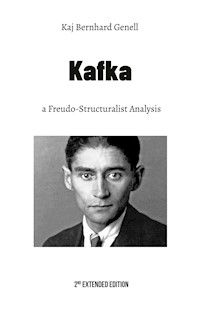
"Kafka - a Freudo-Structuralist Analysis" deals with the stylistic effects of Kafka's Novels and Short Stories and concentrates mainly on understanding what contributed to the famous Kafka effect - the "Kafkaesque". The author - Kaj Bernh. Genell, born in Sweden, who is also an author of novels in English and Swedish, thoroughly explains the determining structural triplicity of a discourse seen as Consciousness. Important in this structure is how Freud, Romantic irony, and Symbolistic Literature simultaneously co-work as a mythical subtext. Kafka created what would become critical parts of the definition of Modern Man. Thus, according to the author, understanding Kafka - and his extraordinary technique - is the main road to understanding Modernity and our Future.
Sie lesen das E-Book in den Legimi-Apps auf:
Seitenzahl: 290
Veröffentlichungsjahr: 2022
Das E-Book (TTS) können Sie hören im Abo „Legimi Premium” in Legimi-Apps auf:
Ähnliche




















This book is dedicated to all those People
Who are fighting for and are doing their best
To uphold Democracy, Parliamentarism,
Freedom of Speech, of Press,
Media & Arts & are advocates for
Human Rights in General, everywhere
On our planet.
CONTENT
I. Preface. Franz Kafka – a unique writer
PART I.
Chapter I. A SHORT BIOGRAPHY
Chapter II . The Literary TRADITION & its influence upon FK.
a.) German romantic Irony and Saga – the ”Kunstmärchen”
b.) Gustave Flaubert
c.) Robert Walser
d.) Charles Dickens
PART II.
ON KAFKA´S LITERARY TECHNIQUE AND THE STRUCTURE OF HIS WORKS
Chapter III . The literary work, the Trick
i. Trance
ii. The Kafkaesque. A split Universe
iii. The NEXUS of the Theory. THE EXTENDED STRUCTURE:- Unconscious B
EXAMPLES
iv. Example: The Trial
v. Example: The Metamorphosis
vi. Example: The Country Doctor
vii. Example: The Verdict
viii. Example: The Castle; The “Bürgel episode”
Chapter VI . Controversies
a.) Kafka and Judaism
b.) Kafka and Marxist Theory
c.) Unfinishedness
d.) The Narrator
e.) Symbolism
f.) Change of style
g.) Deliberation, Irony, and Desire
h.) Kafka and myth
Chapter V. Conclusion
PREFACE
FRANZ KAFKA, A UNIQUE WRITER WITHOUT ANY PREDECESSORS OR SUCCESSORS
In an important sense, Kafka is, of course, neither a "magical realist" nor a "religious mystic," nor, for that matter, any "writer of parables." Kafka´s works are Kafkaesque. If Kafka´s works are political, religious, or psychoanalytical is a matter of interpretation. But that they are Kafkaesque is not. They are distinctly Kafkaesque. Kafka's works are entirely original, and they are so by the existence of the Kafkaesque. And the Kafkaesque is the determining factor when it comes to the effect of the entire work. The Kafkaesque - a product - emanates in its purely technical aspect out of a literary form. Kafka's structural, literary form, in which his significant works are put, is based upon a refined mega-structural narrative split, paraphrased upon Freud´s notion of Unconscious, the division between a hero-"voice" and a world-" voice" on the one hand, and conscious unconscious, on the other. This book is much about these splits and their consequences.
In another aspect, this book claims that the Kafkaesque connects to Romanticism in a combination that thrives in surpassing Symbolism, Freud's theories, and Freudianism.
Whereas Kafka's authorship is very subtle and complex, it is also wholly and utterly unique. It is unique because no other author is even remotely close to having written anything that can even be mistaken to be written by Kafka. There is, at the same time, nothing artificial in it. It is also coherent, and the beauty and truth of these literary works spring from a very rare literary and psychological sensibility and an innate knowledge of writing fiction. On that, many agree.
Furthermore, the uniqueness is of such a kind that Kafka is without actual predecessors. There are no successors either, no "Kafka-school," and there will probably never materialize any such thing. Kafka also, in this splendid isolation, has, as we all know, grown to become a "concept," a concept of his own: Cf.: "It was quite a Kafka scenario."; "Almost Kafkaesque!"; "It certainly was a bit Kafka."
The mind has created the concept of "Kafkaesque." which has become an important, almost everyday concept, extending our way of perception. This concept has almost become vital for the understanding of our culture. Our questions regarding this concept, which is somewhat elusive regarding its actual content despite its frequency and importance, are mainly two:
1. What more precisely do we mean by "Kafkaesque"?
2. How did Kafka DO to create this "Kafkaesque"?
Merely asking for the meaning of the concept of the" Kafkaesque," we find ourselves almost stuck in the classic circular paradox of analysis. Furthermore - since we are trying to describe this effect and the technique that shaped this effect, we are simultaneously executing two studies - genuinely dependent on each other in a scientifically quite forbidden way. These analyses are mutually reliant on each other! In trying to elucidate technique by effect, one could not possibly avoid subjectivity. Therefore, this study that does precisely this is not even pretending to be scientific but is just philosophical. It is philosophical reasoning around a narrative that is split in a twofold manner, around a twofold axis. However, this Philosophical work aims to determine the meaning of the concept of "Kafkaesque" to eradicate mystifications.
-------------------------------
The first question is simply put. What is Kafkaesque?
The EFFECT: When it comes to the hero figure, we have a Buster Keaton-like hero in Kafka´s work without any shadow. According to Adorno, the Kafka heroes are “instructed to leave their psyche at the door.”
We are prone to think that the hero stands close to some wall, shadowless and that we, at the same time, can perceive an extreme contrast. On the one hand, we have a shadowless hero; on the other hand, we seem to have a hero with a giant contrast. One might perhaps say that the impossibility of the description of this effect has led to the creation of a brand new concept derived from the proper name of Kafka: the concept of the Kafkaesque.
One might look upon the Kafkaesque as a literary genre term, although it is not evident that there is a genre. There is much confusion regarding the concept of Kafkaesque. By using the concept, some scientists and other authors refer to the way Kafka wrote, while others, by using the concept, refer to the effect of Kafka's works. By using the word "Kafkaesque," some are referring exclusively to a special kind of fictive universe, some sort of ontological sphere, and it is here as if the concept of Kafkaesque could be put alongside f. ex. "supernatural," "surreal," "Helvetic," "Paradisiac." As a literary concept, it is comparable in cultural importance to "Orwellian," but overshadowing this.
Concepts referring to experiences of literary works are rarely, if ever, concise. The notions of romanticism, realism, magical realism, symbolism, and surrealism, to take a few, have no precise definitions. In determining literary experience, we deal not only with ideological, cultural, and psychological matters but with tacit knowledge and complex matters concerning the ontology of fiction. Perhaps the concept of "Kafka" might be regarded as an ongoing question in Modernity itself that will prevail no matter how much we try to sort out the problem?. The relation: The "Kafka code" ( the central theme in this book ) => The Kafkaesque is not at all obvious. Many technical aspects were most probably not even known to Kafka himself. We shall take a slow approach to find a fruitful explanation of the special connection between the method and the Kafkaesque by first taking a brief look at Kafka's life.
Although this has nothing to do with central technical, formal matters, it is still essential to include some biographical facts concerning Kafka. It is implausible that a work like Kafka's could have been produced by anyone else than Kafka and in another place in another time than in Prague around this very time. I think that historical phenomena have an essential part as requisite and condition in creating the concept of Kafkaesque.
PART I
CHAPTER I A SHORT BIOGRAPHY
PRAGUE.
During this time, the double monarchy of Habsburg was intact, powerful, and wealthy. This superpower was compounded of about fifteen different nationalities, and it was run, since 1848, by the emperor Franz Joseph. Prague is situated on both sides of the river Moldau, almost in the midst of Bohemia. This ancient town 1900 had about 40.000 German-speaking inhabitants, while the majorities were 400.000 Czechs. These groups – who were both Christians and Jews, lived almost segregated. Different groups existed side by side "with and against each other," as someone has said. In Prague, 9% of the population was, like the Kafka family, Jews at this time.
Prague was a more complex city concerning class than, for example, Vienna, the center of power of the Habsburg dynasty, was at this time. In Vienna, with its 1.7 million inhabitants, the group of Jews had rapidly grown to a more predominant group of people, and anti-Semitism was much more trouble than in Prague. The Jewish ghetto of Josephstadt, which was the biggest in Europe, and probably the oldest, had been dissolved in the revolutionary year 1848 when Franz Joseph became ruler, and the Jews had acquired their full rights to marry, etc.
In Prague, socioeconomic bonds generally prevented anti-Semitism, except in economically challenging times, when one blamed the Jews as one had done for centuries all over Europe. Official business, government, and institutions were run mainly by Germanspeaking people, while Czechs handled commerce in general and in the Czech language. Jews in Bohemia were either German or Czech speaking, but they all spoke Yiddish, and many of them in the countryside could read Hebrew. The general Class inequalities in Bohemia were enormous like they were in the empire and Europe.
Prague at this time had a German university with about 17000 students and two German theatres. Kafka could enjoy dramas by August Strindberg and Ibsen, Shakespeare's Hamlet, Lessing's Nathan der Weise, Schiller's, Goethe's, Molière's plays, and those of G. B. Shaw and Arthur Schnitzler. Kafka perhaps attended Verdi's Rigoberto, with Caruso in the main part.
Max Brod asserts that the mood of Prague was naïve. It was almost revolutionary when the Zionist M. Buber started his newspaper there or when Karl Kraus came to town. Karl Kraus was the founder of Die Fackel, a Vienna newspaper concentrating on political satire. "Prussia is very generous as far as muzzles concerns." Kraus pointed out. "Austria is the isolation cell, where you are allowed to scream."
Kraus, in Prague, during lectures, spoke in front of a roaring, excited crowd in the student club, "Die Halle." The great critic of both political and cultural matters, not least of newborn Psychoanalysis, came to this small cultural club more than fifty times, from 1910 and on. We do not precisely know if Kafka listened to Kraus in person, but it is very likely he did so. From his diaries, we see that he was well informed, widely read, and interested in everything in society.
Many Jews in Prague were secular Jews. Kraus had left Judaism, just like f. ex. Wittgenstein did. Kraus later became a forceful opponent of the famous Viennese founder of modern Zionism, Theodor Herzl and Buber. Like Vienna, Prague did not have any radiant cultural figures with the stature of Kraus, i.e., intellectuals, who fundamentally could stir society and stimulate change. Kraus's influence upon Central Europe was enormous, to which many vital scholars, such as Freud, Musil, and Arnold Schonberg, bore witness.
Max Brod, FK's life-long friend, would later characterize himself, together with Franz, as Prague-Austrians, which tells us a lot about the two young authors and their social situation. The era was marked by the dominance of the bourgeoisie and, consequently, by a moral of double standards characterized by the oppression of women.
Oswald Spengler, another important essayist academic voice, nicknamed "der Untergangster" by Kraus, bluntly asserted, in his Untergang des Abendlandes, that every culture was subject to demolition. His field of study, History of Culture, was physiognomics; Culture was a living organism. Spengler´s historicism was of an extremely impressionist kind, quite like Vico´s and Friedell´s.
Certainly, in juxtaposition to Vienna, Prague had acquired a unique, dense, and slightly ghostly atmosphere perhaps because of the city of Prague´s lack of political importance. Its literature reflects this. Within Czech literature, which stood very close to the classic German Romantic one, a genre marked by mysticism, often called "Ghost literature," might be traced back to Rabbi Yehuda Loew, who wrote the famous fable of the strange Golem. Golem was a small creature made of clay that, in this myth, came to life when a rabbi, Maharal, put a small piece of paper with God's name on it in the mouth of Golem. Loew lived around 1600, and his works were done into pastiche by G. Meyrink, E.E. Kisch, and others.
Kafka was part of the very important, somewhat educated German bourgeoisie in Prague during this turbulent time. Around 1910, he rapidly came as a young aspiring author to be a part of Modernism. As a citizen, he never became a revolutionary activist; his early sympathy for anarchism and various socialist movements was known only to a minimal circle of friends. However, it later became an essential subject in many of his short stories and prose poems.
----------------------------------------
Kafka was no ordinary young man. He regarded himself as a kind of Unmensch, a "Quasimodo," and as being "literature." He thus often did not consider himself a human being. We do not precisely know why. Where are there hidden secrets in his life? Based on information in diaries and letters, we are prone to think that Kafka wrote to survive some ordeal. However, survival probably should also fulfill the needs of his mind. ( The strange thing with survival is that one normally does not survive on nothing at all. ) The writing was a "way out," but not into emptiness, but instead into delight. We will later discuss the relation Kafka - writing – desire/jouissance . Mainly the Central European culture of those days was a hedonistic, often eroticist one.
Franz Kafka was born in 1883. Franz [Anschel, as was his Jewish name] was the only son, the son of a son of a kosher butcher from the countryside in Märhren, not far from the place where Sigmund Freud´s grandfather lived.
Herman [ Hermann ] Kafka, FK:s father, was a successful merchant of Western Jewish descent. His wife, Julie, b. Löwy, of Eastern Jewish, was the daughter of a wealthy well known Prager brewer. Herman was a member of the Jewish community's counsel and the only synagogue in Prague that provided a Czech language service, which was the only language Herman ever fully mastered. Franz never got any orthodox Jewish education since this was not compliant with Herman's determinate vision of the Jewish people's future in Europe.
Kafka had three sisters, Valli, Elli, and Ottla, and they had a French governess, Mademoiselle Bailly. The family, who generally had three servants in the house, also had a children's nurse named Anna Pouzarová, not much older than the children themselves, a nurse/playmate of which Franz felt very strongly. G. Rieck asserts that this "forbidden love strongly marks the entire authorship."
It was a bilingual home, but he went to German schools. He never grew completely familiar with the Czech language, and he could not write literature in this idiom.
Already as a boy, Franz came into conflict with his father. The son got locked out on the balcony in the night for a minor offense, which created psychic trauma.
Young Franz never showed any interest in the family business, all the more in art and literature, and hence Herman often treated young Franz with sarcastic Irony. Julie Kafka is hardly mentioned in the diaries, while the father is almost permanently present in these. Franz always sought confirmation from him but hardly ever got any. He also felt physically inferior to his father. In connection with feelings of inability to live, the father more and more stood out as an example of human beings too fit to live. As far as we know, the emotional climate of the Kafka family was neither warm nor cold. There were not much dance and music in the home. Herman liked to play cards in the evening, and when his friends were not available, Julie played with him. Herman seemed to have been all for his business. Religion meant nothing to anybody in the Kafka family.
One might get a glimpse of Kafka's boyhood and Prague's surroundings where he lived from the prose collection Betrachtung, where one might perceive the bittersweet and the unattainable as themes. During high school, young Franz took a pronounced negative attitude to romantic verse. Nevertheless, he was, on the contrary, utterly thrilled by the romantic saga, the Kunst-Märchen – a highly stylized prose that, in a sense, was from the very start a parody of itself.
Kafka was not a prominent scholar in primary and secondary school but more of an average pupil and later student. Emil Utitz, who had been to school with Kafka, later, in a letter to Klaus Wagenbach, gave a vivid and memorable description of F.K.:
"If I were to say something characteristic concerning Kafka, it would be that it was not anything special at all with him."
He took his high school exam in 1901, and he began to study law at the Ferdinand-Karl's-Universität without any particular interest in the subject.
Between 1901 and 1906, he was a student at the University.
As a lawyer, he was later able to devote himself to writing in his spare time. This was his idea from very early on. During his lifetime, Kafka would many times stress the vast importance and meaningfulness of the possibility of indulging in writing, and he was mesmerized by literature and words. Kafka, as a teenager, wrote a lot. He seemed to be born with a very fluent literary style.
------------------------------
In high school, Kafka was introduced to a famous and influential philosopher of his time, Franz Brentano. He generally is described as a phenomenological thinker. Kafka appears to have been susceptible to observations on perception problems, often called a philosophy of mind, around which Brentano had evolved his philosophical psychology. It is striking how there are ideas similar to Brentano's regarding the mental experience in Kafka's Description of a struggle (1909) and some notes in the diary from 1913. B. Smith and J. Ryan are both referring to signs of the impact of Brentano upon Kafka in a passage in Kafka's early work:
"I continued my wandering. But since I as a pedestrian feared the troubles and strains of climbing the steep path, I made it more and more smooth, and then made it sloop down towards a distant valley. The rocks disappeared according to my will, and the wind ceased to blow..."
F.K. bases the content upon the" inner life" of the narrator, upon his fancies and wishes. Kafka purportedly draws consequence from the philosophy of Brentano in surpassing it. Brentano always stressed the difference between perception and object and that we are always left with our experience, of which we, while we have this experience, always obliquely at the same time, are consciously aware. We are thus, according to Brentano, aware of what we are aware. Kafka could easily have grabbed this idea and developed it in this manner, as is seen in the example. Practically, however, Brentano, in his philosophy of perception - like Dilthey does - comes into counter-position to the old romantic idealist philosophy.
Kafka does not mention Brentano at all in his notebooks. Brentano was probably of no significant importance to F.K.. However, F.K. still might have gained essential knowledge of moral philosophy and the philosophy of right by dealing with Brentano's writings, just as he possibly acquired some skill in still purer sophistry by reading the Talmud and other Jewish literature, which he often sought out as a compensation for the lack of intellectual and religious tradition in his own childhood home.
----------------------------------
At Prague University, there was a student Cultural Club, the aforementioned "Die Halle," where one could listen to lectures and discussions concerning political, philosophical, and cultural matters. One night on the 23rd of October 1902, a small, near-sighted, hunchbacked, extremely self-confident boy, Max Brod, held a speech about Schopenhauer's views on destiny at "Die Halle." Since Brod in his speech violently attacked Nietzsche's ideas in this speech and named him "Hochstapler" (scammer), and since Kafka very much did appreciate Nietzsche, Kafka afterward approached Brod, and they then violently discussed these matters. A lifelong friendship started with this quarrel.
Max and Franz soon began to study literature together in privacy, the readings of Plato and Flaubert. Kafka, who was fluent in French due to his love of his childhood nurse, loved to read Flaubert aloud in his baritone voice. Of course, both Brod and Kafka were fluent in both Latin, Greek, and even Hebrew, since they both passed high school. Franz and Max even translated parts of Plato´s Dialogues, which is interesting particularly for a Kafka scholar, since Plato's style might, to some degree, have affected Kafka's style. Being a solid skeptic and an astute Nietzsche fan, Kafka probably found it very hard to believe in the idea of the Good with Plato, though.
During his years at the Carolinum, Kafka also consumed many memoirs and biographies, his favorite lecture throughout his life, together with travel books. He usually read several newspapers and periodicals a day throughout his life, like the Bohemia, Deutsche Arbeit, Der Jude, Der Prager Tageblatt, Hyperion, and Wir.
Kafka wrote to his comrades O. Pollak, Baum, O. Kisch, and M. Brod during summer leaves. In the letters, he told them of his consummation of literature and the beauty of the landscape around the idyllic Triesch to the north of Prague, where Kafka used to visit his uncle, the country doctor.
Kafka was an assimilated Jew if it was possible to be "assimilated" at all in Prague. He was utterly irreligious. It seems that he supported secular Zionism more than covering such. Max Brod propagated lifelong for Zionism, moved to Israel, and ended his days in Israel as a convinced Zionist, acclaimed by the establishment as an honorary citizen. The Zionist outlook never won over Kafka himself. Friedlander: "Kafka was never a Zionist.". However, Kafka's interest in Jewish identity increased with the years - perhaps as his inner desperation grew. Perhaps in line with his surroundings, with the circle of Jewish intellectuals with which he socialized, he increasingly became aware of Prague's insulation, and many of his friends discussed a future ideal society in Palestine. Towards the end of his life, his studies in the Hebrew language were more intense. He first studied this language in two rounds, first as a 25-year-old and later in 1923 when he was dying. However, it is difficult to prove that this study affected his writing. B. Becker, in her thesis, investigated the possible Kabbalistic influences in F.K.'s authorship.
Kafka had read Karl Marx's Zur Judenfrage, written in 1844, where Jewish emancipation is scrutinized. This 88-page book has an essential discussion on power, the power of the mass, the difference between European and American politics and religion, and human rights. It is exceptionally well written, which was often the case with Marx. Marx points to an alleged inherent contradiction between freedom of religious belief and Human Rights. De Beaumont had earlier invented the concept and idea of human rights in France. Bruno Bauer –the opponent against whom the book explicitly is directed – claims that no emancipation for Jews is possible as long as there are religions. Marx asserts that there is no possible emancipation for the Jews before all humans are socially emancipated. This book also contains a minor discussion of alienation.
Kafka, in 1906, graduated with a Doctor of Law. After the usual practice period, the "Rechtspraktik" - a prerequisite for working in the state administration - F.K. got nine-month employment with an Italian insurance company, Assicurazioni Generali, which was headquartered in Trieste - then belonging to Habsburg, at their Prague office. In 1908, he soon got more suitable employment as an investigator at the large Arbeiter-Unfall-Versicherungs-Anstalt in Prague. The insurance system in Bohemia was extensive; over 200,000 contractors and about three million workers were affiliated. Officials' number was on this job not less than 250. Only two of these were Jews.
Kafka FK was an ambitious, resourceful, caring, and much-respected official. He always chose to work parttime but had a good salary and never had severe financial problems, apart from the last years. In Berlin, living with Dora, he was broke. Most often, F.K. lived with the family in different chilly and noisy apartments in Prague's absolute center and rarely rented his own rooms or apartments.
At nighttime Kafka was creative. From 22:30 to 02:00 or 03:00 at night, Kafka occupied himself with his literary work during his "vintage years," i.e., the years 1912 to 1917. His breakthrough novel, The Verdict, was conceived during one single autumn night session. During these years, he seems to have indulged in the creative process instead of sleeping. From 1909 onwards, he wrote a diary, advised to do so by his dynamic, persistent, and optimistic friend Max Brod. It is a sporadic diary, and here literary drafts are mixed with short notes on health status, practical things, and notices about the family members he held very dear.
Kafka's focus was not exclusively on literature. He liked to draw, and he - despite his lack of talent - practiced on his violin, and he was fond of gardening and outdoor life. Kafka often wished to be something entirely other than a lawyer, for instance, an athlete. FK was a good swimmer, and he could, despite his weak constitution, master a horse in terrain. He cared about his health and practiced gymnastics daily in front of an open window from his earliest years. The writer in spe had his rowboat by the river Moldau. He rowed upstream and then floated down, lying on his back in the boat dressed in his usual suit, gliding under the famous Karlsbrücke and the other eight bridges. Kafka was fascinated by naked bodies and beautiful naked bodies in particular; he attended nudist camps, such as the Baltic Sea and health facilities.
Around 1909-1910, trips took Kafka to Northern Italy, Lugano and Venice, Austria, Hamburg, Helgoland, Rügen, and Marienlyst in Denmark. Kafka and Max Brod were to visit Paris together two times. When Max, the music enthusiast, chose to go to the opera, Kafka - who seems to have been almost totally insensitive to music ( although he played the violin at home ) - went to a horse race. When Brod and Kafka were in Italy, they attended an air show outside Brescia. They decided to compete to see who wrote the best record for this event, an airplane race, where the famous French pioneer aviator Bleriot took part.
This article became F.K.'s debut as a writer. The newspaper Bohemia displayed it on 28/9 1909 with the title Die Aeropläne in Brescia. It contains, apart from a description of a vivid scenery in the countryside, reflections on perfection and courage. It is striking in its precision of thought and its exact and fresh descriptions.
He frequently socialized with a small group of tightly knit friends, young men he had met in school or at the university: Oscar Pollak, Oscar Baum, Max, Otto Brod, and Felix Weltsch. These friends meant a lot to Kafka, and he was cautious not to lose them. They generally met at the cafés in Prague, at the Arco, Café Louvre, Savoy, Imperial, or the Concordia. Many of those boys, because they were all boys, came from families who were well established for generations in the city and had a long tradition of high education in their families than Kafka, at least on his father's side.
Kafka and friends also assembled in more private milieus than cafés. At the Prague pharmacy, Zum Einhorn, one Mrs. Bertha Fanta had created a wonderful cultural oasis, the rumor of which spread through the city. Visitors here were, among others, the mathematician Kowalewski, Max Planck, and also Albert Einstein, and the latter both played the violin, accompanied by Brod on the piano and talked of his theory of relativity. He also vividly discussed the philosophy of Immanuel Kant. In the Fanta-house, also debates about psychoanalysis were frequent. Sometimes also matters like Spiritism and Anthroposophy. Kafka often was present at the meetings, and he there listened to the famous mystic Rudolf Steiner and even discussed his own life with him later at his hotel.
Probably around 1904 - four years after the appearance of Freud's Traumdeutung - Kafka became aware of Freud's existence. In 1910 he purchased and read Freud's all-new Leonardo da Vinci - a childhood memory, where Freud uses the term "narcissism" for the first time. In the "psychoanalyst bible" at the time, Three essays on sexual theory discuss the concept of "sublimation." Kafka later also read Freud's essay on Michelangelo's Moses statue. The interest in Moses stayed with Kafka, and he commented to the young student G. Janouch a picture of the Moses statue - never missing a chance to criticize an authority - with the words: "'That is no leader. That is a judge, an austere judge.'". This was not Freud's view of Moses, who saw Moses as a tragic hero, a lone hero who doggedly wore his disappointment over the Jewish people.
We can speculate on the "mythology" behind Kafka's world of thought OVERALL and imagination just as much as we can speculate over the "mythology" behind Freud's work in its entirety. In Kafka's case, the answer about his mythology might actually be … Freud .
Kafka owned, what we know, only a few books on psychology and on school philosophy. We know that Kafka studied The Destiny of Man by Fichte. It is a very educational and well-spoken popular display of Fichte's philosophy and his current philosophical idealism. Kafka studied Schopenhauer, Nietzsche's predecessor, together with his sister Ottla. F.K. probably appreciated the antiauthoritarian approach and the constant reference to skepticism. He also was deeply impressed by the anti-authoritarian Kierkegaard's diaries, as well as S.K.'s two early works, Either-Or and the small book by S.K. on Genesis 22, the story of Abraham and Isaac, Fear and trembling.
Maybe Kafka was fascinated by Kierkegaard´s take on religion and philosophy, mingling these subjects into a kind of insidious abstract horror fiction inspired by the Danish author Steen Steensen Blicher. SSB was the creator of The Vicar of Vejlbye, the world’s first detective story, way before Mark Twain.
Kafka himself was very fond of reading aloud in public and sometimes even made speeches which do not match the general myth about him. His way of reciting his own works was, as his friend Oscar Baum testifies, peculiar: F.K. read in a gradually increasing pitch, read the whole short story almost in one breath, and extremely fast, "with blaring tongue."
He, as a young man, was a man full of self-reproach. He was intuitively sensitive concerning changes in moods around him - and to everything, just like Rimbaud. One would today claim that F.K. suffered from Asperger's.
Max Brod was a more social character. Brod, as a writer, was very productive. He had notably published himself in the erotic magazine Amethyst, which Kafka also subscribed to, with Das Tschechische Dienstmädchen. Brod seemed - as already indicated - to have a deep fascination with Prague, while he early became determined to move away. What Brod later came to write about Kafka seems to many as part of a "hagiography." Regardless of this, he was a friend who never let Kafka down, and he was virtually inexhaustible in good and bad times, word and deed.
Much time was spent by Kafka, before and during his sickness, in sanatoriums in the countryside, often on the Central European Mountain massive. In Prague, Kafka came into contact with Franz Werfel, poet and renowned columnist. For a while, Werfel, charming and extrovert, became one of the most ardent young Kafka critics. After having read Betrachtung, Werfel, who at the time was enjoying success with his writings, claimed with strong emphasis: "This book will never be read outside Bohemia!". He was later proved to be wrong. Werfel, who was extraordinarily productive, was part of the expressionist movement, consisting of authors who often came right from the trenches of World War I, writers like Sternheim - who was a millionaire - Werfel, Edschmid, Heym, and Trakl. F.K. was also acquainted with the learned Robert Musil, who wanted Kafka to write for Neue Rundschau in Berlin, where he was hired as a columnist.
When F.K. was studying law, he met with a renowned professor of Philosophy of Rights, Hans Gross, and attended his lectures for three terms. Gross' son, Otto, born in 1877, was to become a friend of Kafka's. Gross junior seems to have been revolting against his father. O.G. was trained as a physician, served abroad, and then became a psychiatrist, settled in Vienna, where he entered the circles of S. Freud. O.G. distinguished himself as an independent thinker in psychoanalysis, and Freud himself said that there were only two original thinkers he knew of among his friends: CG Jung and Gross. However, Gross slid, because of morphine addiction, into a schizophrenic state, and Jung's attempt to cure Otto G. with psychoanalysis. Hans Gross wanted to have his son incarcerated in a mental institution.
Kafka and Otto Gross first met in 1917. Kafka then had already produced what we now know as Amerika and The Trial and published The Metamorphosis. O.G., intelligent and communicative ( his father had died in 1915 ), was interested in everything from psychoanalysis to revolutionary movements. Franz Werfel, Kafka, and Otto Gross, who by then had left the Freud circle, in 1917 grew plans – in the midst of a war - of starting an anarchist magazine, Blätter gegen Machtwillen, but the whole thing stalled due to economic problems and to F.K.'s bad health. Franz and Otto had conversations about psychoanalysis. It has been assumed that the precocious Gross was the developer of Kafka's insights into Freud's thinking. Kafka took a skeptical view of psychoanalysis as a whole, and he never studied it at all. Gross' influence on Kafka came relatively late but may have confirmed individual perceptions, and it might even further have contributed to setting F.K.'s mind and style free. Otto Gross committed suicide in 1920.
Hermann Kafka, Franz´s father, was planning the wedding between Elli and Karl Herman. Karl Hermann had in mind to start an asbestos factory and needed money: the dowry. Herman Kafka went along with this but took counsel from his son, the lawyer, and made him promise not only to be part of the company's board but also to participate in the factory's management, which had around twenty employees. Thus F.K.'s father tried to force his son towards a future as a supervisor of a factory... The marriage and the up of the factory were soon conducted, and Kafka took part in the legal issues, and he frequently visited the factory, which now was led by a hired engineer. Franz immediately tried to withdraw from the father's "trap," which, of course, threatened to take his entire remaining time outside the insurance institution in claims, and - what was for him the overall disastrous matter -: it thus threatened to prevent him from writing. It was precisely in this situation when he really "hated his family," as Corngold writes, and it is probably the first and only time in his life he did so that he wrote the extraordinary short story The Metamorphosis.
He had earlier this year encountered Felice Bauer, and they had exchanged a couple of letters, and Kafka probably was determined to marry her dutifully.




