


Erhalten Sie Zugang zu diesem und mehr als 300000 Büchern ab EUR 5,99 monatlich.
- Herausgeber: Nick Hern Books
- Kategorie: Geisteswissenschaft
- Sprache: Englisch
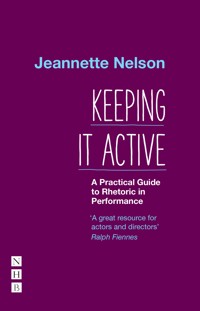
Every time you open your mouth on stage you are trying to persuade somebody of something. Sometimes referred to as 'the art of persuasion', rhetoric means using language to communicate your ideas and intentions to other people – and to make sure you are heard, understood and believed. This clear and concise guide explains how it works in plays, and how actors can use it to bring their performances to life on stage. Drawing on her decades of experience working with actors on major productions, including as Head of Voice at the National Theatre, Jeannette Nelson introduces all the major rhetorical techniques and devices that playwrights use. She offers fascinating breakdowns of dialogue and speeches from across the theatrical canon – from Shakespeare and Ibsen, to Tennessee Williams, Lorraine Hansberry and Arthur Miller, right up to contemporary playwrights such as Helen Edmundson and Tanika Gupta. Each chapter also includes a series of practical exercises which combine spoken word with physical action to help you explore and understand these techniques, and harness their power in performance. Whether you're an actor, a director or a drama teacher, Keeping It Active will empower you with a greater understanding of the ways that language underpins all dramatic works, and will give you the tools you need to unlock the text, understand characters, connect with the audience, and perform with greater confidence, focus and authenticity. 'As this excellent book outlines, rhetoric is everywhere. It's not simply in the parliament, the press conference and the court; it's in the workplace, the home and the family. There's no argument, classical or modern, in a play that isn't informed and helped by Jeannette's work' Josie Rourke, from her Foreword 'A great resource for actors and directors' Ralph Fiennes 'Jeannette Nelson's revelatory relationship to language is, quite simply, life-changing' Simon Godwin 'Jeannette taught me so much... I felt like I could persuade anybody to do anything' Sophie Okonedo
Sie lesen das E-Book in den Legimi-Apps auf:
Seitenzahl: 196
Veröffentlichungsjahr: 2022
Das E-Book (TTS) können Sie hören im Abo „Legimi Premium” in Legimi-Apps auf:
Ähnliche




















Jeannette Nelson
Keeping It Active
A Practical Guide to Rhetoric in Performance
Foreword by Josie Rourke
NICK HERN BOOKS
London
www.nickhernbooks.co.uk
Contents
Foreword by Josie Rourke
Introduction
Preparing the Play: Where Do We Start?
Exercises with Texts
1 Rhetoric
A Little History Rhetorical Strategies
Political Rhetoric
2 Rhetoric in Drama
The Use of Rhetorical Strategies in Dramatic Speeches
Playing the Strategies
Rhetorical Strategies in Dialogue
3 Other Rhetorical Strategies in Drama
Appropriating Your Opponent’s Vocabulary
Revealing the Themes of the Play
Dislocation
Open and Closed Questions
Status in Dialogue
Listening
4 Rhetorical Patterns
Three-part Structure: Storytelling
Tricolon or The Rule of Three
Oppositions
5 Word Play, Imagery and Figurative Language
Metaphor and Simile
Expressing Feelings Actively
Alliteration and Assonance
6 Code Language
7 Showing Several Rhetorical Devices Being Used Within the Scene
8 The Use of Punctuation in Rhetoric
Colon
Semi-colon
A Word of Warning About Commas
Conclusion
Acknowledgements
About the Author
Praise forKeep It Active
Copyright Information
Foreword
Josie Rourke
I was recently a part of a panel discussing ethics in modern politics. The audience was mainly establishment figures: politicians and civil servants. During the Q&A, someone raised their hand and asked how, as a politician, one could be ‘authentic’.
It’s a tricky one because you can – of course – be authentically awful. I think the questioner was asking how politicians make themselves trusted and believed. As Jeannette points out, in this great book: hundreds of years ago, the answer to that would have been ‘with rhetoric’.
It’s a cliché for me to write that rhetoric is a dirty word. Like many dirty words, rhetoric is a powerful and powerfully misused term. Often, the accusation ‘That’s just rhetoric’ is levelled at the idea itself rather than the techniques of argument that ‘rhetoric’ describes. When we say ‘rhetoric’ but mean ‘lying’, we’re finding fault with the car when we meant to criticise the route its driver has chosen.
But can we blame us? As a director who has worked a lot on plays containing rhetoric, I’m not sure that the ‘Rhetoric doesn’t hurt people; people hurt people’ notion always holds. To understand how to make the shape of an argument can make you more argumentative. Once you know how it works and can manipulate the blocks you’re playing with, it’s addictive. It can make you into a full-time salesperson.
For me, it’s a pressing question. If the twentieth century decided everything was for sale, that having gone well, the twenty-first century turned its attention to selling the self. There’s no better moment to interrogate how that’s done and – by extension – what doing it does to the self.
As this excellent book outlines, rhetoric is everywhere. It’s not simply in the parliament, the press conference and the court; it’s in the workplace, the home and the family. There’s no argument, classical or modern, in a play that isn’t informed and helped by Jeannette’s work.
Thinking back to the beginning of that work, with Jeannette and my friend Benet Brandreth, whom she mentions in this book: this idea of ‘rhetoric’ was a big, lovely learning curve for me. Both Jeannette and Benet were teaching me and the acting company concepts we’d not studied before.
It’s important that I can lay this out here because I also think that we’re in a cultural and political moment of acute awareness as to how certain types of education are aligned with certain conditions of privilege. Put simply, there are not debating societies in all schools.
What I’d say of this great work on rhetoric is that there’s some stuff that we may not be taught at school but that doesn’t mean it’s not our cultural inheritance. One of the things I find to be so moving about this book is Jeannette Nelson’s steady and generous determination that we should share and know everything about acting.
Equally, one of the things I admire so much about British actors is their appetite for knowledge and continuing training. This system of thinking about text is fascinating; useful; political and should be accessible to all. I’m so grateful to Jeannette for her laying it out in this book with such great clarity and her compassionate understanding of the whole craft of acting.
Josie Rourke was born in Salford. She is the former Artistic Director of the Bush Theatre and the Donmar Warehouse. She served as a Non-Executive Director of Channel 4. Her current roles include Vice President of the London Library.
RHETORIC IS ABOUT MAKING SURE YOU ARE HEARD,
Standing in the bar of a London theatre one evening, at the interval of a new play, I overheard a conversation between three people that went something like this:
A: I’m struggling with this, the rhetoric is so overdone. I’m not sure I’ll go back in for the second half.
B: Well, you have to get your ear in, don’t you? But I think it’s worth it. I’d say it’s not overdone, I’d say it’s rich.
C: I think the problem is that everyone is speaking a different rhetoric so no one is talking to anyone.
Whatever the problem with this particular play, I think the real problem was that each speaker meant something different when they spoke about rhetoric, and only speaker C got anywhere near the real meaning. Rhetoric isn’t a general catch-all term for spoken language: it’s about how we communicate; how we make an impact on our listeners; and specifically, what language we choose to try to make things happen. If you are an actor, or a director, or a teacher of acting or theatre studies, then you need to know about rhetoric, because it is the Art of Persuasion. In this book I’m going to tell you something about it, how it works in plays, and how it can transform the work of actors.
I think that every time you open your mouth on stage (and maybe in life) you are trying to persuade somebody of something: an idea or point of view, in order to be better understood or to change someone’s mind; to get what you want; or to make something happen. Characters in plays often, consciously or unconsciously, employ various rhetorical techniques to try to gain or maintain ground in some way. Whether that be socially, politically, ethically or emotionally, it is interesting and empowering to discover who can and who cannot, who does and who does not play the rhetorical word game.
In 2005, I was voice coach for the Royal Shakespeare Company’s ‘Gunpowder’ season in the Swan Theatre in Stratford-upon-Avon. As part of that season, Josie Rourke directed a production of Believe What You Will (original title Believe As You List) by Philip Massinger which changed my way of thinking about and working with texts forever. During rehearsals she invited the barrister Benet Brandreth to come and talk to the company about rhetoric. That day he shone a new light on everything I had ever learned about voice and text for theatre. That illumination has steered my work ever since, and I want to share it with you here.
Applying voice work to the text – to the words and thoughts of individual characters – has always been an essential element of a theatre voice coach’s job. Up to that point I had been quite successful, I think, but, now that I have more understanding of the true purpose of rhetoric, I have been able to refine my approach to working with the language of plays, and create a simplicity and unity to the work that is easily understood and used by actors. The results are productions that have been praised for their clarity. When an actor understands and actively uses a play’s rhetoric, it works for them, their character and the audience.
You may think that rhetoric is something old-fashioned and therefore only relevant to older works, like classical Greek plays or those of Shakespeare and his contemporaries. It is not. My aim in this book is to help you to see that rhetoric – language used persuasively and strategically – is to be found in the dialogue and speeches of plays from all periods and in all forms. I hear rhetoric alive and very active in every play I read, listen to or work with, and I am going to share that perspective with you. You will see that, if an actor can recognise and understand the rhetoric, they can allow the character they are playing to own it, and by doing so, they can get deeper into the mind and under the skin of that character. You will also find that working with the rhetoric will greatly aid the clarity and audibility of the dialogue, as it is a way of actively using the text to communicate with other characters in the play, as well as with the audience.
Although I have been a theatre voice coach for over thirty years, my journey to that day in the rehearsal room in Stratford had begun in 1997 when I was the first voice coach at Shakespeare’s Globe Theatre, located in Southwark, on the south bank of the River Thames in London. The Globe is a re-creation of a theatre that Shakespeare had played in and part owned. If you have seen plays there, you will know how beautiful it is and that it enjoys its authenticity as a building. However, for a modern actor, using modern acting techniques, it is not an easy place in which to make yourself heard clearly by every member of the audience. Even in the original building it can’t have been easy: these playhouses were very difficult spaces in which to focus on the play. They were crowded with an audience that wasn’t simply seated in an orderly fashion: there were people walking around; there were people selling fruit and other snacks; the ‘groundlings’ were standing or perhaps milling around in front of the stage; the place was open to the elements and the wooden structure was noisy to walk on. Much of that is true of the modern version too. The audience in the original theatre was very socially varied, and the majority were not literate. However, they would say they were going to hear a play, not see a play, as we say today.
In the modern Globe Theatre, audiences are rather better behaved, but the actors still have to contend with some noise and distractions from inside the building, as well as the intrusive sounds of a modern capital city coming from outside, including aircraft, motorbikes and, when I was there, bridge-building! So, I spent a great deal of time thinking about how I could best focus my work to help the actors perform successfully in that acoustically challenging space. Eventually, my thoughts turned to a very basic question: why had the playwrights writing for those theatres used verse drama? Knowing that verse drama was the dominant form of early European plays and that most of the time they had been performed outside, I realised the simple fact that verse was and still is a very powerful form with which to reach out to an audience. Verse, with all its stylistic elements, can really help the audience to hear the play; to follow the complexities of plot and to engage with the feelings and motivations of characters. Especially in the open air and in those noisy, busy Elizabethan theatres.
Despite this realisation, I wonder what you’ll think when I tell you I never go to a Shakespeare production to hear poetry. I go to hear ideas and stories. I want to tell you I’m not interested in how well an actor speaks the verse; I’m interested in plays that move me in some way because of how characters think and speak in the situations in which they find themselves. I’m interested in hearing the depth and complexity of the human mind that Shakespeare presents to us as his characters try to make their way through the equally complex world they find themselves in. A world that is as complex today.
This doesn’t mean that I don’t look at, use, or care about the style, form and content of poetic texts. For me, everything that is considered to be poetry in Shakespeare, and in other writers who use a poetic form of drama, is rhetoric: language designed to persuade. Alliteration, assonance, rhyme, repetition, metre, antithesis, imagery, the form and shape of the poetry are all hooks to draw the listener’s ear to the meaning of the text. My work engages with all the rhetorical/poetical elements of the text but not for the sake of poetry or beauty, but to empower the actor and their character to own the language and the ideas it carries and use it to be heard. When an actor does this, they play the text very actively, focusing what they are saying on the person or people they are talking to in order to be heard and understood by them. This then goes a long way towards the audience really hearing the play, and quite possibly being moved or changed by what they hear.
Being ‘active’ with a character’s thoughts, speaking ‘actively’, and ‘actioning’ your lines have become almost standard practice for British actors and directors today. The ideas are firmly based in Stanislavsky’s techniques and have been made popular through the work of the director Max Stafford-Clark, with whom I have had the pleasure of working many times. Max outlined his ‘actioning’ method in his book Letters to George (Nick Hern Books, 1989). He introduced the idea of using a transitive verb to describe how characters, moment by moment, try to affect, or change the mind of, the people they are speaking to. I want to show you in this book that, when an actor thinks about being persuasive when their character speaks, they will also be using their words actively. Working with rhetoric is absolutely in line with this modern British acting practice, and plays very well alongside it.
I am indebted to Josie Rourke more that she will ever know, and also to the many talented actors who have taken this understanding of rhetoric into their wonderful performances.
I am also deeply grateful to the directors who have since allowed me and encouraged me to work in this way. In particular Dominic Cooke, Marianne Elliott, Simon Godwin, Nicholas Hytner, Rufus Norris and Ian Rickson.
Preparing the Play: Where Do We Start?
Where do you start when you have been cast in a play, or if you are preparing to direct a play? When you’ve read the text and got a sense of the story, how do you explore the characters? How do you find your way into a part? If you are an actor, you probably look through the play to see what other characters say about your character, and what your character says about themself. You might begin to think through a backstory to fill the character’s life experience and what brought them to the point where they enter the play. As you begin to rehearse you will start to explore how they feel; what is their emotional truth. You may also be thinking about subtext and what is not being said.
When I look at a piece of playtext or listen to it spoken, I look for or listen for structure and patterns in the language. This is the way I discover the characters and the drama. I look for the way people explain themselves, through imagery and ideas. I see and hear where words are repeated or shared between characters; where they question and answer; where they listen or don’t listen; and whether they hear what’s being said to them or not. I discover how characters use vocabulary and idiom, and whether it unites people or divides them. I look for where their linguistic ammunition lies, and if and when they use it. I explore how characters lay out their thoughts, ideas and needs to each other, and I look for how they try to make things happen; how they try to persuade others to do, feel or think certain things. I follow the characters’ language journeys through the drama, and I am looking for how they use rhetoric. I would like to introduce you to this and to the way I help actors find and use some of the rhetorical strategies to be found in plays. I will be sharing my way of thinking, my way of unlocking the language of a text, and how the actors and I can explore and play with what we find.
In my opinion, there is danger in an actor dwelling too much upon what individual words mean to them. It is a style of speaking that is often encouraged when working with Shakespeare. This is the idea that, in order to move the audience, the actor must realise the full emotional potential of the words Shakespeare has written. This can result in the actor being more concerned about how they or their character feels than they are about the effect their words are having on the person or people they are speaking to. Speech then tends to become reflective and passive, and the whole event can be very dull and often hard to follow. It can leave the audience cold or even irritated, as they witness the actor wrenching the language from their bodies.
In my experience, if an actor/character chooses to talk to themself on stage, the audience will never hear clearly what they are saying. Of course, I understand that there will be many moments when an actor instinctively wants to speak the words, or even a single word, reflectively or perhaps with a sense of the personal enjoyment of their character. However, I know that when this happens, the words are rarely heard clearly by the audience, especially in large theatres. Even in a soliloquy I feel it is important that the actor addresses someone or something (the audience, God, the universe). Then there is someone with whom to work out their thoughts: a focus for their argument. In doing so the language becomes active and moves the character and the play forward, and takes the audience with them.
In addition, when the rhetorical elements are understood by an actor and played dynamically, they can also reveal character and support the play’s subtext and supra-text in a powerful way.
Exercises with Texts
In this book I am going to introduce you to some of the rhetorical strategies dramatists have given and are still giving their characters: strategies with which they move forward through the drama of the life they are sharing with us. Then I am going to show you some of the exercises I give to the actors I work with, to help them explore these strategies and use them to the full. I will also show you how other, perhaps more familiar, linguistic elements can be used persuasively, and I will give you further exercises to explore and define these elements.
These exercises are quite simple and usually in some way physical. When actors use their bodies in conjunction with the spoken word, it helps them to see and feel the structure of arguments very clearly. They are not strenuous exercises – I use them with actors of all ages and all physical conditions. As you will see, the exercises generally follow a similar pattern: they are designed to unlock the journey and the geography of thoughts and strategies found in the language of the play – and to unlock how characters debate, persuade, provoke and transform in some way, each other, themselves or their fate.
The work of the great Cicely Berry is the inspiration for many of these exercises. I was lucky enough to be employed by the Royal Shakespeare Company when she was still very active there. Her work was first introduced to me by David Carey when I trained as a voice coach at Central School of Speech and Drama.
RHETORIC IS THE ART OF PERSUASION, DESIGNED FOR DEBATE AND THE EXCHANGE
Today the word ‘rhetoric’ seems to carry negative connotations; to imply manipulation, deceit or just petty wordplay; the tool of the political spin doctor, producing sound bites for media consumption. It is rarely associated with truth.
But rhetoric is the Art of Persuasion, designed for debate and the exchange of ideas. It is a way of understanding and using powerful language: language that will get into the ear and the imagination of the listener. Once you know a bit about it, you will realise that we use rhetoric all the time. In this book I will reveal some rhetorical techniques, and I will show you them used first in political speeches and then in plays. I believe you will understand them very easily. You may even find some of them are familiar to you but perhaps you had not heard them described as rhetoric. I also believe you will probably hear some of them spoken to you or even coming from your own mouth.
A Little History
Speaking appropriately and skilfully has been valued throughout history. In pre-literate oral societies, history and culture were celebrated and passed on through storytelling. Within many of these stories, heroic leaders were admired for the way they could motivate and excite their soldiers and followers through inspirational speech. In the few texts that survive we find out that the ancient Egyptians admired eloquence. The Instruction Addressed to King Merikare states:
If you are skilled in speech, you will win,
The tongue is a (king’s) sword;
Speaking is stronger than all fighting,
The skilful is not overcome.
In another ancient Egyptian text, The Tale of the Shipwrecked Sailor, the servant says to his master, ‘A man’s mouth can save him. His speech makes one forgive him.’ The Chinese philosopher Confucius also spoke of the power of language. In The Analects he states that ‘The sole function of speech is to communicate ideas clearly,’ and that, ‘Without knowing the force of words, it is impossible to know more.’ Isn’t that wonderful? Statements from Confucius could be mottos for me, a modern voice coach.
Rhetoric as we know it today was first developed for the arguing of cases brought to law. Its seeds were sown in Ancient Greece by a group of itinerant teachers called the Sophists (the best known of whom are Gorgias and Isocrates), who travelled through the country, teaching oratorical skills. Its early flowering was in the Assembly and the law courts of Athens. There, as the idea of government by the people evolved, the ability to speak so as to be heard and to persuade became vital and often a matter of life and death.
Aristotle was the student of the great philosopher Plato and, although there are earlier texts mentioning persuasive language, he was the first to write about rhetoric as a structured discipline. His propositions were themselves debated and contested by the teachers and philosophers who followed him: primarily Demosthenes in Greece, and Cicero and Quintilian in Rome. Those that showed skill in persuasive speaking began to teach others, but it was Aristotle who wrote the manual. His treatise The Art of Rhetoric sets out structures, styles and strategies that became the blueprint for all further study of the discipline. It continues to be so today.




