


16,99 €
Mehr erfahren.
- Herausgeber: John Wiley & Sons
- Kategorie: Geisteswissenschaft
- Sprache: Englisch
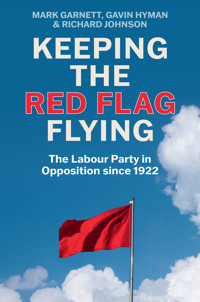
Labour leader Harold Wilson was once asked how difficult he found being prime minister of the United Kingdom. ‘Not half as difficult as being Leader of the Opposition’, he replied. Sadly for the Labour Party, much of the last century has been spent in shadow government. But were these wasted years in the Party’s history? Or did they offer vital opportunities for creation and improvement?
In Keeping the Red Flag Flying political historians Mark Garnett, Gavin Hyman and Richard Johnson offer the first in-depth account of Labour’s periods out of office since becoming the Official Opposition in 1922. They argue that, far from being barren periods in the Party’s history, Labour’s opposition years from MacDonald to Starmer have been undervalued and misunderstood. Across the book’s eight chapters they scrutinise Labour’s approach to reforming the party machinery, its development of policy proposals, its success in appealing to the wider electorate and its skill in opposing the government to identify the key hallmarks of successful opposition, as well as common mistakes. As the Labour Party prepares for a long-awaited return to government, this insightful book on Labour’s past has vital lessons for the Party’s future.
Sie lesen das E-Book in den Legimi-Apps auf:
Seitenzahl: 469
Veröffentlichungsjahr: 2024
Ähnliche



















Table of Contents
Cover
Title Page
Copyright Page
Dedication
Figures and Tables
Figures
Tables
Preface and Acknowledgements
Introduction
Notes
1 In Pursuit of an ‘Insane Miracle’ (1922–1929)
Strengthening the Party Machine: Implementing the Blueprint for Success
Assessing the Record of the Previous Labour Government (1924): A Study in Disappointment
Forming a Clear Policy Agenda: Workers’ Wages, Birth Control, and the King
Holding the Conservative Government to Account: Bark but No Bite
Managing Relationships with the Trade Unions: The General Strike and Its Aftermath
Building the Party’s Relationship with the Electorate: Women and Workers First
Conclusion
Notes
2 A Battle Over Peace (1931–1940)
The Record of the Last Labour Government: Collapse and Betrayal
Rebuilding Labour’s Relationship with the Electorate
Forming a Resolute and Detailed Policy Programme
Redefining the Party’s Relationship with Members and the Unions
Holding the Government to Account: The Approach of War
Conclusion
Notes
3 In Opposition to the Wartime Government (1940–1945)
Notes
4 ‘Fight, Fight and Fight Again’ (1951–1964)
The Previous Labour Government: Mission Accomplished?
Labour and the Electorate: Reluctant Supporters?
The Party’s Electoral Infrastructure: Wilson to the Rescue
Relations with the Trade Unions: Wooing Frank Cousins
Holding the Government to Account: Suez, the EEC and Profumo
Formation of Policy: Continuity Gives Way to Planning?
Conclusion
Notes
5 Yesterday’s Men (1970–1974)
Holding a Hapless Government to Account
Policy Development and Relations with the Unions: The Advent of ‘Bennism’
The Party and the Electorate
The February 1974 Election Campaign
Conclusion
Notes
6 Impossible Promises and Far-Fetched Resolutions (1979–1987)
Assessing the Record of the Previous Labour Government (1974–1979): Discontent, Dishonesty and Disloyalty
Strengthening the Party Machine: The Quest for Party Democracy
Building the Party’s Relationship with the Electorate: Suicide Notes and Beds of Roses
Managing Relationships with the Trade Unions: Miners and Militants
Holding the Conservative Government to Account: Friedman and the Falklands
Forming a Clear Policy Agenda: The EEC and CND
Conclusion
Notes
7 Thatcher’s Greatest Achievement? (1987–1997)
Wooing the Electorate
Electoral Infrastructure: The Millbank Machine
Holding the Government to Account
Policy Development and Relations with the Unions: Coming to Terms with ‘Thatcherism’
Conclusion
Notes
8 In New Labour’s Shadow (2010–2024)
Assessing the Record of the Previous Labour Government (1997–2010): No Heir to Blair
Managing Relationships with the Trade Unions: A Parliamentary Bust-Up
Strengthening the Party Machine: The Rise and Fall of Party Membership
Forming a Clear Policy Agenda: Vote Labour and Win a Microwave
Building the Party’s Relationship with the Electorate: The Base Weakens
Holding the Conservative Government to Account: Five Faces of Power
Conclusion
Notes
Conclusion
Notes
References
Index
End User License Agreement
List of Tables
Chapter 1
Table 1.1 Growth of Labour candidates in the 1920s
Chapter 6
Table 6.1 Total votes cast in the 1981 deputy leadership election, indicating the number o...
Chapter 8
Table 8.1 Ideological placement of Labour’s manifestos
Table 8.2 Class voting in the 2015 and 2017 elections: Support for Labour
List of Illustrations
Chapter 1
Figure 1.1 Number of votes cast for Labour, Conservatives and Liberals, 1922–1929
Chapter 6
Figure 6.1 Constitutional reforms at Labour Party conferences, 1979–1980
Figure 6.2 Polling during the short campaign of the 1983 election, with trendline for Labou...
Figure 6.3 Polling during the short campaign of the 1987 election, with trendline for Labou...
Chapter 8
Figure 8.1 Average left (−100) to right (+100) ideological placement, according to L...
Figure 8.2 Results of the 2010 Labour leadership election, final round
Figure 8.3 Breakdown of voter types in Labour leadership elections, 2015–2020
Figure 8.4 Labour Party membership, 1997–2022
Figure 8.5 Labour’s share of eligible voters and total votes cast, 1997–2019
Guide
Cover
Table of Contents
Begin Reading
Pages
iii
iv
v
vi
viii
ix
x
1
2
3
4
5
6
7
8
9
10
11
12
13
14
15
16
17
18
19
20
21
22
23
24
25
26
27
28
29
30
31
32
33
34
35
36
37
38
39
40
41
42
43
44
45
46
47
48
49
50
51
52
53
54
55
56
57
58
59
60
61
62
63
64
65
66
67
68
69
70
71
72
73
74
75
76
77
78
79
80
81
82
83
84
85
86
87
88
89
90
91
92
93
94
95
96
97
98
99
100
101
102
103
104
105
106
107
108
109
110
111
112
113
114
115
116
117
118
119
120
121
122
123
124
125
126
127
128
129
130
131
132
133
134
135
136
137
138
139
140
141
142
143
144
145
146
147
148
149
150
151
152
153
154
155
156
157
158
159
160
161
162
163
164
165
166
167
168
169
170
171
172
173
174
175
176
177
178
179
180
181
182
183
184
185
186
187
188
189
190
191
192
193
194
195
196
197
198
199
200
201
202
203
204
205
227
228
229
230
231
232
233
234
235
236
237
238
239
240
241
242
243
244
245
246
247
KEEPING THE RED FLAG FLYING
The Labour Party in Opposition since 1922
Mark Garnett
Gavin Hyman
Richard Johnson
polity
Copyright Page
Copyright © Mark Garnett, Gavin Hyman and Richard Johnson 2024
The right of Mark Garnett, Gavin Hyman and Richard Johnson to be identified as Authors of this Work has been asserted in accordance with the UK Copyright, Designs and Patents Act 1988.
First published in 2024 by Polity Press
Polity Press
65 Bridge Street
Cambridge CB2 1UR, UK
Polity Press
111 River Street
Hoboken, NJ 07030, USA
All rights reserved. Except for the quotation of short passages for the purpose of criticism and review, no part of this publication may be reproduced, stored in a retrieval system or transmitted, in any form or by any means, electronic, mechanical, photocopying, recording or otherwise, without the prior permission of the publisher.
ISBN-13: 978-1-5095-6095-0
ISBN-13: 978-1-5095-6096-7(pb)
A catalogue record for this book is available from the British Library.
Library of Congress Control Number: 2023946008
by Fakenham Prepress Solutions, Fakenham, Norfolk NR21 8NL
The publisher has used its best endeavours to ensure that the URLs for external websites referred to in this book are correct and active at the time of going to press. However, the publisher has no responsibility for the websites and can make no guarantee that a site will remain live or that the content is or will remain appropriate.
Every effort has been made to trace all copyright holders, but if any have been overlooked the publisher will be pleased to include any necessary credits in any subsequent reprint or edition.
For further information on Polity, visit our website: politybooks.com
Dedication
In memory of John ‘Jack’ Johnson
Teacher, Socialist, Grandfather
Figures and Tables
Figures
1.1 Number of votes cast for Labour, Conservatives and Liberals, 1922–1929
6.1 Constitutional reforms at Labour Party conferences, 1979–1980
6.2 Polling during the short campaign of the 1983 election, with trendline for Labour (8 May–9 June 1983)
6.3 Polling during the short campaign of the 1987 election, with trendline for Labour (2 May–11 June 1987)
8.1 Average left (−100) to right (+100) ideological placement, according to Labour members, 2010
8.2 Results of the 2010 Labour leadership election, final round
8.3 Breakdown of voter types in Labour leadership elections, 2015–2020
8.4 Labour Party membership, 1997–2022
8.5 Labour’s share of eligible voters and total votes cast, 1997–2019
Tables
1.1 Growth of Labour candidates in the 1920s
6.1 Total votes cast in the 1981 deputy leadership election, indicating the number of abstentions in the second ballot
8.1 Ideological placement of Labour’s manifestos
8.2 Class voting in the 2015 and 2017 elections: Support for Labour
Preface and Acknowledgements
The plan for this book was conceived while two of its authors travelled to an event organised by the third. On 1 October 2022, the 70th anniversary of Labour’s notorious 1952 party conference was marked by an event held at the original venue, Morecambe’s historic Winter Gardens. Thanks to the catastrophic Kwarteng/Truss mini-budget a few days earlier, an opinion poll lead which Labour had held consistently since December 2021 inflated into the kind of advantage enjoyed by Tony Blair’s ‘New Labour’ in the run up to the party’s landslide 1997 election victory.
The Labour Party delegates who met in the Winter Gardens in 1952 were coming to terms with rejection by the British voters, having finished their first of thirteen years in opposition. The activists who gathered to commemorate the occasion seventy eventful years later could allow themselves to dream that another protracted period of opposition would soon be over for their party. In an insightful and often moving address, the keynote speaker at the Morecambe commemoration, the former Shadow Chancellor John McDonnell, emphasised the importance of party unity despite the promising electoral outlook. The remaining question was: unity on whose terms? It was by no means the first time that the party had had to confront this dilemma as a party of opposition. The authors left the Winter Gardens with a reinforced feeling that a full-length study of the subject was sorely needed.
The authors are especially grateful to those who read and commented on particular draft chapters: Bernard Donoughue, Lee Evans, Bryan Gould, Conrad Landin, Colm Murphy, Kate Williams and Lewis Wormald. The two anonymous scholars who reviewed the whole manuscript provided many constructive suggestions.
Although the book was a collaborative endeavour, each chapter was assigned a principal author in initial drafting: Mark Garnett (chapters 5 and 7 and the Conclusion), Gavin Hyman (Introduction and chapters 2, 3 and 4), Richard Johnson (chapters 1, 6 and 8).
Introduction
In June 1971, the BBC broadcast an infamous documentary – ‘fast moving and irreverent’ as one commentator called it – on the Labour Party in opposition.1 It was entitled Yesterday’s Men, a mischievous turning of the tables on the Labour Party, given that they had adopted precisely this phrase in their electoral advertisements in the general election of 1970 to refer to the members of the previous Conservative government. The documentary broke new ground in that it shed some of the deference which political interviewees had hitherto been accorded, and asked questions that until then had been considered taboo.
It also broke new ground in its very focus on the Labour Party in opposition. Media attention has for the most part been lavished on governments and their doings, and opposition parties have tended to be left in the shade. At the beginning of the programme, the presenter David Dimbleby muses as follows: ‘Labour has now been a full year in the wilderness. Perhaps the worst is over; the harsh rediscovery of what it means to be out of power. It was a year to be got through rather than lived, a year when the other people made the running. Politics is severe on those who fail. They’re left to kick their heels and wait, and watch the others have a go.’ But is this all that political opposition is about, kicking one’s heels, waiting and ‘watching the others have a go’? The programme asks and seeks to answer this question, although it focuses more on the fate of the senior former Cabinet ministers and their personal fortunes rather than on the party as a whole and its work in opposition.
In books and studies on the Labour Party – both scholarly and popular – the focus has likewise tended to be on its time in government. In many ways, this is understandable. These were the years in which the party was put to the test of office. It is natural for scholars and commentators to ask how successful it was in achieving its goals, how competent it was in governing the country, to what extent it succeeded in its aim of changing society, whether it remained true to its principles and beliefs when tested in the crucible of government. But such questions are themselves dependent upon, and are only intelligible in terms of, other questions. How did the party determine its goals? How did it prepare for the task of governance? In what way did it seek to change society? How did it determine its principles and beliefs and how have these changed? Such questions can only be answered by turning instead to the time the party spent in opposition, during which, relieved of the task of governance, it had the leisure to engage in self-examination, institutional preparation and policy formation. These are vitally important tasks without which the party’s time in government would be inexplicable.
In recent years, there has been some recognition of the importance of opposition as a subject of political study. In 2010, a Centre for Opposition Studies was established, now based at the University of Bolton. One of the co-founders, Nigel Fletcher, has edited How to be in Opposition: Life in the Political Shadows (2011).2 There have also been volumes studying the Conservative Party in opposition – Recovering Power: The Conservatives in Opposition since 1867 (2005) – and the party leaders in opposition – Leaders of the Opposition: From Churchill to Cameron (2012).3 All of this is to be welcomed, but it is striking that so little attention has so far been paid to the Labour Party in opposition. Where the Labour Party has been considered, this has tended to focus on the particular individuals who served as Leaders of the Opposition, rather than the experience of the party more generally. Such neglect is surprising for at least two reasons. First, because of the sheer number of years that the party has spent in opposition. In the 100 years since it first became the official party of opposition, it has spent only about a third of those years in government. The party is therefore much more used to being in opposition than in government, which makes an examination of its time in opposition all the more pertinent. This also, of course, raises the further question of why the party has spent so much of its time in opposition. Is this because it has squandered much of its time in opposition or more because of its failures in government? Again, this is a question that cannot be answered by an examination of the party’s time in government alone.
Secondly, an examination of its years spent in opposition is particularly relevant for the Labour Party which understands itself to be a party of ‘change’, in contrast to the Conservative Party which, in principle at least, ultimately seeks to ‘conserve’. The change that has been sought has been primarily to the economic system of capitalism, which is why the Labour Party has historically defined itself as a ‘socialist’ party. But the party has had to answer the fundamental question of what form this change should take. In the early years, this entailed the party asking whether it should seek to dismantle capitalism or to reform it. As we shall see, the 1930s were decisive years in which the party ultimately decided to reform capitalism. But this raised further questions over the nature and extent of this reform, prompting arguments that raged throughout Labour’s time in opposition in the 1950s and, again, in the 1980s. In the 1990s, the party decided less to reform capitalism than to administer it more fairly, later expressing considerable dissatisfaction with this minimalist approach in the 2010s. These were vitally important decisions in the evolution of what the party meant by ‘change’ and they were all effected during periods of soul-searching in opposition. It would not be an exaggeration to say that its time spent in opposition has served to define the party. This, in turn, has determined the party’s agenda at the times it has entered into government. And yet, the party’s experience of opposition has not been accorded the attention it deserves. In the chapters that follow, we seek to rectify this neglect.
In the 100 years or so covered by this book, the country, society, politics and the Labour Party have changed enormously. Sensitivity to this has necessitated a chronological approach, and each chapter in what follows is devoted to a particular period of time that the party spent in opposition. But equally, one of the aims of this book is to think across and between these periods, to draw comparisons and to analyse thematically across the broad sweep of the century during which Labour has been one of the two major parties. In order to do this, we have adopted a common set of criteria by which Labour’s time in opposition may be judged. Again, sensitivity to the differences between these periods has led us to apply these criteria in a malleable rather than a rigid way, thus allowing us to work with a common standard of assessment while avoiding undue distortion.
In a very broad sense, we may say that the duties of a party in opposition are of two main kinds – those that look outward and those that look inward. In terms of Britain’s parliamentary system of government, the most important – and outward-looking – role of the main opposition party is to hold the government of the day to account. The Official Opposition in Parliament is meant to scrutinise, question and criticise government legislation. The existence of the opposition in Parliament is to ensure that there is a tangible body of critical opinion to which the government of the day is answerable. An effective opposition does not, of course, indiscriminately oppose everything the government does. Rather, it has to measure the government’s legislative proposals against its own standards, policies and principles and demonstrate the ways in which such legislation is wanting. How to measure the effectiveness of an opposition in this respect is a difficult question. An opposition is at its most effective when it is able to force a government to change course or even bring a government down. There are some examples of an opposition being able to do both of those things. For instance, the Labour opposition in 1935 was able to persuade the government to change its plans for the provision of unemployment benefit, and in 1990 it helped to ensure a change of policy on the poll tax. In the late 1930s, it helped to secure the end of the policy of appeasement. It made a direct contribution to the fall of Neville Chamberlain as prime minister in 1940 and an indirect contribution to the deposing of Margaret Thatcher in 1990. But the very fact that an opposition is in a minority in Parliament means that the opportunities for forcing such radical government concessions are rare. Furthermore, it is usually able to achieve them only by harnessing wider public opinion or by exploiting discontent within the government party itself. More frequently, the success of an opposition in holding a government to account will be measured by the extent to which an opposition is able to persuade the wider electorate that they are a government in waiting who would be more effective than the current incumbents.
This, indeed, is the second of our outward-looking criteria. As much as looking at the government benches facing them in the House of Commons, an effective opposition must communicate successfully to the wider population outside Parliament itself, upon which it depends for its transformation from opposition to government. The nature of this task has changed considerably over the century covered by this book. In the 1920s, the challenge was to persuade voters to trust an untried and untested party with the reins of government. When they were tried and tested, the results were not encouraging. After the Second World War, and Labour’s decisive electoral victory, the voting habits of the electorate settled down into remarkably stable patterns and political identities became markedly tribal. Election results were determined by one or more of three things: Labour supporters staying at home and failing to vote; a change of vote on behalf of the small number of ‘floating’ or undecided voters; and the electoral fortunes of the Liberal Party. In the case of the first two groups, the Labour opposition had to pursue quite distinct tactics to persuade them to vote Labour. The Liberal vote could produce unexpected outcomes. It grew considerably between 1951 and 1964, but the increase tended to come from disaffected Conservative voters, thus allowing Labour to win in 1964, albeit with a smaller vote than in the previous three elections, which it had lost.
After 1979, the nature of the electorate changed considerably. For various societal and cultural reasons, it became much less tribal and entrenched. There was an increasing level of political disengagement, party membership numbers fell, political disillusionment grew and the turnout at elections was smaller. Political ideology waned and public relations, image, social media and ‘spin’ became increasingly important. This meant that the task of appealing to the electorate changed considerably from what it had been fifty years before. The Labour Party became adept at mastering this art in the late 1990s and into the new millennium, and it was rewarded with a sustained period in government. But after 2010, there emerged a new political re-enchantment; a younger generation of voters was politically engaged but found the established political parties to be wanting. The Labour Party was able to appeal to this new constituency of the electorate by decisively renouncing its ‘neo-liberal’ and image-obsessed recent past and adopting a new and more radical set of policies and leaders. The party increased its vote considerably, especially in 2017, but the resistant government vote increased even more, thus making victory elusive. In recent years, the party has shed its radicalism and has been leading in the polls for some time, although whether there is a causal connection between these two things is less clear. As in some previous periods covered by this book, Labour’s recent poll lead may have more to do with an increasing disillusionment with the Conservative government than with a groundswell of popular support for the Labour opposition.
But however much media presentation, advertising and public relations may have been important tools in cultivating the support of the electorate, these can ultimately be no substitute for the formation of a clear and coherent policy offering. This is the first of our inward-looking criteria by which we assess Labour’s respective periods of opposition. A party’s time out of office provides an invaluable opportunity for it to reassess, take stock and reformulate its policy agenda in response to changing political and societal circumstances. As we shall see, different periods of opposition have been of varying degrees of significance in this respect. For instance, the 1930s were of decisive importance in terms of the party’s policy formation. Its previous period in office had not been a success, and this was in large part because it had failed to do detailed and specific policy planning in its previous periods in opposition. It now undertook extensive policy planning which created an ample agenda for Labour’s period in government in 1945–51. In contrast, Labour’s period in opposition from 1951 to 1964 witnessed much policy debate, but little policy innovation. It essentially committed itself to the consolidation and enhancement of the policy agenda it had set itself in the 1930s. By the 1990s, such an agenda was unequivocally repudiated when the party essentially made peace with the country’s free-market reforms of the 1980s, and sought instead to advocate policies of social justice that would work within rather than dismantle those reforms. All of these decisions were to determine the nature and achievements of successive Labour governments, but it is impossible to understand them fully without an appreciation of how these policies were formed during periods of opposition.
There is, however, another important sense in which opposition parties must look inwards during periods out of office. At the party conference of 1960, the young MP Roy Jenkins declaimed, ‘we exist to change society. We are not likely to be very successful if we are horrified at any suggestion of changing ourselves.’4 A period in opposition is indeed an ideal opportunity for a party to change itself – its infrastructure, processes, electoral machine, constitution. As much as a party’s policies, its own organisational structures have to be reassessed, updated and adapted to changing circumstances. Although, on the surface, they can appear to be unexciting exercises in bureaucratic reform, they can nevertheless have far-reaching consequences with the capacity both to galvanise and to demoralise party members. Many Labour Party reforms have been advanced under the banner of ‘democratisation’, such as that of 1937, which gave local parties the right to elect directly their own representatives to the National Executive Committee (NEC). The watchword of ‘democratisation’ was also much heard during the ascendancy of the left in the 1980s, when it came to focus particularly on the method used to elect the party leader.
This was itself an indication of the increased importance of the role of the leader. In the earlier years, the leader of the parliamentary party had been an important source of authority, but one alongside others such as the NEC, the Shadow Cabinet, conference, the parliamentary party and the trade unions. But as time went on, the leadership succeeded in wresting more and more power from these various bodies. There was therefore increasingly more at stake in the election of the party leader. As a result of a process of ‘democratisation’, the electorate for the party leadership evolved from being the parliamentary party, through a series of electoral colleges to being the membership of the party as a whole. This last reform resulted in a more dramatic change in the political complexion of the leadership than had been seen for decades, perhaps ever, when Jeremy Corbyn was elected leader in 2015. This was a graphic illustration of the fact that internal party reform was by no means simply a matter of bureaucratic proceduralism.
The final criterion by which we assess the Labour Party’s periods in opposition is simultaneously both outward- and inward-looking, namely, its relationship with the trade unions. This must be regarded as both an outward- and an inward-looking criterion because of the trade unions’ uniquely ambivalent relationship with the Labour Party. On the one hand, the trade unions are an integral part not only of the Labour movement, but of the Labour Party itself. Indeed, the party was created as a result of the combining of the trade unions with the Independent Labour Party in Parliament, as well as with the various socialist organisations outside. But at the same time, the trade unions have never been subsumed by the Labour Party, and have been concerned to protect their own independent interests and existence. This semi-detached relationship has also well-suited the party itself. It has relied on the trade unions for support, personnel and finances. But it has always been careful to preserve its own independence and to avoid impressions that it is ‘controlled’ by the unions. Consequently, the party’s handling of its relationship with the trade unions has been a delicate matter, and has occasionally been fraught with controversy. The relationship has been rendered more complicated still by the political complexion of the trade unions in relation to the wider party. In the earlier years, the unions were firmly allied to the ‘right-wing’ of the party and were seen as a constant stumbling block to the left. Their concern was with securing a better deal for their membership in the here and now under the current conditions of capitalism; they were impatient with the socialist idealism of those on the left of the party. But in later years, as the party aligned itself more with free-market values, both the unions and the party became increasingly alienated from each other, and the unions now found themselves considerably to the left of the party itself. Although, during these years, relations with the unions were weakened, they were never entirely repudiated. How to manage their relationship has been a tricky question for both party and unions to negotiate. The party’s times in opposition have given the necessary pauses to reconsider the nature of the relationship.
The purpose of this book is to refocus attention away from the Labour Party’s periods in government to its periods in opposition. The party’s raison d’être, of course, is to be in government, and so any time spent in opposition is, by definition, a falling short. But in a democratic system, such opposition periods are inevitable. Further than this, we want to argue that such periods are not only inevitable but also indispensable. A party constantly in government would have no time to take stock, reassess its priorities and policies, revitalise its organisational structures and prepare itself anew for a period of government. We also want to claim that a party’s time in opposition is not to be judged solely by the speed with which it gets re-elected into government. There are a range of criteria by which a Labour opposition is to be assessed – as have been enumerated above – which may well have far-reaching ramifications beyond the simple question of how quickly the party returns to power. As we shall see, some periods of opposition have been more significant than others. Some have determined the course not only of the next Labour government but of several more to come. In others, the opposition members seem to do little more than ‘kick their heels and wait, and watch the others have a go’. But either way, Labour governments cannot be fully understood without a proper understanding of their corresponding time spent as Labour oppositions.
Notes
1
This was Peter Snow’s description of the programme when he introduced it as part of BBC Parliament’s
Harold Wilson Night
on 16 February 2013.
2
Fletcher, 2011.
3
Ball and Seldon, 2005; Heppell, 2012.
4
Quoted in Campbell, 2014, 210.
1In Pursuit of an ‘Insane Miracle’ (1922–1929)
‘Not even on the wildest night of Armistice Week’ had a crowd in central London been so boisterous.1 On 17 November 1922, Piccadilly Circus was teeming with so many people that all motor traffic was blocked. The throng was mesmerised. Looming over them was an electronic sign affixed to a building on Shaftesbury Avenue. Intermittently, the name of a parliamentary constituency would appear and reveal the winner of the seat in that week’s general election. The crowd would erupt in cheers, regardless of the victor, in response to this entirely new phenomenon.2 ‘The excellence of the electrical device – its swiftness of working – rather left the crowd breathless’, reported an exhilarated Manchester Guardian journalist.3
The following day, the dust had settled. With 308 MPs needed for a majority, the Conservatives had won a comfortable 344 seats. Conversely, the situation looked desperate for the Liberal Party, historically the Conservatives’ main rivals for power. Split between supporters of two charismatic figures claiming party leadership – Herbert Henry Asquith and David Lloyd George – the Liberals suffered their worst result to that point. Taken together, just 115 Liberal MPs were elected.
For the first time, the Labour Party secured second place – both in votes and seats. Nearly 30 per cent of the electorate had supported Labour, 8 percentage points shy of the Conservatives, returning 142 Labour MPs, a net gain of eighty-five. ‘The Labour Party is to claim the full privileges of his Majesty’s Opposition’, announced The Evening Standard. The newspaper reported that John Robert Clynes, a diminutive working-class Lancashire MP and chairman of the Parliamentary Labour Party (PLP), was to become the first Labour Leader of the Opposition.4
At the state opening of Parliament on 21 November, Clynes walked alongside the prime minister Bonar Law in Black Rod’s procession to the House of Lords.5 Yet, that evening, Clynes was deposed by his own MPs. It is the only instance in the history of the Labour Party in which an incumbent has been defeated in a leadership challenge. Ramsay MacDonald was elected sixty-one to fifty-five, with twenty-five MPs not voting. MacDonald’s narrow victory was delivered by the party’s left-wing, in part in recognition of his opposition to the Great War. It was a manoeuvre that they would seriously come to regret in the years to follow.
With the Conservatives holding a comfortable majority, no one expected an election in just thirteen months’ time. Even more so, no one expected that the next election would sweep Labour into power. Yet, on 22 January 1924, Ramsay MacDonald was invited by King George V to form a government and become the first Labour prime minister. MacDonald, who had helped to found the Labour Representation Committee in 1900, called the formation of the first Labour government just twenty-four years later ‘an insane miracle’.6
The minority Labour government lasted just over nine months and left an unspectacular legislative record. Yet, its mere existence quashed doubts over whether the Labour Party was fit to rule the United Kingdom and answered whether Labour was prepared to operate within the framework of the British constitution. To the labour movement, however, the disappointing realities of government encouraged some to seek alternative means of achieving working-class goals, culminating in the General Strike of 1926.
The Labour Party had two central challenges in the 1920s. The first was to persuade socialists and the wider labour movement that it could achieve their aims through parliamentary democracy. The temptation of direct action manifested itself in political strikes, grassroots collaborations with Communists, and disruptive stunts by Labour MPs in the House of Commons. By the end of the decade much of the labour movement had set these impulses aside, however, having been chastened by the failure of the General Strike.
The second challenge was to persuade the country that Labour was fit to govern. It was in the 1920s that the Labour Party first demonstrated that it was the only clear alternative to Conservative governments. To do this, the party rejected notions of a progressive alliance with the Liberals and made majority government its overriding goal. Labour also made clear its commitment to the constitution, winning respect from unlikely corners, not least the king himself.7
Organisationally, the 1920s were a triumphant decade for the Labour Party. Key decisions were made about Labour’s internal structures, its electoral machinery, its ties with the trade unions, and its relationship to the revolutionary left. These choices set the tone for the party’s development for a century. The Labour Party today still lives with the legacy bequeathed by those years of opposition from 1922 to 1929. Herbert Morrison, first elected a Labour MP in 1923, reflected nearly forty years later that the ‘twenties, had we known it, was [sic] a shaping time for the Labour Party of the future’.8
Where the Labour Party in the 1920s fell short was in its policy development, especially domestic policy. Too much time was spent on organisational questions at party conferences. Efforts to create a joint policy research department with the unions ended in failure. The Labour leadership, especially Ramsay MacDonald and the (Shadow) Chancellor Philip Snowden, were essentially locked in an orthodox understanding of economics which fell well short of the grand, romantic visions they espoused for a socialist society. In addition, union leadership was far from visionary. The unions were defensive of their own bargaining autonomy, blocking party members’ proposals for a national minimum wage and women’s demands for family allowances. As time wore on, the Labour left grew increasingly critical of this myopia, whereas MacDonald became more hostile to suggestions of moving leftward.
At the May 1929 general election, the hard work in building the party machine and Labour’s careful allocation of resources paid off. On 37 per cent of the vote, Labour won 47 per cent of seats and formed a minority government once again. Yet, the party’s failure to develop a rigorous policy programme resulted in yet another lacklustre legislative record. MacDonald’s, by then, caustic relationship with Labour MPs and the wider labour movement presaged his departure from the Labour Party entirely in 1931, described by Clement Attlee as ‘the biggest betrayal in British political history’.9
Strengthening the Party Machine: Implementing the Blueprint for Success
The blueprint of Labour’s organisational success in the 1920s was its 1918 constitution, written by the socialist LSE academic Sidney Webb. The document rationalised the bureaucratic operation of the Labour Party, creating a clear structure of policy-making, electioneering and governance, as well as articulating Labour’s core ideological commitments. David Howell writes that ‘the Labour Party’s 1918 Constitution was the organizational expression of a party committed to an ambitious electoral strategy’.10
Until this point, there had been no concept of individual Labour Party membership. The party had been founded as a federation of socialist organisations and trade unions in 1900. Supporters ‘joined’ the party through the transitive property – by being a member of an affiliated socialist society, such as the Fabian Society or the Independent Labour Party (ILP), or through membership of an affiliated trade union. While the affiliation system brought individuals into the Labour Party who might otherwise not have joined, it was a barrier to those who simply wanted to support the party as such.
After 1918, individuals were entitled to join Divisional Labour Parties (DLPs), and women could also join the party through the Labour women’s sections. These innovations encouraged the formation of local Labour parties. Before the First World War, just a quarter of constituencies had a local organisation, but by the mid-1920s practically every constituency did.11 Divisional Labour Parties became vital for electioneering – at parliamentary and local levels – and for internal party democracy, such as the selection of conference delegates. They were a home not just for political debate and discussion but for a whole variety of social activities and even social services. In London, Labour-supporting lawyers established a legal advice bureau which assisted party members on rents, housing, pensions and poor relief. Social activities included Labour amateur dramatic clubs, choirs, orchestras, informal sports teams and cycling clubs.12 Ramsay MacDonald, however, regarded the DLPs as too parochial and believed local committees chose ‘men who are quite useless in the House of Commons’ as parliamentary candidates.13
The 1918 constitution cemented the principle of the supremacy of the annual party conference. It declared: ‘It shall be the duty of the Party Conference to decide … what specific proposals of legislative, financial, or administrative reform shall receive the general support of the party.’ Equally, it held that no policy proposal ‘shall be made definitely part of the General Programme of the Party unless it has been adopted by the Conference’.
In between party conferences, Labour was to be run by a National Executive Committee, comprising representatives from the affiliated unions, socialist societies, the Parliamentary Labour Party, women’s sections and DLPs. Underscoring its importance, the NEC attracted some of the party’s top talent. Chief among these was Arthur Henderson, ‘the architect of the party modernization’.14 In the 1920s, the NEC established several standing sub-committees on areas that would be vital for the party’s development: 1) organisation and elections, 2) policy and programme, 3) literature, research and publicity, and 4) finance and general purposes. It created the position of National Agent to oversee the party’s election capabilities. In addition, the NEC created a ‘star speakers’ rota, ensuring that leading figures of the party toured the country, enthusing local Labour parties and raising the party’s profile. The institutional structure set out by the 1918 constitution meant that by the time Labour secured its shock victory in the November 1923 election, the party had, in the words of organisational heavyweight Herbert Morrison, ‘a nationwide political organization covering all but a tiny handful of the constituencies’.15
Local government was an important base for Labour’s parliamentary success. Morrison wrote in 1918, ‘until Labour has shown its capacity in the field of municipal statesmanship it is questionable whether the electorate will be anxious to send our candidates to Westminster’.16 In addition to demonstrating Labour’s capacity to govern, local government provided a training ground for some of the leading Labour figures of the generation of MPs first elected in the 1920s. Labour frontbenchers Clement Attlee, John Wheatley, Manny Shinwell, Herbert Morrison and Sidney Webb had all served in local government prior to their election to Parliament.
Morrison observed in 1921: ‘A machine without high principles is a machine of no real value. And high principles without an efficient machine constitute but a voice crying in the wilderness. We have to make an efficient machine for a high moral purpose.’17 It is, therefore, understandable why the 1918 constitution set out not just details about the technical organisation of the party machinery but also the ideological basis of the party in bold, visionary (if vague) terms. It committed the party explicitly to socialist objectives in its famous Clause IV:
To secure for the producers by hand or by brain the full fruits of their industry and the most equitable distribution thereof that may be possible upon the basis of the common ownership of the means of production and the best obtainable system of popular administration and control of each industry or service.
As with all constitutions, the written word is only as meaningful as the actual practices and norms of politics around it. Labour’s constitutional order was shaped by the party’s electoral advances in the 1920s. For example, the 1918 constitution contained the principle of the sovereignty of the party conference, yet this ideal collided with the demands of electoral strategy, party management and leadership. To illustrate, in 1928 the Labour conference voted to establish a commission that would investigate the feasibility of a national minimum wage. Ramsay MacDonald simply shrugged his shoulders and indicated that he would ignore the commission’s recommendations, whatever they found.
Another example was the invention of the party leader. Before 1922, it is not strictly accurate to say that the Labour Party had a leader at all. The 1918 constitution makes no mention of the position. Since 1906, Labour MPs had elected a chairman, but this position was effectively passed around by MPs and was mostly administrative. This helps to explain why Labour failed to take up the mantle of Official Opposition in 1918 even though after that election it became the largest opposition party to take its seats.18 Alastair Reid and Henry Pelling write, ‘MacDonald was a leader in a sense that none of his predecessors in the party chairmanship (including himself before the war) had been.’19 For the first time, the position became known as ‘chairman and leader’ to indicate that the holder was also Leader of the Opposition and a potential prime minister.20 A strong party leader, however, ran in tension with the constitution’s organisational structure. MacDonald grumbled that he was being suffocated by party bureaucracy, writing in 1928: ‘It is very easy to make the position of the leader of the Labour Party – with all its committees and sub-committees – perfectly impossible, and that is what is happening at present.’21
One of the biggest organisational challenges for Labour in the 1920s was deciding its relationship with the far left. Some local Labour parties, especially in London and South Wales, had expressed sympathies with the Communist experiment in Russia. Upon its founding in 1920, the British Communist Party sought affiliation to the Labour Party. The initial request was rejected by the NEC, but in 1921 an NEC sub-committee was formed to consider the matter in more detail. They concluded that affiliation was out of the question on constitutional grounds. Arthur Henderson, who served on the committee, explained: ‘Parliamentary democracy is the method by which we hope to secure our object … You repudiate the view that the social revolution can come through Parliamentary democracy and I say again that by the repudiation of that view there is a difference which is fundamental.’22 At the 1922 Labour conference, the question of Communist Party affiliation was considered and rejected. The General Secretary of the Miners’ Federation, Frank Hodges, called British Communists ‘the intellectual slaves of Moscow … taking the judgement of middle-class Russia – the residue of the old regime – not even the judgement of the plain Russian people, but the dictates and decrees of the same type of intellectual whom they despised in this country’.23
Although the Communist Party could not affiliate, individuals were still allowed to be members of both parties. One, Shapurji Saklatvala, even stood as a joint Communist and Labour candidate in Battersea North. Winning the seat in 1922, he became the first Labour MP of Asian heritage.24 In 1925, the Labour conference banned dual Labour and Communist individual membership, but Communists could still attend Labour conference as union delegates. It wasn’t until 1928 that Labour conference finally closed this loophole, bringing an end to the participation of Communists within the Labour Party at any level.
Not all local Labour parties were enthused by this decision. Bethnal Green Labour Party had surreptitiously stood on a joint slate with the Communists in the 1925 local elections, leading to their suspension. The local council defiantly named a new housing estate ‘the Lenin Estate’ in ‘recognition of the great work he had done on behalf of the workers of the world’.25 In the summer of 1927 alone, the NEC suspended twenty-three local Labour parties, including fifteen in London, for Communist infiltration.26
Outside of the formal apparatus of the party, the 1920s saw the blossoming of a left-wing media environment which tried to provide alternative perspectives to the right-leaning broadsheets. The main voice of the Labour movement was the Daily Herald, restored as a daily in 1919. From 1922, it fell under the financial control of the Labour Party and Trades Union Congress (TUC), which held a 49 per cent stake. Its editorship transferred from the rebellious George Lansbury to the more pliant Hamilton Fyfe. The Transport and General Workers’ Union (TGWU) leader Ernest Bevin even called the Herald ‘my newspaper’.27 Bevin believed strongly that Labour needed a daily newspaper that could compete with the Mail and the Express, and in this decade its reach increased enormously. By 1929, its circulation was 300,000, climbing to 1 million by 1933. The Herald was the first daily newspaper in the world to reach a circulation of 2 million.28
There were also weekly publications, usually aimed at more intellectual audiences. These included the New Statesman and the ILP’s New Leader. The circulation of the latter peaked at 70,000 in the mid-1920s. The New Leader attracted high-quality articles from H.G. Wells to E.M. Forster to George Bernard Shaw, as well as attractive drawings and wood cuts. Unlike the Herald, the New Leader regarded itself as the purveyor of Labour’s socialist conscience and regularly attacked the leadership for philosophical deviations. Eight months into his first ministry, the Labour prime minister bristled: ‘As to the New Leader frankly I have lost all interest in it. It is not the kind of paper that does any good to anybody. It has neither weight nor place and its egotistical aloofness would kill any movement.’29
Assessing the Record of the Previous Labour Government (1924): A Study in Disappointment
On 18 January 1924, four days before King George V invited Ramsay MacDonald to form the first Labour government, Winston Churchill wrote to The Times to warn the country of impending catastrophe. In apocalyptic terms, he raged, ‘The enthronement in office of a Socialist Government will be a serious national misfortune such as has usually befallen great states only on the morrow of defeat in war.’30 Unlike the apoplectic Churchill, Conservative MP Neville Chamberlain speculated that Labour would be ‘too weak to do much harm, but not too weak to get discredited’.31
The first Labour government lasted from January until November 1924. Labour came to power when the Conservatives, who had lost their majority in the November 1923 election, lost a vote of confidence in January 1924. Rather than call another election, the king decided to ask his Loyal Opposition to form a government. Even though it held just under a third of the seats in Parliament, Labour had ruled out any idea of a coalition with the Liberals and chose to govern as a minority instead.
In hindsight, Labour’s decision to govern alone was probably the right one. It helped to establish Labour as the alternative to a Conservative government and blocked the Liberals’ access to power. Labour’s problem was that it entered government with few ideas of what it wanted to do. So accustomed had Labour been to opposing the other two parties, that it lacked a coherent domestic policy agenda. Attlee explained that this was partly because Labour had not expected an election in 1923, let alone to be the victor. So, the party programme, except in foreign affairs, had not had time to develop as it might have in a four- or five-year Parliament.32 There is some plausibility in this argument.
The new prime minister Ramsay MacDonald showed his interest to be in foreign affairs, deciding to appoint himself as his own Foreign Secretary. In this role, MacDonald made a couple of significant achievements, chief among these was getting the French to agree to the Americans’ Dawes Plan, which resolved the question of outstanding German war reparations. The Labour government also formally recognised the Soviet Union for the first time, in spite of King George V warning MacDonald at their first meeting that he ‘hoped I would do nothing to compel him to shake hands with the murderers of his relatives’.33
For many in the labour movement, the 1924 government was a bitter disappointment. Labour MP Oswald Mosley wrote acerbically to MacDonald: ‘No abiding mark, except possibly in the foreign sphere, will have been left by the first Labour Government with power. In this eventuality, the cause of Labour might be retarded for a generation.’34 In the view of some in the trade union movement, the Labour government had been actively hostile to their interests. The first week of the Labour government saw a nine-day strike by train drivers in the ASLEF union. The ‘big 4’ railway companies had tried to force through reduced pay and longer hours. Much to the irritation of the striking train drivers, the Labour government declined to intervene on their behalf. ASLEF’s leader John Bromley was furious. ‘If the success of the Labour Party and of a Labour Government can only be built on such serious losses in wages and conditions, I am not sure that the workers will very much welcome a Labour government’, he warned.35
Sharing frustrations over government inaction, the Labour left blamed the Labour government for lacking a clear political vision of how to bring about socialism. After Labour’s defeat in the October 1924 election, left-wing Labour MPs tried to remove MacDonald from the leadership. James Maxton of Glasgow and Richard Wallhead of Merthyr proposed George Lansbury as a challenger, but Lansbury declined their nomination.36 MacDonald was saved, but he interpreted the challenge as treachery. He fumed in his diary: ‘The Left Wing were out for my blood, and had not the sense to restrain itself.’37
However, it was the left of the party that had delivered Labour’s one major domestic policy achievement in government. The Housing Act 1924, known more widely as the Wheatley Housing Act after the minister responsible, substantially increased central government subsidies to local councils to build social housing. It led to the construction of half a million new council homes and was the first housing bill to require that the new homes were equipped with an indoor bathroom.38 John Wheatley was that Cabinet’s ‘only one out-and-out left-winger’,39 as a scion of ‘Red Clydeside’ and the Independent Labour Party (ILP).
Upon re-entering opposition, the ILP became the bastion of left-wing critique of the 1924 Labour government. The ILP had been founded by Keir Hardie in 1893 with the aim of electing socialists to Parliament. With little money and no trade union support, the ILP could not survive on its own. Consequently, it teamed up with other socialist groups and trade unions to form the Labour Representation Committee in 1900, considered to be the founding moment of the Labour Party. After 1900, the ILP maintained its distinct identity as an affiliated socialist society within the Labour Party and was generally seen as the high-minded socialist counterbalance to the hardnosed political caution of the trade unions.
The ILP burnished itself as the keeper of the flame of true socialism throughout the 1920s. It was a ‘cave of Adullam for socialists’, a hideout for those awaiting the New Jerusalem.40 MacDonald became increasingly irritated by their harping criticism. Things came to a head at the 1925 ILP conference, the first after the fall of the Labour government. MacDonald, rather condescendingly, told delegates that governing the country was ‘quite different from getting resolutions passed at ILP conference’. In response, Campbell Stephen, a Glaswegian MP and ILP stalwart, charged that there was no evidence ‘sufficient to differentiate [MacDonald’s Government] from Mr Baldwin’s Government today’. An ILP delegate recorded MacDonald’s reaction:
The knuckles of his hands gripping the edge of the table were white with the unconscious pressure he was exerting as he listened to the insulting words. His face was red and his eyes alight with the fury that he was with difficulty repressing … [MacDonald] spat into my face with a hoarse whisper, ‘That damned little swine – Campbell Stephen.’41
It was the last ILP conference MacDonald would ever attend. In 1926, he swore, ‘I can speak at no Conference promoted to popularise absolutely meaningless phrases and to mislead the whole of our Socialist movement.’42 In 1927, the ILP retaliated by refusing, for the first time, to nominate MacDonald to be Treasurer of the Labour Party, a position he had held since 1912. In 1930, he resigned his membership entirely.
Forming a Clear Policy Agenda: Workers’ Wages, Birth Control, and the King
The 1920s were not a decade of significant policy development in the Labour Party. Much of the business that occupied the NEC and party conference was administrative in nature, such as questions about the party’s relationship to Communists. Many of Labour’s leading figures from both the left and right lacked a clear sense of how socialism ought to be brought about. Trade unionists maintained a sectional focus on improving workers’ wages and conditions, with little interest in wider questions of economic and social organisation. Many of Labour’s supposed ‘intellectuals’ also had relatively undeveloped ideas about socialist economics.
For many of them, like George Lansbury, socialism was oppositional. It manifested itself in reaction against a capitalist enemy. In the London Borough of Poplar, Lansbury had helped lead a revolt in 1921 by local




