


7,19 €
Mehr erfahren.
- Herausgeber: Luath Press
- Kategorie: Lebensstil
- Sprache: Englisch
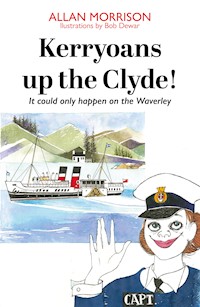
'If the Waverley sank right now and I wanted to swim to the nearest land, how far would that be?' 'About a hundred yards, sur.' 'Amazing. Which way?' 'Down!' True 'Glesca' humour and history combined, Kerryoans up the Clyde! recounts the adventures of a vessel full of character with a captain to match: Morrison's Waverley and 'Big Lizzie' are each as formidable and inalienably Scottish as the other. Morrison captures the charmingly unique spirit of the last of the Clyde's paddle steamers as well as the facts of its history. Full of playful tales, many a chuckle and the quirky illustrations of Bob Dewar, you're sure to find something that floats your boat!
Das E-Book können Sie in Legimi-Apps oder einer beliebigen App lesen, die das folgende Format unterstützen:
Seitenzahl: 125
Veröffentlichungsjahr: 2021
Ähnliche














ALLAN MORRISON is a prolific author whose previous books include Goanae No Dae That, Last Tram Tae Auchenshuggle, Haud ma Chips Ah’ve Drapped the Wean, Naw First Minister, Haud that Bus and Should’ve Gone Tae Specsavers, Ref! His media appearances include The One Show, The Riverside Show, Out of Doors and Good Morning Scotland. He is involved in charity work and after-dinner speaking, and is a member of his local Rotary club. Allan enjoys hillwalking, sport and travel, and is a keen football supporter. He and his wife live in the west of Scotland, and he is the proud grandfather of four grandchildren.
First published 2021
ISBN: 978-1-80425-073-0
The author’s right to be identified as author of this book under the Copyright, Designs and Patents Act 1988 has been asserted.
Typeset in 12 point Sabon by Main Point Books, Edinburgh
© Allan Morrison 2021
ON BEHALF OF CAPTAIN LIZZIE AND THE CREW, LET ME WELCOME YOU ABOARD THE PADDLE STEAMER WAVERLEY!
Contents
Acknowledgements
1 Meet Big Lizzie, Master of the Waverley
2 Introducing the Waverley
3 Master and Commander
Waverley Chuckles
4 The Wedding
Waverley Chuckles
5 Off to Tighnabruaich
Waverley Chuckles
6 A Whale of a Time
Waverley Chuckles
7 Passengers Young and Old
Waverley Chuckles
8 The Offer!
Waverley Chuckles
9 The History of the Waverley
Summary of Waverley Statistical Data
Eventful Occasions
Waverley Chuckles
Acknowledgements
During various cruises in 2021 on Waverley, I received great assistance for this book from members of the Paddle Steamer Society, Waverley officers and engineers. Also fellow passengers, including my companions Alex and Brenda Petrie, and Stuart Wadsworth.
1
Meet Big Lizzie, Master of the Waverley
EVERY SHIP IS a woman.
So, why shouldn’t the Waverley’s captain be female? Someone strong and stable at the helm, who would be a leader of men. And so, cometh the hour, cometh the... woman. The Waverley had two female mates in the past, but now it was time for a woman to be the master. Our heroine, Big Lizzie, had the privilege of captaining the iconic ship.
Just as many ships belong to a shipping line, Big Lizzie came from a line of relatives involved in public transport of one kind or another, every one of them acquiring the sobriquet ‘Big’ due to their name, stature and demeanour as self-assured extroverts. The Waverley is full of character and now had a captain to match.
Granny Aggie MacDonald was a well-known Glasgow tram conductress in the ’40s and ’50s, famous for her caustic, wisecracking tongue and ability to deal with drunks, nyaffs, officialdom and uppity citizens.
Granny Aggie’s daughter, Big Bella Lamont, who displayed all the characteristics of her mother, served on the Renfrew Ferry for many years before it was discontinued in 1984. When the Renfrew Ferry was moored on the Clyde at Glasgow and became a nightclub (named ‘The Ferry’), Bella was the natural choice as bouncer. And now her daughter, Big Lizzie Lamont, has broken the glass ceiling, continuing the proud family tradition of serving the public, this time on the seagoing legend, PS Waverley.
Lizzie (so named by her father, who had worked in the Clyde shipyards and had been proud of the ocean-going Cunard Line Queens) was blessed with the instinctive ability to process multiple pieces of information simultaneously, and as such reigned supreme on the wonderful old paddler. Her seamanship proved to be exceptional, especially in side winds and difficult tides, as the old ship is flat bottomed with a limited keel. That, combined with her amazing verbal dexterity, her nononsense hands-on approach, plus devastating wit and rambunctious style, set her out as a formidable individual who could be quite a firecracker.
Lizzie was an imposing woman well into her 40s, with an ever-expanding girth and a wibble-wabble rear due to her fondness for sampling the Waverley’s excellent fish suppers. One of the reasons she was often referred to as Big Lizzie was due to her enormous bosom, which always seemed to enter a room before she did. That, and her almost six feet stature plus rasping voice, gave her gravitas as a born leader of men, and earned respect with both crew and (most) passengers alike.
Lizzie became well used to staring into the distance, her steely eyes sizing up the oncoming weather and adjudging other ships’ possible movements, while her computer-like brain, augmented by her nautical science degree, computed the appropriate course to take.
A self-assured extrovert, she seemed impervious to any situation involving problem highfalutin passengers, or her crew. The seamen, whether totally conversant in English or not, knew immediately her orders must be obeyed when her authoritative voice rang out. Lizzie did not ‘miss and hit the wall’ and could use her wisecracking tongue to great effect. The inherent toughness in Captain Lizzie as a master mariner was enhanced by her defiance in the face of bureaucracy, fog, stormy weather and awkward passengers. Members of the crew who fell foul of her orders were soon given a broadside and marooned back in Glasgow.
Captain Lizzie did not suffer drunks (to whom she would say, ‘Listen, pal, you’re gonnae get whit ah call cirrhosis o’ the river.’). Though she herself occasionally had a propensity for a good malt. It was difficult to fool Big Lizzie. As she always said, ‘Listen, ah came up the Clyde oan the Waverley, no’ a bike!’
Lizzie gained much affection among passengers, so much so that in her time as captain she received three proposals of marriage.
None were accepted.
2
Introducing the Waverley
PS Waverley is the great survivor. An old lady who is truly a national treasure. The people’s paddle steamer that has been gracing the sea around the Clyde for many years. A wonderful example of the quality of Clyde-built ships from the bygone days of steam. A vessel of pre-eminent national importance and a great operational asset for tourism in Scotland with her four star Tourist Board Award.
The wonderful Waverley, owned by Waverley Steam Navigation Company, provides passengers with a tranquil, nostalgic experience away from the humdrum and hurly-burly of modern life.
Why the name Waverley? It all stems from Sir Walter Scott’s first historical novel, Waverley, published in 1814. It is interesting to note that the original title of his manuscript was ’Tis Sixty Years Since, which was appropriate at the time as the storyline is about an Edward Waverley and his adventures during the 1745 Jacobite uprising, approximately 60 years before the book was written. Edward Waverley now features as a figurehead on the ship’s fan-vented paddle box. It should also be noted that although ‘waverley’ means a ‘meadow of swaying wood’, PS Waverley is an extremely stable vessel.
Clyde paddle steamers started way back in 1812 with Henry Bell’s Comet. Countless have since been built for service locally, in other parts of the UK or in various locations worldwide. With the exception of the Waverley, all present-day examples of paddle propulsion can be found only on lakes, rivers or inland waterways. Waverley is truly the last seagoing paddle steamer in the world. At the start of the 20th century there were 29 paddle steamers on the River Clyde. Now there is one - Waverley.
Sailing on her is a magical experience. There is nothing better than this fine old side-paddled lady winding her nostalgic way in and out of Scotland’s sea lochs or around the coastline, providing transport links for both tourists and locals. A trip is an experience from which you will return with a mind awash with colourful memories.
A blast on her steam whistle as she announces that she is leaving a pier, or giving warning to other vessels, makes the hairs on one’s neck rise.
She is the last in a long line of pleasure steamers who gave the ‘working classes’ the opportunity to escape into another world. Sailing ‘doon the watter’ from Glasgow to various seaside resorts was, and is, a wonderful experience. Indeed, our heroine, Captain Lizzie, remembers going on family trips on this wonderful ship. Little did she know that one day she would be its Master.
Since her preservation in 1975, when she was taken over by the Waverley Steam Navigation Company, it is estimated that over five million passengers have sailed on the Waverley. It is not unreasonable to assume that at least that number sailed on her prior to preservation. At present, she carries well over 100,000 passengers annually. On trips, she carries a crew of 25 and up to 915 passengers.
Passengers join the ship by gangways on her sponson (a projection section providing extra storage and stability), or promenade decks where there are fore and aft shelters. Above is the observation deck, accessed by a stairway. The bridge, which includes the wheelhouse with the captain’s accommodation behind it, and a chart room, is above the forward lounge. Stairs (companionways) go back down to the main deck.
The boiler and engine room are midships. A souvenir shop is in a kiosk close to the restaurant aft. There is also a second bar on the lower deck which is referred to by some as the ‘washing machine bar’, as the water level can run along the portholes.
Gangways are usually placed on the sponson above the paddle box. However, depending on tides, access may be directly from the promenade deck. The captain normally oversees the passengers embarking and disembarking from the wings of the bridge.
Waverley carries two lifeboats and also has inflatable rafts and buoyant seating.
The prow can only be visited by the crew. It has a steam winch for ropes and the anchor. There is also an auxiliary tiller.
At the forward end of the aft deck shelter is the purser’s office where tickets may be purchased or vouchers exchanged.
Behind the deck shelter is a brass plaque commemorating the earlier PS Waverley built in 1898, which was sunk by enemy action at Dunkirk in 1940.
Down in the engine room, engineers in white boiler suits maintain a vigilant watch on Waverley’s powerhouse, scanning the major dials and awaiting telegraphed instructions from the bridge. The triple expansion steam engines with their pistons and rods go whirling around causing a constant smell of hot oil and steam. The main crank is attached to both paddle wheels which cannot turn independently.
Some passengers sail on this phenomenon from a bygone age to bring back evocative childhood memories, perhaps chinwagging together about the good old days when more than 40 steamers sailed the Clyde, with rival companies racing from pier to pier. Others, to enjoy the enchantment of travelling on an elegant method of transport as its paddles leave a broad carpet of foam trailing astern. Others, to enjoy the sea air from her large open decks, or to use the observation lounges to take in the wonderful scenery during an enjoyable day out, while listening to the ever-helpful commentary. Many are North American visitors taking their vacation in ‘Yurrup’. Yes, sailing on the Waverley is a truly magical, charming and unique experience.
A sail on this magnificent vessel is a ‘must have’ experience, made possible by the enthusiasts who saved her from the scrapyard.
3
Master and Commander
THE OVERCAST SKY had cleared. Now it was streaked with gold and red. The air was warm with the familiar smell of the sea. A great golden light drenched the hills, suggesting infinite distances of country beyond the Clyde. Although a thin line of cloud sat on the top of Goat Fell, its various summits were still catching the afternoon sun. All that could be heard was the thump of the paddles, the screeching and squawking of seagulls, and the sound of happy laughter as Waverley, with flags flying, pulled away from Brodick pier and the Isle of Arran, into the main channel of her home waters and up the River Clyde.
Lizzie was her usual chirpy self. Today’s cruise had gone exceedingly well. The Waverley was running like a well-oiled sewing machine.
But that was about to change.
‘In the name o’ the wee man,’ she exclaimed. ‘Where did that come from? Is that a submarine on the radar coming up behind us?’
‘Aye, captain, looks like it,’ replied Chief Officer Dougie. ‘They’re not submerged, fur ah can see their conning tower.’
With a face that suggested a dire case of constipation, Lizzie said, ‘Ah’m fair scunnered wi’ they big lumps o’ nuclear fission goin’ up and doon the Clyde. Right, get the depth charges ready.’
‘Whit! This is the Waverley, Captain. No’ a destroyer.’
‘Jist kidding. We’ll use missiles instead.’
‘Captain Lizzie! Behave yersel. Keep the heid. This is a paddle steamer. Anyway, they’re on our side, or should be. And they have about eight small escort boats surrounding them. I think it’s two police and six marine ones, no doubt all armed to the teeth.’
‘OK. We won’t attack. As Ah huvnae even a whizz bang firework, Ah’ll jist gae them a dirty look.’
Despite her unusual chutzpah, it was generally voiced abroad that Lizzie was born to be a sea captain, having come out of the womb seemingly knowing port was left and starboard right. She was now regarded as the ideal person to command the throbbing bridge of the Waverley.
Just then the radio broke into sound.
‘Hey, Captain, ma’am,’ said Second Mate Shuggie. ‘That’s that submarine on the blower and it’s an American voice. The cheeky lot are saying we should get this old tub oot the road as they’re on important government business, and are late for their scheduled berthing in Loch Long.’
Lizzie went red in the face. Her fingers wagged in fury at the armada behind. ‘That takes the biscuit. We’ve nae depth charges and nae guns an’ that bit o’ kit could wipe us aw aff the face o’ the Earth in a jiffy. Right, Shuggie. Whit are we makin’ at present?’
‘Twelve knots, Captain.’
‘Take her up to 15 knots. An’ if Chief Engineer Hamish can squeeze anything else oot the pistons, tell him tae let it rip.’
‘Aye, aye, Captain,’ replied Shuggie, a great smile spreading across his face.
Five minutes later, an American accent was heard on the radio. ‘Ahoy, Waverley. Listen. We are an ally of yours. We are members of NATO. So slow down and move aside.’
‘Jist ignore them,’ ordered Lizzie.
The American was heard again. ‘Gee, buddy. We are on international business. This nuclear sub cost two billion dollars. We have heavily armed escorting vessels. You’re just a tourist ship.’
‘Just a tourist ship!’ exploded Lizzie. ‘Right. Get onto the engine room again and see if we can get up more speed. See Americans and their gung-ho attitude! Just a bunch o’ bampots. Ah’ll show them. Now, let me speak tae this arrogant wee man in that tin can. Right! Ah’m Master o’ the Waverley. Who am Ah speaking tae?’
‘You are speaking to Commander John Humble of the USS Abilene.’




