


34,99 €
Mehr erfahren.
- Herausgeber: Haufe Lexware
- Kategorie: Fachliteratur
- Serie: Haufe Fachbuch
- Sprache: Englisch
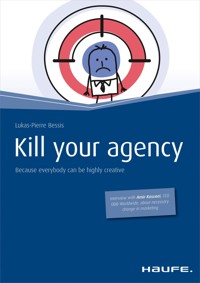
Ideas are not an accidental product! Everyone can be inventive and develop ideas that are creative and thus effective. Lukas-Pierre Bessis' new and successful method for developing ideas also considers aspects of neuro marketing. It is easy to use, sound and practice-approved by renowned companies. About the book: - With recommendations from Amir Kassaei (Chief Creative Officer, DDB Worldwide) and Julian Boulding (President thenetworkone) - Creative Effectiveness: How it works and what it brings - The six factors of effectiveness for a creative idea - Numerous examples from practice, for viewing and downloading
Das E-Book können Sie in Legimi-Apps oder einer beliebigen App lesen, die das folgende Format unterstützen:
Seitenzahl: 204
Veröffentlichungsjahr: 2015
Ähnliche



















Table of content
Copyright Notices
Haufe-Lexware GmbH & Co. KG, Freiburg
Imprint
Bibliographical Information of the German National Library
The German National Library lists this publication in the German National Bibliography. Detailed bibliographical data can be accessed on the internet at http://dnb.dnb.de.
Lukas-Pierre BessisKill your Agency. Because everybody can be highly creative1st edition 2015
© 2015, Haufe-Lexware GmbH & Co. KG, Munzinger Straße 9, 79111 Freiburg, Federal Republic of GermanyEditorial office: Fraunhoferstraße 5, 82152 Planegg/Munich, Germany
[email protected] and product management: Bettina Noé
Editor German edition: Gabriele Vogt Composition: Content Labs GmbH, 79189 Bad Krozingen Cover design: RED GmbH, 82152 Krailling
All Information/Data to the best of our knowledge but without engagement for completeness and correctness.
All rights, including but not limited to printing of excerpts, photomechanical reproduction (including microcopy) and analysis using databases, are reserved.
Dedication
This book is dedicated to my wife, my two daughters and all the wonderful people who have supported me even though I walked some twisty roads once in a while.
Acknowledgement
There are many people worthy of my thanks. Most of them have helped me without even noticing. Through advice, discussion or sometimes simply through their odd quizzical look or an approving nod. I want to thank the following people for their support, be that deliberate or unaware:[2]
Alexander Beck, Amir Kassaei, Andreas Neurohr, Andreas Sasdi, Anna Ciriacidou, Annette Richter, Archontis Moldavanidis, Bettina Noé, Chris Günthner, Christian Harr, Christoph Jaumann, Daniela Schübel, Daniela Maier, Dimitrios Argiriou, Dino Borsellino, Dino Paradiso, Eleftherios Hatziioannou, Florian Kurz, Florian Weischer, Fritz Matz, Gabriele Bender, Gabriele Vogt, Gregor Jasch, Hans Helfferich, Hartwig Glanzer, Jan-Eric Blaesner, Johannes Müller, Julian Boulding, Karl Maier, Kathrin Kulikowski, Katja Garff, Lüder Fromm, Manja Rogler, Marcus Fischer, Marie Martin, Markus Klatte, Martin Alber, Matthias Hauber, Matthias Berzel, Meike Finkelnburg, Michael Frank, Michael Thilow, Nick Sohnemann, Oliver Storm, Paul Squirrel, Peter Länge, Ralf Langwost, Rene Reich, René Staud, Saim Alkan, Sebastian Schulz, Simone Richter, Simone Durina-Sasdi, Sokrates Koutounidis, Stefan Tschakert, Stefan Seipel, Thilo Wessel, Uwe Jakob, Uwe Reiser, Vanessa Meister, Vanessa Herriott, Veit Mathauer, Wolfgang Munske.
Interview with Amir Kassaei, Chief Creative Officer, DDB Worldwide
Why write a preface – if you can just do an interview instead? In your widely acclaimed lecture during the Cannes Lions Festival 2012, you declared a new era of communication: The Age of Brand Networks. The specialist world agreed, but nevertheless we see offline communication becoming more and more generic while the much praised online world still seems to know anything but online banners, as though it were stuck in 1995. What is the error in reasoning here?[3]
I said a few years ago that one of the reasons why online communication just does not work, or at least does not work properly, can be attributed to the false notion of considering the digital medium still as something new, a notion that too many decision-makers as well as many creative and media planners share. They still cannot comprehend that the digital world is not a new form of television or a new marketing platform, but a new infrastructure that we have to deal and play with and design differently. That is the reason why 99 percent of the advertisements that you see online, regardless of which country you find yourself in and which platform you are on, barely convey any content, relevance or values, but are simply annoying instead. Unfortunately, the creators and decision-makers behind these adverts still think they can, so to speak, compensate for the lack of television or the lack of traditional indoor or outdoor media with online advertising. In my opinion, that is the misconception behind it.
Lesen Sie weiter in der vollständigen Ausgabe!
Lesen Sie weiter in der vollständigen Ausgabe!
Lesen Sie weiter in der vollständigen Ausgabe!
Lesen Sie weiter in der vollständigen Ausgabe!
Lesen Sie weiter in der vollständigen Ausgabe!
Lesen Sie weiter in der vollständigen Ausgabe!
Lesen Sie weiter in der vollständigen Ausgabe!
Lesen Sie weiter in der vollständigen Ausgabe!
Lesen Sie weiter in der vollständigen Ausgabe!
Lesen Sie weiter in der vollständigen Ausgabe!
Lesen Sie weiter in der vollständigen Ausgabe!
Lesen Sie weiter in der vollständigen Ausgabe!
Lesen Sie weiter in der vollständigen Ausgabe!
Lesen Sie weiter in der vollständigen Ausgabe!
Lesen Sie weiter in der vollständigen Ausgabe!
Lesen Sie weiter in der vollständigen Ausgabe!
Lesen Sie weiter in der vollständigen Ausgabe!




