


Erhalten Sie Zugang zu diesem und mehr als 300000 Büchern ab EUR 5,99 monatlich.
- Herausgeber: Wilton Square
- Kategorie: Poesie und Drama
- Sprache: Englisch
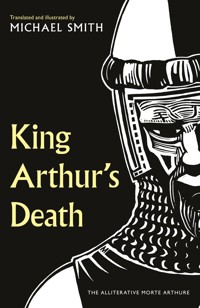
King Arthur's Death, commonly referred to as the Alliterative Morte Arthure, is a Middle English poem written in Lincolnshire at the end of the 14th century. A source work for Malory's later Morte d'Arthur, it is an epic tale which documents the horrors of war, the loneliness of kingship and the terrible price paid for arrogance. The poem tells of the arrival of emissaries from Imperial Rome demanding that Arthur pay his dues as a subject. Arthur's refusal leads him on a quest to confront his foes and challenge them for command of his lands. His venture is not without cost. Although he defeats the Romans, his decision to leave Mordred at home to watch over his realm and guard Guinevere, his queen, proves to be a costly one. He must now face Mordred for control of his kingdom – a conflict ultimately fatal to the pair of them. Combining heroic action, insight into human frailty and great attention to contemporary detail, King Arthur's Death is not only a lesson in effective kingship, it is also an astonishing mirror on our own times, highlighting the folly of letting stubborn dogma drive political decisions.
Sie lesen das E-Book in den Legimi-Apps auf:
Seitenzahl: 368
Veröffentlichungsjahr: 2026
Das E-Book (TTS) können Sie hören im Abo „Legimi Premium” in Legimi-Apps auf:
Ähnliche










Also by Michael Smith
Sir Gawain and the Green Knight (trans.)
For Adrian
CONTENTS
By the Same Author
Dedication
Historical Introduction
The Story
Notes on this Translation
King Arthur’s Death – The Alliterative Morte Arthure
Notes
Glossary
Some FurtherReading
Acknowledgements
A Note on theAuthor
Copyright
Dedicated to the memories of my great uncles:
M. T. Knowles; South Lancashire Regiment, d. 28th October 1918
and
E. H. Knowles; Royal Field Artillery, d. 9th November 1918,
two fair sons of Warrington
who fought and fell in France.
Let me speak proudly: tell the constable
We are but warriors for the working-day
Henry V
HISTORICAL INTRODUCTION
King Arthur’s Death or Arthur’s Death, otherwise known as the Alliterative Morte Arthure, is acknowledged as one of the jewels to emerge from the fourteenth-century revival in alliterative poetry, a poetic form stretching back at least to Anglo-Saxon times. The quality of the poem is widely seen as being second only to the works of the Gawain poet, also known as the Pearl poet. Like SirGawain and the Green Knight, it is a product of provincial England, thought to have been written in the dialect of southern Lincolnshire. While not as sophisticated in style or technique as Gawain, nor indeed in the layering of its messages, King Arthur’s Death is nonetheless an outstanding exemplar of the alliterative technique and is masterful in its use of a newly liberated English language, blossoming during the reigns of Edward III, Richard II and Henry IV. It was also a major source for the Roman Wars section of Sir Thomas Malory’s more famous Le Morte d’Arthur, which was published by William Caxton in 1485.
The only surviving manuscript of this version of the story is in the ‘Lincoln Thornton’ manuscript in the library of Lincoln Cathedral (Lincoln MS 91). It was transcribed c.1440 by Robert Thornton of East Newton, near York, from an earlier script (or scripts) long since vanished. King Arthur’s Death is among more than sixteen major works that Thornton transcribed during his lifetime, which include the only complete text of The Parlement of the Thre Ages and the tantalisingly incomplete Wynnere and Wastoure. These last two appear in a separate, smaller collection of Thornton’s work held in the British Library, known as the ‘London Thornton’ manuscript.
Like many poems of its time, King Arthur’s Death gained its current title in more recent centuries; it is unclear how the manuscript was originally known. Similarly, despite a line added much later to it at the end ascribing it to Robert Thornton, its actual composer is unknown. However, given its style and highly graphic nature, the poet is assumed to be a man; so throughout, I will refer to the poet as ‘he’. While being a key poem of the Alliterative Revival, it also forms a significant component of the Arthurian canon in general, drawing much of its plot and structure from the writings of Geoffrey of Monmouth, Wace, Laʒamon and others (see below). It is the combination of its subject, and its place in the Revival, which make it of particular interest to historians: why was it written at this time and what was its purpose? Elements of the poem help point to a very narrow window of time in which it could have been composed, which may help to answer these questions.
Although the poem has all the qualities of a heroic epic, King Arthur’s Death is far from being a remote, romantic work and instead pays remarkable attention to contemporary detail in terms of politics, warfare, military organisation and geography. It also exhibits an astonishing insight into human psychology as well as a nuanced approach to the chivalric ideal, contrasting the aesthetic ambitions of chivalry with the harsh realities of war and, indeed, the demands of religious duty. Consequently, the work is not so much an Arthurian romance (the magical experiences of individual knights), nor even a typical mediaeval chanson de geste (a song of deeds), but more a cutting observation of the duties of kings in their conduct of war and politics. The message appears to be that power without legitimacy is ultimately flawed, despite the best efforts of those who serve their master. The poem has contemporary relevance.
The Arthurian canon and the poet’s sources
Whether or not King Arthur was a real historical figure, his story has its most remote roots in the time after the Romans left Britain early in the fifth century. The seventh-century Y Gododdin, by the Welsh poet Aneirin, alludes to him in what is thought to be the first historical mention in literature. The later Llyfr Du Caerfyrddin (the Black Book of Carmarthen) refers to Arthur as an exalted prisoner. However, the king’s character and putative history become more established in the ninth-century Historia Britonnum, commonly attributed to the monk Nennius, when Arthur is called dux bellorum (a war lord). His story also develops in the tenth-century Annales Cambriae (the Annals of Wales). Crucially, not one of these works survives in its original form. The extant manuscripts for Y Gododdin and the Llyfr Du are thought to date from the thirteenth century; Nennius’ work, alongside the earliest known copy of the Annales, survives in the British Library in a manuscript (Harley, MS 3859) thought to be no earlier in date than the twelfth century.
It is when Geoffrey of Monmouth (c.1095–1155) created his Historia Regum Britanniae, the History of the Kings of Britain of c.1136, a magnificent – if fantastic – unifying story of Britain, that Arthur became established as a significant historical and literary figure. His work was to spawn a rich canon of Arthurian chronicles and romances which was to stretch over many centuries, including two, by the poets Robert Wace (the Roman de Brutc.1155) and Laʒamon (Laʒamon’s Brutc.1190) which were hugely influential. Wace, embellishing Geoffrey’s work, introduces us to the Round Table for the first time; Laʒamon to Arthur’s dream of his own downfall (albeit a dream which involves Mordred himself rather than Lady Fortune, as in our poem). Both Wace and Laʒamon were to have a significant impact on later works in the canon; it is in the works of Chrétien de Troyes in France (writing somewhere between 1159 and 1191) that the Arthurian stories begin to blossom. Chrétien’s adulterous Lancelot and Grail-focused Perceval were to help transform the genre, culminating in Malory’s great Le Morte D’Arthur, whose influence stretches to the present day.
King Arthur’s Death forms a key, and intriguing, part of this great corpus of work and draws upon much of it for its plot. However, the focus of the poem is less about the Round Table and chivalric romance and more about warfare and consequence. Hence, while characters such as Sir Lancelot, Sir Kay and Sir Bedevere feature within the narrative, they do so as relatively minor figures. Instead, in its pursuit of a military narrative, the poem chooses to focus on Arthur himself, Sir Cador, Sir Gawain and, of course, Sir Mordred. This reflects the historical division of the Arthur narrative into two main traditions: the romantic (e.g Chrétien de Troyes) and the chronicle (in particular works based on Geoffrey of Monmouth, known as the Galfridian tradition).
Maureen Fries, writing in Göller’s The Alliterative Morte Arthure (see Further Reading), reveals that while King Arthur’s Death is strongly placed in the Galfridian tradition it nonetheless draws on elements from romance versions of the story. The poem retains the rage of Arthur from Laʒamon’sBrut and elements of the Lady Fortune dream from the thirteenth-century French Mort Artu; its references to the Nine Worthies (lines 3267–3337 and 3406–3437) are probably drawn from the French Voeux de Paon (the Vows of the Peacock) of c.1310. Elsewhere, the Gawain–Priamus episode (2513 onwards) is thought to have derived from the twelfth-century French romance Fierabras, while the broader section in which this episode occurs is from another French romance, Li Fuerres de Gadres. Crucially, the poem also carries many unique elements of its own, including Mordred’s refusal to act as Arthur’s regent and Guinevere later bearing Mordred’s children. These elements may have been introduced specifically by the poet to further exaggerate Arthur’s own folly or to highlight poor decisions and negative consequences which wise kings should seek to avoid.
It is the combination of the chronicle approach with touches of romance which make the poem a fascinating example of the type. Yet it is the poem’s detail, brutality and pace, combined with its rich poetic quality and latent political and psychological messages, which transform King Arthur’s Death from some tedious martial epic into something much grander, and fundamentally deeper. By embellishing the work with a magnificent attention to contemporary detail, the poet also makes it stand out from others of its genre; it is as if he truly is making a point about the society and times in which he lived.
Credibility through detail
Key to the poem’s credibility – and its ability to deliver its message without moralising or lecturing its audience – is its inherent realism. King Arthur’s Death is a masculine work: an epic sweep of battles and conflict, of passion and revenge, of Christianity versus paganism. Despite its allusions to chivalry and the chivalric ideal, this is not a King Arthur tale of knights errant, queens and courtiers, damsels in distress. Indeed, where women feature, they are shown less to highlight the intricacies of chivalric honour and more to illustrate how war debases morality. It is a significant feature of this work that, with the exceptions of the battle with the Giant of Mont Saint Michel and spiritual interludes, such as the appearance of Sir Priamus (perhaps the only two episodes in the work which could be described as a romance), nearly all of its action could be real. Hence, instead of magical lands, the poem places Arthur in real time and space: Carlisle, Sandwich, the Cotentin peninsula, crossing the Alps. When battles are fought, their tactics are reminders of real conflicts: the organisation of armies at Crécy (1346); the horrors of siege warfare at Limoges (1370); the chaining together of ships at the naval battle off Sluys (1340). When the poet describes knights, the heraldry is accurate (for example, when Mordred changes his coat of arms so he cannot be recognised [lines 4181–5]).
The precise attention to detail and the graphic descriptions of battle all seem to point to the fact that the Arthur-poet had either been to war, was well read about its impact or was well connected. He has a complex knowledge of arms and armour, referencing types of armour from different periods (e.g. the hauberk) and different countries (the jazerant). Some of his references (e.g. the fewter, a rest for a lance) may aid in dating the work to the early fifteenth century. Yet it is his battle descriptions which place the poem right at the action in the mind of the audience. He describes majestically the shock of troops when they suddenly charge after an initial advance (line 1759) or when they shudder under the impact of an arrow storm (2105–6). He talks about the ‘bowmen of Britain’ (2095), alluding to their great triumphs at Crécy (August 1346), Poitiers (September 1356) and elsewhere, and describes in detail the devastating effects of the impact of an arrow storm on animals (2099–2100). Intriguingly, he understands the tactical deployment of archers on the battlefield and their supporting troops (1990–92), the knowledge of which is highly specific and still a subject of debate by military historians. His visceral portrayal of entrails being trodden into the ground by horses (2781–3) or of bodies being cut in two by great blades (1388–9) is great theatre but is not a flourish of invention; nor is his evocation of faces disfigured by horses galloping over them (2149–50). Although his descriptions are occasionally repugnant and sometimes exhibit an almost comic black humour, his writing appears almost as a form of reportage: a collation of information gleaned from a wide variety of sources.
The context of the poem
Yet, if detail grounds the poem in reality, what reality are we being asked to consider? What is the historical context? Research suggests that King Arthur’s Death was written in the final quarter of the fourteenth century or the first decade of the fifteenth century (see below). These years marked a period of political uncertainty in England following the early death in 1376 of Edward, the Black Prince, and the decline of his father, Edward III, who died the following year. Edward had been a warlike and successful king, winning great victories in France; the Black Prince, his eldest son, was an exemplar of the chivalric ideal and a famous, martial knight in the mould of his father. Edward’s death resulted in Richard II, the son of the Black Prince, ascending to the throne at the age of ten. This placed the kingdom in the hands of regency councils, heavily influenced by the child-king’s uncles, John of Gaunt and Thomas of Woodstock. It wouldn’t be until 1389 that Richard would announce his intention to rule as a monarch of full age.
Compared to his ancestors, Richard would be regarded unfavourably as a king, more interested in culture than in pursuing hereditary claims in France. Ascending to the crown at such an early age placed him at a disadvantage; his reign was marked by a reliance on favourites, causing discontent among the English aristocracy. In 1387 a group known as the Lords Appellant took temporary control of the running of the kingdom and, although harmony was restored in the years following 1389, Richard took his revenge in 1397 in a period known as the ‘tyranny’ when many of the Appellants were executed or banished. It was during this period that Gaunt’s son, Henry Bolingbroke, was exiled along with the Duke of Norfolk following an accusation of treason; when Gaunt died in 1399, Henry was disinherited by Richard. However, while Richard was absent in Ireland, Henry returned to England and garnered sufficient support to challenge the king and, indeed, to usurp the crown. Richard himself ended his days at Pontefract Castle in Yorkshire, where he was starved to death in February 1400. It is the instability of Richard’s reign, and Henry’s subsequent coronation (as Henry IV) in October 1399, which appear to form the backdrop to this magnificent poem. King Arthur’s Death, in its portrayal of the vulnerability of monarchical authority, is a fabulous mirror on those uncertain years, when Henry IV was determined not only to maintain control but also, crucially, to assert his own royal legitimacy.
The international backdrop is also important. This was the period of the Papal Schism (1378–1417) when dissension and disagreement within the church, following the election of Urban VI in Rome, led to a rival pope, Clement VII, being elected and an alternative papacy being re-established at Avignon, where it had resided for most of the fourteenth century. The Schism led to a ruler siding with one pope in pursuit of his own claims; England in this period supported Urban while France, for example, supported Clement. Hence, the international flavour taken on by Arthur’s ventures across Europe to Rome had a distinct contemporary relevance. By adapting Geoffrey of Monmouth’s imperial Roman setting of the Arthurian story to European events involving Rome in the fourteenth and early fifteenth centuries, the poet cleverly places the story in a context both real and relevant to its intended audience.
Equally relevant is the figure of the Holy Roman Emperor, a ruler elected by the princes of Germany and crowned by the pope himself; a man who played a key role in the defence of the Catholic faith. The Holy Roman Empire was seen as the successor to the ancient Roman Empire and, in this period, was comprised largely of German and north Italian states. At the time of the writing of King Arthur’s Death, the notional emperor was Wenceslas IV (1378–1400) followed by Rupert of the Palatinate (1400–10), although neither had been officially crowned by the pope and both were known instead as ‘King of the Germans’. Nonetheless, the imperial rule covering Germany, Italy, Bohemia, Hungary and Croatia helps us understand the reference to the ‘The emperour of Almayne, and alle theis este marches’ (line 3210). Thus, when Arthur dreams of Lady Fortune presenting him with the regalia befitting of such an emperor (lines 3350–57), a contemporary audience would have understood that in the dream Arthur has reached the very apogee of his powers: leading ruler of all Western Europe. Perhaps, too, he had over-reached himself – and become a victim of his own pride. Being crowned by the pope (who is within his grasp at Rome), Arthur is shown as being a legitimate Holy Roman Emperor and a king above all others. Such an honour was not beyond the bounds of possibility; Edward III was offered the crown in 1348, as was Richard II in 1397.
The honour of such an elevation carried with it a key role in the defending of the Roman Catholic faith. In the poem Lucius, the fictional Emperor of Rome, draws together not only an army of Germans but also expands this dramatically by engaging the support of ‘pagans’ from Arab lands and beyond. The poet therefore seems to be asking his readers to accept that Lucius, the incumbent (Holy) Roman Emperor, is a danger both to the pope and to Western Europe. Although this is a feature of other poems in the Galfridian tradition, to a contemporary audience this may have had a particular relevance: in 1396 a crusading army assembled to defend Western Europe from Turkish encroachment was defeated by the Ottomans at Nicopolis. A Holy Roman Emperor in league with such forces would have been a threat to the entire Western order; Arthur’s role, therefore, is elevated to one of enormous significance. Lucius’ engagement with the Ottomans may be seen as a reference to the vulnerability of the European monarchical order. In pointing once more to the need for strong Christian leadership, the poet appears to be positioning his Arthur as more akin to Henry IV, himself a crusading knight who fought in Lithuania and also undertook a pilgrimage to Jerusalem, rather than as a cultural aesthete such as Richard II. In asking his audience to consider the duty of kings to defend the Catholic faith, the poet may also be reflecting on the development of heretical forms of religion in the fourteenth century, such as the rise of the Hussites under Wenceslas and, in particular, the sympathy afforded to the views of John Wyclif and his ‘Lollard’ followers in England under both John of Gaunt and Richard II (see below).
Message and themes
In an environment of questionable monarchical legitimacy, a Catholic Church split between two competing factors, the growth of perceived heretical views and the rise in power of the Ottomans, a contemporary audience might – like today – be seeking certainty. Many poems of the Alliterative Revival were allegorical or reflective in nature; some, such as the incomplete Mum and the Sothsegger, were also satirical and even critical. In penning King Arthur’s Death, it may well have been the poet’s intention to warn against the dangers of foreign wars when the political landscape at home was so unstable. Yet, in a time of distrust and suspicion, he may also have sought to conceal open criticism of the king by dressing the story up as an apparently tame Arthurian chronicle. If so, the poet’s use of Geoffrey of Monmouth as a framework for his critique seems both intelligent and inspired; he could craft his message within the uncontroversial structure of a pre-existing and well-known chronicle. In such a setting, the depravity of war is laid out for all to see; the failings of kings laid bare. King Arthur’s Death lets its readers look behind the stuff and spin of the glories of war and national grandeur to greater horrors: the suffering of all for the dreams of the few.
With careful reading, King Arthur’s Death can be seen to reflect the political environment of its time, again dressed in the clothes of Arthur. While not an allegorical work per se, if it was written at the end of the fourteenth century, the general approach then appears supportive of a vulnerable Henry Bolingbroke following his usurpation of the crown; he seems to imply that good monarchy is essential to deliver stability. In this light, it has been suggested that Mordred might represent a fallen Richard and that Arthur represents Henry; both characters highlight traits that a just and honest king must seek to avoid if he is to rule well. Mordred shows what happens when a king steals power by treachery; Arthur what can happen to a king if, being victorious, he falls victim to pride, vanity and the pursuit of tyranny. By highlighting the folly of overweening pride – what poets of the Revival called ‘surquedry’ (e.g. line 2616) – this poem acts as a reference work for good kingship. In lifting Arthur to the heights of Holy Roman Emperor only to toss him down from the Wheel of Fortune, the poet reveals to any king obsessed by power that he is only there by the will of God and that God, in His own caprice, can just as quickly snatch it back.
Yet if the poem appears to advocate firm leadership and a devotion to what is right, it also questions the morality of the way in which leaders gain their power. Throughout there is an astonishing tripartite conflict between competing forces: chivalry, warfare and religion. In Sir Gawain and the Green Knight, these themes are addressed in a highly nuanced way, yet here we are shown this trinity in a much more graphic fashion, illustrated again and again as knights in chivalric panoply slay their enemies in the most brutal fashion, and yet at their own end seek confession. This is not in itself unusual; in a society tied to the Christian Church and bound to defend it, its denizens created their own moral codes based firmly around Church and State. This is exemplified in Geoffroi de Charny’s Book of Chivalry written around 1350.
De Charny’s writings – indeed his very actions – are seen as archetypal in the practice of chivalry and the pursuit of honourable war; King Arthur’s Death often reflects his influence. For example, Arthur is honourable in his treatment of women both in his tearful concern for the Duchess of Brittany following her capture by the Giant of Mont Saint Michel (lines 870–75), and in his gracious actions towards the Duchess of Metz (3057–9). Elsewhere, a knight’s duty to his lord is shown by Sir Idrus not leaving Arthur’s side to help his own father in distress (4135–54), while the lengthy passage covering Sir Gawain’s combat with Sir Priamus (followed by the latter’s surrender) might be seem as the spiritual apogee of the chivalric ideal of honour in warfare. Unchivalrous acts are criticised by the poet too; for example, when Sir Kay is struck by his enemy from behind (2171–84), or when Mordred changes his coat of arms to avoid being recognised (4181–5). The poet also seems to lament the unchivalrous nature of modern war when he alludes to the devastation wrought by the longbow: ‘Such warfare is foul that so hurts the flesh’, he exclaims (2099).
Yet chivalry in King Arthur’s Death is also deliberately contrasted with reality. It is a curious feature of this poem that while it extols the chivalric ideal through knightly prowess, it nevertheless does not pull any punches concerning the impact of war. When knights are slain, they don’t just suffer a generic mortal wound but are wounded specifically and in gory detail. For example, when Sir Florent slays Sir Feraunt (lines 2768–71), the latter’s face is disfigured and his brain pierced by the lance. In lines 2167–8, Sir Kay inflicts such damage with his lance that the lungs and the liver of his opponent hang from the shaft. Sir Kay himself is slain by a lance piercing his bowels on line 2175 while Sir Gawain, slicing with his sword, Galuth, reveals the liver of Sir Priamus on line 2561. At times, the poet exhibits a truly dark sense of humour in his descriptions, a feature which decorates the work throughout, for example in lines 2207–9 when King Arthur slices an opponent in half, leaving the man’s horse to ride around with the top half of its rider missing; the poet writes ‘My hope, true to say, is his wound never heals!’
It has been argued that this presents a realist flavour and that the explicit details would have been seen by its audience as commonplace, in the manner of a literary setting. Certainly, it is difficult for us today to imagine a mediaeval battlefield where combatants by and large were left to die of their wounds, but this was the reality. In such a world, it is easy to understand why deep religious faith is a necessary corollary to violence; both the poet and his characters remind us throughout of their deep beliefs. Arthur’s shield carries the Virgin and Child (lines 3648–50); Sir Kay takes confession and kneels in prayer at his death (2195–6); Arthur himself seeks confession of his sins at the end (4314–15); and Sir Priamus seeks conversion to Christianity 2585–8).
Yet the poem appears conflicted in its presentation of chivalric display, brutal killing and religious virtue. How can it be that the slaying of fifty knights (lines 1809–12) is a ‘noble’ act? How can it be that knights bedecked in jewels and bright colours can cause such slaughter? While the Round Table might be imagined as a group of chivalrous companions, its grounding in war is never far away (2910–13):
They hew through the helmets of haughty nobles
Such that their hilted swords run down to their hearts,
And then those renowned ranks of the Round Table
Rush down and rive through those renegade wretches.
The poet’s use of contrast between chivalry and bloodshed is fascinating and intriguing. In juxtaposing glamour and panoply with bloodshed and gore, he appears to be working on two levels. Laura Ashe has written that Richard’s reign was characterised by a weariness of war and its cost, adding ‘more insidious was the sense that the chivalric ideal might itself be empty’. Hence, there is a possibility that the poet is also intending to share an anti-war agenda.
The concept of the ‘Just War’, a war fought for legitimate aims and sanctioned by the Church, was a significant component of international politics in the mediaeval period (indeed, war today still demands legitimacy if it is to be sanctioned). A key exponent of this at the time of the poem was John Wyclif (c.1330–84), a leading theologian whose followers – a group known as the ‘Lollards’ – had been protected by both John of Gaunt and Richard II. Reflecting the burgeoning of the English language in the fourteenth century, Wyclif was also a leading force in translating the Bible into English and garnered sufficient support from court and parliament to continue his work, despite its being seen as a threat within the Church as a whole. Significantly, across much of his work, Wyclif also questioned the legitimacy of war and whether it could ever be right to kill another. In this light, is it possible the poet was Wycliffite in his sympathies and was pursuing an additional agenda?
While not graphically in evidence as a theme, it is possible to interpret the poem in this way. Dr Rory Cox (John Wyclif on War and Peace) writes, ‘The mediaeval just war was understood to operate on a level of interdependency between the three major conditions of just cause, proper authority and correct intention. If any of these conditions was not fulfilled, the entire enterprise was rendered unjust.’ Arthur, in facing unjust demands from Lucius at the beginning of the poem, is aggrieved and vengeful, yet he seeks the advice of the Round Table and others (including theologians) before committing to war. In this light, we can see that Arthur is revealing to his audience that he has ‘just cause’ to go to war with Lucius. The major questions arise, however, concerning whether he has ‘proper authority’ and, indeed, the ‘correct intention’. Certainly, it would seem that, without obtaining the support of the pope, Arthur does not have the proper authority. Indeed, in taking on Lucius – the notional Holy Roman Emperor and king above kings – he is actually challenging the authority of the Holy Church itself. Hence, the poet may also be suggesting that Arthur’s intention is not correct; in Just War theory, Arthur has only met one of the three criteria. While Arthur’s rage at Lucius for stealing his own lands, and his intention is to reclaim what is rightfully his (his ancestral realms on the continent) might appear legitimate, it is what becomes of this intention (to take over Rome and the Church) which perhaps holds the key to understanding the poem as a whole and why Arthur fails at the end.
Wyclif argues against revenge and cruelty and argues for the natural order of things. Hence, almost any war is unjust, unsanctioned by God and devoid of correct intention. Throughout the poem knights avenge others, including Arthur himself in killing Mordred, which it is possible to interpret as a fundamental questioning of the legitimacy of war and its deeds. Only God has the right to take life, indeed to avenge sin. In some cases, such as when the ‘bowmen of Britain’ shoot their arrows causing horses to suffer (lines 2098–2100) or when knights stab horses (1488), a Wycliffite interpretation might suggest that these warriors are even more sinful because in the animal kingdom, warfare does not exist. To sin against innocent animals is an affront to God Himself.
If the poet is expressing Wycliffite sympathies, this could be one of the key explanations for his graphic description of war and its consequences. Certainly, war’s horror is everywhere; it is as if we are seeing what can happen when order is disturbed and chaos unleashed. Consequently, the figure of the Giant of Mont Saint Michel, raping women and eating children, might well be a metaphor for the poem as a whole: war has no order, no chivalry, no religion. While Arthur defeats this ghoulish creation in the flesh, his pains are nothing compared to what is to follow. If his intention is to seize Rome, his overweening pride will become his downfall; in his pursuit of an unjust war, he is doomed by God. Lady Fortune’s appearance in his second dream, where Arthur rises to the highest level only to be dashed to the ground (lines 3250–3393), delivers a harsh verdict on a king who seeks to follow an unjust path.
Dating the poem
The context and themes discussed above appear to suggest a date for the poem in the latter half of the fourteenth century, with many pointing to the reigns of either Richard II or Henry IV. A broad date can be ascribed to the poem by its descriptions of warfare and placing it within the Alliterative Revival. As seen above, the poem pays strong attention to military detail and as such suggests inspiration from the success of the English in France under Edward III. However, this only suggests a date for the poem somewhere between the Battle of Sluys (1340) and perhaps the Siege of Limoges (1370), the description of which in Froissart’s Chronicles seems to mirror the horror of the destruction of Metz in the poem. This, combined with some of the descriptions of the armour used by the knights, means that the best we can conclude from the purely military narrative is that the poem was written somewhere between 1340 and 1400.
Equally, the place of King Arthur’s Death in the Alliterative Revival of the fourteenth and fifteenth centuries is only of general assistance. It is possible after all that this ‘revival’ is a misnomer and may instead reflect a period in which an oral tradition in alliterative poetry began to be written down in English for the first time. However, the poem’s inclusion of the Nine Worthies (see above) means that it cannot be earlier than the Voeux de Paon of c.1310. This, combined with a strong reliance on the Galfridian narrative and its drawing of themes from other romances, suggests that the poem is not derived from an oral tradition but instead is an innovative (if derivative) work and the product of a particular time.
In recent years, historians have examined the text in greater detail to try and establish when this may have been. It is thought, for example, that the countries referred to in Lucius’ distant empire are derived from those described in a travel memoir purportedly written by a Sir John Mandeville c.1357, establishing that the Arthur poem could not have been written before then. Individual work by both L. D. Benson and Mary Hamel has pushed the date of the poem’s composition to the first years of the fifteenth century. It is suggested, for example, that the reference to the Duchess of Brittany as a victim of the Giant of Mont Saint Michel (852) – a name which does not occur in the work’s potential sources – would have been an inappropriate or offensive reference after Henry IV married the widow of John IV of Brittany in 1402; placing the writing of the poem in the early years of Henry’s reign. Benson draws attention to the poet’s reference to (and inferred criticism of) ‘the Montagues’ (3773), a curious reference to some of Mordred’s allies who appear nowhere else in the poem. Assuming that this name was not added by Thornton himself, Benson argues that this refers to the heretical Lollard, Sir John Montagu, a prominent supporter of Richard II, who was executed following the failed Epiphany Plot of 1399–1400. By 1409, the Montagues had been restored to their estates as allies of Henry IV, limiting the writing of the poem to the first decade of the fifteenth century. Benson also suggests that the description of Mordred as Malebranche, the falsely engendered or bastard (4062, 4174), may refer to a contemporary rumour (mentioned in the chronicles of Froissart) that Richard was not the son of Edward, the Black Prince, but instead of a liaison between his mother, Joan of Kent, and a priest. Such rumours may well have been promulgated by supporters of Henry to legitimise his position following his return to England (in the manner of Arthur, indeed) and his usurpation of the crown from Richard in 1399.
In this light, Joan of Kent may be a model for Guinevere. In the poem Guinevere grants Mordred access to Arthur’s wardrobe – in effect the office of state – at Wallingford and his ceremonial sword, Clarent (lines 4202–8). Benson suggests that Joan’s own residence at Wallingford between 1361 and 1385, combined with contemporary rumours about her perceived licentious behaviour, are used by the poet to imply that Richard II was illegitimate. Joan was married to Sir William Montagu, Second Earl of Salisbury, before that marriage was annulled by the pope on the grounds of her secret marriage (at the age of twelve) to Sir Thomas Holland, which was then reinstated. His death and Joan’s subsequent marriage to the Black Prince did little to quell the rumours about her, not least because Montagu himself was still alive and a source of gossip. The poem’s reference to Mordred and Guinevere seeking refuge in the west of Britain (Mordred) and the north-west (Guinevere), is a further link between them and Richard, with his interests in Ireland and his supporters in Cheshire. It may well be that the poet, in drawing these parallels and rekindling old rumours, sought to legitimise the claims of Henry IV to the English crown by implying that Richard’s own paternal descent could not be proven. In other words, Richard II had no right to the crown of England unlike Henry who, as son of John of Gaunt (brother of Edward III), had cast-iron credentials; that is, Mordred, the Malebranche, might loosely be seen as Richard II, and Arthur as Henry.
Italian politics, in particular those involving the city state of Milan, are also instructive on dating and, though confusing, represent a strong contemporary interest in the region. Benson argues that it was only with the marriage of Lionel Duke of Clarence to Violante, daughter of Galeazzo II of Milan in 1368, that ‘many Englishmen knew about northern Italy’ and subsequently that Richard II established ‘what amounted to an alliance’ with the dukedom. The titles of ‘Sire of Milan’ (3134) and the ‘Viscount of Rome’ (325 and elsewhere) appear to link the poem to the lives of Bernabò Visconti (who succeeded as sole ruler of Milan in 1378) and that of Giangaleazzo, his successor as ‘Sire’ (Signore) of Milan until the proper title became ‘Duke’ in 1395. The poet’s reference to Piacenza, Ponte, Pontremoli, Pisa and Pavia (3140–41) are also seen as indicative: Pavia did not come under the control of Milan until 1360; Pisa not until 1399 (i.e. after the title of ‘Sire’ became redundant). If the inclusion of Pisa in this list of possessions is correct, the poet may have been using the term ‘Sire’ based on common practice rather than up-to-date information, placing the date of the poem after 1399. Professor P. J. C. Field, on the other hand, suggests the Duke of Milan’s offering of ‘one million in gold’ to Arthur (3144) may have been inspired by the dowry of two million florins paid to Lionel in 1368. This, alongside indications in the poem about warring regions to be avoided, place the writing of the work closer to the wedding of Lionel; perhaps somewhere between 1375 and when Bernabò achieved sole governance of Milan in 1378.
Benson believes the date to be later. He suggests the route taken by Arthur across Europe to Rome – the ‘German Way’ (down the Rhine to Lucerne and then via the Gotthard Pass) – is very particular and, in the context of recorded English history, unusual. Although it is possible that records are yet to be found of Englishmen making this journey in an earlier period, it is suggested that the poet part-based his description of Arthur’s journey on knowledge of that taken by Adam of Usk in 1402 as recorded in his Chronicon. It points to the fact that wars in Milan forced Adam to avoid Tuscany and that his route through Italy to Rome was via towns also referred to in the narrative of King Arthur’s Death. Not only does Arthur take this route but so does Sir Valiant (lines 325–9) when he refers to avenging the Viscount of Rome (possibly a reference to the Visconti) for taking some of his men in Tuscany (suggesting wars in that area to be avoided).
If it is the case that the poet borrows from Adam – or from travellers who drew upon Adam’s knowledge – then this, combined with the other factors mentioned above, makes the case for the writing of King Arthur’s Death in the first decade of the fifteenth century highly compelling: between 1402 (Adam of Usk) and 1409, when the Montagues were brought back into the royal fold. Furthermore, if the poem is accepted as anti-Richard, and was written before Henry’s marriage to Joan (1402), the window becomes even narrower: placing the poem between 1400 and 1402. However, if the poet’s intimate knowledge of Milanese affairs does suggest an earlier creation, perhaps written in the shadow of Lionel’s wedding to Violante and an increased English knowledge of Italian city state diplomacy, then this places the work in the mid-1370s. The challenge for the reader is whether to see the poem as reflective of the legitimacy of Henry’s cause (written c.1400) or as a more general work on the probity of kings (written c.1375–78, at the end of the reign of a dotard Edward III and the beginning of the reign of a child king Richard). A third option is that the poem may instead be a product of the 1370s which was then amended at some point before its final transcription by Thornton. Perhaps the best we can say is that the original poem was written somewhere between 1375 and 1402; either way, it was written at a time when the kingdom of England was in a period of great political instability. Weighing all the options in the balance, however, a date of c.1400 remains the most attractive.
The intended audience
What did an early fifteenth-century audience look like? The messages and themes within King Arthur’s Death are so rich and complex, so multi-layered, that they suggest an intelligent audience. Robert Thornton collected together works which were either secular entertainment, religious or instructive in nature; King Arthur’s Death falls into the first of these categories. At first glance, the poem gives every appearance of being enjoyed by knights and lords in some chivalric setting, laughing at the brutality, siding with the patriotic thrust, revelling in the chivalric display and martial rigour of the British abroad. Certainly, given the context of the Hundred Years War and England’s military malaise under Richard, this is appealing. It is also questionable.
The poem begins with a prayer (lines 4–6), asking God
… that by His grace and guidance we govern ourselves
In this wretched world, and through virtuous living
And care, we reach His court, the Kingdom of Heaven
The poet appears to be a religious man, not secular in his approach, despite the apparent subject matter of the poem itself. Indeed, it features constant references to God, Christ and Mary; Sir Kay and King Arthur seek confession and Sir Priamus seeks conversion. It is clear that the poet is guided by religious morals and, in his reflection on the brutality of war, invites the reader to see behind the propaganda of the chivalric ideal. Following King Arthur through triumph and then fall, illustrating that all men go the same way, his message appears to be one of persuasion by reflection rather than conversion by didactics. For all his earthly power, Arthur’s last words are In manus tuas Domine, commendo spiritum meo (Into your hands, Lord, I commend my spirit). Arthur, his grandeur gone, slips into God’s judgement. For all its length and magnificent sweep, in this one moment the poem contains all the deep power of Thornton’s transcription of Parlement of the Thre Ages, which also reflects on the folly and brevity of life as one prepares for death. Certainly, therefore, the Arthur-poem has a spiritual and strong philosophical context.
Yet we must not forget that King Arthur’s Death contains astonishing contemporary detail of warfare, tactics, geography, international trading routes, sailing and navigation, and even heraldry. It has been argued convincingly (for example by Professor Turville-Petre) that the physical quality of the works of the Alliterative Revival is too inferior to suggest that the poets were themselves aristocratic or were writing for an aristocratic audience. Many of the finest works that survive today have done so not necessarily because of their content but because of their physical quality. Aristocratic collections of this time are defined by beautifully illuminated, bound and handwritten works – usually in French or Latin – kept and bequeathed as statements of knowledge and wealth. The works of the alliterative poets were of a lesser nature and few were illustrated (the illustrations accompanying Sir Gawain and the Green Knight, for example, have often been derided). So, while many of the poems of the Revival may possess great literary merit, their manuscripts are not impressive, are less grand; not necessarily the treasured possession of a noble lord. Indeed, we must not forget that these works were not ‘published’ in the current sense and their use, distribution and reason for survival is a subject for debate. Yet they are rich in message and magisterial in their employment of a blossoming English language, in particular the dialect languages of the English regions; they had a specific purpose and a mission, it would seem. So who was the reader? Who heard the poems being read aloud – and why?
The poet himself was clearly knowledgeable, indeed is almost encyclopaedic. He may have been well travelled, perhaps as a merchant or even acting in some form of ambassadorial role, or was well read. The heraldic references are intriguing; the arms of the Viscount of Valence (lines 2050–57), Sir Priamus (2521–3) and King Arthur himself (3646–51) are discussed from the point of view of someone highly knowledgeable in the use of heraldry in military service. As discussed above, his words may be indicative of a knowledge of wars being fought in Italy (most famously, from an English point of view, by the condottiero Sir John Hawkwood [c




