


64,99 €
Mehr erfahren.
- Herausgeber: John Wiley & Sons
- Kategorie: Geisteswissenschaft
- Sprache: Englisch
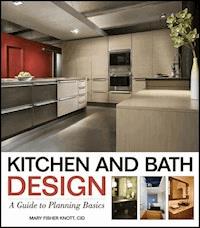
The all-in-one reference to designing stunning and functional kitchens and baths Designing for today's kitchens and baths requires technical savvy, a keen eye for aesthetics, and perhaps most important of all, the ability to coordinate efforts across many disciplines. Kitchen and Bath Design simplifies these complex decision-making processes with a comprehensive strategy for achieving kitchen and bath designs that successfully integrate beauty and practicality--while meeting client expectations. Fundamental design basics are covered, along with a host of important issues that designers must consider when conceptualizing these specialized rooms, such as ergonomics, codes and safety requirements, proper lighting and ventilation, flooring, cabinetry, countertops, wall surfaces, and more. Some of the topics that appear in this book include: * A detailed introduction to construction, plumbing, and electrical basics * A systematic approach to incorporating "green," energy-conscious design * An overview of crucial design elements, including pattern, texture, line, form or mass, color, space and light, and sound * The latest building codes and manufacturers' guidelines Written by a leading expert in interior design, Kitchen and Bath Design uses three-dimensional drawings and corresponding photographs to deliver valuable information that is critical when it comes to planning, designing, specifying, estimating, building, pricing, or evaluating a kitchen or bathroom. Whether they're working on a new or existing space, professional designers can apply the lessons learned from this current andaccessible resource to masterfully take on all kitchen or bathroom projects--from the simplest to the most highly challenging.
Sie lesen das E-Book in den Legimi-Apps auf:
Seitenzahl: 350
Veröffentlichungsjahr: 2010
Ähnliche




















Contents
Cover
Half Title Page
Title Page
Copyright
Acknowledgments
Introduction
Who Are Residential Space Planners?
Overview of the Book
Kitchen Design Principles
Bath Design Principles
Half Title Page
1: Design Basics
Basic Design
Planning Procedures in Kitchen and Bath Design
2: Basic Construction Methods for Kitchens and Baths
Introduction
Codes and Standards
Foundations
Framing
ADA-ANSI Standards
3: Universal and Ergonomic Design
Definition of Terms
Assessment Methods and Techniques
Ergonomic Solutions for Kitchens and Baths
Ergonomic Storage System
4: Kitchen Design Basics
Standard Cabinet Dimensions
Standard Countertop Dimensions
Industry Guidelines for Countertop Work Space
Total Integrated Planning
Space Planning
CoreKitchen™
Food Preparation Techniques
Food Storage
Plumbing Selections for Kitchens
Appliances
Counters and Backsplashes
Cabinetry
Spatial Clearances and ADA Guidelines
Food Preparation Flow
Integrating the Kitchen with Living Spaces
5: Appliances
Refrigeration
Cooking Methods
Ventilation
Dishwashers
Water Appliances
Coffee Brewing Systems
Summary
6: Cabinetry
Cabinet Construction Types
Standard Cabinet Dimensions
Interior Cabinet Hardware
Custom Cabinetry
Adjustability in Cabinetry
Appliances and Standard Cabinetry
7: Bath Design Basis
Information Objectives
Codes, Clearances, ADA and Universal-Design Bathrooms
Plumbing Codes
Electrical Codes
Basic Bathroom
Planning Checklist for Bathrooms
Bathroom Space Planning
How to Get Started
Bathroom Electrical
Plumbing Fixtures
Selecting Bathroom Fixtures
Environmental Factors
Heating and Air Conditioning
Sound Control
8: Plumbing
Plumbing Codes
9: Electrical and Lighting Basics
How Electrical Power Is Delivered to the House
Electrical Terms and Definitions
Electrical Receptacles
Electrical Codes and Standards
Lighting Systems
10: Mechanical Applications
Ventilation
Heating
Water Heating
Sound
11: Surfaces
Natural Stone
Wall Tile
Floor Coverings
Walls
Ceilings
Counters
Summary
12: Sustainability
Kitchen and Bath Projects
Recycling of Materials
Water
Plumbing
Energy Conservation
Summary
Appendix
Project Inventory Assessment
Planning Procedure Checklist—Kitchens
Planning Procedure Checklist—Baths
Plan Checklist
Ergonomic Profile
Ergonomic Profile Measurements
Glossary
Bibliography
Index
Kitchen and Bath Design
This book is printed on acid-free paper.
Copyright © 2011 by John Wiley & Sons, Inc. All rights reserved.
Published by John Wiley & Sons, Inc., Hoboken, New Jersey.
Published simultaneously in Canada.
No part of this publication may be reproduced, stored in a retrieval system, or transmitted in any form or by any means, electronic, mechanical, photocopying, recording, scanning, or otherwise, except as permitted under Section 107 or 108 of the 1976 United States Copyright Act, without either the prior written permission of the Publisher, or authorization through payment of the appropriate per-copy fee to the Copyright Clearance Center, Inc., 222 Rosewood Drive, Danvers, MA 01923, 978-750-8400, fax 978-646-8600, or on the web at www.copyright.com. Requests to the Publisher for permission should be addressed to the Permissions Department, John Wiley & Sons, Inc., 111 River Street, Hoboken, NJ 07030, 201-748-6011, fax 201-748-6008, or online at http://www.wiley.com/go/permissions.
Limit of Liability/Disclaimer of Warranty: While the publisher and author have used their best efforts in preparing this book, they make no representations or warranties with respect to the accuracy or completeness of the contents of this book and specifically disclaim any implied warranties of merchantability or fitness for a particular purpose. No warranty may be created or extended by sales representatives or written sales materials. The advice and strategies contained herein may not be suitable for your situation. You should consult with a professional where appropriate. Neither the publisher nor author shall be liable for any loss of profit or any other commercial damages, including but not limited to special, incidental, consequential, or other damages.
For general information on our other products and services, or technical support, please contact our Customer Care Department within the United States at 800-762-2974, outside the United States at 317-572-3993 or fax 317-572-4002.
Wiley also publishes its books in a variety of electronic formats. Some content that appears in print may not be available in electronic books.
For more information about Wiley products, visit our Web site at http://www.wiley.com.
Library of Congress Cataloging-in-Publication Data:
Knott, Mary Fisher.
Kitchen and bath design : a guide to planning basics / Mary Fisher Knott ; with CAD illustrations by J. Webster Knott.
p. cm.
Includes bibliographical references and index.
ISBN 978-0-470-39200-3 (pbk. : alk. paper); ISBN 978-0-470-89005-9 (ebk); ISBN 978-0-470-89007-3 (ebk); ISBN 978-0-470-89008-0 (ebk); ISBN 978-0-470-95098-2 (ebk); ISBN 978-0-470-95115-6
1. Kitchens. 2. Bathrooms. I. Knott, J. Webster. II. Title. III. Title: Guide to planning basics. NA8330.K595 2011 747.7′dc22 2010016470
Acknowledgments
Over the past four decades, I have learned so much from the artisans, subcontractors, and clients for whom I’ve worked. It is that knowledge that I am sharing with you in this book, so I want to thank all of these master craftspersons for their practical solutions over the years.
Many thanks go to my clients, who have so willingly allowed us to photograph their homes and use their projects to illustrate design principles. In addition, I’d like to thank BSH Home Appliance Corp., Franke, Asko Appliances, Fisher-Paykel, and Sub-Zero/Wolf Appliances for their photographic support.
The support and collaboration of other design professionals helped me present a variety of design solutions. My thanks to David Dalton, David Dalton, LLC; Judy Svendsen, Raven Interiors; Brooke D’Allyrand, Sub-Zero/Wolf Southwest; Amber Carlson, BSH Home Appliance Corp.; Pam Perfect and Kristi Leudenia, Sunwest Distributors; Barbara Houston, Vancouver, BC; NY Loft Cabinetry; and Steve Johnson Poggenpohl Cabinetry.
Dr. Dylan Foster and the occupational and physical therapists I’ve interviewed have provided valuable information regarding body mechanics and the influence they have on our home work spaces.
Writing a book while you are working on projects under construction and in the various design stages requires a great deal of understanding and support from your family. I appreciate the support and understanding my family has shown me, especially my husband and partner, Webb, who not only did all the CAD work on our projects (thereby freeing up my time to write), but also provided the CAD drawings and illustrations for this book.
Introduction
Kitchens and baths are two rooms of the home that involve every trade of the construction industry. To effectively design these spaces, you must fully understand space planning techniques, basic construction methods and terminology, and building code constraints.
This book provides the reader with practical information gleaned from practicing design professionals, as well as craftsmen and craftswomen of the construction industry. It features practical guidelines from those who must take a design on paper and make it a reality. The prudent designer will seek out the specialty trades involved in the project and ask about installation procedures; the answers will often influence the designer’s vision for the space during the design concept phase. Design details often require specific clearances and construction constraints affecting various other components of the room.
As one can see from Figure i-1, the coordination of several construction trades is involved in achieving one specific detail. By first researching installation requirements of the finish materials selected for use, the designer can accurately create design details that are ready for execution in the field. This requires close collaboration with the architect, general contractor, and subcontractors.
Figure i-1 A special stone-tile surround at a window affects the window size and placement, wall space on all sides, crown moldings and cabinetry adjacent to the window, window coverings, and lighting fixtures.
The checklists, case studies, and problem-solving techniques in this book will help the reader isolate and correct some potential problems prior to construction. This book also serves as a reference guide for designers of kitchens and bathrooms, and can significantly aid in the understanding and teaching of kitchen and bath design in real applications.
Written from a residential space planner’s point of view and underlain by four and a half decades of experience, this book provides insight into proven techniques for designing kitchens and baths.
Who Are Residential Space Planners?
Residential space planners are experienced design professionals who approach kitchen and bath design as problem solvers. By isolating a set of design criteria from the client, the space planner begins by tackling the space planning process first; then makes product selections to meet those criteria functionally and aesthetically; and then creates solutions unique to that client and space.
Winston Churchill once stated, “We shape our dwellings and afterwards, our dwellings shape us.” It is the space planner’s goal to shape the dwelling to fit the client.
Overview of the Book
Initial chapters focus on design criteria common to kitchens and baths. These criteria include construction methods, basic plumbing and electrical applications, national codes, and anthropometric information. Anthropometric information is thoroughly covered in Chapter 3, Universal and Ergonomic Design.
Basic Construction Methods
It is the responsibility of the architect, engineer, and general contractor to ensure the integrity of the building envelope. Decisions affecting the structural elements must be engineered by those qualified and licensed professionals. However, it is critical that kitchen and bath designers understand general construction methods and terminology, so that they can work effectively with the allotted space and communicate with the construction tradespersons.
This book examines types of building foundations that directly influence locations of the mechanical systems in the kitchen and the plumbing layout in the bath. The difference between load-bearing and nonload-bearing walls is explained to illustrate how optional alterations of walls can be executed. Unless the designer is also a licensed general contractor, decisions on whether a wall can be removed must be made by those who are licensed and qualified to do so. However, by understanding how a house is framed, the designer can recognize design possibilities should structural alterations be planned. Mechanical systems, air returns, ductwork and special plumbing applications must be housed within the framework of the structure; all these are covered in Chapter 10.
Chapter 2 discusses window and door types and how they affect kitchen and bath space planning and ergonomic considerations. Because windows are a major focal point within a space, how they look and function affects the entire space.
Architectural features such as niches, arches, columns, ceiling treatments, exposed beams, and soffits are examined as they relate to design of the kitchens or baths in the case studies.
Codes: ANSI Regulations and ADA Guidelines
The International Building Code (IBC) is a compilation of the Uniform Building Code (UBC), the Building Code Officials and Code Administration National Building Code (BOCA), and the Standard Code. Some states and municipalities have not adopted these codes, so it is necessary for designers to be aware of the code constraints governing their practice and project locations. This is particularly important for designers working in multiple states. Chapter 2 defines and discusses various codes relating to fire, health, and safety issues. Codes and ANSI standards specific to kitchens and baths are covered in Chapters 4 and 7, on kitchens and baths, respectively.
Plumbing Basics
The plumbing system provides a means of bringing water to the house and distributing it to water appliances and fixtures, as well as a means of taking used water (graywater or wastewater) away from the house. In addition, it involves the proper venting of fixtures and appliances. When natural gas is being used to power appliances, a qualified plumber is required for installation. Chapter 8 illustrates a typical plumbing system, showing gas and water supply and drainage in a single-story and a two-story house. Island vents, sewer vents, and gas appliance vents are defined and illustrated, showing their influence within the design. Certain shower systems require a higher-capacity water supply than normal. Case studies are presented that show these installations. The selection of plumbing fixtures for kitchens and baths is covered in each of the respective chapters (4 and 7).
Energy-efficient water heaters are important to both kitchen and bath design and we examine the several options available in Chapter 9.
Electrical Basics
Just as a plumbing system is concerned with conveying gas and water to and from the house, so the electrical system is concerned with acquiring power from the supplier, bringing it to the house, and distributing it throughout the house. Chapter 9 covers how electrical energy comes to the house and how the distribution occurs from the main panel throughout the home. Reading the main electrical panel capacity and understanding how circuits work is necessary for planning adequate power supply to appliances. Electrical plans from actual projects illustrate electrical layouts, as well as means of calling out convenience outlets, ground fault circuit interrupters, switches, and controls. Motion sensors and other automatic controls are defined based on code constraints.
Lighting systems, both structural and decorative, are studied in detail to illustrate basic applications and their relationship to the construction package. Specific lighting layouts are featured in Chapter 4 for kitchens and Chapter 7 for bathrooms.
Mechanical Systems
The importance of mechanical systems, including sound control, air and water quality, ventilation, and moisture control cannot be overemphasized. Because the layout of such mechanical systems as the heating/cooling and ventilation systems is done by other licensed professionals during the framing stage (new construction) or rough-in stage (remodeling), it is very important that the designer be involved in providing space planning information related to the location of controls, registers or diffusers, and air returns to the architect before the architect submits final plans to the client and all pertinent agencies. Poor location of these items dramatically affects the space planning of the kitchen and bath.
When the project is a remodel rather than new construction, certain constraints already exist that will influence the design of the space. Available options are studied to give the designer basic knowledge, so that communication among the designer, architect, and contractor can be achieved. Although aesthetic considerations are very important, it is the heating, ventilation, and air conditioning (HVAC) contractor and architect that must set the mechanical plan.
Moisture control is critical in both kitchens and bathrooms. We discuss how this is effectively done to maximize comfort within the space, using case studies to illustrate these applications. An examination of moisture barriers and how they protect the structure and surfaces is provided.
Sound control is often ignored in the design process. With open-plan kitchens and the exposure of appliances and kitchen task areas to the social spaces of the home, sound control is a critical element of design. Designers must understand sound emission levels so that they can select products and materials conducive to sound suppression. Refer to Chapter 10. Construction methods for reducing sound with sound board, insulation wraps, and other sound-deadening materials are investigated.
Steam appliances and fixtures are frequently being used in kitchens and bathrooms. A water supply of the proper size coming to the house and the extraction of ambient steam in the room are primary concerns of an adequate ventilation system. Mold and mildew can result if ventilation is not planned effectively. Building code requirements and manufacturers’ guidelines are examined.
Sustainability, Conservation, and Energy Resources
Sometimes deciding what is really a sustainable and environmentally responsible material can be extremely confusing. How and where a product is manufactured, how it should be correctly used for maximum benefit, and budget constraints should all be considered. An examination of the benefits of sustainability, opportunities for reuse of material, energy conservation programs, and understanding alternative energy sources applicable to kitchens and baths appears in Chapter 12.
Solar systems, natural gas applications, efficient electrical uses such as induction cooking and laser-monitored cooktops, and wireless technology are all explored as they apply to kitchen and bath design.
Basic Design Principles
Chapter 1 presents a review of the basic principles and elements of design. Kitchens and baths lacking these basic design disciplines turn out to be mediocre at best. Aesthetic principles—scale, proportion, rhythm, balance, harmony, and emphasis—must be employed.
Design elements consist of pattern, texture, line, form or mass, color, space, and light. Checklists have been developed to assist designers in the development of their plan. Though this is second nature for most seasoned designers, these checklists of basics can be particularly helpful to designers who are just beginning their career. No two projects are exactly the same.
Universal and Ergonomic Design
Accessibility of a completed space should be a prime consideration. There is a difference between universal design and ergonomic design. Ron Mace, founder and program director of the Center for Universal Design, is credited with coining the term universal design, which he defined as “[t]he design of products and environments to be usable by all people, to the greatest extent possible, without the need for adaptation or specialized design.”
Karl H. E. Kroemer in his book, Extra-Ordinary Ergonomics (2006), states, “Design to match the characteristics of the user is the guiding principle of ergonomics or human factors, also called human factors engineering.” He goes on to say, “For most designs, the common user population is not a unitary, homogeneous assemblage but rather a group of individuals with diverse characteristics and varying capabilities.”
It has been my experience that when the capabilities of the individual are accounted for and incorporated into the kitchen or bath design, the designer can integrate the individual traits of the client into the space place(s) in a way that meets the client’s particular ergonomic profile.
Everyone has some physical challenge when dealing with movement and stress in their lives. Each person accesses a space differently based on physical stature alone. In this book, we recognize that universal design is the umbrella for human-factors design common to all; ergonomic design is the act of defining specific design applications for the individual user. Ergonomic design considerations are featured in every aspect of this book. Many resources, and hours of research by respected ergonomists and physical and occupational therapists, have been pared down to provide the basic, practical information needed for good design of kitchens and baths. Chapter 3 expands on these principles and includes a practical format for retrieving ergonomic information and measurement techniques. One section deals with weights and measurements of items used in the kitchen and how they affect movement and body mechanics.
How the body works physically is considered to help the designer fully understand the importance of designing space that works in concert with the body rather than against it. Good body posture and alignment can be encouraged when the design of the kitchen or bath minimizes the fatigue and stress of tasks performed.
Throughout the book, the symbol (E) can be found next to products and applications with ergonomic relevance.
Kitchen Design Principles
Industry standards for kitchen and bath design are presented along with codes affecting the kitchen specifically. Ergonomic design principles are introduced here for the first time. Techniques for developing a client/project inventory, space planning methods used in creating a bubble plan and plan variations, and ergonomic considerations regarding the space lead off Chapter 1.
Allowances for stagnant and active space, minimum to maximum clearances for movement and work zones (Figure i-2), and space planning principles are given.
Figure i-2 The residential space planner measures traffic-lane clearances as the distance between the two most protruding parts on opposite sides of the lane.
Reference charts of industry standards have been developed to make this valuable information readily available.
A new kitchen design concept, the CoreKitchen™, is introduced. This concept plays an important role in today’s kitchen design philosophy. The unique features of each are given and the designer is shown how to implement them in a design. The design flexibility created by the CoreKitchen™ is phenomenal. All this is discussed in Chapter 4.
Furniture, storage systems, color, texture, lighting, and sound are issues arising in open kitchen concept plans, and each is addressed as it relates to the kitchen and adjoining spaces. Implementation of the elements and principles of design are particularly evident, as we understand that the kitchen should not be designed in isolation from adjoining areas.
Matching appliance and plumbing selections to the client and space is explored in detail. A surface cooking unit, for example, should match the food-preparation skills of the cook. Unfortunately, many kitchens are built with professional-style appliances for their look alone. Ergonomic considerations are a prime factor in selecting the right appliances for the project. We investigate ways to use standard appliances creatively in solving ergonomic design criteria; see Chapter 5. Case studies of various kitchen sizes are utilized to illustrate these planning techniques.
Structural and decorative lighting systems are explained as they relate to the kitchen. The extensive section on fixtures equips the designer with the product knowledge necessary to create lighting plans that feature task lights, ambient or general lighting, and decorative or accent lights.
A reference guide to lamps and definitions of each type (including incandescent, fluorescent, CFL, halogen, xenon, and LED), along with new technology being introduced, is provided. In addition, the benefits of each type of fixture as it relates to light output, color, temperature, and energy efficiency are studied. Knowledge of the Kelvin scale, lumen output, and heat index is necessary for an understanding of lighting systems and their influence on the safety and ambience of the space. Wired, wireless, motion-sensor, and remote-control systems are also featured in the kitchen lighting section. The important role of controls in energy conservation, ergonomic applications, and creation of a soothing atmosphere is examined. Case studies illustrate the options available to designers.
Appliances
For years, appliance manufacturers have been bringing restaurant cooking techniques into the residential kitchen. By calibrating appliances to meet code constraints, manufacturers have given the home cook many options. This is both a blessing and a curse. How the designer selects the right appliance for the client depends on how well the designer listens to the client. With the popularity of television chefs and cooking shows, a whole new breed of cook has appeared. Many men now are the primary cooks in the family. Direct questions must be asked of cooks as to what they prepare, how they entertain, and what appliances they want. An appliance questionnaire is provided to help guide the designer. An additional section of this chapter features food preparation techniques and terminology. It is difficult to ask the right questions and understand the answers if the designer has never held a whisk or zester in her or his hand!
Appliances are defined by type, size, and use. Cooking, cold storage, and specialty appliances such as water quality units are all covered. Explanations are given as to why one model may be a better choice than another. Alternates for standard appliances, such as modular cooktop units, give the designer insight into installation options that are often overlooked.
Appliance finishes are covered in Chapter 11 on surfaces.
Cabinetry
It is important to have a thorough understanding of cabinet construction and current industry standards, as well as cabinet terms and options. Terms such as custom, semi-custom, custom modular, modular, inset, overlay, framed, and frameless must be understood before the design process begins. When dealing with independent cabinet shops or dealerships, the designer needs to have the style of construction clearly in mind. We also study design trends and classic looks as they relate to cabinets. Cabinetry makes a major statement about the aesthetic and functional aspects of the kitchen and bath design. Scale and proportion are emphasized in relation to the size of the space, as well as adjacent cabinets. Techniques in using moldings and architectural elements to add character and unique storage to the space are illustrated, as are the ergonomic influences on storage systems, access to interior cabinet space, and custom options in standard and custom cabinetry.
Bath Design Principles
Bathrooms range in size from small powder rooms to large, spa-inspired master baths. Selecting the right fixtures and designing them into a functional, aesthetic space requires a full understanding of plumbing basics and mechanical systems. Bathrooms must include moisture barriers, sound controls, appropriate ventilation and lighting, and fixture and finish materials that work in wet areas. Water supply lines, water heating requirements, extraction of moist air, and sound control are dictated by code; the plumbing contractor implements those codes and the manufacturer’s suggested installation procedures. Industry standards for heights, clearances, and code constraints are fully detailed. Methods of creating full-access bathrooms that are visually pleasing and meet universal-design and ADA standards are illustrated in case studies. A bathroom checklist provides guidelines for the phase of the design process prior to submission of the plans; it features structural, decorative, and ergonomic checks and notes.
Methods of choosing fixtures that fit the ergonomic profile of the client are discussed in detail; by reviewing client characteristics and specifying a toilet, tub, or other fixtures meeting those criteria, the designer achieves many goals. Barrier-free showers, shower seats, shower sound and audiovisual systems, steam showers, soft bathtubs, walk-in tubs, and wall-mounted toilets are just a few of the fixtures and applications studied. Each application presents its own set of issues that the designer must confront and solve. Case studies of actual bath projects show the developmental process used to achieve the final design.
Installed heights of counters, toilets, and tubs have changed over the years, as homeowners may have been exposed to unique design features in resort hotels, spas, and even television and movies. Exposure to the resort/spa environment is a driving force in bath design today. An extensive section examines why and how bathroom design should reflect this feeling, no matter what the size of the space. Creating an atmosphere of tranquility that is easy to maintain is a common request from clients seeking their dream bathroom design.
Surfaces and Materials
The elements making up a space—color, texture, form or mass, and pattern—create the visual impact of the room. Balance between these elements must be achieved for harmony in the room. Surfaces include floor covering, wall and ceiling finishes, countertops and backsplashes, tile and stone surfaces, recycled products, metals, fabric, wood, and paint. Because of the many options for materials in each category, methods of selecting the correct surface for each area within the kitchen or bath are illustrated in photographs of completed projects. Each potential material must be considered regarding its appropriate use in the kitchen and bath.
Installation procedures for selected materials are presented from the subcontractor’s point of view. The guidelines drawn from on-the-job experience give the designer more freedom in considering how materials will be used. This practical information on the proper use of material can help alleviate costly installation errors. Communication among all parties is paramount.
Kitchen and Bath Design
1
Design Basics
Lesen Sie weiter in der vollständigen Ausgabe!
Lesen Sie weiter in der vollständigen Ausgabe!
Lesen Sie weiter in der vollständigen Ausgabe!
Lesen Sie weiter in der vollständigen Ausgabe!
Lesen Sie weiter in der vollständigen Ausgabe!
Lesen Sie weiter in der vollständigen Ausgabe!
Lesen Sie weiter in der vollständigen Ausgabe!
Lesen Sie weiter in der vollständigen Ausgabe!
Lesen Sie weiter in der vollständigen Ausgabe!
Lesen Sie weiter in der vollständigen Ausgabe!
Lesen Sie weiter in der vollständigen Ausgabe!
Lesen Sie weiter in der vollständigen Ausgabe!
Lesen Sie weiter in der vollständigen Ausgabe!
Lesen Sie weiter in der vollständigen Ausgabe!
Lesen Sie weiter in der vollständigen Ausgabe!




