


36,99 €
Mehr erfahren.
- Herausgeber: John Wiley & Sons
- Kategorie: Fachliteratur
- Sprache: Englisch
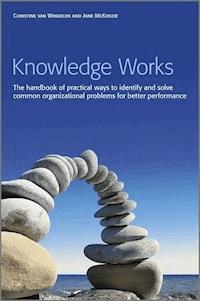
Knowledge Works is a handbook full of ideas to help you draw on people's knowledge to keep ideas fresh, reduce waste, and build competence and capability. You can either dip into it according to your needs, or work through it in a more systematic way to create a plan to improve your organization's performance. "Knowledge Works is a very practical book that provides proven solutions for important knowledge-related problems in organizations including: how to convince managers that knowledge is important, how to create a knowledge-sharing culture, and how to improve the quality of conversations. A must-read for all managers of knowledge-intensive organizations." Daan Andriessen, Professor of Intellectual Capital, Inholland University of Applied Sciences, The Netherlands "To be successful as a manager, you need to make better decisions, be more innovative and to do more with less. In this highly practical handbook, Christine Van Winkelen and Jane McKenzie offer new ideas to challenge your current thinking and achieve this. Their work is soundly based on 10 years collaborative research with the Knowledge Management Forum at the Henley Business School." David Gurteen, Founder and Director, Gurteen Knowledge Community "This book shows in a very inspiring and hands-on way how knowledge works. This is an utmost important understanding in the growing intellectual economy for increased operational knowledge effectiveness. The book has in an impressive way systematized many challenging K-works perspectives, from knowledge mapping and flows to social media and knowledge creating conversations. It is demonstrating a number of insightful real life stories and projects during 10 years of the Henley KM Forum, as well as providing valuable reading notes. Happy Knowledge Work ..." Leif Edvinsson, Honorary Chairman for the Henley KM Forum, The World´s First Professor of Intellectual Capital
Sie lesen das E-Book in den Legimi-Apps auf:
Seitenzahl: 437
Veröffentlichungsjahr: 2011
Ähnliche



















Table of Contents
Cover
Table of Contents
Praise for Knowledge Works
Title page
Copyright page
INTRODUCTION
Section I Establish strategic priorities
What do we mean by strategic priorities?
How do you establish them?
Key questions to ask yourself
Chapter 1 IDENTIFYING VALUABLE KNOWLEDGE
Snapshot
Why this matters
What this means for your organization
Creating an action plan
Real life stories
Top tips
The research and the team involved
Final reflections from the research
Chapter 2 MAKING A COMPREHENSIVE ASSESSMENT OF KNOWLEDGE FLOWS
Snapshot
Why this matters
What this means for your organization
Knowledge flows that start from individuals
Creating an action plan
Real life stories
Top tips
The research and the team involved
Final reflections from the research
Section II Enable operational effectiveness
What do we mean by operational effectiveness?
How do you enable it?
Key questions to ask yourself
Chapter 3 TAKING KNOWLEDGE INITIATIVES TO THE FRONT LINE OF THE ORGANIZATION
Snapshot
Why this matters
What this means for your organization
Creating an action plan
Real life stories
Top tips
The research and the team involved
Final reflections from the research
Chapter 4 INTEGRATING KNOWLEDGE PRACTICES INTO PROJECTS
Snapshot
Why this matters
What this means for your organization
Creating an action plan
Real life stories
Top tips
The research and the team involved
Final reflections from the research
Chapter 5 WORKING COLLABORATIVELY IN PARTNERSHIPS
Snapshot
Why this matters
What this means for your organization
Creating an action plan
Real life stories
Top tips
The research and the team involved
Final reflections from the research
Section III Stimulate innovation
What do we mean by innovation?
How do you stimulate it?
How do you make it a habit?
Key questions to ask yourself
Chapter 6 BUILDING KNOWLEDGE ENABLED INNOVATION CAPABILITY
Snapshot
Why this matters
What this means for your organization
Creating an action plan
Real life stories
Top tips
The research and the team involved
Final reflections from the research
Chapter 7 RETAINING AND DEVELOPING EXPERTISE
Snapshot
Why this matters
What this means for your organization
Creating an action plan
Real life stories2
Top tips
The research and the team involved
Final reflections from the research
Section IV Increase learning capacity
What do we mean by learning capacity?
How do you increase it?
Key questions to ask yourself
Chapter 8 JOINING UP INDIVIDUAL AND ORGANIZATIONAL LEARNING
Snapshot
Why this matters
What this means for your organization
Creating an action plan
Real life stories4
Top tips
The research and the team involved
Final reflections from the research
Chapter 9 EXTRACTING KNOWLEDGE VALUE USING DOCUMENT MANAGEMENT SYSTEMS
Snapshot
Why this matters
What this means for your organization
Creating an action plan
Real life stories
Top tips
The research and the team involved
Final reflections from the research
Chapter 10 SUSTAINING EFFECTIVE COMMUNITIES OF PRACTICE
Snapshot
Why this matters
What this means for your organization
Creating an action plan
Real life stories
Top tips
The research and the team involved
Final reflections from the research
Chapter 11 LEARNING FROM EXTERNAL COLLABORATIONS
Snapshot
Why this matters
What this means for your organization
Creating an action plan
Real life stories
Top tips
The research and the team involved
Final reflections from the research
Section V Become more agile
What do we mean by agility?
How do you develop the key attributes of agility?
Key questions to ask yourself
Chapter 12 MAKING MORE KNOWLEDGEABLE DECISIONS
Snapshot
Why this matters
What this means for your organization
Creating an action plan
Real life stories
Top tips
The research and the team involved
Final reflections from the research
Chapter 13 USING SOCIAL MEDIA FOR KNOWLEDGE SHARING
Snapshot
Why this matters
What this means for your organization
Creating an action plan
Real life stories
Top tips
The research and the team involved
Final reflections from the research
Chapter 14 TRANSFORMING RELATIONSHIPS AND STRUCTURES IN ORGANIZATIONS
Snapshot
Why this matters
What this means for your organization
Creating an action plan
Real life stories
Top tips
The research and the team involved
Final reflections from the research
Section VI Make change stick
What makes change so difficult?
How can you make it easier for people to accept change?
Key questions to ask yourself
Chapter 15 DEVELOPING KNOWLEDGE-SHARING BEHAVIOURS AND EFFECTIVE KNOWLEDGE ACTIVISTS
Snapshot
Why this matters
What this means for your organization
Creating an action plan
Real life stories
Top tips
The research and the teams involved
Final reflections from the research
Chapter 16 MOVING FROM HARD SELL TO COMPELLING BUY
Snapshot
Why this matters
What this means for your organization
Creating an action plan
Real life stories
Top tips
The research and the team involved
Final reflections from the research
Chapter 17 IMPROVING THE QUALITY OF CONVERSATIONS
Snapshot
Why this matters
What this means for your organization
Creating an action plan
Real life stories
Top tips
The research and the team involved
Final reflections from the research
Chapter 18 TAKING ACCOUNT OF NATIONAL CULTURE IN DESIGNING KNOWLEDGE INITIATIVES
Snapshot
Why this matters
What this means for your organization
Creating an action plan
Real life stories
Top tips
The research and the team involved
Final reflections from the research
Index
Praise for Knowledge Works
“Knowledge Works is a very practical book that provides proven solutions for important knowledge-related problems in organizations including: how to convince managers that knowledge is important, how to create a knowledge-sharing culture, and how to improve the quality of conversations. A must-read for all managers of knowledge-intensive organizations.”
Daan Andriessen, Professor of Intellectual Capital, Inholland University of Applied Sciences, The Netherlands
“To be successful as a manager, you need to make better decisions, be more innovative and to do more with less. In this highly practical handbook, Christine Van Winkelen and Jane McKenzie offer new ideas to challenge your current thinking and achieve this. Their work is soundly based on 10 years collaborative research with the Knowledge Management Forum at the Henley Business School.”
David Gurteen, Founder and Director, Gurteen Knowledge Community
“This book shows in a very inspiring and hands-on way how knowledge works. This is an utmost important understanding in the growing intellectual economy for increased operational knowledge effectiveness. The book has in an impressive way systematized many challenging K-works perspectives, from knowledge mapping and flows to social media and knowledge creating conversations. It is demonstrating a number of insightful real life stories and projects during 10 years of the Henley KM Forum, as well as providing valuable reading notes. Happy Knowledge Work …”
Leif Edvinsson, Honorary Chairman for the Henley KM Forum, The World’s First Professor of Intellectual Capital
“Christine and Jane are attentive tour guides on the never ending journey of learning, improvement and change charted in Knowledge Works. Together they have compiled an invaluable collection of grounded research and practical, real-world examples from a wide range of organisations. This is a book which you will find yourself dipping into repeatedly; be sure to have an ample supply of bookmarks before you start – you will use them all!”
Chris Collison, Business Author and Knowledge Management Consultant
“Christine van Winkelen and Jane McKenzie have developed a practical framework that links together a decade of research by the KM Forum. It should be useful to any organization where knowledge is a key asset.”
Richard McDermott
This edition first published in 2011
Copyright © 2011 Christine van Winkelen and Jane McKenzie
Registered office
John Wiley & Sons Ltd, The Atrium, Southern Gate, Chichester, West Sussex, PO19 8SQ, United Kingdom
For details of our global editorial offices, for customer services and for information about how to apply for permission to reuse the copyright material in this book please see our website at www.wiley.com
The right of the author to be identified as the author of this work has been asserted in accordance with the Copyright, Designs and Patents Act 1988.
All rights reserved. No part of this publication may be reproduced, stored in a retrieval system, or transmitted, in any form or by any means, electronic, mechanical, photocopying, recording or otherwise, except as permitted by the UK Copyright, Designs and Patents Act 1988, without the prior permission of the publisher.
Wiley also publishes its books in a variety of electronic formats. Some content that appears in print may not be available in electronic books.
Designations used by companies to distinguish their products are often claimed as trademarks. All brand names and product names used in this book are trade names, service marks, trademarks or registered trademarks of their respective owners. The publisher is not associated with any product or vendor mentioned in this book. This publication is designed to provide accurate and authoritative information in regard to the subject matter covered. It is sold on the understanding that the publisher is not engaged in rendering professional services. If professional advice or other expert assistance is required, the services of a competent professional should be sought.
Library of Congress Cataloging-in-Publication Data
Winkelen, Christine van.
Knowledge works : the handbook of practical ways to identify and solve common organizational problems for better performance / Christine van Winkelen and Jane McKenzie.
p. cm.
Includes bibliographical references and index.
ISBN 978-1-119-99362-9 (pbk.)
1. Knowledge management. 2. Organizational learning. 3. Problem solving. I. McKenzie, Jane. II. Title.
HD30.2.W563 2011
658.4′038—dc22
2011007716
A catalogue record for this book is available from the British Library.
ISBN 978-1-119-99362-9 (hardback), ISBN 978-1-119-97108-5 (ebk), ISBN 978-1-119-97781-0 (ebk), ISBN 978-1-119-97782-7 (ebk)
INTRODUCTION
“Knowledge Works” came about as a result of reflecting on a decade of highly applied and collaborative research at Henley Business School in the UK. Those associated with the various projects have benefited from the insights, approaches, tools, and methods that came from the work, as their comments throughout the book show. However, until now further distribution has been limited to an academic audience. To mark the 10th anniversary of a Forum that examines knowledge issues in organizations and
actively challenges current thinking by encouraging new ideas, exploring links with other disciplines, and expanding the boundaries of the subject
it seemed appropriate to share the practical aspects of what we have learnt with a wider audience.
Where Does the Content of the Book Come From?
The Knowledge Management Forum (KM Forum) was established in 2000 at Henley Business School. Its members are large organizations, both multi-national private sector firms and major UK public sector bodies. The intention from the outset was to create a community where business professionals could think together with peers facing similar challenges about knowledge related issues. Since then, the KM Forum has established an international reputation for thought leadership in the field.
Each year, we use a consultation process to surface pressing and topical knowledge related challenges facing organizations. From these, projects emerge which inspire working groups of members to congregate around them. The research approach is relatively unusual because it is always highly collaborative from start to finish. In addition to the consultation process and the working groups, each project is co-championed by an academic and an experienced KM practitioner. The research has been “with” rather than “on” the organizations involved. All the projects have benefited from remarkable access to senior people facilitated by the representatives of the organizations that belong to the KM Forum. Interviews with senior directors and functional leads have been at the heart of most of the projects. A constant balance of academic and practice input produces findings that are both rigorous and relevant.
Research relevance is a topic of considerable debate in the field of business and management. We set out to embed relevance into both the design and project management principles of our research. On the whole, the research has been exploratory and qualitative, which means we have looked for patterns and indicators rather than proof or categorical “truth”. One notable exception is the Knowledge Sharing Behaviours research which was highly quantitative and the researcher was awarded a PhD at the end (see Chapter 15). The more usual exploratory approach for the projects described in the other chapters reflects the diversity of organizations involved in the KM Forum. What happens in a public sector body such as the Ministry of Defence or Department of Health is unlikely to be the same as for a private sector firm such as Vodafone or Syngenta. Nor are they likely to benefit from exactly the same answers. However, the value of participant diversity is that the principles, illustrative examples, models, and insights coming from research across different contexts can be adapted and adopted more easily in other large organizations.
We believe this is the strength of our approach. Our proposition is that by involving many different types of organizations in the research, the outputs will be more broadly relevant and applicable. Although useful approaches to managing knowledge have been generated by many other writers, our view is that sometimes the very important influence of context isn’t fully taken into account. What works for an organization which needs to make long-term capital investments (such as in the car or oil industries) may not work for a high-technology firm that sees six months as a long planning timeframe, or for parts of the public sector.
Who Is It Intended For?
We have written this book for managers who want to do more with less by improving productivity and stimulating innovation. Whenever knowledge and learning are factors that affect organizational performance, our intention is that there will be ideas to stimulate thinking and some practical approaches in the book. Managers responsible for distributed and international teams, increasingly a prevalent feature of organizational life, will find several of the chapters particularly useful for considering how to achieve more productive learning processes.
Those with functional responsibility for knowledge, organizational capability building, or learning (including knowledge and information managers, strategists, human resource managers, and organization development specialists) are also likely to find the content directly relevant to their activities. The topics and the way the research was formulated and carried out came from people with just these functional responsibilities.
What’s the Best Way to Use the Book?
The book has been created as a handbook that you can dip into according to your needs. Alternatively, you can work through it in a more systematic way to create a plan to improve your organization’s performance. The six sections organize the chapters around essential objectives for any business. The sections build cumulatively from strategy to action. Each section starts with a short introduction which offers an overview of the theme and explains the rationale for what is included. We can’t claim that every section provides a completely comprehensive view of that theme. The material is simply a reflection of the research projects identified by and prioritized by the business professionals working with us.
The structure of all the chapters is the same and is intended to make it as easy as possible for you to navigate around the material. When your time is limited, you just need to know why the issue matters and what to do about it. We include information about the way the research behind each chapter was carried out too, as well as a few final reflections of a more conceptual nature in case you are interested. The real life examples included in each chapter were collected at the time of the research. They have been selected for inclusion here because the principles they demonstrate remain relevant even though some time may have passed. Where the organization’s name is provided, we are grateful that they have given us permission to use the material.
Will a Static Book Be Enough?
Knowledge work is a context-specific mix of creative insight and scientific investigation. As academics, we have enjoyed the search for viable solutions to the various challenges posed by managers working in the field. What has been achieved together has come about through those at the sharp end of business practice thinking together. Conversation and interaction have been a critical source of inspiration. In truth, they are a vital way to combine knowledge and intellect and inspire insights that can improve organizational performance. In that sense, the contents of this book can only be a starting point for further knowledge work. We invite you to continue the conversation with ourselves and with other like-minded individuals facing the same challenges. Share your experiences as you grapple with key activities of each section and start to apply some of the thinking. We have set up a website and a blog where together we can continue the process of improving the impact of knowledge work on business performance: www.knowledgeworkshandbook.com. On the website you will also find further resources that may help you improve the knowledgeability of your organization.
Knowledge work is a never ending journey of learning, improvement and change. We hope that the material in this book provides some inspiration and invigoration along the way!
Christine and Jane
Section I
Establish strategic priorities
Chapter 1 – Identifying valuable knowledge
Chapter 2 – Making a comprehensive assessment of knowledge flows
In a rapidly changing world, current success and future survival depend on constantly learning to do things differently and better. Knowledge is both the raw material that is the foundation for learning and the output from it, offering new opportunities and new sources of revenue. Arguably this means we would be neglecting our strategic responsibilities if we did not review organizational priorities in terms of the knowledge available to the business and focus our management and leadership practices on creating the conditions where knowledge can be used productively.
What Do We Mean by Strategic Priorities?
Even when you accept the importance of taking a knowledge perspective on the organization, it is still a challenge to prioritize time, attention, effort, and financial resources to improve the way knowledge delivers results. Often people tend to be more drawn to immediate task requirements and don’t sustain the longer term perspective required to join up areas of knowledge activity smoothly and seamlessly. There is an additional challenge too: judging the returns on investments in knowledge-related initiatives can be perceived as highly subjective because the link between action and result can be very diffuse and slow to become visible in any measurable way. Unlike other resources which are consumed with use, knowledge tends to increase the more it is used in different contexts; its impact is amplified through sharing. Both of these attributes create huge potential for value generation. However, the consequences of knowledge initiatives are often difficult to measure directly without considerable effort and focus. Careful thought is needed to make evident the connection between knowledge initiatives, the results they produce, and the ultimate impact that these have on something that matters to key stakeholders in the organization.
As an example, a knowledge initiative could involve investment to establish and maintain more effective networks of people across the organization. One consequence could be speeding up access to the knowledge needed to put together proposals for new business, resulting in higher quality and timelier bids. These can be judged as the immediate outputs of the investment; it is possible to quantify in hard financial terms the increase in bid to win rate, growth in sales, or profit generated as a consequence. However, the final step in any strategic assessment should be checking that this is a strategic priority for the organization. For example, if resources are really limited, have the knowledge-related initiatives addressed what matters most? Is it really the highest priority for the organization to win new business, as opposed to delivering an excellent service to existing customers? If both are important, have resources been distributed between initiatives to improve them appropriately?
Potentially valuable knowledge comes from many sources, not all of which lie within the organization itself. The people who work closely with the organization (through whatever form of contract or relationship) are the main source. However, tapping into knowledge from the outside world in terms of suppliers, customers, partners, competitors, and other players in the sector is essential to supplement this and to provide early signs of the need to evolve and change. Finally, embedded knowledge that helps make the organization productive and unique is also valuable. We should not ignore what is special and distinctive about the way the organization runs, from the use of technology to the design of effective processes, and from the way people are managed to the culture.
By understanding from the outset what knowledge makes a difference to organizational performance, you can focus limited resources on the things that will have the most impact and generate the most value. Initiatives could range from increasing access to knowledge in an area where there is obviously a gap, to improving the distribution of critical knowledge to those who need it when they need it, or even to intervening to protect certain knowledge from reaching competitors because of its unique value. Some knowledge may even need to be shared freely to influence the way thinking and practice evolves in the sector or industry in general; this can grow potential opportunities for everyone. However, it is the piecemeal approach to knowledge initiatives which fails to help organizations make more meaningful and informed strategic choices. Lack of a structured approach also means that it is easy to overlook vital areas in which a knowledge perspective would help achieve the organization’s strategic objectives.
How Do You Establish Them?
The starting point is to understand what makes the organization able to survive and thrive in the face of competition and external change. By viewing knowledge as a resource we can make choices about how far it can be characterized as valuable and how much investment should be targeted at developing, maintaining, and protecting it. However, this isn’t sufficient because we also need to determine the organizational capability to use that knowledge. How readily can knowledge flow around the organization and to and from the outside world? Do the management and leadership practices create the conditions to enable this to happen?
The two chapters in this section provide complementary approaches to help determine strategic priorities, as shown in Figure I.1. The first offers a way of mapping and evaluating valuable knowledge and the second includes a structure to evaluate the priority of key knowledge flows and whether they are working well or are blocked by certain barriers.
Figure I.1: A strategic approach to designing knowledge initiatives
The fact that both “value” and “knowledge” are not absolute ideas that everyone can agree on, means that it is best to involve as many interested parties as possible in these strategic explorations. Those who have a stake in the outcome of the investments need to contribute to the assessment, particularly if they are interested and have influence on what is allowed to happen or how the results are interpreted.
Although these two approaches will get you started, a completely predetermined, structured approach is not necessarily feasible or desirable. Opportunities arise to try things out; success stories emerge that can be used to bring attention to a different way of working; someone with enthusiasm creates a momentum around something that was unforeseen. All of these are the realities of a complex organizational environment and sufficient flexibility is needed to respond. The value in using these models and frameworks to structure thinking about the organization from a knowledge perspective is that it is easier to recognize these serendipitous opportunities and evaluate them relative to others already underway. The challenge is to use the approaches described here to shape rather than constrain thinking about strategic knowledge priorities.
The knowledge strategy will need to evolve as the organization becomes more collaborative and knowledge-sharing behaviours become embedded. Organizational priorities and external drivers also change continuously. Thinking about strategic priorities is an ongoing activity and using knowledge well in the organization needs to become a dynamic capability which is recognized and valued.
Key Questions to Ask Yourself
As you start to use the ideas in the next two chapters:
Ask who needs to be involved to both ensure that you can make sense of the situation properly and so that there is buy-in to the proposals that are generated.Think about when you should do this structured thinking about knowledge priorities and how you can keep an up to date view of what matters and what has changed.Be clear about why you are trying to improve the use of knowledge in the organization. Keep close attention to the generation of value for the organization.Chapter 1
IDENTIFYING VALUABLE KNOWLEDGE
Snapshot
Valuable knowledge can be found in many places in organizations, from unique business models or solutions, key value-adding processes, core technology competencies, to business support systems that integrate knowledge across the organization. Identifying an organization’s most valuable knowledge is the first step in deciding how to prioritize investments in projects designed to retain and develop that knowledge.
A systematic plan of action can be created by mapping key knowledge resources and then evaluating their importance and accessibility. There is a series of questions you can use to help you with this process. The approach works for different levels of detail. You can adapt it depending upon whether you are looking to create an overall strategy or to develop specific initiatives. Three case studies show how different types of organizations applied the approach and what they learnt from it.
Lesen Sie weiter in der vollständigen Ausgabe!
Lesen Sie weiter in der vollständigen Ausgabe!
Lesen Sie weiter in der vollständigen Ausgabe!
Lesen Sie weiter in der vollständigen Ausgabe!
Lesen Sie weiter in der vollständigen Ausgabe!
Lesen Sie weiter in der vollständigen Ausgabe!
Lesen Sie weiter in der vollständigen Ausgabe!
Lesen Sie weiter in der vollständigen Ausgabe!
Lesen Sie weiter in der vollständigen Ausgabe!
Lesen Sie weiter in der vollständigen Ausgabe!
Lesen Sie weiter in der vollständigen Ausgabe!
Lesen Sie weiter in der vollständigen Ausgabe!
Lesen Sie weiter in der vollständigen Ausgabe!
Lesen Sie weiter in der vollständigen Ausgabe!
Lesen Sie weiter in der vollständigen Ausgabe!
Lesen Sie weiter in der vollständigen Ausgabe!
Lesen Sie weiter in der vollständigen Ausgabe!
Lesen Sie weiter in der vollständigen Ausgabe!
Lesen Sie weiter in der vollständigen Ausgabe!
Lesen Sie weiter in der vollständigen Ausgabe!
Lesen Sie weiter in der vollständigen Ausgabe!
Lesen Sie weiter in der vollständigen Ausgabe!
Lesen Sie weiter in der vollständigen Ausgabe!




