


18,99 €
Mehr erfahren.
- Herausgeber: John Wiley & Sons
- Kategorie: Geisteswissenschaft
- Serie: Key Contemporary Thinkers
- Sprache: Englisch
Julia Kristeva is one of the most creative and prolific writers to address the personal, social, and political trials of our times. Linguist, psychoanalyst, social and cultural theorist, and novelist, Kristeva's broad interdisciplinary appeal has impacted areas across the humanities and social sciences.
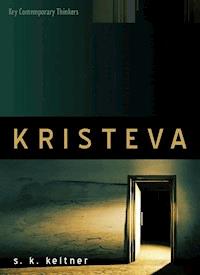
S. K. Keltner's book provides the first comprehensive introduction to the breadth of Kristeva's work. In an original and insightful analysis, Keltner presents Kristeva's thought as the coherent development and elaboration of a complex, multidimensional threshold constitutive of meaning and subjectivity. The ‘threshold' indicates Kristeva's primary sphere of concern, the relationship between the speaking being and its particular social and historical conditions; and Kristeva's interdisciplinary approach. Kristeva's vision, Keltner argues, opens a unique perspective within contemporary discourses attentive to issues of meaning, subjectivity, and social and political life. By emphasizing Kristeva's attention to the permeable borders of psychic and social life, Keltner offers innovative readings of the concepts most widely discussed in Kristeva scholarship: the semiotic and symbolic, abjection, love, and loss. She also provides new interpretations of some of the most controversial issues surrounding Kristeva's work, including Kristeva's conceptions of intimacy, social and cultural difference, and Oedipal subjectivity, by contextualizing them within her methodological approach and oeuvre as a whole.
Julia Kristeva: Thresholds is an engaging and accessible introduction to Kristeva's theoretical and fictional works that will be of interest to both students and scholars across the humanities and social sciences.
Sie lesen das E-Book in den Legimi-Apps auf:
Seitenzahl: 362
Veröffentlichungsjahr: 2013
Ähnliche




















Table of Contents
Cover
Pubilished
Title page
Copyright page
Dedication
Acknowledgments
Abbreviations
Introduction: Thresholds
Kristeva’s Autobiographical Reflections
Chapter Descriptions
1 Kristeva’s Theory of Meaning and Subjectivity
The Semiotic and the Symbolic
From the Symbolic to the Semiotic – The Phenomenological Theory of Meaning
From the Semiotic to the Symbolic – The Psychoanalytic Theory of Meaning
The Dialectic of Semiotic and Symbolic
2 Kristeva’s Psychoanalytic – Abjection, Love, and Loss
Kristeva’s Theory of Subjective Diachrony
Abjection, Love, and Loss in the Wake of Symbolic Collapse
3 The Public Stakes of Intimacy
What is Intimacy?
Intimacy and the Event of Natality
Freud’s Involution of Intimacy
Abjection – Intimate Suffering / Public Horror
“Ravaged Intimacy” and the Event of Death
What’s Love Got to Do with It?
4 Intimate Revolt, Temporality, and the Society of the Spectacle
The Spectacular Horizon of Kristeva’s Concept of Revolt
The Scandal of Timelessness – Kristeva’s Phenomenological-Psychoanalytic Concept of Time
In Search of an Experience, or Revolt
Sex and Time – The Interminable Revolt of Female Genius
The Future of Intimate Revolt
5 So Many Oedipuses, So Little Time
Reviving Oedipus
Oedipus is Dead, and We Have Killed Him
The Irony of Antigone, Pariah of the Phallic Sacred
Anti-Oedipus – Beyond Sexual Difference, an Incurable Stranger
6 Kristeva’s Novelistic Approach to Social and Political Life
Homo Spectator
Detective Fiction – A Proper, Specular Inquiry
Inspector Freud; Dr. Delacour
My Own Private Byzantium; or, the Odd Future Anterior of Kristeva’s Hero
Conclusion: Politics at the Margin – Kristeva’s Wager on the Future of Revolt
Further Reading
Bibliography
Index
Pubilished
Jeremy Ahearne, Michel de Certeau
Peter Burke, The French Historical Revolution: The Annales School 1929–1989
Michael Caesar, Umberto Eco
M. J. Cain, Fodor
Filipe Carreira da Silva, G. H. Mead
Rosemary Cowan, Cornel West
George Crowder, Isaiah Berlin
Maximilian de Gaynesford, John McDowell
Reidar Andreas Due, Deleuze
Eric Dunning, Norbert Elias
Matthew Elton, Daniel Dennett
Chris Fleming, Rene Girard
Edward Fullbrook and Kate Fullbrook, Simone de Beauvoir
Andrew Gamble, Hayek
Neil Gascoigne, Richard Rorty
Nigel Gibson, Fanon
Graeme Gilloch, Walter Benjamin
Karen Green, Dummett
Espen Hammer, Stanley Cavell
Christina Howells, Derrida
Fred Inglis, Clifford Geertz
Simon Jarvis, Adorno
Sarah Kay, Žižek
Valerie Kennedy, Edward Said
Chandran Kukathas and Philip Pettit, Rawls
Moya Lloyd, Judith Butler
James McGilvray, Chomsky
Lois McNay, Foucault
Dermot Moran, Edmund Husserl
Michael Moriarty, Roland Barthes
Stephen Morton, Gayatri Spivak
Harold W. Noonan, Frege
James O’Shea, Wilfrid Sellars
William Outhwaite, Habermas, 2nd Edition
Kari Palonen, Quentin Skinner
John Preston, Feyerabend
Chris Rojek, Stuart Hall
William Scheuerman, Morgenthau
Severin Schroeder, Wittgenstein
Susan Sellers, Hélène Cixous
Wes Sharrock and Rupert Read, Kuhn
David Silverman, Harvey Sacks
Dennis Smith, Zygmunt Bauman
James Smith, Terry Eagleton
Nicholas H. Smith, Charles Taylor
Felix Stalder, Manuel Castells
Geoffrey Stokes, Popper
Georgia Warnke, Gadamer
James Williams, Lyotard
Jonathan Wolff, Robert Nozick
Ed Pluth, Badiou
Oliver Davis, Rancière
Gareth Dale, Karl Polanyi
Copyright © S. K. Keltner 2011
The right of S. K. Keltner to be identified as Author of this Work has been asserted in accordance with the UK Copyright, Designs and Patents Act 1988.
First published in 2011 by Polity Press
Polity Press
65 Bridge Street
Cambridge CB2 1UR, UK
Polity Press
350 Main Street
Malden, MA 02148, USA
All rights reserved. Except for the quotation of short passages for the purpose of criticism and review, no part of this publication may be reproduced, stored in a retrieval system, or transmitted, in any form or by any means, electronic, mechanical, photocopying, recording or otherwise, without the prior permission of the publisher.
ISBN-13: 978-0-7456-3896-6 (hardback)
ISBN-13: 978-0-7456-3897-3 (paperback)
ISBN-13: 978-0-7456-5806-3 (Single-user ebook)
ISBN-13: 978-0-7456-5805-6 (Multi-user ebook)
A catalogue record for this book is available from the British Library.
The publisher has used its best endeavours to ensure that the URLs for external websites referred to in this book are correct and active at the time of going to press. However, the publisher has no responsibility for the websites and can make no guarantee that a site will remain live or that the content is or will remain appropriate.
Every effort has been made to trace all copyright holders, but if any have been inadvertently overlooked the publisher will be pleased to include any necessary credits in any subsequent reprint or edition.
For further information on Polity, visit our website: www.politybooks.com
for Jay and Brando
Acknowledgments
The present work is indebted to a diverse, yet deeply interrelated, set of communities, philosophical, feminist, and personal, old and new, to which I owe the existence of this book.
I am deeply indebted to several people who, for various reasons, have not been directly involved in the technical writing of this book, but without whom it would not have been written. I owe a special thanks to my mother, Sheryl Allen, who stands at the crossroads of my personal and public life, who taught me to speak, to think, and to love. I am grateful to Anthony Beavers, my first intellectual mentor, whose philosophical spirit, close mentorship, and personal encouragement first shaped my philosophical development. I am indebted to Julia Galbus, my first feminist mentor, for selflessly guiding my initial introduction to feminist thought. I especially thank Tony and Julia for their support and friendship during my earliest years in the academic community.
I owe a profound debt to several people who have stimulated, encouraged, and supported in infinite ways my professional and intellectual development in general and this book in particular. I am indebted to Sara Beardsworth for her intellectual and spiritual generosity. It would not be an exaggeration to say that the fruit of the whole book is indebted to her mentorship, scholarship, and friendship, as one will no doubt note in the endnotes and suggested reading sections for nearly every chapter. Kelly Oliver’s generosity is also responsible for this book. I’ve had the good fortune to experience in concrete and multiple ways Kelly’s commitment to inspire, support, and befriend junior scholars. My thanks to Tina Chanter for pushing me to develop my initial hunches about Kristeva’s Oedipus, but also for modeling unparalleled critical rigor and for supporting my philosophical and professional development more generally. I especially thank Robert Bernasconi for his long-standing support and philosophical inspiration. Robert’s critical questions and keen insight initially inspired my turn to explicate the phenomenological dimension of Kristeva’s thought. I thank Jena Jolissaint for her general irreverence and idealizations as a thinker, an activist, and a friend.
I am greatly indebted to the invitations of several people who provided the opportunities to develop and revise the central insights of the present study, including those thanked above, but also Sean Kirkland, Maria Margaroni, Hugh Silverman, Rochelle Green, and the WIPsters (Women in Philosophy) at Goucher College. The greatest thanks to Kelly Oliver, Ewa Ziarek, my ever patient editor Emma Hutchinson, and Matthew Stewart for reading and commenting on the full manuscript of Kristeva: Thresholds during the final months of its development. Their critical insight provided the final push and confidence to finish it. Special thanks to Matthew for preparing the index.
Finally, I am most profoundly indebted to the loves of my life, Jay and Brando, to whom I dedicate this book. – To Jay for listening to my love–hate diatribes on Kristeva for over a decade, for commenting on the various ideas and papers from which this book began, and for supporting me emotionally and intellectually through all of the trials of its development and beyond. – To Brando for teaching me the patience and love of motherhood (which I discovered to be essence of thought and writing) and for returning me to the joyful novelty of the world in all of its risks. They are the real authors of the present work.
Abbreviations
Introduction: Thresholds
A quick tour through the themes of Julia Kristeva’s works reveals an overarching intention to interrogate the personal trials of singular psychic life. Experiences of horror, fear, rejection, crime, love, loss, despair, grief, suffering, violence, alienation, banality, strangeness, foreignness, migrancy, and intimacy, for example, fill the titles and pages of her corpus. Her style of approach may be heard as equally intimate, drawing as she does from her experiences as an analyst, a reader of literature, a writer, a foreigner, a woman, a mother, a daughter. Descriptions of personal experience, autobiographical reflections, the personal stories of her patients, and biographical accounts of philosophers, artists, writers, saints, and psychoanalysts all punctuate Kristeva’s critical, as well as her fictional works. Even her descriptions of psychoanalytic structures and dynamics are overwhelmed by the narrative of a personal “I.” Kristeva’s works are intent on returning her reader to the animating experiences of everyday life, in all of its joys and failures.
Lesen Sie weiter in der vollständigen Ausgabe!
Lesen Sie weiter in der vollständigen Ausgabe!
Lesen Sie weiter in der vollständigen Ausgabe!
Lesen Sie weiter in der vollständigen Ausgabe!
Lesen Sie weiter in der vollständigen Ausgabe!
Lesen Sie weiter in der vollständigen Ausgabe!
Lesen Sie weiter in der vollständigen Ausgabe!
Lesen Sie weiter in der vollständigen Ausgabe!
Lesen Sie weiter in der vollständigen Ausgabe!
Lesen Sie weiter in der vollständigen Ausgabe!




