


29,99 €
Mehr erfahren.
- Herausgeber: ELLINOEKDOTIKI
- Kategorie: Geisteswissenschaft
- Sprache: Englisch
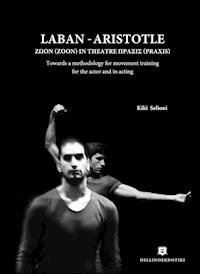
The focus of this book rests on an investigation into the links between Laban and Aristotle and aims at proposing a new approach to movement training for the actor. In contrast to the standard Platonic reading, Laban’s development is best understood through the conceptual framework of Aristotle. This not only provides a more secure theoretical approach, but a practical one as well, which establishes the art of movement as a science. This investigation intends to establish Laban’s philosophical foundation upon a reading of Aristotle’s Poetics, and in particular, on the reading of the Poetics by contemporary Greek philosopher Stelios Ramfos in his two-volume book ΜIΜΗΣΙΣ ΕΝΑΝΤΙΟΝ ΜΟΡΦΗΣ Ἐξήγησις είς το Περί Ποιητικής τοῦ Ἀριστοτέλους (MIMESIS VERSUS FORM Exegesis about Aristotle’s Poetics) (1991-1992). What is significant about Stelios Ramfos’ exegesis is that he attempts an analysis and interpretation of the concepts of the Poetics in terms of theatre performance. Ιt is this emphasis on performance that makes the task I have embarked upon possible. The discussion will serve as a critical framework that will propose a new way of applying Laban’s movement concepts to the movement training for actors in practice. The research methodology is also practical. I will therefore also develop and present a performance that attempts to apply Laban’s terms, as these are discussed, in relation to Aristotle, and in relation to the new methodology as well as a syllabus of practical classes addressing actor movement training in both kinaesthesia and characterization. The ultimate goal of the project is to contribute an approach that can inform the way Laban’s concepts are taught and provide suggestions for structuring technical movement classes for actors.
Das E-Book können Sie in Legimi-Apps oder einer beliebigen App lesen, die das folgende Format unterstützen:
Veröffentlichungsjahr: 2020
Ähnliche




















LABAN - ARISTOTLE
ZΩΟΝ (ZOON) IN THEATRE ΠΡΑΞΙΣ (PRAXIS)
Towards a methodology for movement training for the actor and in acting
BY
ΚIKI SELIONI
Kiki Selioni
Laban - Aristotle: Zώον (Zoon) in Theatre Πράξις (Praxis);
Editor:
Natalie Katsarou
Art & Creative Director:
Laertis Vila
Desktop Publishing:
DTP ELLINOEKDOTIKI
Cover photo:
George Labrou
Cover design:
Laertis Vila
DVD Editor:
Seraphim Arkomanis
Physical book info:
First Edition: October 2014
ISBN: 978-960-5630-77-5
© Copyright:
D.V. HELLINOEKDOTIKI S.A.
& Kiki Selioni
The republication or more generally the reproduction of the present work, in whole or in part, even of a page or a summary, or in the form of a paraphrase or adaptation, by any means whatsoever (mechanical, electronic, by photocopying, recording, or otherwise), in accordance with the laws N.237/1920, 4301/1929 and 10074, N.D. 3565/56, 4264/62, 2121/93 and other rules of International Law, without the prior written consent of the Publisher, which retains exclusive rights of ownership for itself, is prohibited.
D.V. HELLINOEKDOTIKI S.A.
Publications and trading
Ippokratous 82, Athens, 106 80
Tel. & Fax: +30 210 3613676 − 210 3640632
www.ellinoekdotiki.gr, e-mail: [email protected]
CONTENTS
Acknowledgements
Dedication
Preface
Chapter I: Mimesis and Laban philosophical background
1.1 The Roots of the Problem and the Case for New Knowledge
1.2 The Concept of Mimesis in Philosophy
1.2.1 Plato
1.2.2 Aristotle
1.2.3 Post-Aristotelian approaches to mimesis
1.2.4 Stelios Ramfos: Mimesis versus Imitation and Representation
Chapter II: Aristotle-Laban: the Links.
2.1 Mimesis: The creation of a world per se
2.2 The art as a Science-The Poetic science-The Logic in art
2.3 The Intentionality of Art – Demiourgos and Prothesis
2.4 The Notion of Indestructible Time–Indestructible Dynamics in relation to the Notion of Presence and Corporeality (Kinaesthetic Experience and Zώον)
Chapter III: Overview of the tradition of Laban movement for actors
3.1 Rudolf Laban: The Mastery of Movement on the Stage
3.2 Laban’s legacy in actor’s movement training: the next generation
3.3 Contemporary Laban-based Approaches to actor movement training: Trish Arnold–Brigid Panet–Barbara Andrian
3.4 Towards a New Laban Methodology in Teaching Movement to Actors
Chapter IV: Proposed Methodology
4.1 The Basis of the Methodology
4.2 The Units of Actions: The analysis of the units of actions and their significance in acting
4.3 Fundamental Exercises in Units of Actions
4.4 Effort/Eukinetics: The actor’s kinesthetic awareness and his presence on stage
4.5 Space as a Cube
4.6 Space exercises
4.7 Relationships
4.8 Exercises in relationships
4.9 Main Principles in Combining Movement and Textual Content (Speech)
4.9 Exercises
4.11 Summary
Chapter V: Conclusion
5.1 Praxis Outcomes – An integrated Body and Mind for the Actor
5.2 Aristotelian Laban Practice and its relation to the field of Movement for Actors
Outline of my working method
Glossary
Index
Bibliography
Acknowledgements
This book succeeded because of the great Stelios Ramfos, who gave me the key to reading Aristotle in order to support my research.
This book is the result of a research project and doctoral thesis completed within the Royal Central School of Speech and Drama University of London. I am therefore grateful to my first supervisor Dr Tony Fisher for his continual guidance and support in completing this book. Special thanks go to my second supervisor Dr Jane Munro. I owe a great deal to my third supervisor Dr Katia Savrami for her enthusiastic encouragement and continued support during my research. I am particularly grateful to my original supervisor Professor Ana Sanchez-Colberg and to Honorary Doctorate Costas Georgousopoulos during the first year of my research for their support and clear advice. Special thanks to Professor Robin Nelson for his helpful advice on my research. I would like to thank Professor Andy Lavender for his support and kindness during my research. Very special thanks to all my students for their invaluable help throughout my research. A special expression of appreciation goes to all my collaborators and colleagues who supported me during my research. I am particularly grateful to my editor Natalie Katsarou and collaborators Antonis Galeos, Athanasia Triantafyllou, Seraphim Arkomanis, Eudokia Veropoulou, Dionysis Tsaftaridis, Thodoris Vournas, Eugenia Papageorgiou, Stela Anton, Alexandros Psychramis, Panagiotis Pantazis, Arguro Tsirita. I would like to thank all my friends for their continuous love and constant support: Andreas Peristeris, Evaggelia Katsali, Nikos Mpouras, Vaso Panagiotakopoulou, Andreas Peridis, Michael Seibel, Vasilis Nikolaidis, Maria Ntotsika, Panos Panagiotou, Xristina Theodoropoulou, Barbara Douka, Giorgos Thalassinos, Lampros Vlachos, Akis Vloutis, Nikos Anagnostopoulos, Katerina Berdeka.
Special thanks go to the Michael Cacoyiannis Foundation for supporting me in my research.
I will never forget my mentor and teacher Dora Tsatsou who introduced me to Laban’s method and helped me in continuing my studies, as well as Mairi Vogiatzi-Traga for giving me all the necessary tools for carrying out my methodology.
Finally, I would like to express my gratitude towards the publishing house Hellinoekdotiki for readily taking on the task of publishing my work.
Dedication
In memory of my parents Michalis and Aliki Selioni
Preface
The application of Laban’s method in actor training has a long history that extends beyond his work in dance and it is in this area that the project focuses on. Although Laban himself applied his method to the training of actors, it was left mainly to his followers to develop, often erratically – or such is the proposal of this project – Laban’s insights. Practitioners such as Jean Newlove, Yat Malmgren, Geraldine Stephenson, Brigid Panet and so on have all continued developing his work by offering movement classes for actors based on Laban’s principles. Each of these individuals has developed a specific method for actors based upon Laban’s principles. It is worth noting that these methods do not differ from one another and all of them agree in principle that the philosophical foundation of Laban’s theory and practice is to be interpreted according to platonic precepts. In this work I will argue that it is this Platonic foundation that underscores each of the above practitioners’ own development and notwithstanding the differences between them, it is Platonism that unifies them all under a common philosophical approach.
This Platonic interpretation originates in Laban’s Rosicrucian period during which he explored the directions of the human body in terms of the Platonic icosahedron.1 It was an investigation that brought the art of dancing to a new era by breaking the stability of the dancer and introducing instead the concept of lability or instability. Laban replaced the three dimensional conception of space in dance by a ‘Platonic’ icosahedral perspective. Up to this point the dancer was located in an iconic cube and his directions were limited to front/behind, up/down, left/right. Laban’s icosahedron opens up new possibilities of movement because it expands the boundaries of the body’s directions by employing the full dimensions of space, in both stability and lability. This innovation led Laban to be celebrated in the field of dance as the father of contemporary dance. The platonic influence on Laban’s theory and practice was explicitly established in Curl’s Philosophical Foundations originally written as a series of articles in 1966-1967 and published in the Laban Art of Movement Guild Magazine. These articles discuss the relation between Laban and his followers and their pursuit of a philosophical foundation. Ullmann, Laban’s principal collaborator during the last years of his life, explains: ‘serious study of this kind requires a philosophical foundation’ (Ullmann as cited in Curl 1966: 7). Two other factors would dramatically influence Laban’s descendants in developing movement training for actors: firstly, Laban’s background in expressionistic ideas and secondly, the connection of his theory and practice to Stanislavsky’s work. This book will discuss how these factors influenced their teaching methods in ways that may be considered to be working against Laban’s aims.
The project is divided as follows:
Chapter One examines the roots of the problem, by placing the research within contemporary issues regarding actor movement, particularly those stemming from the Laban heritage. In order to examine the main problems in this heritage, the first chapter concentrates on readings of Laban’s work that rely on a platonic philosophical foundation, the expressionistic tones of his work and his connection to Stanislavsky’s acting method. Since this requires a re-evaluation of the philosophical foundations underlying Laban’s work, the chapter will also focus on mimesis as examined by Plato, Aristotle and post-Aristotelians. With regards to the concept of mimesis I will be adopting and adapting Stelios Ramfos’ approach to Aristotle’s Poetics in his two-volume book ΜΙΜΗΣΙΣ ΕΝΑΝΤΊΟΝ ΜΟΡΦΗΣ Ἐξήγησις είς το Περί Ποιητικής τοῦ Ἀριστοτέλους (MIMESISVERSUS FORM Exegesis about Aristotle’s Poetics) (1991-1992). Ramfos introduces an analysis of mimesis as a ‘life force’ (ζώον) rather than representation, as the notion is commonly translated. His explanation of the notion of ζώονas a ‘life force’ supports Aristotle’s connection to Laban’s movement dynamics (Ramfos 2004: 181). This chapter uses Ramfos’ argument as a framework in which the comparative analysis between Laban and Aristotle takes place.
Stelios Ramfos explains mimesis in a way that is radically opposed to the concept of representation or imitation. In his preface, Ramfos starts by analysing Plato’s statements about mimesis in the latter’s Symposium, Republic and Phaedo. For Plato, as it is widely known, in the Republic dramatic art is exiled; in Symposium it is transformed into divine eros (Love); and in Phaedo it becomes an ecstatic creation. In all three woks, Plato treats tekhnê (art) as non-mimetic, while mimesis remains a mere mirroring of this world without adding to knowledge. This is one of the principal reasons why the poet is exiled. Aristotle, on the other hand, by introducing the notion of ζώον (zoon), treats dramatic art as a political issue, Ramfos argues. What the theatre creates is a living presentation of a complete Πράξις (Praxis); people are able to mirror themselves through the theatre and learn what they could avoid in real life. In his article ‘Memory Mimesis Tragedy: The scene before philosophy’ in the Theatre Journal (2003), Paul Kottman seems to be confirming Ramfos’ insights on mimesis. He says:
The problem lies in this: the political sense of mimesis – which relates the theatrical experience of being on the scene to political life ‒ cannot be fully grasped in terms of the fictional or artistic character of performance or work, and its relation to an outside reality. Rather, mimesis acquires its political sense in theatrical experience insofar as it corresponds to the living relation of the scene. A radical politics of mimesis, in sum, would therefore need to move beyond the centrality of representation, of what is represented, and begin to take account of this correspondence. (Kottman 2003: 96)
Ramfos re-introduces the idea that, in order to create such a correspondence with reality, mimesis must be seen through the prism of Aristotle’s ζώον. Performance is in fact the ζώον, namely, a living force that constitutes a world per se, which does not exist before the performance. Ζώον is defined as constant movement conveying symbols of human values (and not mere facts). This movement is an amalgam of various actions that build each and every moment, or now (νῦν), into a time other than physical time. According to Ramfos, since tragedy is a political issue, it must be presented in front of the spectators as a live performance and as if the spectators were present before the presented events. The scene is a mirror of values in which men can see themselves; they feel pity and fear but also hedone (pleasure) for witnessing these events. Ramfos believes that with the notion of ζώον, Aristotle opens up the possibility of witnessing and examining the performance and not just the text. Only through this mirroring is it possible for symbols to convey the values that are inscribed deep in the spectators’ souls, thus creating hedone (pleasure) and synkinesis (commotion).
What causes the performer to feel pleasure, according to Ramfos, is the magnitude of the tragedy. In order for this to happen, the performer must experience a constant presence on stage and achieve ‘a moment of full concentration in which all distractions are gone’. This is why he calls performance a moment of indestructible time (Ramfos 2010). It is this somatic state that the performer attains hedone (pleasure) from during his execution. Ramfos’ view that pleasure is a bodily state induced by certain activities and not a psychological effect is well-attested by neuroscience. In his work The Compass of Pleasure: How Our Brains Make Fatty Foods, Orgasm, Exercise, Marijuana, Generosity, Vodka, Learning, and Gambling Feel So Good, neuroscientist David Linden explains:
Most experiences of our life that we found transcended, either illicit vices or socially sanctioned rituals and social practises, as diverse as the exercise, meditative prayer, or even charitable giving ‒ activate an anatomically and biochemically-defined pleasure circuit in the brain. Shopping, orgasm, learning, high caloric foods, gambling, and prayer, dancing ’til you drop, and playing in the Internet: They all evoke neural signals that converge on a small group of interconnected brain areas called the medial forebrain pleasure circuit. It is in these tiny clumps of neurons that human pleasure is felt. (Linden 2011: 3-4)
This also coincides with Laban’s idea that it is through somatic rituals and practices that theatre produces pleasure for both the performer and the audience; this idea, backed up by Ramfos’ analysis of Aristotelian pleasure and commotion, releases Laban from the aura of platonic idealism and Rosicrucianism. It may also lead to updating his method into a scientific system.
Chapter Two introduces four important links between Aristotle and Laban and establishes a new philosophical background against which Laban’s movement principles can be understood. This will then serve as a theoretical framework for my own practice insofar as it seeks to renew the methodological grounds of Laban-based movement training for actors. The research suggests that the links between Laban and Aristotle are stronger than those between Laban and Plato. This review of Laban’s philosophical foundations has a direct impact on the re-evaluation of Laban’s theory and practice. The four links I will be examining are the Aristotelian principles or concepts that bear a direct relation to Laban which will help to redefine our understanding of mimesis: (1) the creation of a world per se (ένας κόσμος αυτός καθ’αυτός), (2) art as a science – the poetic science, (3) the artist as a demiourgos,2 and (4) the notion of indestructible time-indestructible dynamics in relation to the notion of presence and corporeality (kinaesthetic experience and zώον).
Chapter Three follows this line of thought by critiquing the work of the main practitioners who have continued Laban’s legacy in movement training for actors, and the way in which they connect Laban’s approach to Stanislavsky’s acting method. Reference is made to more recent approaches in teaching movement for actors influenced by Laban’s principles in order to show to what extent they have based their work on the connection between Laban and Stanislavsky. In Chapter Four, based on this revised theoretical approach to Laban, I will be introducing a new practical methodology for actor movement training.
Chapter Five seeks to critically reflect on my methodological recommendations, and evaluate the principal claims of the project in light of my practical experiments in the studio.
1 In Timaeus Plato states that the creation of the Cosmos is based on five solids, each of them representing one of the elements of nature: cube for earth, tetrahedron for fire, octahedron for air, dodecahedron for the cosmos as a whole, and icosahedron for water. See also: Newlove’s Laban For All, where she refers to Laban and his connection to platonic ideas.
2 Demiourgos: creator. A notion discussed in Plato’s Timaeus.
Chapter I: Mimesis and Laban philosophical background
INTRODUCTION
This research project is a theoretical and practical enquiry into the proposition that there is a strong link between Laban’s movement theory and Aristotle’s Poetics. More specifically, it proposes that Laban’s analysis of human movement is inextricably linked to Aristotle’s concept of mimesis conceived as a zώον (life force). Up until now the discussion on Laban’s philosophical foundations has been limited to an assumption of Platonic influence (Curl 1966: 7-15). However, in his Mastering Movement (2001) John Hodgson mentions, perhaps for the first time, the connection between Laban and Aristotle:
Laban was drawn to Greek thinking. He enjoyed Greek roots and word formations. From the classic background he devised new terms such as ‘choreosophie’ and ‘choreology’ and brought words like ‘kinetic’ into more regular use and awareness. He makes passing reference to Aristotle, Pythagoras, Plato and several times refers to Lucian and his awareness of the power of dance, especially without music. (Hodgson: 2001: 56)
The idea that the art of dance in Ancient Greece was without music, is first mentioned in Aristotle’s Poetics; it is subsequently discussed by Lucian in his Peri Orheseos written in 2 AD. Hodgson also points out that although Laban refers to Plato, he ‘does not seem to have made any detailed or thorough study of him’ (Hodgson 2001: 60). It is very obvious, as we will see in section 1.1, that there is a great amount of confusion concerning the philosophical foundation of Laban’s work, even amongst the people who were closest to him.
I will be arguing that Laban, in his ‘English period’ following the second world war, undertook a shift away from the Platonic philosophy that had originally inspired his initial interest in dance, to the field of theatre and an engagement with Aristotle’s thinking. As Preston-Dunlop, one of Laban’s students during that period, indicates in her work Rudolf Laban: An Extraordinary Life, Laban’s key text, The Mastery of Movement on the Stage (1950), is in fact written for actors rather than dancers (Preston-Dunlop 1998: 253). Moreover, Warren Lamb, Laban’s disciple during the same period, interviewed by Dick McCaw in An Eye for Movement (2006), supports Preston-Dunlop’s suggestion of Laban’s shift of focus at this time:
All his work in factories at this time was concentrated on Effort, without much reference to shape or space harmonies. He was teaching space harmony to dancers and teachers, but it seemed that he had made an inseparable connection of work with effort (McCaw 2006: 86, 87).
The research of effort, Lamb continues, was ‘Laban’s assertion that Effort was an indication of the character’ (McCaw 2006: 88). McCaw agrees with Lamb; he states: ‘Laban thought that an analysis of effort was the way to understand human behaviour’ (McCaw 2006: 77). In his last book The Mastery of Movement on the Stage, Laban states that the theatre is ‘the mirror of man’s physical, mental, and spiritual existence’ (Laban 1950: v). I shall argue here that this statement is to be understood in direct opposition to platonic precepts, thus undermining the idea that the art of theatre is a means of mirroring the ideal world of the Forms; on the contrary, it is in full agreement with Aristotle’s famous passage in the Poetics defining tragedy as the mimesis of human praxis.
Therefore, this study suggests that Laban’s concepts are more in tune with the Aristotelian concept of ζώον, as discussed in the Poetics. I will use this argument to underpin the proposal of a new methodology for teaching movement to actors. Moreover, contrary to conventional approaches (e.g. Newlove and Malmgren), that align Laban’s concepts with Stanislavsky’s, Laban is in fact in direct opposition to Stanislavsky, both in terms of their aesthetic/philosophical and practical approach as well as their attitude towards psychological implications concerning character development. Furthermore, the critical analysis of Laban and Aristotle will serve as a framework supporting a new series of classes, based on Laban’s theory and practice. Bear in mind that Aristotelian mimesis is to be understood in terms of the notion of ζώον (zoon) – a living organism that is synonymous to life, or life force – and only on this basis can it be used in relation to the training of the actor’s body for the theatre. Moreover, the classes will be constructed within a framework that seeks to address both theoretical and practical issues in terms of scientific methodological demands. In other words, the structure of the classes should follow a logical order, as Aristotle suggests when he talks about science (first principles, middle terms etc); the classes should follow the methodological basis of proceeding from a first simple action to a more complex one.
This investigation therefore intends to establish Laban’s philosophical foundation on Aristotle’s work and mainly as this is developed in his famous treatise on theatre, the Poetics. The research will re-examine the conceptual basis of the philosophical systems they have in common in order to establish similarities between Aristotle and Laban’s understanding of humanpraxis in the theatre. More significantly, the research will propose that they share a common understanding of the role of the performer’s kinaesthetic experience and that this experience is to be understood as possessing no psychological implications. The research will discuss how, for both Laban and Aristotle, the process of art-making is one of intentionally creating a world per se, namely, a new poetic reality that does not exist in this world. This idea is the foundation for understanding mimesis based on a process of poetic science, the aim of which is for the performer to have a constant presence on the stage. In other words, the performer must constantly be attentive to his body’s ever-changing rhythms in present time and thus be able to continually experience what we might call, based on Aristotle, an aesthetic time and not merely a physical sense of time during the performance. This presupposes a well-trained body; the performer works under the condition that his training develops bodily awareness of both movement and voice and addresses the needs of dramatic art holistically. If the performer lacks that ability, his presentation stands as a schematic presence that reveals its inartistic character. Aristotle calls this constant presence on stage ζώον (living thing, or as Ramfos calls it, ‘life force’), whereas Laban defines it as kinaesthetic experience. Relating these two concepts I will be arguing that Laban’s conceptual framework is very close to Aristotle’s. Moreover, by linking Aristotle to Laban, this project provides the opportunity to develop not only a theoretical approach, but also a practical one, which establishes the art of movement as a science. Laban’s followers have often dismissed the idea of a scientific approach in movement, since they have emphasized first and foremost on the emotional and expressionistic character of this method. A movement science, on the other hand, would focus on logical elaboration and a conscious intention while training as well as when structuring a character.
In order to suggest a new theoretical basis and practical training for actors I will be incorporating Stelios Ramfos’ theoretical approach to Aristotelian mimesis as ζώον (life force). Since mimesis is conceived as a ζώον, the actor should live in a state of constant presence on stage; this means that during this ‘aesthetic time’ the beauty of ζώον lies in the execution of the logical development of actions, which constitute the unity of a praxis (complete performance). Ramfos argues:1
Time in the case of the work of art and its pleasure is to be found in the whole of its duration, from the beginning to the end, and not in some moments that require the participation of the spectator’s soul […]. Indeed the poetic synkinesis (commotion) is not produced by assembling the external parts of the work of art, but is extracted from its existential perfection, namely its function as an energetic living whole. (Ramfos 1991: 201)
Insofar as it accomplishes this, the body experiences time as a constant νῦν (now), thus transforming abstract physical time into the indestructible time of living presence. Actually, the now has been transformed into an aesthetic time free from ‘the everyday world of our sufferances and gaieties’ (Laban 1950: 6). Laban recognizes that a body on stage experiences its effort rhythms in a constant ‘now’, in a specific space and having a specific duration, by interrupting physical time and replacing it with the experience and fullness of its somatic energy. Thus, being on stage consists of turning physical time into a moment of catharsis. The actor sets external reality aside and experiences the pleasure of his existence through his movement, i.e. he experiences time as he embodies it. The research will establish links between indestructible time and Laban’s approach to movement as a kinaesthetic experience, in his Effort Theory. One issue that the research aims to address is how this framework can propose a new way of applying Laban’s movement concepts to movement training for actors. Namely, the research establishes that Laban proposes a way of ‘living on stage’ not only in indestructible time, but through effort as well.
Aristotle provides an ontological theory for the text and its plot as an organic whole. It is important to acknowledge that in Aristotle’s time the semiotics of speech was understood in terms of rhythms that were capable of transferring emotions; this is why Aristotle offers the principles of dramatic art in terms of text and speech. However, on a second level he implies that the body’s movement is related to his notion of ζώον. Having lived in a different time, where words were symbols that meant nothing specific when viewed on their own, Laban realized that body movement on stage is more capable of conveying meaning and can thus present vast nuances. He wrote:
The oldest rhythms of which we have knowledge are those of ancient Greece and these in the main are related to poetry […]. These rhythms, called measures, were arranged in verses, strophes and poems. The Greeks considered rhythm to be the active principle of vitality […], it is reported that the arrangement of the rhythm was the first step in creating poetic and dramatic art (Laban 1950: 132,133)
Laban replaces language rhythms with the body’s movement rhythms (including voice), and like Aristotle, steers dramatic art away from all psychological implications during the training of actors. In short, when developing kinaesthetic awareness, actors do not need to identify with any character nor do they need to experience emotions. The exercises proposed in this book focus on actions and their effort qualities, and hence promote interaction between body and mind.
On this basis, Laban offers a mode of training that could function as a support to every acting method since he establishes a practical guide for a new poetic science: The Art (and its Mastery) of the Movement on the Stage. In 1950 Laban stated that ‘the elements of movement when arranged in sequences constitute rhythms’ (Laban 1950: 130) and from this point on he developed Eukinetics, the study of movement dynamics. Laban calls as ‘effort rhythms’ the visible movements of the human body, which are the result of its inner attitude. His effort analysis ‘enables us to define our attitudes towards the factors of movement (weight, space, time, flow) on the background of the general flux of movement in proportional arrangements’ (Lange 1970: 5). Finally, this research can be seen as a practical explanation of the manner in which the Aristotelian ζώον moves, thereby contributing to Aristotle’s ontological and poetic theory a practical training guide for the actor’s kinaesthetic experience. The result of this analysis will be presented in Chapter Four in the form of a syllabus of practical classes addressing actor movement training. The ultimate goal of this work is to contribute a new approach that can inform the way Laban’s concepts are taught and provide suggestions for structuring technical movement classes for actors in an attempt to offer a complete methodology of Laban theory and practice focusing exclusively on characterization and not on Laban studies for dance.
1 All translations from the original Greek text to English are done by the author.




