


Erhalten Sie Zugang zu diesem und mehr als 300000 Büchern ab EUR 5,99 monatlich.
- Herausgeber: Parthian Books
- Kategorie: Geisteswissenschaft
- Sprache: Englisch
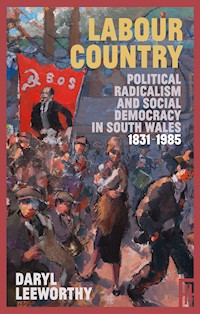
Since the end of WWI, one party has held the momentum of political and social change in South Wales: the Labour Party. Its triumph was never fully guaranteed. It came quickly amidst a torrent of ideas, actions, and war. But the result was a vibrant, effective and long-lasting democracy. The result was Labour Country. In this bold, controversial book, Daryl Leeworthy takes a fresh and provocative look at the struggle through radical political action for social democracy in Wales. The reasons for Labour's triumph, he argues, lay in radical pragmatism and an ability to harness lofty ideals with meaningful practicality. This was a place of dreamers as well as doers. The world of Arthur Horner and Aneurin Bevan. And yet, as the author shows, this history is now over. Although a trajectory leads from the end of the Miners' Strike both to the advent of devolution and the circumstances that led to the Brexit vote in 2016, these are exits from Labour Country, not a continuation. Sustained by a powerful synthesis of scholarship and original research, passionate and committed, this book brings the cubist epic of South Wales and its politics to life.
Sie lesen das E-Book in den Legimi-Apps auf:
Seitenzahl: 835
Veröffentlichungsjahr: 2020
Das E-Book (TTS) können Sie hören im Abo „Legimi Premium” in Legimi-Apps auf:
Ähnliche



















Labour Country
Political Radicalismand Social Democracyin South Wales
1831-1985
Labour Country
Political Radicalismand Social Democracyin South Wales
1831-1985
DARYL LEEWORTHY
For Jayne Louise Leeworthy (née Salway),1968-2000, and Agnes Leeworthy(née Carruthers), 1928–.
CONTENTS
Abbreviations
Preamble
Part I: Building South Wales
Chapter One
Making a Working Class
Chapter Two
Bread of Heaven
Part II: Remaking South Wales
Chapter Three
On the Brink
Chapter Four
And Quiet Flows the Taff
Part III: Defending South Wales
Chapter Five
Picking up the Pieces
Chapter Six
A Sad but Beautiful Joke
Part IV: A New South Wales?
Chapter Seven
Labour’s Citadel
Chapter Eight
The Fall
Chapter Nine
Exit Labour Country
Acknowledgements
Index
ABBREVIATIONS
AL
Aberdare Leader
ALS
Aberdare Local Studies, Aberdare Library
ASLEF
Associated Society of Locomotive Engineers and Firemen
ASRS
Amalgamated Society of Railway Servants
BDN
Barry Dock News
BH
Barry Herald
BL
British Library
BodL
Bodleian Library, Oxford
BSP
British Socialist Party
CA
Carmarthenshire Archives, Carmarthen
CarmJ
Carmarthen Journal
CBC
County Borough Council
CC
County Council
CJ
Caerphilly Journal
CLP
Constituency Labour Party
CLS
Cardiff Local Studies Department, Cathays Heritage Centre
CMG
Cardiff and Merthyr Guardian
CPGB
Communist Party of Great Britain
CT
Cardiff Times
DH
Daily Herald
DLP
Divisional Labour Party
DW
Daily Worker
EC
Executive Committee
EEx
Evening Express
GA
Glamorgan Archives, Cardiff
GFP
Glamorgan Free Press
GG
Glamorgan Gazette
GwA
Gwent Archives, Ebbw Vale
IISH
International Institute of Social History, Amsterdam
ILP
Independent Labour Party
IRSH
International Review of Social History
LHASC
Labour History Archive and Study Centre, Manchester
LL
Labour Leader
LRC
Labour Representation Committee
LSE
London School of Economics
MEx
Merthyr Express
MFGB
Miners’ Federation of Great Britain
MG
Merthyr Guardian
MM
Monmouthshire Merlin
MT
Merthyr Telegraph
MWF
Miners’ Welfare Fund
NLW
National Library of Wales, Aberystwyth
NS
Northern Star
NUM
National Union of Mineworkers
NUR
National Union of Railwaymen
NUT
National Union of Teachers
PC
Pontypridd Chronicle
PFP
Pontypool Free Press
PLS
Pontypridd Local Studies, Pontypridd Library
PO
Pontypridd Observer
PSOE
Spanish Socialist Workers’ Party / Partido Socialista Obrero Español.
RBA
Richard Burton Archives, Swansea University
RDC
Rural District Council
RGASPI
Russian State Archive of Socio-Political History, Moscow
RL
Rhondda Leader
RPA
Robin Page Arnot Papers, Hull History Centre, Hull
SCOLAR
Special Collections and Archives, Cardiff University
SDF
Social Democratic Federation
SDP
Social Democratic Party
SLP
Socialist Labour Party
SPGB
Socialist Party of Great Britain
SSS
Socialist Sunday School
SWA
South Wales Argus
SWCC
South Wales Coalfield Collection, Swansea University
SWDN
South Wales Daily News
SWDP
South Wales Daily Post
SWE
South Wales Echo
SWLP
South Wales Labour Pioneer
SWMF
South Wales Miners’ Federation
SWML
South Wales Miners’ Library, Swansea University
TCLP
Trades Council and Labour Party
TG
Tarian y Gweithiwr
TLC
Trades and Labour Council
TLS
Treorchy Local Studies, Treorchy Library
TNA
The National Archives, Kew, London.
UDC
Urban District Council
VWC
John E. Morgan, A Village Worker’s Council: A Short History of the Lady Windsor Lodge, South Wales Miners’ Federation (Pontypridd, 1950)
WCML
Working Class Movement Library, Salford
WGA
West Glamorgan Archives, Swansea
WHR
Welsh History Review
WM
Western Mail
PREAMBLE
For the greater part of the twentieth century, one party held the momentum of political and social change in South Wales: the Labour Party. Its role in society, its ability to effect alterations in the landscape, to project hope and expectation and aspiration, was defined by its dominant position across politics, social organisation, and culture. In the twenty-first century, it is easy to think of the Labour Party – and the labour movement more generally – as a defence mechanism, as conservative and too attached to the legacies of the past, for that is how they have governed in devolved Wales, but for generations the labour movement – and its political wing – aspired towards radical change and inspired it. For many socialists in the late-nineteenth and early twentieth centuries the idea that the revolution was at hand, that it was possible to smell, hear, and see the utopia of the New Jerusalem, was a powerful guiding force.1 Its effects are still with us, just. There was once little in Ebbw Vale or Pontardawe besides the steel industry; little in Treherbert, Maerdy2, or Ynysybwl besides the mining of coal3; but the labour movement – particularly its most dynamic leader – in Gwyn Thomas’s words ‘took the image of this place out of the valleys … and presented it, its imperfections, its struggles, its humour, as a challenge to those parts of Britain that have never been scarred by poverty or the monstrous toil that heavy industry exacts from beauty’.4 This was Labour Country.
But what exactly do I mean by those terms: ‘South Wales’ and ‘Labour Country’? For nineteenth-century compilers of trades directories, the southern part of Wales extended from the Bristol Channel to the northern fringes of Cardiganshire and Breconshire. Today, as encountered on blue motorway signposts, perhaps, South Wales is more geographically contained: at its greatest extent, it includes the old counties of Glamorgan and Monmouthshire with the former industrial fringes of Carmarthenshire and Breconshire. In essence: the coalfield with its allied ports and the rural hinterland that lies in between. The South Wales encountered in the pages that follow, which I refer to as Labour Country, was more than geography. It is a version of the American Wales identified by Sir Alfred Zimmern shortly after the First World War, and since explored in social and cultural terms by generations of labour historians. ‘Of American Wales, the Wales of the coalfield and the industrial working class’, Zimmern wrote, ‘let me only say … what a joy it has been to pass a too fleeting and infrequent weekend among men and women who really care for ideas and love the search for truth’.5 American, then, because of the enormous industrial and demographic capacity of the coalfield; because of the vibrancy of the society and culture made by an immigrant population; and because, like America, it was young and curious about the world. To rediscover it I employ not the teleology of a telescopic viewfinder but rather the shake of a kaleidoscope for its shards of the unexpected, the glints and colours of a changing, now vanished, experience.
At the heart of what made South Wales different was its frontier experience. This was a nineteenth-century industrial frontier that, by the First World War, had reshaped itself into an urban society. When the population of Wales was calculated in 1801, it stood at around half a million. A century later, it had risen to more than two million and four-fifths of the Welsh lived in Glamorgan and Monmouthshire. Glamorgan’s population in 1801 had been around seventy five thousand people, but by the outbreak of the First World War it was in excess of one million. Here was the rise of South Wales measured in its rawest material terms, that of people and of potential labour. Few places experienced this rise more acutely, more tellingly, than the Rhondda. The five hundred or so people that comprised Rhondda’s population in 1801 or the four hundred living in the neighbouring parish of Llanwynno could have little imagined existing in a place, as was the case in 1911, of more than one hundred and fifty thousand on the one hand or more than forty thousand on the other. Nowhere grows that dramatically without calling on, and absorbing, resources – notably people – from elsewhere. The alternative was a steady, if unimpressive, growth and eventual decline, as occurred in Pembrokeshire and Cardiganshire. Therein, in those western counties, lies the story of what would have happened to Wales in the absence of the industrial dynamo: the permanent periphery.
The people who moved to South Wales from all over the world had to make a society and a culture from scratch. Houses, streets, sewage systems, cemeteries, churches and chapels, schools and hospitals, courts of law, council offices, theatres and cinemas, public meeting places, libraries, these things and more had to be constructed in communities that simply did not exist – or were little more than hamlets or villages or a collection of hillside farms – before the industrial revolution. In the chaotic novelty of those first decades of settlement, when muddy roads and privies offered little tangible difference from the rural existence scratched out by scores of previous generations – they may even have provided some comfort in the rawness of change – facets of modern civilisation such as the public park, library, and hospital, were but a dream. But as one generation gave way to the next and new ideas came to the fore, this industrial frontier came alive with simmering tensions and far-reaching aspirations. The liberalism which encompassed social radicalism, religious independence, national self-consciousness, and industrial and commercial interests, eventually struggled to adapt to demands for industrial democracy from below, giving rise first to an annexe – the Lib-Labs – and then to a rival, the Labour Party.
Central to this story was coal. Coal powered the iron industry in Merthyr Tydfil, the copperworks in Swansea, and propelled South Wales into a new, industrial existence. Industry encouraged scientific interest and the establishment of new production techniques, it linked South Wales to global networks of trade, and it made investors extremely wealthy.6 The imperial grandeur of Cardiff’s civic centre and its docklands coal exchange were a testament to that nineteenth-century largesse, as was the commercial opportunity, indicated by the surviving shop buildings, to be found in industrial towns such as Barry and Pontypridd. Until the 1870s, the primary destination for South Wales coal was the domestic iron industry. Of the nine million tons of coal produced in the mid-1850s more than one third was consumed by iron production. The export market at that time accounted for just one million tons.
By 1900, however, coal output had leapt to nearly forty million tons per annum, half of which was exported, and a further five million tons used to power steam ships. The amount used for iron production remained the same – around three and a half million tons.7 South Wales overtook the coalfields in the North East of England as the principal source of coal for the Royal Mail and the Royal Navy (the Admiralty was the South Wales Coalfield’s best customer), and steam coal was found on many of the commercial passenger liners, merchant vessels, and the navies of rival empires.8 By the early twentieth century, South Wales was home to great coal combines, such as Powell Duffryn, and to smaller independent coal companies, which harnessed the substantial profitability of the coalfield for the business elite. Profit was not redistributed into the hands of the miners themselves, whose wage packets included stoppages for everything from candles to pick sharpening to a contribution to the colliery doctor’s retainer.
If the difference between company profit and an individual’s wage packet provided one reason for the emergence of the labour movement, so too did the character of work in the coalfield – particularly work underground which was done almost universally by hand. The introduction of technology – cutting machines – which had a substantial impact on Scottish collieries where around a fifth of coal was machine cut by 1913, had a negligible presence in South Wales. There the amount was around one per cent, although geological conditions made the use of technology unviable in most cases.9 Consequently, South Wales miners worked, on average, the longest hours of any mineworker in Britain.10 Small wonder that miners’ leaders, such as A. J. Cook, frequently appealed to the ethical considerations of the majority of people who were not miners when responding to industrial action. Mining was extremely hard and physically arduous work with the act of hewing coal and other associated tasks accompanied by dangers of gas, roof collapse, and flooding. As Cook put it in the 1920s,
I wonder if those who abuse the miners were made to work even for one year in the pits, hauling nine hours a day down hot narrow galleries, lying half naked at the coalface, sweating at a narrow seam, working in water or excessive heat, living in a miner’s row and taking home, week by week, a miner’s average pay. With a risk of terrible mutilation and death ever present. I wonder if these people would be quite so sure that it was those paid agitators who made the miner’s struggle for better treatment?11
The historical contours of South Wales, well mapped by historians, are now overwhelmingly familiar, as are the causes of complaint evident in Cook’s speech. From the Merthyr Rising in 1831 and the Chartist Rising in Newport in 1839, which marked the beginnings of the working-class movement that was to come to prominence in the twentieth century, we move swiftly on to the start of democracy in the 1860s, the arrival of the Liberal Party as its political manifestation, and the election of the pacifist radical Henry Richard at Merthyr in 1868. William Abraham, Mabon, followed suit as MP for Rhondda in 1885. From the 1890s, the complexion altered significantly. The formation of the South Wales Miners’ Federation in 1898 galvanised miners and provided a vital means of fusing together political and industrial radicalism. Keir Hardie’s election at Merthyr two years later, Wales’s first independent Labour MP, further signalled that change was on the horizon if not yet a political revolution. By the time the people of Mid Rhondda took to the streets in 1910, battling against the injustices of Edwardian capitalism and the compromises made by that earlier generation of labour leaders, the miners had switched allegiance from the Liberal Party to Labour and it was not long before the first local councils changed hands either.
After the First World War, after the Russian Revolutions of 1917, the political and intellectual environment altered completely – from 1922, the Labour Party was the largest parliamentary party in South Wales and ran most of the local councils. The transition of power from Liberal to Labour took place, however, in the context of a rapidly deteriorating economy. This prompted the miners’ last stand in 1926, it led to the mass protests against unemployment, poverty, and deprivation in the 1930s, it fuelled widespread outmigration and depopulation in industrial areas, and convinced much of the labour movement that the survival of the social democratic ideas and values which were being put into practice municipally rested on winning control of central government and manifesting social democracy at all levels of society. The programme of nationalisation which accompanied the Labour governments of 1945-1951, of coal mining in 1947 and healthcare and the railways in 1948, was a fulfilment of that collective desire never to return to the experiences of the interwar Depression. In the decades that followed, amidst pit closure programmes from both Conservative and Labour governments in the 1950s and 1960s, there were attempts to diversify the economies of mining communities, but neither party was able to revitalise the dynamics of South Walian social democracy. In the 1970s, radicalism was temporarily revived, with those miners who remained calling once more for a living wage, a more secure job, and better prospects. The twin strikes of 1972 and 1974 offered hope, the election of the Conservatives in 1979 dismay, and the 1984-5 miners’ strike the final curtain. Social democracy as it once was ceased to exist.
But what do we find when we step away from the mapping and remapping of these contours, from the telling and retelling of ‘mainstream’ events and the actions of leading politicians and trade union leaders, and concentrate on all that swirled around them and emanated from them? To dance, in effect, around the Labour Party, the political core of Labour Country, but also with it. After all, South Wales – Labour Country – is relatively easy to grasp from its demographic and political changes, they can be expressed by a graph or by colours on a map, but the social and cultural meaning of this place is far more complex, as are the twin legacies of political radicalism and a strong social democratic tradition. These complex legacies and intertwined meanings are what lie at the heart of this book and its connected studies in political radicalism and social democracy. Labour Country is, at once, a study of institutions, ideas, and people; it is about the interactions between those elements; and it is about the social, cultural, and political consequences of those interactions. It may indeed have been the case that the middle classes set the tone for nineteenth-century urban reform, as in Merthyr and Cardiff, but the grassroots impulse was not packed away after the bloody insurrection of 1831 and reopened in Tonypandy in 1910.12 It persisted, together with the high infant mortality rates and low life expectancy which the liberal middle classes ignored except where they were politically useful.
The counterpoint both to liberal governance conducted by the middle classes, on the one hand, and to the conservative, paternalistic alliance between the industrial-aristocratic elite and the great mass of the working population, on the other, were the co-operative societies, trade unions, and friendly societies, in which the origins of a popular social democracy lie. These institutions were the manifestation of a grassroots, mutualist alternative to a society whose terms were established by industrial and commercial interests. Once the middle class had won control of local affairs, a clash between working-class mutualism and middle-class liberal reformism was inevitable. The choice made in this book, then, is to explore the making of that grassroots alternative rather than, as is so often the case in the existing historical literature, to place the narrative arc of the nineteenth century into the hands of liberal reformers once the radicalism of the 1830s has been rehearsed. It is a choice made in order to respond both to whiggish models of history which stress consistent, inevitable progress and to the nationalist models of history that deny the validity of the South Walian industrial dynamo as a specific, indeed overwhelming, maker of modern Wales. It is, invariably, also a rejoinder to more traditional labour histories, which place institutions and collectivities, unions and politics, the doers rather than the dreamers, in the foreground. What follows examines the paths travelled by the agitators and activists whose aspirations responded to, but also helped to shape, the mosaic world of South Wales. In this sense, Labour Country is, to borrow Dai Smith’s phrase, a ‘cubist’ history.13
This begs the question, however, of how to approach writing about those alternatives and what sources inform such a history. There is, put simply, no single archive that informs this study: everyday politics, perhaps as opposed to their expression through ideas and in institutions, are multifaceted and not easily pared down to singularities. The challenge lies not so much in finding source material but in spotting the trends and patterns – the hints at alternative choices – which are present in the archival record. Inevitably sources are held in numerous different locations and survive in numerous languages, not just English and Welsh, itself a reflection of the global character of South Wales. Newspaper readers in Reykjavik, Tallinn, Helsinki, or Stockholm, knew about colliery disasters in places that even people in Birmingham or London would have had trouble placing on a map; readers in Paris, Moscow, Berlin, or Madrid, could read interviews with the leading figures of the South Wales Miners’ Federation; police officers in Bristol, Bath, and Swindon, knew to look out for particular individuals with Rhondda addresses; and Spanish and Italian anarchists the world over knew of Abertillery, Dowlais, Ammanford, and Abercraf. The borders of Labour Country have always been porous and have always been global. And, yes, imperial.14
The early twentieth century, as mapped in those sources, was an age of globalisation long before the term was popularised by economists in the 1980s as a way of describing, as the sociologist Anthony Giddens put it, the ‘intensification of worldwide social relations’.15 But the politics described here were local, as much as they were informed by globalised networks of information and political philosophies. They were, in effect, ‘glocalised’ – a term employed by the sociologist Roland Robertson to emphasise the agency of peoples at the local level when responding to globalising influences in ways that reinforce local cultural traditions and possibilities.16 Cardiff, the principal city of the world of South Wales, linked together Joseph Conrad, Eugene O’Neill, Paul Robeson and Bertolt Brecht.17 The list of consuls for the port of Cardiff, published regularly in city directories from the 1890s onwards, served as evidence enough of a region connected to the outside world in myriad ways.18 Thus we cannot truly hope to understand South Wales and its importance by refashioning the past as the pursuit of nationhood in which south Wales appears but South Wales does not.
Mass digitisation of newspapers has similarly opened up the past, serving at once to expand our knowledge of both great historical themes and everyday minutiae. I believe that the unprecedented range of archival material I have been thus able to access puts a great deal, even of what is familiar, into a different light, and certainly allows an accretion of detail which is, like a novel perhaps, redolent of past lives. We can know, for instance, the lengths that coffee house owners went to sell their various blends of coffee to a willing public. We can know just how many foreign musicians managed to keep their heads above water by giving language instruction to company clerks in the docks of Barry, Cardiff, and Swansea. We can know that shorthand writers set up their own society and published their own journal – in shorthand of course – with a separate society for those who mastered Rev. R. H. Morgan’s adaptation for the Welsh language. And we can know just when and where vegetarianism first became an organised movement in Wales: in Cardiff in July 1898.19 Hardly a coincidence that it took place at the time of the coal lockout. Not to be outdone by Cardiff, vegetarian societies were soon established in Barry, Newport, and Swansea, and an intrepid Mrs Churchill ran her own vegetarian stores on Salisbury Road in Cathays.20 Perhaps the first in a long line of radical stores to be established in that part of Cardiff. Promoters of vegetarianism at that time felt that the challenges faced by miners and their families during the lockout might encourage the take up of vegetarianism on economic grounds. The butcher’s bill, observed one activist, was a considerable item for family budgets. Vegetarians responded to the lockout by travelling to the coalfield and handing out recipes to miners’ wives to help them make the most of the fruits and vegetables they could afford.21
Of course, the central story of nineteenth- and twentieth-century South Wales is not so much the story of militant vegetarians, Welsh-speaking shorthand writers, or French-speaking office clerks, although they undoubtedly form part of a total history; rather, the core story is that of the growth of the state and how organisations with a particular set of ideas sought either to harness its power or to curtail it. Before the changes to local government in 1894, which dragged South Wales out of its rural past, sub-parliamentary administration was often a matter of accident, and for coalfield towns administered by sanitary authorities and local boards of health, the notion of ‘government’ at all was a distant one. Chance saw Aberdare prosper with many of the institutions of civilisation that Merthyr, with its absentee barons of industry and frustrated would-be middle-class reformers, lacked until the twentieth century. After 1894, the local authority became a much more efficient branch of the state. It became a living organisation which mirrored, through its workforce and strict hierarchy of power, the divisions of contemporary society. There were posts of influence, posts of prestige, and positions of labour. The scramble for jobs in local government throughout the twentieth and twenty-first centuries highlights the long-standing importance of the public sector as employer, and the ways in which local government existed as a life buoy amid economic storms. In November 1932, for instance, just two council jobs in the Rhondda attracted nearly seven hundred applications, a figure that included two councillors, a tax inspector, a school teacher, and a cinema manager.22
The state, particularly after the First World War, provided jobs and it was also increasingly central to the implementation of Labour’s ideas for change. As Keir Hardie explained to voters in Aberdare in 1901, the purpose and great potential of independent Labour representation in local government lay in ‘helping to improve the locality in which you live, helping to improve the conditions under which you live, and helping to uplift your class from the position it occupies into that of a self-respecting unit in the life of the nation’.23 In the view of other early Labour activists, such as Tom Morris, Labour’s regional organiser in Wales after the First World War, local government was the ‘most democratic institution at our very doors which can be made a powerful lever for social reform through its administrative powers’.24 In this sense, the process of municipalisation described in the pages that follow was simply the construction or incorporation of local services under the control and auspices of municipal officials such as local councillors and their committees, the clerk of the council, or the council surveyor and medical officer. The expansion of this process to central government after the Second World War, from this perspective, was a logical one.
Yet it was not an entirely inevitable progression. There was a clear debate about shifting from ‘the ideology of “workers’ control” (roughly 1910-23) into an implicit acceptance of state-ownership as the best solution (c.1926-1950)’, just as alternatives to state socialism faded in the interwar years.25 For a period, notably in the 1920s, Labour sought to balance the pursuit of power in the name of the working class with continuing to support efforts that fostered empowerment and self-help through socialised means. This was especially apparent in healthcare, which was typically funded through voluntary organisations such as the Tredegar Medical Aid Society and its equivalent in other communities, but was also in evidence in the provision of recreation grounds, libraries, cinemas, ambulances, and so on. But such a model was vulnerable to economic turbulence, and most in the Labour Party came to recognise that the collapse, during the long depression of the 1930s, of the financial supports that had underpinned voluntary action was reason enough to embrace the greater resources and stability of the state. It was, after all, local authorities which stepped in across the coalfield to protect valuable resources, such as miners’ welfare grounds, when the resources of the voluntary committees dissipated. No surprise, therefore, that local authority spending across Britain rose from one hundred and forty million pounds in 1913 to five hundred and thirty three million in 1939: Labour were willing partners, and beneficiaries, of this expansion.26
Those who lived in Labour Country were, justifiably, proud of their achievements in the face of considerable adversity and material hardship. When King Edward VIII toured South Wales in mid-November 1936 and declared ‘something must be done’ (he abdicated a few weeks later, and not much was done), he was taken to the co-operative farm at Boverton run by the Welsh Land Settlement Society, he was shown around the intermediate training centre at Pentrebach, and he was shown the sorry carcass of the former steel works at Dowlais. He was also shown Dinas Park, built by the unemployed members of the Ton Pentre Miners’ Welfare Association on the site of a disused coal tip. He might just as easily have been shown the headquarters of the Ynysybwl Co-operative Society in Pontypridd, a multi-storey emporium in the town’s market square which the society had acquired shortly after the First World War, or the miners’ hospital in Caerphilly, or one of a network of over one hundred miners’ institutes and welfare halls. The scale of ambition and the extent to which that ambition was brought into being is one of the greatest success stories of modern Britain, and ought to be hailed as a triumph of working-class ingenuity and determination – in short, as a triumph of socialism in a democracy.
Opinion has long differed as to the nature of that triumph. In the late-1940s and early 1950s, when long-standing political activists and co-operators such as William Hazell, Ted Stonelake, and John E. Morgan, sat down to write the histories of their movements up to the present day, they surveyed a landscape of social, political, and economic activity that was changing. Where once there had been vivid voluntary effort and local, democratically accountable initiative, there was now the state; a transfer that sat uncomfortably with them all. As Alun Burge has recorded of Hazell, it ‘pained him’. Burge continues:
Hazell’s reservations about other aspects of the welfare state come through clearly. He believed that there needed to be more individual discipline in the welfare state, which he referred to as ‘over-paternal’. … He thought there was a loss in everything being ‘planned and geometrical, orderly and tidy’. … He pointed out that as the state became omnipotent, so distrust grew of its efficiency and referred to calls for management of the nationalised coal and railway industries to be decentralised.27
Likewise, for John E. Morgan, for all his delight in raising the National Coal Board flag over the Lady Windsor Colliery on 1 January 1947, and the confirmation that this gave to a lifetime’s commitment to socialism, it was clear that the achievements of his ‘village workers’ council’ ought not to be overridden by nationalisation. He wrote:
It should be remembered that the pioneers had to create and establish the institutions that we now enjoy, and to lay the foundations of others upon which we have since built. Let us recapitulate some of them –
An institute, owned and controlled by the workmen.
A successful cinema, the profits of which accrue to the workmen.
A hospital and convalescent homes fund. A highly efficient ambulance service.
…Abolition of house-rents being retained at the office. Improved colliery approaches. A people’s park and welfare ground. Majority Labour representation on the District Council (later it became 100%).
…More pleasing still it is to record the Committee’s attempt to take private profit out of the housing of the people at Ynysybwl by forming a Garden Village.28
A few years later, Morgan could have added a small paddling pool to the list. Indeed, the influence of labour activists delivered nursery education, maternity clinics, infant welfare centres, community libraries, and leisure facilities. They changed the political, social, cultural, and built landscape. At a time when the South Wales Coalfield resembles the flotsam and jetsam of deindustrialisation – the new kind of bleak, as the writer Owen Hatherley has put it – it behoves us to reflect on the achievements of earlier generations, to relate them to the South Wales that has come about in the aftermath of their destruction, and to reflect on the relationship between the state and the people.
When Wales voted very narrowly for devolution in 1997, with a majority of less than seven thousand votes, commentators, particularly those on the left, enthused that the Assembly might lead to a new Wales.29 To take up the words of Ron Davies, the then Secretary of State for Wales, there was a feeling that perhaps, at last, it was a ‘very good morning in Wales’. In his Wales: A Question for History published that year, Dai Smith wondered whether 1997 might turn out to be ‘the single most important year in the Welsh twentieth century. Or not, since no single constitutional reform … can effect that scale of cultural change by mere political direction or administrative action’. Compared to the despair that followed the 1979 referendum when historians such as Gwyn A. Williams wrote of Wales voting itself out of existence, such cautious optimism was understandable. But how far has the ‘New Wales’ come in responding to the radical legacy of the South Wales Coalfield and using it as the basis of a social democratic settlement for the twenty-first century? That leaves fewer grounds for optimism today than twenty years ago. Speaking at an Index on Censorship event at the Chapter Arts Centre in November 2014, Dai Smith returned to the essential themes of his work of the early 1980s:
Imagine if you will a country of around three million people, in which seven hundred and fifty thousand people – a quarter of the entire population of the country – live in one extended conurbation which is more populous than that country’s two largest cities put together. A conurbation in which from eighty to ninety five percent are native born (that is more than first or second generation), a true heartland in other words, one which formed the politics, the society, and the culture of that country’s last century like nothing else and like nowhere else in the country. So much so that in the eyes of outsiders that part became the whole to the continued distress of those who would shun the reality of that country. Shun it, shunning that populous huge sector, shunning it by demonising the population, by caricaturing them, by despising them, by arguing, quite seriously, for decanting them in swathes from the communities that they have made, so that they can live forcibly together near the only work apparently feasible for them in the city, not in the so-called region. Imagine how strange that country would be. Open your eyes and think of Wales.30
It is hardly the image of a self-confident nation that has learned to embrace the sum of its parts. The element – the elephant in the room – that is missing from twenty-first century Wales is the culture, society, and politics of the valleys themselves. The collapse of the Labour citadel into a static, bureaucratic, devolved machine has starved the valleys of their potential to be, once more, the engine of Welsh (and British) life. There can be no starker reminder of the failure of South Walian social democracy to renew itself than the seemingly uniform decision of the former coalfield to leave the European Union in June 2016.
Looking back at the rise and fall of that social democracy to locate possible remedies for renewal, we will not find a joined-up answer within the framework of a nationalist perspective. The real legacy of the coalfield’s radicalism and democratic tradition lies in grassroots, communitarian lines of solidarity that had relatively little to do with the concept of a nation but recognised fully the need to rely on the stable resources of the state for the benefit of ordinary people. The step-by-step decline evident since the 1970s reflects, in part, Labour’s managerialism in office and its tendency, in Wales, to be caught in the headlights of nationalism, left and right. Devolution’s current slide towards a failure to engage its electorate is tantamount to an unwillingness to look properly at the possibilities and problems of state-supported grassroots activity. The miners’ welfare fund, which bequeathed a network of recreation grounds, swimming pools, and welfare halls, was a tax on industrial profits redistributed to the communities which did the work, but which crucially reverted to the state when the money ran out to sustain them voluntarily. The medical aid societies rested on a foundation of a levy of wages that was pooled to provide healthcare for all and became the model for the National Health Service. And the co-operative societies, too, were apparent as beacons of collective action that spoke to another potential way of doing things in a socialist manner. In this way solidarity – as well as the struggle for it – did not mean with the trade union alone, but with society as a whole. The South Wales that was formed by the rise and fall of coal mining, and by the concomitant rise and fall of social democracy, was driven by this kind of solidarity. It did not mean, nor could it mean, uniformity, either of personnel or of policies.
It is now almost two centuries since the red flag was first raised on the Waun overlooking Merthyr Tydfil in 1831, the starting point of a journey that has, by now, come to an end. The defeat of the miners in 1985 shattered any meaningful possibility of mirroring the political activism of the past; as miners’ institutes stood empty and vandalised, and were then burned down or demolished, the visible symbols of what was once possible in South Wales disappeared. For two generations, South Wales was lit up by a popular politics that fulfilled the ambitions of the two generations that preceded them and gifted to the two generations that followed a remarkable legacy. Nurseries, infant welfare clinics, recreation grounds, hospitals, swimming pools, libraries, public halls, cinemas, dedicated men and women who ran their own newspapers and shops, educated themselves in ways that today’s university students can only dream of, looked after refugees, sent vital aid into warzones, and even fought and died to protect the principles of democracy. That was the essence of the South Wales of Aneurin Bevan and Gwyn Thomas. South Wales today lives in their shadow, and what follows is their history, and of the individuals, hitherto somewhat discarded if not ignored, whom I champion and namecheck in the pages which follow. How the story continues is another matter, an outcome dependent on knowing and acknowledging their history.
Notes
1 See, for example, the letter sent by the then secretary of the Aberdare Divisional Labour Party, Edmund Stonelake, to Goronwy Jones of Ynysybwl, 12 February 1941. In it Stonelake reflected that when he was a young man, like many of his socialist comrades, he had considered the revolution to be at hand. RBA, MNA/PP/61/5 (Goronwy Jones Papers). The letter was sent amidst the People’s Vigilance Committee controversy in the early part of the Second World War. Established by the Communist Party, it was an attempt to maintain the spirit of the popular front of the late 1930s. The central feature of the committee was the People’s Convention held on 12 January 1941. Goronwy Jones was lodge chairman at the Lady Windsor Colliery at the time. He was expelled from Labour together with the lodge secretary, John E. Morgan, for his support for the Convention. See John E. Morgan, VWC, 47 and the letters contained in NLW, Pontypridd Miners’ Agents’ Papers: Goronwy R. Jones of Ynysybwl, File 1 (Correspondence, 1941-1969). See also James Jupp, The Radical Left in Britain, 1931-1941 (London, 1982), ch. 11.
2 Although contemporary spelling of Maerdy varied, sometimes with an ‘e’ and at other times – as Thomas Isaac Jones’s nickname discussed below demonstrates – without, I have followed present practice except insofar as sources use ‘Mardy’. These instances have been left as they were found. Likewise I have favoured Llanelli over Llanelly. Elsewhere, I have employed the most commonly used spellings in use today. Thus, Aberdare is preferred to Aberdâr; Rhymney to Rhymni; Ynysybwl to Ynys-y-bŵl, and so forth.
3 This is a point underlined in many of the oral history interviews undertaken by the Coalfield History Project in the 1970s. For an indicative recording see those with Abel Morgan, Ynysybwl. SWML, AUD/310, ‘Interview with Abel Morgan, 9 October 1972’; AUD/311, ‘Interview with Abel Morgan, May 1972’.
4 Gwyn Thomas, Shades of Gwyn Thomas: Programme Two, Ebbw Vale (HTV Wales, 1996). This was a repeat of the original broadcast made in 1960.
5 Alfred Zimmern, My Impressions of Wales (London, 1921).
6J. H. Morris and L. J. Williams, The South Wales Coal Industry, 1841-1975 (Cardiff, 1958), 77.
7 B. R. Mitchell, Economic Development of the British Coal Industry, 1800-1914 (Cambridge, 1984), 7, 17; Michael Asteris, ‘The Rise and Fall of South Wales Coal Exports, 1870-1930’, WHR 13, no. 1 (1986).
8 Steven Gray, Steam Power and Sea Power: Coal, the Royal Navy, and the British Empire, c.1870-1914 (London, 2017).
9 Mitchell, Economic Development, 83.
10 As above, Economic Development, 138.
11 A. J. Cook, Appeal to the Workers of Britain (Lansbury’s Labour Weekly Record, c. 1926). Available online: http://www.bishopsgate.org.uk/content/1430/Recordings-of-Talks [Accessed: 2 November 2017]
12 Joe England, Merthyr: The Crucible of Modern Wales (Cardigan, 2017); Neil Evans, ‘The Welsh Victorian City: The Middle Class and National Consciousness in Cardiff, 1850-1914’, WHR 12, no. 3 (1985), 350-387.
13 Dai Smith, ‘Excesses of the Past or Stopping the Narrative’, Llafur 8, no. 4 (2003), 109. See also his Out of the People: A Century in Labour (Aberystwyth, 2000).
14 Gwyn A. Williams, ‘Imperial South Wales’, in his The Welsh in their History (London, 1982).
15 Anthony Giddens, The Consequences of Modernity (Cambridge, 1991), 64.
16 Roland Robertson, ‘Glocalization: Time-Space and Homogeneity-Heterogeneity’, in Mike Featherstone, Scott Lash and Roland Roberts (eds.), Global Modernities (New York, 1995), 25-44.
17 The Brecht story, which also refers to Barry Dock, is an appendix to a collected volume of his short stories. Bertolt Brecht, ‘The Life of the Boxer Samson-Körner’, in idem (ed. John Willett and Ralph Manheim), The Short Stories of Bertolt Brecht (London, 2015 edn). On Conrad in Wales see Dai Smith, Aneurin Bevan and the World of South Wales (Cardiff, 1993), 115, 343. Eugene O’Neill, ‘Bound East for Cardiff’ in The Provincetown Plays (New York, 1916), 6-25.
18 Dai Smith, In the Frame: Memory in Society, Wales 1910 to 2010 (Cardigan, 2012), xii-xiii.
19SWE, 16 July 1898.
20BH, 9 December 1898; EEx, 18 February 1899; CT, 9 December 1899; Weekly Mail, 16 December 1899.
21SWE, 19 September 1898; SWDN, 12 October 1898.
22GFP, 5 November 1932.
23 Keir Hardie, Labour Representation on Different Bodies: An Address (Aberdare, 1901), 7. Copy consulted at Aberdare Library.
24GFP, 10 January 1908. Chris Williams, ‘An Able Administrator of Capitalism? The Labour Party in the Rhondda, 1917-21’, Llafur 4, no. 4 (1987), 20-33.
25 Dai Smith, ‘The Future of Coalfield History’, Morgannwg 19 (1975), 57-70, p. 64. See also, idem, ‘What Does History Know of Nail Biting?’, Llafur 1, no. 2 (1973) and Chris Williams, ‘The South Wales Miners’ Federation’, Llafur 5, no. 3 (1990), 45-56.
26 This is discussed in Daryl Leeworthy, Fields of Play: The Sporting Heritage of Wales (Aberystwyth, 2012). See also my ‘Workers’ Fields: Sport, Landscape, and the Labour Movement in South Wales, 1858-1958’ (Unpublished PhD thesis, 2011).
27 Alun Burge, William Hazell and the Gleaming Vision: A Cooperative Life in South Wales, 1890-1964 (Talybont, 2014), 195.
28 John E. Morgan, VWC, 70.
29 Leighton Andrews, Wales Says Yes (Bridgend, 1999); Denis Balsom and J. Barry Jones (eds.), The Road to the National Assembly for Wales (Cardiff, 2000).
30 The speech is available online: https://www.youtube.com/watch?v=4H9XtrQ5OR0 [Accessed: 10 March 2018].
PART I
Building South Wales
CHAPTER ONE
Making a Working Class
This is to give you a notice Argoed Colliers you cannot leave your old ways. Levi Harris – Chas. Williams, the two Devils and John Morgan take a work under price 14s a week and Wilks long legged devil pray on G-d for mercy. O Lord look on thy situation – they shall be in hell before Monday morning – and you all Brothers if you will work with such a people I will break your bones – And after you can’t work in any work.1
Notice left at Argoed Colliery, 16 May 1834
This notice signed with the hieroglyph of a bull – the mark of the Tarw Scotch (Scotch Cattle) – was found at the Argoed Colliery near Tredegar in May 1834.2 One of scores of similar notices left at collieries and ironworks across Monmouthshire and the eastern parts of Glamorgan in the 1820s, 1830s, and 1840s, it forewarned of a visit by a group of men, with blackened faces and wearing disguises, who would proceed to terrorise those workers who had accepted wage reductions or worsened conditions, thus broken ranks with the rest of the workforce and undermined solidarity.3 At times, particularly in moments of deepest crisis, the Scotch Cattle took aim at the masters themselves. In her journal, Lady Charlotte Guest commented on 18 June 1834 that some of the local ironmasters had received letters threatening their lives; the next morning one such letter arrived at Dowlais threatening to bring the Scotch Cattle in early July ‘unless all the Irish were discharged from the works’. She reflected, ‘I was far from well during the morning’.4 Two days later, the threats made to workers at Argoed Colliery were carried out. Three houses were attacked by a roving gang and shots fired. One of those alleged to have taken part, a 20-year-old Somerset man called Aaron Smallcombe, was arrested having been identified by a little girl woken up when the Scotch Cattle entered the house she was living in.5
When the case came before the Assizes that summer, Smallcombe was acquitted because the girl, Rebecca Rogers, was too young to be able to legitimately testify against him in court.6 Nevertheless, the evidence given by adult witnesses in the case gives a good sense of the terror that could be inflicted by the Scotch Cattle as they moved from house to house, from village to village. The sounds that they made – ‘a sort of bellowing noise, resembling the noise made by oxen’ – was undoubtedly a key part of this terroristic impression, and was well remembered by Mary Rogers, Rebecca’s mother.7 Others recalled being awoken by the blowing of a horn and the rattling of chains that announced the arrival of the cattle in the middle of the night.8 What they saw when their eyes opened were men with blackened faces, wearing deliberately unusual clothes – whether women’s clothes, turned in jackets, or their Sunday best. The leaders amongst them were disguised with cattle skins and masks, and occasionally wore horns on their heads. And they all carried tools of destruction: stones, the handles of mandrels, and axes. The work tools, indeed, that were essential to their livelihood, along with such projectiles that could be gathered, stored, and carried easily to the site of harassment.9
There can be little doubt that the motivations of the Scotch Cattle reflected economic and industrial circumstances: the fragility of working class life in communities governed by wage labour (but not a living wage) and the exploitative truck system which meant workers were paid in shop goods at the company store instead of money that they then possessed.10 In a letter sent to the Home Office in April 1832, John Moggridge of Blackwood, a Monmouthshire magistrate, explained that those carrying out violence in Fleur-de-Lys were motivated by the fact that they had been ‘recently paid in shop goods instead of in money’. This had left the workers at the mercy of the company stores. Moggridge noted that the ‘obnoxious shop [was] nearly demolished’. The deliberate focus of the cattle was clear to him, since ‘these disturbers of the peace came from a distance, and were directed only as to the particular objects of their vengeance’.11 The Marquess of Bute, in a letter sent to Lord Melbourne a few weeks later, expressed similar sentiments.
I believe the great majority of the workmen at Merthyr to be well disported to remain quiet; there are some parts in that neighbourhood, but of comparatively trifling important as to numbers, where they are in a more inflammable state, the fact is that there is a very great difference in the wages and conditions of the workmen at the various ironworks and mines connected with them, arising from the different system of management. […] This inequality of wages falls very severely upon many respectable men and families but it affects too many who are not very able or willing to understand why their wages are lower without injustice to themselves.12
In his reports to the Home Office, the garrison commander at Brecon, Colonel Love, offered more sympathy with the rioters, noting that ‘in the course of our enquiry [it appeared] that the truck system is by no means entirely abandoned, and that […] the workmen may have just cause of complaint’.13 These views were given a wider airing at a meeting of the ironmasters and the magistrates of Glamorgan, Monmouthshire and Breconshire at the Angel Inn in Abergavenny on 4 May 1832. During the meeting, they resolved to end the truck system, thereby bringing an end to the probable cause of the disturbances in the valleys. They also came to collective agreement to ‘suppress the [Scotch Cattle] and to defeat and bring to justice all persons guilty of these flagrant outrages’ and as part of that determination to take steps to establish a new permanent police force. This would replace the ad hoc swearing in of special constables, a system which had been found wanting.14
But what of the working-class men who joined the Scotch Cattle gangs? Their antagonism towards the truck system and the bondage that resulted from it was quite clear, as was their desire to collectively shield their wages from price fluctuations in the market. On several occasions prior to the passage of the 1831 Truck Act, parliament had passed legislation outlawing aspects of the practice, most notably in 1817, but these acts failed to prevent the presence of truck shops in South Wales.15 The system operating in Glamorgan and Monmouthshire was not outright bondage resulting from compulsion to deal with the employer’s shop or be paid in goods as a condition of employment, rather it was a ‘compulsion to deal with the truck shop only if one drew an irregular anticipation of wages accrued but not yet due to be paid’ – a system of ‘credit’ which tied workers to their employers. Those workers who did not draw an advance on their wages, or drew it on the designated ‘draw day’ (typically mid-way through the payment cycle) were not obliged to spend their money in the shop. Those who took part of their wages at any other time had to spend the clear majority – typically around eighty per cent – in the truck shop.16
The operation of this kind of truck was most prevalent in the valleys of Monmouthshire. As Thomas Evans, principal agent for the Guest Iron Works at Dowlais, explained in his evidence to the parliamentary select committee on payment of wages in 1842, the truck system prevailed ‘considerably in Monmouthshire, but not in the neighbourhood of Merthyr Tidvil; within two miles of us, at the Romney [sic] and other iron-works in Monmouthshire, it prevails; the nearest to us is two miles’.17 The key complaint from workers focused on the prices that were charged at the truck shops. One collier from Newbridge, who gave evidence to the committee, related how it was possible to buy the same amount of everyday items in Newport for thirteen shillings, and four pence, as were charged for one pound (or twenty shillings) in the truck shop of Abercarn. ‘It squeezes us very badly’, he remarked.18 The Chairman of the Merthyr Board of Guardians, himself a trader, explained similarly that there was at least six pence difference in the cost of flour in Merthyr and Dowlais compared to the prices being charged in Rhymney, a situation that was much worse when buying butter, bacon and cheese. The workers ‘were extremely anxious to get their money from the receiving officer at Merthyr on the Saturday, instead of being paid in the district, so as to be able to lay it out in the shops at Merthyr’.19
Aside from deliberate manipulation of where they received parish relief payments (which was not always feasible), workers and their families had few legal means of redress. With the near universal operation of truck in the valleys of Monmouthshire, workers had no means of escaping it. Truck thrived on workers caught in the trap of having to live hand to mouth and having no visible escape route. It was exacerbated by housing conditions which reflected the role of speculators in meeting housing demand. In the words of one government inspector, writing about Merthyr:
The best of the workmen’s houses are, for the most part, those erected by the different iron companies for such as labour in connexion with their establishments. Some of these appear to have been unsold, especially at Dowlais. Speculators of various kind seem to have built courts, alleys and rows of houses, wherever opportunities presented themselves, in order to meet the demand for the rapid increase of the town, without regard to any order or system, and without any control as to lines, the form of the streets, or arrangements for drainage.20
The differences were largely superficial, however, since ‘the absence of piped water and any sanitary facilities was universal’.21 Merthyr had its shanty towns and some residents even sought shelter under bridges when no other option was available to them.22 Dowlais was no different, with most of the eight thousand residents in the town by the middle of the nineteenth century crammed, as many as ten per house, into buildings that had two or three rooms at most.23 Half a century later, nothing had changed. As a delegation from the Merthyr branch of the Independent Labour Party explained to the town’s primarily Liberal councillors in 1901, there were houses no more than three hundred yards from the town hall where families were living nine in a room. When one of them died, the others had to live, sleep, eat, and do the washing, with the body laid out on the table, until the funeral was held. As to why nothing was done by the authorities, the ILP delegation explained to party members at a subsequent branch meeting that ‘we did not think [they] were in sympathy’.24 Such was the impact of liberalism on the material lives of the poor.
Housing, wages, and free access to a market of goods and services, in which working people were not exploited, provide the contextual themes of this chapter, which explores the range of efforts by working people to try and ameliorate, through politics and different models of consumption, the circumstances in which they lived. Friendly societies, co-operatives, trade unions, and the first generation of labour politicians, were the immediate ancestors of the formalised labour movement of the twentieth century. Steadily there emerged a new political language too, labourism, and those who preached its gospel. The most prominent of these was William Abraham, Mabon, the charismatic but singular leader of the Rhondda miners. His rise to prominence in the 1870s and his election as the first MP for the Rhondda in 1885, marked a new period in the history of Labour Country.
Towards a Friendly Society
By the 1830s, efforts to forge mutualised responses to speculative industrialisation were already several years old. Gwyn Alf Williams, writing of the late-eighteenth century, the time of the American and French Revolutions, called this a ‘time of beginnings’.25 It was when the Welsh population began to grow, when the ideas that emerged from (and in opposition to) the revolutions abroad kick-started political thought, and when dissent of both a political and religious kind was fast becoming the order of the day.26 Out of this fermentation came the friendly societies, voluntary associations which gathered subscriptions from members and provided assistance in times of need: whether those needs derived from a loss of income during illness or injury, or came in old age when work became difficult and the idea of a state pension was more than a century away, or came on the death of a family member with the money being used to enable a family to survive after losing a breadwinner. But friendly societies were about more than social insurance, they were cooperatives, trade unions, and an early phase in the women’s movement providing women with a clear political voice.27 No surprise then that, as Ieuan Gwynedd Jones noted, ‘there were more members of Friendly Societies than of chapels’.28
The earliest friendly societies in Wales developed in the mid-eighteenth century, just as the agricultural and industrial revolutions began to alter the fabric of life, and they tended to be based on a community, rather than a trade or those who drank in a particular public house, as would be the case in the nineteenth century.29 The Union Club of Swansea, founded in the early 1760s, was probably the first in Glamorgan.30 When official registration of friendly societies was introduced in 1794, it revealed over thirty societies in existence across Glamorgan; within a decade this had grown to over one hundred and twenty.31 In all, the registered societies boasted a combined membership of some twelve thousand people at a time when Glamorgan had a population of around seventy thousand. By the time of the Merthyr Rising in 1831, there were nearly two hundred registered societies in Glamorgan – over thirty of them in Merthyr alone.32 Although not every friendly society submitted to the registration regime, these figures nevertheless give some indication of their organisational strength.
But what of their purpose and meaning beyond the provision of insurance and mutual aid? Some friendly societies, although not all, provided an environment in which working-class visions of society could be thought about and acted upon. For E.P. Thompson, they were a ‘unifying cultural influence’ and bridged the gap between eighteenth century forms of popular organisation and later nineteenth century forms such as Chartist lodges, co-operatives, and the labour movement.33 If working-class visions of society, as Raymond Williams argued, may be understood as collectivist and mutual, brought together by the effects of capitalist production and distribution, then friendly societies represented a working-class means of ameliorating those effects.34 One consequence of efforts to bind communities together for collective purpose was the institution of rules and regulations designed to preserve integrity. The United Blaina Society of Nantyglo, for instance, enjoyed no support from the ironmasters and met at a public house, its business was conducted in Welsh and members swore an oath of absolute secrecy to maintain the security of the society.35 Those who joined the politically-radical Vulcan Friendly Society, based at the Swan Inn in Dowlais, were compelled to go one stage further and not join another society.36
If workers recognised the possibilities of the friendly society, so too did employers – and in various ways. Some, such as the owners of the Melingriffith Tin Works near Cardiff or the Nantyglo Iron Works in Monmouthshire, provided a degree of sponsorship to works-based friendly societies. The Melingriffith Friendly Society, established for men in 1786 and for women in 1803, met in the club facilities set aside by the tinmasters for the clerks and managerial staff at the works.37 This provided the societies with considerable stability, and they thrived: celebrating their anniversary in 1860, the men’s society drew deliberate attention to their financial status – some two thousand, three hundred pounds in the bank – and the continued enrolment of young members.38




