


11,99 €
Mehr erfahren.
- Herausgeber: CLEUP
- Kategorie: Geisteswissenschaft
- Sprache: Englisch
In the variegated cultural panorama of the early modern age, a fascinating alternative to the transmission of knowledge to posterity by a single author became increasingly popular. This was a form of layered wisdom, generated by the combined and stratified contributions of different authors, publishers, editors and translators. This book focuses on one of the most representative expressions of this phenomenon: the 16th-century collections of political maxims. Working at different times and in different places, the exponents of this little-known chapter of intellectual history came together in the attempt to define the rules of statecraft. This research traces their experimentation, illustrating how it helped pave the way for the evolution of modern political science.
Das E-Book können Sie in Legimi-Apps oder einer beliebigen App lesen, die das folgende Format unterstützen:
Veröffentlichungsjahr: 2017
Ähnliche




















La filosofia e il suo passato
59
Collana diretta da
Marco Forlivesi, Fabio Grigenti, Sarah Hutton, Mario Longo, Giuseppe Micheli, Gregorio Piaia
Comitato scientifico
Enrico Berti, Carlo Borghero,
Mário Santiago de Carvalho, Michele Ciliberto,
Girolamo Cotroneo, Chiara Crisciani, Michel-Henri Kowalewicz,
Filippo Mignini, Ann Moyer, Stefano Poggi,
Riccardo Pozzo, Jacob Schmutz
Valentina Lepri
Layered Wisdom
Early Modern Collections of Political Precepts
Layered wisdom : early modern collections of political precepts / Valentina Lepri. – Padova : Cleup, 2015. – 229 p. ; 22 cm. (La filosofia e il suo passato ; 59)
ISBN 978 88 6787 445 3 (print)
ISBN 978 88 6787 446 0 (ePub)
1. Politica – Aforismi – Sec. 16.
I. Lepri, Valentina
320.09031
First edition: October 2015
First digital edition: December 2015
ISBN 978 88 6787 445 3 (Print)
ISBN 978 88 6787 446 0 (ePub)
© 2015 CLEUP
“Coop. Libraria Editrice Università di Padova”
via G. Belzoni 118/3 – Padova (t. +39 049 8753496)
www.cleup.it
www.facebook.com/cleup
All right reserved.
Publication proposals should be addressed to: Professors Giuseppe Micheli and Gregorio Piaia, Università degli Studi di Padova, Dipartimento FISPPA, Piazza Capitaniato n. 3, I-35139 Padova (PD); e-mail: [email protected] and [email protected]. Acceptance for publication of the submitted texts is conditional on a peer review process.
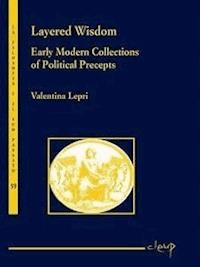
Cover: Raffaello, La filosofia
(Palazzi Vaticani, Stanza della Segnatura)
Table of contents
Foreword
Acknowledgements
1. Political Genres and the Collections of Precepts at the End of the 16th Century
1. The Precepts and their Readers
2. Classifying the Political Works: The Bibliographies
3. Inside and Outside the Books: General Characteristics of the Anthologies
2. The Writers and their World
1. The Tuscan Genesis
2. “Guichardin en ses Axiomes”
2.1. The School of Law
2.2.Family Books and Zibaldoni
3. The Unscrupulous Giovan Francesco Lottini
3. The Bustling Print Shop
1. Form and Content Conceived for Political Advisers
2. The Rules of the Market and the Ambitions of Francesco Sansovino
3. Two Collections, the Same Goal
4. The Epistemology of Precepts
1. Multum in Parvo. The Tight Schedule of the Statesman
2. Aristotle and Machiavelli
2.1. Syllogisms for Action
2.2. The Language of Politics
5. The Destiny of the Collections
1. Translations and Adaptations
2. New Paths
3. The case of Andrzej Maksymilian Fredro’s Monita
Afterword
Abstract
The author
Foreword
The idea that knowledge is constructed jointly, through a collective effort, is an ancient concept that dates back to the classical age. It was, however, in the early modern age that it became the basis of a programmatic plan for a number of institutions, through the support of the powerful new instrument of printing. Throughout Europe academies, universities and symposia were engaged in intellectual debates regarding the epistemological characteristics of the subjects of study, and these discussions also extended to methodological approaches and concerned the hierarchy between disciplines.
The subject of this book is not the sites traditionally appointed to the promotion of knowledge, but the printing workshops and the various professional figures operating in the sphere of publishing who fostered the production of a particular type of collective knowledge in the early modern age: the collections of political precepts. The production of Renaissance political precepts is an extremely vast subject. The numerous studies that have addressed it to date have concentrated predominantly on the use of the precept as a vehicle for specific currents of thought, such as Neostoicism and Tacitism, or to circulate the reflections of certain censured writers, foremost among them Niccolò Machiavelli.
However, an equally important aspect of these works, which is connected with their intrinsically choral nature, has been completely neglected. The true merit for the success of such collections resides with the editors, translators and publishers of the volumes, whose work gave rise to a fundamental cultural experience which played a decisive role, not only in the circulation of the texts but also in the political debate in general.
Indeed, the multiplicity of voices that characterises the anthologies of political precepts is found not only within the covers of the books, but in the context of their production as a whole, since it extends to all those involved in their making. In the print shops of the late 16th century, the publishers and their collaborators showed themselves to be attentive to the market but also to social change, to the extent that they intervened on the texts with the greatest freedom. They supplemented them with commentaries and guided the reader by providing explanatory tables and compendia, with the result that – and this is the most interesting aspect – at times their manipulations constituted works in their own right. In their reorganisation, their cutting here and adding there, they constructed new and original collections on political topics, both by reworking existing anthologies and by developing new ones. They did so with what would probably nowadays be considered a lack of due respect for the original texts and authors, selecting fragments of the writings of different thinkers and appropriating their words and ideas.
There is nothing odd about the fact that in their work – which at times resulted in a radical distortion of the original material – they acted as if they themselves were the authors. And that’s not all: by drawing emblematic phrases from the writings of other thinkers, they transformed them too into precept writers: they were writers of maxims malgré eux, since they had at no point made a conscious decision to try their hand at the genre. Thus, in such anthologies we might find on the same page precepts by Fadrique Furió Ceriol and reflections by the editor of the volume rubbing shoulders with maxims taken from the writings of, say, Paolo Giovio.
However many times the aphorisms were mixed and matched, changed hands and places, the aim of various editions continued to be the same: to furnish advice and instructions for government along with a new vision of politics. The lack of attention towards this extraordinary aspect of the cultural history of the early modern age can probably be explained by the fact that it is a ‘concealed’ collective production. Indeed, the persons involved – both authors and editors – do not act in the same place and contemporarily but in different social contexts and at different times. The common effort is bent to the same purpose, namely to elucidate politics, but it materialises in a vertical direction through a stratification of actions at the end of which only the finished object, the book, documents the participation of the various agents.
This study is devoted to a description of the main features of several texts and their editorial history, developing over a timespan stretching approximately from the end of the sixteenth century to the middle of the seventeenth. The phenomenon is too vast to permit a complete reconstruction. Consequently, the idea is to focus on a series of emblematic cases, mapping a symbolic route from the compilation of the first collections, through the codification of the genre by experts in textual production up to its gradual transformation and decline.
The first two sections of the book provide a general overview of the argument and the genesis of the precepts in Tuscany. One of the financial and economic powers of the time, Florence was also a place of great political changes. It had had a long history as a Republic, comprising innovative systems of political and social control, such as the civic militia. Equally out of the ordinary was the rapid rise and hegemony of the Medici family, richly entwined with internal intrigues and foreign relations. Among its more cultured citizens, the practice of government was an argument of absorbing interest, directly connected as it was with the business and the destiny of the various dynasties. Consequently politics was frequently the subject of texts of different kinds, from treatises to humanist dialogues, and even notes in the Zibaldoni. And it was indeed in Florence that two works saw the light that were to provide an inspiring model for the editors of the anthologies of precepts, who used them to usher in a season of intense experimentation. These were the Ricordi by Francesco Guicciardini and Gli avvedimenti civili by Giovan Francesco Lottini, two writers who had very little in common in terms of education and career, but whose destinies were strangely linked by the great and often joint popularity which their precepts enjoyed in late-sixteenth-century Europe. Conceived for private use, these collections were the fruit of the writers’ experience in their capacities as counsellors and ambassadors: their main subject is the rules of politics which are illustrated not ex parte principis, but rather addressed directly to his assistants, and to the political counsellors in particular.
The third section of the book homes in on the print shops themselves, the places from where the Tuscan precepts were launched on their international adventures by a series of enterprising editors. One of them was the energetic Francesco Sansovino, whose editions of political maxims are striking for the astute choice of the extracts, the logical order of their presentation and the attentive overall organisation of the material. Using the collections of Guicciardini and Lottini as a basis, Sansovino and later editors in Italy and elsewhere in Europe then added their own thoughts, as well as fragments extrapolated from various other works. Although the collections are not restricted to Italian writers, they constitute a significant presence in the form of passages from the works of Giovanni Botero, Paolo Giovio and, above all, Niccolò Machiavelli. To a degree these were operations of censure, performed in order to sidestep ecclesiastical bans or royal prohibitions. But alongside interventions of this kind there was another modus operandi which stemmed from the common objectives of the editors of the anthologies. Their intentions were to raise the precepts to the role of theorems of political thought, in which the brief formula of the maxim drew on the particular languages of the jurist’s consilia, the orders of the military captain and the doctor’s prescriptions. The inspiration to be drawn from the various literary genres that condensed vast areas of knowledge such as law, medicine and the art of war into brief and pithy aphorisms was essential in view both of the intricacy of the subject being dealt with – namely, politics – and of the particular character of the target audience.
The reader envisaged in the compilation of these collections was indeed the political counsellor, who at the end of the sixteenth century was a pivotal figure on the European cultural stage, absorbing the legacy and incorporating the characteristics of other crucial Renaissance roles such as those of the courtier, the humanist and the captain. The precepts addressed to him belong to the same fertile terrain that nurtured the reflections of Antonio Guevara on the education of the politician, and the thoughts of Scipione Ammirato on the theory of the waiver of power. The figure of the counsellor traced in the collections of precepts appears to drive the discourse on the practice of politics towards a distinctly novel form of realism, a prelude to the political language that was shortly to emerge in a number of treatises devoted to the concept of the ‘Reason of State’. These anthologies, which drew unscrupulously on the works of many authors, and notably on those of the Tuscans Machiavelli and Guicciardini, ushered in a new phase in terms of both the concept and the conduct of politics, seen as embedded in the reasons of strength and of interests.
The fourth section addresses the multiple-level influence of Aristotle and Machiavelli in the anthologies, from subject-matter to logical structure and even language. Aristotle’s Politics provides fragments or topics for the collections, but the precept-writers also draw inspiration from an approach that we might define as ‘rhetorical’, promoting it to the status of a logical method. Indeed, while the Politics and the Nicomachean Ethics provide indications for political practice, the writers also draw inspiration from the Rhetoric: in this case, in their choice of the literary genre of the precept and the consequent manipulation of the texts. Like Aristotle, the mark that Machiavelli left on the precepts was less one of theme than of method, since his fragments are complementary to the system of transmission of knowledge applied in the collections. In quoting entire passages from Machiavelli’s works the anthologies reproduce the freshness of his language which becomes an instrument for underpinning the logical structure of the precepts. Concise punctuation and a simple vocabulary do indeed make it easier to discern the skeletal structure of the maxims, to follow the logic of the premises, examples drawn from experience and instructions for action.
The last section of the book focuses on the mature stage of the experimentation launched by the specialists of the publishing world. Although it would be excessive to say that the collections generated a political science in the strict sense of the word, these editors undoubtedly seized an opportunity and made the most of it. They left a significant legacy, which was then taken over again by the ‘authors’, all of whom were then able to draw in turn on the rich treasure of precepts that lived on in the collections of Robert Hitchcock and Eberhard von Weyhe, and even in the anthologies compiled by the Bohemian Jaroslav Shiřický and by Sir Walter Raleigh. The examples discussed in the last part of the book illustrate how the influence of the political maxims lived on up to the middle of the seventeenth century, despite the changing times and the distance from the Italian model. Finally, the case of the Monita politico-moralia by the Polish political thinker Andrzej Maksymilian Fredro offers a paradigm of the incessant transformation of the genre in response to the cultural climate. Fredro’s collection too is conceived to furnish an example of the practice of power, the aim being always to offer guidance to those engaged in politics, as intuited by the very first editors of the anthologies. At the same time it also makes room for reflections on the moral sphere and for a display of erudition and encyclopaedic knowledge consonant with Baroque taste.
The work of the editors who assembled the aphorisms and drafted the anthologies is a fascinating chapter in the history of culture, underscoring the fact that the creation of knowledge is not the prerogative of academies and universities. Working behind the scenes on the volumes that bequeathed wisdom to posterity were a plurality of figures who sought to offer a systematic framework for the theory and rules of the practice of statecraft. Considering the phenomenon in a wider perspective, the collections of precepts undoubtedly deserve greater attention: the instructions they contain represent an eloquent barometer for observing the context of a significant phase in political reflection, prior to the consolidation of modern political thought in the seventeenth century.
Acknowledgements
Having reached the end of this book, I should like to thank all those who have helped me with the research that went into it.
In the first place, I should like to express my gratitude to Gregorio Piaia, who kindly agreed to include this contribution in his series. In the second place, many thanks to all the personnel of the English, French, German, Italian and Polish libraries in which I worked for their careful and patient collaboration.*
A special thank you goes to Villa I Tatti – The Harvard University Center for Italian Renaissance Studies, which is the foremost research institution in the world for Italian Renaissance art, history, literature, and music. It was indeed there that my work took shape, sustained and nurtured by the stimulating environment of the Villa, in which I was able to enjoy an intense dialogue with scholars of different disciplines and expertise. Among them I would particularly like to thank: Nadja Aksamija, Andrew Berns, Giancarlo Casale, Emanuela Ferretti, Nicoletta Marcelli, Laura Refe and, above all, Marco Sgarbi.
I should also like to express my thanks to Michele Ciliberto, president of the Istituto Nazionale di Studi sul Rinascimento in Florence, of whom I am a proud alumna, and all my friends at the Istituto: Simonetta Bassi, Laura Fedi, Fabrizio Meroi, Elisabetta Scapparone and in particular, Maria Elena Severini. I am also most appreciative of the helpful conversations with Francesco Bausi, Giovanna Brogi-Bercoff, Marco Faini, Neil Harris, Mario Infelise, Diego Quaglioni, Piotr Salwa, Merio Scattola, Lech Szczucki and my dear friend Helen Cleary.
With similar gratitude I would also recall my colleagues in the Artes Liberales Faculty of the University of Warsaw, especially its illuminated dean Jerzy Axer, who encouraged me at every stage of the research and set an inspiring example of devotion to one’s work.
Finally, my most heartfelt thanks to Danilo Facca, director of the Department of Philosophy of the Polish Academy of Sciences, for his generous advice and, even more importantly, for his Aristotelian philia.
* In addition to the numerous Italian libraries these include: the Bibliothèque Nationale de France, the Bibliothèquede l’Arsenal; the British Library; the Herzog August Bibliothek, Wolfenbüttel; the National Library of Poland; the University Library of Warsaw (BUW) and the Jagellonian University Library in Krakow.
Habent sua fata libelli
To Fulvio
1. Political Genres and the Collections of Precepts at the End of the 16th Century
1. The Precepts and their Readers
Towards the close of a versatile literary career studded with editorial successes, Francesco Sansovino (1521-1583),1 son of the famous artist Jacopo, published in Venice a collection of political precepts which he presented to readers with a short preface by his own hand. The work was entitled Propositioni overo Considerationi in materia di stato,2 and it appeared in the spring of 1583 in an elegant quarto edition produced in the print shop of Altobello Salicato (operative from 1569 to 1607). Although Sansovino had his own printing workshop, it was not unusual for him to have his books published elsewhere. As well as working on his own behalf and as a proofreader at the print shop of Gabriele Giolito (1508-1578), he occasionally also used the presses of De Alaris, Farri, Sessa and Valgrisi.3 When he delivered his book to Salicato, moreover, Sansovino was in poor health and his eyesight was severely deficient. Evidently he felt it wiser to entrust the work to a fellow publisher with experience in printing such volumes who already had several anthologies of aphorisms on legal and military arguments in his catalogue.
The editor’s need to explain the purpose of his work emerges clearly from the very first notes on the frontispiece; he seeks to clarify both the nature of the text and the reasons that led him to produce it. From the details on the frontispiece we learn that Sansovino had already published political precepts, in the form of an anthology produced in his own print shop just a few years earlier in 1578.4 Here, however, he informs readers that the new edition has been expanded and corrected for their benefit, trusting that they will be in a position to appreciate the result. His Propositioni “contain laws, rules, precepts and maxims most useful to those who are in charge of Principalities and Republics and indeed any other sort of government”. The dedication, which is dated 15 April 1583, is addressed to a foreign politician, a British citizen called William Parry (-1585) who sojourned at length in Venice and may even have frequented Sansovino.5 A Member of Parliament and diplomat, Parry was a somewhat enigmatic visitor to Venice at the time; shortly after the publication of the volume he was accused in England of being party to a plot to kill the Queen. In those last years of the century, the court which Parry came from and to which he was preparing to return was ravaged by profound religious strife and endless conspiracies against the crown. Elizabeth I staunchly defended the Anglican church against the attempts at Catholic restoration perpetrated by Mary Stuart and her circle of supporters. Upon his return from Italy Parry too became caught up in the mesh of the Queen’s repressive exercise, and was put to death shortly afterwards.
This woeful epilogue to Parry’s career also coincided with the death of Sansovino. However, only a short time before, the latter had showered Parry with lavish words of praise, describing him as both an able politician and a man who was familiar with the different cultures of the world. Parry embodied the heroic image of a “new Ulysses”, capable of “understanding the customs, manners and laws of other peoples and nations.” Homer’s hero evidently held a certain fascination for the editor, and he had already appeared in the note to the readers in one of his first and most important editorial successes, , which he had printed in Venice in 1561. At the beginning of this earlier work, Sansovino cited the authority of Aristotle and other ancient writers on how Principalities and Republics ought to be governed, while also boldly declaring that he wished to sketch out the theory of a “new Politics”. It was for this purpose that he used the model of Ulysses, who represented the hero and the true political expert in that: “he was not a philosopher because he had studied, but a pragmatist because he had seen many peoples, and the customs of many different races, from which man can undoubtedly learn much more in a brief time than he can from reading at great length.”
Lesen Sie weiter in der vollständigen Ausgabe!
Lesen Sie weiter in der vollständigen Ausgabe!
Lesen Sie weiter in der vollständigen Ausgabe!
Lesen Sie weiter in der vollständigen Ausgabe!
Lesen Sie weiter in der vollständigen Ausgabe!
Lesen Sie weiter in der vollständigen Ausgabe!
Lesen Sie weiter in der vollständigen Ausgabe!




