


16,99 €
Mehr erfahren.
- Herausgeber: John Wiley & Sons
- Kategorie: Fachliteratur
- Sprache: Englisch
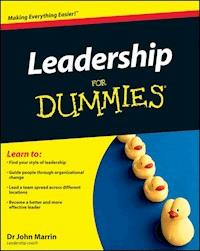
Do you find yourself being asked to lead others but have no idea where to start? Do you lead a team spread across different offices or even continents? In this no-nonsense guide to leadership you will find answers to crucial questions like: what is leadership? And what style of leadership should I be using? You'll discover how to lead your friends whilst remaining their friend; how to lead change in a way that people accept and understand; when and where to draw the line; and how to reflect on your experiences to become a better and more effective leader.
Only a lucky few of us are natural born leaders. It takes time and effort to develop a range of leadership styles which work for you and those around you as well as discovering how to become comfortable leading others. Leadership can be a lonely occupation; Leadership For Dummies is your ideal companion. John Marrin explores the fine line between managing and leading and the book is full of tips for making the most of your leadership experiences and how to cope with the dilemmas and discomfort all leaders at some point experience.
Sie lesen das E-Book in den Legimi-Apps auf:
Seitenzahl: 480
Veröffentlichungsjahr: 2011
Ähnliche



















Leadership For Dummies®
Visit www.dummies.com/cheatsheet/leadershipuk to view this book's cheat sheet.
Table of Contents
Leadership For Dummies®
by Dr John Marrin
Leadership For Dummies®
Published byJohn Wiley & Sons, LtdThe AtriumSouthern GateChichesterWest SussexPO19 8SQEngland
E-mail (for orders and customer service enquires): [email protected]
Visit our Home Page on www.wiley.com
Copyright © 2011 John Wiley & Sons, Ltd, Chichester, West Sussex, England
Published by John Wiley & Sons, Ltd, Chichester, West Sussex
All Rights Reserved. No part of this publication may be reproduced, stored in a retrieval system or transmitted in any form or by any means, electronic, mechanical, photocopying, recording, scanning or otherwise, except under the terms of the Copyright, Designs and Patents Act 1988 or under the terms of a licence issued by the Copyright Licensing Agency Ltd, Saffron House, 6-10 Kirby Street, London EC1N 8TS, UK, without the permission in writing of the Publisher. Requests to the Publisher for permission should be addressed to the Permissions Department, John Wiley & Sons, Ltd, The Atrium, Southern Gate, Chichester, West Sussex, PO19 8SQ, England, or emailed to [email protected], or faxed to (44) 1243 770620.
Trademarks: Wiley, the Wiley Publishing logo, For Dummies, the Dummies Man logo, A Reference for the Rest of Us!, The Dummies Way, Dummies Daily, The Fun and Easy Way, Dummies.com and related trade dress are trademarks or registered trademarks of John Wiley & Sons, Inc. and/or its affiliates in the United States and other countries, and may not be used without written permission. All other trademarks are the property of their respective owners. Wiley Publishing, Inc., is not associated with any product or vendor mentioned in this book.
Limit of Liability/Disclaimer of Warranty: The contents of this work are intended to further general scientific research, understanding, and discussion only and are not intended and should not be relied upon as recommending or promoting a specific method, diagnosis, or treatment by physicians for any particular patient. The publishe, the author, AND ANYONE ELSE INVOLVED IN PREPARING THIS WORK make no representations or warranties with respect to the accuracy or completeness of the contents of this work and specifically disclaim all warranties, including without limitation any implied warranties of fitness for a particular purpose. In view of ongoing research, equipment modifications, changes in governmental regulations, and the constant flow of information relating to the use of medicines, equipment, and devices, the reader is urged to review and evaluate the information provided in the package insert or instructions for each medicine, equipment, or device for, among other things, any changes in the instructions or indication of usage and for added warnings and precautions. Readers should consult with a specialist where appropriate. The fact that an organization or Website is referred to in this work as a citation and/or a potential source of further information does not mean that the author or the publisher endorses the information the organization or Website may provide or recommendations it may make. Further, readers should be aware that Internet Websites listed in this work may have changed or disappeared between when this work was written and when it is read. No warranty may be created or extended by any promotional statements for this work. Neither the publisher nor the author shall be liable for any damages arising herefrom.
For general information on our other products and services, please contact our Customer Care Department within the U.S. at 877-762-2974, outside the U.S. at 317-572-3993, or fax 317-572-4002.
For technical support, please visit www.wiley.com/techsupport.
Wiley also publishes its books in a variety of electronic formats. Some content that appears in print may not be available in electronic books.
British Library Cataloguing in Publication Data: A catalogue record for this book is available from the British Library
ISBN: 978-0-470-97211-3 (paperback), 978-0-470-97435-3 (ebook), 978-0-470-97300-4 (ebook), 978-0-470-97301-1 (ebook)
Printed and bound in Great Britain by Bell and Bain Ltd
10 9 8 7 6 5 4 3 2 1
About the Author
Dr John Marrin is an expert on how leaders of organisations totally engage their directors, managers and employees to enhance their commitment and achieve higher levels of individual, team and business performance. He is a leadership coach and organisation development specialist to a wide range of clients including large multinationals, privately owned businesses and public sector organisations. While working primarily with organisations throughout the United Kingdom, John is also experienced in supporting clients in Europe and South America.
John is intensely enthusiastic about engaging people to work better together through enhancing mutual understanding and establishing shared commitment and accountability for achieving success: he redefined the meaning and practice of engaging through his DPhil. John is a Chartered Fellow of the Chartered Institute of Personnel and Development, and holds a Master of Arts in Management Learning from Lancaster University.
John is founder of Marwel & Co. which specialises in leadership development and employee engagement. To find out more about the services of Marwel & Co., visit his website: www.marwel-co.com. John’s email address is [email protected].
Author’s Acknowledgements
My special thanks go to my wife and sons for putting up with seeing much less of me during the process of writing this book, and to my wider family and friends for their tolerance. You have all been much neglected, but not forgotten, for many months. I also want to acknowledge my parents, John and Vera, for encouraging me and instilling values that I continue to cherish.
Thanks to the team at Wiley, especially David Palmer for inviting me to write this book, to Rachael Chilvers for guiding and supporting me throughout the process, and to Andy Finch for helping me to clarify my thinking.
I thank my clients and colleagues for the opportunities to work and learn with you, and for the experiences that have eventually been distilled into the contents of this book.
Dedication
I dedicate this book to my wife Linda, and my sons, Paul and David, who have given me the inspiration, encouragement and support to clarify and fulfil my vocation.
Publisher’s Acknowledgements
We’re proud of this book; please send us your comments through our Dummies online registration form located at www.dummies.com/register/.
Some of the people who helped bring this book to market include the following:
Commissioning, Editorial, and Media Development
Project Editor: Rachael Chilvers
Development Editor: Andy Finch
Commissioning Editor: David Palmer
Technical Editor: Richard Pettinger, Business Management lecturer, UCL
Proofreader: Kim Vernon
Assistant Editor: Ben Kemble
Production Manager: Daniel Mersey
Cover Photo: © Steve Hamblin / Alamy
Cartoons: Ed McLachlan
Composition Services
Project Coordinator: Kristie Rees
Layout and Graphics: Andrea Hornberger, Corrie Socolovitch
Proofreader: Laura Albert
Indexer: Claudia Bourbeau
Introduction
Leadership is something that you recognise when you see it and notice when you don’t see it, and yet most people find it hard to articulate what leadership really is. I’ve written this book because I want to remove the mystique of leadership and enable you to ground leadership in your everyday work practice.
Every chapter in this book is designed to help you to understand different aspects of leadership and how to lead in different contexts and situations. The information you find within the covers of this book is grounded in the real world. This information is primarily distilled from my working with thousands of leaders in many different types of organisations, including owner-managed and public limited companies, public sector organisations and charities. I coached and mentored leaders, built high-performing work teams, worked through difficult leadership dilemmas and facilitated senior management teams to transform their organisations.
About This Book
Reading this book enables you to discover how to work on becoming the great leader you aspire to be (who aspires to be an average leader?). If you’re new to the world of leadership, you can find all you need to succeed in your new position. If you’re an experienced leader, I challenge you to turn the kaleidoscope, and look at your leadership philosophy and practice from a new perspective to identify what’s working for you – and the people you lead – and what’s not.
You can make the fastest progress in enhancing your leadership skills by putting what you learn into practice, and then reflecting on and learning more from your experiences.
Leadership in a work setting is all about engaging people and gaining their commitment to making a highly valued contribution to improving the performance and success of their organisation, and enable them to gain a real sense of fulfilment through doing so. Among the topics covered in this book are:
How leading and managing people are different.
How to gain the commitment of people who work for and with you.
Why you have to start with leading yourself.
How to succeed in leading people through change.
How to increase your influence in your organisation.
How to challenge people whose behaviour or performance doesn’t meet your standards.
How to lead different types of teams.
How to build a great senior leadership team.
I do my best to explain these things, and much more, clearly and concisely. Now that you have an insight into the content of this book, I hope you’re raring to go!
Conventions Used in This Book
To help you navigate through this book, I’ve set up a few conventions:
Italic is used for emphasis and to highlight new words or terms that I define.
Boldfaced textis used to highlight important text in lists.
Monofont is used for web and email addresses.
Also, I use the term organisation quite loosely. I define an organisation as a group of people who have formally come together to achieve objectives. Many different types of organisations exist, including small owner-managed businesses, global public limited companies, charities, public sector organisations and so on. I use the term organisation (or sometimes company) to refer to the business, charity or whatever that you work for.
What You’re Not to Read
I’ve written this book so that you can easily access and understand what you want to find out about leadership in a work context. I’ve made it easy for you to identify material that you don’t absolutely have to read. This information is interesting stuff, and you can benefit from it, but it isn’t essential for you to know:
Text in sidebars: The sidebars are shaded boxes that share interesting stories about real life examples to illustrate points made elsewhere in the text, but you can skip them if you wish.
The stuff on the copyright page: You’ll find nothing here of value unless you’re looking for legal notices and reprint information! If you are, then this is the place to look.
Foolish Assumptions
I wrote this book assuming some things about you:
You’re enthusiastic about developing your leadership ability.
You want to improve your own and others’ performance.
You’ve some experience of leadership through coming into contact with good or bad leaders, or through the position you currently hold in your organisation or positions you’ve held in the past.
You want to know what works. While you want to understand key concepts about leadership, you’re more interested in a pragmatic and practical approach to becoming the leader you aspire to be.
You like discovering why as well as what. That is, you want to know why people typically do what they do at work rather than just knowing what they do.
You want to make a positive difference and contribution to the organisation you work for and the people you work with.
How This Book Is Organised
I’ve organised this book into six parts to make the material easier to understand and access by keeping related material together. Each part is broken down into chapters, and the table of contents gives you details on each chapter.
Part I: Introducing Leadership
In this part, I provide an overview of leadership and explain the words and phrases you typically encounter in talking and reading about leadership. You discover how to come up with a definition of leadership that really works for you, and start to identify your own leadership strengths and development needs. You also find the key differences between leading and managing people in this part.
Part II: Leading Yourself
This part focuses on you. I introduce you to the notion of being an authentic leader, and explain why working on leading yourself is critical to becoming the leader you aspire to be. You find out how to identify the values that are really important to you and how these may impact on how you lead people. You discover how to learn more about leadership from reflecting on your experiences, and how to handle the dilemmas you may experience in stepping up to a leadership position.
Part III: Leading Others
To be a successful leader, others have to choose to follow you. I explain how you can really engage people so that they give you their commitment: they put all the effort, knowledge, expertise, and skills they have into doing a great job rather than just being compliant. You find out about leadership styles and how to choose the most appropriate style for different situations. I emphasise why you have to consciously set the standards that you expect people to work to, and you discover how to effectively challenge people who don’t meet your standards.
Part IV: Leading People Through Change
In this part, I explain why many people don’t like change, and you find out how to be a change agent. I introduce you to approaches to implementing change in teams and organisations that enable people to embrace change. You also find techniques for embedding new ways of working, and how to prevent people from slipping back into old habits.
Part V: Leading Different Types of Team
This part is where you find out about different types of teams that you may have to lead, and the challenges that you may experience. You discover the characteristics that separate great teams from good ones, and how you can build a high-performing team. I provide tips on how to create a senior leadership team that’s a great role model for everyone in the organisation.
Part VI: The Part of Tens
When you’re looking for a quick reminder of good leadership practice or a bit of inspiration, you can find it here. This part directs you to ten tips on taking the lead, leading yourself and leading people.
Icons Used in This Book
The icons in this book point out particular kinds of information that you may find useful. Here’s an explanation of what each icon stands for:
Take particular notice of the text next to this icon because it provides advice on how to become an exceptional leader.
This icon is a friendly reminder of important points to take note of.
This icon highlights practical advice that you can use to lead people in a wide range of work situations.
This icon highlights real-life stories about leadership that I hope you find inspiring or useful.
Discover exercises to help you to explore leadership next to this icon.
Watch out! If you don’t heed the advice next to this icon, you may end up facing a worse situation.
Where to Go from Here
You don’t have to read this book from cover to cover as you can get most benefit from it by going though it in the order and at a pace that’s right for you. I organise the contents of this book to enable you to take the lead. You can take a structured, sequential approach or read the chapters in any order; immediately diving into a section to find out what you need to know to deal with a situation or problem you’re experiencing.
Use the table of contents to see what you’re attracted to first. For example, if you want to improve your understanding of leadership, go to Chapter 2. Or if you’d like to hone your skills in encouraging people to work to your standards turn to Chapter 11.
Regardless of how you work your way through Leadership For Dummies, I’m sure that you’ll become the great leader you aspire to be. I’m enthusiastic about helping people to become great leaders so if you’ve any specific questions or comments, please feel free to visit my website at www.marwel-co.com.
Here’s to your ongoing success!
Part I
Introducing Leadership
In this part . . .
The chapters in this part help you to acquire an understanding of leadership and start to lay the foundations for you becoming the great leader you aspire to be. I introduce you to common language used in practising leadership and in management literature, and guide you to see the key differences between leading and managing. You can use these chapters to work on clarifying your expectations of yourself and others as leaders.
Chapter 1
Taking the Lead
In This Chapter
Appreciating the need for leaders
Understanding why people turn to (and into) leaders
Spotting opportunities to take the lead
Implementing change and leading different types of teams
Leadership is common sense; but unfortunately not always common practice. With the right information gleaned from my experience of working closely with thousands of managers, and some practice and thought on your part, leading can become as natural as riding a bike (even if you do experience a few wobbles along the way)!
fLesen Sie weiter in der vollständigen Ausgabe!
Lesen Sie weiter in der vollständigen Ausgabe!
Lesen Sie weiter in der vollständigen Ausgabe!
Lesen Sie weiter in der vollständigen Ausgabe!
Lesen Sie weiter in der vollständigen Ausgabe!
Lesen Sie weiter in der vollständigen Ausgabe!
Lesen Sie weiter in der vollständigen Ausgabe!
Lesen Sie weiter in der vollständigen Ausgabe!
Lesen Sie weiter in der vollständigen Ausgabe!
Lesen Sie weiter in der vollständigen Ausgabe!
Lesen Sie weiter in der vollständigen Ausgabe!
Lesen Sie weiter in der vollständigen Ausgabe!
Lesen Sie weiter in der vollständigen Ausgabe!
Lesen Sie weiter in der vollständigen Ausgabe!
Lesen Sie weiter in der vollständigen Ausgabe!
Lesen Sie weiter in der vollständigen Ausgabe!
Lesen Sie weiter in der vollständigen Ausgabe!
Lesen Sie weiter in der vollständigen Ausgabe!
Lesen Sie weiter in der vollständigen Ausgabe!
Lesen Sie weiter in der vollständigen Ausgabe!
Lesen Sie weiter in der vollständigen Ausgabe!
Lesen Sie weiter in der vollständigen Ausgabe!
Lesen Sie weiter in der vollständigen Ausgabe!
Lesen Sie weiter in der vollständigen Ausgabe!
Lesen Sie weiter in der vollständigen Ausgabe!
Lesen Sie weiter in der vollständigen Ausgabe!




