


19,99 €
Mehr erfahren.
- Herausgeber: John Wiley & Sons
- Kategorie: Fachliteratur
- Sprache: Englisch
A Guide for English communication amongst international professionals Leading in English provides a valuable resource for more effective international business communication. Whether you're a non-native English speaker working in English every day, or a native speaker working with non-native speakers, this book levels the playing field with a host of insights and tips using real-time examples. Through shared experiences and an engaging narrative, you'll gain confidence as you build the skills you need to communicate more effectively in the workplace. Impart information, relate to coworkers, or just have a friendly chat--this book helps remove uncertainty and streamline interactions. Whether language is a small stumbling block or a large hurdle in your workplace, this book can help you overcome the issues and be happier, more confident, and more effective at your job. Communication is tremendously important in the workplace. When English presents a barrier, removing that obstacle must be priority number one. This book helps you do that, with expert insight, practical tips, and a bit of humor to help shift your perspective. * Boost your confidence as a non-native English speaker * Work more effectively with coworkers and clients * Speak more confidently to an international audience * Strengthen your communication skills in all areas In the course of a single work day, you have many one-to-one conversations, several group conversations, and maybe even a presentation or two-wouldn't it be nice to know that you've been heard, understood, and correctly interpreted? English is a tricky language, but there are ways around the issues that tend to trip up non-native speakers. Leading in English shows you how to clear the air and communicate more effectively at any level of English proficiency.
Sie lesen das E-Book in den Legimi-Apps auf:
Seitenzahl: 254
Veröffentlichungsjahr: 2017
Ähnliche



















Contents
Cover
Title Page
Copyright
Acknowledgments
At the Airport Lounge
Chapter 1: It Takes Two to Tango
Speaking Clearly—It's about You
Speaking with Impact—It's about Them
Developing a Compelling Narrative—It's about Moving Them
Chapter 2: Speaking Clearly—It's about You
Jin-Young: Talent without Confidence
Edward: A Brooklyn Story
Pengfe: How to Build Confidence with Marginal English Skills
Key Takeaways from Jin-Young, Edward, and Pengfe
Examining Accent and Communication
Assess It!
Embrace It!
Name It!
Leverage It!
Chapter 3: Speaking with Impact—It's about Them
Non-Native Speakers
Native Speakers
Both Native and Non-Native Speakers
Language Example 1: “Safe” English
Language Example 2: “Must Speak Perfect” English
Language Example 3: “Not a Care in the World” English
Language Example 4: “Second-Grade” English
Language Example 5: “Fading, Fading, Gone” English
Language Example 6: “Impossible” English
Connection to the Audience
Chapter 4: Developing a Compelling Narrative—It's about Moving Them
Behold: The Power of Stories
Stories Drive Behavior
Delivery
Leadership Presence
Style Shifting
Implications for International Professionals
Back at the Lounge
Toolkit
Four-Step Process for Clear Speaking
Difficult Sound Exercises
Exercise for Versatility of Expression
The Accent Cycle in Organizations
Organizational Analysis
Breaking Down the Accent Cycle
Debunk Your Beliefs
Recovery Skills
Vocabulary Learning System: Vocabulary Log
Volume 1, 2, 3 Exercise Scale
About the Authors
Index
End User License Agreement
List of Illustrations
Figure 2.1
Figure 2.2
Figure 3.1
Figure 3.2
Figure 3.3
Figure 4.1
Figure 4.2
Guide
Cover
Table of Contents
Begin Reading
Chapter 1
Pages
i
ii
v
vi
vii
viii
ix
x
xi
xii
xiii
xiv
xv
xvi
xvii
xviii
xix
xx
1
2
3
4
5
6
7
8
9
10
11
12
13
14
15
16
17
18
19
20
21
22
23
24
25
26
27
28
29
30
31
32
33
34
35
36
37
38
39
40
41
42
43
44
45
46
47
48
49
50
51
52
53
54
55
56
57
58
59
60
61
62
63
64
65
66
67
68
69
70
71
72
73
74
75
76
77
78
79
80
81
82
83
84
85
86
87
88
89
90
91
92
93
94
95
96
97
98
99
100
101
102
103
104
105
106
107
108
109
110
111
112
113
114
115
116
117
118
119
120
121
122
123
124
125
126
127
128
129
130
131
132
133
134
135
136
137
138
139
140
141
142
143
144
145
146
147
148
149
150
151
152
153
154
155
156
157
158
159
160
161
162
163
164
165
166
167
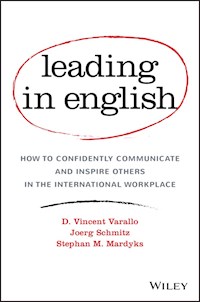
Leading in English
How to Confidently Communicate and Inspire Others in the International Workplace
D. Vincent Varallo
Joerg Schmitz
Stephan M. Mardyks
Cover design: Wiley
Copyright © 2017 by John Wiley & Sons, Inc. All rights reserved.
Published by John Wiley & Sons, Inc., Hoboken, New Jersey.Published simultaneously in Canada.
No part of this publication may be reproduced, stored in a retrieval system, or transmitted in any form or by any means, electronic, mechanical, photocopying, recording, scanning, or otherwise, except as permitted under Section 107 or 108 of the 1976 United States Copyright Act, without either the prior written permission of the Publisher, or authorization through payment of the appropriate per-copy fee to the Copyright Clearance Center, 222 Rosewood Drive, Danvers, MA 01923, (978) 750-8400, fax (978) 646-8600, or on the web at www.copyright.com. Requests to the Publisher for permission should be addressed to the Permissions Department, John Wiley & Sons, Inc., 111 River Street, Hoboken, NJ 07030, (201) 748-6011, fax (201) 748-6008, or online at www.wiley.com/go/permissions.
Limit of Liability/Disclaimer of Warranty: While the publisher and authors have used their best efforts in preparing this book, they make no representations or warranties with respect to the accuracy or completeness of the contents of this book and specifically disclaim any implied warranties of merchantability or fitness for a particular purpose. No warranty may be created or extended by sales representatives or written sales materials. The advice and strategies contained herein may not be suitable for your situation. You should consult with a professional where appropriate. Neither the publisher nor the author shall be liable for damages arising herefrom.
For general information about our other products and services, please contact our Customer Care Department within the United States at (800) 762-2974, outside the United States at (317) 572-3993 or fax (317) 572-4002.
Wiley publishes in a variety of print and electronic formats and by print-on-demand. Some material included with standard print versions of this book may not be included in e-books or in print-on-demand. If this book refers to media such as a CD or DVD that is not included in the version you purchased, you may download this material at http://booksupport.wiley.com. For more information about Wiley products, visit www.wiley.com.
Library of Congress Cataloging-in-Publication Data:
Names: Mardyks, Stephan, 1962- author. | Varallo, Vince, 1973- author. | Schmitz, Joerg, author.Title: Leading in English : how to confidently communicate and inspire others in the international workplace / Stephan Mardyks, Vince Varallo, Joerg Schmitz.Description: Hoboken : Wiley, [2017] | Includes index. |Identifiers: LCCN 2017000482 (print) | LCCN 2017021062 (ebook) | ISBN 9781119361329 (pdf) | ISBN 9781119361336 (epub) | ISBN 9781119361305 (cloth)Subjects: LCSH: Communication in management. | English language–Rhetoric. | Leadership.Classification: LCC HF5718 (ebook) | LCC HF5718 .M369 2017 (print) | DDC 658.4/52–dc23LC record available at https://lccn.loc.gov/2017000482
Acknowledgments
We would like to thank our wives, Ivette, Latha, and Marie-Genet, and our families for their support, patience, and enthusiasm for this project.
Our sincere gratitude goes to our dedicated team who played an instrumental role in guiding this book to publication:
Christina Schmitz, who helped us organize our thoughts and sharpen our focus
David Westley Covey, whose astute suggestions helped the manuscript flow
Carmela O'Flaherty for her support and excellent contributions to the Toolkit
Maggie Kennedy and Jacquelyn Hayward, whose expertise in manuscript submissions proved invaluable
The team at Cape Cod Compositors for their proficient copyediting skills
The team at Wiley for their ongoing support and for patiently guiding this book to publication
David M. R. Covey, Ken Price, and our colleagues at ThomasLeland for their ongoing support
We also would like to thank our clients worldwide and the many international professionals we have met along the way who have told us their stories and placed their trust and confidence in us.
Finally, we dedicate this book to the international professionals who are on a journey to find their authentic voice across cultural and linguistic backgrounds. We wish you the success you truly deserve.
At the Airport Lounge
Liz stood impatiently in front of the large screens outlining the departures and arrivals for the afternoon's travels. Her eyes fixed on departing flights, as the airline had yet to post her gate. She anxiously waited, her bag hanging heavily on her right shoulder, and her suitcase on the floor in front of her. The crowd around her got larger, she could hear a young child behind her crying to her mother for another piece of candy, but her gaze stayed fixed on the bright blue departure screen. After what felt like hours of waiting, the dreaded word “DELAYED” appeared next to her flight in big, bold, red letters.
Liz mumbled under her breath, “Another delay…great….”
She grabbed her suitcase and begrudgingly decided to have a drink to get her through what was now a six-hour layover. Liz was very familiar with the Los Angeles International Airport (LAX). She made her way to her favorite lounge and took a seat at a small round table near the bar. She ordered a dirty martini and logged in to the WiFi to check her e-mail. She looked up to get the bartender's attention for a snack menu and noticed a man enter the lounge, seeming frustrated. He let his briefcase fall to the floor as he whipped off his jacket, folded it, and placed it neatly on a barstool. He took a seat at the bar and flipped through the menu. Liz was unable to get the bartender's attention as he made his way to attend to his new customer.
“What can I get for you, sir?” said the bartender to the man.
“I would like an am-buh-gah medium rare with cheese and a glass of waw-ta with gas please,” said the man slowly in a strong French accent.
The bartender looked at the man and asked, “Can you say that again, buddy?”
The man repeated his order, but the bartender still looked perplexed as he tried to understand what exactly he needed to write down on his order pad. The man began getting more and more frustrated as he continually repeated himself. At this point he must have ordered eight or nine hamburgers and mineral waters! Liz overheard their struggle and offered her help.
“I think he would like a cheeseburger and a glass of water. If you have sparkling water that would be great,” she said from her table and added, “and can I get the snack menu, please?”
Both of them looked in her direction. The look of confusion eased from the bartender's face as he breathed a sigh of relief and put the order in. The man looked over at Liz, still visibly frustrated, but offered up a friendly “Thanks.”
“You're very welcome,” Liz said. “I have the same problem where I live.”
“Oh, really? Where are you from?”
“I am originally from New Jersey, but I was relocated to Brazil four months ago for work. I probably wouldn't have interrupted you when you were ordering, but when I'm in Brazil speaking English some people can't seem to understand my New Jersey accent. When I heard you ordering, it really hit home for me. I know how it feels.”
The man's mouth widened into a smile. “That's pretty funny, because you speak great English, and it's your native language but people still can't understand your accent? I don't believe—”
“Even when I'm traveling throughout the United States people always say, ‘You must be from New Joisey,’” Liz interrupted as she exaggerated her words to create the classic New Jersey accent. “Where are you from?” she asked the man.
“I am from France but I work for a Swedish manufacturing company in the UK.”
Liz smiled. “I'm Liz, by the way,” she said as she stuck her hand straight out for him to shake.
“I'm Pierre,” he said as he stretched across an empty seat to meet her hand.
“So what brings you to the United States?” Liz questioned.
“I was doing a site visit for my company in Houston, and then I had a quick meeting in LA. Now I'm going back to headquarters in Stockholm. You know, with my heavy French accent people don't understand me easily. In business it's not too bad, but when I try to order things, like today, sometimes it is pretty difficult. It seems like a lot of people find me hard to understand.”
Liz nodded her head in understanding. “What happens with me feels even more challenging because it's my native language, and I feel like an outsider when I'm speaking English in Brazil. I can really empathize with your situation.”
Pierre's eyes widened and he shook his head in disbelief. He looked at Liz. “Unreal—you sound so clear. But truthfully, when I speak English with non-native English speakers—I mean, when I'm with my colleagues from Sweden, and Mexico, and Dubai—we don't have problems to work with and understand each other. In my mind, the major issue is when we work with native English speakers—our American, English, or even Australian colleagues. I feel that there is a bigger disconnect there. It should be a two-way street, but they make it seem like it is our problem…as if only the non-native English speakers have the problem. The truth is we have a hard time understanding them, too; it's not only them having a hard time understanding us.”
“Tell me more about that—what do you mean?” Liz asked him, trying to better understand his experience. As a native English speaker, Liz was interested in this new perspective.
“English is their first language and it seems like they don't realize that we all speak broken English. Sometimes it feels like they don't make the effort to try to work with us to—how do you Americans say?—‘level the playing field.’ They will speak really very fast and use a lot of expressions that we don't totally understand. It makes me really frustrated and angry sometimes.” Pierre looked down at his hands as if a bit embarrassed that he had just expressed his frustrations to one of “them”—a native English speaker.
Liz sensed his hesitation. “I don't think you speak broken English. I am listening to you speaking very clearly and easily right now. Where did you get the impression that your English is broken?”
Pierre looked up at Liz and sensed her genuine interest. “Well, I guess it is because of my accent, and I get really nervous and I always feel so stressed. I am an executive expected to make presentations all of the time in English. I usually have to prepare a lot. I spend hours and hours preparing slides to make sure the English is right. I always practice with my wife, and it's a lot of work. Even after all that work it often feels that people don't understand what I am trying to say. I want people to see me as an innovator and a top contributor, but I'm not sure they do. On the team there are so many native speakers of English, and they seem to present with such ease. My boss—a native English speaker of course—has given me feedback that I need to improve, but I feel that his feedback is just holding me back. I feel very judged by my boss whenever I make presentations. When I present at trade shows, or when I'm invited to speak about our company, some people will come and tell me that I have such a great accent, but frankly I'd like for them to come and comment on what I have just said, instead of how I sounded saying it.” Pierre laughed suddenly. “Ahh, I am so sorry to bore you with such details.”
Liz laughed along with Pierre. “Well, your boss should go to Brazil and try his English there. I used to give feedback to my non-native speakers of English just like your boss gives you. But now, I actually feel more like you,” Liz said with a huge smile on her face. She laughed again. “I too am an executive, and we are in the same boat. Just a few weeks ago I gave a presentation. Even though the official language of the company is English, I'm not sure the audience understood me. I was just seeing a sea of empty faces. I felt a little shattered! I am surrounded by Portuguese speakers who are working in English with me, but I am clearly at a major disadvantage.”
Pierre looked at her thoughtfully. “Thank you for sharing that, because I do not hear that too often. I often feel that we—the non-native speakers of English—do all the hard work. We take accent reduction courses and conversation classes, all after long days at work.” He laughed again. “What I would dream of is for native English speakers to develop some skills to be more comfortable with different cultures and accents. I'm okay to work hard, but they could meet us halfway. I want you to be at ease in Brazil, but I must confess how wonderful it is to hear a native speaker struggling in English!”
Pierre and Liz both burst out laughing. Pierre continued, “I see this problem in many companies in Asia. They spend hours and hours on accent reduction and work on their pitch—all of those painful things. I have a friend in Japan who's a genius—he really is—but a lot of Americans are having a hard time understanding him. He's totally brilliant and should be a part of the executive team. I think he has equal skills or even better skills than some of the current leaders, but he's not promoted because of his accent.”
Pierre and Liz had been so wrapped up in their conversation they didn't realize how crowded the airport lounge had become. Almost all the tables were filled with travelers frustrated with their long layovers. A dark-haired man had been sitting at the table next to Liz sipping on his scotch and trying to hide his overt interest in their conversation.
“I am so sorry, but I overheard what you said,” the man said to Pierre and Liz.
Pierre and Liz were both now becoming aware that the lounge was cramped and the crowd was growing. They looked over at the man.
“I apologize, but it is very interesting to me,” continued the man. “What you say is so true for me as well. I'm so sorry for interrupting. I just find it very interesting that you are talking about this. I have many friends in companies who are very frustrated because they don't feel they can express themselves well in English.”
Liz and Pierre shared a glance. “Don't apologize!” said Liz. “Do you have the same frustrations at work? Your English sounds fine!”
The man's eyes widened and he brought his index finger near the tip of his nose and tapped into the air three times. “Me?” he asked Liz.
Liz furrowed her eyebrows slightly. “Yes, yes, you. Do you have a hard time at work?”
“Well, like many Japanese it is really very difficult for us. We often sit in meetings and can't follow the meaning very well. Then there is what people call ‘brainstorming,’ but it just seems like people are guessing in public and people speak all at the same time—or even try to speak over each other. It is not very organized.” He hesitated. “I…I…I find it very difficult. I have gotten some cultural training where people told me this would happen, but I find it very frustrating, and I don't understand how this way is useful.”
Liz sat back in her seat and chuckled. “It's funny you say that, because when I worked in the U.S. brainstorming was second nature to me. But the first time I ran a meeting in Brazil, I opened up the chance for brainstorming and I was the only one speaking! It made me feel very uncomfortable.”
In disbelief, the Japanese man asked, “In Brazil?”
“Oh yeah! I thought brainstorming was second nature for people, but now I'm learning exactly what you're learning. What's your name, by the way?” asked Liz.
“I am Toshi.” He paused. “Yes, it is very difficult for me. And I worry sometimes how I will then get my ideas so quickly out in English. I really admire my American colleagues for just being able to speak to strangers, but for us Japanese it is very difficult.”
Pierre, sitting at the end of the bar, turned toward Toshi and asked, “Are you in a position where you have to speak up in meetings?”
“Yes, yes. I get feedbacks from my boss that I must speak more and contribute to team meetings, and all of that has to do with speaking. Sometimes I struggle to find when to start saying something because everyone talks already. I even don't know when to enter. Sometimes it takes me some time to express my ideas, and then I do not find the opportunity to respectfully inject my point of view. I am even more embarrassed since I am a vice president, and they expect to hear words from me.”
Liz chuckled and, shifting her gaze to Pierre, said, “American people are excellent at interrupting people.” Pierre added, “Well—the French do it, too!”
Liz and Pierre burst into laughter, and Toshi smiled slightly and said, “Yes, but that is impolite in my culture.”
Liz's laughter turned into a smile as she answered, “There is a way to do it gracefully, I guess. But if you don't do it, you won't get your ideas across.”
Toshi was still a bit uneasy with the direction of this conversation but felt comfortable expressing his true feelings after having overheard most of Liz and Pierre's previous conversation. “I feel that there are so many other ways for expressing your ideas—it doesn't always have to be in meetings in public, in front of everybody.”
Pierre could relate to Toshi's struggle with this. “Many corporations are really looking to become more global, and I think that everyone should recognize the extra effort it takes for non-native English speakers to work and lead in English. Frankly, I am not seeing recognition, sympathy, or encouragement from any human resources people or direct leadership. It's not taken into consideration. It's not on their minds at all. Yes, English is the language of business, but if we really, truly want corporations to be global, we need to address this question and acknowledge that there is work to do on both sides and get more support. I'm not talking about learning specific things in English—most of us speak English well enough. I don't know if Einstein spoke perfect English, but he was making remarkable presentations even with a heavy German accent.”
Pierre paused to take a quick sip of his sparkling mineral water that had finally arrived. “A good friend of mine—he is Greek—is one of the top experts in his field and is teaching in many universities around the world. One of his colleagues introduced him to a university in the U.S. and encouraged him to send over his resume to them. He sent an e-mail, and the person at the university basically said that based on his English and the grammar of his e-mail he would never be invited to teach at the university. I was finding it funny because it's as if someone had said to Einstein, ‘Your accent is too hard to understand to teach in our university,’” Pierre said in a mocking voice.
Liz was surprised. “He lost the job because of it?”
“He didn't get the job, no. All because of his casual e-mail where his grammar wasn't perfect.”
Toshi's eyes widened in surprise, but he remembered a time in his own company when grammar and the use of U.S. slang had caused a problem with a Japanese colleague of his.
“I also have one experience of a colleague who had a big problem because of a grammar issue—well, really it was the use of American slang. We have many American executives, and one of them came to Japan to make a presentation. He had a presentation slide that said in big letters G-O-T-C-H-A.”
Toshi finished spelling the word and Liz quickly interrupted and giggled, “Oh! Gotcha!”
“Yes, gotcha,” Toshi repeated. “My Japanese colleague, like many of the Japanese in my office, carries around an electronic dictionary, so he looked up what the meaning of ‘gotcha’ is and it did not come up in the dictionary. He was very upset that this American executive was making a presentation and using words that were not even in the dictionary. He actually got up from the meeting and left. The meeting was all about becoming a more global workplace and inspiring everyone to work hard to respect diversity in the organization, but using the word ‘gotcha’ was disrespectful to us, because we as Japanese had a very difficult time understanding or even finding the meaning in a dictionary.”
Pierre and Liz both shook their heads disapprovingly. Liz asked, “What happened to your colleague who left the meeting?”
“Nothing. The American executive didn't think it was a sign of misunderstanding. Apparently many people in America leave meetings to take phone calls or do other work, so for him it was not a big problem.”
Pierre and Liz both shrugged their shoulders, acknowledging that in the United States that happens frequently: people leave meetings, and nobody thinks twice about it.
“I have a good friend of mine whose name is Frederic,” Pierre began. “He was working for a joint venture between a French company and an American company in the aeronautics industry. The leader was very visionary; he wanted to have 50 percent American employees and 50 percent French employees, and he sent the French people to America and vice versa. When he was giving presentations in America he would make sure that the French people were heard. I think he is like…what is the expression—hmm, a poster child for what leadership should be—it really is the leader's responsibility to be, well…inclusive.”
Pierre, Liz, and Toshi all nodded their heads in agreement. A short silence in the conversation led them all to become aware of their surroundings. The lounge had become packed with travelers, many of whom were now sitting on the floor as all the seats at the bar and the tables were filled. A woman standing at the bar with her hand in the air caught Pierre's eye. He watched as she tried many times to get the attention of the bartender, but with no luck she slowly put her hand to her side and stood looking for a seat.
“Wait a minute—I'll be right back,” said Pierre.
Pierre slid off the barstool he was currently occupying, making sure to leave his slightly crinkled jacket there so as not to lose his place. He approached the woman to offer some help.
“Excuse me, madame. Do you need help to get the attention of the bartender?”
The woman looked up at Pierre. “Oh, I am just trying to order some food.”
Pierre turned to the bar and in his loud, deep voice called over the bartender, “Bartender! Bartender! Can you come over when you are done? This woman has been standing here for a long while.”
The bartender, still not fully understanding Pierre, made his way over to the end of the bar where the woman was standing.
“What can I help you with?” the bartender asked Pierre. Pierre looked over at the woman and the bartender's gaze shifted over to her as well.
“May I please have a mixed green salad with grilled chicken and salad dressing on the side?” the woman asked.
The bartender scribbled something in his notepad and walked away. The woman turned to Pierre and said, “Thank you! I could well be standing there for another 20 minutes!”
Pierre smirked. “You might still be standing there for a while. I ordered my food a long time ago and I still haven't gotten it, but you're welcome! I am Pierre. Where are you from?”
“I'm Wendy,” responded the woman. “I am living and working in Dallas, but I originally came from China.”
Pierre couldn't hide his excitement. “Wow! Would you like to join us while you wait for your food?”
She blushed with slight embarrassment, but said, “Yes! I'm on a four-hour delay here, so it would be great to share some company.”
“It's funny because we were just talking about working in English. You may have your own stories,” Pierre shared as they approached the table where Toshi and Liz sat.
“Liz and Toshi, this is Wendy. Wendy, this is Liz and Toshi. Toshi is from Japan but is working in the U.S. Liz is from the U.S. but works in Brazil. And Wendy here works in Texas but is from China!”
“Hi, Wendy! I'm so glad you are joining us! Like Pierre said, I am originally from the U.S., from New Jersey actually, and I moved to Brazil a few months ago. But my next assignment is in Shanghai. I was wondering if I need to take some courses to understand the Chinese culture—I'm used to working with international people, but would you advise me to take some courses in the U.S.?
“Yes,” offered Wendy politely. “Any cultural program that you can take is wonderful. In my company, we have actually had a hard time finding programs for international professionals. If you can find one, I would definitely recommend taking it. I am going to be starting an accent modification program in two weeks.”
“Really?” Pierre asked. “But your accent is so perfect—why would you waste your time in that program?”
“Well, a lot of people say that to me, but I…well, I was nominated for it within my company, and that's really the only program that my company offers. I really need to improve my communication skills,” Wendy replied. “I did take a two-day course on living and working in the U.S. It was fun, but I am not sure how much of that information was useful.”
Pierre fired back, “I find it very odd that you should take an accent modification class, because you are so fluent. It sounds crazy to me!” He now tried to bring everyone into the conversation. “Liz, I have been working in so many countries—in Japan, Thailand, Argentina—all over the world, and I'm not sure that I—well, I have taken courses to understand cultures, but they're really so superficial. What I understand is that there is an international code and there is a certain behavior that works pretty well in every culture. I am not an expert, Toshi, on Japanese culture, and in a two-day course I wouldn't become an expert! What are your thoughts, Toshi, about the culture course?”




